
How to Review AI Trading Performance
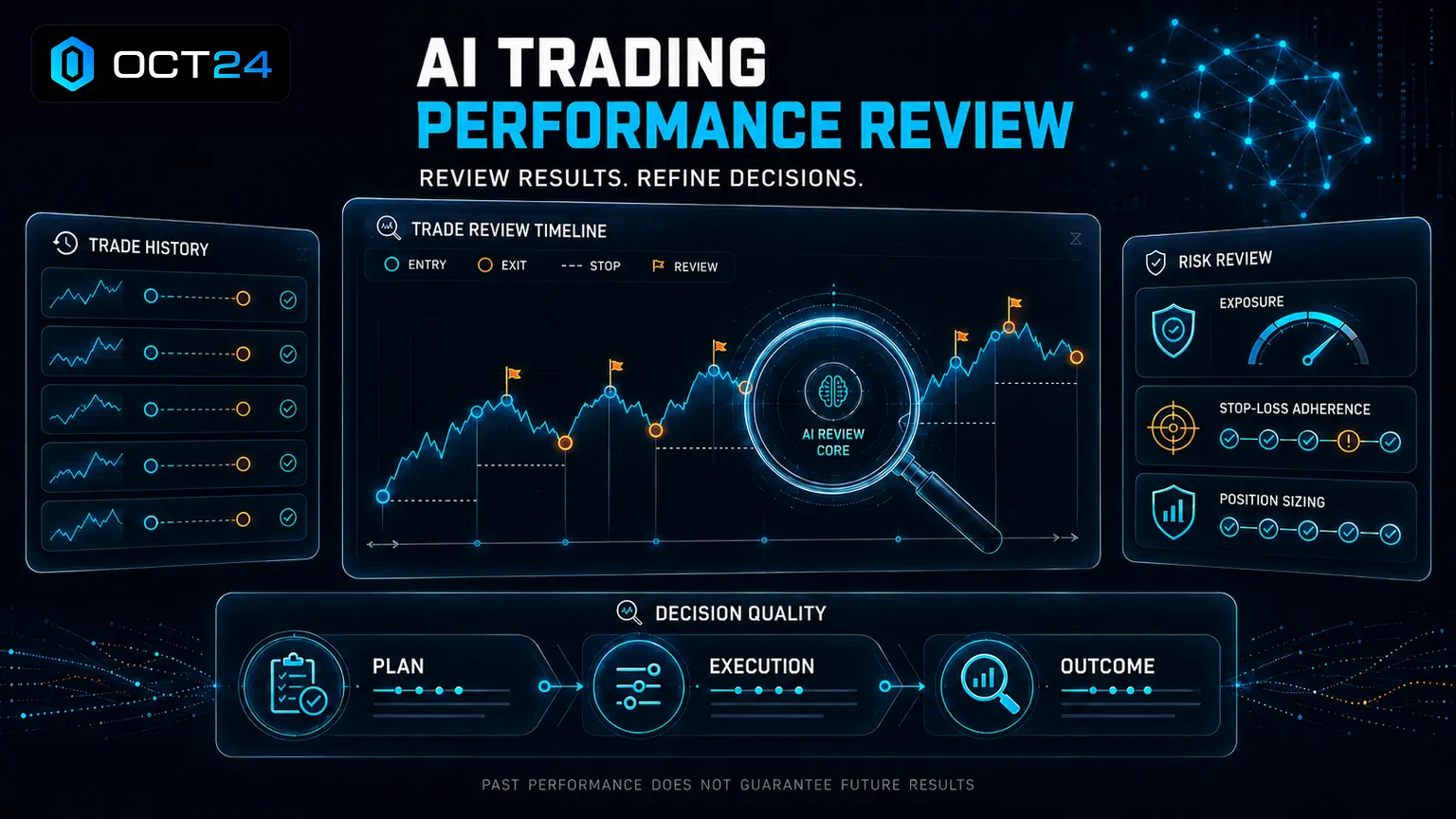
Learning how to review AI trading performance is one of the most important skills for anyone using AI-supported trading tools. A strong review process helps traders understand what is working, what needs attention, and whether their risk decisions still make sense.
The short answer is simple: review AI trading performance by looking beyond profit and loss. Traders should compare win rate, target profit, loss coverage, trade frequency, risk exposure, behavior, and consistency over time.
Performance review is not about proving that every trade was right. It is about learning from results and improving the next decision. A trader can have a profitable week and still use poor risk habits. A trader can have a losing trade and still follow a strong process.
OCT24 supports a simpler AI trading experience by presenting AI-supported trade and bot opportunities with clear performance-related metrics such as target profit, loss coverage, and win rate. These metrics can help users review opportunities more efficiently, but they do not remove market risk or replace trader judgment.
Why performance review matters
Many traders only review performance when something goes wrong. They check results after a loss, feel frustrated, and then change strategy too quickly. That is not a useful review process.
A better approach is to review performance consistently, even after positive results. This helps traders separate luck from skill, discipline from impulse, and strong setups from emotional decisions.
AI can support this process because it can organize trading information more clearly than manual chart watching alone. But the trader still needs to interpret the results responsibly.
This is why performance review belongs beside trading bot risk management, position sizing controls, and AI trading risk vs reward. Performance is not only about how much was gained or lost. It is also about how much risk was taken to get that outcome.
A trader who understands performance can make calmer decisions. They are less likely to chase every signal, increase size after a loss, or abandon a working plan after one bad result.
Start with the right performance mindset
The first step is to avoid judging performance from one trade. One result does not tell the whole story. Markets are uncertain, and even well-planned trades can lose.
A useful review looks for patterns over time. Did the trader follow the plan? Did risk stay controlled? Were trades taken for clear reasons? Did the trader become more disciplined or more emotional as the session continued?
This mindset is especially important with AI trading. AI can help analyze conditions and present opportunities, but it does not guarantee outcomes. A trader should review the whole process, not only the final number.
Think of performance review as a mirror. It shows both market results and trader behavior. If the trader only looks at profits, they may miss the habits that created unnecessary risk.
The best traders review wins and losses with the same seriousness. A lucky win can teach bad habits. A disciplined loss can confirm that the process is still healthy.
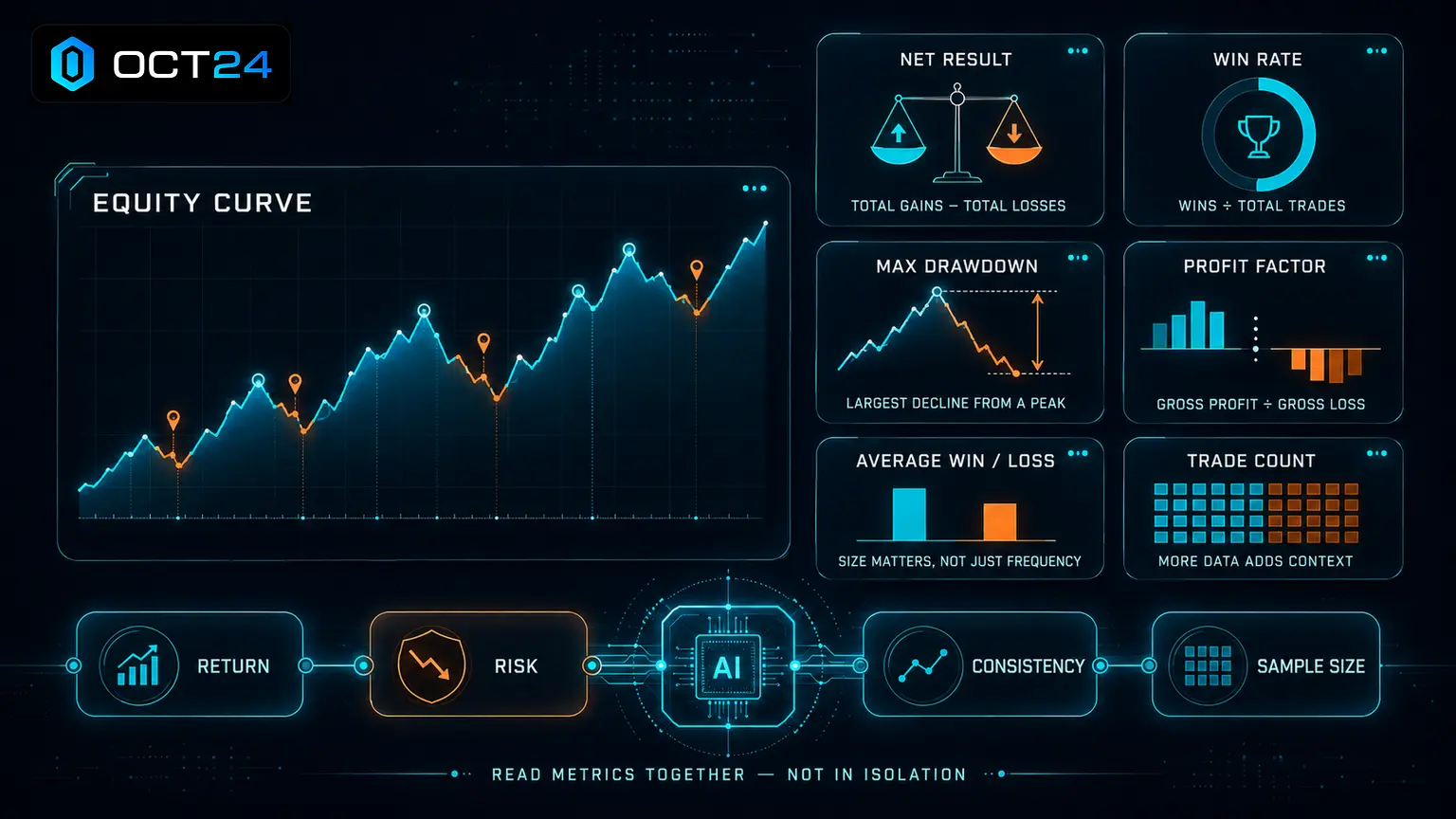
Performance metrics traders should understand
Beginner traders often focus on one number: profit. That is understandable, but it is incomplete. Profit shows what happened. It does not always explain whether the decision was good.
A more useful review includes several metrics.
- Win rate
- Average result per trade
- Largest loss
- Trade frequency
- Target profit
- Loss coverage
- Capital allocation
- Drawdown
- Consistency over time
- Behavior after wins and losses
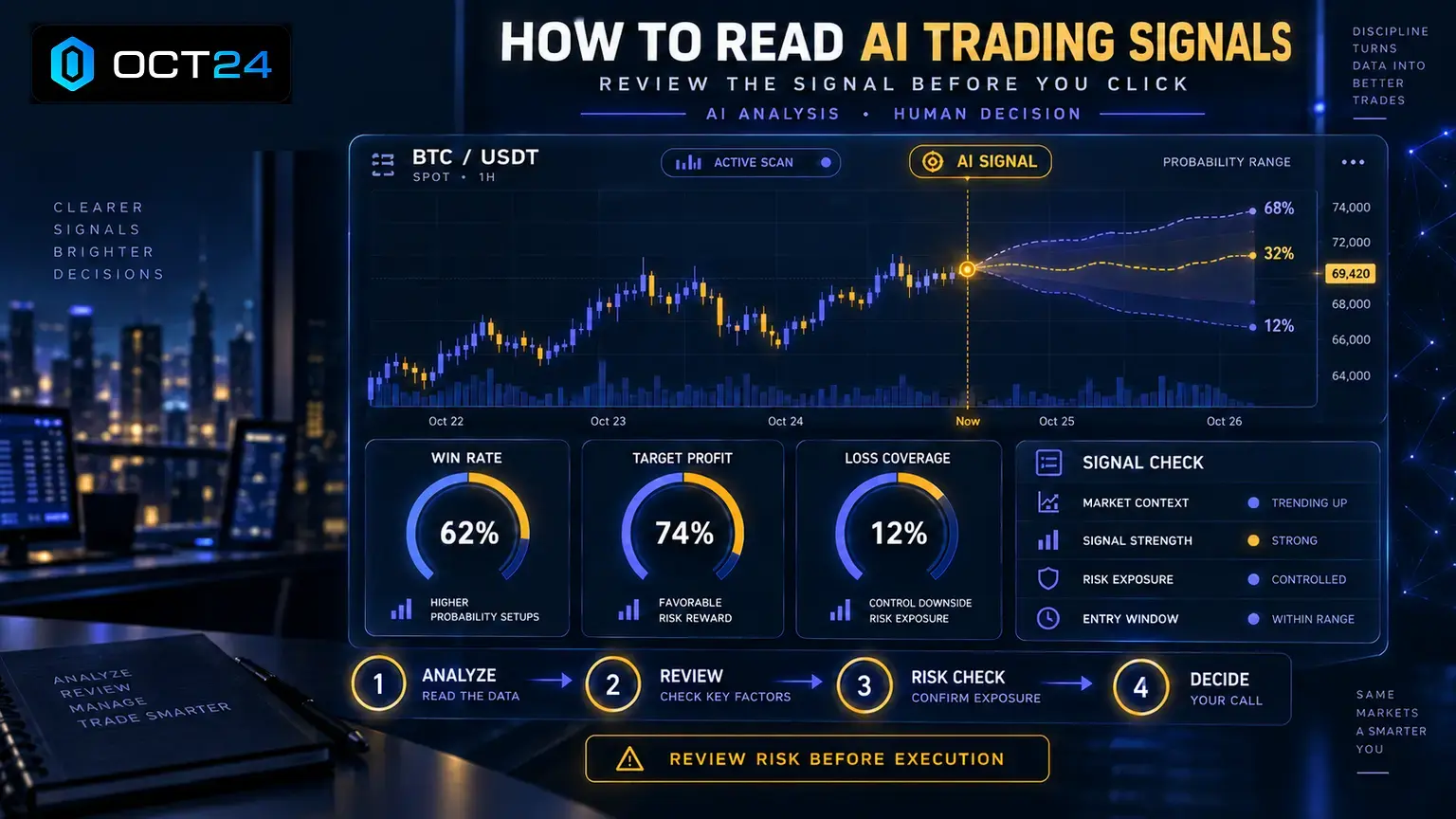
For OCT24 users, visible metrics such as target profit, loss coverage, and win rate can be useful starting points. They help users review a trade or bot opportunity before deciding whether to proceed.
However, these metrics should not be read in isolation. A strong win rate does not guarantee the next outcome. A target profit does not mean the trade will reach that result. Loss coverage does not mean the trader can ignore exposure.
Performance review works best when metrics are connected to real trading behavior.
How to review win rate without being misled
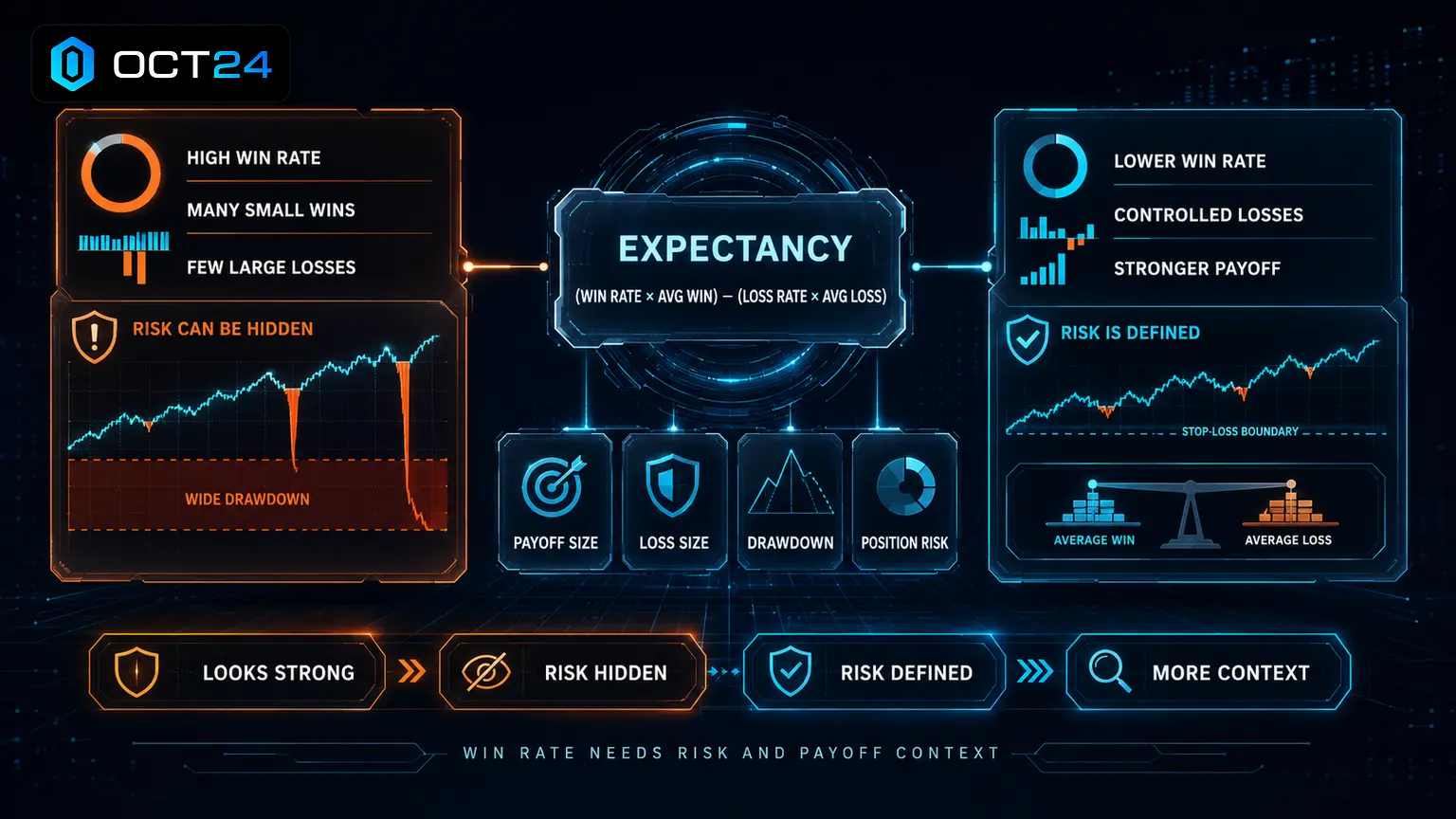
Win rate is one of the most popular performance metrics because it is easy to understand. If a system wins often, it may look attractive. But win rate alone can be misleading.
A strategy can have a high win rate and still be risky if the losing trades are much larger than the winning trades. Another strategy can have a lower win rate but still be effective if the winning trades are large enough compared with losses.
This is why traders should connect win rate with risk and reward. If a bot or trade opportunity shows a win rate, the next question should be: what is the possible downside when it loses?
This connects with can AI predict the market and AI trading myths. AI can support probability-based decisions, but it cannot make every trade certain.
On OCT24, win rate can help users review an opportunity, but it should not become the only reason to act. It should be compared with target profit, loss coverage, capital allocation, and personal risk limits.
How to review target profit and loss coverage
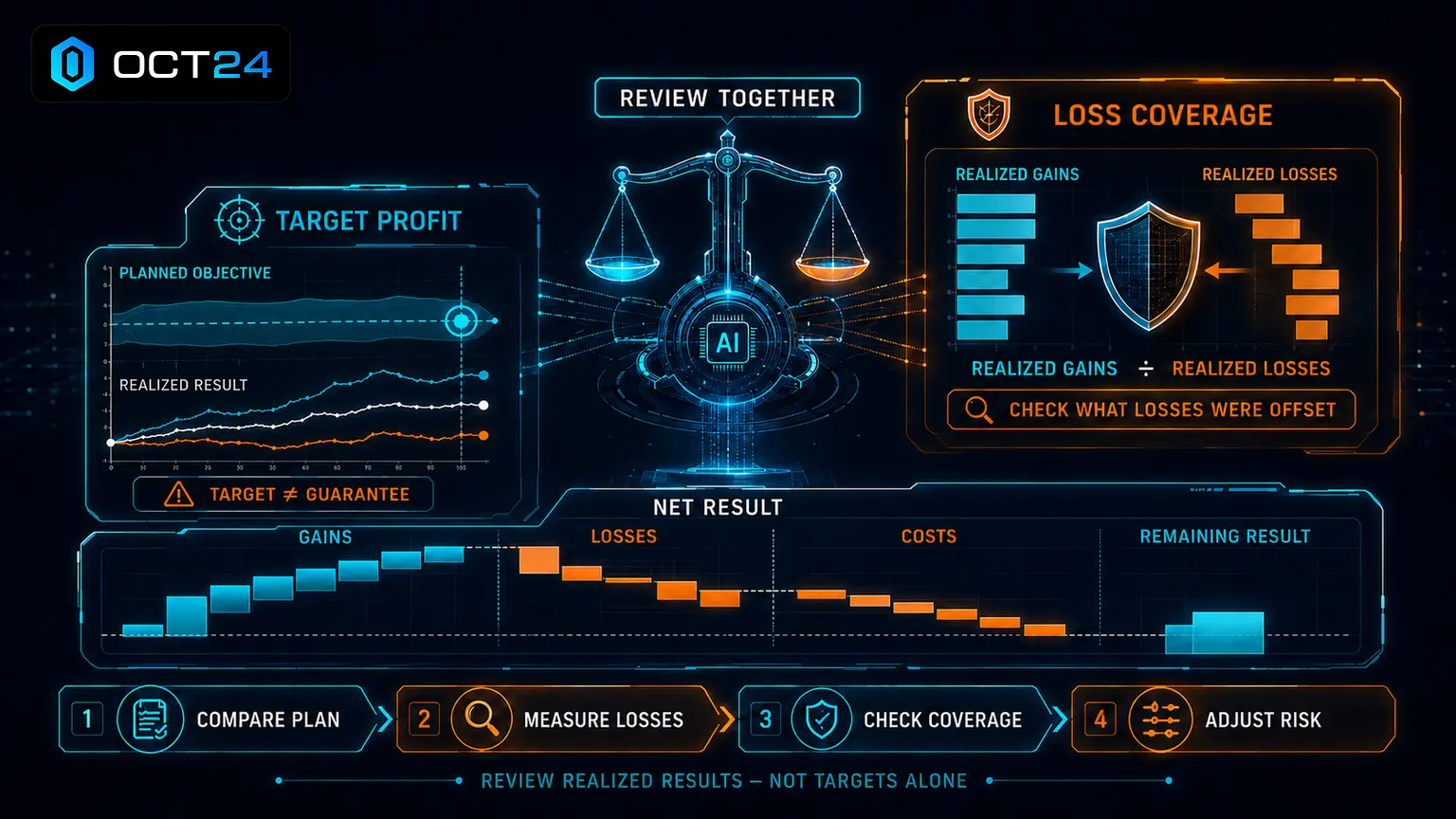
Target profit helps traders understand the intended upside of a trade or bot opportunity. Loss coverage helps frame the downside. Together, they help traders think about whether the possible result is worth the risk.
A target profit should not be treated as a promise. It is a target, not a guaranteed destination. Markets can reverse, volatility can change, and liquidity can affect results.
Loss coverage should also be reviewed carefully. It can help traders think about protection, but it does not make a trade risk-free. If the trader uses too much capital or takes too many trades, loss coverage alone cannot protect the entire account.
A simple review question is: “Would I still take this opportunity if the result is a loss?” If the answer is no, the position may be too large or the trader may be acting emotionally.
This is where AI trading entry and exit signals become relevant. Entry and exit thinking should always be connected to risk context. A signal may look useful, but the trade still needs acceptable exposure.
Review trade frequency and overtrading
Performance is not only about individual trades. It is also about how often the trader acts. Too much activity can weaken even a reasonable strategy.
Overtrading can make performance look worse because it increases exposure, emotional pressure, and the chance of low-quality decisions. It can also make it harder to identify which trades were planned and which were impulsive.
This is why avoid overtrading belongs inside performance review. If results are inconsistent, the problem may not be the AI tool. It may be how often the trader is using it.
A trader should ask these questions during review.
- How many trades or bot activations did I take
- Did I follow my daily limit
- Did I increase activity after a loss
- Did I use simple execution as a reason to click too often
- Did I pause when conditions were unclear
OCT24 can make the trading process faster and simpler. That is useful when a trader has a plan. It can become risky if the trader treats every available opportunity as something they must act on.
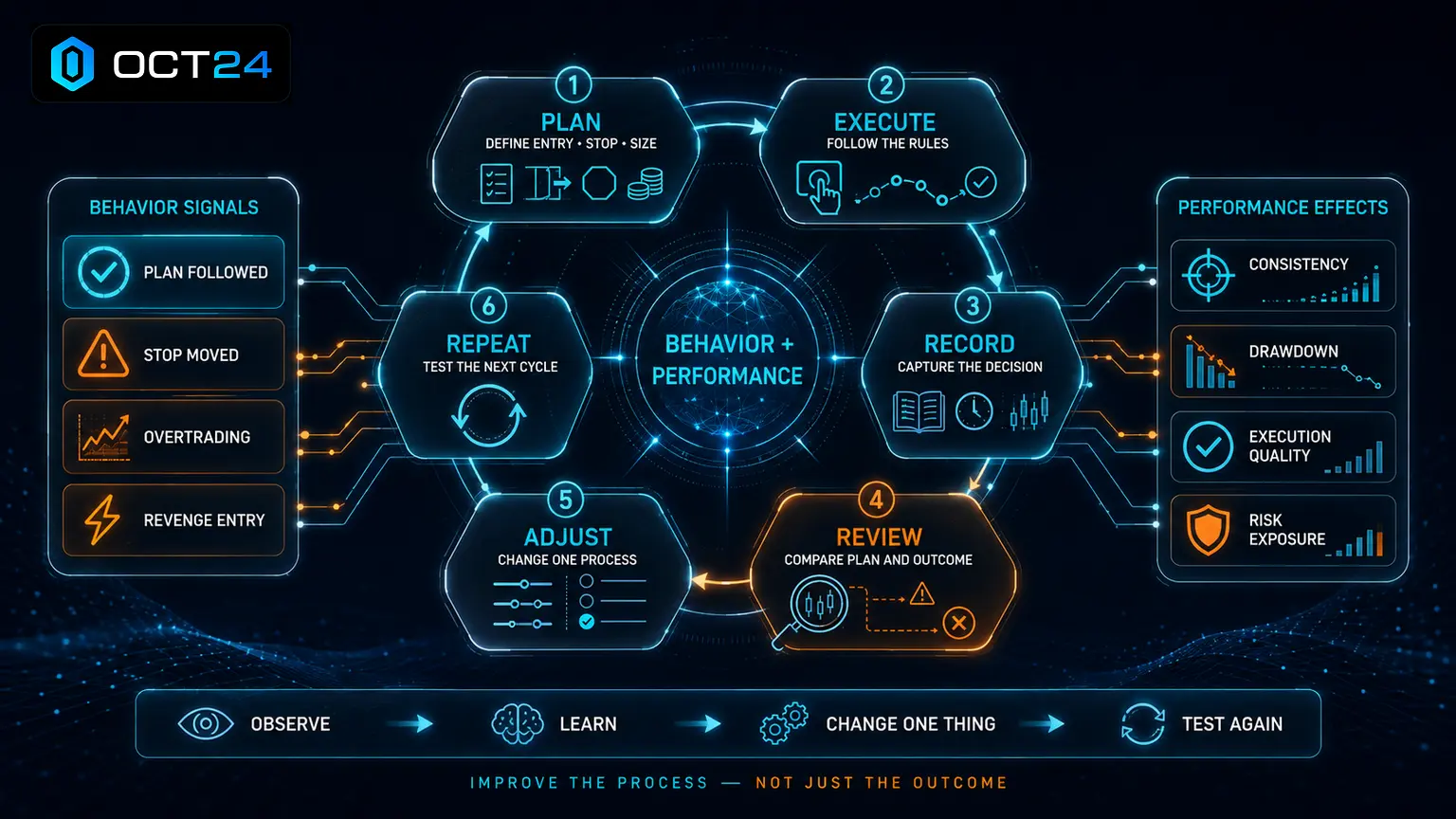
Review behavior after wins and losses
Good performance review includes emotional behavior. Traders often change after a win or a loss without realizing it.
After a win, a trader may become overconfident. They may increase size, take more trades, or assume the next opportunity will also work.
After a loss, a trader may become frustrated. They may chase recovery, ignore risk limits, or take trades they would normally skip.
This is why trading psychology is part of performance review. The numbers show outcomes. Behavior explains how those outcomes happened.
A useful question is: “Did my next decision become better or worse after the last result?” If the answer is worse, the trader may need stricter pause rules.
Where OCT24 fits into performance review
OCT24 is designed to simplify AI-supported trading by presenting trade and bot opportunities in a structured way. The platform can help users spend less time manually scanning charts and more time reviewing whether an opportunity fits their plan.
For accuracy, traders should understand the current review experience. OCT24 does not currently provide a full on-platform market analysis dashboard for each opportunity, and users do not see detailed asset information or exact entry and exit points for every trade. The main visible information includes target profit, loss coverage, and win rate.
That makes the performance review process simpler, but it also means the user must think carefully. A trader should not rely on one metric alone. They should review the metrics together and compare them with their own limits.
The G6 Trading Bot may be useful for users who want a faster AI-supported trading workflow. It can support a cleaner path from opportunity review to execution, but it does not guarantee results or remove the need for risk controls.
OCT24 performs much of the market scanning and opportunity identification behind the scenes, but the trader remains responsible for risk settings, exposure, capital allocation, and execution decisions.
A useful way to review OCT24 performance is to compare what the platform presents with how the trader responds. The platform may present a trade or bot opportunity, but the user decides whether the target profit, loss coverage, and win rate are suitable for their own account.
This helps separate platform review from behavior review. If a user repeatedly chooses opportunities that do not fit their risk limit, the issue may be the decision process rather than the availability of AI-supported signals.
Traders should also review whether simple execution is helping or hurting discipline. If one-click trading makes the user faster but not more careful, the review process should include stricter limits before any new trade is executed.
The best use of OCT24 is not to chase every available opportunity. It is to review AI-supported opportunities with a repeatable process, act only when the metrics fit the plan, and stop when the risk limit has been reached.
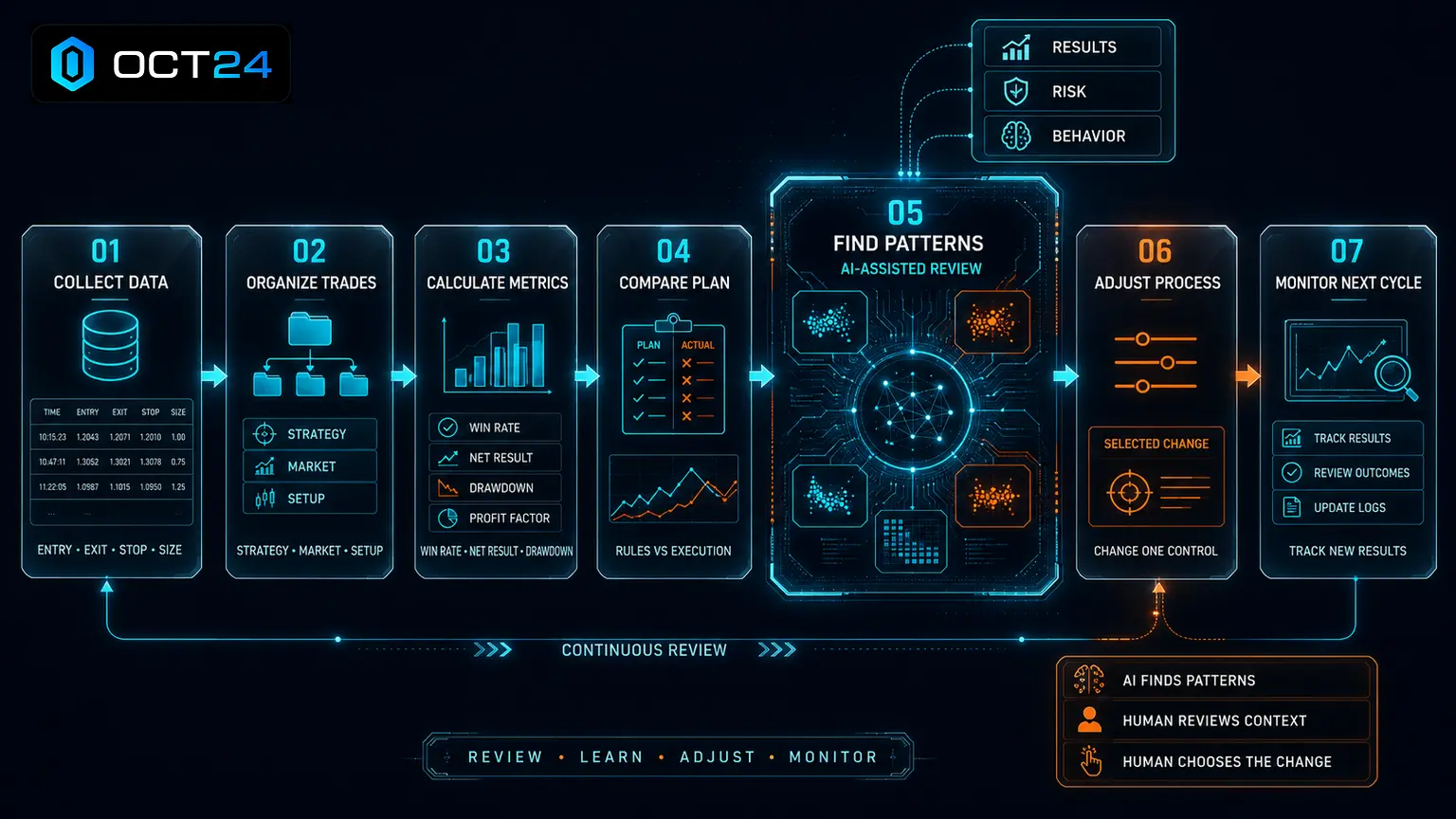
How to build a simple AI trading performance review routine
A performance review routine does not need to be complicated. The best routine is one the trader will actually use.
A simple routine can include three review points: before trading, after each decision, and at the end of the week.
Before trading, review your available capital, daily risk limit, and maximum number of trades. This helps prevent emotional decisions before they happen.
After each decision, write down why you acted. If you cannot explain the decision in one sentence, the trade may not have been clear enough.
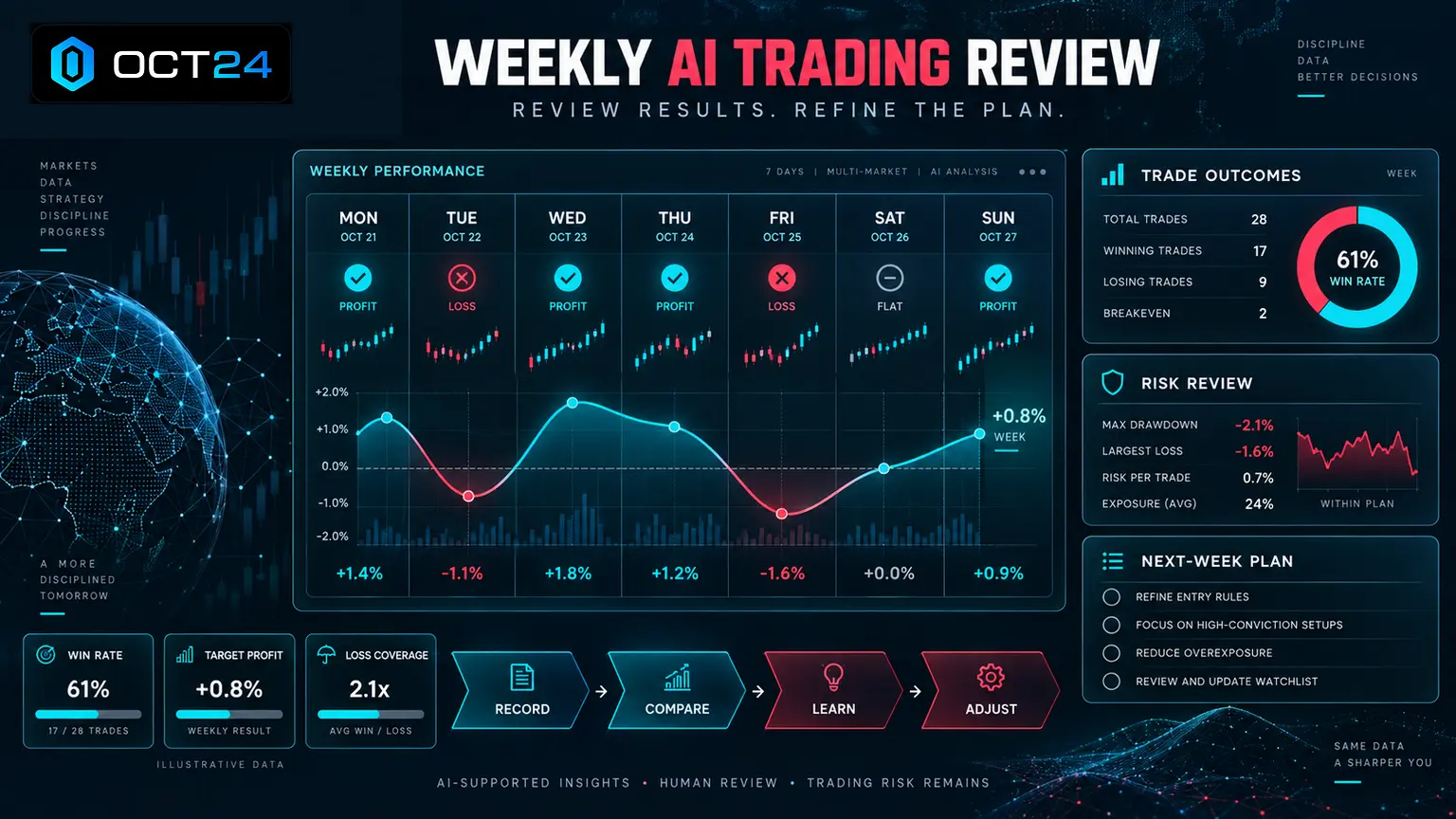
At the end of the week, review patterns. Look at win rate, losses, trade frequency, behavior after wins and losses, and whether you followed your limits.
This connects naturally with building a consistent trading routine. A routine turns performance review into a habit instead of a reaction.
Review performance across different market conditions
AI trading performance can change across market environments. A strategy that works well in trending markets may struggle during sideways markets. A setup that looks strong during calm conditions may become riskier during high volatility.
This is why traders should review performance by condition, not only by date. Ask whether results were better during clear trends, fast volatility, quiet markets, or choppy ranges.
If performance weakens during volatile periods, review how AI handles market volatility. If results weaken when the market is moving sideways, review AI trading during sideways markets.
For crypto traders, it can also help to understand whether performance changes when capital rotates between Bitcoin, Ethereum, and altcoins. This connects with compare Bitcoin Ethereum and altcoins and crypto market rotation.
The goal is to learn which conditions fit the strategy best. That helps traders avoid forcing trades when conditions are less suitable.
Review performance across tools and workflows
Different tools can create different behavior. Manual trading may lead to overchecking charts. Automated systems may lead to overconfidence. One-click execution may make action feel too easy if the trader lacks rules.
This is why performance review should include the tool and the behavior around the tool. A trader should ask whether the platform helped them become more disciplined or whether they used it to act more impulsively.
Readers comparing trading bots vs human traders should remember that both can make mistakes. Bots can follow rules quickly, while humans provide judgment and restraint. Good performance review looks at how both parts work together.
For people learning how AI trading bots work, performance review is a way to understand whether the bot workflow fits their trading style, risk tolerance, and schedule.
This is also why choosing the right AI trading platform matters. A useful platform should make review easier, not make traders ignore responsibility.
Common mistakes when reviewing AI trading performance
Performance review can become misleading when traders focus on the wrong things. The most common mistake is looking only at profit and ignoring risk.
Other mistakes include the following.
- Judging the system from one trade
- Treating win rate as a guarantee
- Ignoring the size of losses
- Reviewing only winning periods
- Changing strategy too quickly
- Ignoring trade frequency
- Forgetting fees, volatility, and market conditions
- Blaming the platform for decisions made outside the plan
These mistakes overlap with common AI trading mistakes. AI can make trading more structured, but poor review habits can still lead to weak decisions.
The better approach is to review process and outcome together. Did the trader follow the plan? Did the metrics make sense? Was the risk acceptable? Did the result come from discipline or luck?

A simple performance review checklist
A checklist helps traders review performance without overcomplicating the process. It also makes the review easier to repeat.
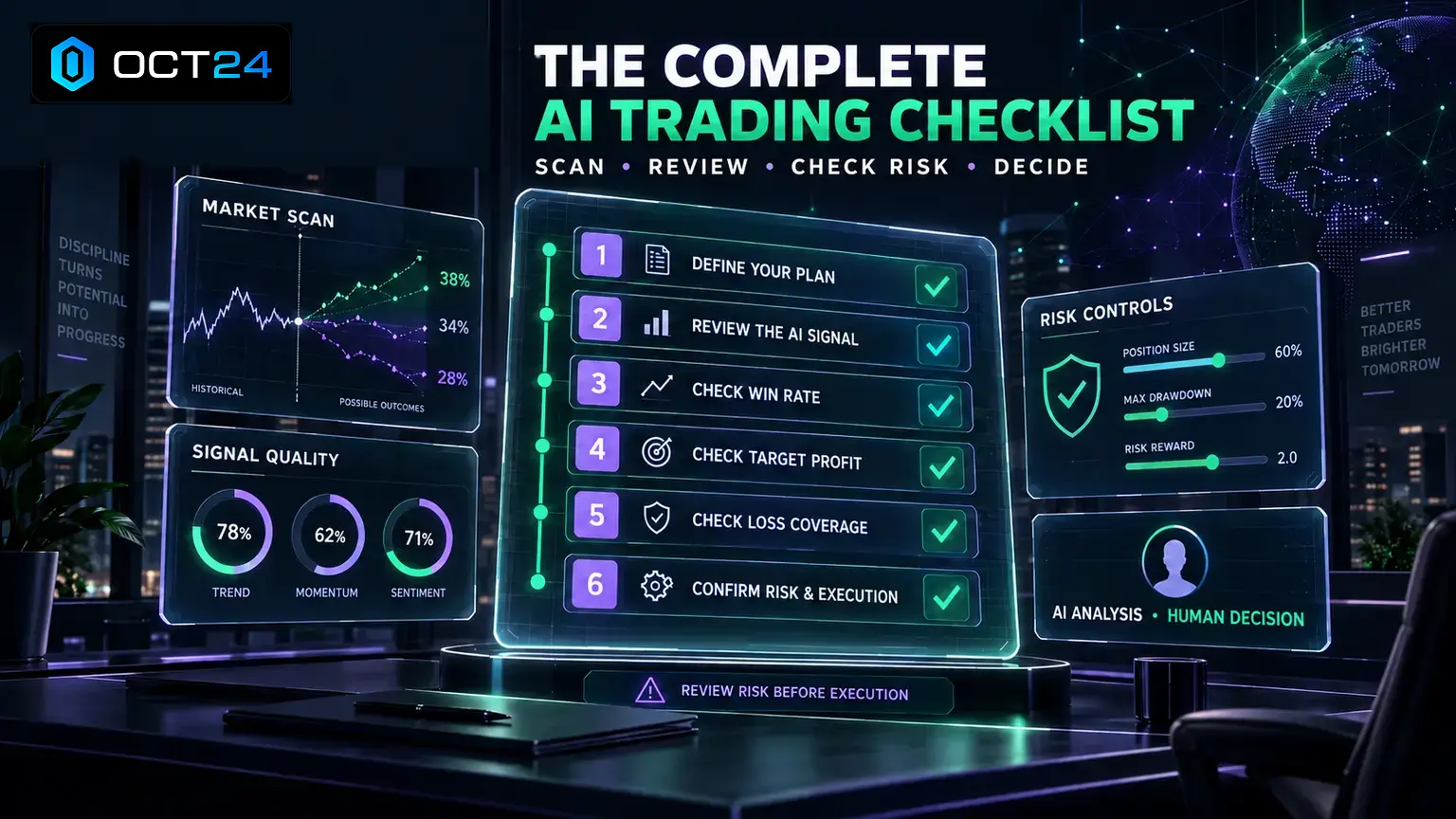
Use these questions at the end of each trading session or week.
- What was my total result
- How many trades or bot activations did I take
- What was my win rate
- Were my losses acceptable compared with my plan
- Did I follow my capital allocation rules
- Did I trade more after a loss
- Did I skip low-quality opportunities
- Which market conditions worked best
- Which behavior needs improvement
- What one rule should I improve next week
This checklist can be useful for beginners, busy professionals, and traders using AI-supported workflows. It keeps the review focused on learning rather than emotion.
It also supports better use of AI trading strategies for beginners, AI trading alerts, and AI trading watchlist content because the trader can connect education with real results.
How OCT24 users can review performance responsibly
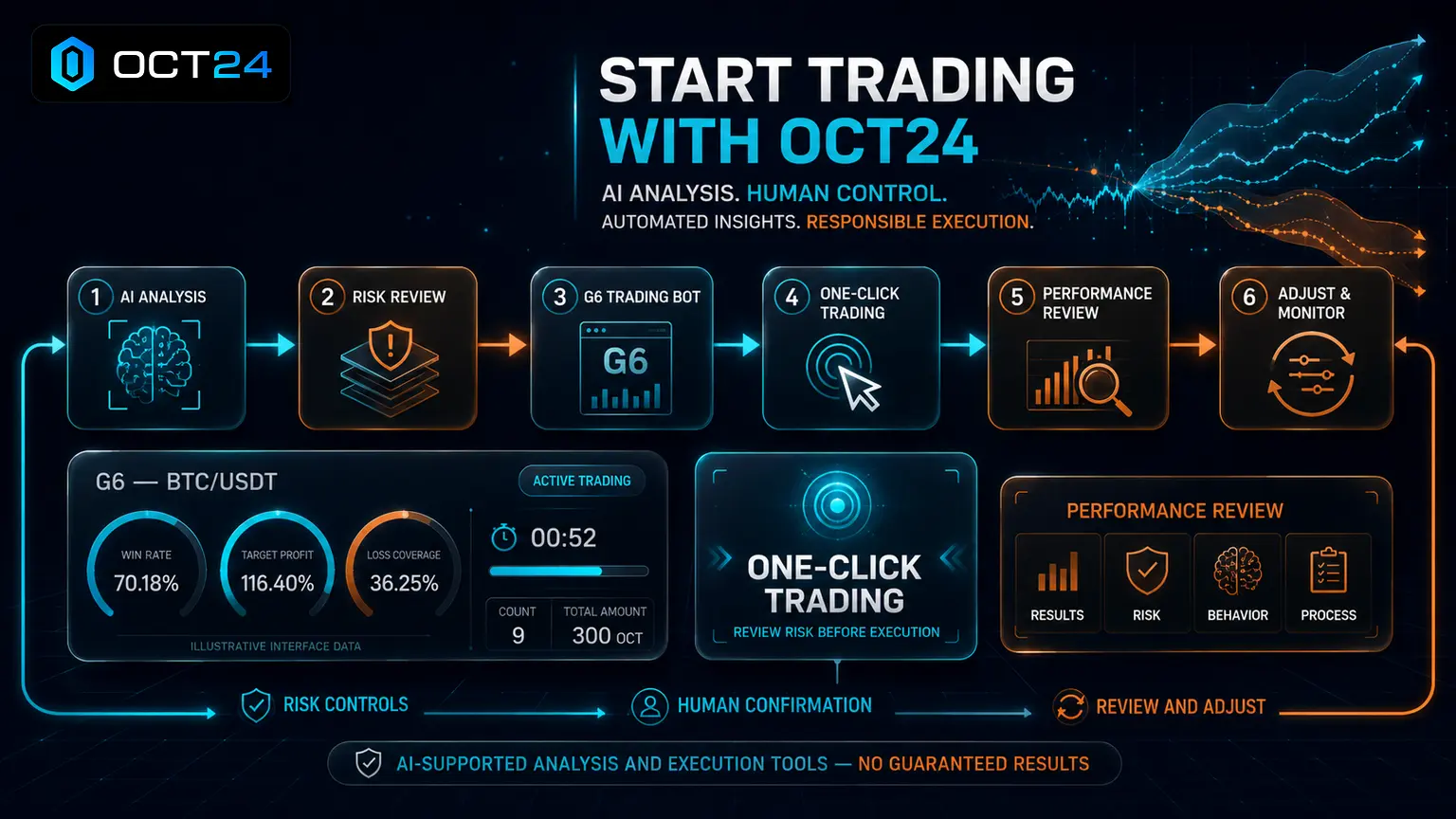
OCT24 users can keep performance review practical by focusing on the information available to them. Review the target profit, loss coverage, and win rate for each trade or bot opportunity. Then compare those metrics with your own limits.
A responsible OCT24 review process might look like this.
- Review the available trade or bot opportunity
- Check target profit, loss coverage, and win rate
- Decide whether the opportunity fits your risk limit
- Use one-click trading only after review
- Track how often you act
- Compare outcomes over time
- Adjust your personal limits when behavior becomes too aggressive
This connects with one-click trading. Simple execution can make the experience smoother, but it should not remove the review step. The decision should still be careful before the click happens.
OCT24 can support a cleaner, faster workflow, but the trader still controls risk settings, exposure, capital allocation, and execution decisions. The platform does not remove risk or guarantee results.
Readers who want to understand the company’s broader approach can visit About OCT24. Traders ready to explore the platform can Start Trading with OCT24.
FAQs
What is AI trading performance review?
AI trading performance review is the process of checking how AI-supported trades, bots, or signals are performing over time. It includes profit, losses, win rate, risk, trade frequency, and trader behavior.
What metrics should traders review first?
Traders should start with win rate, target profit, loss coverage, average result, largest loss, drawdown, trade frequency, and capital allocation.
Is win rate the most important performance metric?
No. Win rate is useful, but it can be misleading if it is not compared with loss size, risk exposure, and target profit.
How often should traders review AI trading performance?
Traders can review briefly after each session and more deeply at the end of each week. The goal is to identify patterns rather than react emotionally to one trade.
Does OCT24 show detailed performance analytics for every asset?
OCT24 currently focuses on a simplified experience. Users review visible trade or bot metrics such as target profit, loss coverage, and win rate, rather than a full asset-level research dashboard for each opportunity.
Can performance review improve discipline?
Yes. Reviewing performance can help traders spot overtrading, emotional decisions, poor risk habits, and strategy changes that happen too quickly.
Should traders change strategy after one losing trade?
Usually no. One losing trade does not prove that a strategy is broken. Traders should review patterns over time before making major changes.
Can OCT24 guarantee better performance?
No. OCT24 does not guarantee results. It can support AI-assisted opportunity review and execution, but traders remain responsible for risk settings and capital decisions.
How does performance review help with one-click trading?
Performance review helps traders use one-click trading more responsibly. It reminds them to review risk, metrics, and behavior before using simple execution.
What is the biggest mistake in performance review?
The biggest mistake is focusing only on profit and ignoring risk. Good performance review looks at both outcome and process.
Final thoughts
Reviewing AI trading performance helps traders become more disciplined, realistic, and consistent. It shows whether the trader is using AI support responsibly or simply reacting to short-term results.
The best review process looks beyond profit. It includes win rate, target profit, loss coverage, risk exposure, trade frequency, emotional behavior, and market conditions.
OCT24 can support this process by presenting AI-supported trade and bot opportunities with key metrics that are easier to review. The platform can simplify the path from opportunity to execution, but it does not guarantee performance or remove risk.
The trader remains responsible for risk settings, exposure, capital allocation, and execution decisions.
Used responsibly, AI can help traders review performance more clearly and build better habits over time.
Start Trading with OCT24 to explore a simpler AI-supported trading experience while keeping performance review and risk management at the center of every decision.