
AI Trading Entry and Exit Signals Explained
AI trading entry and exit signals help traders understand when a trade may be worth considering and when it may be time to close, avoid, or manage a position. They do not guarantee the right decision, but they can make trading more structured and less emotional.
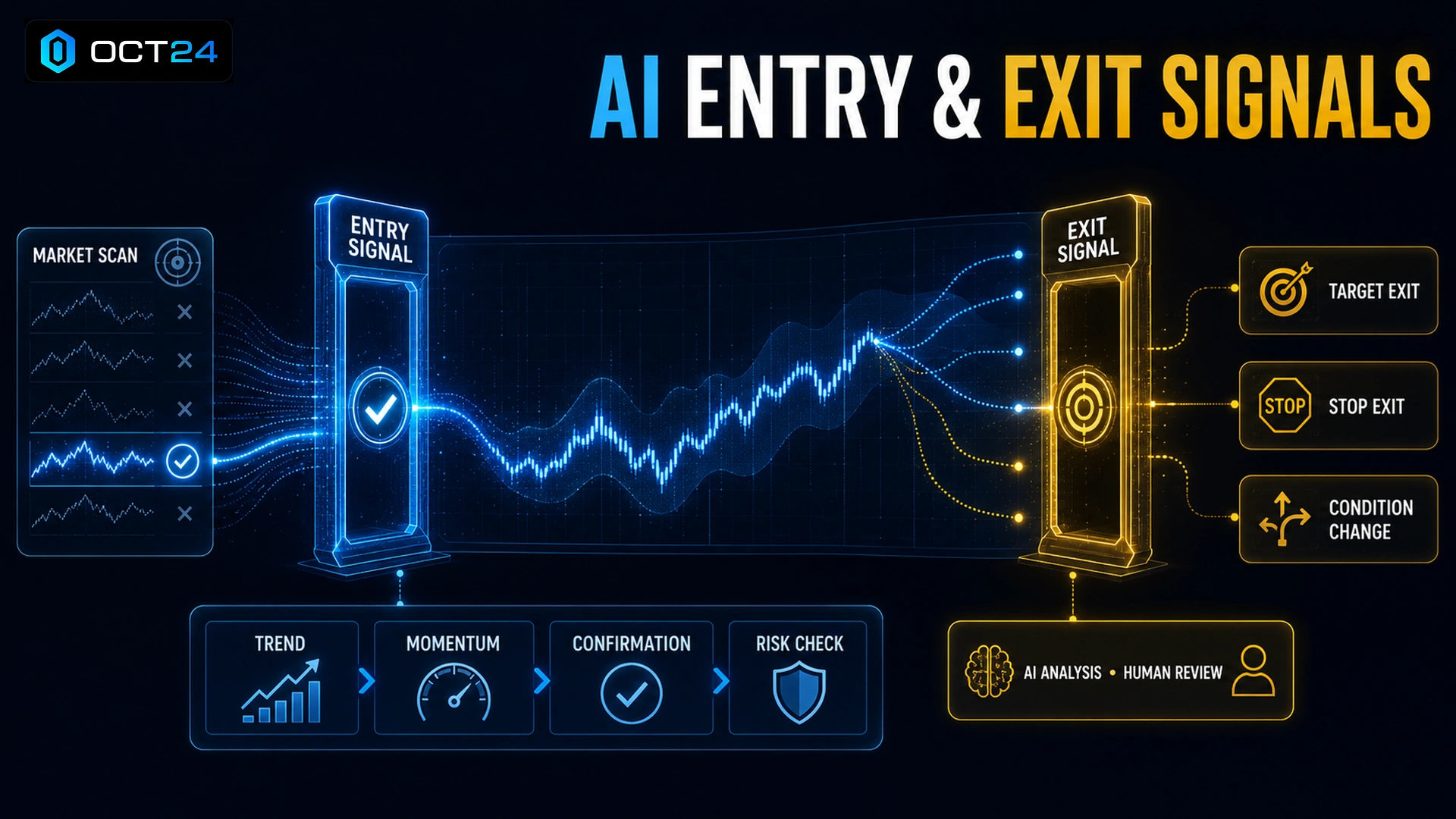
In simple terms, an entry signal points to a possible moment to enter a trade. An exit signal points to a possible moment to leave, reduce exposure, or avoid staying in a trade too long. AI can support both by reviewing market behavior faster than a human trader can manually process it.
For beginner and intermediate traders, the real value is not just speed. It is structure. A trader who understands signal quality, risk, and timing is less likely to chase random candles or hold positions without a plan.
OCT24 is designed to make AI-supported trading simpler by presenting trade and bot opportunities with key metrics such as target profit, loss coverage, and win rate. Traders still need to decide whether the opportunity fits their risk settings, exposure, capital allocation, and execution choices.
What entry and exit signals mean
An entry signal is a sign that a trade may be worth considering. It might come from price action, momentum, volatility, volume, trend strength, or a mix of technical conditions.
An exit signal is a sign that a trade may need to be closed, reduced, skipped, or managed more carefully. It may appear when momentum fades, volatility changes, risk increases, or the original reason for the trade no longer looks valid.
The important word is signal. A signal is not a promise. It is not a guarantee. It is a piece of structured information that helps a trader decide what to do next.
This is one reason AI trading signals are useful for beginners. They can turn a messy chart into a clearer decision point. Instead of asking, “What is happening everywhere?” the trader can ask, “Does this opportunity fit my plan?”
Entry and exit signals should work together. A trader who only thinks about entry may get into trades without knowing how to respond later. A trader who only thinks about exit may miss why the trade was considered in the first place.

Why entry signals matter
Entry signals matter because timing affects risk. A good idea can become a poor trade if the entry is rushed, late, oversized, or based on emotion.
Many traders enter because a price is moving quickly. They see momentum and assume the move will continue. Sometimes it does. Sometimes they enter just as the move slows down.
A useful entry signal should help answer three simple questions.
- Why might this trade be worth attention
- Is the timing reasonable compared with current market conditions
- Does the possible reward make sense compared with the possible risk
AI can support this process by scanning conditions and identifying potential opportunities faster than a manual trader could. But the trader still needs to decide whether the setup is suitable for their own capital and risk tolerance.
This is where understanding how AI uses technical analysis can help. AI may review patterns, price movement, volatility, or other technical behavior, but the result still needs human review and responsible execution.
How AI can support entry signal decisions
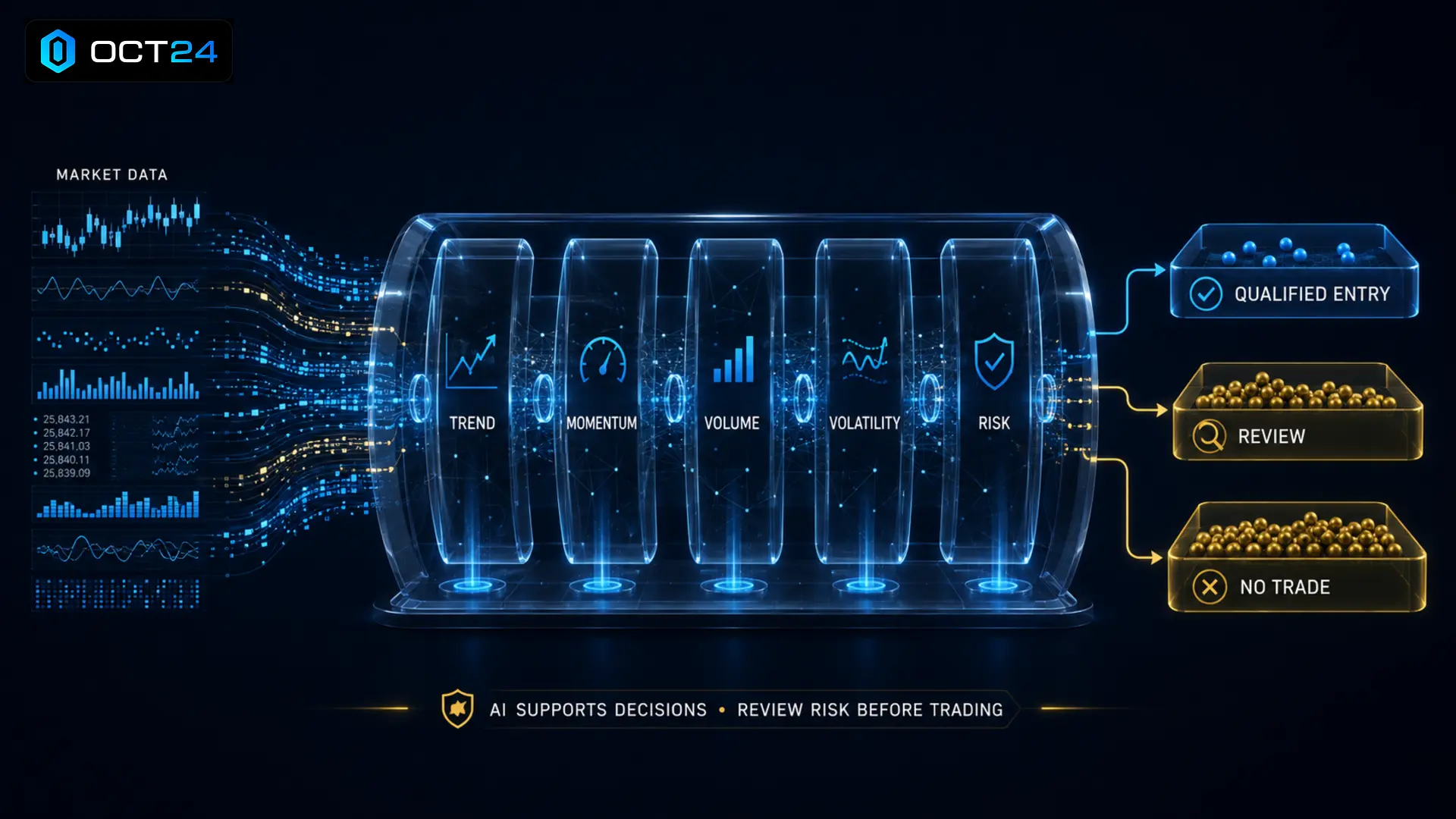
AI can support entry decisions by filtering market movement into more useful information. Instead of reacting to every small move, traders can use AI-supported tools to focus on opportunities that meet selected conditions.
For example, a trader may be watching crypto markets during a busy session. Bitcoin is moving, Ethereum is reacting, and several altcoins are changing direction. Manually reviewing every asset can become overwhelming.
AI-supported systems can help reduce that workload by scanning market activity and presenting structured opportunities. That does not mean every opportunity should be taken. It means the trader starts from a clearer point than random chart watching.
This is one of the differences between AI trading vs manual trading. Manual trading often requires the trader to find, judge, and execute every setup alone. AI-supported trading can help with the analysis and filtering side, while the trader remains responsible for final execution decisions.
A good entry process should be selective. The goal is not to click every time something appears. The goal is to decide whether the opportunity fits the current plan.
Why exit signals matter
Exit signals matter because getting into a trade is only half of the decision. The other half is knowing when the trade no longer fits the plan.
Many beginners focus heavily on entry. They want to know when to buy, when to activate a bot, or when to participate. But once the trade is active, emotions often become stronger.
A trader may hold too long because they want a bigger result. They may exit too early because a small pullback feels uncomfortable. They may ignore changing conditions because they do not want to admit the trade has weakened.
Exit signals can help reduce those emotional reactions. They provide a framework for deciding when a trade should be closed, protected, reduced, or reviewed.
This is closely connected to trading psychology. Entry decisions often involve excitement. Exit decisions often involve fear, hope, impatience, or regret. AI can support structure, but the trader still has to follow the process.
How AI can support exit signal decisions
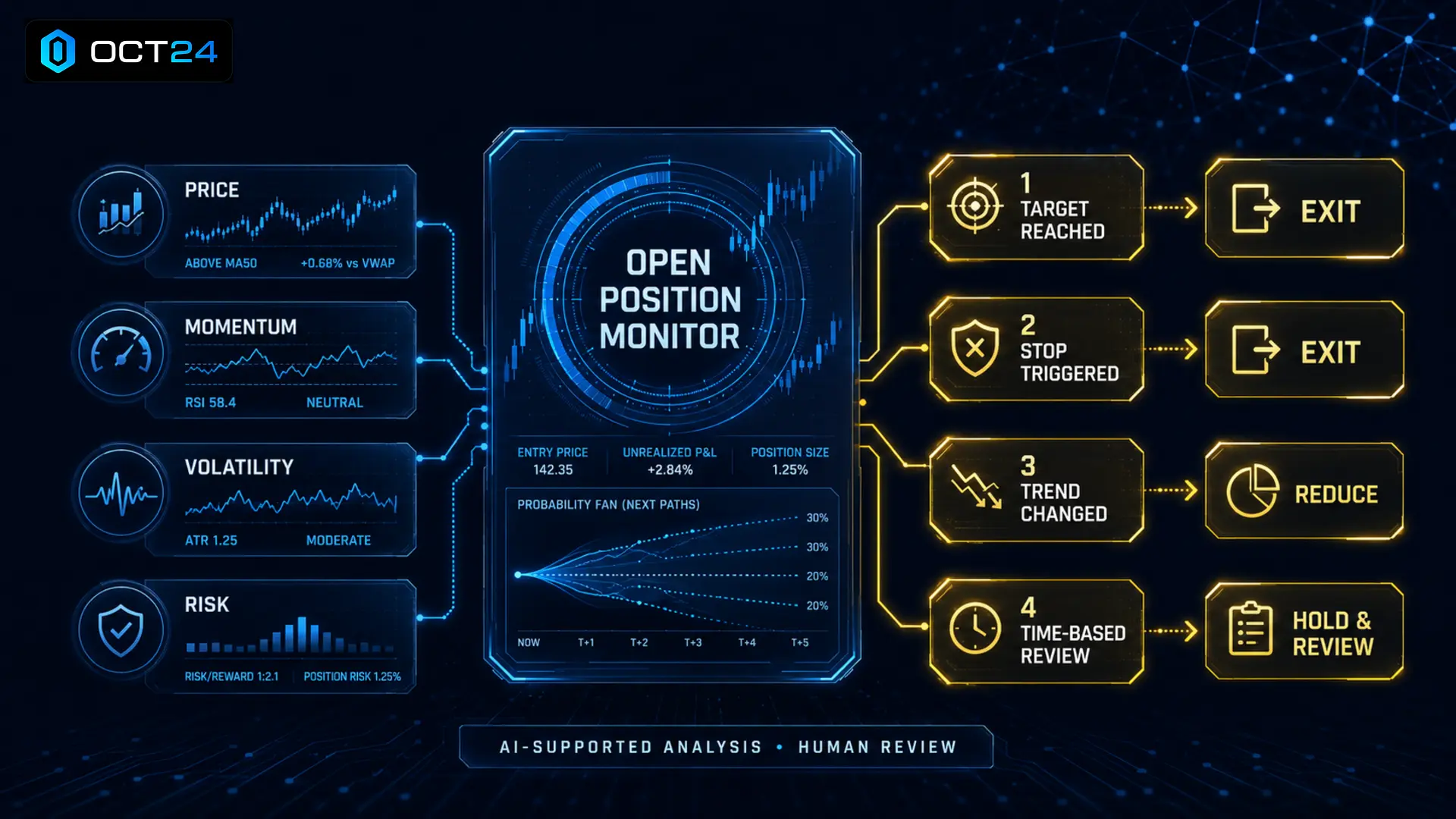
AI can support exit decisions by monitoring whether market conditions still support the original trade idea. If momentum changes, volatility increases, or price behavior becomes less favorable, the trader may need to review the position.
For traders using bots or AI-supported trade opportunities, exit thinking is still important even when the platform simplifies the experience. The user needs to understand the possible outcome, the risk being taken, and the conditions that would make them stop or avoid further exposure.
A basic exit review might include the following.
- Has the trade reached its planned target
- Has the risk changed since the trade was opened
- Is the trader holding because of a plan or because of hope
- Would the trader take the same trade again if they were not already in it
- Has daily exposure become too high
AI can help organize some of this thinking, but it should not be treated as certainty. Markets can move suddenly, especially in crypto, and even strong-looking setups can fail.
This is why trading bot risk management matters. A bot or AI-supported system can make trading more efficient, but risk rules still protect the user from poor decisions and unexpected market changes.
Entry and exit signals need risk context
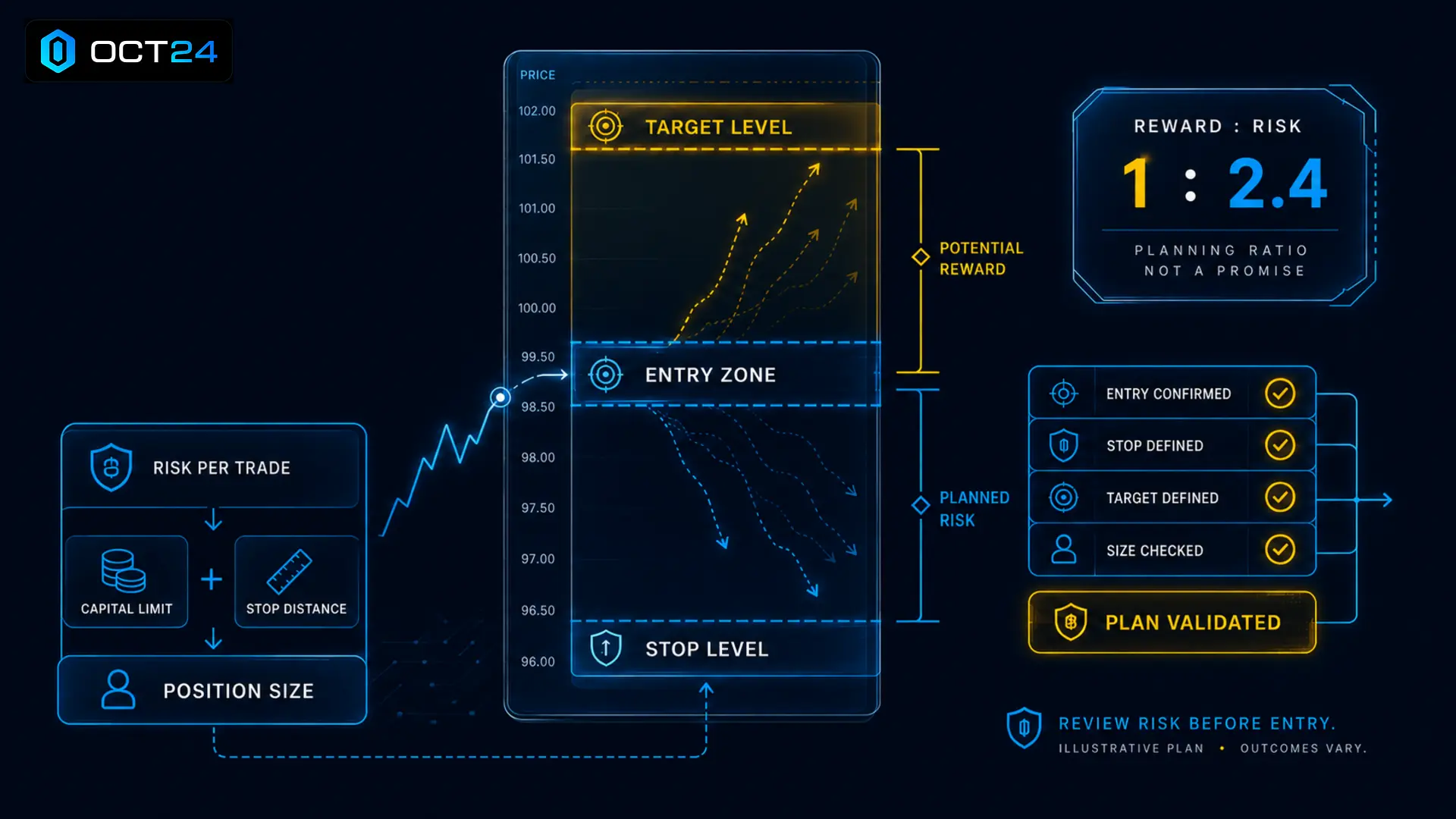
Entry and exit signals are not useful on their own. They need risk context. A signal may look strong, but if the potential loss is too large compared with the possible reward, the trade may still be unsuitable.
Risk context includes position size, capital allocation, market volatility, loss tolerance, and the trader’s current behavior. A trader who has already taken several trades that day may need stricter standards than someone reviewing their first opportunity.
This connects directly to AI trading risk vs reward. Traders should not ask only whether a signal looks attractive. They should ask whether the possible reward justifies the exposure.
A simple risk review can include these questions.
- What is the possible upside
- What is the possible downside
- How much capital is exposed
- What happens if the signal fails
- Does this trade fit the daily risk limit
- Is the trader acting from plan or emotion
This is especially important when using faster tools. The easier it is to act, the more important it becomes to pause before acting.
Risk context also protects traders from treating every entry signal the same way. A small trade during calm conditions may require one type of review. A larger trade during volatile conditions may require a stricter review.
This is why beginners should avoid asking only whether the signal looks good. They should also ask whether the signal is appropriate for the amount of capital they are about to use.
A signal that does not fit the account size, the daily limit, or the trader’s current emotional state should be skipped. Discipline often means letting a technically interesting setup pass because the risk context is not right.
Where OCT24 fits into signal review
OCT24 helps simplify the trading process by presenting AI-supported trade and bot opportunities in a more accessible way. Instead of asking users to manually analyze every chart from scratch, the platform focuses on a simpler review experience.
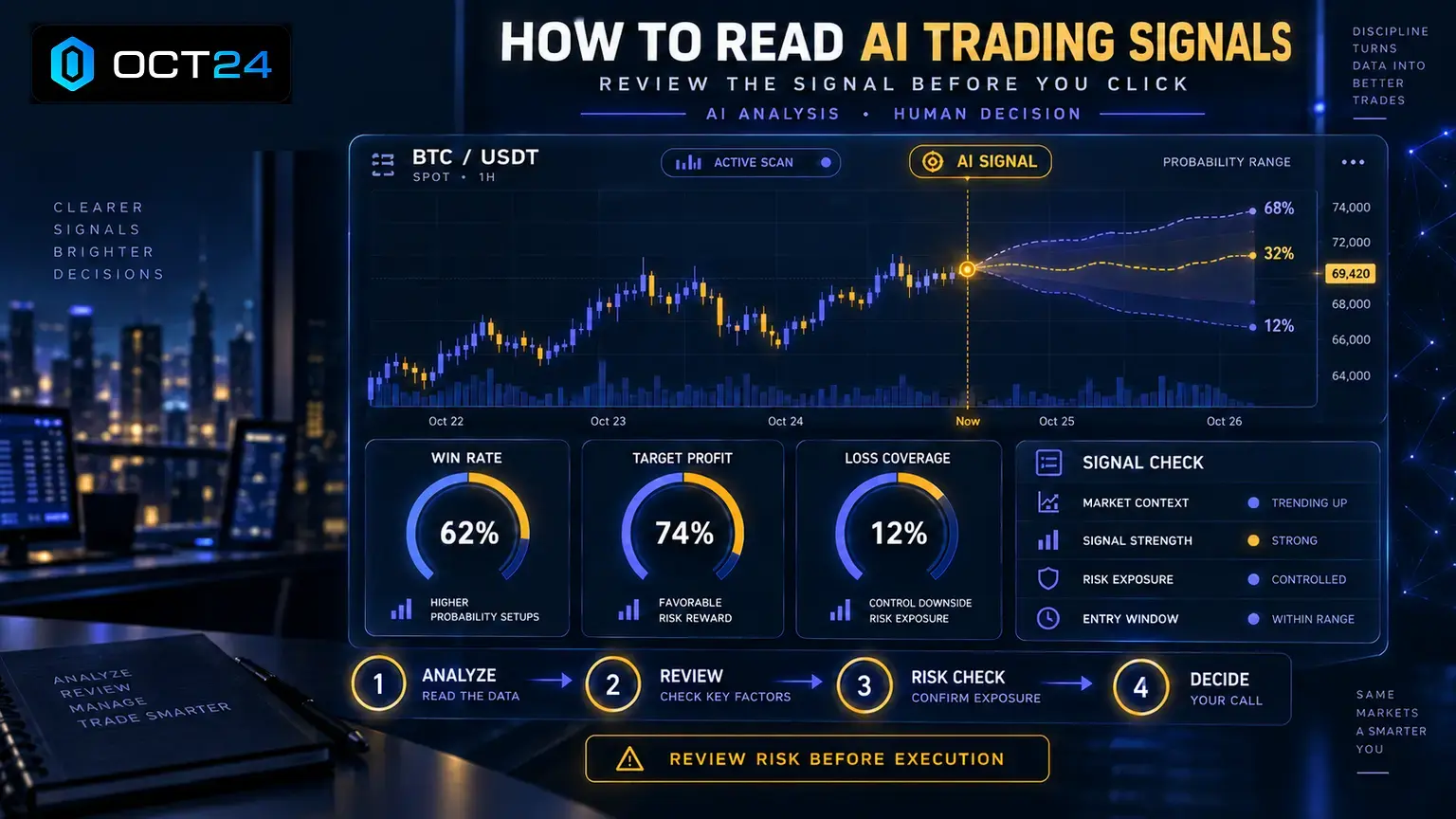
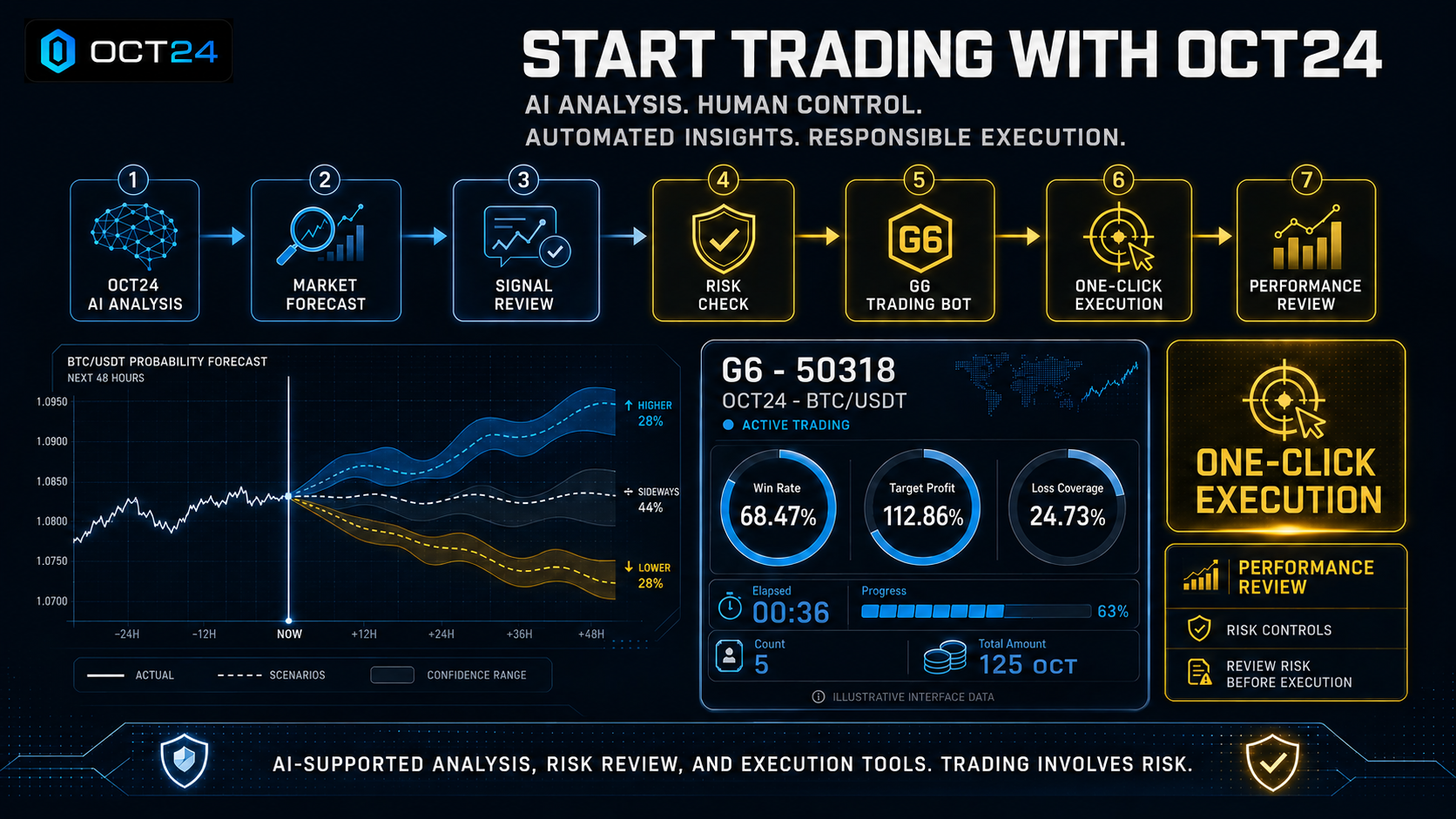
For accuracy, it is important to understand what OCT24 currently shows. OCT24 does not currently provide a full on-platform research dashboard with detailed asset information, exact entry points, or exact exit points for every presented trade. Users review key trade or bot metrics such as target profit, loss coverage, and win rate.
That means OCT24 can support signal review, but it should not be described as giving a full entry-and-exit breakdown for every opportunity. The trader still needs to decide whether the visible metrics fit their risk rules and whether they are comfortable with the exposure.
This can be useful for people who want a cleaner, faster trading experience. It can also help traders avoid spending too much time jumping between charts. But it does not remove market risk, and it does not guarantee results.
The G6 Trading Bot is relevant for traders who want a fast, simplified AI trading experience. Speed can be helpful when the trader has a plan, but it should not encourage repeated clicking without risk limits.
OCT24 works best when the user treats the platform as part of a disciplined process. Review the metrics, compare them with your limits, and only act when the opportunity fits your plan.
This is especially useful for newer traders who want a simpler way to think through opportunities. The platform can reduce some of the manual workload, but it should not encourage blind trust or repeated action without review.
A good OCT24 habit is to slow down before execution. Look at the target profit, loss coverage, and win rate. Then ask whether the trade fits your personal risk rules before using one-click execution.
The platform can make the process feel cleaner, but the trader still decides how much to risk, whether to participate, and when to stop.
How entry and exit signals relate to market conditions
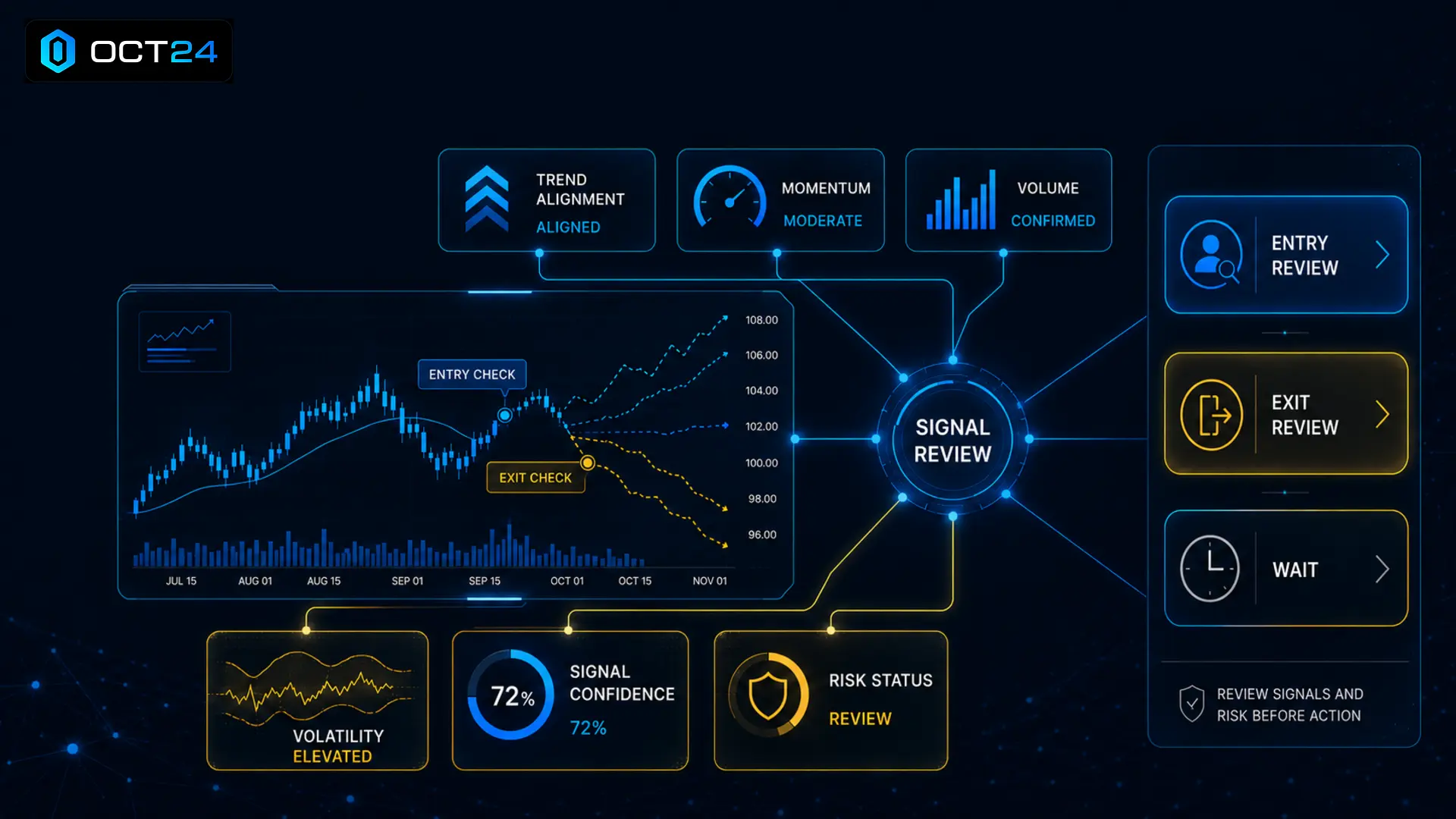
A signal that works well in one market may not work well in another. Trending markets, volatile markets, and sideways markets each behave differently.
In a strong trend, entry signals may appear during pullbacks, breakouts, or continuation moves. Exit signals may appear when momentum weakens or the trend becomes extended.
In volatile markets, signals may appear more often, but the risk of false moves can also increase. Traders need to be careful because fast movement can make poor timing more expensive. This is where understanding how AI handles market volatility can support better judgment.
In sideways markets, entry signals can be more difficult because price may move back and forth without clear direction. Traders who understand AI trading during sideways markets know that patience and filtering matter more when direction is unclear.
AI can help monitor these conditions, but it cannot make uncertain markets certain. A trader still needs to recognize when the best decision is to wait.
Entry signals are not predictions
A common mistake is treating an entry signal as a prediction. Traders see a signal and assume the market is about to move in their favor. That is not how signals should be used.
A signal is a probability-based clue, not a guarantee. It may highlight conditions that have been useful in similar situations, but the next trade can still lose.
This is one reason can AI predict the market is such an important topic. AI can identify patterns and probabilities, but markets are influenced by news, liquidity, sentiment, and sudden changes that no system can control perfectly.
The safest mindset is to treat every signal as something to review. Ask whether it fits your rules. Ask whether the risk is acceptable. Ask whether you are prepared for the trade to fail.
This mindset helps traders stay realistic. It also protects them from one of the most common AI trading myths: the idea that AI removes uncertainty. It does not. It helps organize information inside uncertainty.
Exit signals are not failure signals
Another mistake is treating exit signals as failure. Some traders feel that leaving a trade means they were wrong. That mindset can lead to holding too long.
An exit signal is simply information. It may protect capital, lock in a result, reduce exposure, or prevent a small problem from becoming a larger one.
A disciplined trader does not need every trade to become perfect. They need a repeatable way to make decisions. Exits are part of that process.
This is why position sizing controls and exposure limits matter. If the trade size is reasonable, exits feel less emotional. If the trade size is too large, every exit decision can feel stressful.
The goal is to make both entry and exit decisions calm enough to review clearly.
Common mistakes with entry and exit signals
Entry and exit signals become less useful when traders use them without rules. The signal may be reasonable, but the behavior around it may be poor.
Common mistakes include the following.
- Entering because a signal appeared without checking risk
- Ignoring exit signals because the trader wants a bigger result
- Using win rate as the only decision factor
- Increasing capital after a losing trade
- Taking too many signals in one session
- Confusing fast execution with safe execution
- Following signals without understanding the basic strategy
- Forgetting that fees, volatility, and timing can affect outcomes
These mistakes overlap with common AI trading mistakes and avoid overtrading. A trader can have useful technology and still make poor decisions if they overuse it, ignore risk, or chase every alert.
The better approach is to use signals as decision support. They should help the trader become more selective, not more impulsive.
How beginners can use signals more responsibly
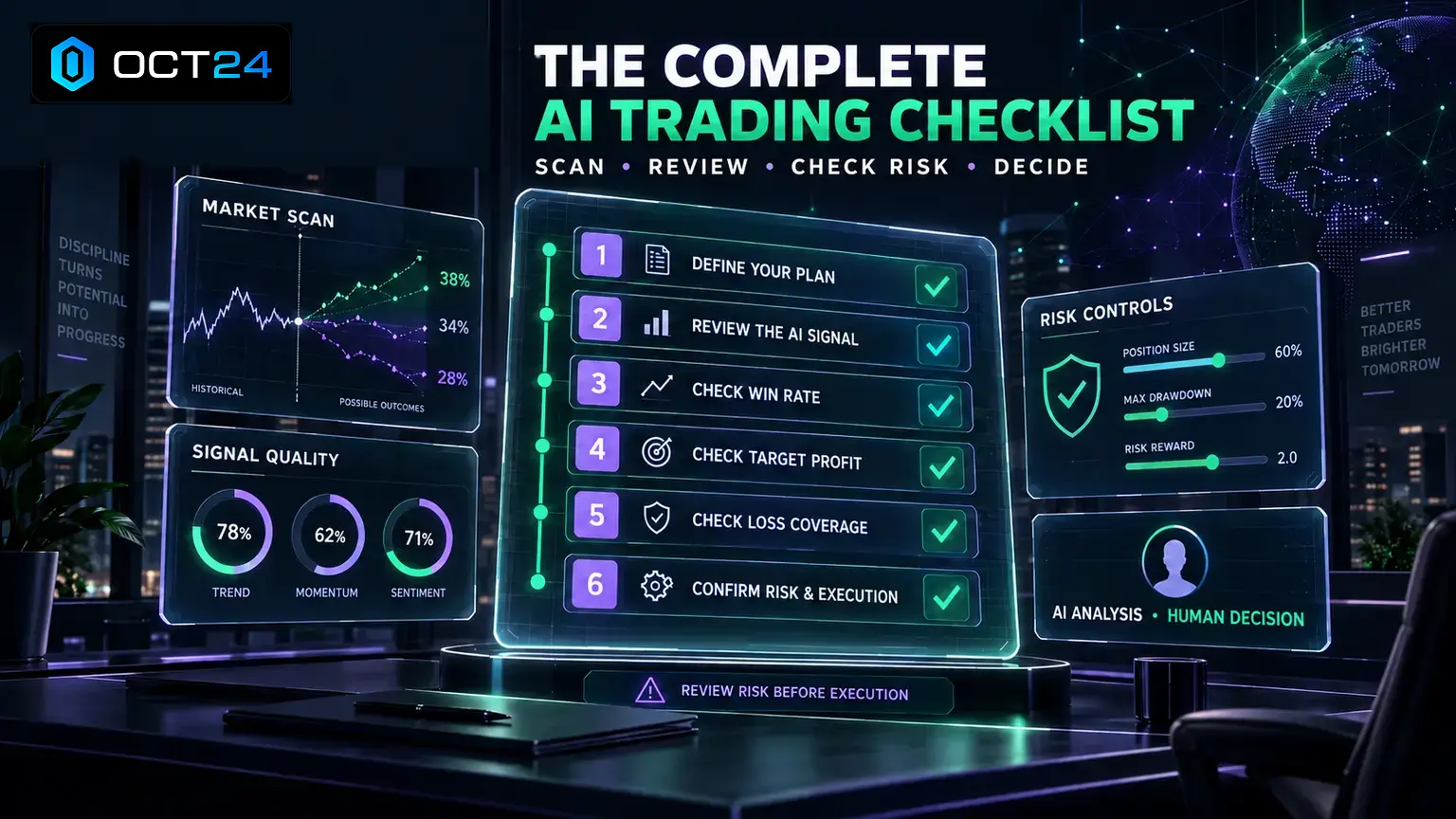
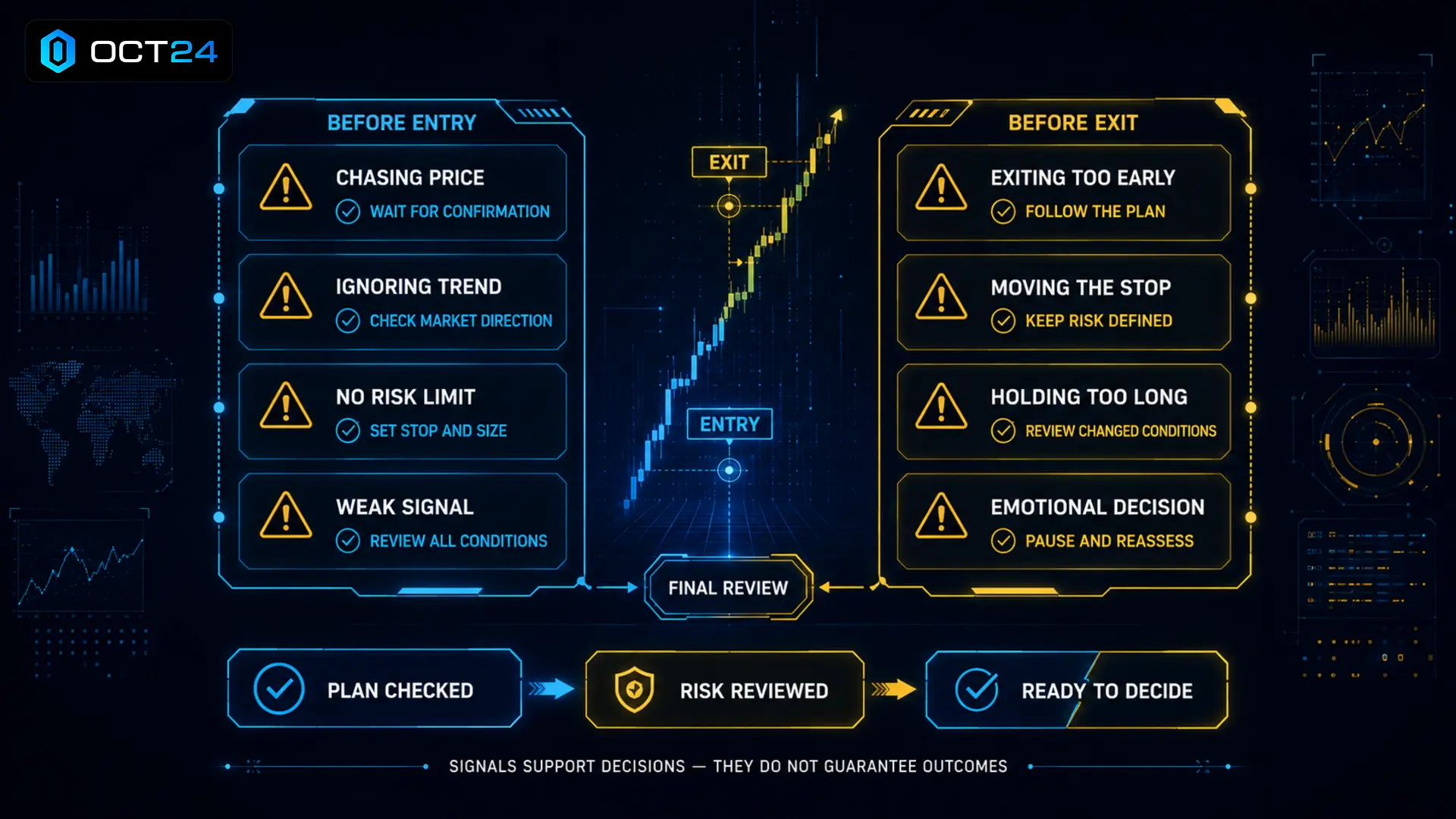
Beginners should keep the process simple. Entry and exit signals are easier to use when the trader has a short checklist.
Before acting on an entry signal, ask these questions.
- Does the signal match my trading plan
- Is the market condition suitable
- Is the possible loss acceptable
- Have I already taken too many trades today
- Am I entering because of structure or emotion
Before reacting to an exit signal, ask these questions.
- Has the original trade idea changed
- Is the trade still within my risk limit
- Am I holding because of logic or hope
- Would closing or reducing exposure protect my account
- Does this exit decision fit my plan
This type of checklist works for manual traders, bot users, and people exploring best AI trading tools. The tool matters, but the review process matters just as much.
How signals fit into a broader trading routine
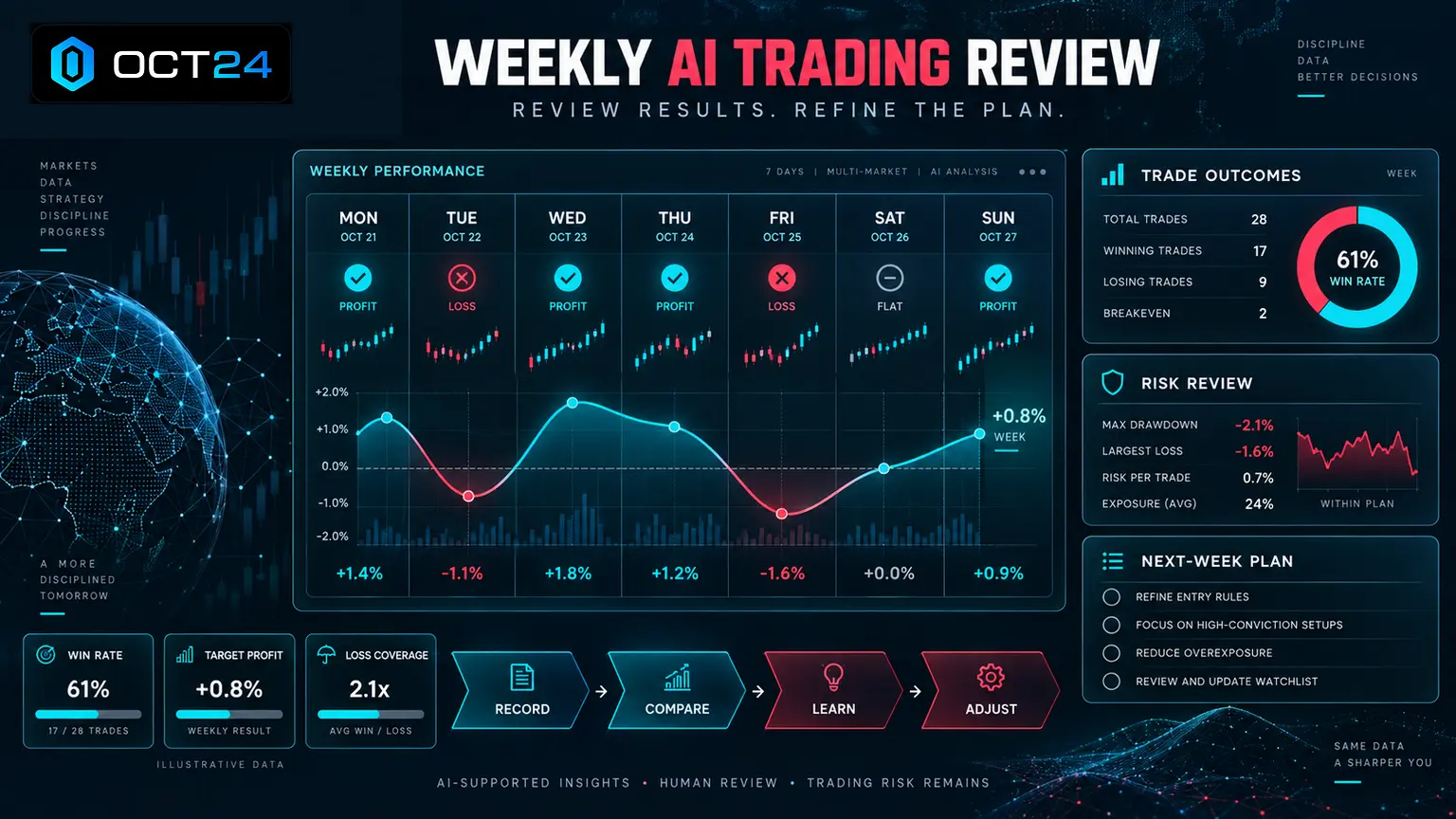
Signals are most useful when they belong to a routine. Without a routine, the trader may react differently every time. With a routine, the trader knows how to review signals before the market becomes emotional.
A simple routine may include checking an AI trading watchlist, reviewing available signals or bot metrics, deciding whether the opportunity fits risk rules, and stopping once the daily plan is complete.
This also helps traders who follow 24/7 market monitoring. The market may run all day, but the trader does not need to make decisions all day. Structured review times can reduce stress and prevent random action.
For traders comparing different assets, AI can also help organize attention across Bitcoin, Ethereum, and altcoins. That connects with using AI to compare Bitcoin Ethereum and altcoins and understanding crypto market rotation.
The key is selectivity. More data should not automatically mean more trades. Better data should lead to better decisions.
Using OCT24 without overcomplicating the process
OCT24 is designed for traders who want a simpler way to interact with AI-supported trading opportunities. The platform can help reduce the need to manually search through every chart, while still keeping the final decision with the user.
A practical OCT24 review process might look like this.
- Review the available trade or bot opportunity
- Check target profit, loss coverage, and win rate
- Compare the metrics with your risk limit
- Decide whether the trade fits your capital allocation plan
- Use one-click execution only when the decision already makes sense
- Stop when your daily trade or exposure limit is reached
This connects naturally with one-click trading. A simpler trading action can save time, but it should not remove the review step. The click may be quick, but the decision should still be thoughtful.
If you are comparing platforms, review choosing the right AI trading platform and think about how each tool handles simplicity, risk information, execution, and user responsibility.
What to remember before acting on any signal
The best signal is not always the signal with the most excitement. It is the signal that fits the trader’s plan, risk limit, and current market condition.
Before acting, remember these points.
- A signal is support, not certainty
- An entry is only useful if the risk is acceptable
- An exit is part of discipline, not a sign of failure
- Fast execution still requires careful review
- AI can reduce workload, but it cannot remove market risk
- The trader remains responsible for exposure and capital allocation
OCT24 can help make the process more accessible by presenting AI-supported trade and bot opportunities in a simplified format. It can support faster review and easier execution, but it does not guarantee outcomes.
Readers who want to learn more about the company can visit About OCT24. Those ready to explore the platform can Start Trading with OCT24.
FAQs
What are AI trading entry and exit signals?
AI trading entry and exit signals are AI-supported clues that help traders review when a trade may be worth entering and when it may be time to close, reduce, or avoid a position.
Are entry signals guaranteed to be correct?
No. Entry signals are not guarantees. They can support decision-making, but every trade still carries risk.
Are exit signals only used after a trade is profitable?
No. Exit signals can help manage profitable trades, losing trades, or trades that no longer fit the original plan.
Does OCT24 show exact entry and exit levels for every trade?
No. OCT24 currently focuses on a simplified trade and bot review experience. Users review metrics such as target profit, loss coverage, and win rate rather than detailed asset information or exact entry and exit analysis for every opportunity.
How should beginners use AI trading signals?
Beginners should use signals as decision support. They should still check risk, capital allocation, market conditions, and daily limits before acting.
Can AI help traders avoid emotional entries and exits?
AI can help by adding structure and reducing the need to react to every market move. It cannot remove emotion completely, so traders still need personal rules.
What is more important, entry or exit?
Both are important. Entry affects timing and risk, while exit affects how the trade is managed after it begins.
Can one-click trading make signal use easier?
Yes, one-click trading can make execution simpler. It should still be used only after the trader has reviewed the opportunity and accepted the risk.
Should traders take every AI signal?
No. Traders should only act on signals that fit their strategy, risk tolerance, capital allocation, and current market conditions.
Does OCT24 remove trading risk?
No. OCT24 does not remove trading risk or guarantee results. Traders remain responsible for risk settings, exposure, capital allocation, and execution decisions.
Final thoughts
AI trading entry and exit signals can make trading easier to understand because they turn market movement into clearer decision points. They can help traders review when to consider a trade, when to manage exposure, and when to avoid emotional decisions.
The key is to treat signals as support, not certainty. AI can scan market conditions and identify potential opportunities, but it cannot guarantee the next outcome.
OCT24 supports a simpler AI-powered trading experience by presenting trade and bot opportunities with key metrics such as target profit, loss coverage, and win rate. Traders still need to decide whether those metrics fit their plan.
The trader remains responsible for risk settings, exposure, capital allocation, and execution decisions.
Used responsibly, AI can help traders become more structured, more selective, and less emotional. That is where entry and exit signals become most useful.
Start Trading with OCT24 to explore a simpler AI-supported trading experience while keeping risk management at the center of every decision.