
Trading Bots vs Human Traders
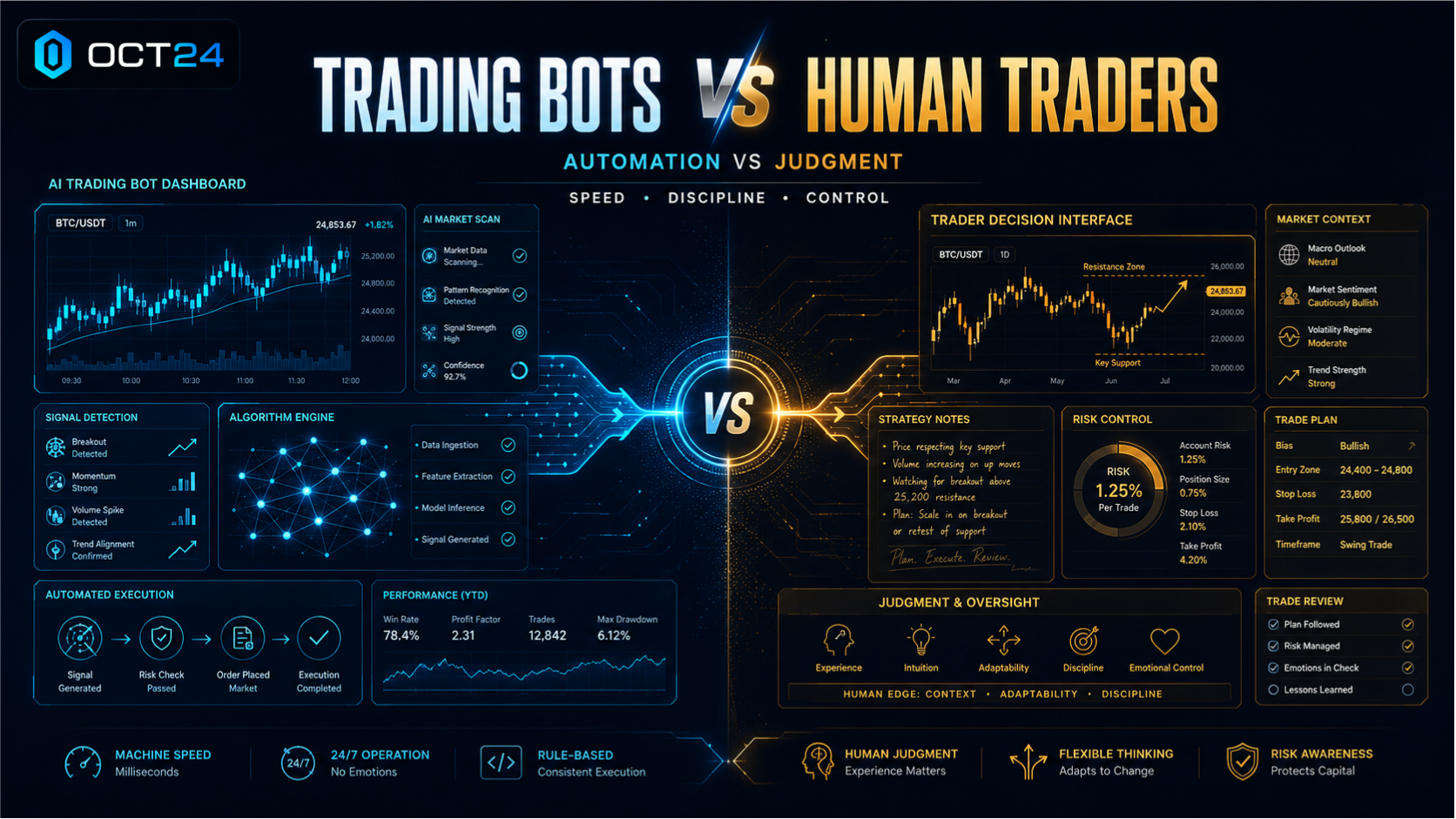
Trading Bots vs Human Traders is one of the most important comparisons for anyone learning how automation fits into modern trading. Trading bots are strong at speed, consistency, data processing, market monitoring, and emotion-free execution. Human traders, on the other hand, are stronger at judgment, context awareness, strategic thinking, risk preferences, and adapting to unusual market conditions.
That does not mean one side is always better than the other. A trading bot can process information faster than a person, but a person can still decide whether a strategy makes sense for their goals, risk tolerance, and market outlook. A bot can follow rules without hesitation, but a human trader still needs to choose the rules, understand the risks, and avoid using automation blindly.
This is why the better question is not always, “Should I use a bot or trade manually?” A more useful question is: “How can traders combine AI-powered automation with responsible decision-making?”
That is where platforms like OCT24 fit into the trading workflow. OCT24 is designed to perform much of the market analysis traders would normally need to do manually. It can scan market conditions, identify potential opportunities, and present AI-supported trading signals in a structured way. However, OCT24 does not remove trading risk or guarantee results. Traders still need to use appropriate risk settings, understand their exposure, manage capital responsibly, and make informed execution decisions.
In other words, trading bots can make the trading process faster and more structured, but human oversight still matters.
What Are Trading Bots Designed to Do?
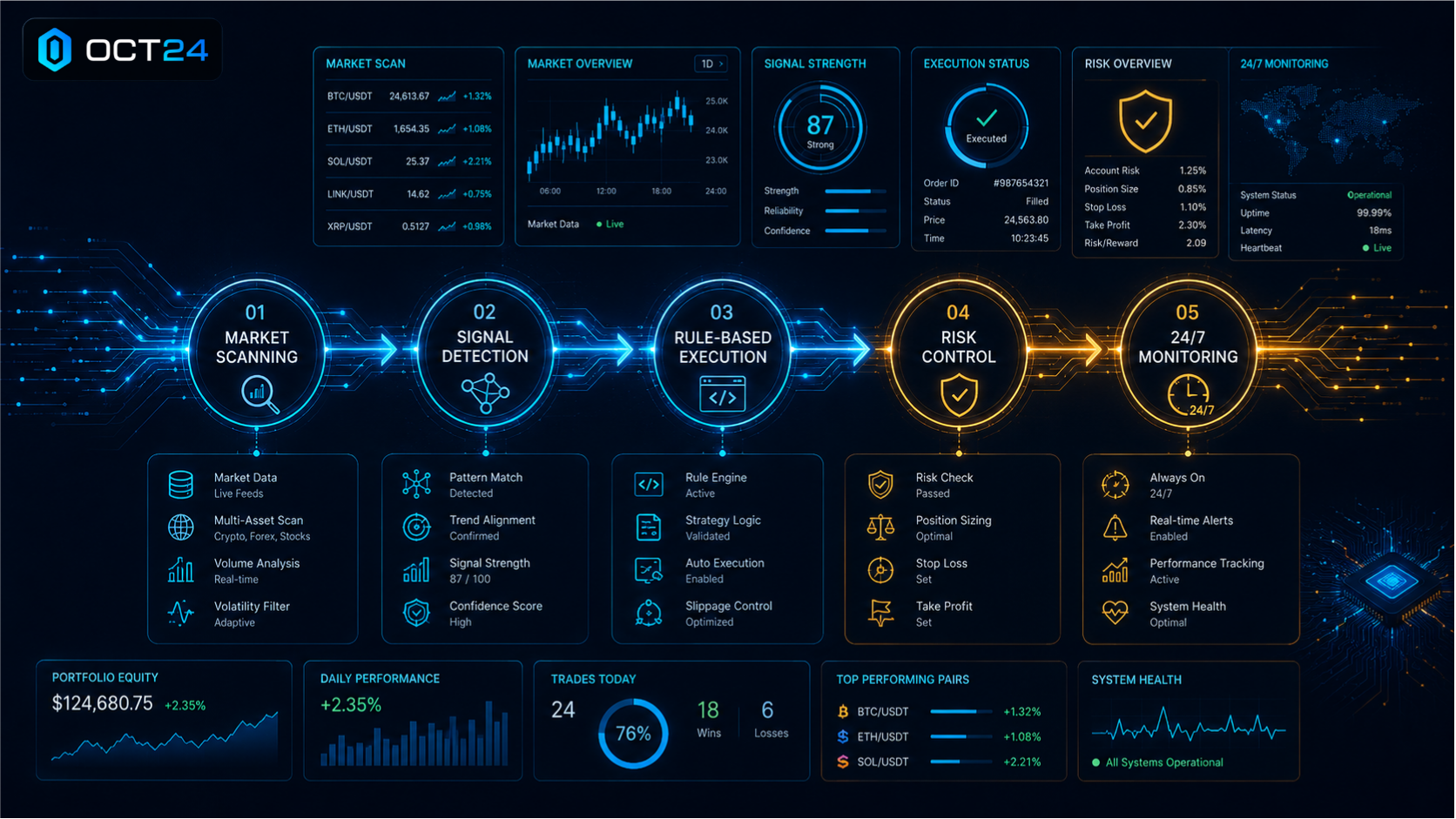
Trading bots are designed to handle repetitive, rule-based, and data-heavy parts of trading. Instead of manually watching charts all day, a trader can use automation to scan markets, detect signals, and respond to predefined conditions.
At a basic level, AI Trading Bots can help with tasks such as:
- Scanning markets for potential setups
- Detecting trading signals
- Monitoring price movement
- Following technical rules
- Supporting entry and exit decisions
- Applying risk controls
- Tracking multiple assets at once
- Reducing repetitive manual work
This is where Automated Trading becomes useful. A human trader may be able to analyze one or two charts carefully, but markets move quickly. Crypto markets also operate 24/7, which makes constant manual monitoring unrealistic for most people.
A trading bot does not get tired. It does not need breaks. It can monitor conditions continuously and respond when specific criteria appear.
For example, a trader might want to know when a crypto asset breaks above a resistance level while volume increases and volatility remains within a certain range. Manually checking for that setup across multiple assets would take time. A bot can scan for those conditions much faster.
This does not mean every bot is intelligent or effective. Some bots simply follow fixed rules. Others use more advanced systems that combine signals, technical analysis, and market behavior. This is why understanding Algorithmic Trading matters. Algorithmic systems follow predefined logic, while AI-powered systems may analyze larger sets of data and adapt their signal evaluation more dynamically.
The quality of the bot depends on the quality of the platform, strategy logic, data inputs, and risk controls behind it. That is why traders should not evaluate automation only by asking whether a bot can place trades. They should ask whether the bot can support a better trading process.
Good AI Trading Software should help traders reduce manual workload, understand signals more clearly, and apply risk controls in a structured way. OCT24 is built around this kind of workflow. Through tools like the G6 Trading Bot, OCT24 can support market analysis, opportunity detection, and structured execution without requiring traders to manually scan every chart themselves.
The key point is that trading bots are not designed to “think like humans” in every situation. They are designed to process data, follow logic, detect opportunities, and support execution more efficiently than a person could do manually.
What Human Traders Still Do Well
Even with powerful automation, human traders still matter.
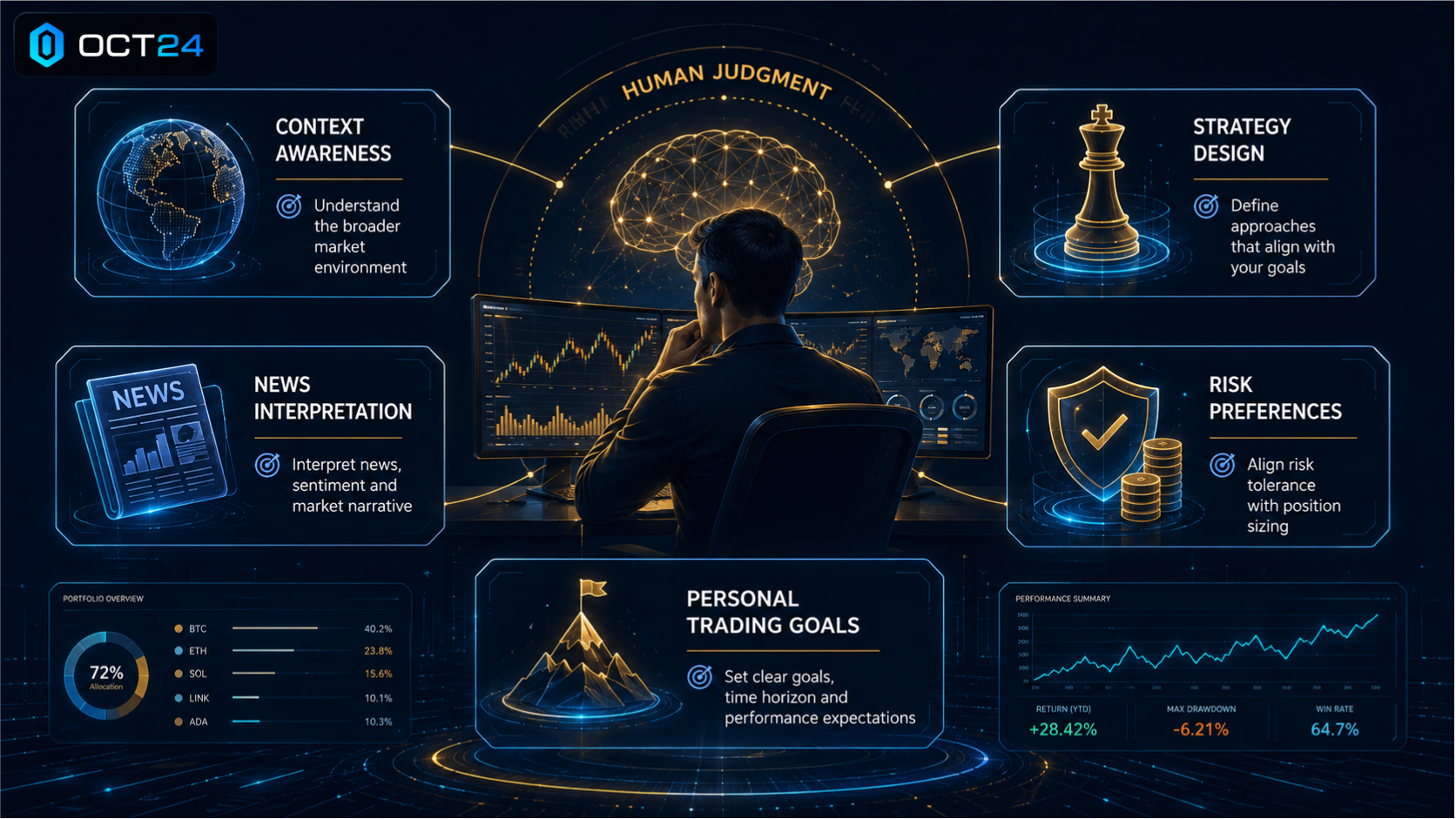
Trading is not only about reacting to signals. It also involves judgment, planning, risk preferences, and understanding the bigger picture. A bot may detect that a setup matches certain technical conditions, but a human trader still needs to understand whether that setup fits their goals.
Human traders are especially important when decisions require context.
For example, a bot may identify a breakout based on price movement and volume. But a human trader may also consider whether a major news event is coming, whether the asset has been unusually volatile, or whether the broader market is showing signs of weakness. That type of judgment can be difficult to fully automate.
Human traders also set the direction of the strategy. They decide whether they want to trade aggressively or conservatively. They choose how much capital to risk. They decide whether they are focused on short-term opportunities, longer-term trends, or a mix of both.
This is where the comparison between AI Trading vs Manual Trading becomes useful. Manual traders have direct control over every decision, but they may struggle with speed, discipline, and constant monitoring. AI-assisted traders can use automation to reduce workload, but they still need to understand how the system fits into their broader plan.
Human traders are also better at recognizing when not to trade.
That may sound simple, but it is one of the most important trading skills. Sometimes the best decision is to wait. Markets may be too volatile, signals may be unclear, or risk may be too high. A bot can be designed to avoid certain conditions, but a human trader still plays an important role in defining those boundaries.
Human traders are also responsible for avoiding over-automation. A trading bot can make it easier to act quickly, but that speed can become a problem if the trader uses poor settings, too much leverage, or unrealistic expectations.
This is why the strongest trading workflow often combines both sides. The bot handles scanning, analysis, signal detection, and execution support. The human trader provides goals, judgment, risk awareness, and responsible decision-making.
OCT24’s role is to reduce the manual analysis burden while still giving traders a structured way to review opportunities and manage risk. The platform can perform much of the analysis, but the trader still needs to understand the risk and decide how to use the information responsibly.
Trading Bots vs Human Traders: Key Differences
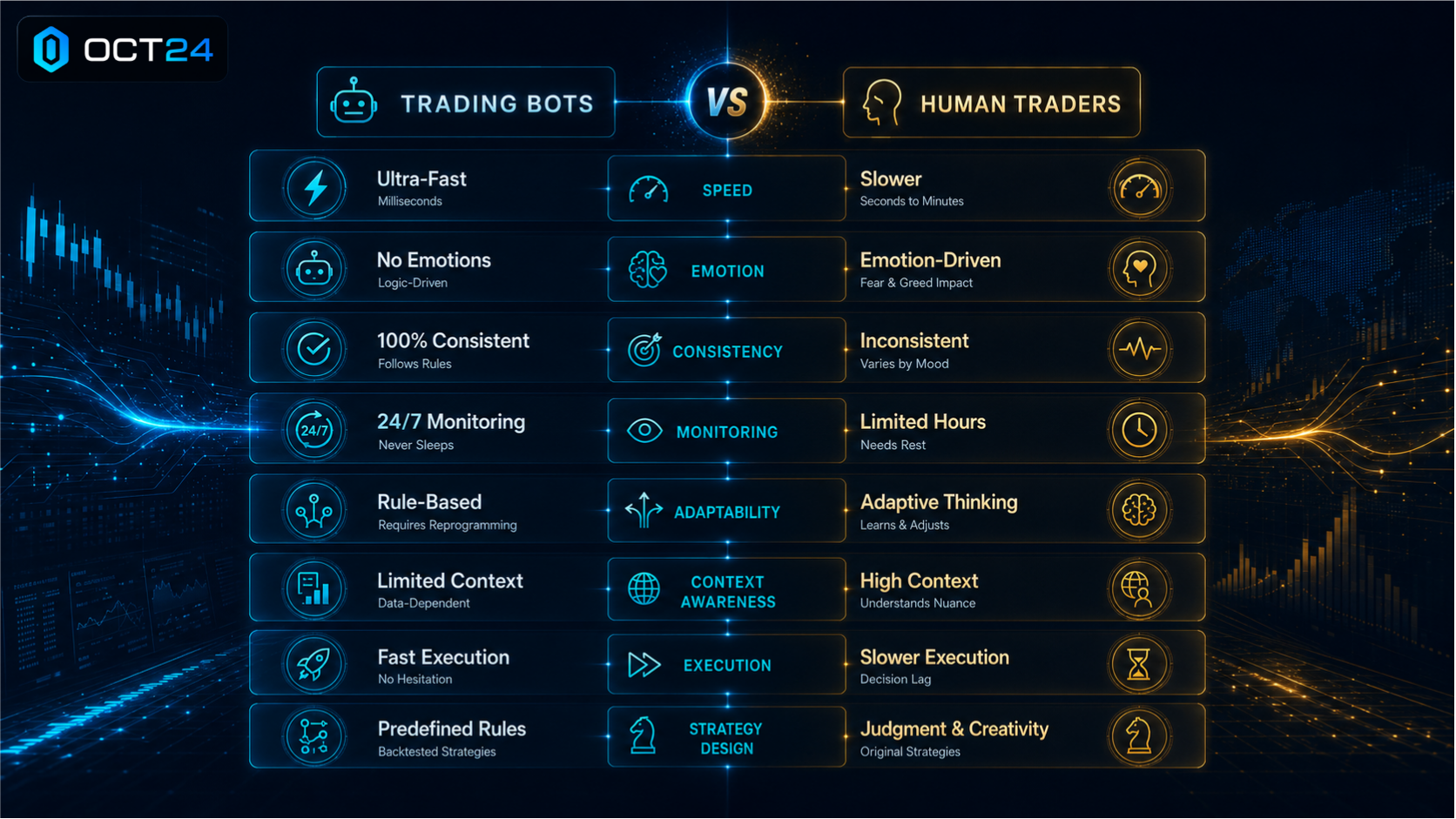
The difference between trading bots and human traders is not just about automation. It is about how each side handles information, risk, emotion, speed, and decision-making.
Trading bots are strongest when the task is repetitive, data-driven, and rule-based. Human traders are stronger when the task requires judgment, context, and flexibility.
Trading bots are usually faster than human traders because they can process signals and respond to market conditions almost instantly. A human trader may need time to notice a setup, review the chart, compare indicators, calculate risk, and decide what to do next.
When it comes to emotion, trading bots have a clear advantage. They do not experience fear, greed, hesitation, or frustration. Human traders can make excellent decisions, but emotions can interfere, especially during fast markets, losing streaks, or periods of high volatility.
Consistency is another major difference. A trading bot can follow the same rules repeatedly without becoming tired or distracted. Human traders may start with a clear plan but become inconsistent when pressure increases or when recent results affect their confidence.
Market monitoring is also different. Trading bots can monitor markets 24/7, which is especially useful in crypto markets. Human traders are limited by time, attention, and availability. They cannot watch every chart at every hour of the day.
Human traders, however, often have stronger context awareness. A bot may understand the data it is designed to analyze, but a human trader can consider news, sentiment, market narrative, personal goals, and unusual conditions that may not be fully captured by a system.
Adaptability also depends on the situation. A trading bot can adjust only within the logic and settings it has been given. A human trader can step back, reassess the market, and decide that a strategy no longer fits current conditions.
Risk control works best when both sides are used properly. Bots can apply predefined limits consistently, such as position size, trade frequency, and stop-loss rules. Human traders can decide whether those rules make sense for their personal risk tolerance and current market environment.
Execution is another area where bots are usually stronger. They can respond quickly and without hesitation. Human traders may be more flexible, but they are usually slower.
Strategy design is where human judgment still matters. A bot can execute rules, but a trader still needs to understand the strategy, choose appropriate settings, and review whether the approach fits their goals.
This is why neither side should be viewed as perfect.
A trading bot may be faster, but speed is only useful when the strategy is sound. A human trader may have better judgment, but judgment can be affected by fear, greed, fatigue, or overconfidence.
For example, a human trader may spot a strong opportunity but hesitate because of a recent loss. A bot does not hesitate if the conditions match the rules. That can be an advantage.
However, a bot may continue following rules in a market environment where a human trader would pause and reassess. That is why risk controls, strategy design, and ongoing review matter.
The goal is not to remove the human from trading completely. The goal is to use automation where it performs best and human judgment where it still adds value.
OCT24 supports this type of balanced approach. The platform can perform market analysis, scan for opportunities, and present AI-supported signals, while traders remain responsible for selecting suitable settings, understanding risk, and deciding how to act.
Where Trading Bots Can Outperform Human Traders
Trading bots can outperform human traders in areas where speed, consistency, and continuous monitoring matter most.
Speed
Markets can move in seconds. A human trader may need time to notice a setup, check indicators, compare charts, calculate risk, and decide whether to enter. A bot can scan conditions and respond much faster.
This is especially useful in fast-moving crypto markets, where price movements can happen at any time. If a trader is away from the screen, distracted, or asleep, they may miss a potential opportunity entirely.
OCT24 helps reduce that problem by performing much of the scanning and analysis in the background. Instead of requiring traders to manually search for every setup, OCT24 can identify potential opportunities and present them in a more structured workflow.
24/7 Market Monitoring
Human traders have limited attention. They need sleep, breaks, and time away from screens. Trading bots can monitor markets continuously.
This is one of the biggest advantages of automation in crypto trading. Because crypto markets do not close at the end of a trading day, opportunities and risks can appear at any hour.
A bot can track price movement, volatility, and technical conditions without needing rest. This does not guarantee better results, but it can help traders avoid relying only on manual observation.
Scanning Multiple Assets
A human trader may be able to follow a few assets closely, but scanning many markets at once is difficult. Bots can monitor multiple assets, timeframes, and conditions simultaneously.
This supports the process covered in How AI Identifies Trading Opportunities. Instead of manually checking every chart, an AI-supported system can look for patterns, signals, and market changes across a broader set of assets.
That wider view can help traders discover opportunities they may not have noticed manually.
Following Rules Consistently
One of the biggest challenges in trading is consistency. Many traders create a plan but fail to follow it when emotions take over.
A bot can follow predefined rules without fear, greed, hesitation, or frustration. If the setup matches the conditions, the bot can respond according to the strategy. If the setup does not match, it can ignore the trade.
This consistency is one of the major Benefits of AI Trading. Automation can help reduce emotional decision-making and make the trading process more disciplined.
However, the rules still need to be sensible. A bot that follows poor rules consistently can still produce poor outcomes. That is why strategy design and risk management remain important.
Reducing Emotional Decisions
Human traders are emotional. Even experienced traders can feel pressure after losses, excitement after wins, or fear during volatile markets.
Trading bots do not feel FOMO. They do not revenge trade. They do not panic because a candle moves quickly. They simply follow the logic they are given.
This can be helpful when the trader has a clear strategy and risk controls. A structured system can prevent impulsive decisions and make the workflow more consistent.
OCT24 supports this by turning market analysis into a more organized process. Instead of reacting emotionally to every price movement, traders can review AI-supported signals, risk factors, and execution options more calmly.
Identifying Opportunities Faster
AI-supported platforms can process technical data faster than humans. This includes price action, volume, volatility, indicators, and market structure.
This connects closely with How AI Uses Technical Analysis. Technical analysis often involves reviewing several inputs at once. A trader may look at trend direction, support and resistance, moving averages, momentum indicators, and volume. Doing that manually takes time.
AI systems can analyze these inputs more efficiently and present potential signals in a structured way.
For example, a platform may detect that price is approaching a breakout zone, volume is increasing, and momentum indicators are strengthening. Instead of requiring the trader to manually combine all those signals, the system can surface the potential setup more clearly.
This is also where AI Trading Signals become useful. Signals help organize complex market data into a clearer decision point. They do not remove risk, but they can help traders understand what the system is seeing.
Processing Technical Data
Technical analysis can become overwhelming, especially for beginner and intermediate traders. There are many indicators, timeframes, chart patterns, and market conditions to consider.
Learning the Best Indicators for AI Trading can help traders understand what the system may be analyzing, but traders do not always need to manually calculate every signal themselves. Platforms like OCT24 can perform much of that analysis and present the information in a more accessible way.
This can save time and reduce confusion. Instead of jumping between charts and indicators, traders can focus on reviewing the opportunity, checking risk, and deciding whether the trade fits their plan.
Supporting One-Click Execution
Speed does not only matter during analysis. It also matters during execution.
Once a trader identifies an opportunity, slow execution can affect the trade. Price may move, spreads may change, or the setup may become less attractive. One-Click Trading can help reduce friction by allowing traders to move from review to execution more efficiently.
This does not mean traders should click without thinking. One-click execution is most useful when it sits inside a structured workflow: analysis first, risk review second, execution third.
OCT24’s approach supports that kind of workflow. The platform can scan the market, identify potential opportunities, present AI-supported signals, and help traders act more efficiently while still keeping risk settings and execution decisions in the trader’s control.
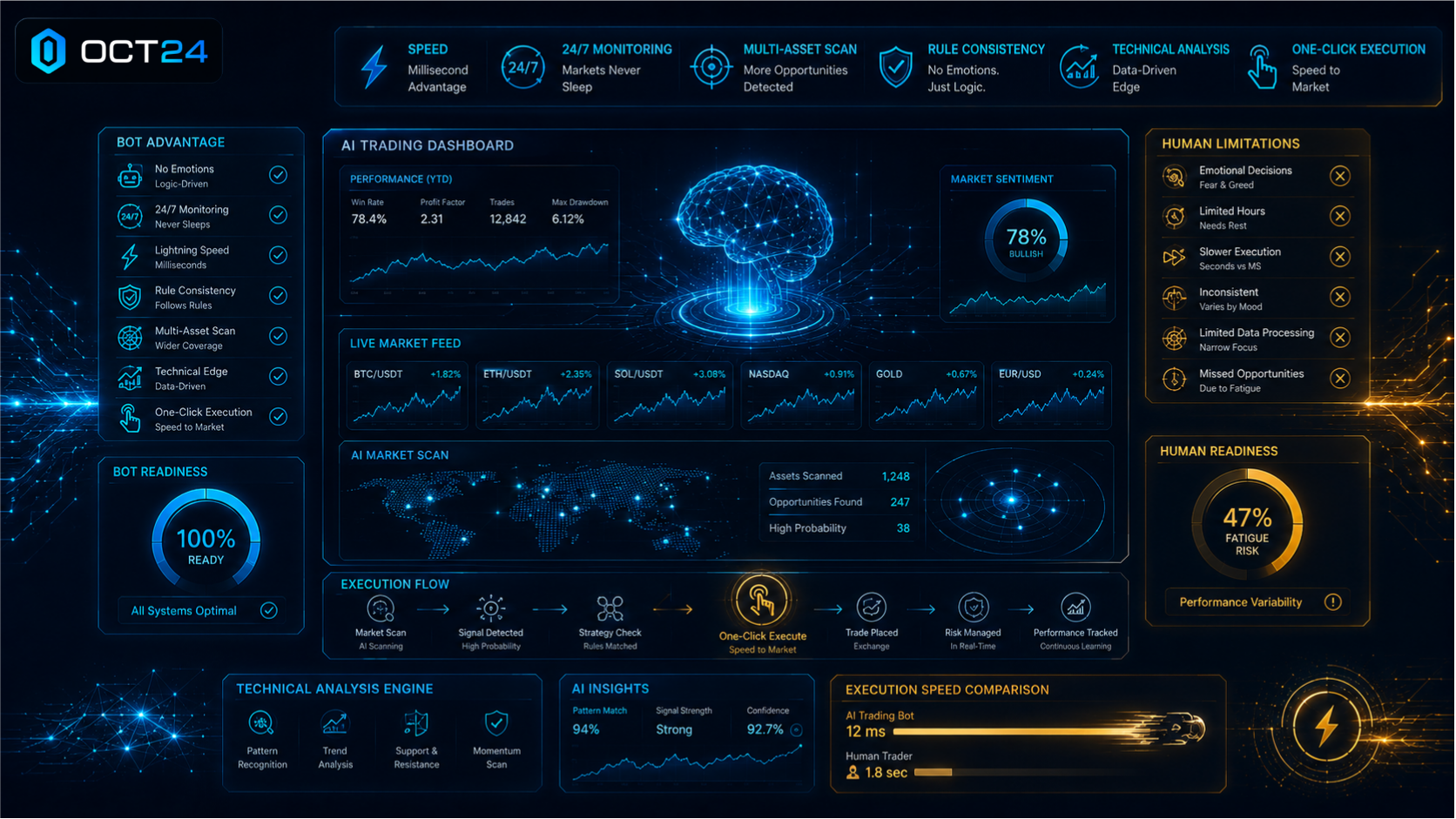
Trading bots can be powerful because they reduce the manual workload that slows many traders down. They can scan faster, monitor longer, follow rules more consistently, and process technical data more efficiently than humans.
But that does not mean human traders are no longer important.
Automation can improve the trading process, but it does not replace judgment, risk awareness, emotional discipline, or responsible platform use. The strongest approach is often not choosing between a bot and a human trader, but combining AI-powered analysis with informed human oversight.
Where Human Traders Can Outperform Trading Bots
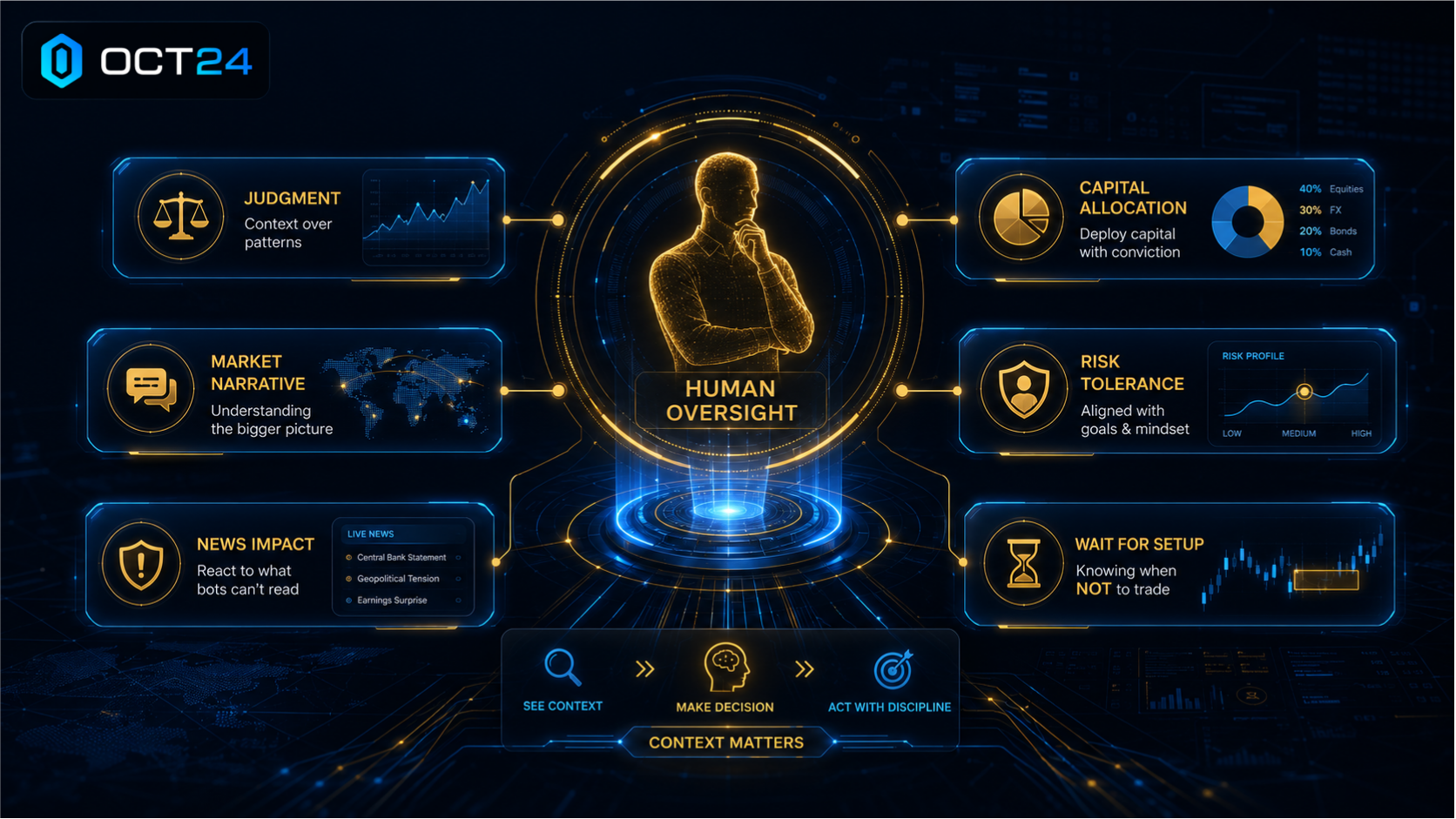
Trading bots are powerful, but they are not perfect substitutes for human judgment. A bot can process data quickly, follow rules consistently, and monitor markets without getting tired. However, human traders still have an advantage when decisions require context, interpretation, strategy design, and personal risk judgment.
A trading bot can identify that a market setup matches predefined conditions. A human trader can ask a different question: “Does this trade still make sense right now?”
That question matters. Markets are influenced by more than chart patterns and technical signals. News events, macroeconomic conditions, liquidity changes, sentiment shifts, and unexpected announcements can all affect how a trade plays out. A bot may recognize the technical setup, but a human trader may recognize that the broader environment is not ideal.
Human traders are also better at understanding market narrative. For example, a crypto asset may be moving because of a major announcement, regulatory concern, exchange listing, liquidity event, or broader market rotation. A bot can analyze price behavior, but a human trader may be better at interpreting why the movement is happening and whether it is likely to continue.
Strategy design is another area where humans remain important. A bot can execute a strategy, but it does not decide what a trader wants from the market. The trader still needs to define goals, choose suitable risk levels, decide how aggressive or conservative the approach should be, and review whether the strategy fits their capital, experience, and time horizon.
This is where overreliance becomes one of the most important Common AI Trading Mistakes. Some traders assume that because a bot can scan markets and present signals, they no longer need to understand the strategy or manage risk. That is a dangerous assumption. Automation can improve the trading process, but it should not replace responsible thinking.
Human traders also have the ability to recognize when not to trade. This can be just as important as finding an opportunity. A bot may identify a setup that technically matches the rules, but a trader may decide to wait because volatility is too high, liquidity is too thin, or the market feels too uncertain.
Capital allocation also requires human judgment. A trader needs to decide how much capital to risk, how many positions to hold, and whether a trade fits into the broader portfolio. A bot can support this process, but the trader still needs to understand exposure.
In simple terms, bots are better at processing and executing. Humans are better at judgment, goals, context, and responsibility.
The strongest workflow often comes from combining both. OCT24 can perform much of the market analysis by scanning market conditions, identifying potential opportunities, and presenting AI-supported trading signals. The trader then uses that information to make more informed decisions about risk, settings, and execution.
Trading Psychology: Bot Discipline vs Human Emotion
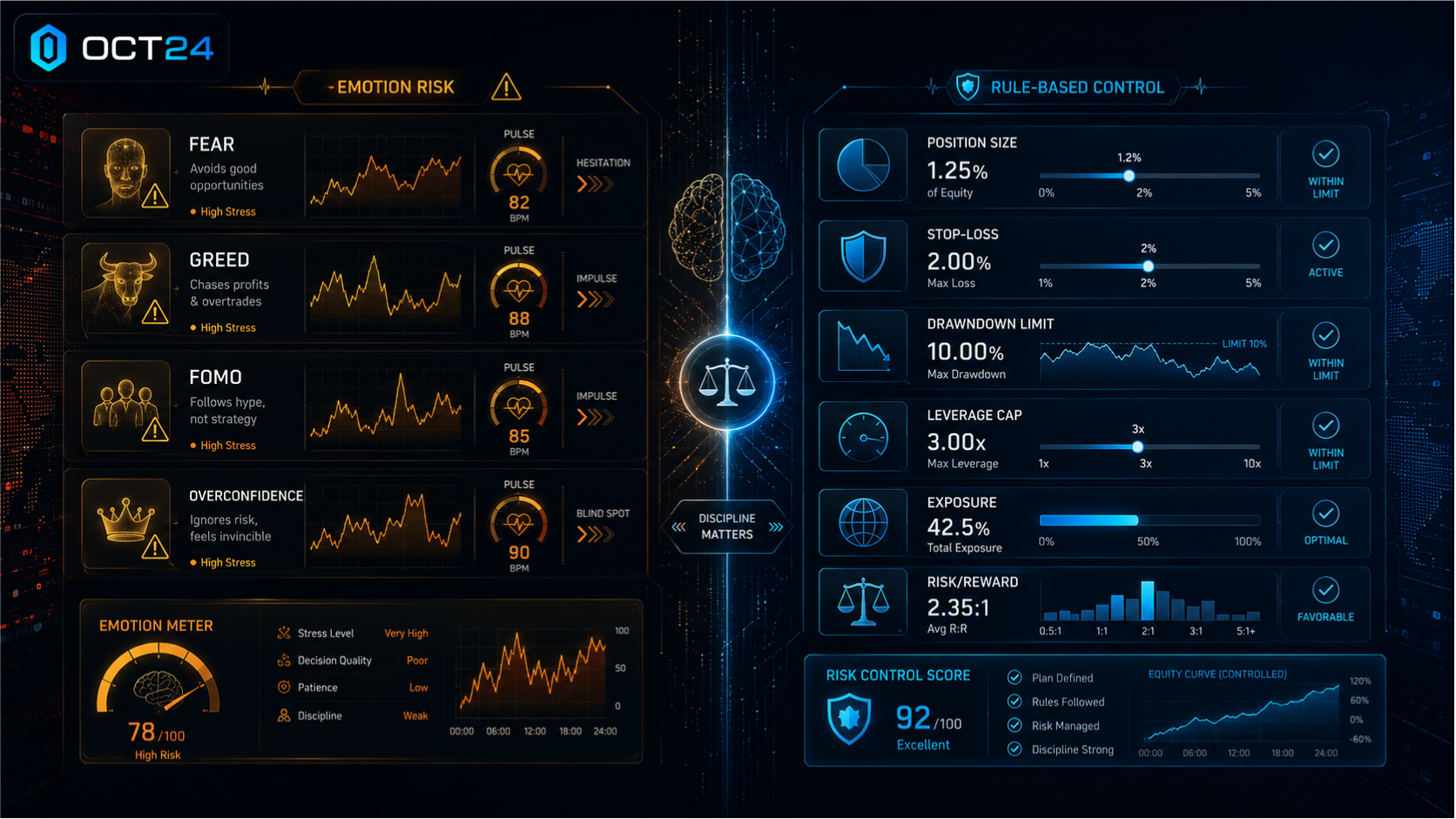
Trading psychology is one of the biggest reasons traders look at automation in the first place. Human traders do not only deal with charts and signals. They also deal with fear, greed, hesitation, overconfidence, and pressure.
A trader may have a clear plan before entering the market, then abandon that plan when price moves quickly. Fear can cause someone to exit too early. Greed can cause someone to hold too long. FOMO can push a trader into a setup they did not properly review. Revenge trading can lead to larger and riskier positions after a loss.
Trading bots do not feel those emotions.
A bot does not panic when a candle turns red. It does not become overconfident after a winning trade. It does not chase a market because it feels left behind. If the bot is configured properly, it follows the rules it has been given.
That discipline can be valuable. It is one reason Trading Bot Risk Management matters so much. When risk rules are clear, automation can help apply them consistently. This may include trade size, stop-loss logic, entry conditions, exit rules, or limits on how frequently trades are placed.
However, automation does not remove emotion completely. The trader still controls the settings. A trader can still increase risk after a loss, override rules impulsively, switch strategies too often, or rely on unrealistic expectations.
This is why a Consistent Trading Routine is still important. Even when using trading bots, traders should review performance, check settings, understand risk exposure, and avoid making emotional changes based on one trade or one bad day.
One of the common AI Trading Myths is that automation removes all human weakness. In reality, automation changes where those weaknesses appear. Instead of hesitating before a manual trade, a trader may over-adjust the bot. Instead of revenge trading manually, a trader may increase leverage or loosen risk controls after a loss.
The benefit of a platform like OCT24 is that it can make the workflow more structured. OCT24 can perform much of the analysis, surface AI-supported signals, and help traders review opportunities with more clarity. But traders still need discipline. They still need to use sensible settings, avoid emotional changes, and trade with realistic expectations.
Bots can reduce emotional execution. They cannot fix poor risk habits by themselves.
Risk Management: Why Neither Bots Nor Humans Should Trade Without Rules
Risk management matters whether a trade is placed manually, automatically, or through an AI-assisted workflow. A trading bot can make execution faster, but faster execution without clear risk rules can create problems.
Every trader needs to understand the basics of risk before relying on automation. This includes position sizing, stop-losses, drawdown limits, leverage limits, portfolio exposure, risk-to-reward, trade frequency, and performance review.
Position sizing is especially important. Even a strong setup can lose money. If the position size is too large, one bad trade can damage the account. A bot can help apply position rules consistently, but the trader still needs to choose settings that match their capital and tolerance.
Stop-losses and drawdown limits also matter. A stop-loss can help define the point where a trade is no longer valid. A drawdown limit can help prevent a strategy from continuing unchecked during unfavorable conditions.
Leverage requires extra caution. A bot may identify opportunities quickly, but leverage can magnify both gains and losses. Traders should avoid assuming that automation makes high-risk settings safer.
Portfolio exposure is another key factor. A trader may have several positions open at once without realizing they are all exposed to the same market movement. For example, multiple crypto assets may fall together during broad market weakness. A bot can help monitor positions, but the trader still needs to understand overall exposure.
This is why AI Trading Risk vs Reward should be considered before every strategy. The question is not only whether a trade has potential upside. The question is whether the potential reward is reasonable compared with the risk being taken.
Market Volatility can also affect both bots and human traders. During volatile conditions, signals can appear quickly and fail quickly. Spreads may widen, price may move sharply, and emotional decision-making may become more likely. Bots can help monitor volatility, but traders still need to decide whether conditions are suitable.
OCT24 helps traders approach risk more structurally by combining AI-powered analysis with risk-aware workflows and execution tools. The platform can scan markets, identify potential opportunities, and support faster decision-making. But it does not guarantee outcomes. Traders still need to manage capital responsibly, choose appropriate settings, and understand that every trade carries risk.
Good risk management does not make trading risk-free. It helps traders stay disciplined when the market becomes uncertain.
How OCT24 Combines AI Trading Bots With Trader Control
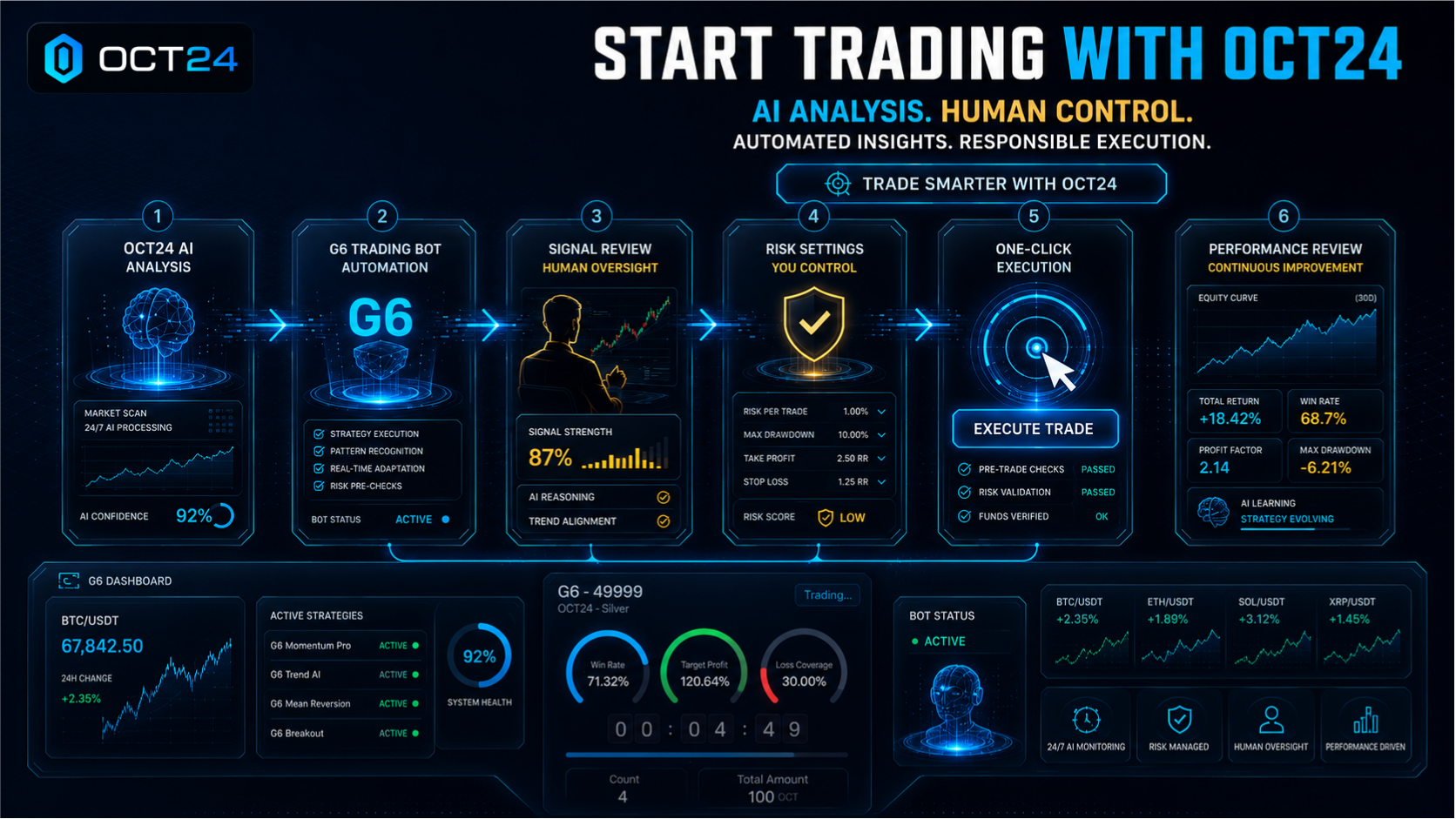
OCT24 is designed to reduce the manual work involved in active trading. Instead of requiring traders to scan every chart, compare every indicator, and monitor every price movement themselves, OCT24 performs much of the market analysis through an AI-supported workflow.
The platform can scan market conditions, identify potential trading opportunities, analyze market trends, review technical signals, present AI-supported trading signals, support faster execution, and help traders review performance over time.
This is important because many traders struggle not because they lack interest, but because active markets demand time, focus, and speed. Crypto markets move continuously. Opportunities can appear while a trader is working, sleeping, or watching another asset. OCT24 helps reduce that manual burden by bringing analysis, signal review, and execution support into a more structured process.
The G6 Trading Bot can support this workflow by helping traders use automation more efficiently. It can assist with market analysis, opportunity detection, and structured trading execution. This does not mean traders should treat the bot as a guaranteed profit system. It means the bot can help reduce repetitive work and support a more disciplined process.
This is also why Choosing the Right AI Trading Platform matters. Traders should look for a platform that does more than simply place orders. A strong platform should help with analysis, risk awareness, signal review, execution tools, and performance visibility.
OCT24 is positioned around that balanced approach. It can help traders scan market conditions, identify potential opportunities, review AI trading signals, apply risk management tools, support One-Click Trading, reduce emotional decision-making, and review performance over time.
The key distinction is control. OCT24 can perform much of the analysis, but the trader still remains responsible for how the platform is used. Traders need to choose appropriate settings, understand exposure, manage capital responsibly, and use the platform with realistic expectations.
This balance is what makes AI-assisted trading different from fully hands-off trading. OCT24 can reduce the analysis workload, but it does not remove the need for informed decisions.
For traders who want to learn more about the company, the About OCT24 page can help explain the platform’s broader mission and approach. For those ready to explore the workflow directly, Start Trading with OCT24 can be used as a natural next step after understanding the risks and responsibilities involved.
Practical Example: Bot Speed + Human Oversight
Imagine a crypto asset begins moving quickly after a breakout. The price pushes above a key level, volume increases, and momentum begins to build.
A human trader may not notice immediately. They may be watching another chart, away from the screen, or unsure whether the move is meaningful. By the time they manually check the asset, the opportunity may have changed.
A trading bot can respond differently. It can scan the market, detect the setup, and present an AI-supported signal based on the conditions it is designed to monitor.
OCT24 can then show relevant information such as trend direction, volatility, signal strength, technical conditions, and potential risk factors. Instead of starting from a blank chart, the trader receives a structured view of the opportunity.
The trader can then review the setup, check position size, consider the risk, and decide whether to use one-click execution. After the trade, the trader can review performance and ask whether the setup followed the plan.
This example shows why the strongest workflow is not always bot versus human. It is bot-assisted human decision-making.
The bot improves speed and monitoring. OCT24 performs much of the analysis and organizes the signal. The trader remains responsible for risk, settings, and execution choices.
Are Trading Bots Better Than Human Traders?
Trading bots are better than human traders at speed, consistency, scanning, rule-based execution, and technical monitoring. They can process market conditions quickly, follow predefined logic, monitor multiple assets, and reduce emotional execution mistakes.
Human traders are better at judgment, context, strategy design, risk preferences, and understanding personal goals. They can interpret unusual events, adjust to changing conditions, and decide whether a strategy fits their broader plan.
So the answer is not that trading bots are always better, or that human traders are always better. They are better at different parts of the trading process.
For many active traders, the strongest approach is a hybrid workflow: AI-powered analysis plus human oversight.
OCT24 is an example of this kind of hybrid approach. It can perform much of the market analysis, identify potential opportunities, and present AI-supported trading signals. At the same time, traders remain responsible for risk settings, capital allocation, and responsible execution decisions.
This makes the comparison between trading bots and human traders less about replacement and more about collaboration.
Frequently Asked Questions
Are trading bots better than human traders?
Trading bots are better at speed, consistency, scanning, and rule-based execution. Human traders are better at judgment, context, strategy design, and risk decisions. The strongest approach often combines both.
Can trading bots replace human traders?
Trading bots can automate parts of the trading process, but they should not fully replace human responsibility. Traders still need to understand risk, choose settings, manage capital, and review performance.
What do trading bots do better than humans?
Trading bots can monitor markets continuously, process technical data quickly, follow rules consistently, and reduce emotional execution. They are especially useful for repetitive and time-sensitive tasks.
What do human traders do better than bots?
Human traders are better at understanding context, interpreting news, setting goals, managing personal risk preferences, and recognizing when not to trade.
Are AI trading bots good for beginners?
AI trading bots can help beginners reduce manual workload and understand structured trading workflows. However, beginners still need to learn basic risk management, avoid unrealistic expectations, and understand how the platform works.
Can trading bots remove emotion from trading?
Trading bots can reduce emotion during execution because they follow rules instead of feelings. However, traders can still make emotional decisions when changing settings, increasing risk, or overriding the system.
Do trading bots work during market volatility?
Trading bots can monitor volatile markets and respond quickly, but volatility can increase risk. Traders should use careful settings, understand exposure, and avoid assuming that automation makes volatile markets safe.
How does OCT24 combine bots and human control?
OCT24 performs much of the market analysis by scanning conditions, identifying potential opportunities, and presenting AI-supported trading signals. Traders still control risk settings, execution choices, and capital management.
What is the G6 Trading Bot?
The G6 Trading Bot is part of OCT24’s AI-assisted trading workflow. It supports market analysis, opportunity detection, automation, and structured execution while keeping responsible risk use important.
Should traders use one-click trading?
One-click trading can help traders act more efficiently after reviewing a setup. It should be used with clear risk settings, realistic expectations, and a structured process rather than impulsive decision-making.
Trading Bots vs Human Traders: Key Takeaways
Trading bots and human traders both have strengths.
Bots can improve speed, consistency, monitoring, analysis, and execution support. They can scan markets continuously, process technical data, and follow rules without emotional hesitation.
Humans still matter for strategy, risk decisions, context, and responsible use. A trader needs to understand goals, manage exposure, choose suitable settings, and recognize when market conditions may not support a trade.
OCT24 brings these strengths together by performing much of the market analysis while still supporting trader control, risk management, and structured execution. The platform can help traders identify potential opportunities, review AI-supported signals, and act more efficiently, but it does not remove market risk or guarantee results.
The best trading workflow is often not about choosing between automation and human judgment. It is about using AI-powered analysis to reduce manual workload while keeping informed decision-making at the center.
To explore a more structured AI-assisted trading workflow, Start Trading with OCT24.