
Can AI Predict the Market?
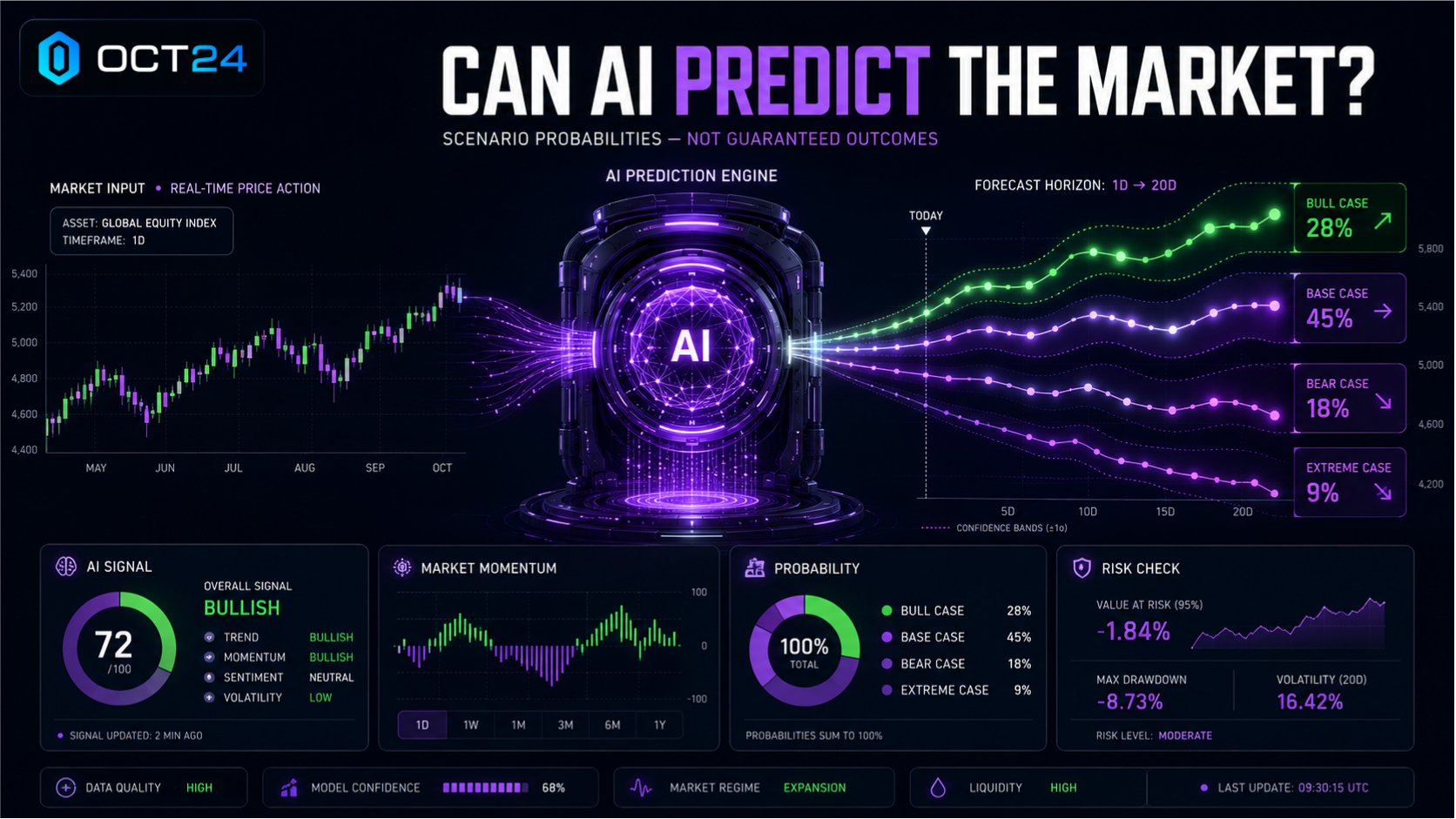
AI Market Prediction means using artificial intelligence to analyze market data, patterns, trends, and probabilities to understand where price may move next.
So, can AI predict the market?
AI can help predict possible market direction. It can study price behavior, volume, momentum, volatility, and trading signals faster than a human trader.
But AI cannot predict the market with certainty.
It cannot guarantee profitable trades.
It cannot know every future event.
Financial markets are affected by many moving parts, including:
- Price movement
- Trader behavior
- News
- Liquidity
- Market volatility
- Large buyers and sellers
- Unexpected events
This is why AI should be seen as a decision-support tool, not a crystal ball.
OCT24 performs most of the market analysis for traders by scanning market conditions, identifying potential opportunities, and presenting AI-supported trading signals in a structured workflow. This can help traders understand possible setups more clearly.
But OCT24 does not remove trading risk or guarantee results. Traders still need to use appropriate risk settings, understand their exposure, manage capital responsibly, and make informed execution decisions.
In AI Trading, the goal is not to know the future perfectly.
The goal is to make better-informed decisions using data, probability, and structure.
What Does “Predict the Market” Really Mean?
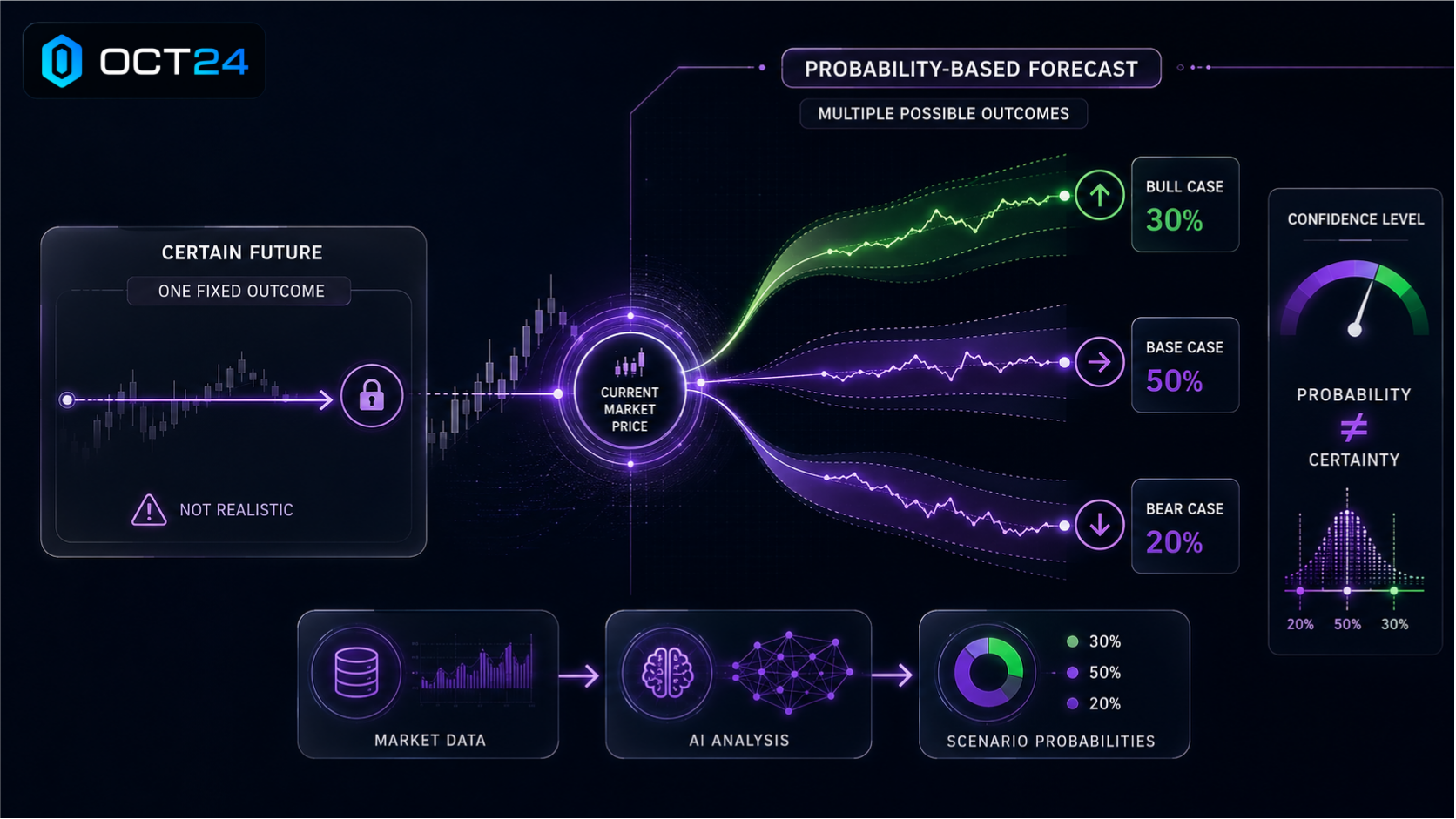
Market prediction does not mean knowing the future perfectly.
In trading, prediction usually means making an informed estimate about what price may do next.
AI may help estimate:
- Possible price direction
- Market trend strength
- Momentum changes
- Volatility changes
- Possible breakouts
- Possible reversals
- Trading signal quality
- Market conditions
But this is not the same as certainty.
A better way to think about market prediction is probability.
For example, if AI sees that price is rising, volume is increasing, and momentum is strong, it may suggest that the upward move could continue.
But the market can still change.
A sudden news event, weak liquidity, market volatility, or a large sell order could quickly change the outcome.
That is why a prediction in trading is more like an informed estimate than a guaranteed answer.
This connects closely to How AI Identifies Trading Opportunities. AI looks for possible setups based on market behavior. It does not promise that every setup will work.
AI may then turn that information into AI Trading Signals.
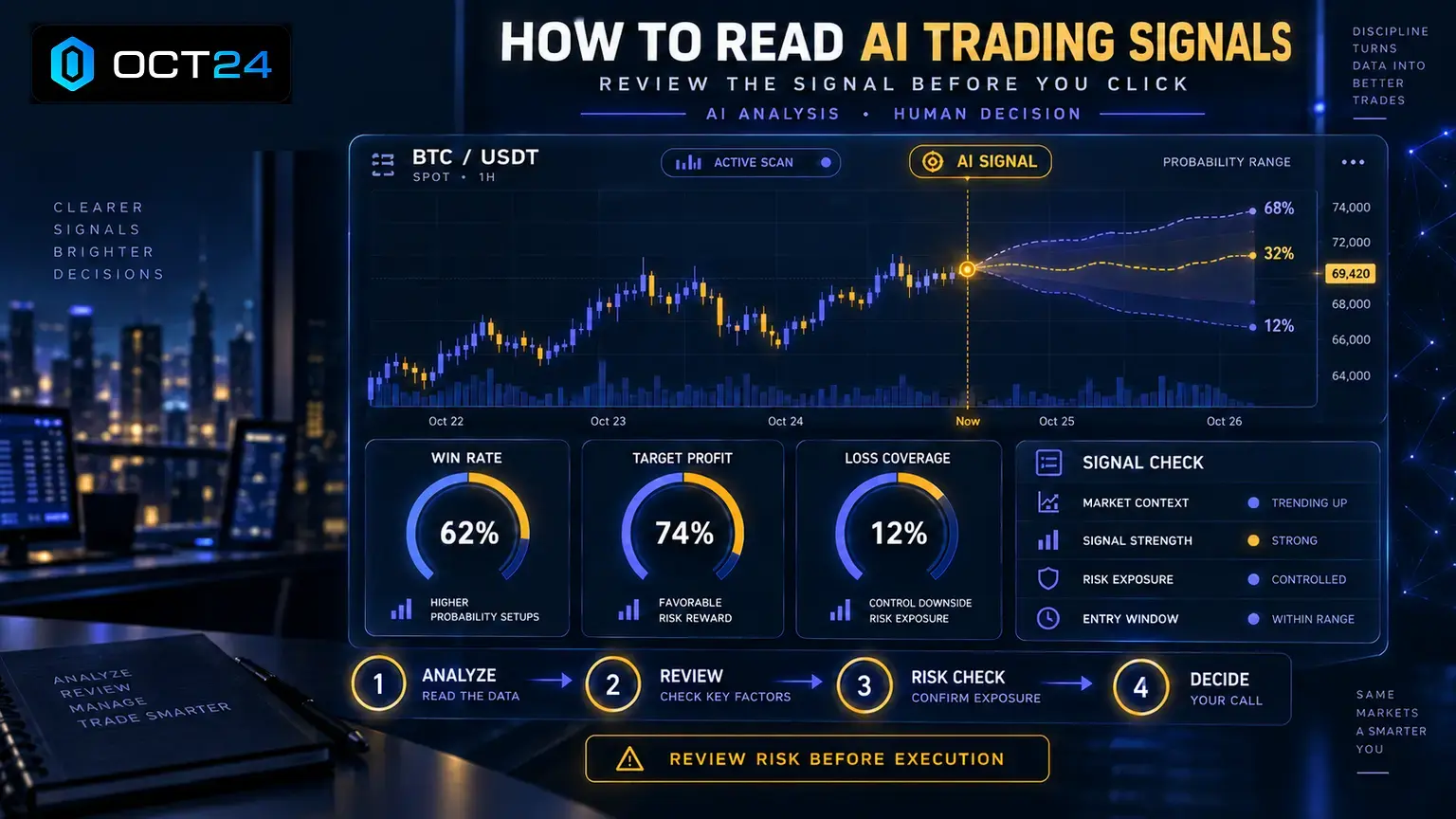
A trading signal can help organize market data into a clearer decision point. But it should still be reviewed with risk in mind.
A signal can say:
“This setup may be worth reviewing.”
It should not be understood as:
“This trade will definitely win.”
That difference is important.
Why Market Prediction Is Difficult
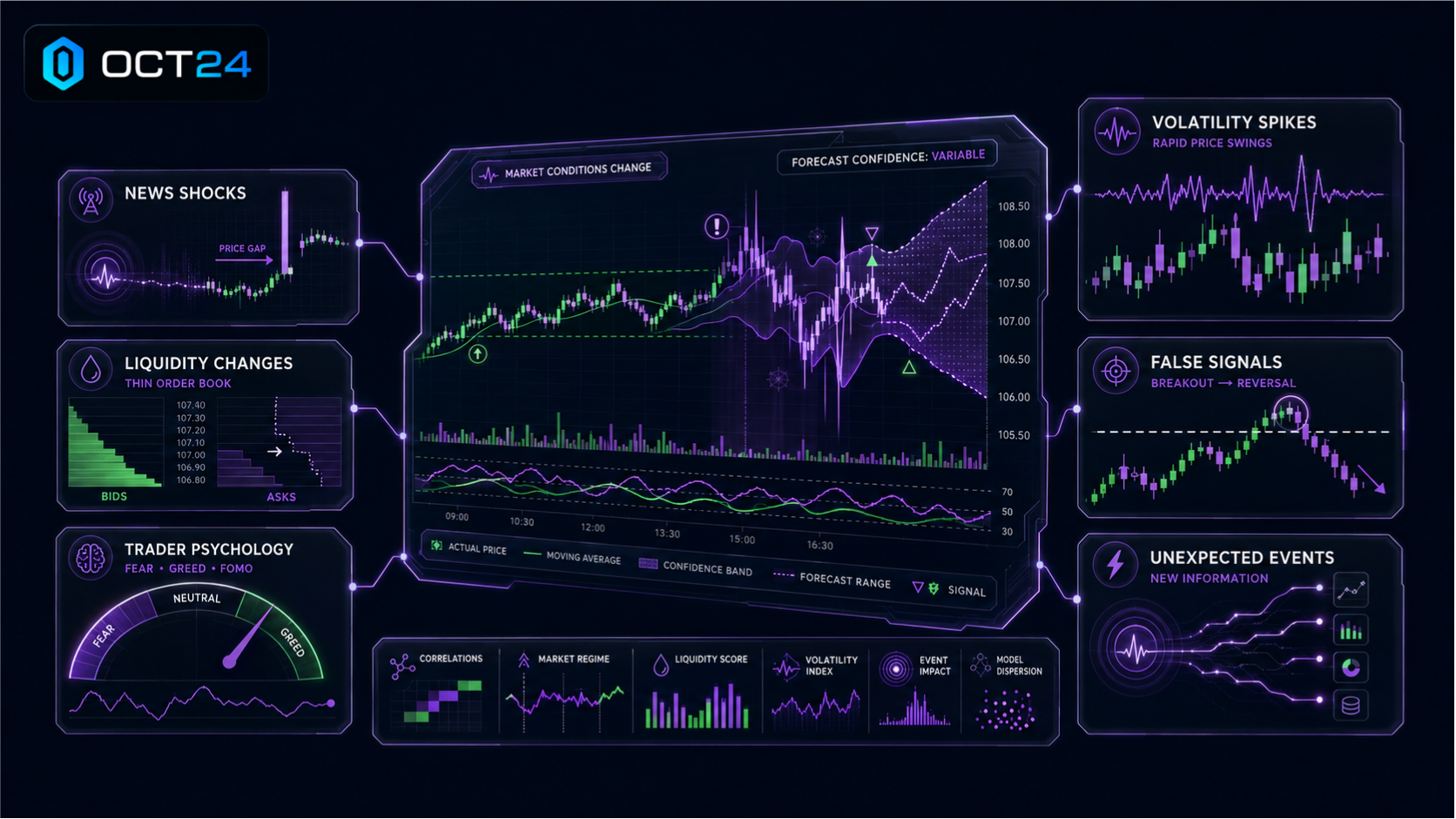
Market prediction is difficult because markets are always changing.
Even advanced AI has limits.
Markets are influenced by many things at once. Some are visible in the data. Others are harder to predict.
For example, price may move because of:
- News
- Market sentiment
- Trader emotions
- Liquidity changes
- Large orders
- Global events
- Exchange issues
- Regulatory updates
- Technical signals
- Market volatility
AI can analyze the data it has.
But it cannot know every future event before it happens.
This is why Market Volatility can make prediction harder. When markets move quickly, signals can change fast. A setup that looked strong a few minutes ago may become weaker if momentum fades or price reverses.
False signals can also appear.
A market may break above a key level, attract buyers, and then quickly fall back down. This is one reason traders should be careful about blindly following forecasts.
One of the most common Common AI Trading Mistakes is believing that AI can predict every move.
It cannot.
Another mistake is treating every AI forecast as a command to trade.
It is not.
AI can help traders analyze possible outcomes. It can reduce manual work. It can scan more data than a person could review alone.
But markets are still uncertain.
This is why traders need risk controls, realistic expectations, and a clear plan.
How AI Uses Data to Forecast Market Movement
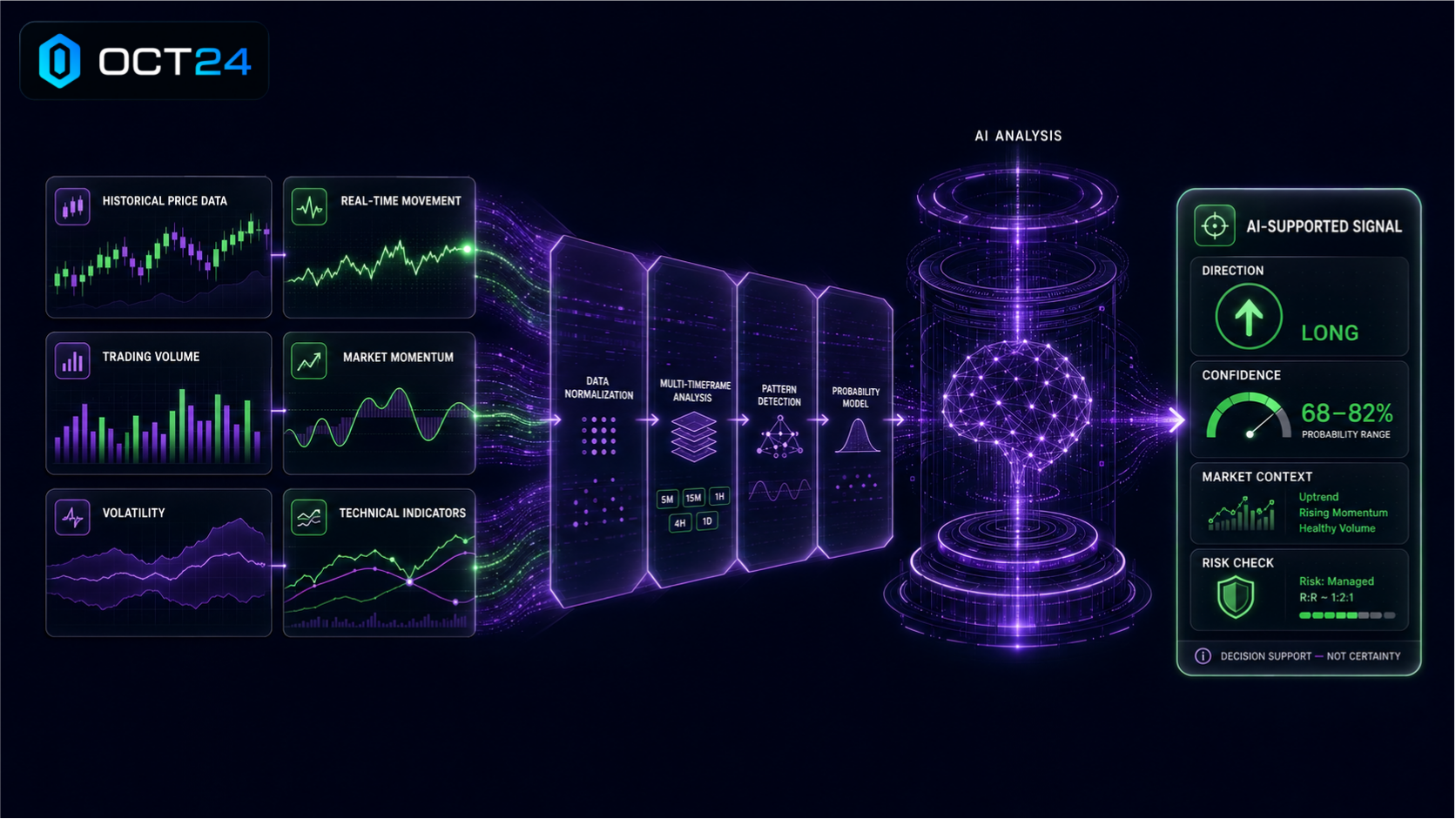
AI uses data to forecast possible market movement.
It looks for patterns, relationships, and changes in market behavior.
A human trader may look at one chart and a few indicators. AI can scan much more information at the same time.
AI may review:
- Historical price data
- Real-time price movement
- Volume
- Market momentum
- Volatility
- Trend strength
- Support and resistance
- Indicator readings
- Multiple assets
- Multiple timeframes
This helps AI compare what is happening now with patterns it has seen before.
For example, AI may notice that price is approaching resistance, volume is increasing, and momentum is strengthening. It may then identify a possible breakout setup.
Or it may notice that price is rising, but volume is falling. That could suggest the move is weaker than it looks.
This connects naturally to How AI Uses Technical Analysis. AI can review indicators, chart behavior, price action, and trend conditions together.
It can also use information from the Best Indicators for AI Trading, such as:
- Moving averages
- RSI
- MACD
- Bollinger Bands
- Volume indicators
- Support and resistance levels
These indicators can help AI evaluate market trends, momentum, and possible turning points.
Still, no single indicator is enough.
A strong AI-supported forecast should look at several pieces of information together.
This is also why traders benefit from understanding How to Read Crypto Charts. When traders understand candles, volume, support, resistance, and trend direction, they can better understand what AI-supported forecasts are showing.
OCT24 can help by scanning these data points and organizing them into clearer AI-supported signals. Instead of manually checking every chart, traders can use OCT24 to review possible opportunities in a more structured way.
This can save time.
It can also help reduce confusion.
But the trader still needs to decide whether the signal fits their strategy and risk plan.
AI Prediction vs AI Probability

There is a big difference between prediction and probability.
Prediction sounds certain.
Probability is more realistic.
AI does not know the future. It estimates what may be more likely based on available data.
For example, AI may detect that a market has strong upward momentum. It may assign higher confidence to a possible continuation move.
But even a high-probability setup can lose.
That is normal in trading.
A simple way to understand this is to think about a weather forecast.
A forecast may say there is a high chance of rain. That does not guarantee exactly when rain will fall or how heavy it will be. It simply means the conditions suggest rain is more likely.
AI market prediction works in a similar way.
AI may say a certain market outcome looks more likely, but it cannot guarantee it.
This is why probability-based thinking is important.
Traders should ask:
- What is the likely direction?
- How strong is the signal?
- What could go wrong?
- What is the possible loss?
- Does the trade fit the plan?
- Is the risk worth the possible reward?
This is where AI Trading vs Manual Trading becomes useful to understand.
AI can process probability faster than a human trader. It can scan more data, compare more signals, and detect patterns more quickly.
But human traders still need judgment.
They still need to decide whether the setup makes sense, whether the risk is acceptable, and whether the trade fits their goals.
This is also why Trading Bot Risk Management matters.
Even if an AI signal looks strong, the trade still needs risk controls. Position sizing, stop-losses, drawdown limits, and exposure rules still matter.
Probability can help traders make better decisions.
It does not remove risk.
What AI Can Realistically Predict
AI can help forecast certain market conditions.
It is better at identifying possible scenarios than making perfect predictions.
AI can help estimate:
- Possible trend direction
- Momentum strength
- Volatility changes
- Breakout probability
- Reversal risk
- Volume confirmation
- Market condition shifts
- Potential trading setups
- Signal strength
These insights can be useful for traders.
For example, AI may identify that a market is trending upward with strong volume and rising momentum. That may suggest that the trend could continue.
AI may also identify that volatility is increasing and momentum is weakening. That may suggest a higher risk of reversal or unstable price movement.
These are decision-support insights.
They are not guaranteed outcomes.
In Automated Trading, AI-supported forecasts may help feed a structured workflow. A system may scan for conditions, identify a signal, and prepare possible execution steps.
AI Trading Bots may also use AI-supported signals to monitor setups or assist with execution.
But bots still need clear settings and risk limits.
A bot should not trade simply because AI sees a possible opportunity. The setup should still fit the strategy, risk level, and current market conditions.
OCT24 performs much of this analysis by scanning active market conditions and presenting AI-supported signals. This helps traders review potential opportunities more clearly without needing to manually analyze every chart.
But the trader still remains responsible for execution choices.
AI can help traders understand probabilities, patterns, and possible scenarios.
That is powerful.
But traders also need to understand what AI cannot predict, how risk controls protect the account, and how platforms like OCT24 support more structured trading decisions.
What AI Cannot Predict

AI can analyze market data, but it cannot know every future event.
This is one of the most important limits of AI Market Prediction.
AI may detect patterns, compare market trends, review volatility, and identify possible trading signals. But financial markets are affected by events that may not appear in the data until after they happen.
AI cannot reliably predict:
- Unexpected news
- Sudden regulatory events
- Exchange issues
- Large trader behavior
- Liquidity shocks
- Emotional market reactions
- Black swan events
- Exact price levels
- Exact timing
- Guaranteed outcomes
For example, AI may identify a strong upward trend in a crypto asset. Volume may be rising, momentum may look healthy, and the signal may appear strong.
Then unexpected news may hit the market.
Price can reverse quickly.
This does not mean the AI was useless. It means the market changed because new information entered the system.
One of the biggest AI Trading Myths is that AI can predict every market move. It cannot.
AI can support analysis. It can improve speed. It can help traders compare data more clearly. But it does not remove uncertainty.
This is why every AI forecast still needs AI Trading Risk vs Reward review.
Before acting, traders should ask:
- What is the potential upside?
- What is the possible downside?
- What happens if the forecast is wrong?
- Is the position size reasonable?
- Is the stop-loss clear?
- Does this trade fit the plan?
OCT24 supports AI-powered analysis by scanning market conditions, identifying potential opportunities, and presenting AI-supported trading signals. But OCT24 does not promise certainty.
The goal is not perfect prediction.
The goal is better structure.
How Traders Should Use AI Market Forecasts
Traders should use AI market forecasts as decision support.
A forecast can help traders understand what may be happening in the market. It can highlight possible direction, momentum, volatility, and signal strength.
But a forecast should not replace thinking.
A responsible trader should use AI forecasts to support a broader trading process.
That means traders should:
- Treat forecasts as decision support
- Look for confirmation
- Review market context
- Check risk settings
- Use position sizing
- Avoid chasing signals
- Compare possible upside and downside
- Review performance regularly
- Use forecasts as part of a strategy
This is where AI Trading Strategies matter.
A forecast is more useful when it fits a clear plan. For example, a trader using a breakout strategy may only act when the AI-supported forecast aligns with volume, momentum, and a clean breakout level.
A trader using a pullback strategy may wait for price to return to a stronger entry zone instead of chasing price after a fast move.
One of the most common Common AI Trading Mistakes is blindly following predictions.
A trader may see an AI-supported signal and enter immediately without checking risk, volatility, position size, or market context.
That can be dangerous.
A better approach is to use a Consistent Trading Routine.
For example:
- Review the signal
- Check the chart
- Confirm trend and volume
- Review volatility
- Set position size
- Set stop-loss
- Check total exposure
- Decide whether the trade fits the plan
- Review performance afterward
OCT24 presents AI-supported market insights in a structured workflow. This helps traders review potential opportunities more clearly, while still keeping risk decisions in the trader’s control.
AI can make analysis faster.
A routine helps make decisions more disciplined.
AI Predictions, Trading Bots, and Automation
AI predictions can connect to trading bots and automated workflows.
For example, AI may identify a possible setup. A bot may then help monitor the market, follow rules, or support execution.
Automation can improve speed.
But speed should not replace risk management.
During active markets, a bot may react faster than a human trader. This can be useful when markets move quickly. But poor settings can also increase trading risk.
For example, if a bot trades every AI signal without limits, it may open too many positions. If the stop-loss settings are weak, losses may build quickly. If leverage is too high, a small price move can have a larger impact.
This is why the question Are Trading Bots Worth It? depends on how the bot is used.
Trading bots can be useful when they are paired with clear rules, sensible settings, and risk controls. They should not be used as a shortcut around discipline.
This also connects to Trading Bots vs Human Traders.
Bots can be faster. They can follow rules consistently. They do not panic or hesitate.
But humans still provide judgment.
A trader still needs to decide:
- Does this signal fit the strategy?
- Is market volatility too high?
- Is the account already exposed?
- Is the risk acceptable?
- Should the bot continue, pause, or reduce activity?
In Algorithmic Trading, systems usually follow predefined rules. With AI vs Algorithmic Trading, AI-supported systems may analyze more data and adapt to changing conditions more dynamically.
But both still need oversight.
OCT24 and the G6 Trading Bot can support automation inside a structured, risk-aware workflow. The platform performs much of the market analysis, but traders still need to use suitable settings, review risk, and avoid treating automation as a guarantee.
Automation should support better decisions.
It should not remove responsibility.
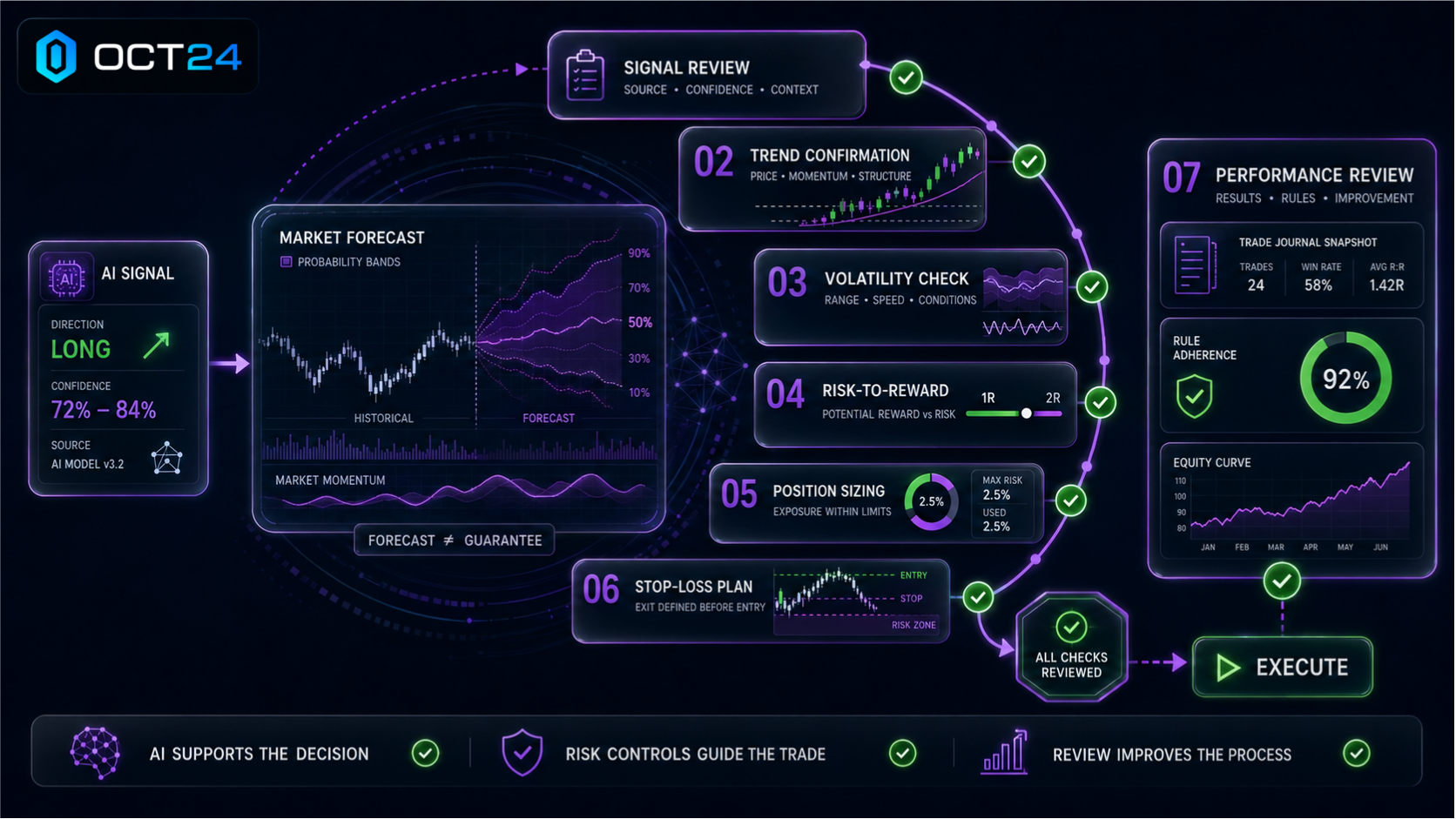
Practical Example: Using AI Prediction Responsibly
Imagine a crypto asset has been rising for several hours.
Price is moving upward. Volume is increasing. Momentum appears strong.
AI detects a possible continuation setup.
OCT24 presents an AI-supported trading signal with market context.
At this point, the trader does not need to guess from scratch. OCT24 has already scanned market conditions, reviewed potential opportunity, and organized the signal into a clearer workflow.
But the trader should still review the setup.
They check:
- Trend direction
- Market volatility
- Volume strength
- Position size
- Stop-loss placement
- Total exposure
- Risk-to-reward
- Whether the signal fits the strategy
The trader then decides whether to act, wait, or ignore the setup.
If the setup fits the plan, the trader may use One-Click Trading after reviewing the signal and risk settings.
If the setup does not fit the plan, the trader can wait.
That is an important point.
Responsible AI prediction is not about blindly acting on every forecast. It is about using AI to support structured decision-making.
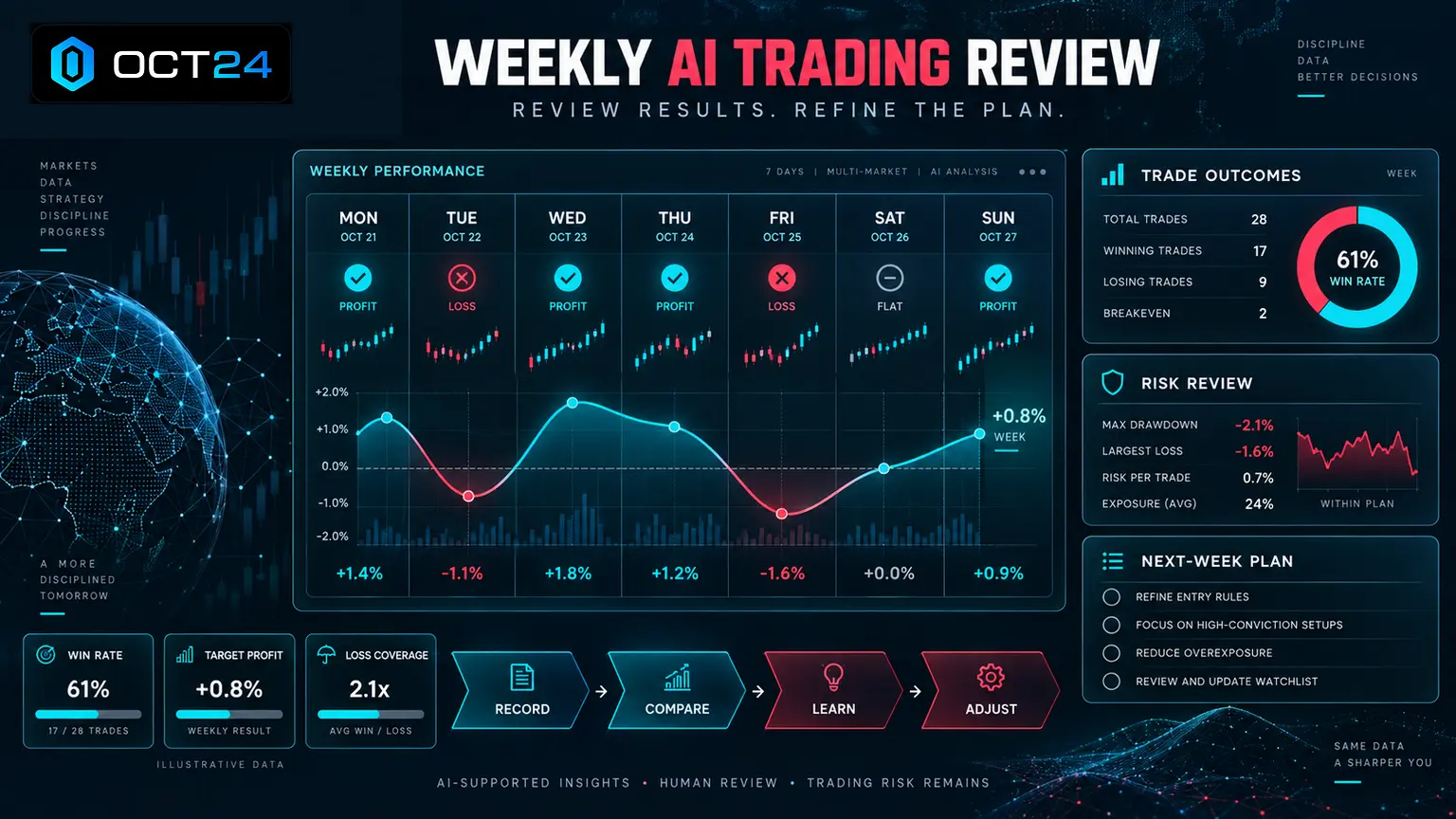
After the trade, the trader reviews performance.
They ask:
- Did the forecast make sense?
- Were the risk rules followed?
- Was the position size appropriate?
- Did the trader act calmly?
- What can be improved next time?
This turns AI market forecasting into a learning process.
The trader is not just reacting.
They are building a more disciplined workflow.
How OCT24 Supports AI Market Prediction
OCT24 is designed to reduce the manual work involved in active trading by performing most of the market analysis.
Instead of requiring traders to manually monitor every chart, signal, indicator, and market condition, OCT24 helps organize the process into a structured AI-assisted workflow.
OCT24 can help by:
- Scanning market conditions
- Identifying potential trading opportunities
- Reviewing market momentum
- Analyzing volatility changes
- Reviewing technical signals
- Presenting AI-supported trading signals
- Supporting faster execution
- Helping traders review performance over time
This matters because market prediction is not only about guessing where price goes next.
It is about reviewing probability, signal quality, risk, and execution timing.
The G6 Trading Bot can support this process by helping traders use automation inside a more organized workflow. This can be especially useful in active markets where conditions change quickly.
OCT24 can help traders:
- Understand AI-supported market forecasts
- Review potential opportunities more clearly
- Check signal quality
- Compare market conditions
- Review risk settings before execution
- Use automation more thoughtfully
- Support one-click trading after review
- Reduce emotional decision-making
- Build a more disciplined trading workflow
This is why Choosing the Right AI Trading Platform matters.
A strong platform should not only show signals. It should help traders understand what those signals mean, how market conditions are changing, and what risk decisions still need to be made.
For readers who want to understand the platform’s broader mission, About OCT24 can provide more context.
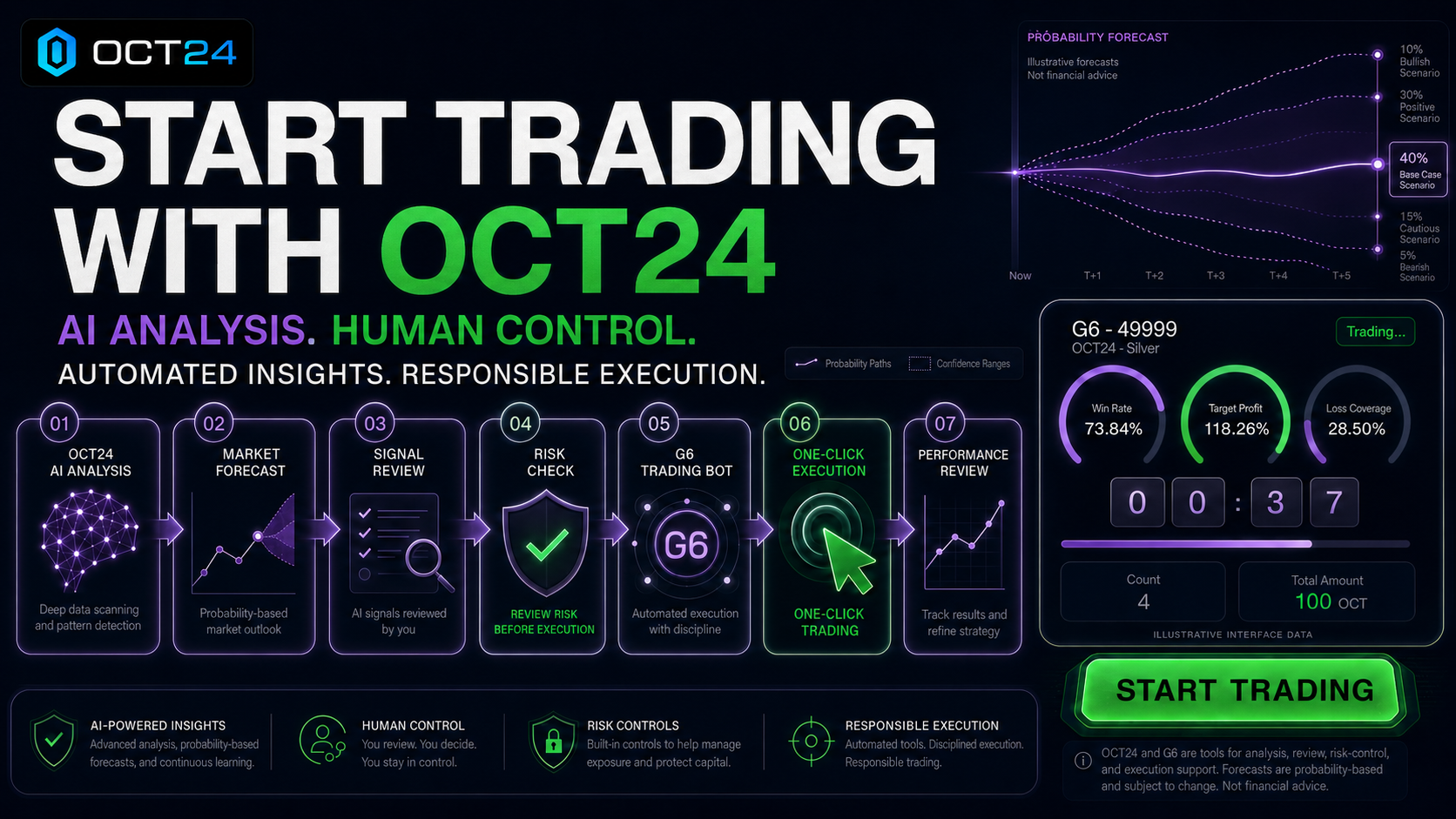
For traders ready to explore an AI-assisted workflow, Start Trading with OCT24 can be the next step.
Still, expectations matter.
OCT24 does not guarantee results. Traders still need to choose appropriate settings, understand exposure, manage capital responsibly, and use the platform with realistic expectations.
AI Market Prediction Checklist
Before acting on an AI forecast, traders should slow down and review the setup.
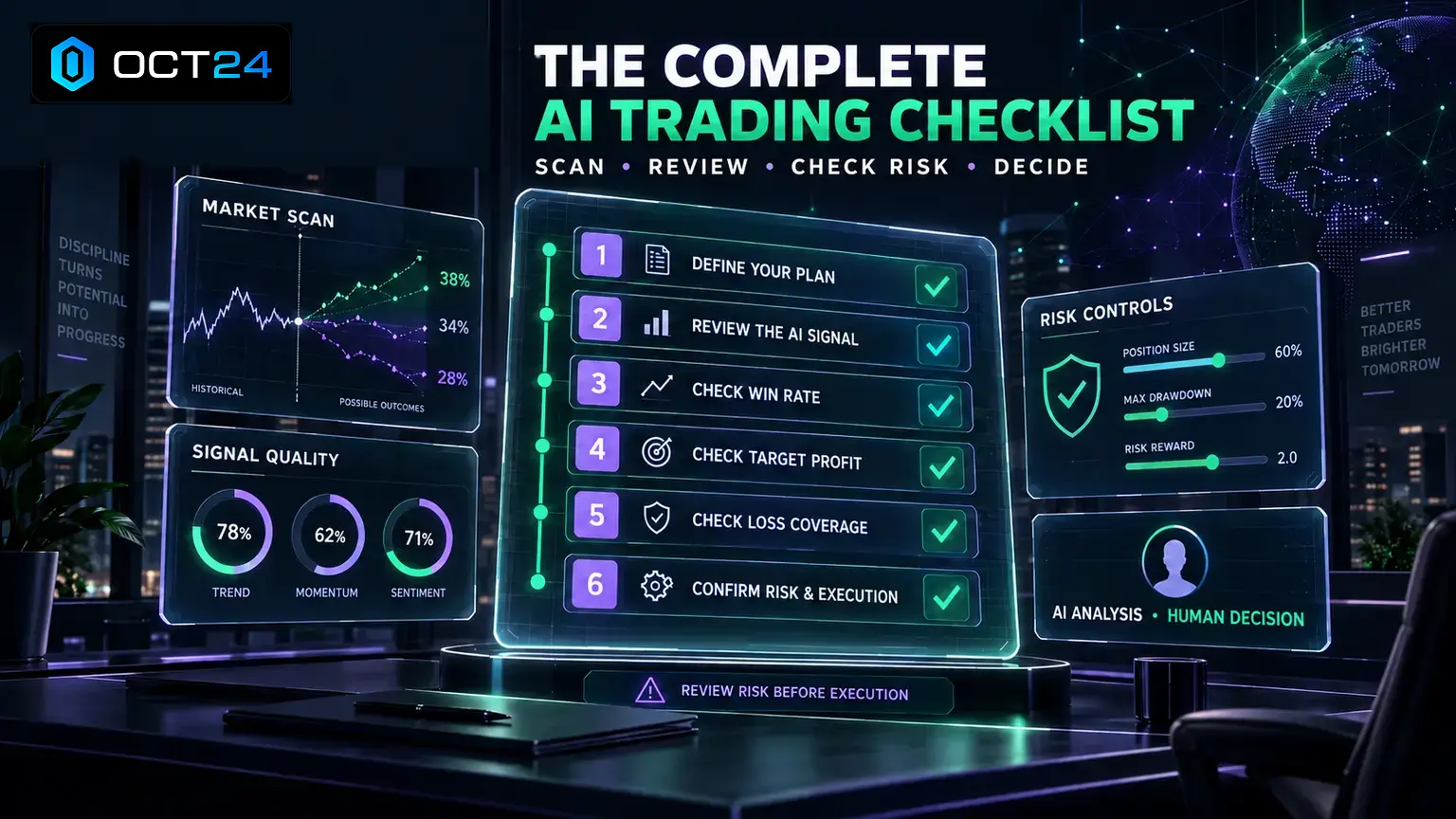
Use this checklist:
- Is the signal based on clear market data?
- Is the trend direction clear?
- Is volume supporting the move?
- Is volatility unusually high?
- Does the setup fit the strategy?
- Is the position size reasonable?
- Is the stop-loss clear?
- Is leverage controlled?
- Is total exposure understood?
- Is the trader chasing the prediction emotionally?
This checklist helps traders treat AI forecasts as structured information, not guaranteed outcomes.
AI can help identify possible opportunities.
Risk controls help decide whether those opportunities are worth taking.
Frequently Asked Questions
Can AI predict the market?
AI can help forecast possible market direction by analyzing data, patterns, trends, and probability. But AI cannot predict the market with certainty or guarantee profitable trades.
What is AI Market Prediction?
AI Market Prediction is the use of artificial intelligence to analyze market data and estimate possible future price movement. It focuses on probability, not certainty.
Can AI predict crypto prices?
AI can analyze crypto price data, volume, momentum, volatility, and market trends to forecast possible scenarios. However, crypto markets are highly volatile, so predictions should be used with risk controls.
How accurate is AI market forecasting?
AI market forecasting accuracy depends on data quality, market conditions, volatility, model design, and risk settings. Even strong forecasts can be wrong because markets are uncertain.
Can AI trading prediction guarantee profits?
No. AI trading prediction cannot guarantee profits. AI can support analysis and decision-making, but every trade still carries risk.
What data does AI use to predict market movement?
AI may use historical price data, real-time price movement, volume, volatility, market momentum, indicators, support and resistance, and multi-timeframe analysis.
Should traders follow AI trading signals automatically?
Traders should not follow AI trading signals blindly. Signals should be reviewed alongside market context, risk settings, position size, stop-losses, and strategy rules.
How does OCT24 support AI market prediction?
OCT24 supports AI market prediction by scanning market conditions, identifying potential opportunities, and presenting AI-supported trading signals in a structured workflow. Traders still remain responsible for risk and execution decisions.
What is the G6 Trading Bot?
The G6 Trading Bot is part of OCT24’s AI-assisted trading workflow. It can support automation, market analysis, signal review, and structured execution.
Should traders use one-click trading after an AI signal?
Traders can use one-click trading after reviewing the signal, market context, and risk settings. It should not be used impulsively or without a clear plan.
Can AI Predict the Market? Key Takeaways
AI can help traders analyze data, identify patterns, forecast possible scenarios, and understand probabilities.
But AI cannot predict the market with certainty.
Traders should focus on:
- Probability
- Market trends
- Volume
- Volatility
- Signal quality
- Position sizing
- Stop-losses
- Risk-to-reward
- Exposure
- Performance review
OCT24 brings these elements together by performing most of the market analysis while still supporting trader control, risk management, and structured execution.
This can help traders review possible opportunities more clearly, reduce manual analysis, and use AI-supported signals more responsibly.
The most realistic way to use AI is not to expect perfect predictions.
It is to use AI to make more informed, structured, and risk-aware trading decisions.
To explore a more disciplined AI-assisted trading workflow, Start Trading with OCT24.