
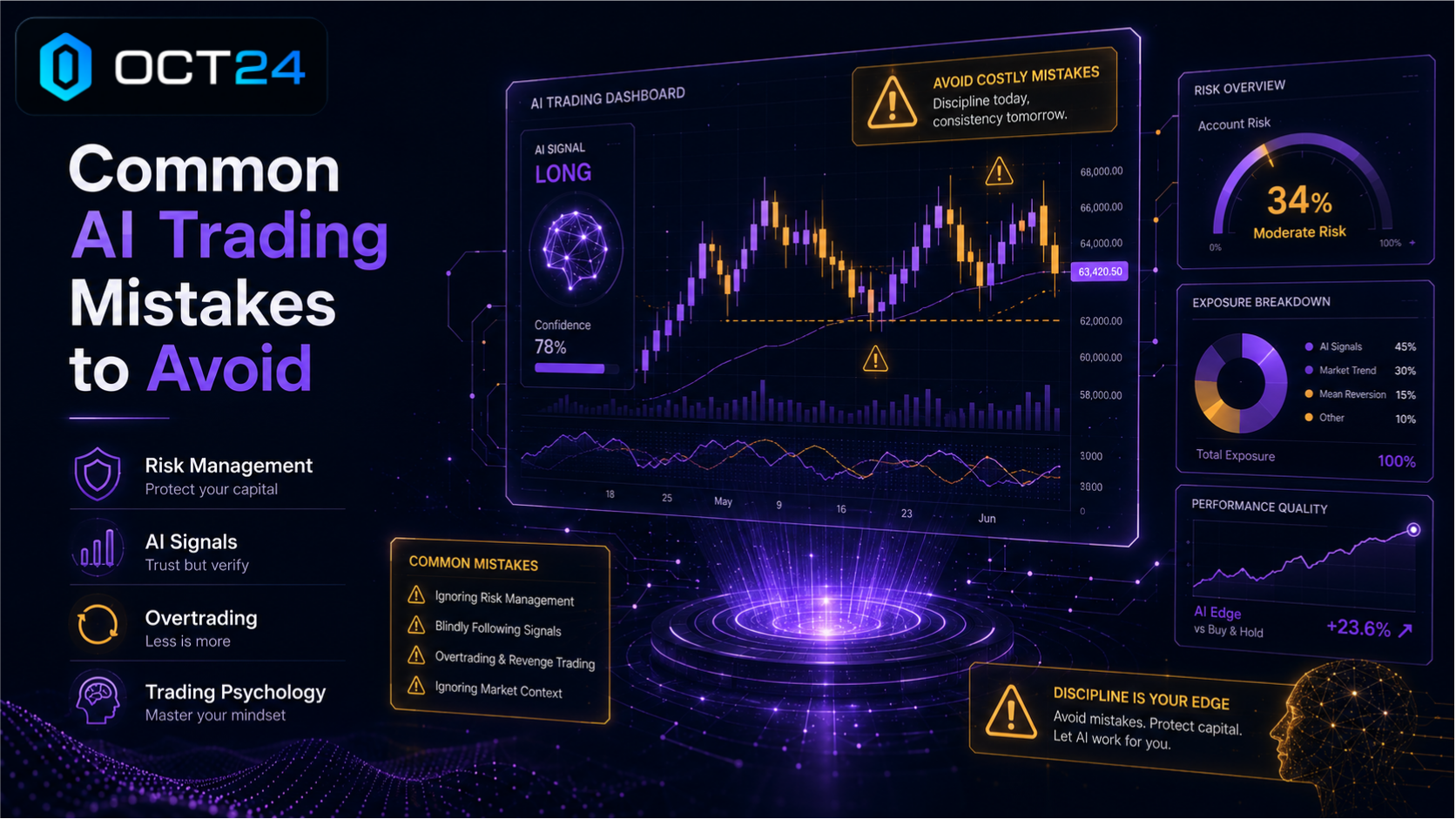
Common AI Trading Mistakes to Avoid
AI trading has changed how modern traders analyze markets, identify opportunities, and make decisions. Instead of manually scanning charts for hours, traders can now use artificial intelligence to process large amounts of market data, detect patterns, and respond to changing conditions with greater speed and consistency.
For anyone learning about AI trading, this technology can be exciting. AI-powered systems can help traders analyze price action, identify potential setups, automate repetitive tasks, and reduce some of the emotional pressure that often comes with trading. When used correctly, AI can support a more structured and data-driven trading process.
But AI trading is not a shortcut to effortless success.
Many beginner and intermediate traders make mistakes because they treat AI as a replacement for strategy, discipline, and risk management. They assume that because a tool is powered by artificial intelligence, every signal must be accurate and every trade must be worth taking. This is where many AI Trading Mistakes begin.
Choosing the right AI trading software can help traders organize data, review signals, and manage workflows more efficiently. However, software alone does not create a complete trading plan. Traders still need to understand what the tool is showing them, how much risk they are taking, and whether each trade fits their broader strategy.
AI can help traders make more informed decisions, but it does not eliminate uncertainty. Markets are influenced by volatility, liquidity, macroeconomic events, news, trader behavior, and unexpected price movements. Even advanced AI tools work with probabilities, not guarantees.
That is why platforms like OCT24 are designed to support a more disciplined approach to AI-assisted trading. Instead of encouraging impulsive decisions, OCT24 helps traders combine automation, analytics, and structure. The goal is not to remove the human trader from the process completely, but to help traders make smarter decisions with better tools.
For beginners, understanding the most common AI trading errors can be just as important as learning how AI trading works. Avoiding these mistakes can help traders build better habits, manage risk more carefully, and approach the market with realistic expectations.
Mistake 1: Relying Blindly on AI Signals
One of the most common AI Trading Mistakes is following every AI-generated signal without understanding the market context behind it.
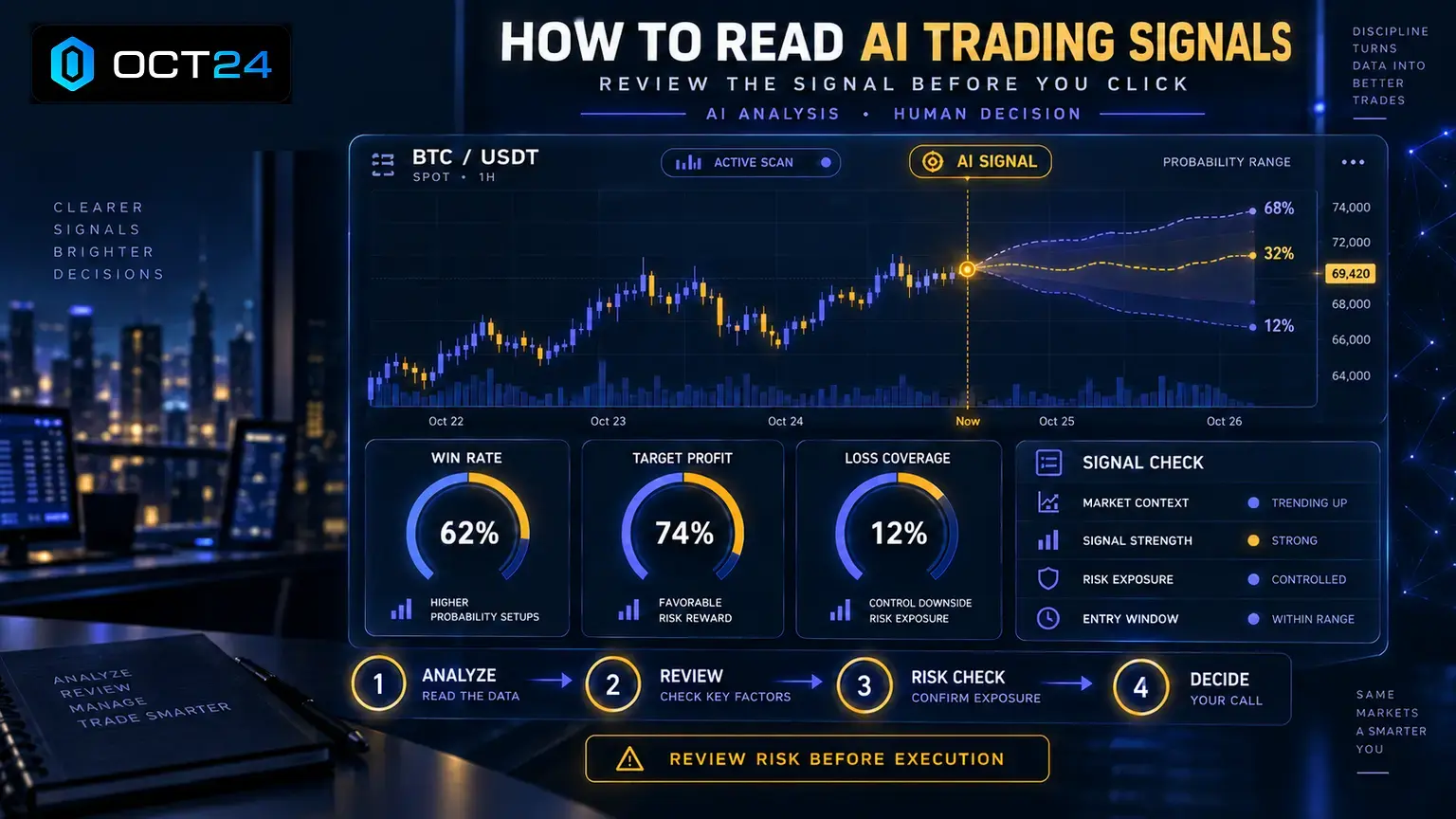
AI trading signals can be useful because they help traders identify potential opportunities faster than manual analysis alone. A signal may be based on price action, momentum, volume, volatility, technical indicators, or a combination of market data points. However, a signal is not the same thing as a complete trading decision.
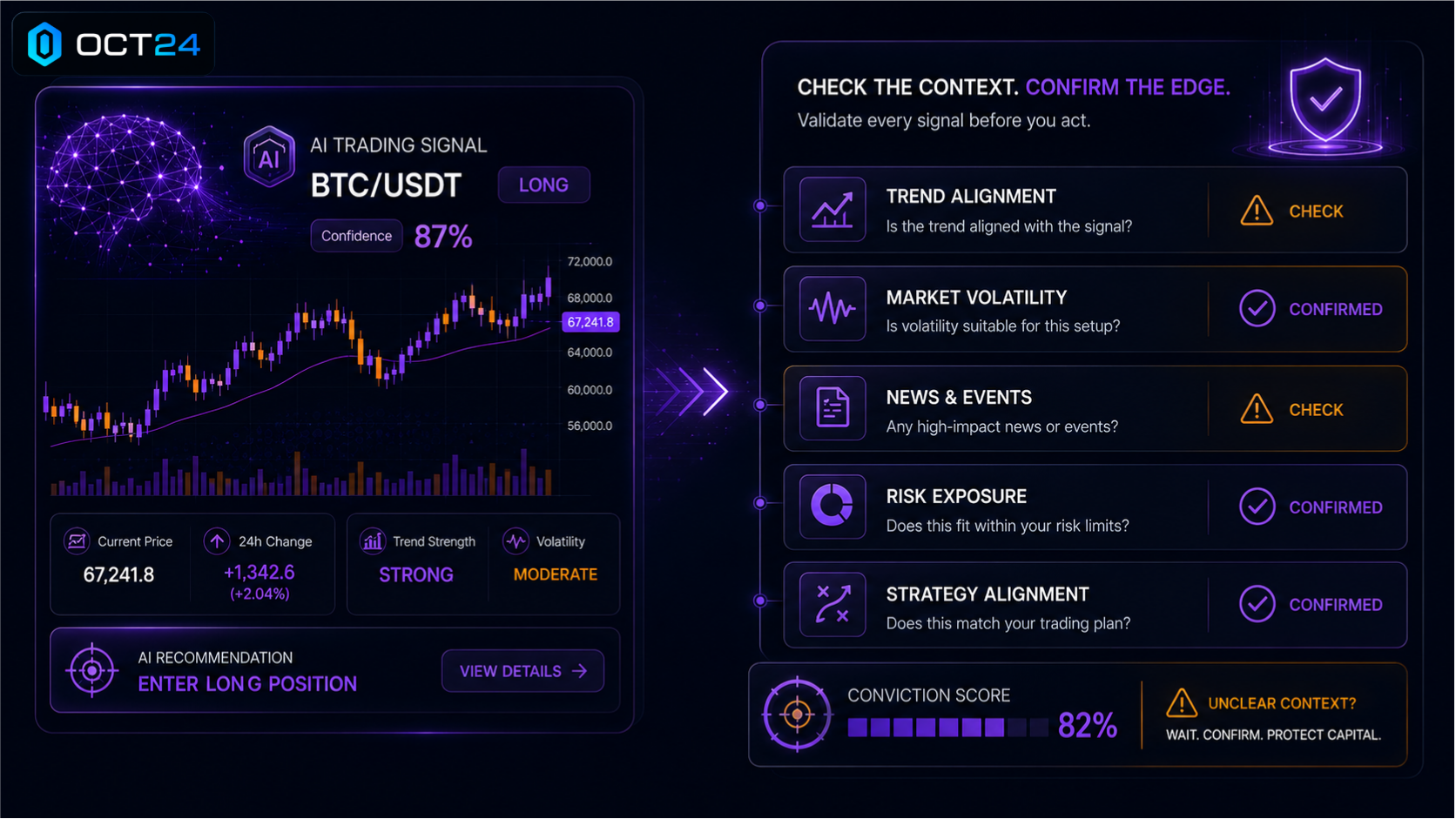
AI trading systems can analyze technical indicators, price history, volume, volatility, and other data points. They may identify patterns that suggest a potential buy or sell opportunity. However, a trading signal is not a guarantee. It is an output based on available data, model assumptions, and the logic of the system.
This mistake is especially common among traders who are still learning how trading bots work. Because bots can process information quickly and generate signals automatically, it may feel natural to trust every output. But speed does not always equal accuracy, and automation does not remove the need for judgment.
For example, an AI system may identify a bullish pattern based on recent price action. But if broader market sentiment is negative, volatility is rising, or a major news event is about to occur, the signal may carry more risk than it appears. A trader who follows the signal blindly may enter a position without understanding the bigger picture.
This is where technical analysis still matters. AI can process chart patterns and indicators quickly, but traders should understand the basics behind those signals. If a system highlights a breakout, trend reversal, or momentum shift, the trader should still ask whether the setup makes sense within the current market environment.
Traders should also avoid assuming that the best indicators for AI trading will work in every market condition. Indicators can help measure trends, momentum, volatility, and potential reversals, but they are not perfect. An indicator that works well in a trending market may produce weaker signals in a sideways or highly volatile market.
This is one of the key differences between using AI as a tool and treating AI as an authority. AI can support analysis, but traders still need to evaluate the environment around each trade.
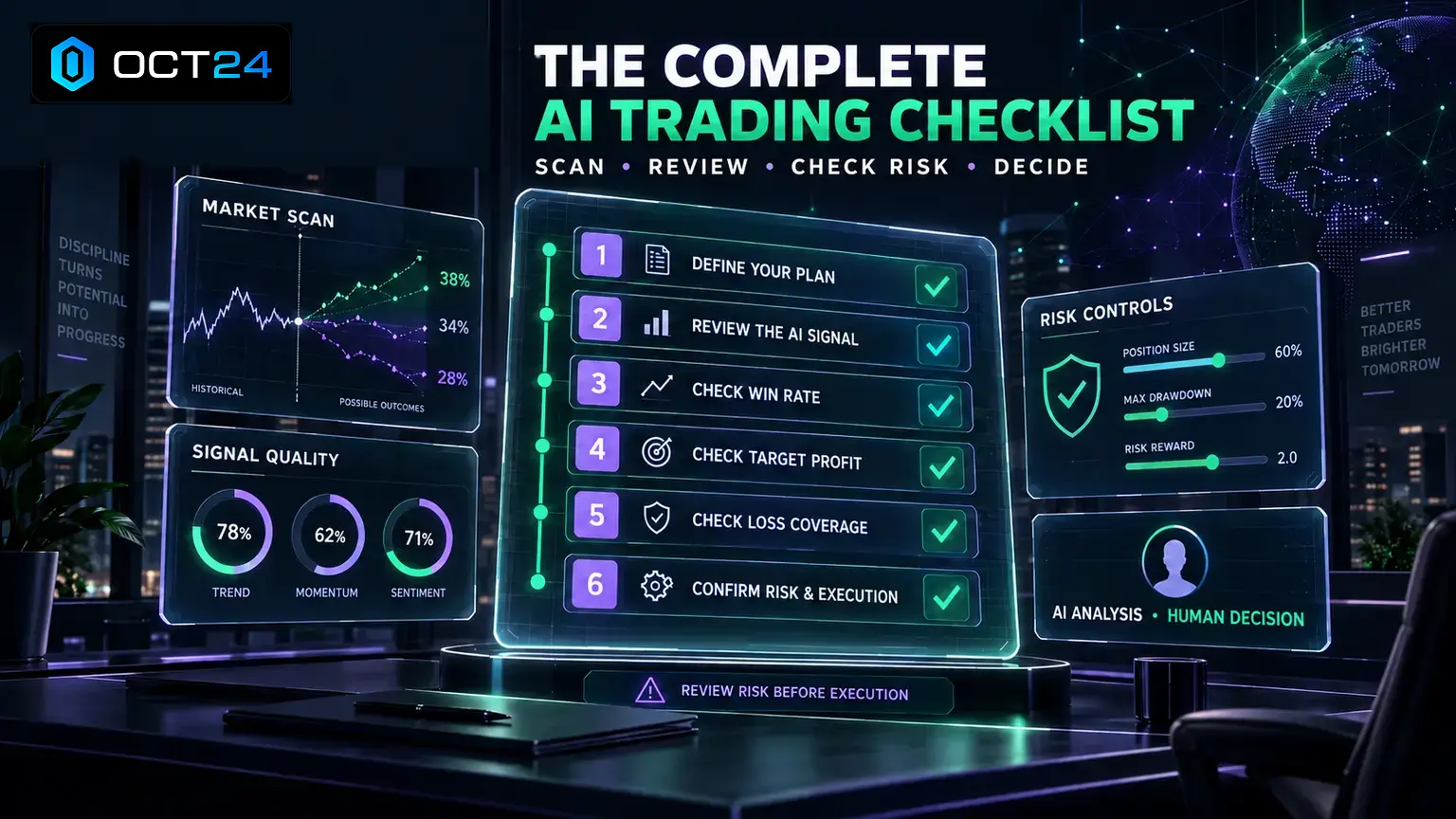
Before acting on an AI signal, traders should consider several factors:
- Is the broader market trending or ranging?
- Is volatility unusually high?
- Are there upcoming economic announcements or major news events?
- Does the trade fit the trader’s risk tolerance?
- How much portfolio exposure already exists?
- Does the signal align with the trader’s broader strategy?
OCT24 is built around the idea that AI trading should support better decision-making, not encourage blind execution. By combining AI-powered tools with a more structured trading environment, OCT24 helps traders approach signals with more context and discipline.
The best traders do not simply ask, “What does the AI say?” They ask, “Does this signal make sense within my strategy, risk plan, and current market conditions?”
That mindset can help prevent one of the most damaging beginner trading mistakes: outsourcing judgment entirely to a tool.
Mistake 2: Ignoring Risk Management
No matter how advanced a trading platform becomes, risk management remains one of the most important parts of long-term trading success. Ignoring risk is one of the most serious AI trading errors because it can turn a few bad trades into a major portfolio setback.
AI trading tools can help identify opportunities, automate decisions, and reduce some emotional pressure. But they cannot protect a trader who risks too much, uses excessive leverage, or fails to define loss limits.
Many beginners focus too much on potential profits and not enough on potential losses. They may ask, “How much can this trade make?” before asking, “How much can this trade lose?” That is a dangerous mindset.
This mistake can happen in both AI-assisted and manual trading. A manual trader may enter a position based on emotion or instinct. An AI-assisted trader may enter because a signal appears convincing. In both cases, the problem is the same: the trade is not supported by a clear risk plan.
Responsible trading starts with understanding that losses are part of the process. Even strong strategies can go through losing periods. The goal is not to avoid every loss, but to keep losses controlled enough that one trade, or even a series of trades, does not damage the entire account.
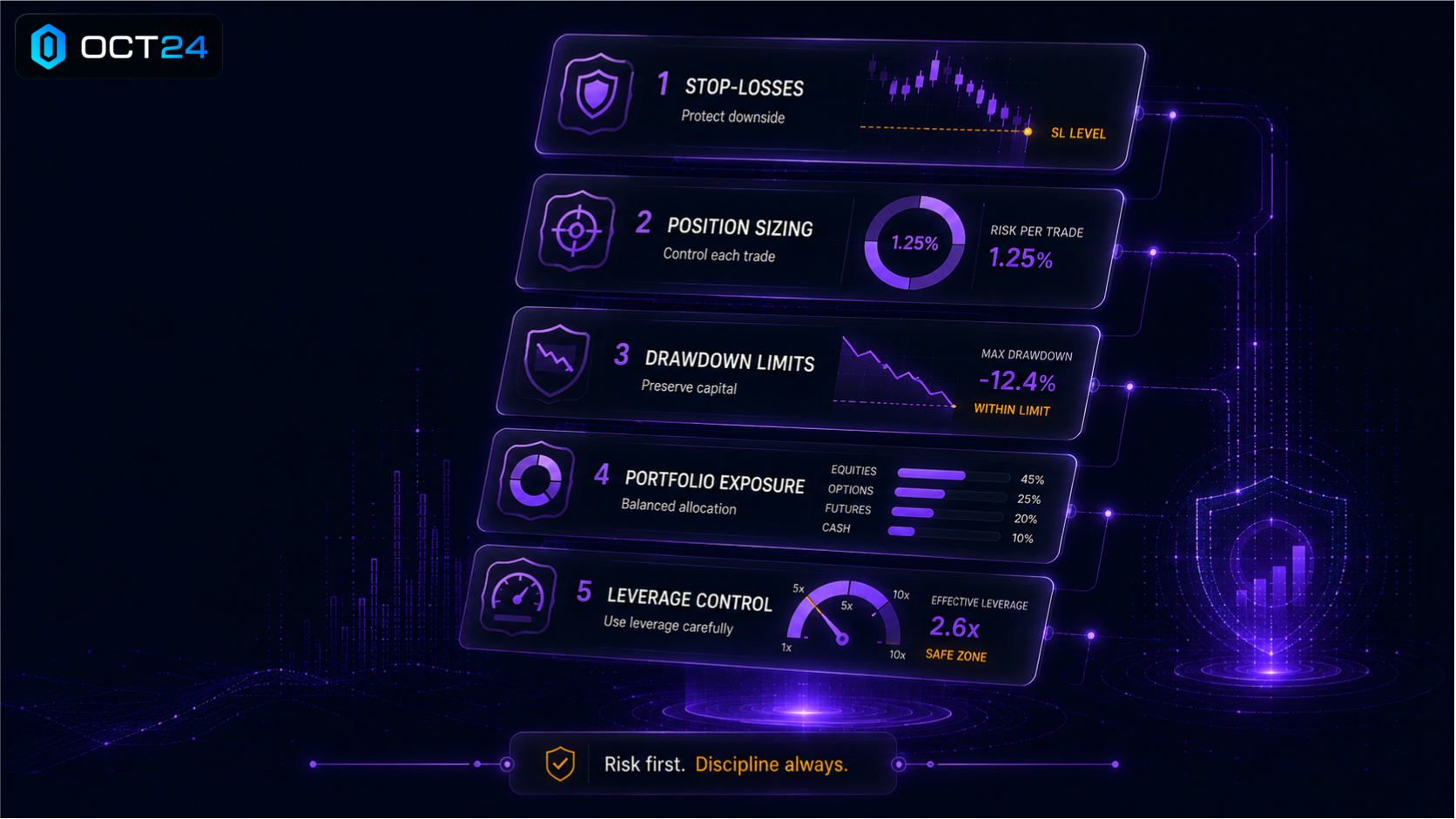
Important risk management concepts include:
- Position sizing
- Stop-loss planning
- Portfolio exposure
- Drawdown limits
- Diversification
- Risk-to-reward ratios
- Leverage control
Position sizing is especially important. A trader may have a good strategy, but if they allocate too much capital to one trade, a single loss can have an outsized impact. Poor position sizing is one of the most common beginner trading mistakes because it often comes from overconfidence or impatience.
Stop-losses can also play an important role. A stop-loss is not a guarantee that every loss will be small, especially in highly volatile markets, but it can help traders define their exit plan before emotions take over. Without a planned exit, traders may hold losing positions too long, hoping the market will reverse.
Drawdowns are another key issue. A drawdown measures how much an account declines from a previous high. Large drawdowns can be difficult to recover from and can place significant emotional pressure on traders. AI tools may help traders monitor performance, but traders still need to decide how much drawdown they are willing to tolerate.
OCT24’s trading environment can support more structured decision-making by encouraging traders to think beyond individual trades. Instead of focusing only on signals or entries, traders should also consider exposure, consistency, and overall portfolio discipline.
Risk management is not the most exciting part of trading, but it is often what separates disciplined traders from impulsive ones. AI can help improve the process, but it cannot replace the need for clear rules.
A useful way to think about AI trading is this: AI may help you find opportunities, but risk management helps you stay in the game.
Mistake 3: Overtrading
Overtrading happens when traders place too many trades, trade too frequently, or enter positions without a strong reason. It is one of the most common AI Trading Mistakes, especially for beginners who are excited by automation and fast market analysis.
AI trading tools can make trading feel easier and more efficient. Signals may appear quickly. Market data may update in real time. Automation may reduce the friction of entering and exiting trades. While these features can be valuable, they can also tempt traders to become too active.
More trades do not automatically mean better results. In many cases, overtrading can lead to higher fees, more emotional stress, and lower-quality decision-making.
A trader who overtrades may start taking setups that do not fully match their strategy. They may enter trades out of boredom, fear of missing out, or the belief that constant activity is necessary to succeed. This can be especially risky during periods of market volatility, where rapid price movements can create the illusion of endless opportunity.
Overtrading can also create a feedback loop. A trader takes too many positions, experiences a loss, then immediately tries to recover by entering another trade. This behavior can lead to revenge trading, where decisions are driven by frustration rather than strategy.
AI tools can sometimes make this worse if traders interpret every alert as an action item. But not every signal needs to become a trade. Sometimes the best decision is to wait.
OCT24 supports a more disciplined approach by helping traders think in terms of structure, data, and process rather than constant activity. AI-assisted trading should help traders filter opportunities, not chase every possible move.
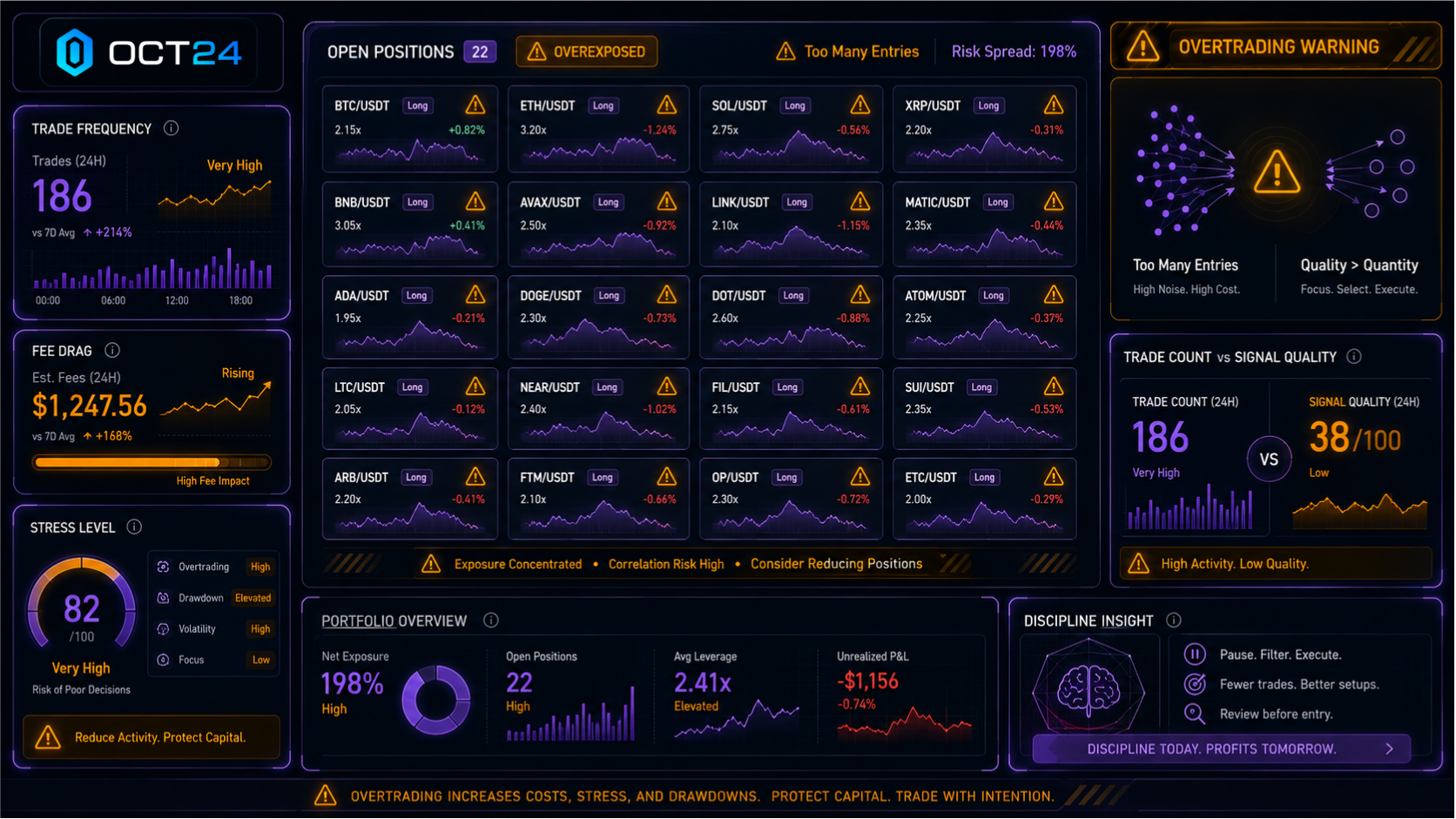
To avoid overtrading, traders should define clear rules before entering the market. These rules may include:
- How many trades they are willing to take per day or week
- What conditions must be present before entering a trade
- How much risk they are willing to take per position
- When they should stop trading after a loss
- Which assets or markets they are focused on
A disciplined trader does not need to act on every market movement. The goal is to identify higher-quality opportunities that fit a defined strategy.
Overtrading is often connected to impatience. Many beginners believe they need to constantly do something to make progress. But in trading, patience is often a skill. Waiting for the right setup can be just as important as executing the trade itself.
AI can process information quickly, but traders still need to decide when action is appropriate.
Mistake 4: Letting Emotions Override the Strategy
AI trading can reduce some emotional decision-making, but it does not remove emotion from trading completely. Traders are still human. They still experience fear, greed, excitement, frustration, and doubt. That is why trading psychology remains a critical part of AI-assisted trading.
One of the biggest beginner trading mistakes is creating a strategy, then abandoning it as soon as emotions rise.
For example, a trader may enter a position with a clear plan. But when the market moves against them, fear takes over. They exit too early, only to watch the market recover later. Another trader may see a position move into profit and become overconfident, increasing risk on the next trade without proper analysis.
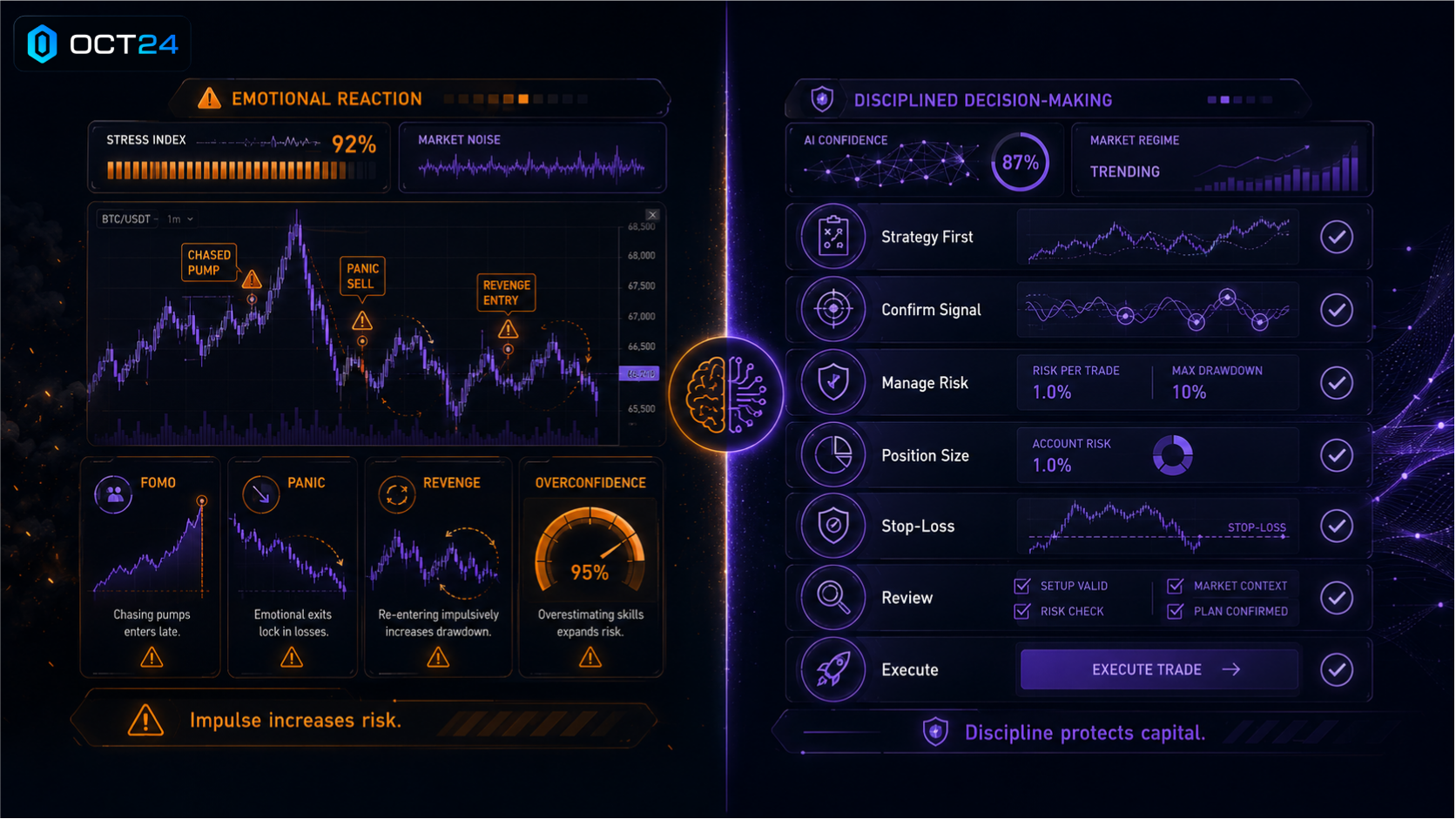
Common emotional trading behaviors include:
- Fear of missing out
- Panic selling
- Revenge trading
- Overconfidence after a win
- Increasing position size too quickly
- Ignoring stop-loss plans
- Abandoning a strategy after a few losses
Fear of missing out, often called FOMO, is especially common in fast-moving markets. A trader sees an asset rising quickly and enters late without a clear plan. The decision is not based on strategy; it is based on the fear that an opportunity will disappear. This can lead to buying near the top of a move and taking unnecessary risk.
Revenge trading is another dangerous behavior. After a loss, a trader may feel the need to win the money back immediately. This often leads to rushed decisions, larger position sizes, and poor risk control. AI tools may still be available, but the trader’s emotional state can distort how they interpret the data.
Overconfidence can be just as harmful. After a few successful trades, a beginner may assume they have mastered the market. They may increase leverage, ignore position sizing, or take trades that do not fit their plan. This can quickly lead to losses.
This is where AI can be helpful, but only when used correctly. Tools that support automated trading can help traders follow rules more consistently, reduce impulsive decisions, and avoid reacting emotionally to every price movement. However, automation should still be guided by a clear strategy and risk plan.
OCT24’s AI-powered environment is designed to support more objective decision-making, but traders still need to manage their own behavior. AI can provide structure, signals, analytics, and automation, but it cannot force a trader to stay disciplined.
This is why trading psychology and risk management are closely connected. A trader with clear risk rules is less likely to panic. A trader with realistic expectations is less likely to chase unrealistic gains. A trader with a defined strategy is less likely to react emotionally to every price movement.
The best use of AI is not to remove responsibility from the trader. It is to help the trader make decisions with better information and less emotional noise.
Mistake 5: Using AI Without a Clear Strategy
Another common mistake is using AI trading tools before defining a clear trading strategy. This is one of the most overlooked AI Trading Mistakes because many beginners assume the tool itself is the strategy.
AI can analyze data, identify patterns, generate alerts, and support automation. But traders still need a framework for how they will use that information. Without a clear strategy, AI outputs can become confusing, inconsistent, or even counterproductive.
This is especially important for traders who are still learning how to build AI trading strategies. New traders may see AI-powered tools as an easier way to enter the market, but AI works best when it supports a plan that already exists. The trader still needs to define what they are trying to accomplish, how much risk they can tolerate, and which market conditions they want to trade.
A trader should understand the purpose behind each trade. Are they looking for short-term momentum? Are they following trend-based setups? Are they focused on risk-controlled portfolio growth? Are they trading manually with AI support, or using automation within defined rules?
Without these answers, traders may jump from one signal to another without understanding why they are entering or exiting positions. This often leads to inconsistent results and emotional decision-making.
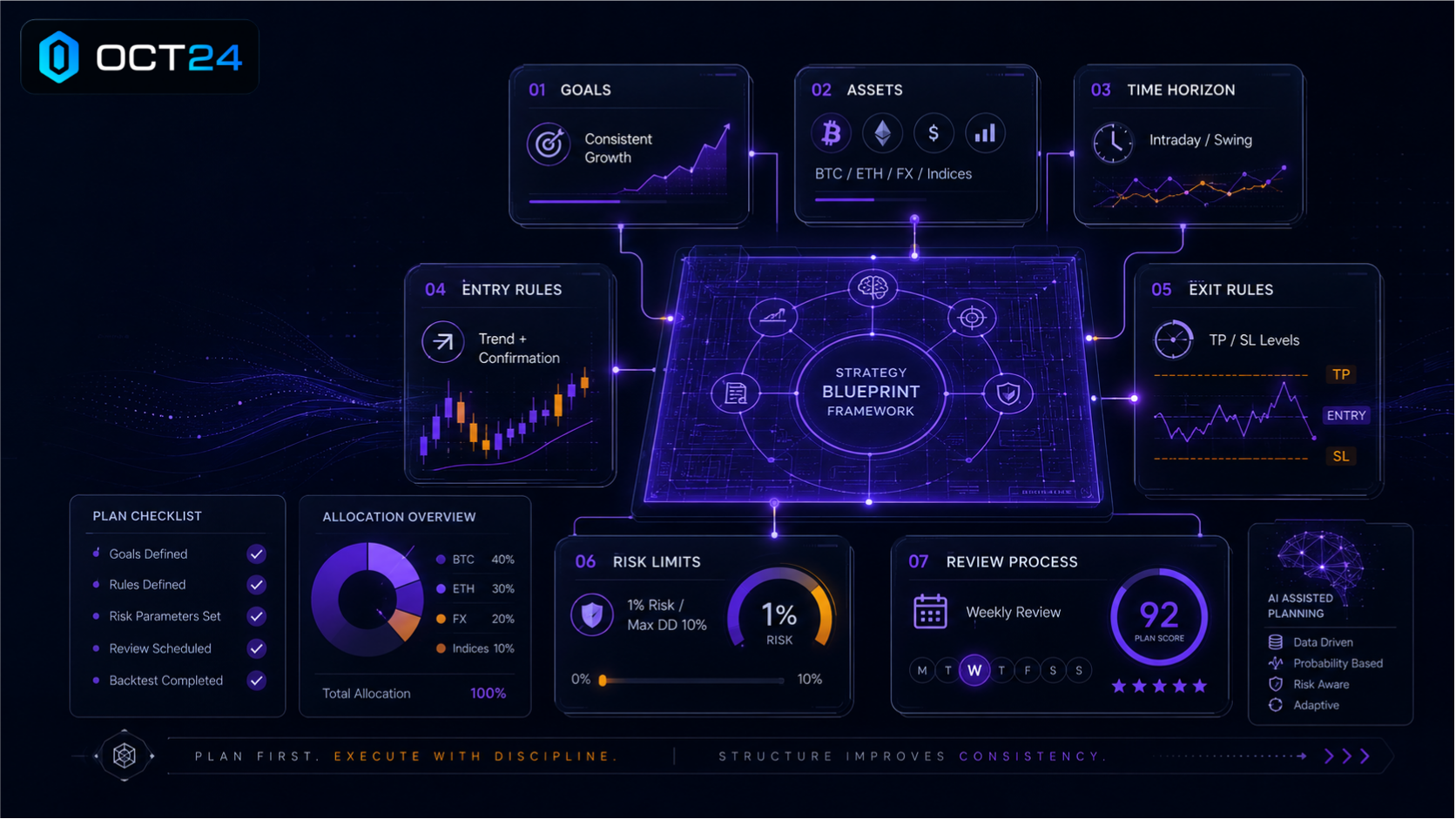
A clear AI trading strategy should include:
- Defined trading goals
- Preferred assets or markets
- Time horizon
- Entry and exit criteria
- Position sizing rules
- Risk limits
- Performance review process
- Market conditions to avoid
For example, a trader using AI to identify short-term crypto opportunities should not apply the same expectations as someone using AI to support longer-term portfolio management. Different goals require different strategies, risk levels, and review methods.
OCT24 helps traders think beyond random signals by supporting a more structured AI-assisted trading experience. Instead of treating AI as a magic button, traders can use OCT24 to combine automation, analytics, and disciplined decision-making within a clearer process.
The key is to know what role AI plays in your strategy. Is it helping you scan the market? Is it supporting trade timing? Is it assisting with portfolio monitoring? Is it helping reduce emotional decisions?
When traders define the role of AI clearly, they are less likely to misuse it.
Mistake 6: Expecting AI to Predict the Market Perfectly
One of the biggest misconceptions about AI trading is the belief that artificial intelligence can predict the market with certainty. This is one of the most dangerous AI trading errors because it creates unrealistic expectations.
AI can analyze large amounts of historical and real-time data. It can identify patterns, measure probabilities, and detect signals faster than a human trader could manually. But markets are not fully predictable.
Prices can move because of unexpected news, liquidity changes, regulatory developments, macroeconomic data, institutional activity, or sudden shifts in trader sentiment. Even a strong AI model cannot know every future event before it happens.
This is why traders should avoid thinking of AI as a prediction machine. A better way to think about AI is as a decision-support system. It can help traders make more informed decisions, but it cannot remove risk from the market.
Expecting perfect predictions can lead to several problems. Traders may risk too much because they believe the AI is “sure.” They may ignore stop-losses because they trust the model too strongly. They may become frustrated after normal losses and abandon a strategy too early.
These unrealistic expectations are often connected to common AI trading myths. Some beginners believe AI can remove losses, predict every price movement, or make trading completely passive. In reality, AI can improve analysis and execution, but it still operates in uncertain markets.
Realistic expectations are essential. No trading tool wins every time. No system eliminates volatility. No platform can guarantee profit.
OCT24’s value is not in promising certainty. Its value is in helping traders approach the market with better structure, stronger tools, and more disciplined decision-making. That distinction matters.
AI can improve the trading process, but it should always be used with risk management and human judgment.
Mistake 7: Using Too Much Leverage
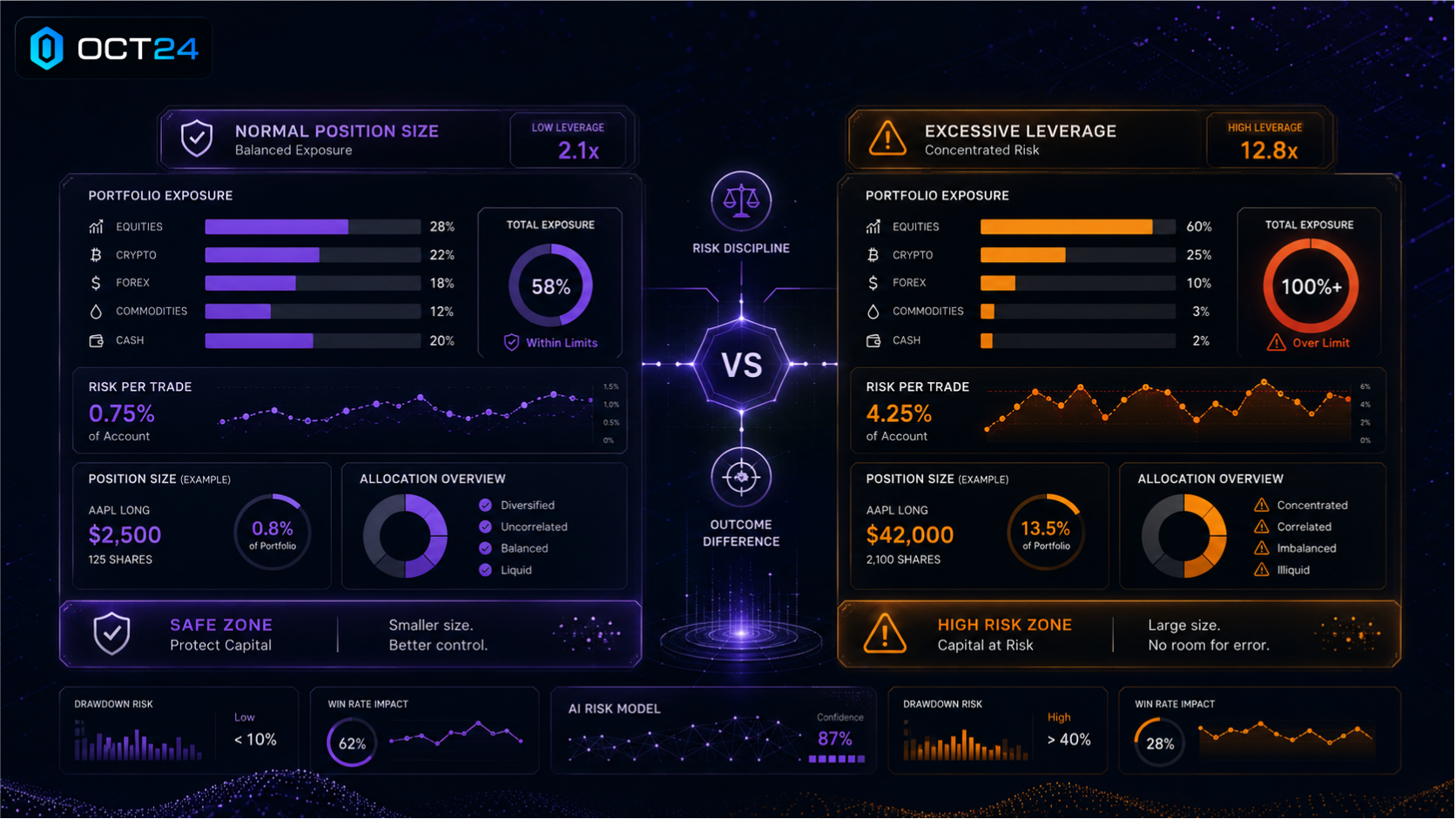
Leverage allows traders to control a larger position with a smaller amount of capital. While leverage can increase potential returns, it can also increase potential losses. For beginners, using too much leverage is one of the fastest ways to turn a small mistake into a major loss.
This is especially important in AI trading because automation and fast signals can make traders feel more confident than they should. If an AI tool identifies a strong-looking opportunity, a beginner may be tempted to increase leverage without fully considering the downside.
The problem is that even a small market move in the wrong direction can create a large loss when leverage is involved. During periods of market volatility, prices can move quickly and unpredictably. A trade that looked reasonable at normal position size can become extremely risky when amplified by leverage.
This is where AI trading risk vs reward becomes important. Traders need to evaluate whether the potential upside of a trade is worth the possible downside. A trade may look attractive, but if the risk is too large relative to the expected reward, it may not fit a responsible trading plan.
Using leverage responsibly requires discipline. Traders should understand how much they can lose, how margin works, and what happens if the market moves sharply against them. They should also consider whether leverage fits their experience level and overall trading plan.
Responsible traders define maximum risk per trade, maximum account exposure, stop-loss rules, and leverage limits before entering the market. These rules help prevent emotional decisions when a trade moves quickly.
AI does not make leverage safe. It may help analyze market conditions, but it cannot remove the risk of amplified losses.
OCT24’s disciplined trading environment can help traders focus on structure instead of impulsive risk-taking. Rather than using leverage because a signal appears attractive, traders should evaluate whether the position fits their risk limits, portfolio exposure, and broader strategy.
For many beginners, the smarter approach is to prioritize consistency and capital protection before increasing complexity.
Mistake 8: Poor Position Sizing
Poor position sizing is another major risk management mistake. Position sizing refers to how much capital a trader allocates to a single trade. Even with a strong AI-assisted strategy, poor position sizing can create unnecessary risk.
A common beginner mistake is putting too much capital into one trade because the setup looks promising. This can happen when traders become overly confident in an AI signal or want to recover quickly from a previous loss.
But no signal is guaranteed. If one trade represents too much of the account, a single loss can cause serious damage. This can also create emotional pressure, making it harder to follow the original plan.
Good position sizing helps traders stay objective. It keeps each trade within a manageable level of risk and reduces the chance that one outcome will dominate the entire portfolio.
Traders should consider:
- Account size
- Risk tolerance
- Market volatility
- Stop-loss distance
- Portfolio concentration
- Correlation between assets
- Maximum acceptable loss per trade
For example, a trader may decide that they do not want to risk more than a small percentage of their account on any single trade. This type of rule can help prevent emotional decisions and keep losses more controlled.
Position sizing is also closely connected to trading bot risk management. If trading bots or AI-assisted systems place trades too aggressively, even a good signal process can create poor outcomes. Traders should understand how position sizes are determined, how risk is capped, and how the system responds when market conditions change.
OCT24 can support a more thoughtful trading process by encouraging traders to think about the full trade, not just the entry signal. A strong AI trading approach should include the question: “How much should I risk?” not only “Should I enter?”
Position sizing is not exciting, but it is one of the foundations of responsible trading.
Mistake 9: Switching Strategies Too Often
Many beginners move from one strategy to another too quickly. After a few losing trades, they abandon the approach and search for something new. This can become a cycle of constant strategy switching, where the trader never gives any method enough time to be properly evaluated.
This is one of the more subtle AI Trading Mistakes because AI tools can expose traders to many signals, indicators, and market ideas. The more information available, the easier it becomes to second-guess the current strategy.
A trader might start with a trend-following approach, then switch to short-term scalping, then move to breakout trading, then follow a new indicator, all within a short period. This creates confusion and makes it difficult to know what is actually working.
Not every losing trade means a strategy is broken. Losses are part of trading. A strategy should be evaluated over a meaningful sample size, not judged by one or two outcomes.
That does not mean traders should never adapt. Markets change, and strategies may need adjustment. But changes should be based on review and evidence, not frustration or impatience.
This is where a consistent trading routine can make a major difference. Instead of reacting emotionally after every win or loss, traders should review performance on a regular schedule, track whether they followed their rules, and make adjustments based on data rather than impulse.
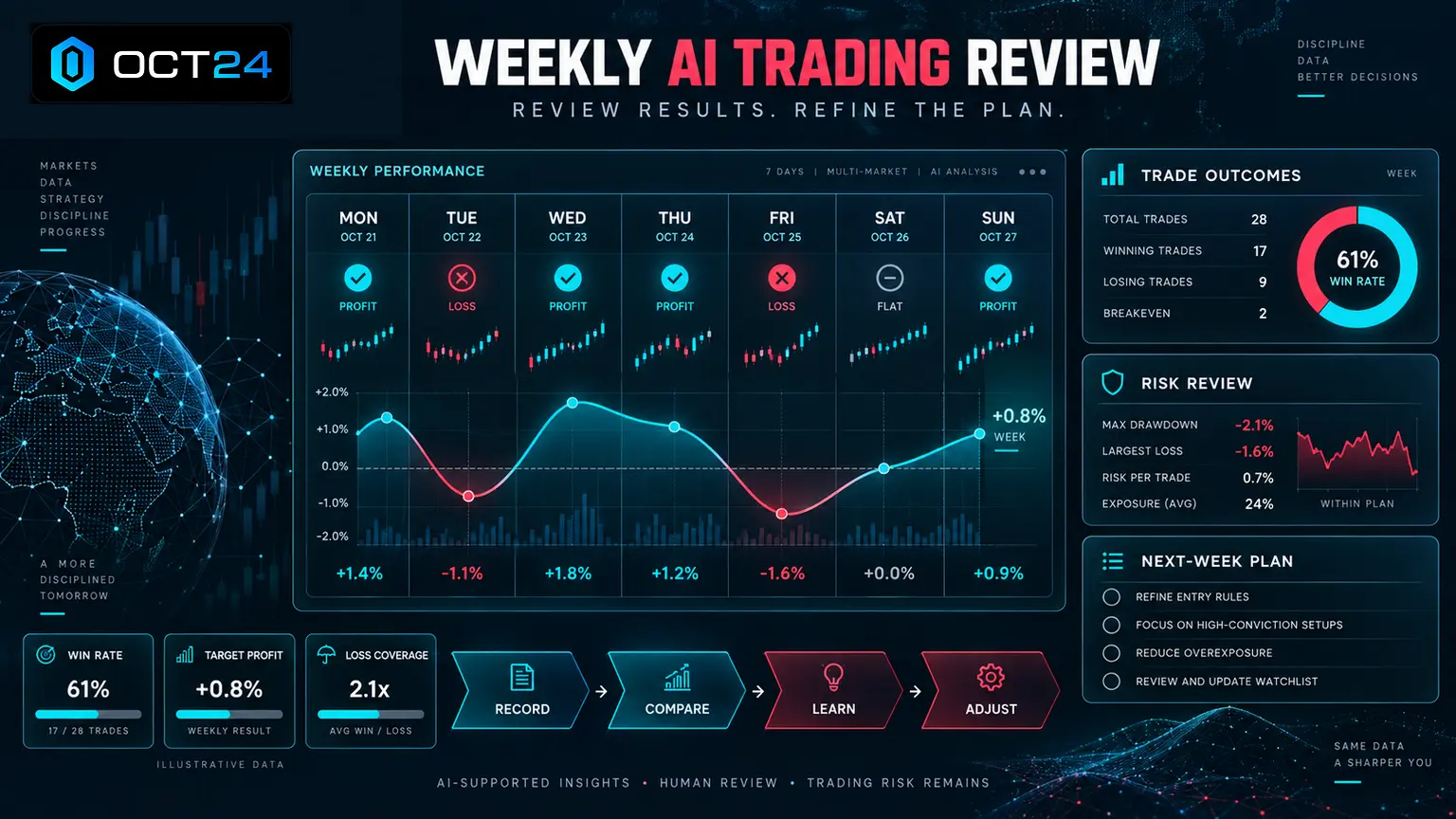
A structured review process can help traders avoid unnecessary strategy switching. Traders should track:
- Win rate
- Average gain and average loss
- Maximum drawdown
- Market conditions
- Trade frequency
- Risk-to-reward ratio
- Emotional decision points
- Whether trades followed the plan
OCT24 can help traders think more systematically about AI-assisted trading by encouraging a process-based mindset. Instead of reacting emotionally to every result, traders can focus on reviewing performance, identifying patterns, and making more informed adjustments.
Consistency does not mean refusing to improve. It means avoiding random changes that are not supported by data.
How OCT24 Helps Traders Avoid Common AI Trading Mistakes
The most common AI Trading Mistakes usually happen when traders use technology without enough structure. They rely too heavily on signals, ignore risk, trade too often, or expect AI to remove uncertainty from the market.
OCT24 is designed to support a smarter approach to AI-assisted trading. As an AI-powered trading environment, OCT24 combines automation, analytics, and risk-aware tools so traders can focus on process instead of impulse.
For beginner and intermediate traders, this can make a meaningful difference. The goal is not to replace education or personal responsibility. Instead, OCT24 helps traders use AI in a more practical and thoughtful way.
OCT24 can support traders by helping them:
- Analyze market opportunities more efficiently
- Use AI insights as part of a broader strategy
- Approach trading with clearer structure
- Reduce emotional decision-making
- Stay focused on risk awareness
- Avoid chasing every market movement
- Think beyond individual trades and consider portfolio discipline
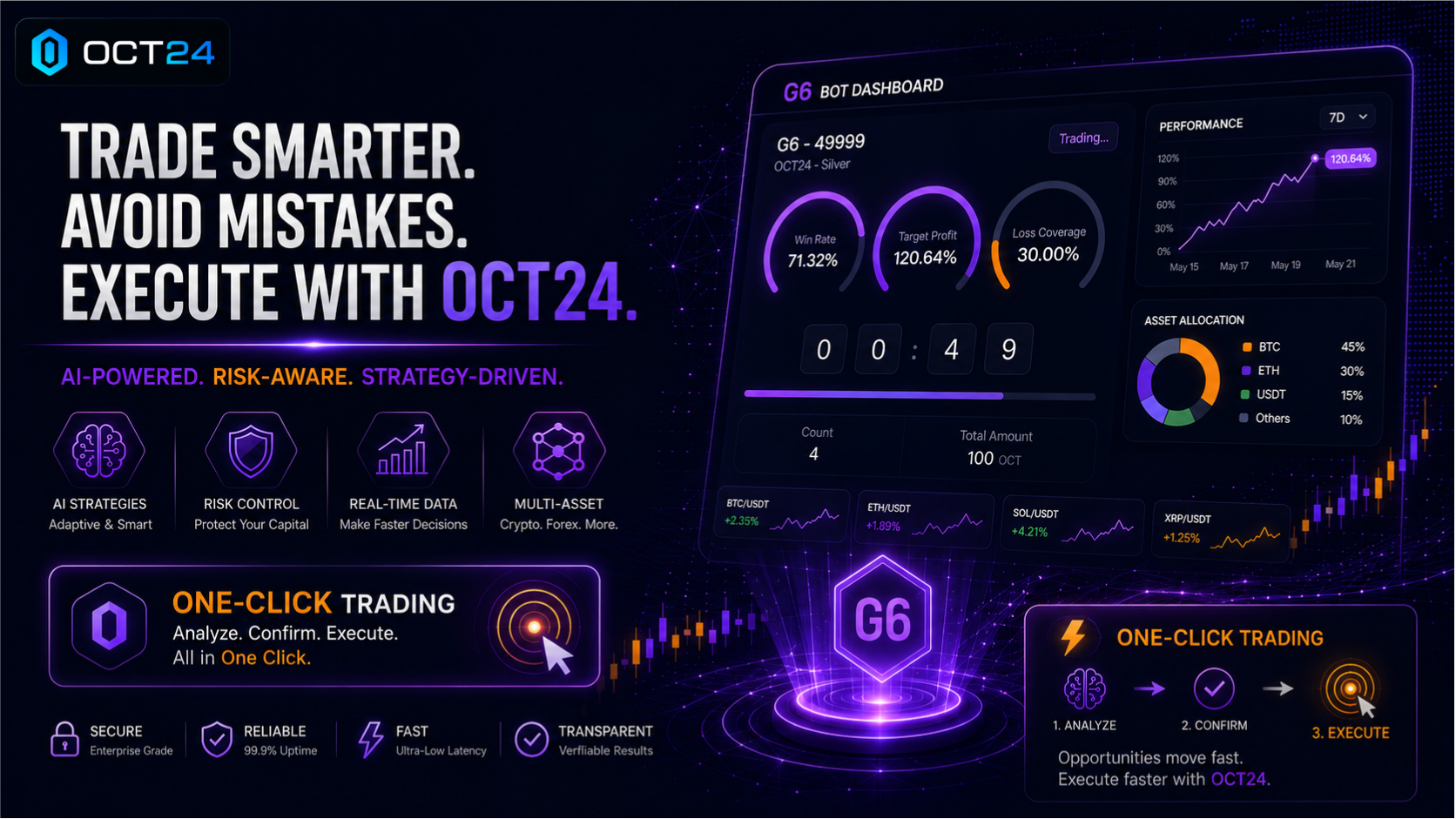
For traders interested in automation, the G6 Trading Bot is an important part of the OCT24 ecosystem. It represents the kind of AI-assisted trading technology that can help traders respond to market data more efficiently while still needing clear rules, risk limits, and responsible oversight.
This is especially important for traders who are still learning. Many beginner trading mistakes happen because new traders focus only on entries. They ask what to buy, when to buy, or what signal to follow. But long-term trading discipline requires more than entries.
Traders also need to understand exits, position sizing, market conditions, risk exposure, and emotional control.
The About OCT24 story also matters because traders should understand the platform behind the tools they use. Choosing an AI trading solution is not only about features; it is also about trust, transparency, usability, and whether the platform supports responsible decision-making.
OCT24’s educational and AI-powered approach helps traders build a more complete trading mindset. Instead of viewing AI as a shortcut, traders can use it as a tool to strengthen their decision-making process.
Conclusion: Avoid AI Trading Mistakes by Combining Technology With Discipline
AI trading can be a powerful advantage for modern traders, but only when it is used responsibly. The biggest AI Trading Mistakes happen when traders expect technology to do all the work.
AI can help analyze data, identify patterns, automate tasks, and support faster decision-making. Features like automation, analytics, and one-click execution can make trading more efficient, but they do not remove the need for strategy and discipline.
AI cannot remove risk, guarantee results, or replace the need for a clear trading plan. Traders still need patience, risk management, trading psychology, and realistic expectations.
Beginners should be especially careful to avoid common problems such as relying blindly on signals, ignoring market conditions, overtrading, using too much leverage, poor position sizing, and letting emotions control decisions.
OCT24 gives traders a smarter way to approach AI-assisted trading by combining automation, analytics, and structure. For traders who want to use AI more responsibly, OCT24 can help support better habits and more disciplined decision-making.
The best traders do not treat AI as a shortcut. They treat it as a tool.
Used wisely, AI can help traders become more informed, more consistent, and more prepared. But the foundation remains the same: strategy, risk management, and discipline.
FAQ: Common AI Trading Mistakes
What are the most common AI Trading Mistakes?
The most common AI Trading Mistakes include relying blindly on AI signals, ignoring risk management, overtrading, using too much leverage, poor position sizing, switching strategies too often, and expecting AI to predict the market perfectly.
Can AI trading tools guarantee profits?
No. AI trading tools can analyze data and support decision-making, but they cannot guarantee profits. Markets are uncertain, and every trade carries risk.
Why is risk management important in AI trading?
Risk management helps traders control losses, manage position sizes, reduce emotional decision-making, and protect their portfolio during unfavorable market conditions.
Is overtrading common among beginner traders?
Yes. Overtrading is one of the most common beginner trading mistakes. AI tools can make trading feel faster and easier, which may tempt traders to place too many trades without enough strategy.
How can OCT24 help traders avoid AI trading errors?
OCT24 helps traders use AI in a more structured way by combining automation, analytics, and risk-aware decision-making tools. This can support better discipline and help traders avoid common AI trading errors.
Trade With More Discipline Using OCT24
AI trading works best when it is paired with strategy, risk management, and realistic expectations. OCT24 helps traders use AI-powered tools in a more structured way, supporting smarter analysis, automation, and disciplined decision-making.
Whether you are learning how to avoid beginner trading mistakes or looking for a more organized way to manage AI-assisted strategies, OCT24 gives you the technology and structure to trade with more confidence.
Ready to use AI with more structure and discipline? Start Trading with OCT24 and build a more responsible approach to AI-assisted trading.