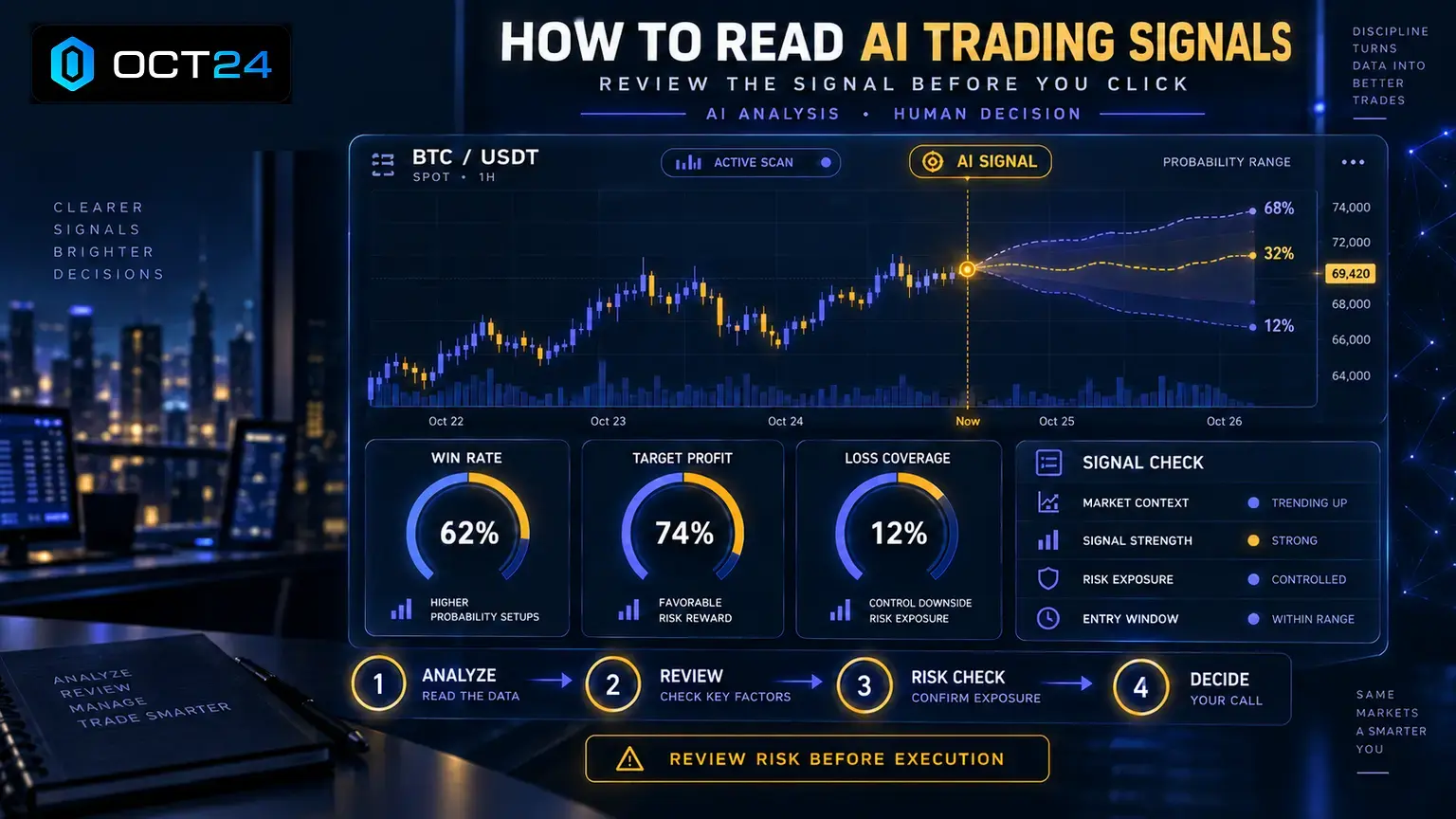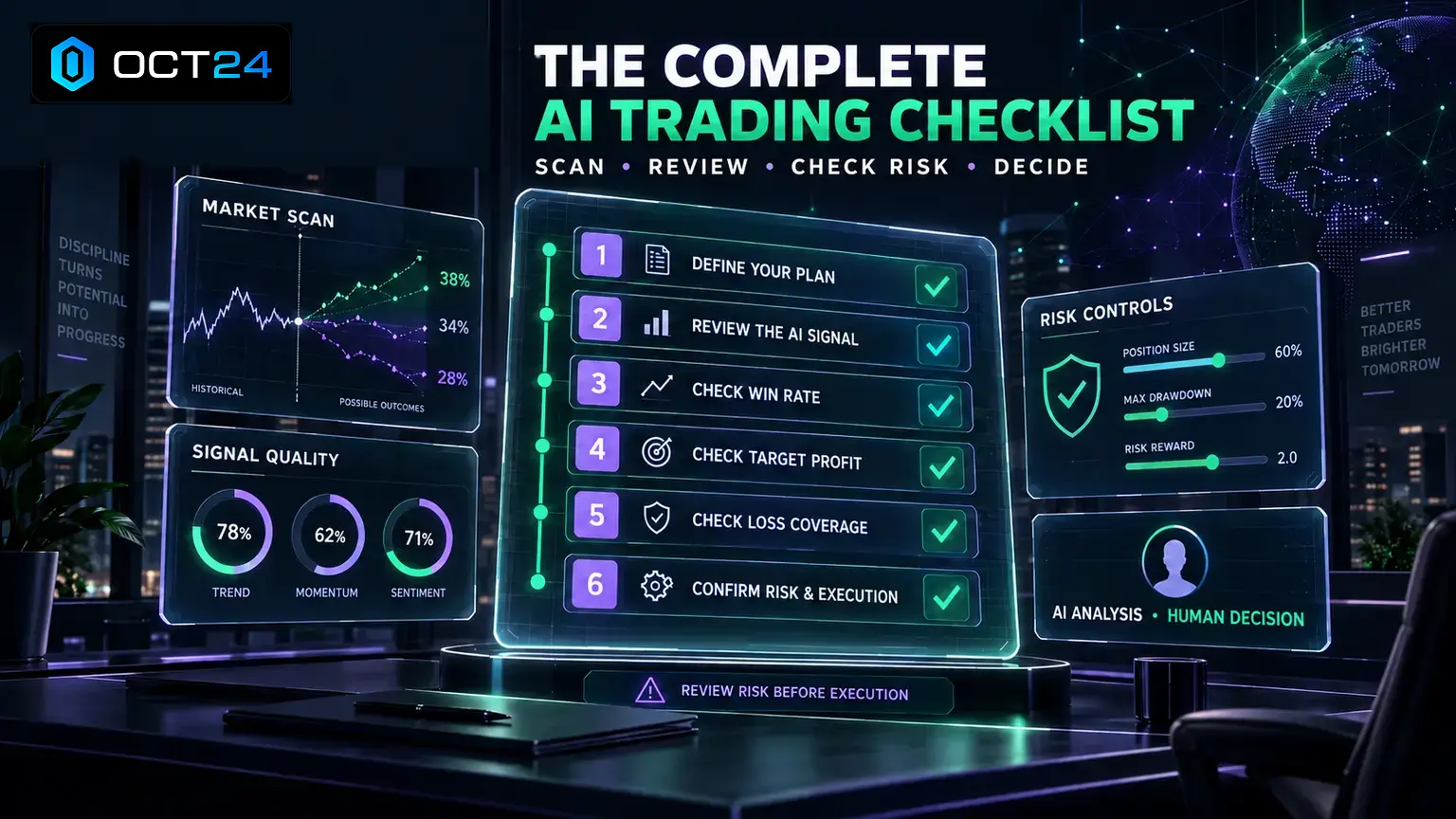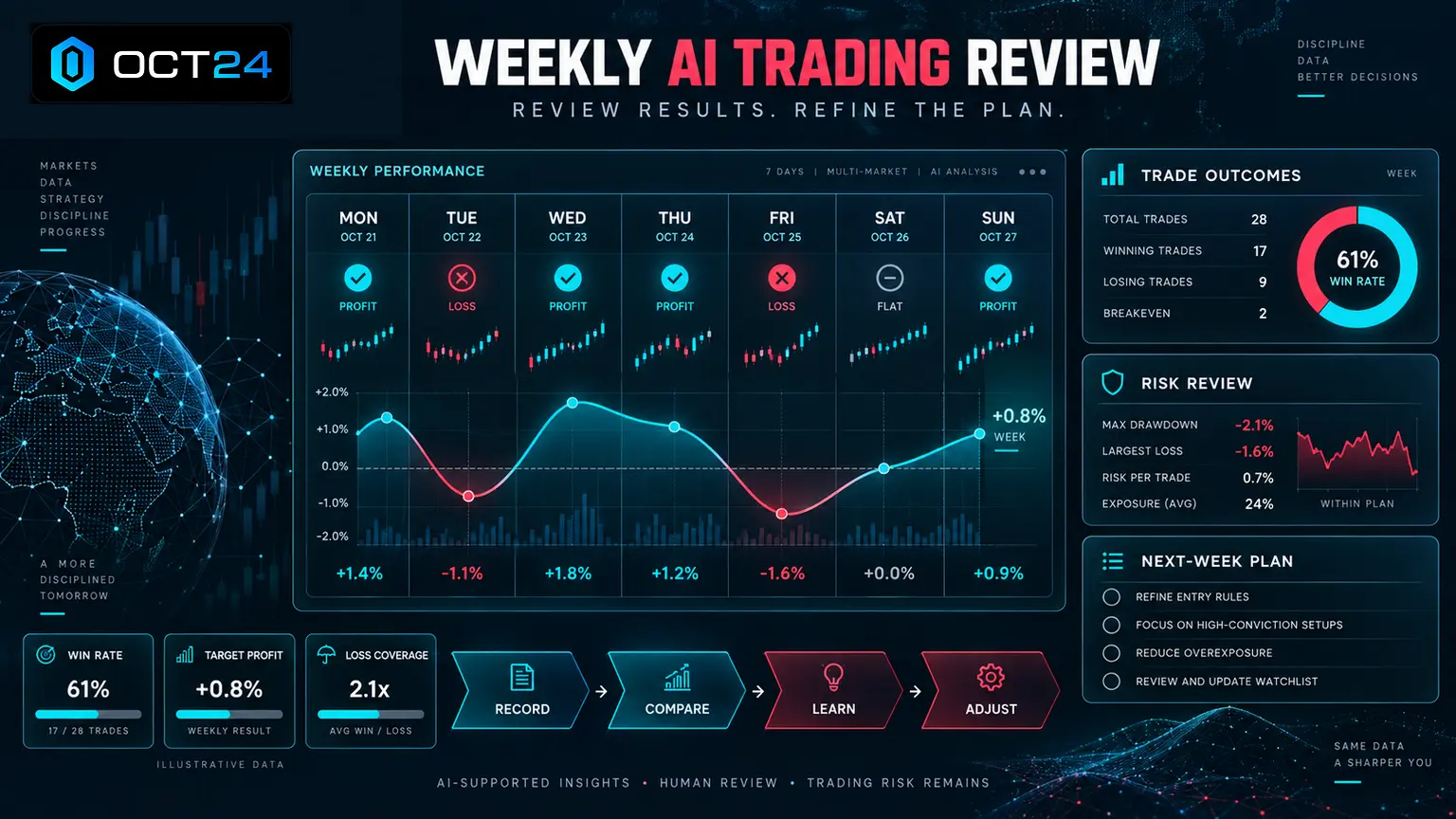

Trading Bot Risk Management
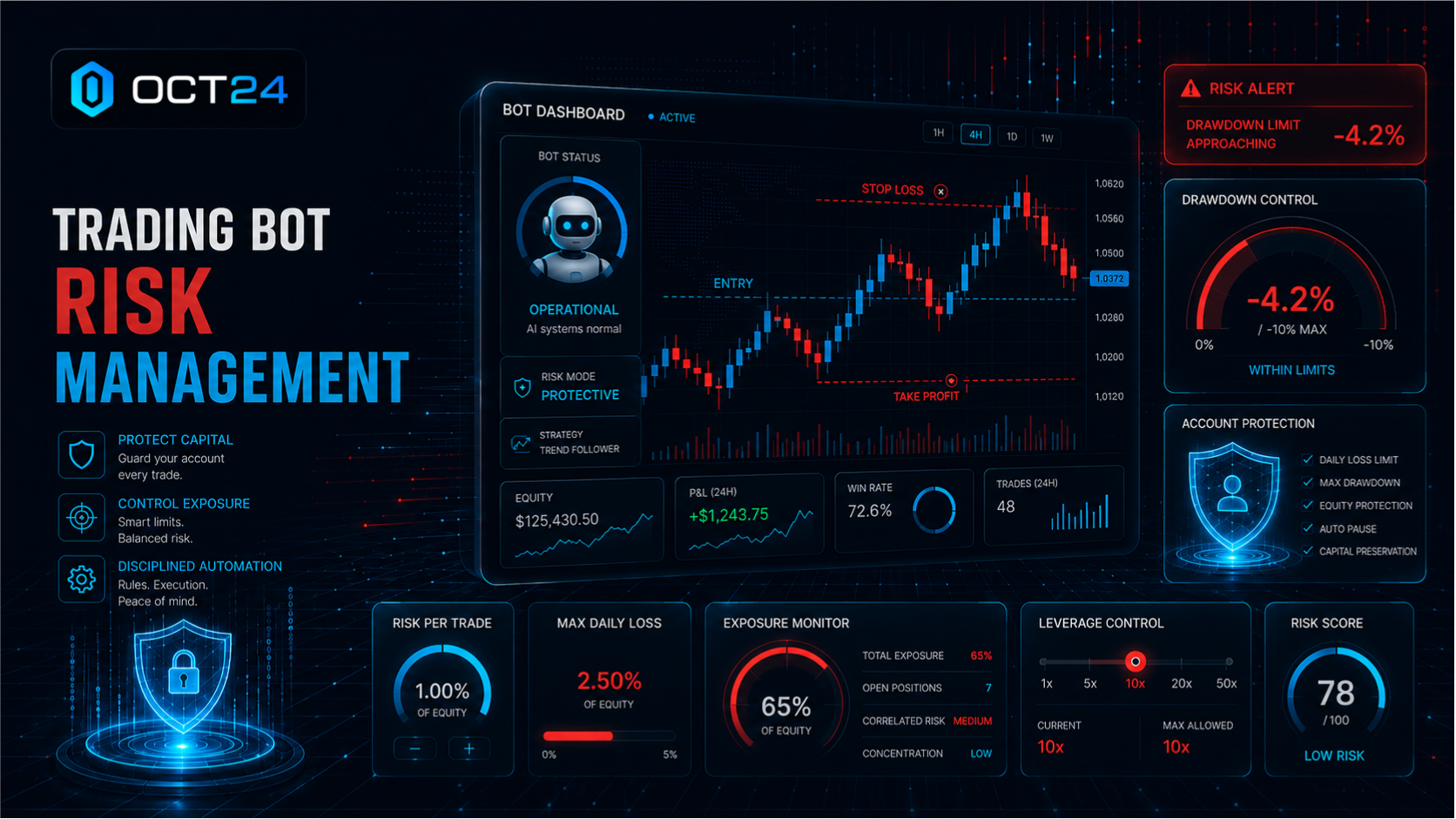
Trading Bot Risk Management means using clear rules to control how much risk a trading bot can take.
Trading bots can help traders scan markets, find possible opportunities, and execute trades faster. But they still need limits. A bot can act quickly, but speed can be risky if the settings are wrong.
A simple way to think about it is this:
A trading bot follows instructions. If the instructions are good, the bot can help create a more structured trading process. If the instructions are poor, the bot can repeat mistakes faster than a human trader would.
That is why risk management matters.
AI Trading Bots can help traders save time and reduce manual work, but they do not remove market risk. A bot can still lose money. A signal can still fail. A market can still move in the wrong direction.
OCT24 is designed to reduce the manual work involved in active trading. The platform performs much of the market analysis by scanning market conditions, identifying potential opportunities, and presenting AI-supported trading signals in a structured workflow.
But OCT24 does not guarantee results. Traders still need to choose sensible risk settings, understand their exposure, manage capital responsibly, and make informed trading decisions.
Good trading bot risk management helps answer questions like:
- How much should I risk on one trade?
- When should a trade close if it goes wrong?
- How many trades should the bot place?
- When should the bot stop trading?
- How much of my account is exposed?
- Are market conditions too risky right now?
The goal is not to remove risk completely. That is impossible in trading. The goal is to keep risk controlled, measured, and easier to manage.
Why Risk Management Matters With Trading Bots
Risk management matters because trading bots can act faster than humans.
That speed can be helpful. A bot can scan charts, monitor signals, and respond to market conditions without getting tired. This is one of the main reasons traders use Automated Trading.
But speed can also create problems.
If a bot has weak settings, it may repeat the same mistake again and again. If the bot is allowed to place too many trades, use large positions, or keep trading during unstable markets, losses can build quickly.
In Algorithmic Trading, the system follows rules. But rules are only useful if they are well designed.
For example, imagine a bot finds several trading setups during a volatile market. The signals may look interesting. But without limits, the bot could open too many positions at once.
That could expose the trader to too much risk.
This is why risk controls are important. They help define what the bot can and cannot do.
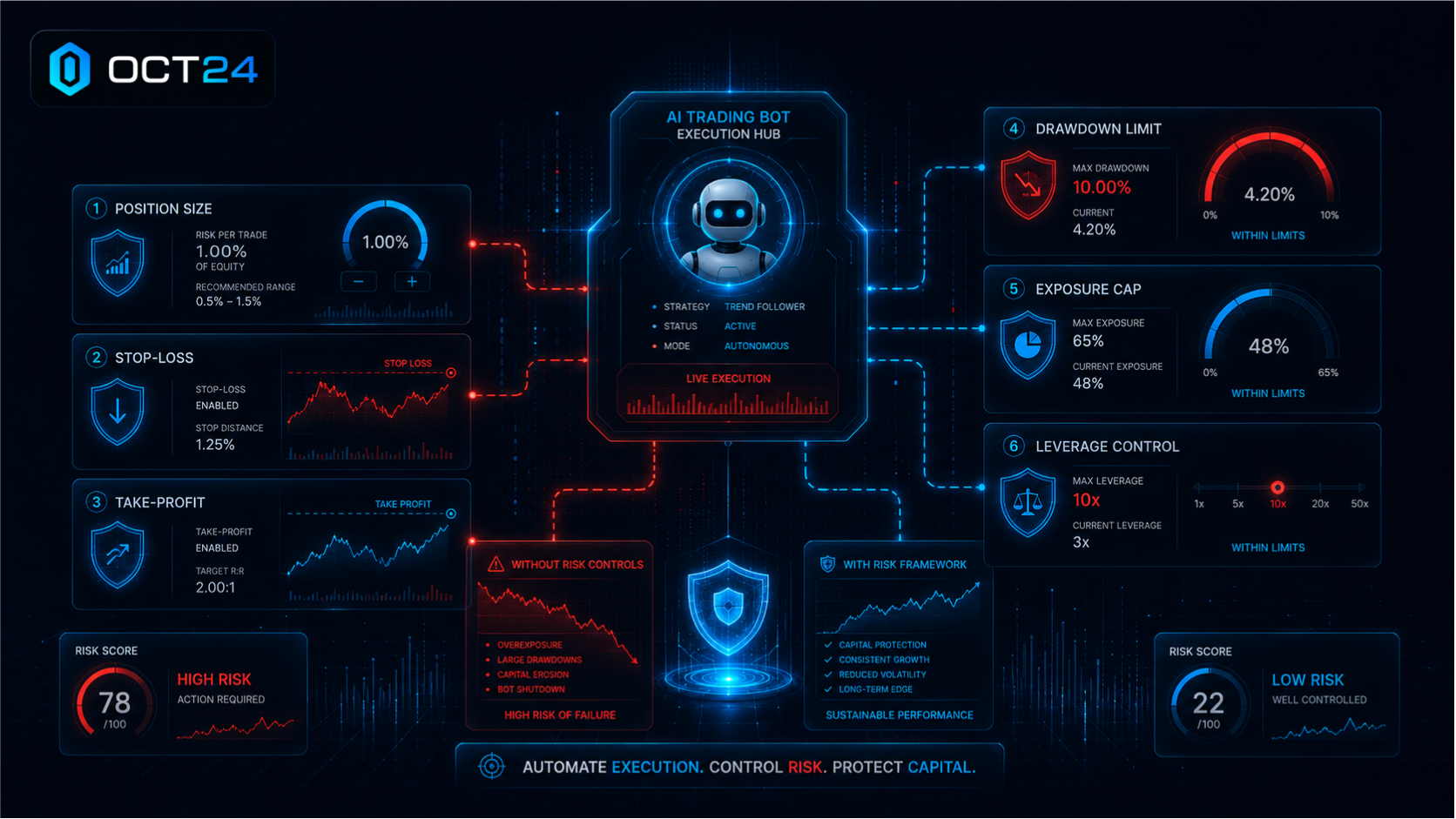
Strong risk controls may include:
- Position size limits
- Stop-loss rules
- Drawdown limits
- Leverage limits
- Trade frequency limits
- Exposure limits
- Regular performance reviews
These controls do not make trading risk-free. They help prevent one bad setup, one poor strategy, or one unstable market from causing more damage than expected.
This is also why the question Are Trading Bots Worth It? depends on how the bot is used. Trading bots can be useful when they support a clear strategy and sensible risk rules. They become dangerous when traders treat them like guaranteed profit machines.
OCT24 helps traders approach this process more carefully. The platform can perform much of the analysis, but traders still need to review risk settings and decide whether a trade fits their plan.
A trading bot should not be judged only by how fast it works. It should be judged by whether it follows a clear, controlled, and responsible process.
The Main Risks of Trading Bots
Trading bots can be useful, but they come with real risks.
The biggest risk is not usually the bot itself. It is how the bot is set up and used.
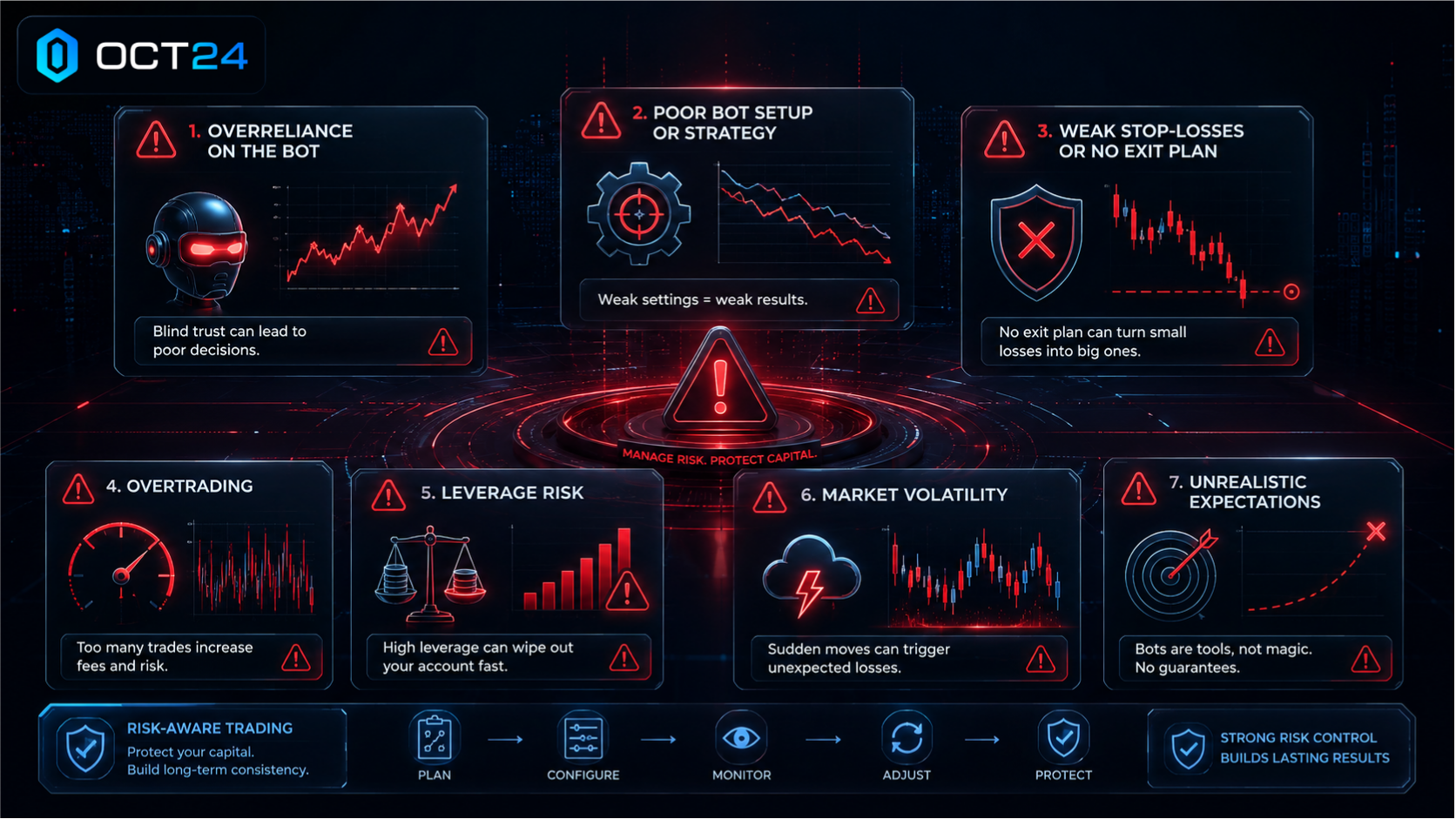
Here are the main risks traders should understand.
Overreliance on automation
Some traders assume the bot can do everything for them. This is a mistake.
A bot can scan markets, analyze signals, and support execution. But traders still need to understand risk, settings, and exposure.
Blindly trusting automation is one of the most common Common AI Trading Mistakes. The trader should still know what the bot is doing and why.
Poor strategy setup
A bot follows the strategy it is given.
If the strategy is weak, unclear, or too aggressive, the bot will not fix it. It may simply repeat the weak strategy faster.
This is why traders should understand their AI Trading Strategies before relying on automation.
Large position sizes
Position size means how much money is placed into a trade.
If the position is too large, one losing trade can have a big impact. If several large trades lose in a row, the damage can grow quickly.
This is especially important with crypto trading bots because markets can move fast.
Weak or missing stop-loss rules
A stop-loss helps define when a trade should close if the market moves against it.
Without a clear stop-loss or exit rule, a bot may stay in a losing trade longer than expected.
A bot should not only know when to enter a trade. It should also know when to exit.
Excessive leverage
Leverage allows traders to control a larger position with less capital.
This can increase potential gains, but it can also increase losses. When leverage is combined with automation, the risk can grow quickly if the bot keeps trading during poor conditions.
Overtrading
Overtrading means placing too many trades.
A bot can trade more often than a human trader. But more trades do not always mean better results.
Too many trades can increase:
- Fees
- Slippage
- Account exposure
- Stress
- Risk of repeated losses
A good bot workflow should focus on quality setups, not just activity.
Ignoring market volatility
Market Volatility can affect how well a bot performs.
A strategy that works well in calm conditions may struggle when prices move sharply. Fast markets can create false signals, sudden reversals, and wider price movements.
Strong bot settings still need to be reviewed when market conditions change.
Blindly trusting signals
AI Trading Signals can help organize market information, but they should not be treated as commands.
A signal is decision support. It helps the trader understand a possible setup. It does not guarantee that the trade will work.
OCT24 can help traders review AI-supported signals in a structured way, but traders still need to consider risk before acting.
Unrealistic expectations
One of the most harmful AI Trading Myths is that bots guarantee profits.
They do not.
Trading bots can help with speed, analysis, monitoring, and execution support. But every trade still carries risk.
A responsible trader should use a bot as part of a risk-aware trading plan, not as a shortcut around risk.
Position Sizing: The Foundation of Trading Bot Risk Management
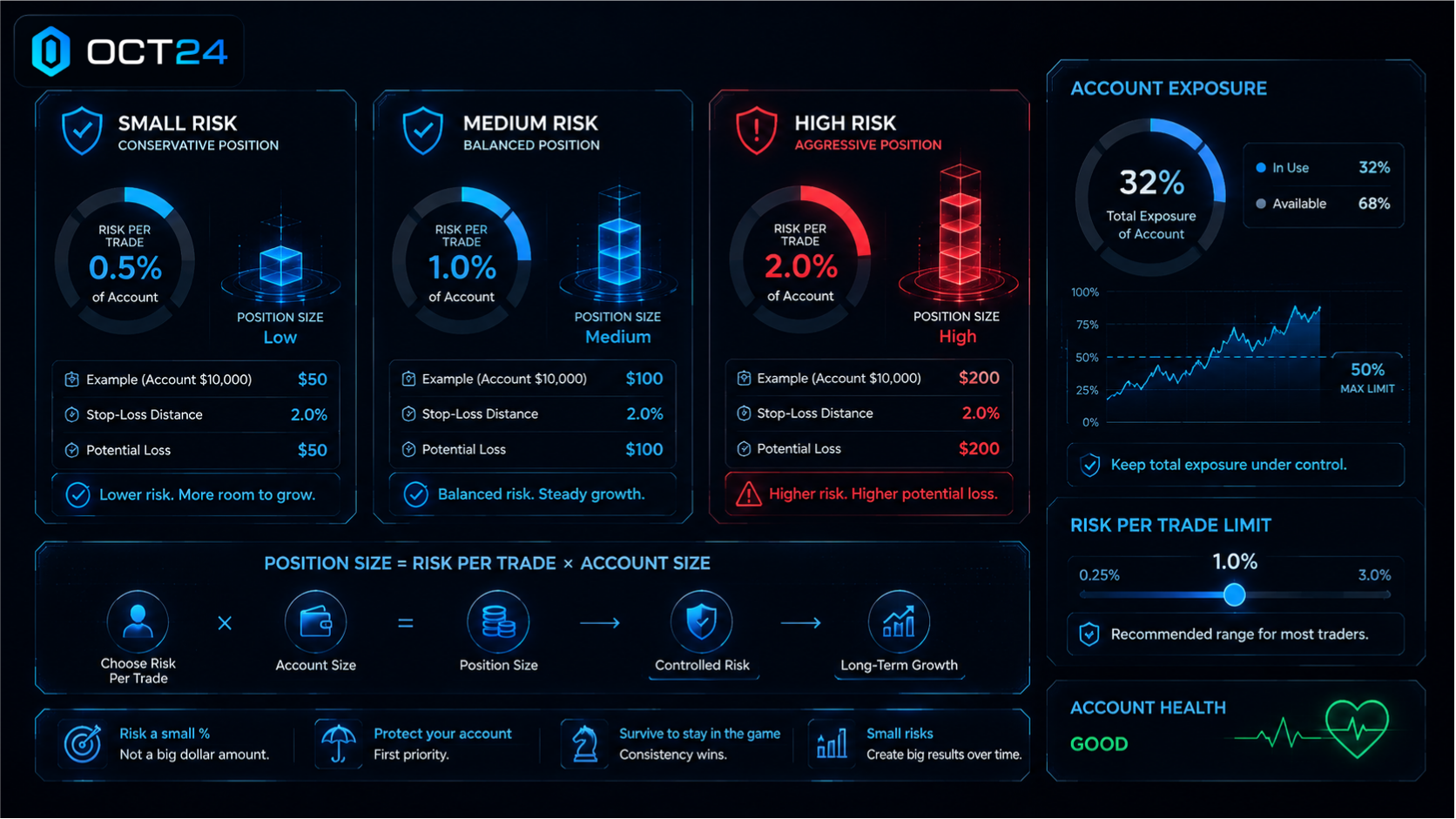
Position sizing means deciding how much capital to use on a trade.
It is one of the most important parts of Trading Bot Risk Management because it controls how much damage one losing trade can do.
A simple rule is:
Before thinking about how much a trade could make, think about how much it could lose.
This is especially important for beginners. A strong signal can still fail. A good setup can still lose. A market can still move suddenly in the wrong direction.
If the position size is too large, one loss can hurt the account. If several losses happen in a row, the account can decline quickly.
For example, imagine two traders using the same bot.
One trader uses large position sizes on every trade. The other trader uses smaller, controlled position sizes.
If both traders have five losing trades in a row, the first trader may suffer serious account damage. The second trader may still have room to review the strategy and continue more calmly.
That is why position sizing matters.
It helps traders stay in control even when the market does not behave as expected.
Position sizing also connects closely to AI Trading Risk vs Reward. Traders should not only ask whether a trade has potential upside. They should ask whether the possible reward is worth the possible loss.
Trading bots can apply position size rules consistently. A bot does not suddenly increase trade size because it feels excited or frustrated.
But the trader still needs to choose sensible settings.
OCT24 can support this process by helping traders review opportunities, signals, and risk settings before execution. Since OCT24 performs much of the market analysis, traders can spend more time checking whether the trade size fits their plan.
Position sizing may sound simple, but it is one of the most important controls in automated trading.
A bot without sensible position sizing can turn a normal losing trade into a serious account problem.
Stop-Losses and Exit Rules
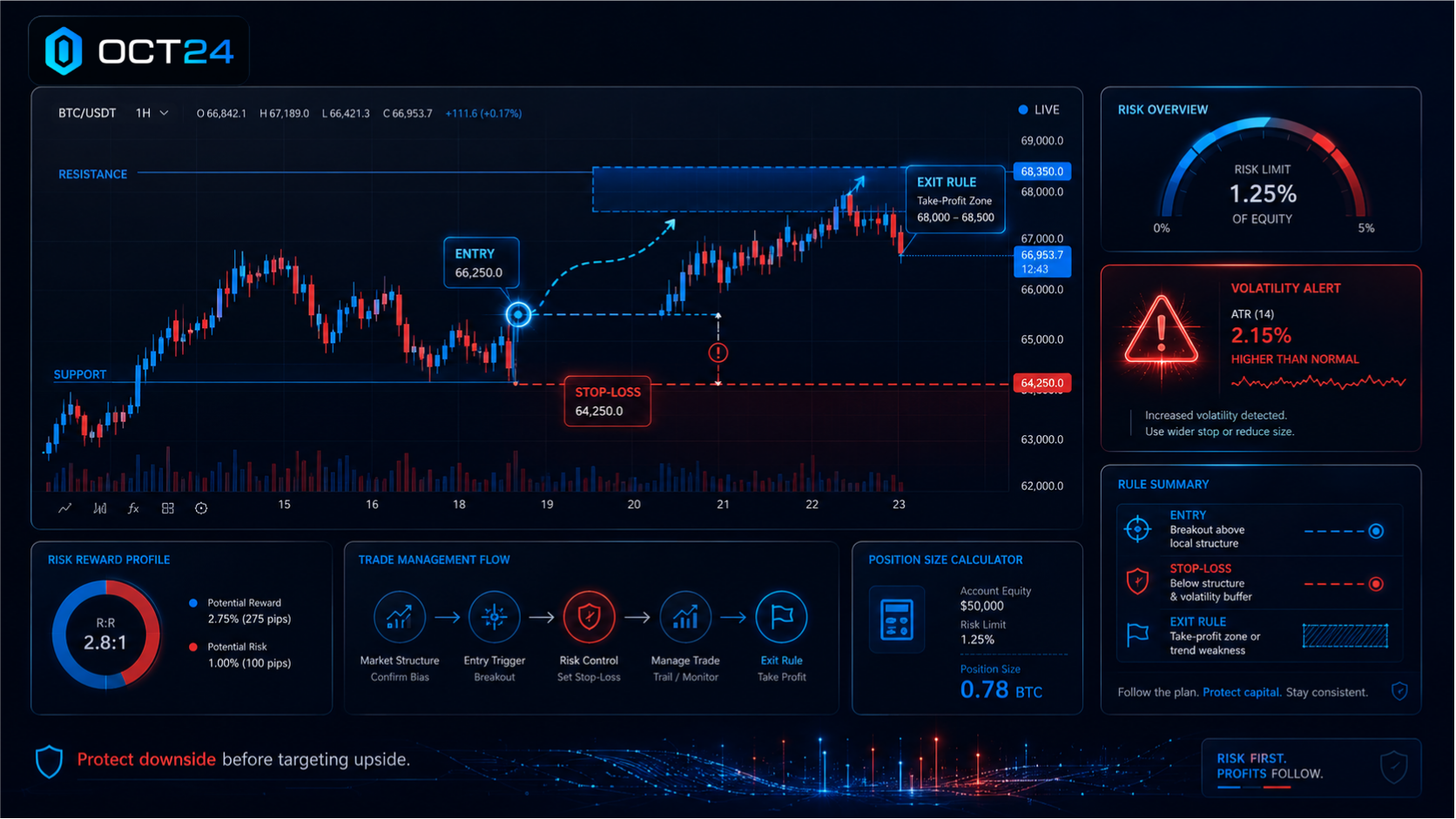
A stop-loss is a rule that closes a trade if the price moves too far in the wrong direction.
It helps define the risk before the trade is placed.
For trading bots, stop-losses and exit rules are essential. A bot should not only know when to enter a trade. It should also know when to leave.
This matters because markets do not always move as expected.
A trade may look strong at first, then quickly fail. Without an exit rule, the bot may stay in the trade longer than the trader intended.
Stop-losses help traders answer a simple question:
“At what point is this trade no longer worth staying in?”
Exit rules can also reduce emotional decision-making.
A human trader may hesitate to close a losing trade because they hope the price will recover. A bot can follow the exit rule without fear or hesitation, as long as the rule is set correctly.
However, stop-losses are not perfect.
In fast markets, price can move quickly. The final exit price may be different from the expected stop level. This is called slippage.
Volatility can also cause price to briefly move through a stop level before reversing.
That is why traders should understand the chart before setting exits. How to Read Crypto Charts can help traders understand support, resistance, trends, and price levels.
AI-supported tools may also use technical information to help review exits. How AI Uses Technical Analysis explains how AI can analyze price action, volume, volatility, and trend conditions.
OCT24 can help traders review AI-supported signals, technical context, and risk settings before acting. But traders still need to understand what the exit plan means.
A good exit rule should consider:
- Where the trade idea becomes invalid
- How volatile the market is
- How much the trader is willing to lose
- Whether the stop is too tight or too wide
- Whether the position size matches the stop distance
A stop-loss should not be random. It should fit the strategy and the risk plan.
Without clear exit rules, a trading bot is incomplete.
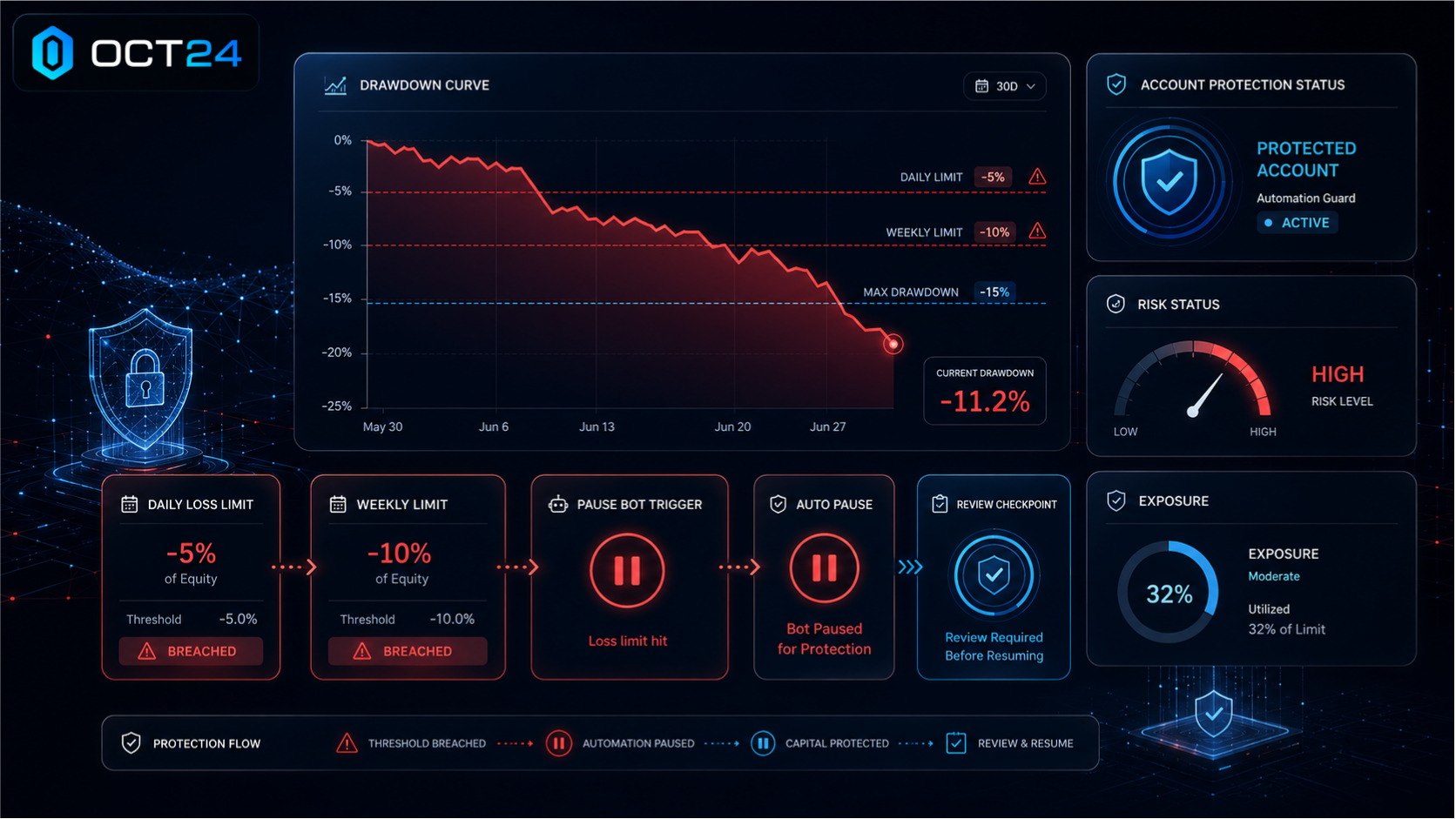
Drawdown Limits and Account Protection
Drawdown means a drop in account value from a previous high.
For example, if an account grows and then falls, the decline is called drawdown.
Every trading strategy can go through drawdowns. Even strong strategies can have losing streaks. Market conditions can change. Signals can fail. Volatility can increase.
Drawdown limits help protect the account from larger declines.
A drawdown limit tells the bot when to slow down, pause, or stop trading. This can help prevent one bad period from becoming a much bigger problem.
For example, a trader may set:
- A daily loss limit
- A weekly loss limit
- A maximum strategy drawdown
- A rule to pause trading after several losses
- A review point after a certain account decline
These limits are important because bots can keep trading unless they are told to stop.
Without drawdown limits, a bot may continue placing trades during poor market conditions. It may follow the rules correctly, but the rules may no longer fit the market.
This is where Trading Bots vs Human Traders becomes useful to understand.
Bots can follow drawdown limits consistently. They do not get emotional. They do not try to “win it back.”
Human traders may struggle with this. After losses, some traders may feel tempted to increase risk, override rules, or keep trading out of frustration.
That is why a Consistent Trading Routine matters.
Traders should regularly review bot performance and account health. This helps them understand whether the bot is following the plan or whether the settings need to be reviewed.
A simple drawdown review can include questions like:
- Did the bot follow the strategy?
- Were position sizes too large?
- Did the market become more volatile?
- Were too many trades placed?
- Did several trades depend on the same market direction?
- Was the stop-loss too wide or too tight?
- Did the trader override any rules?
OCT24 can support this kind of structured review by helping traders organize signals, risk factors, and performance information.
The goal is not only to find trading opportunities. The goal is also to protect the trading plan when conditions are not favorable.
Once traders understand position sizing, stop-losses, and drawdown limits, they can look at the next layer of risk: leverage, portfolio exposure, trade frequency, market volatility, and performance review.
A trading bot can make the process faster. Risk controls help make that speed more responsible.
Leverage Risk: Why Automation Can Magnify Losses
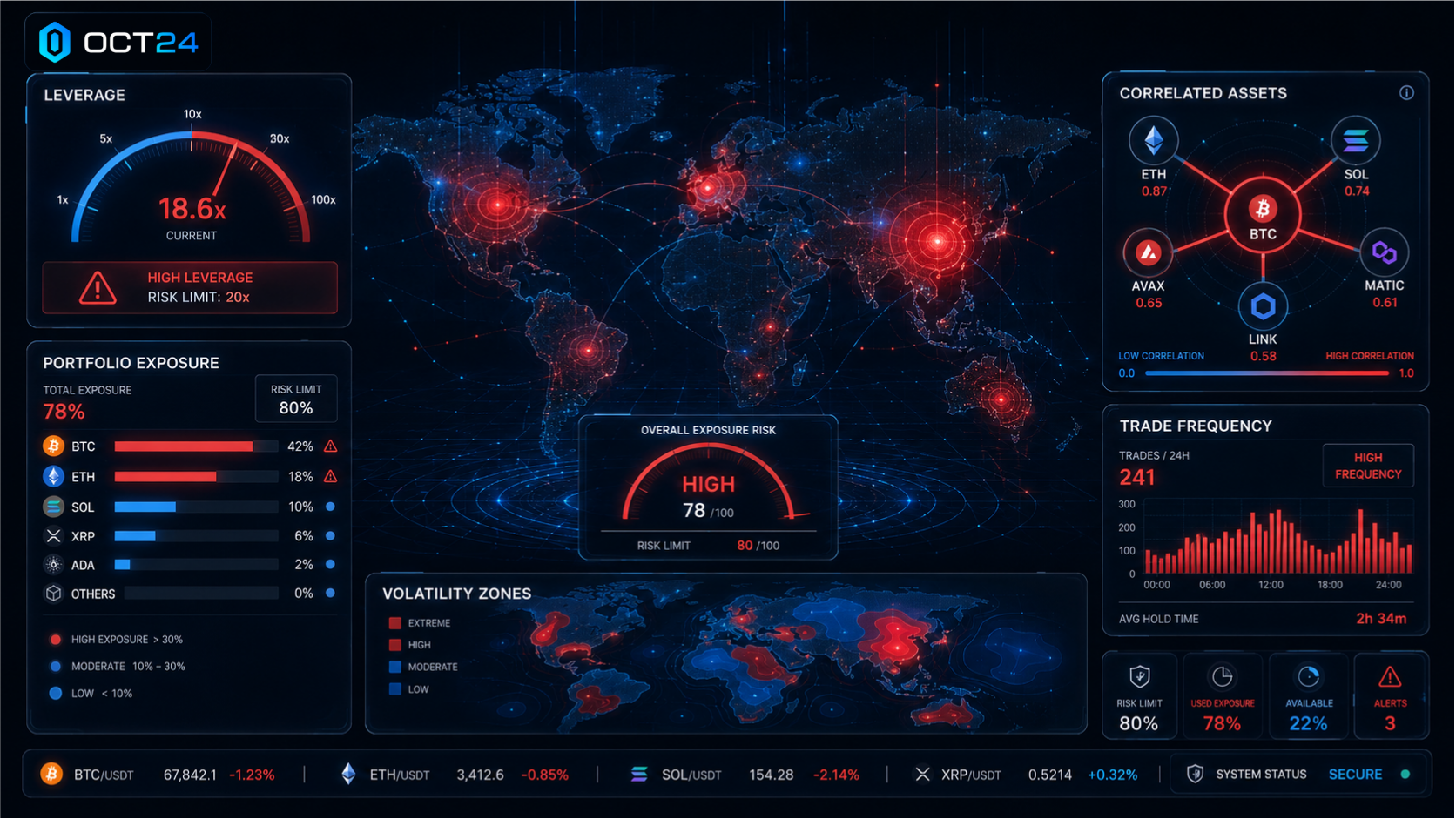
Leverage means using borrowed funds or margin to open a larger trade.
It can increase potential gains.
But it can also increase potential losses.
This is why leverage risk is important when using trading bots.
A bot can scan the market quickly. It can identify signals quickly. It can also execute trades quickly.
But leverage does not become safer just because a bot is involved.
If the leverage setting is too high, a small price move can create a large loss. This can happen even if the bot followed the rules correctly.
For beginners, high leverage can be especially dangerous. The trade may look small at first, but the real risk may be much larger than expected.
This becomes even more serious during Market Volatility.
When markets move quickly, prices can rise or fall sharply. A leveraged trade can lose value much faster in these conditions. If the bot keeps trading with high leverage, losses may grow before the trader has time to react.
That is why traders should think about AI Trading Risk vs Reward before using leverage.
The question is not only:
“How much could this trade make?”
The better question is:
“How much could this trade lose if the market moves against me?”
Before using leverage with a trading bot, traders should set clear limits.
These may include:
- Maximum leverage per trade
- Maximum account exposure
- Daily loss limits
- Rules for pausing the bot
- Lower leverage during volatile markets
OCT24 can support a more structured workflow by helping traders review signal quality, risk settings, and exposure before execution. OCT24 performs much of the market analysis, but traders still need to decide whether the level of risk is appropriate.
Leverage should be used carefully.
A fast bot with aggressive leverage can create problems quickly if the risk rules are weak.
Portfolio Exposure and Correlated Risk
Portfolio exposure means the total amount of risk across all open trades.
Many traders only look at one trade at a time. But this can be misleading.
A single trade may look reasonable. But several trades together may create too much risk.
This is especially important with crypto trading bots.
A bot may open several trades across different crypto assets. At first, this may look diversified. But many crypto assets often move in the same direction.
For example, a trader may have five open trades:
- Bitcoin
- Ethereum
- Solana
- XRP
- Another altcoin
These may look like five separate trades.
But if Bitcoin drops sharply, the other assets may fall too. This means the account may be more exposed than the trader realizes.
This is called correlated risk.
Assets are correlated when they tend to move together. In crypto markets, many assets are affected by Bitcoin direction, liquidity, and overall market sentiment.
This is why traders need to monitor total account exposure, not just individual trades.
Different AI Trading Strategies can also be exposed to the same market trend. A breakout strategy, a momentum strategy, and a trend-following strategy may all struggle if the market suddenly reverses.
One of the Benefits of AI Trading is that AI-supported systems can scan more data and organize market information faster.
But more signals do not always mean better diversification.
A trader still needs risk controls.
OCT24 can help traders organize market analysis, AI-supported signals, and exposure in a more structured way. The platform can identify potential opportunities, but traders still need to check whether several trades create too much combined risk.
Diversification can help reduce some risks.
But it does not remove risk completely.
A trader should always ask:
“Are these trades truly different, or are they all depending on the same market move?”
Trade Frequency Limits and Overtrading
Trade frequency means how often trades are placed.
With trading bots, this matters because bots can trade faster than humans.
A human trader may pause, review a chart, compare signals, and think before entering. A bot can act much faster if the rules allow it.
That speed can be useful.
But it can also lead to overtrading.
Overtrading means placing too many trades. This can happen when a bot enters too many setups without enough quality control.
Too many trades can increase:
- Fees
- Slippage
- Account exposure
- Stress
- Repeated losses
- Poor decision-making
More trades do not always mean better results.
This is one of the most common Common AI Trading Mistakes. Some traders believe that more activity means more opportunity. But the quality of each setup matters more than the number of trades.
Trade frequency limits can help.
A trader may set rules such as:
- Maximum trades per day
- Maximum open positions
- Minimum time between trades
- Limits on repeated entries
- Limits on trading the same asset too often
These controls help prevent the bot from becoming too active during noisy market conditions.
The comparison between Trading Bots vs Human Traders is useful here. Bots can follow frequency limits consistently if the rules are set. Humans may be tempted to override rules after a win, a loss, or a missed opportunity.
That is why a Consistent Trading Routine still matters.
Traders should review bot activity regularly. They should check whether the bot is placing quality trades or simply placing too many trades.
A review can include:
- How many trades were placed?
- Were the trades aligned with the strategy?
- Were fees too high?
- Was slippage a problem?
- Were too many trades opened during volatile conditions?
- Did the trader override any settings?
OCT24 can help traders review opportunities in a more structured way by organizing AI-supported signals and risk information before execution.
A trading bot should not be judged by how busy it is.
It should be judged by whether it follows a clear strategy, respects risk limits, and fits the trader’s plan.
Market Volatility and Changing Conditions
Market conditions can change quickly.
A strategy that works well in one market may struggle in another.
This is why trading bots should not be treated as “set and forget” systems.
Market Volatility can affect signal quality. During unstable periods, prices can move sharply. Breakouts may fail. Reversals may happen quickly. Signals may appear strong at first, then fail soon after.
For example, a breakout strategy may work well when the market is trending smoothly.
But in a choppy market, the same strategy may enter several false breakouts.
The bot may follow the rules correctly. But the market environment may no longer support the strategy.
This is why traders should understand How AI Identifies Trading Opportunities connects to risk. AI can scan for setups, but a setup is not a guarantee.
AI Trading Signals should be reviewed in context.
A signal may show a possible opportunity, but the trader should still consider:
- Volatility
- Liquidity
- Overall trend
- Market sentiment
- Open exposure
- Position size
- Risk settings
One of the most common AI Trading Myths is that trading bots work equally well in every market condition.
They do not.
Some strategies work better in trending markets. Others may work better in range-bound markets. Some may struggle when volatility rises sharply.
This does not mean traders should constantly change settings emotionally.
That can create new problems.
Instead, traders should review performance carefully. Settings should only be adjusted when there is a clear reason.
OCT24 can help traders evaluate market conditions, signal strength, and risk factors before acting. Since OCT24 performs much of the market analysis, traders can use the information to make more structured decisions.
Trading bots can help traders respond faster.
But they still need monitoring.
Markets change, and risk settings need to reflect that.
Practical Example: Risk Controls Before a Bot Trade
Imagine a crypto asset begins moving quickly after a breakout.
The price moves above a key level. Volume increases. Momentum starts to build.
OCT24 scans the market conditions and identifies a potential opportunity. The system presents an AI-supported signal in a structured workflow.
The G6 Trading Bot helps organize the automation workflow. Instead of manually scanning every chart and indicator, the trader can review the setup more clearly.
Before execution, the trader checks the risk controls.
They review:
- Position size
- Stop-loss placement
- Drawdown limits
- Leverage
- Total portfolio exposure
- Current market volatility
The trader also checks whether other open trades are already exposed to the same market direction.
If volatility is unusually high, the trader may decide to reduce position size, avoid leverage, wait for more confirmation, or skip the trade.
Only after this review does the trader decide whether the setup fits their plan.
One-Click Trading can help make execution faster, but it should come after risk review, not before it.
After the trade, the trader reviews performance.
They can ask:
- Did the bot follow the rules?
- Was the position size reasonable?
- Did volatility affect execution?
- Was the signal reviewed in context?
- Did the trade fit the strategy?
- Were risk limits followed?
This example shows that responsible trading bot use is not only about finding opportunities.
It is also about controlling downside before, during, and after the trade.
How OCT24 Supports Risk-Aware Trading Bot Workflows
OCT24 is designed to reduce the manual work involved in active trading while supporting more structured, risk-aware decision-making.
The platform does not simply leave traders to analyze everything on their own. OCT24 performs much of the market analysis by scanning conditions, identifying potential opportunities, and presenting AI-supported trading signals in an organized workflow.
This matters because active trading can involve many moving parts.
Traders may need to review:
- Trend direction
- Volatility
- Technical signals
- Risk settings
- Open positions
- Execution timing
- Performance history
Without structure, it is easy to feel overwhelmed or make rushed decisions.
OCT24 can help by:
- Scanning market conditions
- Identifying potential trading opportunities
- Analyzing market trends
- Reviewing technical signals
- Presenting AI-supported trading signals
- Supporting faster execution
- Helping traders review performance over time
The G6 Trading Bot can support this workflow by helping traders use automation more efficiently. It can help organize market analysis, opportunity detection, and execution support inside a more structured trading process.
This is also why Choosing the Right AI Trading Platform matters.
Traders should look for more than speed.
A useful platform should support:
- Market analysis
- Signal review
- Risk controls
- Execution tools
- Performance visibility
- Responsible trading workflows
OCT24 can help traders review AI-supported trading signals, check risk settings before execution, use automation more thoughtfully, support One-Click Trading after review, apply position sizing and risk controls, monitor bot performance, reduce emotional decision-making, and build a more disciplined trading workflow.
Still, OCT24 does not guarantee results.
Traders need to choose appropriate settings, understand exposure, manage capital responsibly, and use the platform with realistic expectations.
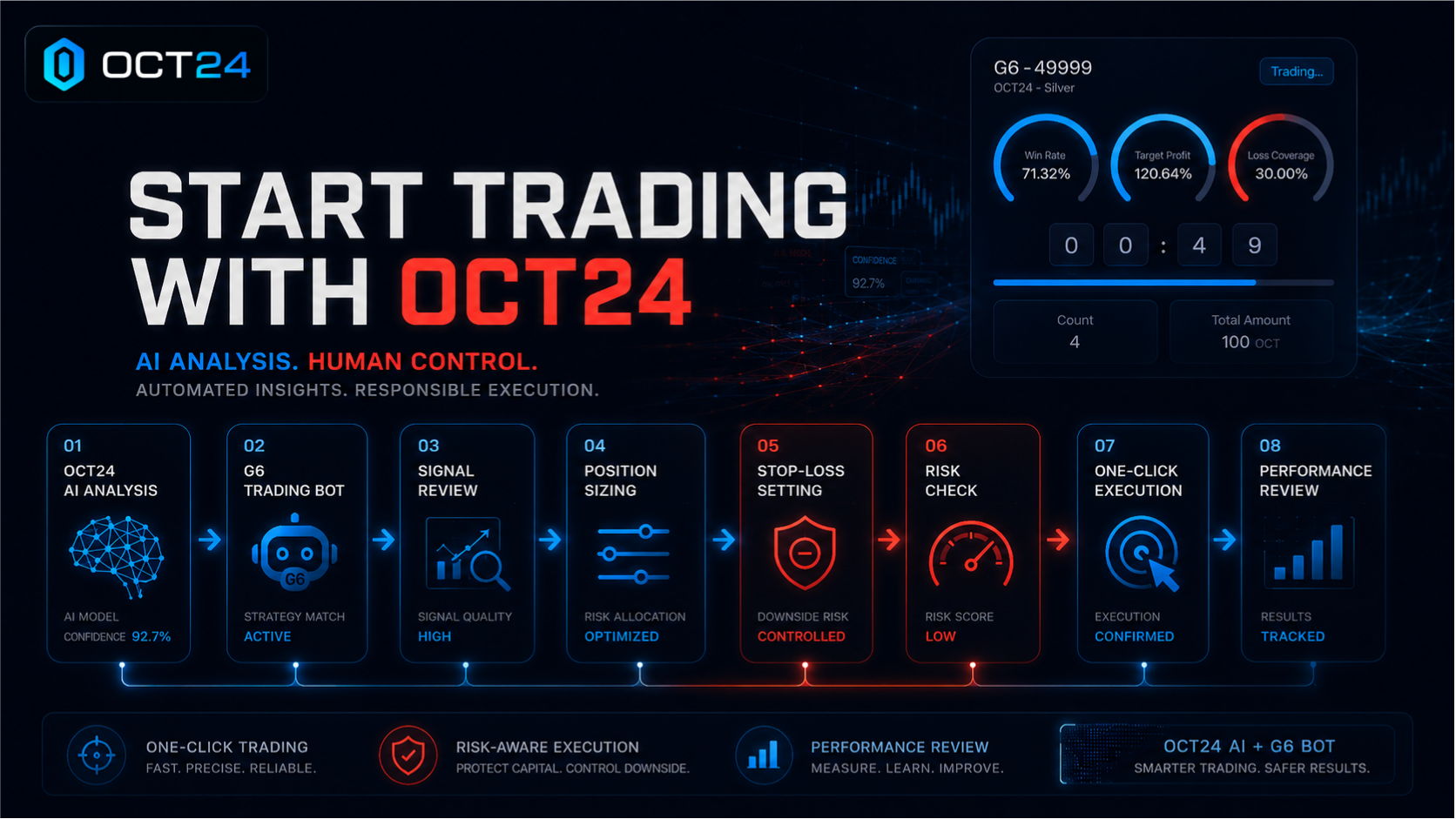
For readers who want to understand the company’s broader approach, About OCT24 can provide more context. For traders ready to explore a more structured AI-assisted workflow, Start Trading with OCT24 can be the next step after understanding the risks and responsibilities involved.
Trading Bot Risk Management Checklist
Before relying on automation, traders should review a simple checklist.
Ask these questions before using a trading bot:
- Is the position size reasonable?
- Is a stop-loss or exit rule clearly defined?
- Are drawdown limits set?
- Is leverage controlled?
- Is total portfolio exposure understood?
- Are trade frequency limits in place?
- Is the strategy suitable for current market volatility?
- Are signals being reviewed in context?
- Is performance being reviewed regularly?
- Are expectations realistic?
This checklist does not remove risk.
But it helps traders slow down before execution.
That matters because trading bots can act quickly. A structured review helps make sure that speed is supported by risk controls.
Trading bot safety depends on more than the bot itself.
It depends on the strategy, the settings, the market environment, and the trader’s discipline.
Frequently Asked Questions
What is trading bot risk management?
Trading bot risk management means using rules and limits to control how a trading bot operates. This includes position sizing, stop-losses, drawdown limits, leverage controls, portfolio exposure, trade frequency, and performance review.
Are trading bots risky?
Yes. Trading bots carry risk because markets are uncertain. Bots can improve speed and consistency, but they do not guarantee profits or remove the need for risk controls.
Can trading bots lose money?
Yes. Trading bots can lose money if market conditions change, the strategy performs poorly, risk settings are too aggressive, or signals fail.
What is the most important risk control for trading bots?
Position sizing is one of the most important risk controls because it decides how much capital is exposed on each trade. Stop-losses, drawdown limits, leverage controls, and exposure limits are also important.
Why does position sizing matter with trading bots?
Position sizing matters because a bot can place trades quickly and repeatedly. If the position size is too large, a short losing streak can cause serious account damage.
Should trading bots use stop-losses?
Trading bots should usually have clear exit rules. A stop-loss can help define risk before a trade is placed, although it does not guarantee perfect protection in fast or volatile markets.
How does leverage affect trading bot risk?
Leverage increases both potential gains and potential losses. When combined with automation, high leverage can increase drawdowns quickly if the bot keeps trading during poor conditions.
Can trading bots handle market volatility?
Trading bots can monitor volatile markets and respond quickly, but volatility can increase risk. Traders should review settings, exposure, and strategy performance when market conditions change.
How does OCT24 support risk-aware trading?
OCT24 supports risk-aware trading by performing much of the market analysis, identifying potential opportunities, presenting AI-supported signals, and helping traders review risk settings before execution.
What is the G6 Trading Bot?
The G6 Trading Bot is part of OCT24’s AI-assisted trading workflow. It can support market analysis, opportunity detection, automation, and structured execution while still requiring responsible risk settings.
Trading Bot Risk Management: Key Takeaways
Trading bots can improve speed, consistency, monitoring, and execution support.
But they still need strong risk controls.
Automation can make trading more efficient. It can also make poor settings more dangerous if traders do not manage risk carefully.
Effective Trading Bot Risk Management should focus on:
- Position sizing
- Stop-losses
- Drawdown limits
- Leverage control
- Portfolio exposure
- Trade frequency
- Market volatility
- Performance review
- Realistic expectations
OCT24 brings these elements together by performing much of the market analysis while still supporting trader control, risk management, and structured execution.
The platform can scan market conditions, identify potential opportunities, and present AI-supported trading signals. But traders still need to choose appropriate settings, understand exposure, and manage capital responsibly.
A trading bot should not be treated as a shortcut around risk.
It should be used as part of a structured workflow where AI-powered analysis supports better decisions and risk controls help protect the trading plan.
To explore a more structured AI-assisted trading workflow, Start Trading with OCT24.