
How to Build a Weekly AI Trading Review
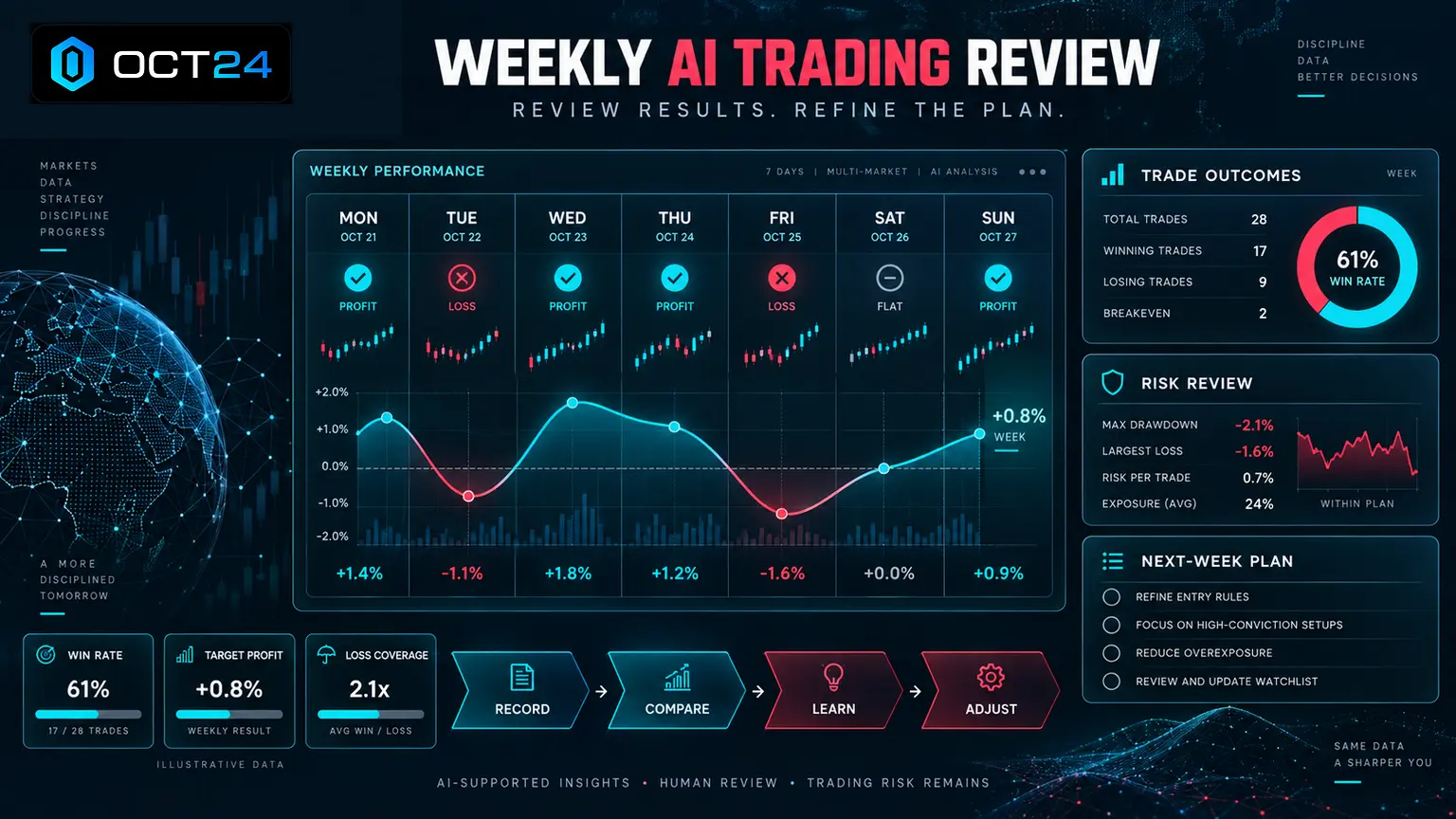
A weekly AI trading review is a simple routine for checking what happened in your crypto trades, what your signals showed, and what you may need to adjust before the next trading week. It helps traders slow down, review decisions with more structure, and avoid repeating the same mistakes.
OCT24 can support this process by scanning market conditions, identifying potential crypto trading opportunities, and presenting AI-supported trading signals. The trader still remains responsible for risk settings, exposure, capital allocation, and execution decisions.
The goal is not to predict every market move. The goal is to build a clear weekly habit that makes trading less emotional and more consistent.
Why a Weekly AI Trading Review Matters
Crypto markets move quickly. Prices can change while you are working, sleeping, traveling, or simply away from the screen. That speed can make trading feel reactive if you only look at the market when something dramatic happens.
A weekly review creates a pause. Instead of judging one trade in isolation, you look at the whole week. You can see whether your trade activity matched your risk plan, whether you overreacted to volatility, and whether you followed the information in front of you.
This is especially useful for people using AI Trading tools. AI can scan more market data than a human can reasonably check manually, but traders still need a review process. A signal can look interesting in the moment and still require disciplined risk thinking.
A weekly AI trading review helps you ask better questions. Did I activate too many trades? Did I ignore loss coverage? Did I focus only on target profit? Did my position size fit my account? Did I trade because the signal made sense, or because I felt impatient?
These questions are simple, but they matter. They turn trading from a stream of random decisions into a routine you can actually improve.
What OCT24 Handles Before Your Weekly Review
OCT24 is designed to do much of the heavy analysis before a trader reviews an opportunity. It scans crypto market conditions, looks for potential trading setups, and presents AI-supported signals in a format that is easier to review.
This matters because many beginners do not know which charts to check first. They may jump between coins, indicators, social posts, and news headlines. That can become overwhelming fast.
With OCT24, the workflow is more focused. The platform helps bring potential opportunities forward, then the trader decides whether the opportunity fits their own risk limits and trading plan.
OCT24 does not make trading risk disappear. It does not guarantee a winning trade, a specific result, or a perfect signal. It supports analysis and signal review, while the trader stays responsible for how much capital to use, how much exposure to take, and whether to activate a trade.
That is why the weekly review is useful. It gives you a regular place to compare what the AI presented with what actually happened afterward.
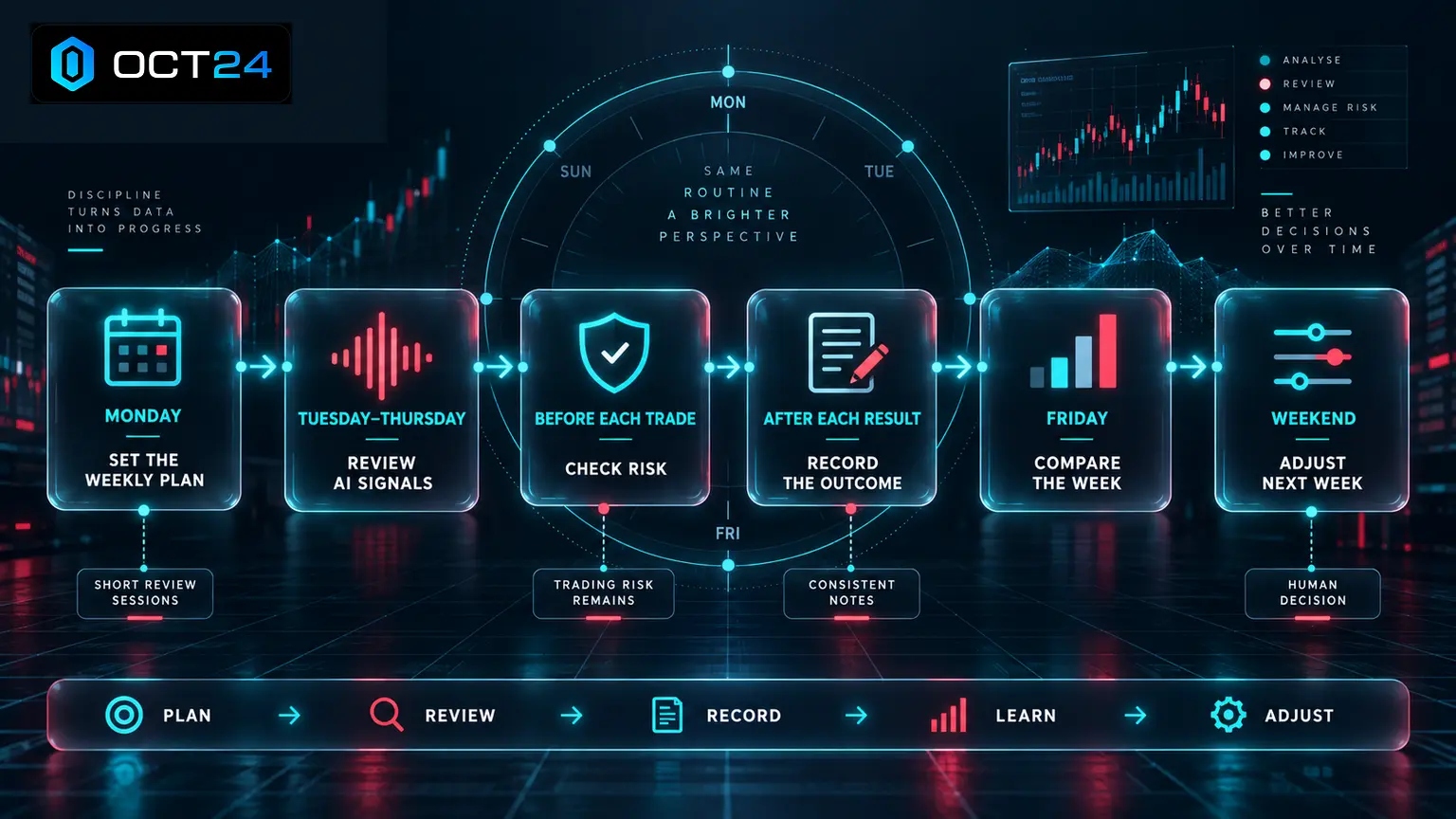
Start With a Simple Weekly Trading Snapshot
Do not start your weekly review with a complicated spreadsheet. Start with a simple snapshot. The point is to understand your trading behavior, not to create a report that takes hours to maintain.
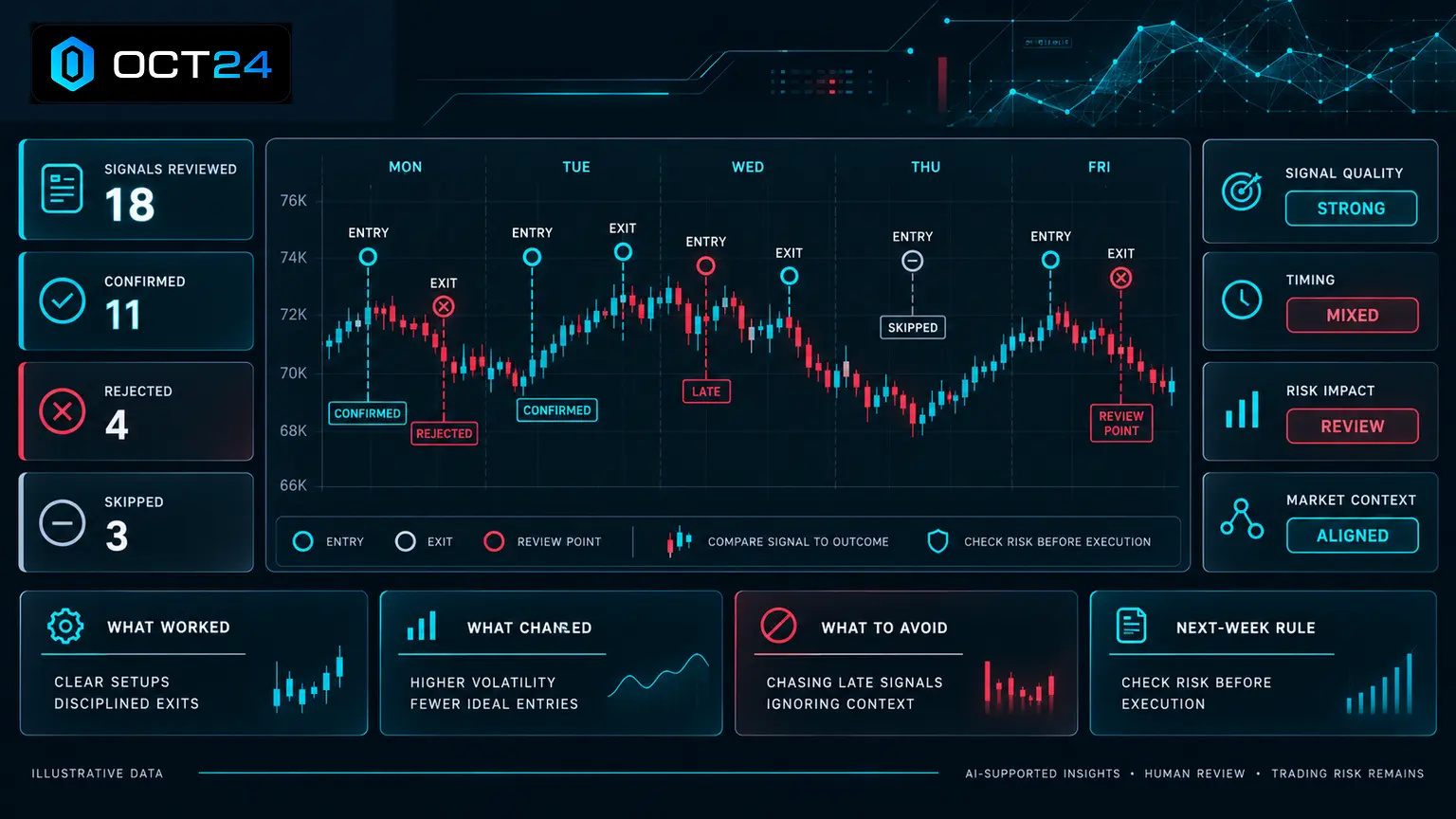
A useful weekly snapshot can include the number of trades you reviewed, the number you activated, the number you skipped, and whether the week felt calm or rushed. This gives you a basic picture of your decision-making pace.
For beginners, this is often more helpful than advanced performance ratios. If you activated every signal because you did not want to miss out, that tells you something. If you skipped every signal because you were afraid after one loss, that also tells you something.
The best weekly review is honest and short enough that you will actually keep doing it. A review that takes ten minutes every week is usually more useful than a perfect review that you abandon after two weeks.
If you use OCT24, your snapshot can be centered around signal review. You can look at what the platform presented, what you activated, and whether your decisions matched the risk level you were comfortable with.
- How many OCT24 signals did I review this week?
- How many trades did I activate?
- Which signals did I skip, and why?
- Did I feel rushed, calm, or unsure?
- Did my total exposure stay within my comfort zone?
Review Signal Quality, Not Just Trade Results
Many traders make the same mistake during a weekly review. They only ask whether they made or lost money. That question matters, but it is not enough.
A trade can lose even when the original setup was reasonable. A trade can win even when the decision was careless. If your review only looks at the final result, you may reward bad habits or punish good discipline.
A better review asks whether the signal was clear, whether the metrics made sense, and whether the decision matched your plan. This is where AI trading signals become easier to evaluate. You are not just reacting to a chart. You are reviewing structured information.
For OCT24 users, this means looking beyond one outcome. The platform may present an opportunity based on market scanning and AI-supported analysis. Your weekly review should then check whether you understood the signal, respected your risk limits, and avoided emotional activation.
This approach helps traders avoid the common trap of judging a trading system too quickly. One week is only one sample. The review is not there to declare success or failure forever. It is there to improve how you make decisions next week.
The Three Signal Metrics to Review Every Week
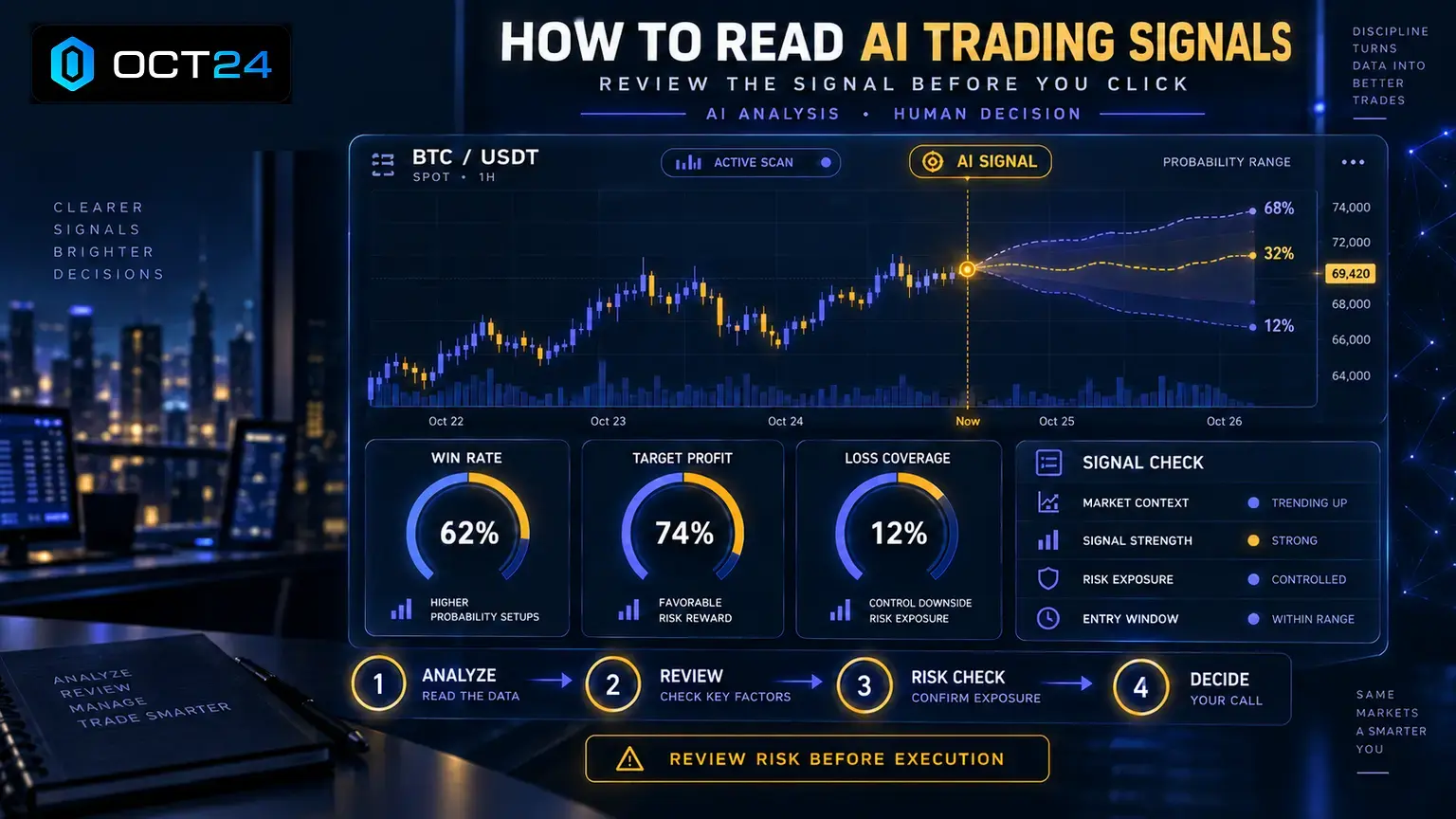
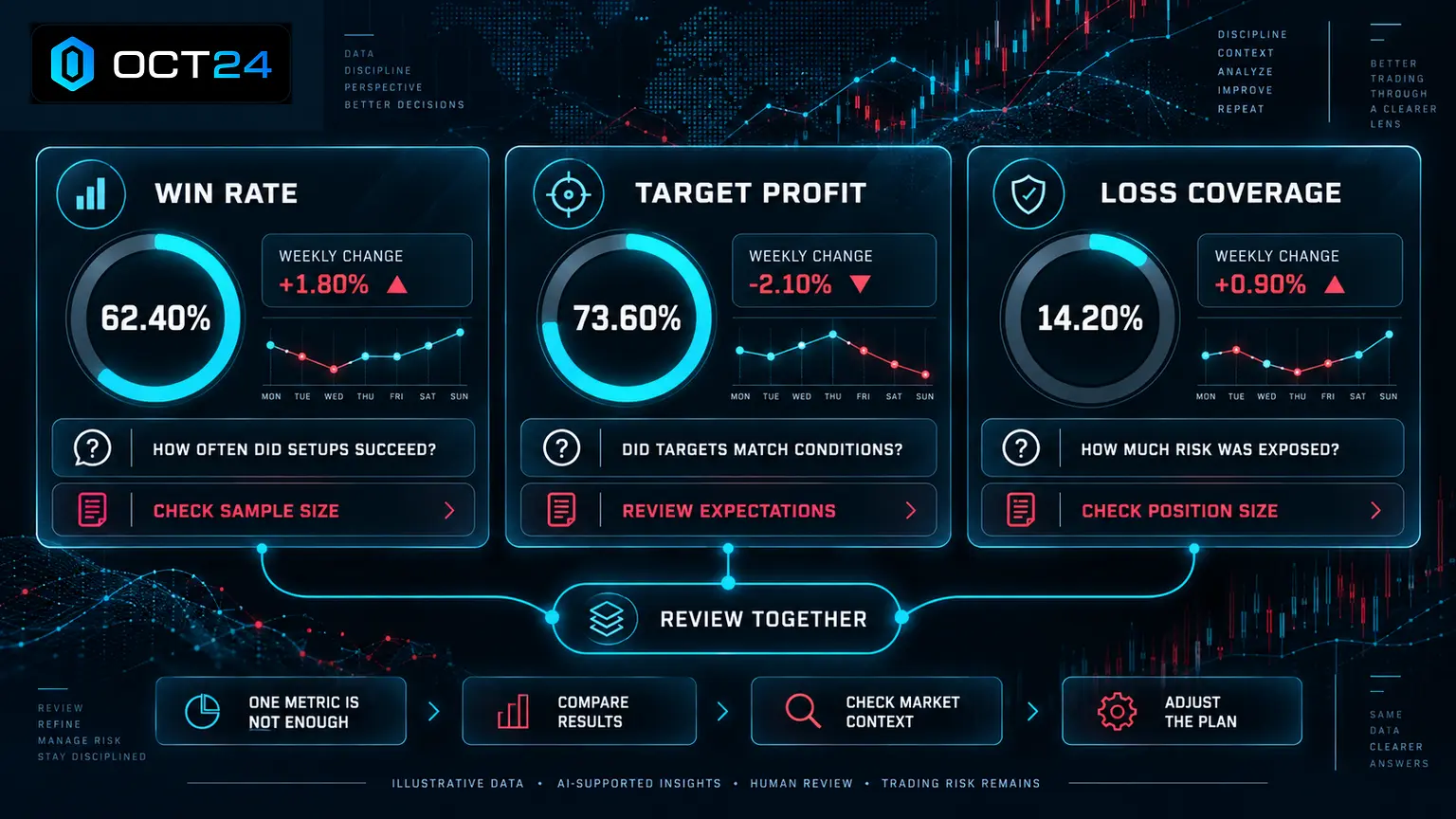
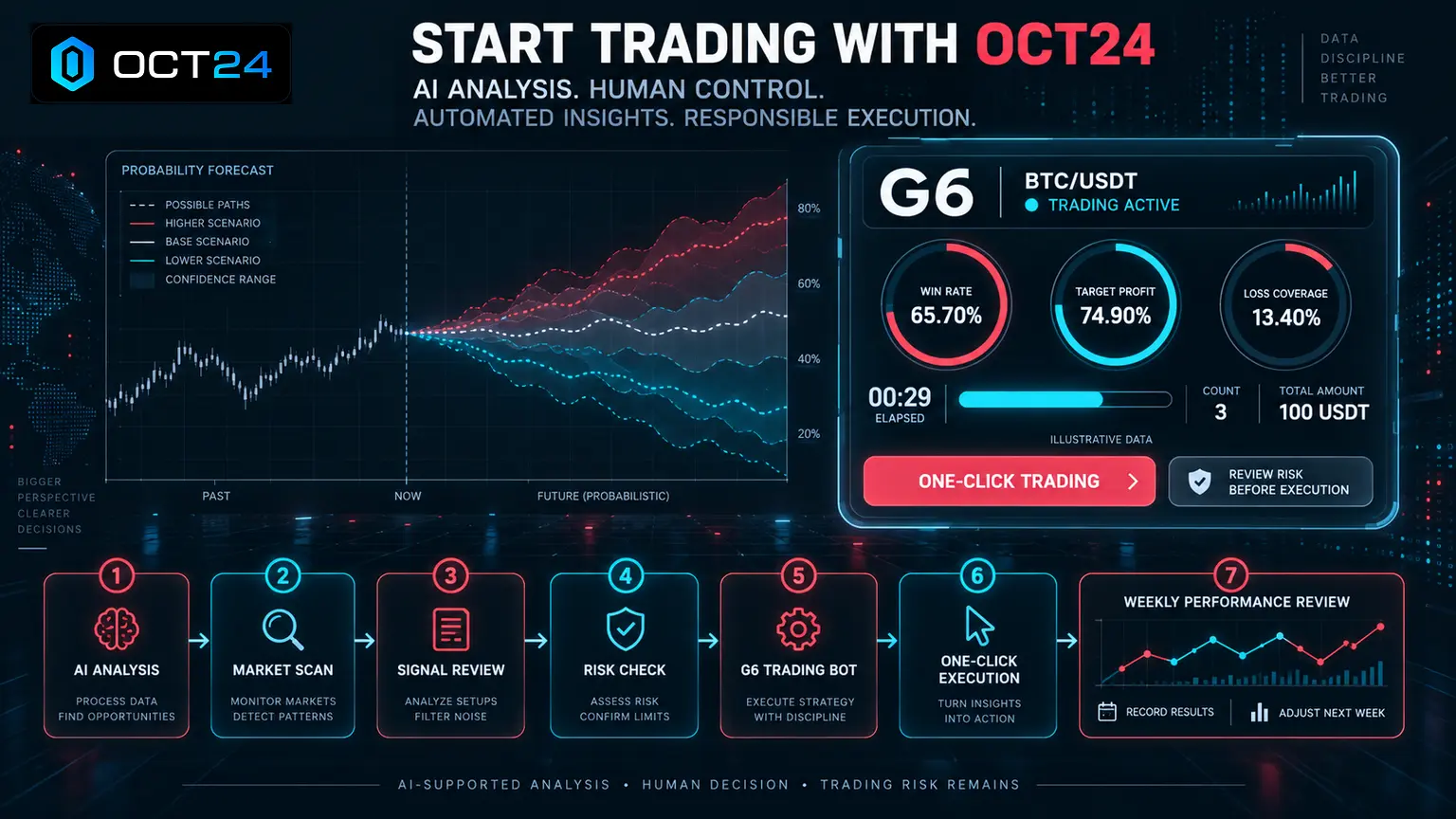
A weekly AI trading review becomes much clearer when you focus on a few important metrics. For OCT24 traders, three signals deserve special attention: win rate, target profit, and loss coverage.
These metrics help you compare opportunities before activation and review decisions afterward. They are not promises. They are decision-support signals that help you understand the trade idea more clearly.
Win rate can help you understand how often a similar setup has historically or statistically worked within the platform’s model. Target profit helps you understand the potential upside being presented. Loss coverage helps you think about downside protection and how much risk may be involved.
The key is to review all three together. Looking at only one can create a distorted view.
Win Rate
Win rate is often the first metric traders notice. A higher win rate may feel comforting, especially for beginners. But win rate should never be treated as a guarantee.
In a weekly review, ask whether you overvalued win rate. Did you activate a trade only because the win rate looked attractive? Did you ignore target profit or loss coverage because one number looked strong?
A practical trader looks at win rate as one piece of the decision. It can be helpful, but it needs context.
Target Profit
Target profit shows the potential return the signal is aiming for. It can help traders understand whether the possible upside is meaningful enough for the risk being taken.
In your weekly review, compare target profit with your actual behavior. Did you chase trades because the target looked exciting? Did you take too many similar opportunities because the upside looked bigger than usual?
A high target profit does not mean a trade is safe. It simply shows what the signal is targeting.
Loss Coverage
Loss coverage is especially important for beginners because it brings attention back to downside risk. A trader who only looks at possible profit can miss the most important part of the review.
Each week, ask whether you gave loss coverage enough weight. Did you avoid trades where the downside felt too large? Did you keep exposure controlled when loss coverage showed more risk than you wanted?
OCT24 can present AI-supported trading signals, but the trader still needs to decide whether the risk fits their own account and comfort level.
How to Review Trades You Activated
When reviewing trades you activated, keep the process simple. You are not trying to replay every second of market movement. You are trying to understand whether your decision was reasonable when you made it.
Start with the signal information. What did the win rate suggest? What target profit was shown? What did loss coverage tell you about downside risk? Then compare that with how you felt when you activated the trade.
This emotional note is important. Trading decisions are often shaped by fear, excitement, frustration, and impatience. Trading PsychologyTrading psychology can affect beginners and experienced traders in different ways, but nobody is completely immune to it.
If a trade reached a target profit, note what you did well. Maybe you waited for a clear signal. Maybe you kept your size controlled. Maybe you avoided activating another trade immediately afterward.
If a trade hit a stop loss or closed negatively, do not treat that alone as failure. Losses are part of trading. The review should ask whether the trade was within your rules and whether the risk was acceptable before you entered.
This is how a weekly AI trading review stays practical. You learn from both take profits and stop losses without turning every result into an emotional verdict.
How to Review Trades You Skipped
Skipped trades are easy to ignore, but they can teach you a lot. A skipped trade shows how you responded to uncertainty.
If you skipped a signal and the trade later looked profitable, avoid blaming yourself automatically. The right question is not, why did I miss it? The right question is, did I have a good reason to skip it at the time?
Maybe the target profit was too small for the risk. Maybe loss coverage did not fit your comfort level. Maybe you already had enough open exposure. Maybe the signal appeared during a time when you could not focus.
Those are valid reasons. A disciplined trader does not need to take every trade. A weekly review should help you separate careful skipping from fear-based hesitation.
If you skipped every trade, that may also be useful information. It could mean the market did not fit your plan. It could also mean you do not yet trust your review process. Either way, the weekly review gives you a place to notice the pattern.
Check Your Risk Settings and Exposure
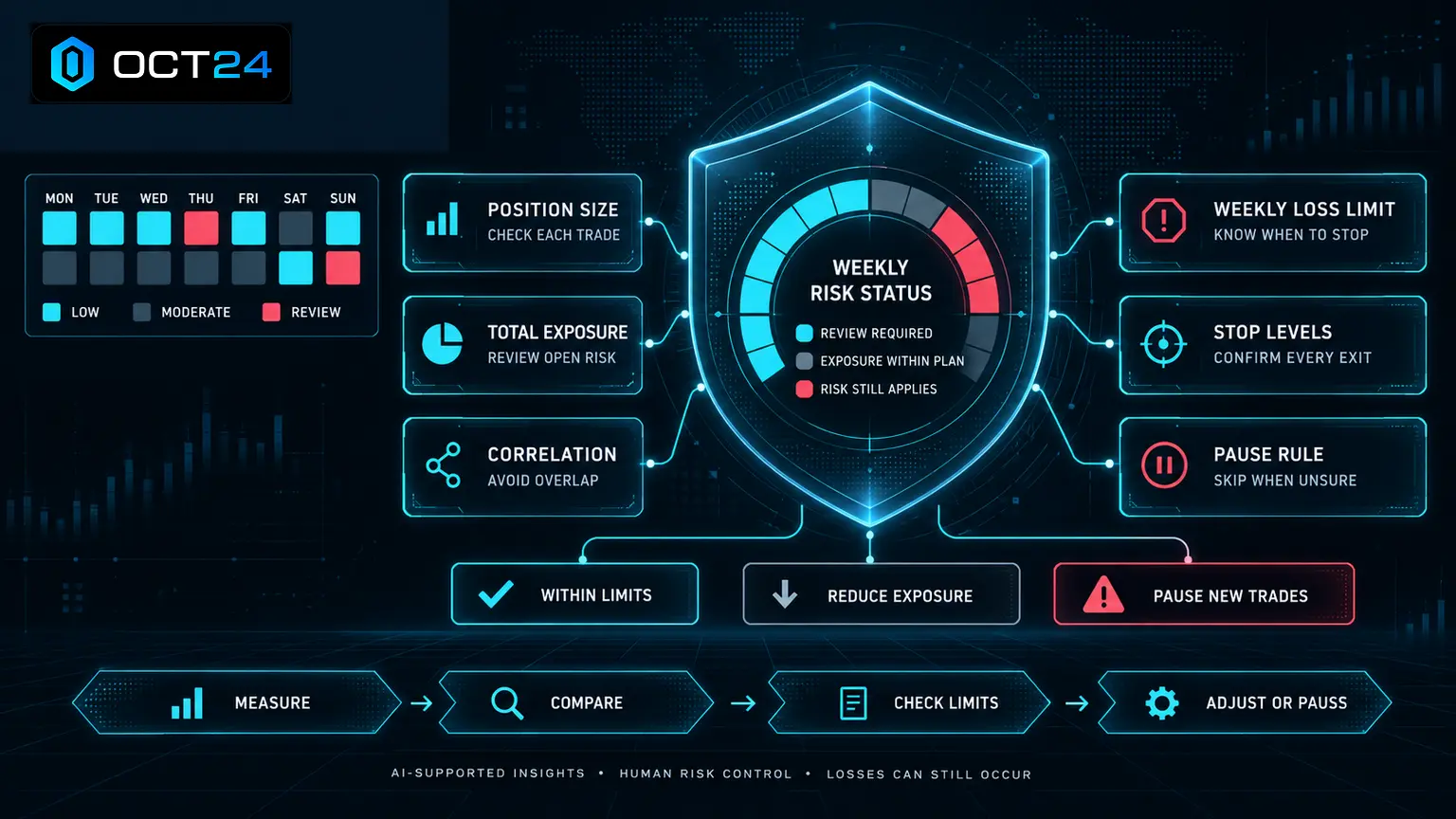
A weekly trading review should always include risk. This is true even when the week was profitable. Good weeks can sometimes make traders careless because confidence rises faster than discipline.
Start by checking whether your position sizes were reasonable. Did you increase size after a win? Did you try to recover quickly after a loss? Did you activate multiple trades that created more exposure than you intended?
This is where Position Sizing Controls and Portfolio Diversification Tools become useful concepts. Even when an AI tool helps with analysis, traders still need to think about how much of their capital is exposed to the market.
OCT24 helps simplify the signal review process, but it does not replace responsible capital allocation. The trader decides whether the trade fits their account, risk tolerance, and broader crypto exposure.
A simple weekly risk check can prevent small habits from becoming larger problems. You do not need complex math. You need honest answers.
- Did I risk more than planned on any trade?
- Did I activate trades too close together?
- Did one market move affect too much of my account?
- Did I reduce size when conditions felt uncertain?
- Did my trading activity fit my weekly schedule and energy level?
Use Charts for Context, Not Confusion
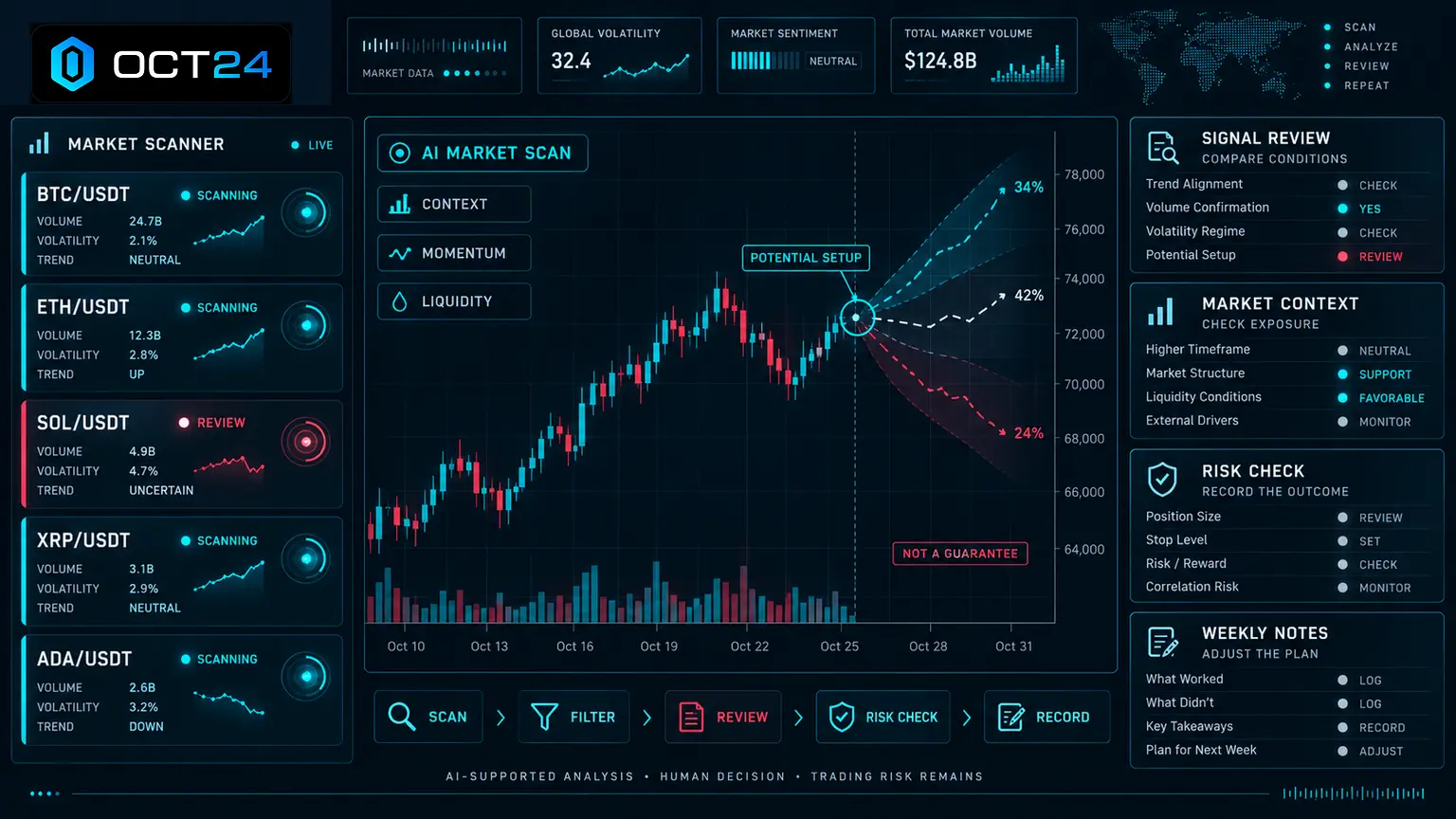
A weekly review does not need to become a full technical analysis session. Still, it can help to review a few charts for context.
You might look at Bitcoin, Ethereum, and any crypto assets connected to the trades you reviewed. The goal is to see whether the broader market was trending, ranging, volatile, or quiet.
If charts confuse you, keep this part simple. Use How to Read Crypto Charts as a basic skill, not as a reason to overcomplicate your review. You are looking for broad context, not a perfect explanation for every candle.
For example, if most of the week was choppy, you may understand why signals felt less clear. If the market moved sharply in one direction, you may understand why target profit opportunities appeared more attractive.
OCT24 already supports market scanning and signal discovery. Your chart review is only there to give you a clearer sense of market mood before the next week begins.
Compare OCT24 Signals With Your Own Behavior
One of the most useful parts of a weekly AI trading review is comparing signal quality with trader behavior. This helps you avoid blaming the tool for every result or blaming yourself for every loss.
Ask what OCT24 presented, then ask what you did with that information. Did you read the signal carefully? Did you understand the win rate, target profit, and loss coverage? Did you activate quickly because the 60-second decision window made you feel rushed?
A faster workflow can be helpful, but speed still needs discipline. With one-click trading, the review step matters even more. Traders should know why they are activating a trade before they click.
This is also where AI Trading Bots and AI Trading Strategies should be understood realistically. AI can support scanning, structure, and execution speed. It cannot remove volatility, emotional pressure, or the need for thoughtful risk limits.
A weekly review gives you a calmer environment to study your decisions. You are not trying to act before a signal expires. You are simply learning from the week.
Build a Simple Weekly Review Template
The best weekly AI trading review template is short enough to use consistently. If it is too detailed, you may avoid it. If it is too vague, it will not help you improve.
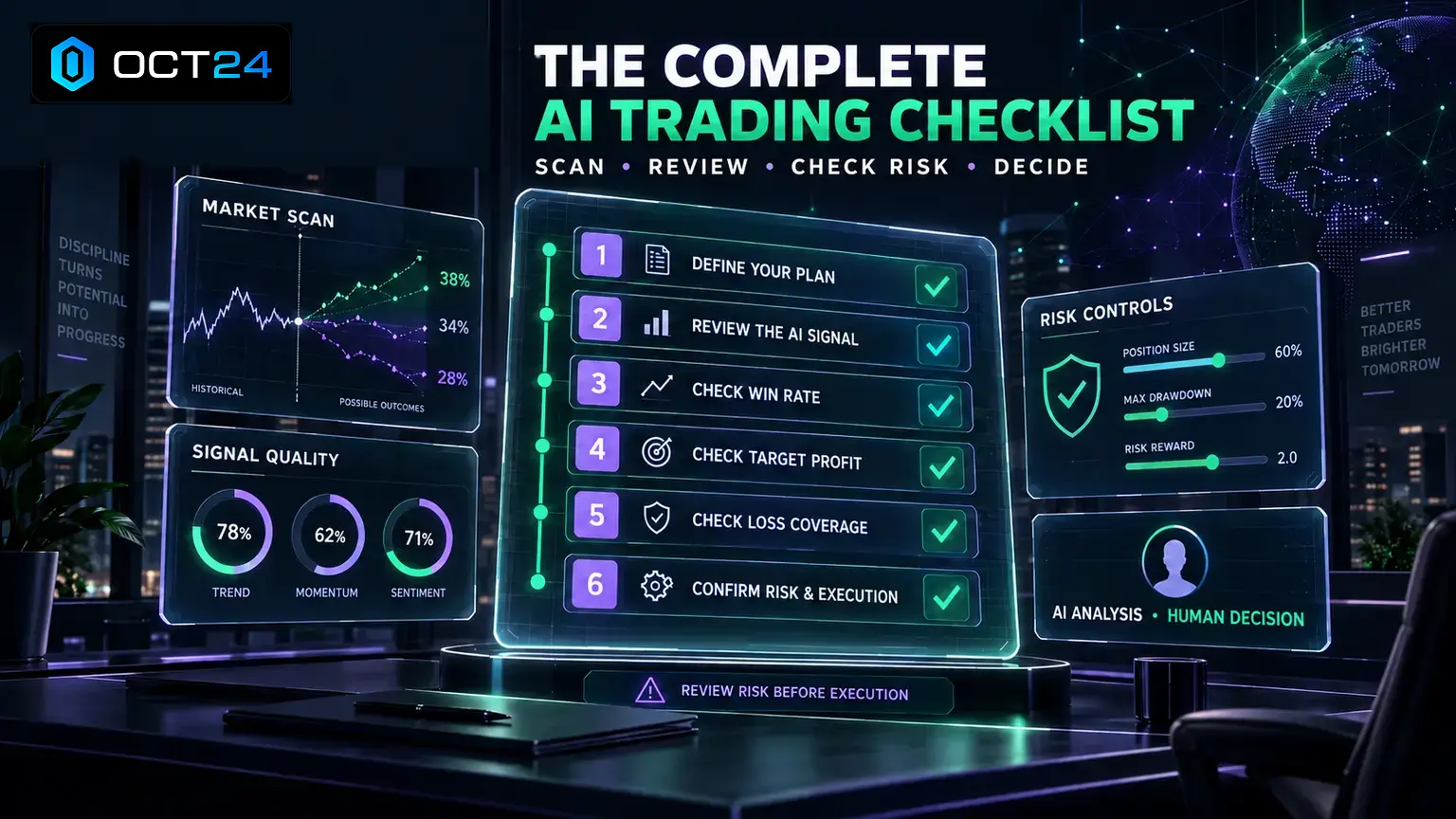
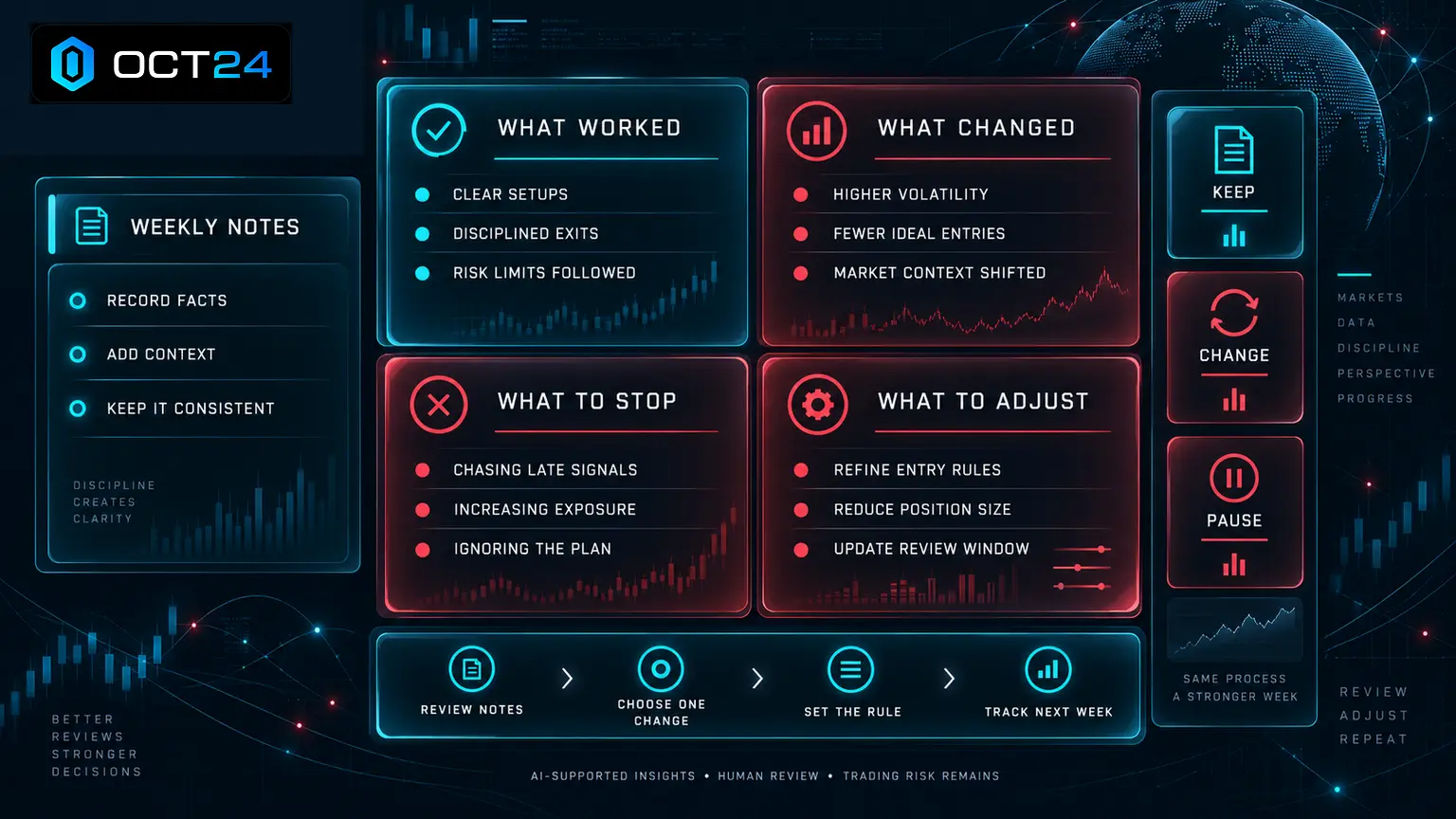
A good template should cover signal review, trade behavior, risk, and one small adjustment for next week. That is enough for most beginners.
You can write the review in a notebook, spreadsheet, notes app, or document. The format matters less than the habit. What matters is that you answer the same questions every week.
Here is a simple structure you can use.
- Week reviewed: Write the dates of the trading week.
- Signals reviewed: Note how many OCT24 opportunities you looked at.
- Trades activated: Record how many trades you chose to enter.
- Trades skipped: Write down the main reasons you passed.
- Best decision: Choose one decision that showed discipline.
- Decision to improve: Choose one habit to adjust next week.
- Risk check: Note whether your position size and exposure stayed reasonable.
- Next week focus: Pick one simple theme, such as patience, smaller size, or better signal comparison.
Common Weekly Review Mistakes to Avoid
A weekly review should make trading clearer. It should not become another source of stress. To keep it useful, avoid a few common mistakes.
The first mistake is only reviewing losing trades. Losing trades are useful to study, but winning trades matter too. A winning trade can still reveal poor sizing, emotional clicking, or overconfidence.
The second mistake is changing your whole approach after one week. Crypto markets can be noisy. One week of results should not control your entire strategy. Look for patterns over time.
The third mistake is ignoring risk when the week looks good. Strong results can make traders feel safe, but market conditions can change quickly. Trading Bot Risk Management remains important even after a profitable period.
The fourth mistake is trying to review too many metrics. Beginners often add more data because they want certainty. But more data does not always create better decisions. Start with win rate, target profit, loss coverage, trade count, and exposure.
The fifth mistake is turning the review into self-criticism. The purpose is improvement, not blame. A calm review is more useful than a harsh one.
How Professionals Can Use the Same Weekly Review
A weekly AI trading review is not only for beginners. Professional and experienced traders also benefit from structured review habits.
The difference is usually depth. A beginner may review five simple questions. A more experienced trader may compare market regimes, signal categories, average result, timing, and exposure across different conditions.
The foundation is still the same. Review the signal. Review the decision. Review the risk. Review the outcome. Then choose one improvement for next week.
Professionals often know that discipline matters more than excitement. They understand that a clean process can be more valuable than a dramatic week. OCT24 can support this by organizing opportunity review around AI-supported signals instead of scattered market noise.
Beginners can borrow this mindset. You do not need to trade like a professional to review like a careful trader.
Where the G6 Trading Bot Fits Into the Review
The G6 Trading Bot can be part of the weekly review when traders use it to review and activate OCT24 opportunities. The point is not to assume that a bot makes every decision perfect. The point is to understand how the bot-supported workflow fits into your broader routine.
Each week, consider whether you used the available signal information properly. Did the one-click process help you stay focused, or did it encourage quick decisions without enough review? Did you respect your risk limits before activation?
OCT24 is built around making crypto opportunity review simpler. That simplicity is valuable, especially for busy traders. But simple does not mean careless. The weekly review helps keep the workflow grounded.
This is also why your review should include both results and behavior. A tool can present a signal. A trader still chooses how to engage with that signal.
A 15-Minute Weekly AI Trading Review Routine
You do not need an hour. A useful weekly AI trading review can take about 15 minutes if you keep it focused.
Spend the first few minutes checking your activated trades. Then review the signals you skipped. After that, look at your total exposure and any emotional patterns. Finish by choosing one adjustment for the next week.
This routine works because it is realistic. Busy traders are more likely to follow a review that fits into normal life. The review should feel like a simple reset, not a second job.
If you are new to OCT24, you can also use the weekly review to become more comfortable with the platform. Read more about About OCT24 in the body of your research process if you want to understand the platform background, then focus your review on how the signal workflow supports your decisions.
When you are ready to explore the platform directly, use Start Trading with OCT24 and approach each opportunity with clear risk limits and realistic expectations.
Weekly Review Checklist for OCT24 Traders
Use this simple checklist at the end of each week. Keep the answers brief. The value comes from repeating the process consistently.
- I reviewed the number of signals I saw this week.
- I recorded which trades I activated and which I skipped.
- I checked win rate, target profit, and loss coverage together.
- I reviewed whether my position sizes were reasonable.
- I checked whether my total crypto exposure stayed controlled.
- I noticed one emotional pattern, such as fear, impatience, or overconfidence.
- I chose one small improvement for next week.
- I avoided treating one result as proof that the whole system works or fails.
Final Thoughts
A weekly AI trading review is one of the simplest ways to become more disciplined. It helps you look at your trades with more structure and less emotion.
For OCT24 traders, the review can stay focused on the information that matters most: which opportunities were presented, which signals were activated, how win rate, target profit, and loss coverage compared, and whether risk stayed controlled.
OCT24 can help by scanning crypto market conditions, identifying potential opportunities, and presenting AI-supported trading signals. It does not guarantee results or remove risk. The trader remains responsible for exposure, capital allocation, risk settings, and execution decisions.
Use the weekly review as a calm reset. Learn from the week, choose one small improvement, and keep the process simple enough to repeat.
To explore a simpler way to review AI-supported crypto trading opportunities, visit OCT24 or Start Trading with OCT24 when you are ready.
FAQs
What is a weekly AI trading review?
A weekly AI trading review is a simple routine for checking your AI-supported crypto trades, signal decisions, risk exposure, and behavior from the past week. It helps you learn from both winning and losing trades.
Why should crypto traders review trades weekly?
Crypto traders should review trades weekly because markets move quickly and emotions can affect decisions. A weekly review helps traders slow down, spot patterns, and improve the next week’s process.
Can OCT24 do the weekly review for me?
OCT24 can support your trading process by scanning market conditions and presenting AI-supported crypto trading signals. The trader still needs to review decisions, exposure, capital allocation, and personal risk limits.
Which metrics matter most in a weekly AI trading review?
The most useful starting metrics are win rate, target profit, loss coverage, trade count, skipped signals, position size, and total exposure. Beginners should keep the review simple before adding more advanced metrics.
Should I change my strategy after one bad week?
Usually, one bad week is not enough information to change everything. It is better to look for repeated patterns over several weeks and make small adjustments instead of reacting emotionally.
How long should a weekly trading review take?
A beginner-friendly weekly review can take about 15 minutes. The goal is to create a consistent habit that is easy to repeat, not a complex report that becomes difficult to maintain.
Does AI trading guarantee better results?
No. AI trading can support analysis, speed, and structure, but it cannot guarantee profits or remove market risk. Traders remain responsible for risk settings, exposure, capital allocation, and execution decisions.
How does OCT24 help part-time traders review crypto opportunities?
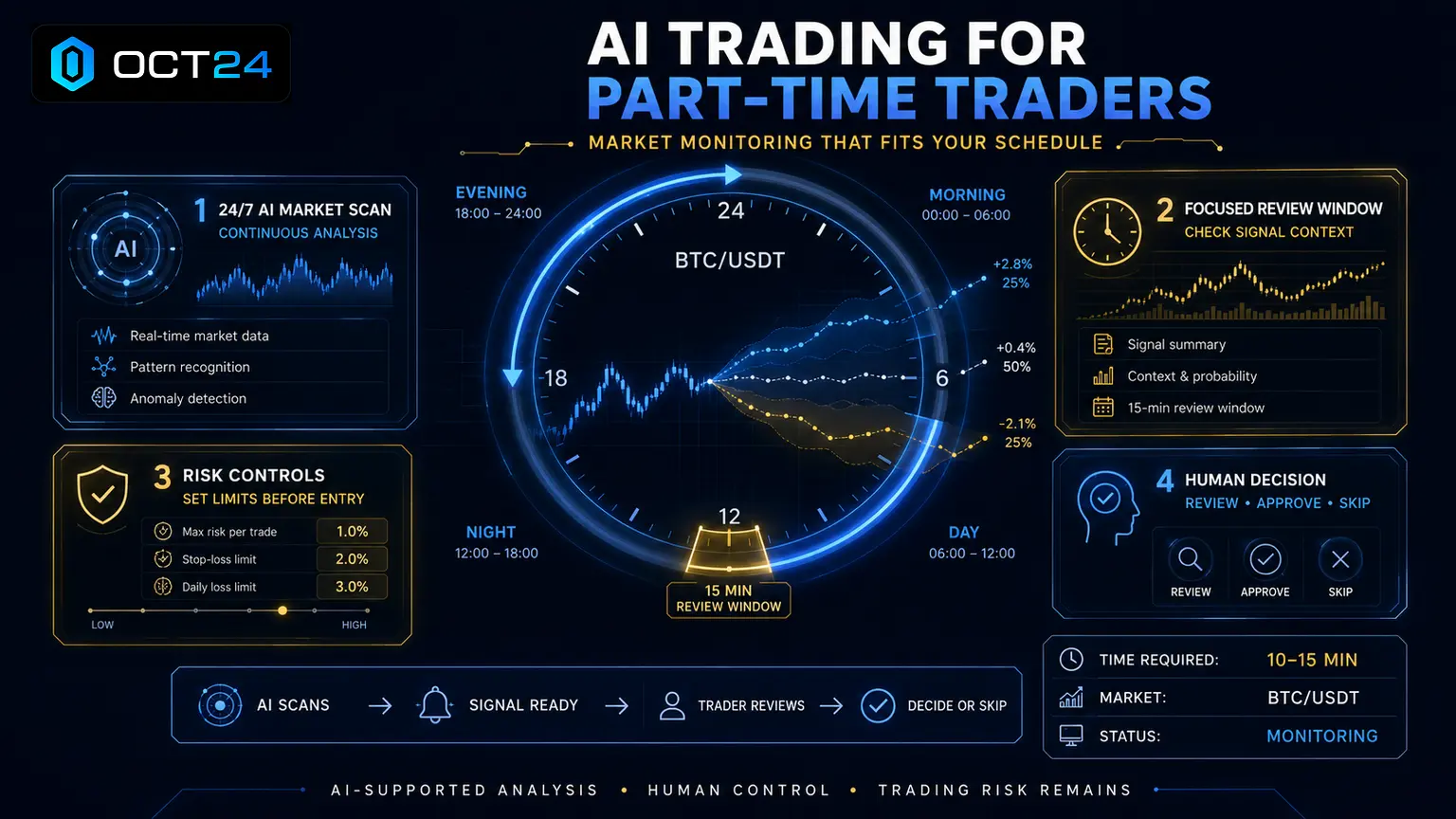
OCT24 helps by scanning crypto market conditions, identifying potential opportunities, and presenting AI-supported signals in a simpler format. This can make weekly review easier for traders who do not want to monitor charts all day.