
How to Use AI to Compare Bitcoin, Ethereum, and Altcoins
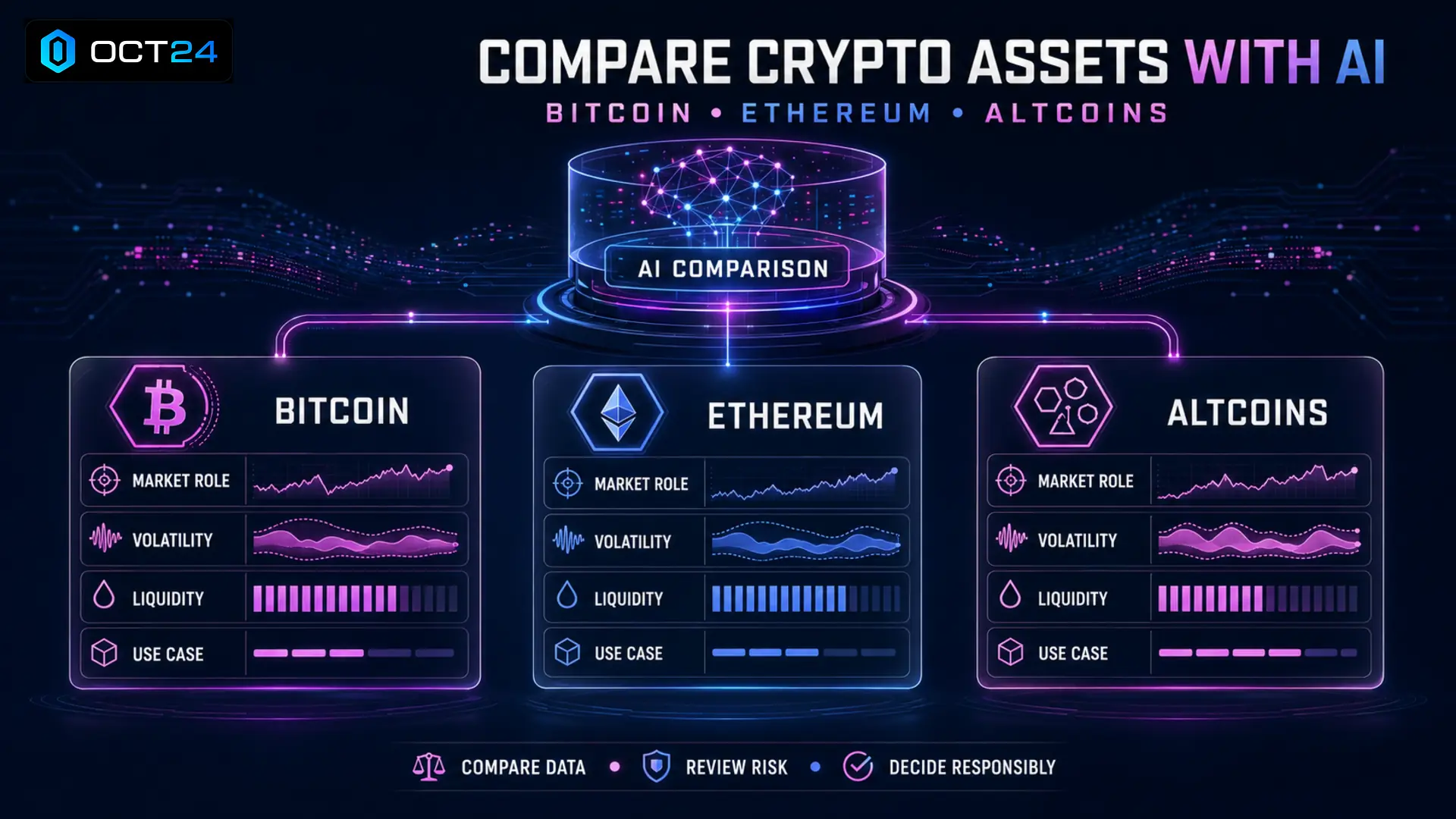
Learning how to compare Bitcoin Ethereum and altcoins can help beginner crypto traders make clearer decisions instead of reacting to whichever asset is moving the fastest. Bitcoin, Ethereum, and altcoins often behave differently because they play different roles in the market, attract different types of traders, and carry different levels of risk.
AI can support this comparison by organizing large amounts of market information into a cleaner decision process. It can help traders compare relative strength, volatility, liquidity, trend behavior, sentiment changes, and risk conditions.
The important point is simple: AI should help traders compare markets, not promise that one asset will definitely outperform another. Crypto remains volatile, and every trade still needs risk control.
OCT24 can fit into this process as an AI-powered trading platform focused on simplified trade review and one-click trading. OCT24 does not remove trading risk or guarantee outcomes. Traders still need to review the available trade or bot metrics, manage capital responsibly, and decide whether the opportunity fits their risk tolerance.
Why Comparing Crypto Assets Matters
Many beginners look at crypto prices in isolation. They see Bitcoin rising, Ethereum slowing down, or an altcoin making a sharp move, then assume the strongest-looking asset is automatically the best trade.
That is not always true. A fast move can be strength, but it can also be late-stage excitement. A slow asset can be weak, but it can also be consolidating before a bigger move.
Comparing assets gives traders more context. Instead of asking, “Is this coin going up?” the trader asks, “How is this asset behaving compared with the rest of the market?”
That small change can improve the quality of a trading decision.
A useful comparison can show:
- Which asset is leading the market
- Which asset is lagging behind
- Whether altcoins are following Bitcoin or acting independently
- Whether Ethereum is gaining strength against Bitcoin
- Whether risk appetite is increasing or decreasing
- Whether a move looks broad or isolated
This is closely connected to AI trading because AI systems can process many market inputs faster than a manual trader. The trader still needs to interpret the result responsibly.
Start With Market Role, Not Price
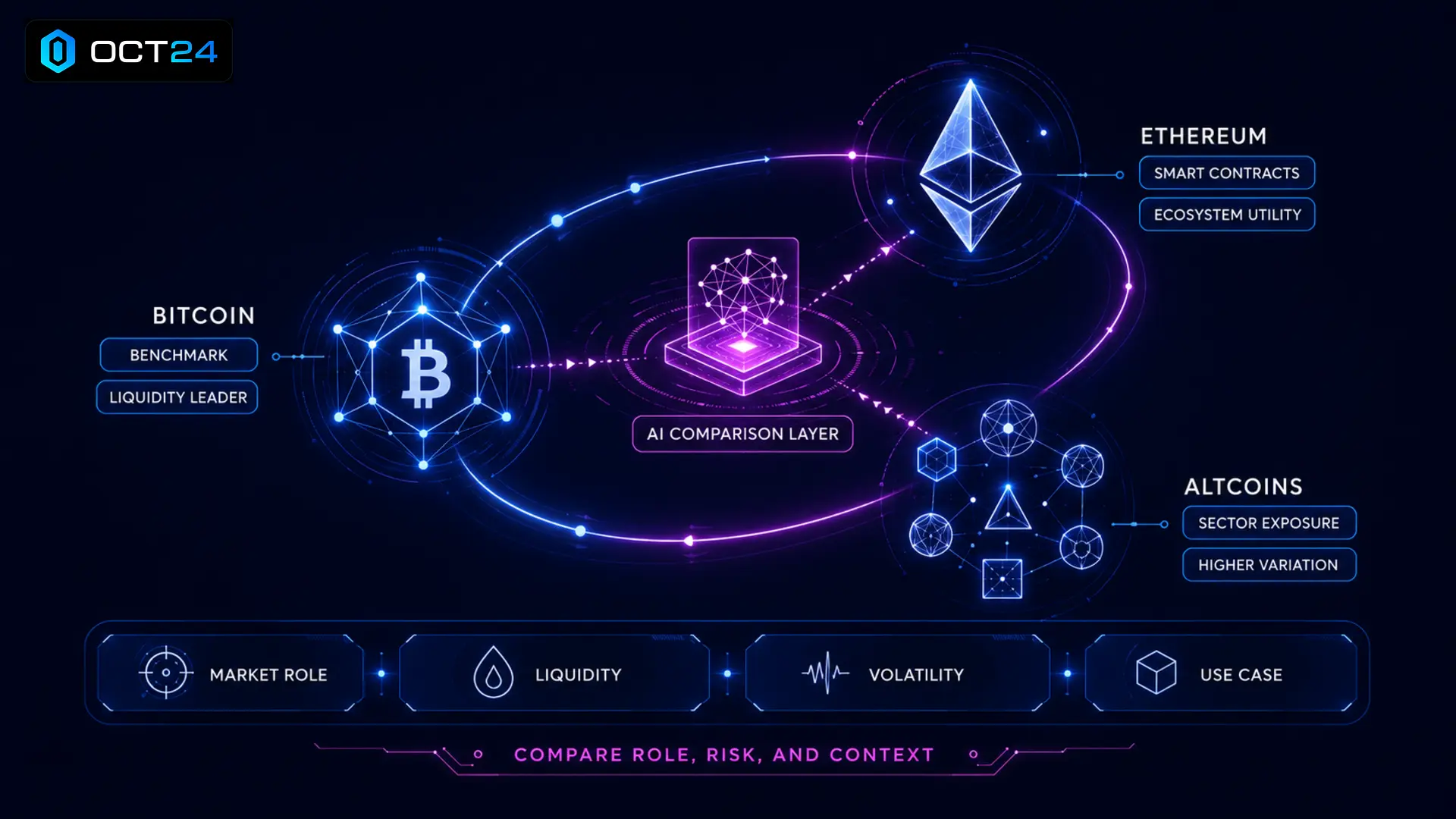
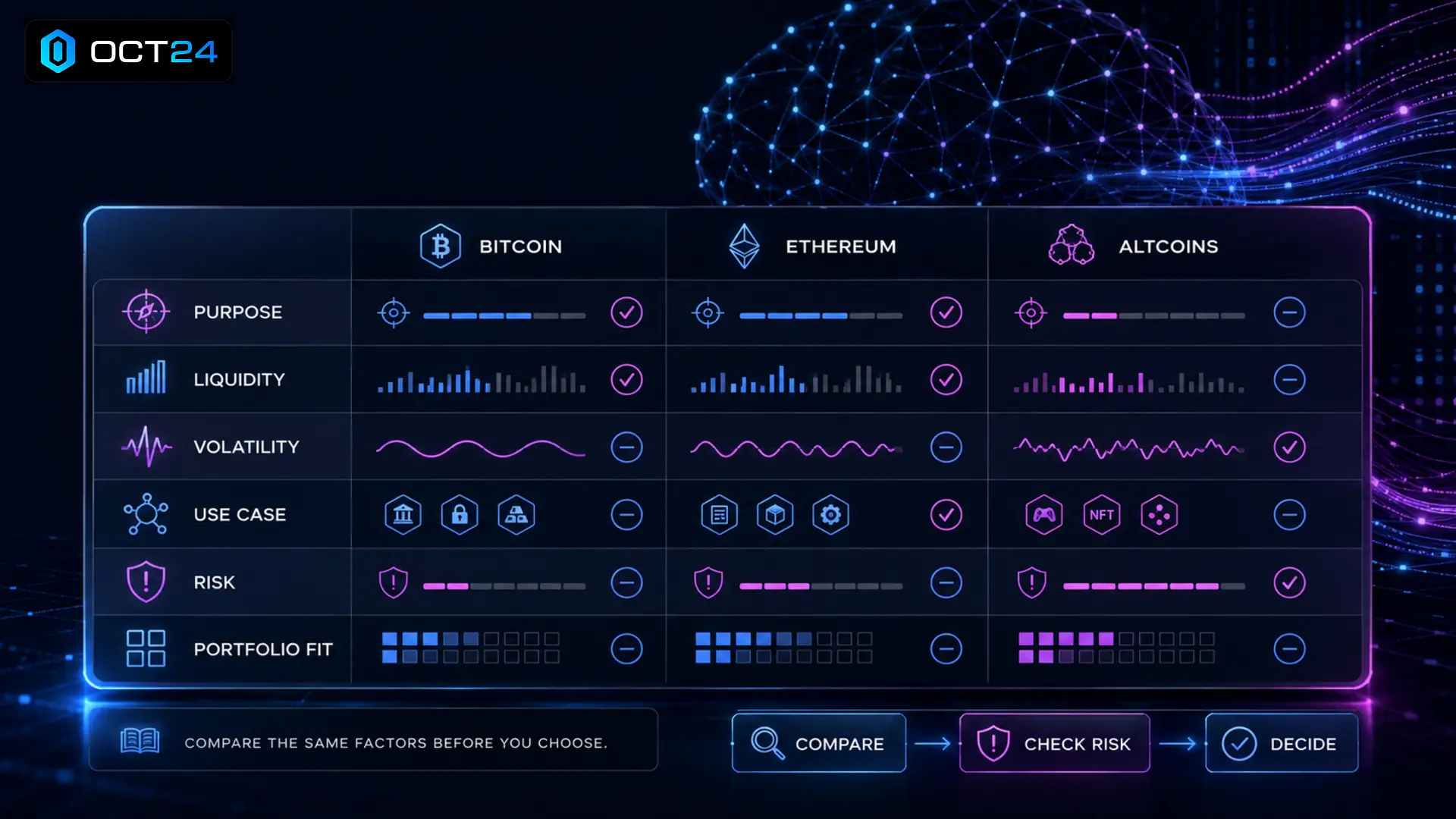
The first step is to understand the basic role of each asset. Bitcoin, Ethereum, and altcoins are not identical markets with different names. They often respond differently to the same market environment.
Bitcoin is usually treated as the market benchmark. When people talk about the overall direction of crypto, they often start with Bitcoin because it has the largest market presence and attracts major attention from traders, institutions, and media.
Ethereum often behaves like a bridge between Bitcoin and the wider altcoin market. It is a major asset, but it is also connected to smart contracts, decentralized finance, NFTs, stablecoins, and blockchain applications.
Altcoins can offer stronger short-term movement, but they can also carry higher volatility, lower liquidity, and sharper drawdowns. Some altcoins follow Bitcoin closely. Others move because of sector news, token-specific announcements, or speculation.
A beginner can use AI to sort these assets into simple role categories:
- Bitcoin as the benchmark asset
- Ethereum as the major ecosystem asset
- Large-cap altcoins as higher-beta market plays
- Narrative-driven altcoins as theme-based opportunities
- Low-liquidity altcoins as higher-risk speculation
This framework helps traders avoid comparing every crypto asset as if it were the same type of opportunity.
Use AI to Compare Relative Strength
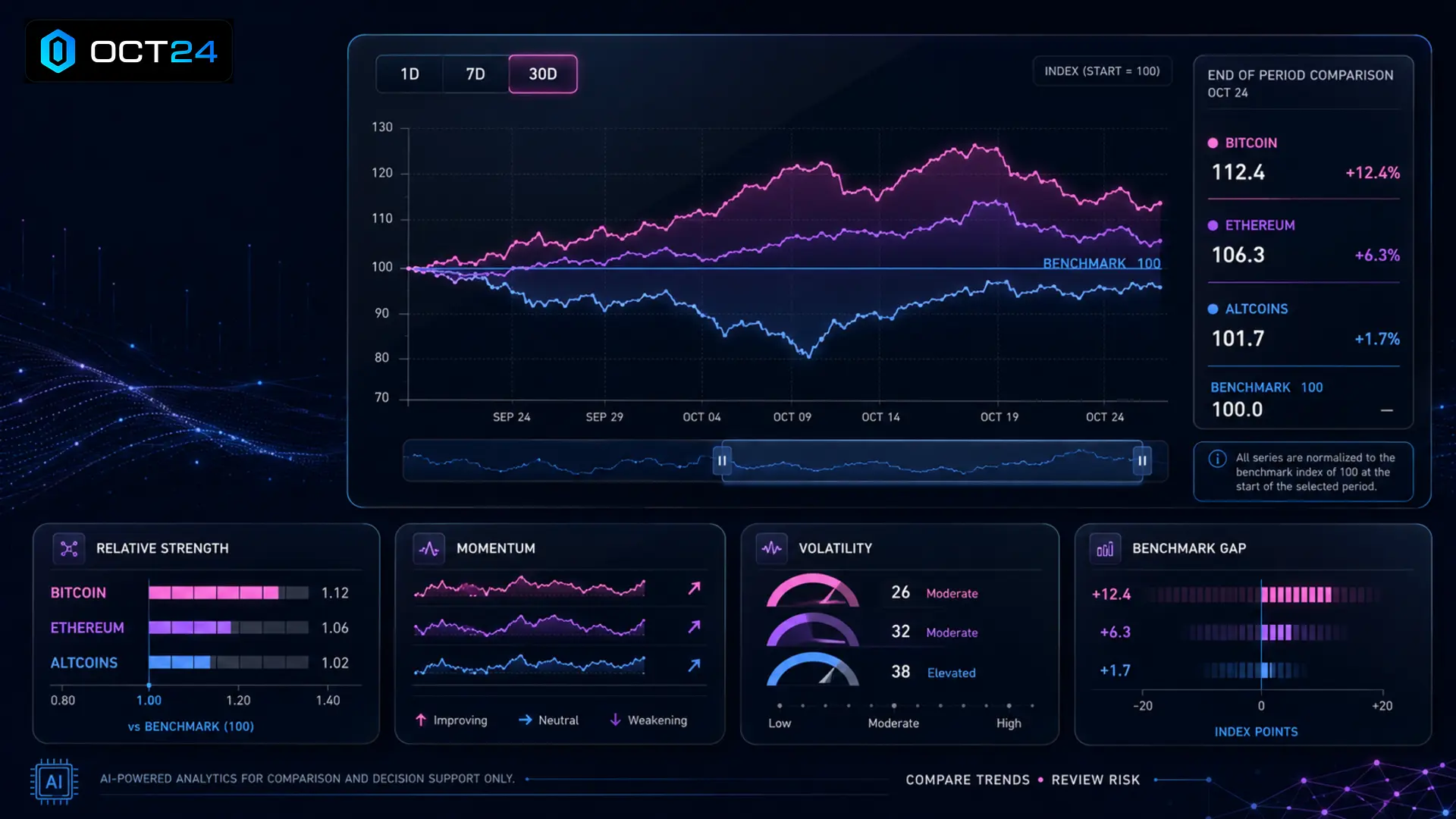
Relative strength means how one asset performs compared with another asset or benchmark. In crypto, traders often compare altcoins against Bitcoin, Ethereum against Bitcoin, or one sector against the broader market.
For example, if Bitcoin is flat but Ethereum is rising, Ethereum may be showing relative strength. If Bitcoin is rising but most altcoins are falling, the market may be cautious and concentrated in the safest crypto asset.
AI can support relative strength comparison by scanning multiple assets at once and ranking them by performance over different time periods.
A beginner might compare:
- One-hour performance
- Twenty-four-hour performance
- Seven-day performance
- Thirty-day performance
- Performance against Bitcoin
- Performance against Ethereum
- Performance compared with the wider crypto market
This is useful because a coin can look strong on one time frame and weak on another. A short-term pump may not mean the asset is strong on a wider view.
AI comparison also helps reduce manual scanning. A trader can use watchlists, alerts, and ranking tools to identify which assets deserve attention. A guide on building an AI trading watchlist can help organize this process.
Compare Liquidity, Volatility, and Risk
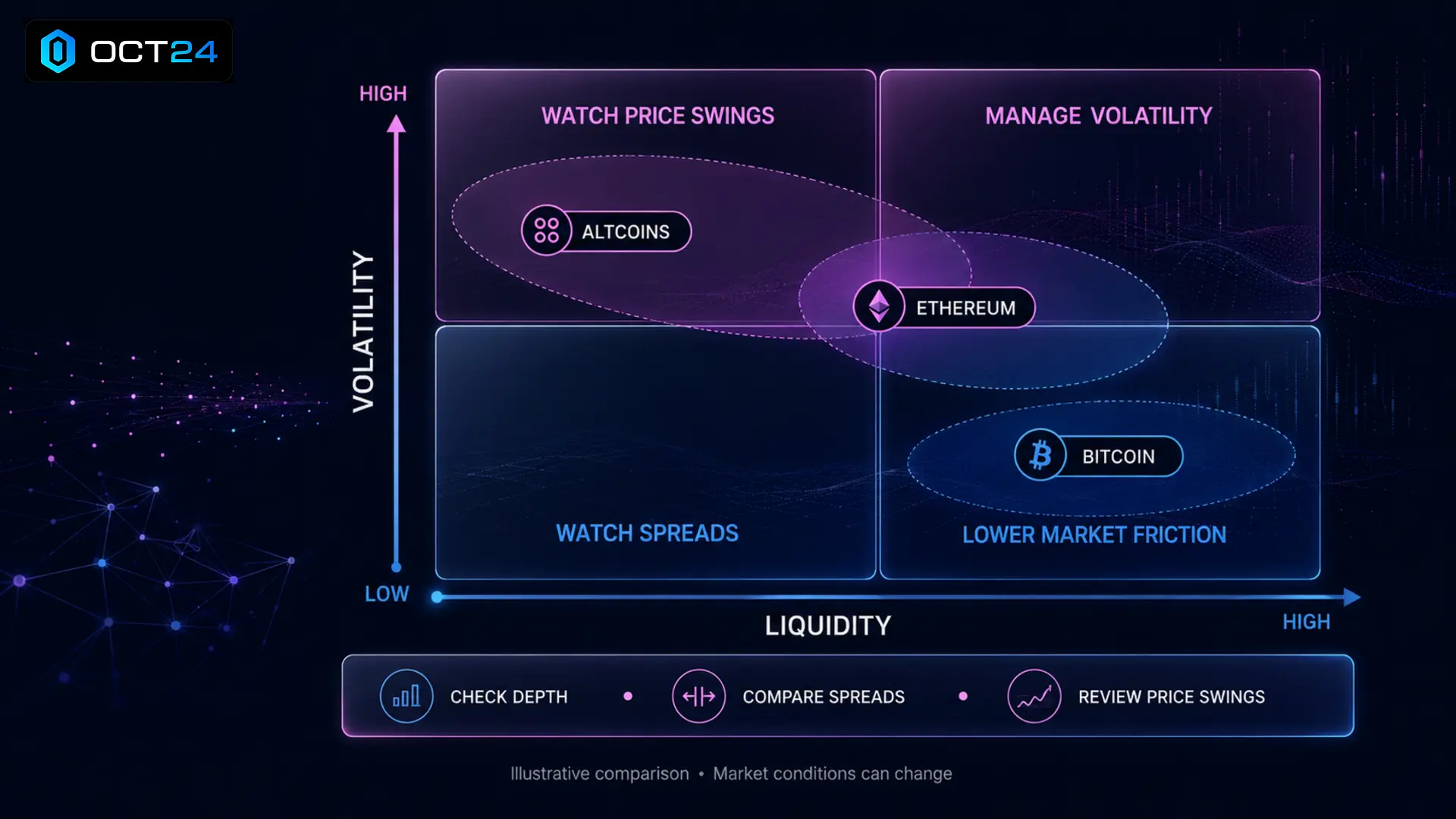
Price movement is only one part of comparison. A beginner also needs to compare liquidity, volatility, and risk.
Liquidity describes how easily an asset can be bought or sold without a large price impact. Bitcoin and Ethereum usually have deeper liquidity than smaller altcoins. That can make them easier to trade in many conditions.
Volatility describes how much the price moves. Altcoins may move faster than Bitcoin, but faster movement also means faster losses if the trade goes wrong.
Risk is the wider picture. It includes volatility, liquidity, position size, leverage, news risk, project risk, and the trader’s own behavior.
AI can help compare these factors by sorting assets into simple risk groups:
- Lower relative volatility
- Moderate volatility
- High volatility
- Strong liquidity
- Thin liquidity
- News-sensitive assets
- Narrative-driven assets
This kind of comparison is especially useful during unstable markets. The guide on how AI handles market volatility explains why fast-moving conditions require extra discipline.
Risk comparison also connects directly with trading bot risk management, position sizing controls, and AI trading risk vs reward. The goal is not to find the most exciting asset. The goal is to understand whether the possible reward is worth the risk.
Use AI to Compare Trends and Market Structure
Trend comparison helps traders see whether Bitcoin, Ethereum, and altcoins are moving in the same direction or sending mixed signals.
For example, a healthy crypto rally may show Bitcoin rising, Ethereum confirming the move, and selected altcoins gaining strength. A weaker rally may show Bitcoin rising alone while altcoins fail to follow.
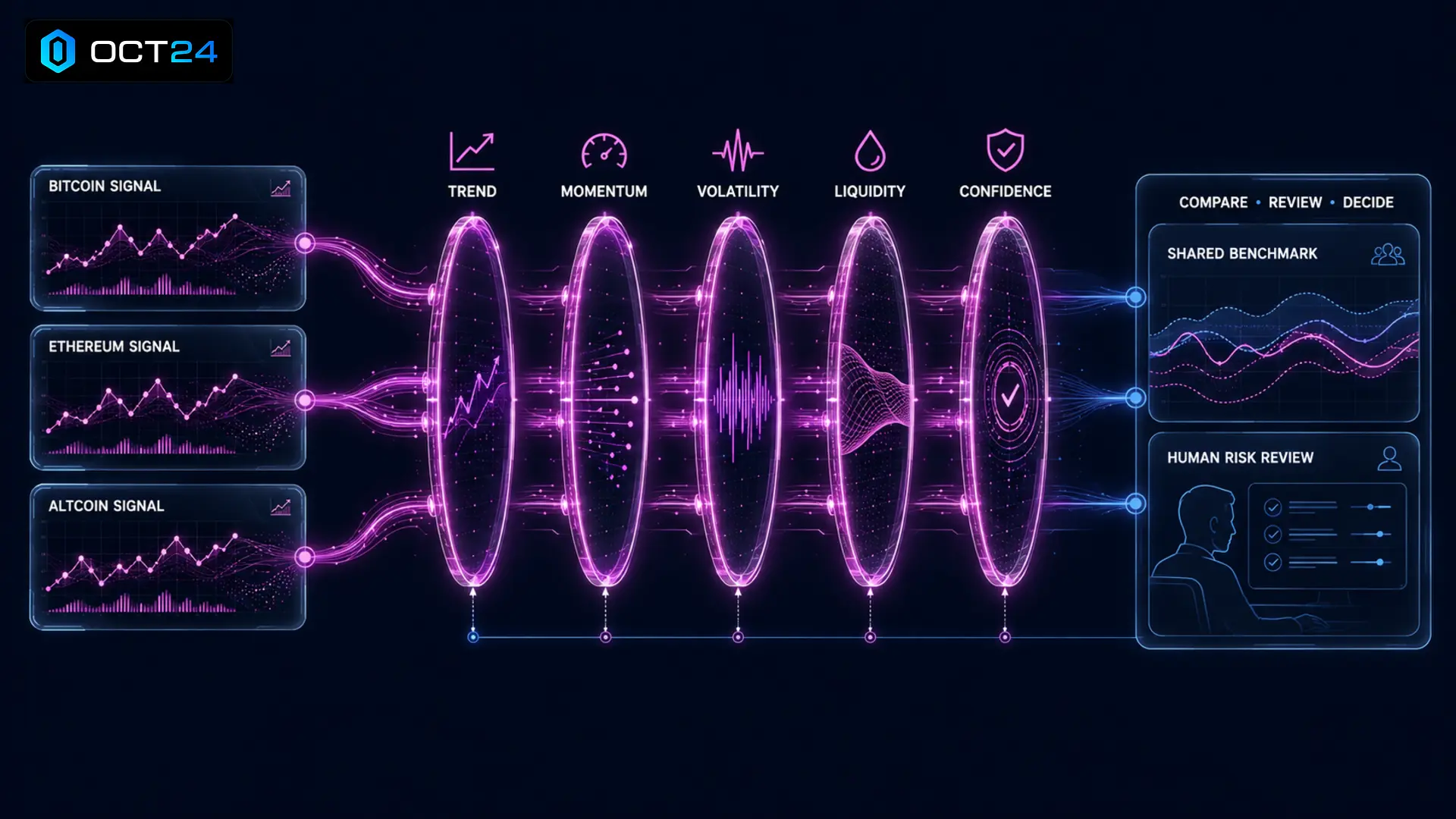
AI can help compare trend conditions across multiple assets by reviewing price direction, momentum, support and resistance behavior, volume changes, and volatility.
A simple trend comparison may ask:
- Is Bitcoin trending up, down, or sideways?
- Is Ethereum confirming Bitcoin’s direction?
- Are large-cap altcoins joining the move?
- Are smaller altcoins lagging or leading?
- Is volume supporting the move?
- Is the trend stable or choppy?
This does not mean AI can predict the next candle. It means AI can help organize technical context. If you want a deeper explanation, review how AI uses technical analysis and can AI predict the market.
For beginners, the most useful trend comparison is often simple. If Bitcoin, Ethereum, and altcoins are all pointing in different directions, the market may require more caution.
Compare Bitcoin, Ethereum, and Altcoin Behavior in Different Market Conditions
Different assets can behave differently depending on the market environment. AI comparison is useful because it can help traders group market behavior instead of treating every move as random.
In a risk-on market, traders may be more willing to buy altcoins. Ethereum may strengthen, and smaller assets may move faster than Bitcoin.
In a risk-off market, traders may move back toward Bitcoin, stablecoins, or cash. Altcoins may fall harder because traders reduce exposure to higher-risk assets.
In a sideways market, Bitcoin may stay in a tight range while altcoins rotate one by one. This can create short bursts of opportunity, but it can also create false breakouts.
In a news-driven market, one asset may move because of a specific event while the rest of the market does not confirm the move.
AI can help traders compare these conditions by watching how assets behave together. The question is not only whether one coin is rising. The question is whether the wider market agrees.
How AI Can Support Signal Comparison
An AI trading signals workflow can help traders compare possible opportunities across Bitcoin, Ethereum, and altcoins. Instead of reviewing each chart manually, AI can rank or filter markets based on preselected conditions.
For example, an AI-supported process may look for assets with improving momentum, stronger relative performance, higher activity, or cleaner trend behavior.
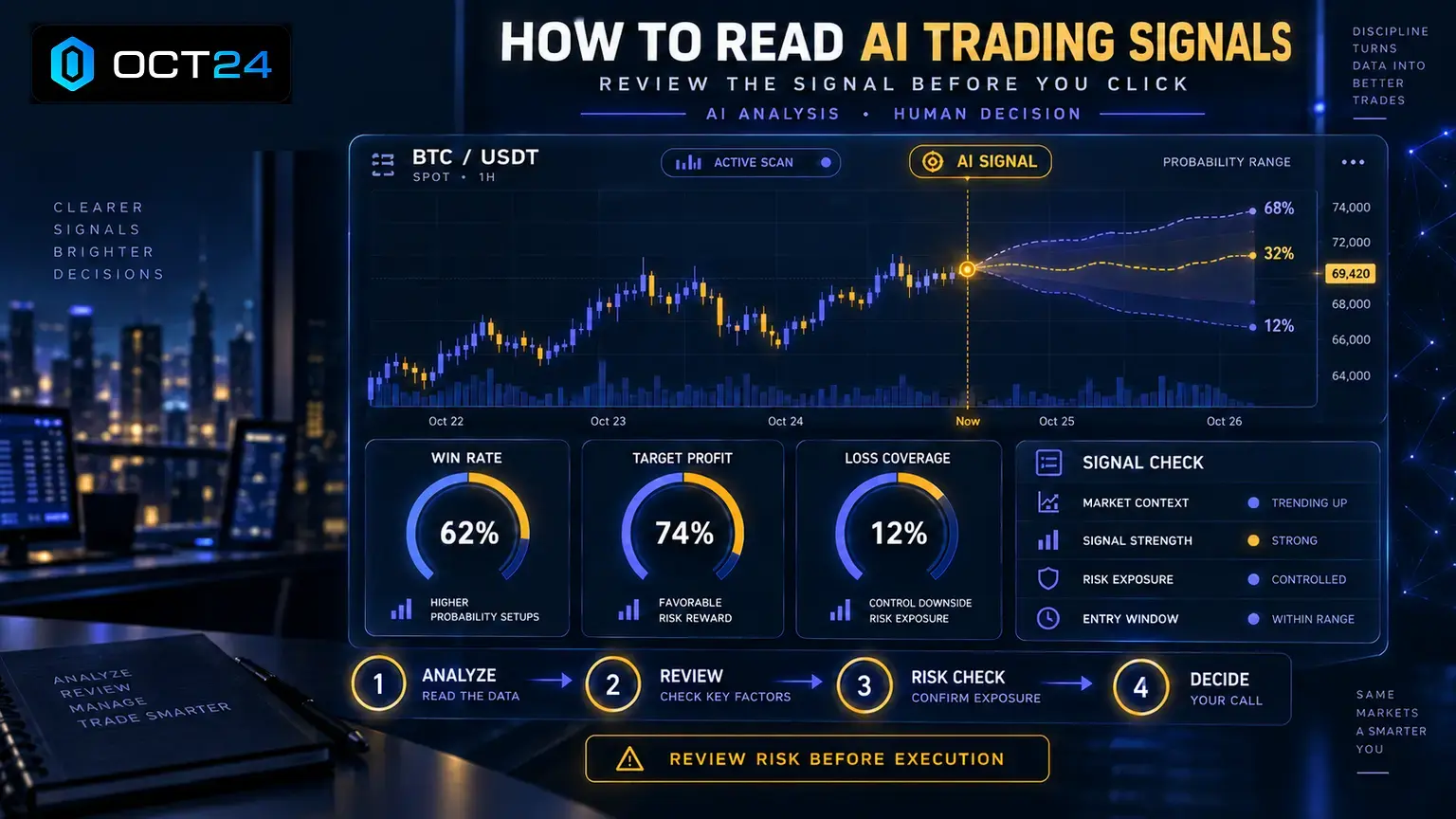
However, signals should be treated as decision support, not instructions. A signal can highlight a possible setup, but the trader still needs to review risk and decide whether the trade makes sense.
Beginners should compare signals using practical questions:
- Is this asset stronger than Bitcoin or just moving with the market?
- Is Ethereum confirming the direction?
- Is the signal appearing during high volatility?
- Is the asset liquid enough for my approach?
- Does the potential reward justify the risk?
- Am I acting on a plan or chasing a move?
This is also where AI trading vs manual trading becomes useful. AI can scan and organize faster than most humans, while the trader remains responsible for judgment and risk.
Where OCT24 Fits Into Crypto Comparison
OCT24 can be part of a crypto comparison workflow, but it should be understood accurately. The platform is built around simplified AI-powered trading access and one-click interaction. It is not currently a full on-platform asset research dashboard.
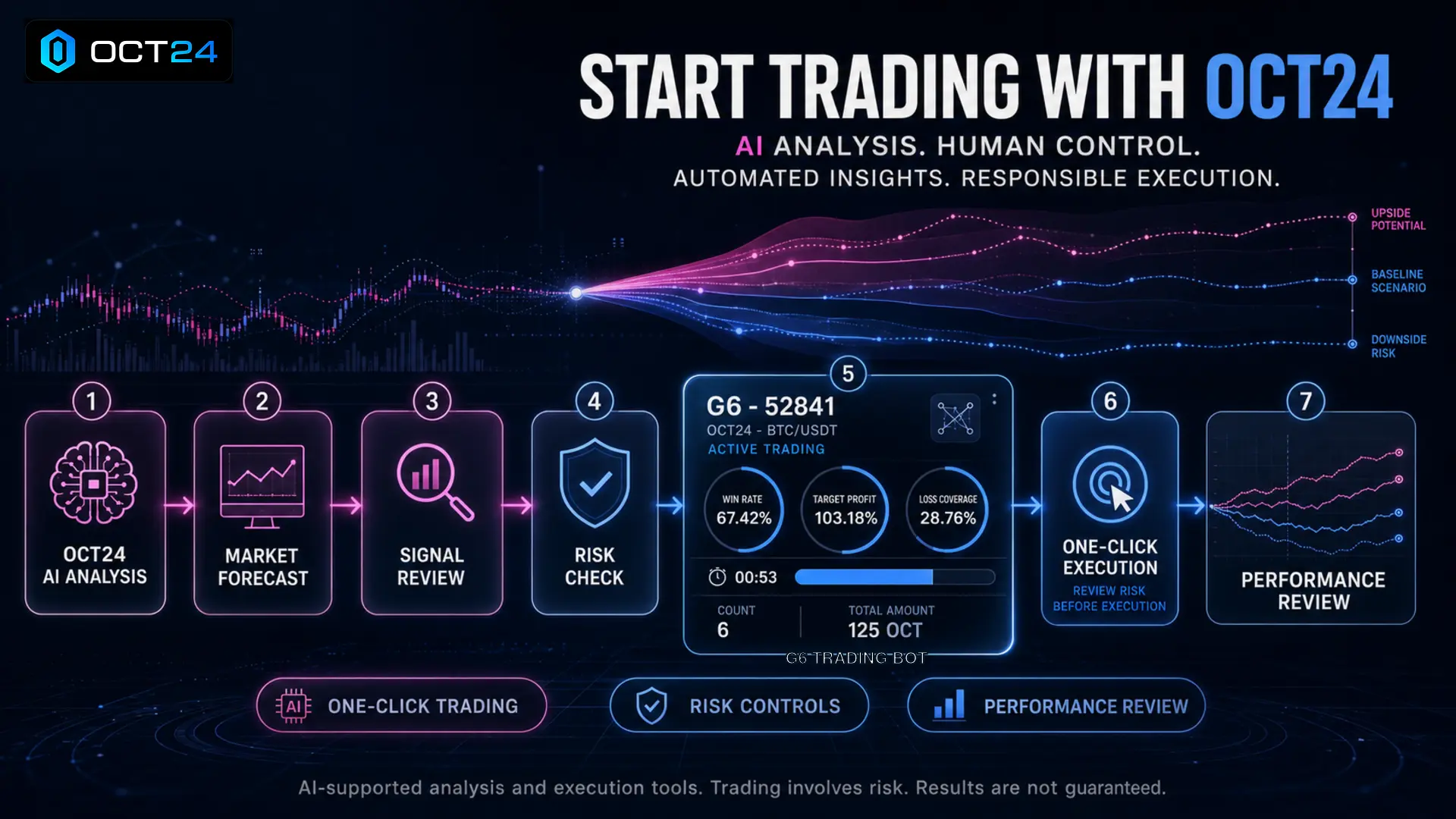
That means traders should not expect OCT24 to show detailed asset research, entry points, exit points, or full chart analysis for every presented trade. When a trade or bot is presented, users mainly review simplified metrics such as target profit, loss coverage, and win rate.
This can make the review process faster and easier to understand, especially for beginners who do not want a complicated trading interface. But simplified review does not remove responsibility.
A responsible OCT24 workflow may look like this:
- Use external research, watchlists, or alerts to understand market context
- Compare Bitcoin, Ethereum, and altcoins before taking risk
- Review the available OCT24 trade or bot metrics
- Check whether the target profit, loss coverage, and win rate fit your risk tolerance
- Decide whether to use one-click execution
- Review results over time and adjust behavior
The G6 Trading Bot is relevant for users exploring OCT24’s bot experience. Traders should still review the available metrics carefully and avoid assuming that speed equals certainty.
If you are still deciding whether this type of platform fits your needs, read choosing the right AI trading platform. You can also learn more through About OCT24.

A Simple Comparison Checklist for Beginners
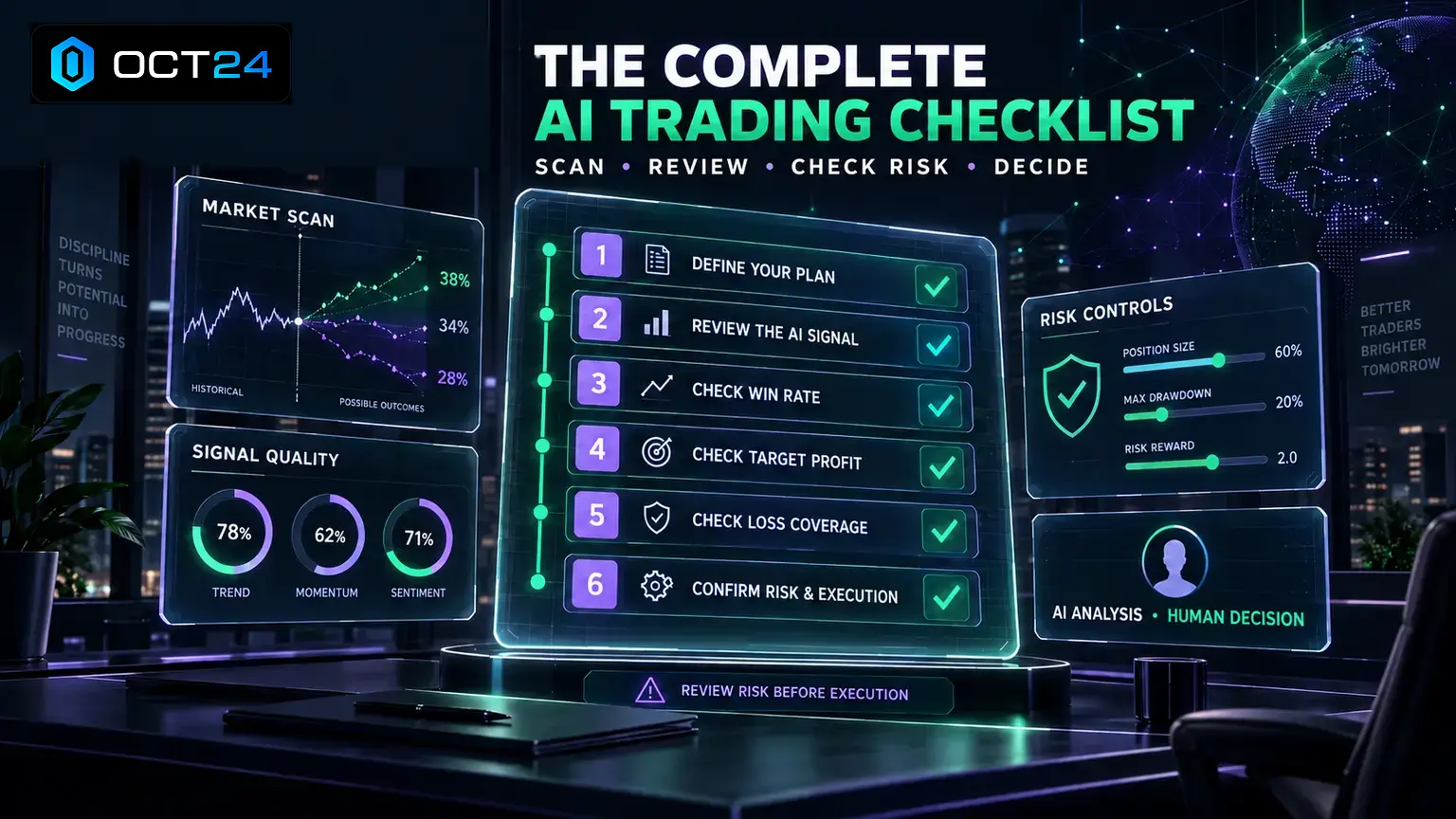
A beginner does not need a complex model to compare Bitcoin, Ethereum, and altcoins. A simple checklist can make the process easier and more consistent.
Before choosing an asset to trade, ask:
- What is Bitcoin doing?
- Is Ethereum confirming or disagreeing with Bitcoin?
- Are altcoins showing broad strength or isolated movement?
- Is the asset liquid enough?
- Is volatility higher than usual?
- Is this move supported by trend, volume, or a clear catalyst?
- Does the risk fit my account size?
- Am I comparing assets or simply chasing the biggest move?
This checklist works because it slows the decision down. It helps the trader move from reaction to review.
It also fits naturally into a consistent trading routine. A routine does not guarantee better results, but it may reduce impulsive behavior.
For traders who are short on time, AI trading for busy professionals offers a useful way to think about efficiency without rushing.
Common Mistakes When Comparing Crypto Assets
Comparison can help, but only if the trader compares the right things. Beginners often make a few repeat mistakes.
Mistake 1: Comparing Only Price
A lower-priced coin is not automatically cheaper, and a higher-priced coin is not automatically stronger. Market capitalization, liquidity, supply, and volatility all matter.
Mistake 2: Chasing the Fastest Altcoin
Altcoins can move quickly, but fast movement can reverse just as quickly. A strong move should be reviewed in context before a trade is made.
Mistake 3: Ignoring Bitcoin
Bitcoin still influences the wider crypto market. If Bitcoin is unstable, many altcoin setups become more difficult to manage.
Mistake 4: Treating AI as Certainty
AI can support comparisons, but it cannot remove uncertainty. This is one of the most important AI trading myths for beginners to understand.
Mistake 5: Forgetting Position Size
An altcoin trade may look attractive, but if the position is too large, the risk may be too high. Position size should match volatility and account tolerance.
Mistake 6: Comparing Without a Plan
A comparison is only useful when it leads to a disciplined decision. The guide on common AI trading mistakes explains how beginners can avoid overconfidence, overtrading, and poor risk habits.
How to Build a Simple AI Comparison Workflow
A beginner-friendly AI comparison workflow should be simple enough to repeat. It does not need to include every possible metric.
One practical workflow could look like this:
- Choose a short watchlist that includes Bitcoin, Ethereum, and selected altcoins
- Compare relative strength over several time frames
- Check whether Ethereum and altcoins are confirming Bitcoin’s direction
- Review volatility and liquidity
- Watch for alerts or signals that match your plan
- Review risk before execution
- Record the decision and result in a journal
This process can work with many different tools. The guide to best AI trading tools can help beginners build a cleaner tool stack around comparison, alerts, risk, and execution.
OCT24 can then serve as a simplified AI-powered trading option within that wider workflow. Traders can review available trade or bot metrics and decide whether the opportunity fits their plan before using one-click trading.
How to Compare Crypto Assets Without Overcomplicating It
A beginner does not need to build a professional trading model to compare crypto assets. In many cases, a simple three-layer approach is enough.
The first layer is market direction. This means checking whether Bitcoin, Ethereum, and the wider altcoin market are generally moving up, down, or sideways.
The second layer is asset quality for the current setup. This means reviewing whether the asset has enough liquidity, reasonable volatility, and a clear reason for attention.
The third layer is personal risk. This means asking whether the trade fits the account size, trading plan, and current exposure.
AI can help with the first two layers by organizing market data and highlighting differences between assets. The third layer still belongs to the trader.
For example, AI may show that an altcoin is outperforming Ethereum over the last twenty-four hours. That is useful information. But the trader still needs to ask whether the asset is too volatile, whether the move is already extended, and whether the position size is appropriate.
This is where beginners often improve. They stop asking only, “Which coin is moving?” and start asking, “Which coin fits the conditions I am prepared to trade?”
A simple comparison score can be built around five plain questions:
- Is the asset stronger than Bitcoin right now?
- Is the asset stronger than Ethereum right now?
- Is the move supported by enough liquidity?
- Is volatility manageable for my account size?
- Does the setup still make sense after reviewing risk?
This type of score does not need to be perfect. It simply gives the trader a cleaner way to compare opportunities instead of making a decision from emotion.
OCT24 users can apply the same thinking before reviewing any available trade or bot metrics. The platform may simplify the trading interaction, but the trader should still understand whether the broader market context supports taking risk.
Why Human Judgment Still Matters
AI can compare more data than most traders can review manually. That does not mean the trader disappears from the process.
Human judgment still matters because markets involve uncertainty, emotion, and changing conditions. A comparison may show that Ethereum is stronger than Bitcoin today, but that does not mean Ethereum will remain stronger tomorrow.
The trader still needs to decide how much capital to risk, whether the timing makes sense, and whether the trade fits the bigger routine.
This is why the comparison between trading bots vs human traders matters. Automation can support speed and structure, while human review supports responsibility.
The future of crypto trading will likely include more AI, more automation, and more simplified interfaces. The guide on the future of AI trading explains why traders should learn how to use these tools without handing over all judgment.
FAQs
How can AI help compare Bitcoin, Ethereum, and altcoins?
AI can help organize market data, compare relative strength, monitor volatility, review liquidity, and identify differences in asset behavior. It should be used as decision support, not as a guarantee.
Is Bitcoin always safer than altcoins?
Bitcoin is usually more liquid and widely followed than smaller altcoins, but it still carries market risk. Altcoins may move faster, but they can also fall faster and become harder to manage during volatility.
Why compare Ethereum against Bitcoin?
Ethereum compared with Bitcoin can help traders understand whether the market is favoring the broader crypto ecosystem or concentrating strength in Bitcoin. This can provide useful context for altcoin decisions.
Can AI predict which crypto asset will perform best?
No. AI can compare data and highlight possible patterns, but it cannot guarantee which asset will perform best. Market conditions can change quickly.
What should beginners compare before trading an altcoin?
Beginners should compare liquidity, volatility, trend behavior, relative strength, news sensitivity, and position size. They should also check whether Bitcoin and Ethereum support or contradict the altcoin move.
Does OCT24 show detailed Bitcoin, Ethereum, or altcoin analysis?
OCT24 is not currently a full asset research or charting dashboard. When a trade or bot is presented, users mainly review simplified metrics such as target profit, loss coverage, and win rate.
How does OCT24 fit into crypto asset comparison?
OCT24 can fit as the simplified AI-powered trading part of a broader workflow. Traders may use other tools to compare assets, then review OCT24 trade or bot metrics before deciding whether to execute.
Should beginners trade altcoins more than Bitcoin or Ethereum?
Not necessarily. Altcoins may offer larger moves, but they often carry higher volatility and lower liquidity. Beginners should focus on risk first, not only possible reward.
What is the biggest mistake when comparing crypto assets?
The biggest mistake is comparing only price movement. Traders should also review liquidity, volatility, trend quality, market role, and overall risk.
Can one-click trading replace research?
No. One-click trading can make execution simpler, but it does not replace responsible review. Traders still need to manage exposure, capital allocation, and risk.
Final Thoughts
Using AI to compare Bitcoin, Ethereum, and altcoins can make crypto trading more organized. It helps beginners see which assets are leading, which are lagging, and where risk may be increasing.
The goal is not to find a perfect prediction. The goal is to build a clearer decision process.
Bitcoin can act as the benchmark. Ethereum can show strength in the wider crypto ecosystem. Altcoins can reveal risk appetite, sector interest, and speculative movement. AI can help compare these signals faster, but the trader still needs to decide what to do with the information.
OCT24 can support this type of modern trading workflow by offering simplified AI-powered trade or bot review and one-click interaction. The trader still controls risk settings, exposure, capital allocation, and execution decisions.
To explore OCT24 directly, visit OCT24 or Start Trading with OCT24.