
AI Trading Risk vs Reward
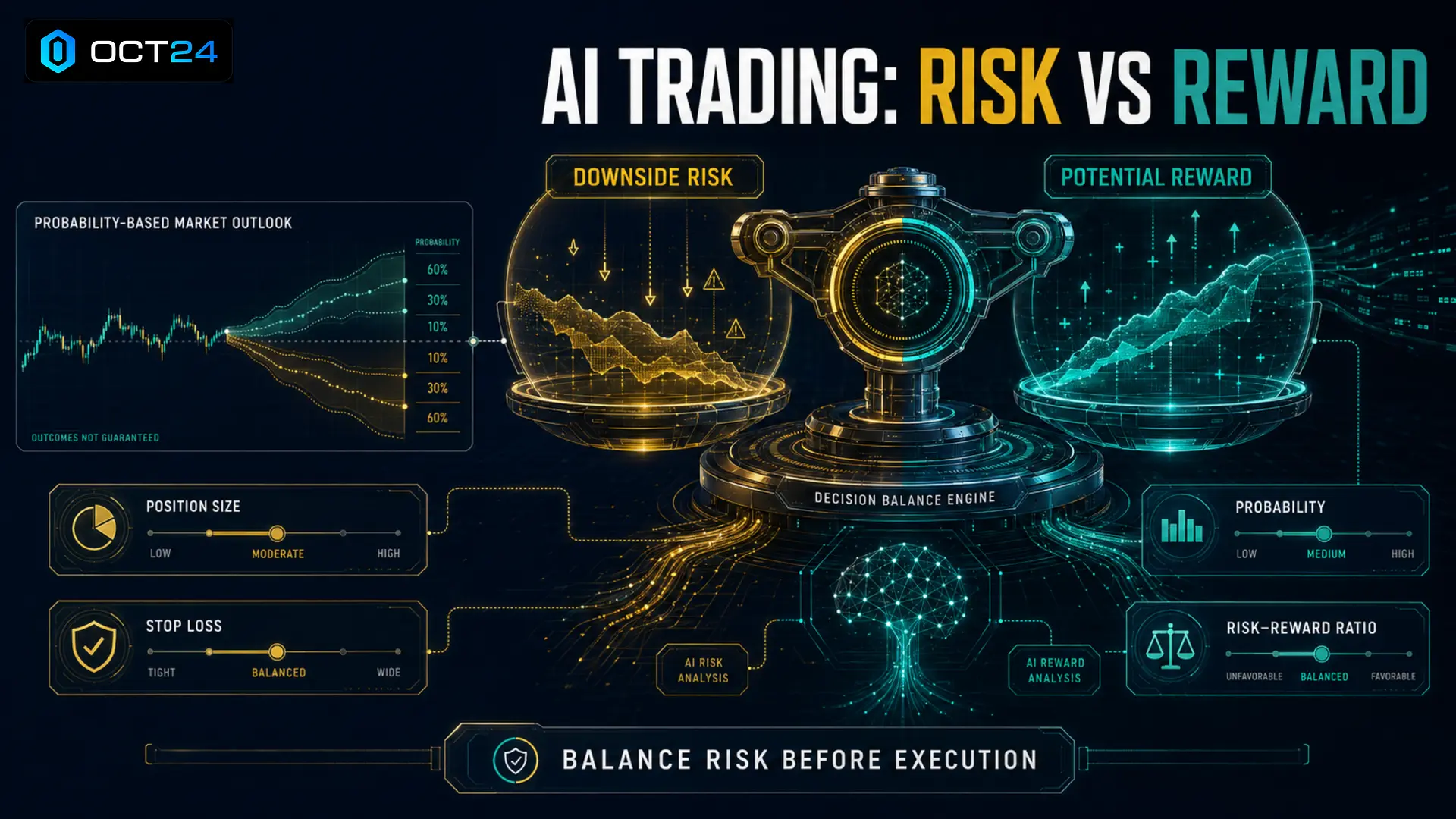
AI trading risk vs reward is the balance between how much a trader is willing to risk on a trade and how much potential reward the trade may offer. In simple terms, it helps traders decide whether a setup is worth taking before they put money at risk.
This matters because a trade can look exciting and still be a poor decision. A signal can look strong and still have too much downside. A market can move quickly and still offer a weak reward compared with the risk required to enter.
OCT24 helps traders approach this more clearly by scanning market conditions, identifying potential opportunities, and presenting AI-supported trading signals. The platform performs much of the analysis work, but it does not remove trading risk or guarantee results. Traders still need to choose risk settings, understand exposure, manage capital responsibly, and make informed execution decisions.
The goal of this article is simple: to help you understand how risk and reward work together, why AI can support better decision-making, and why trader discipline still matters.
What Risk vs Reward Means in AI Trading
Risk is the amount you could lose if a trade goes against you. Reward is the amount you could make if the trade moves in your favor.
A risk-reward comparison asks one practical question: is the possible reward large enough to justify the possible loss?
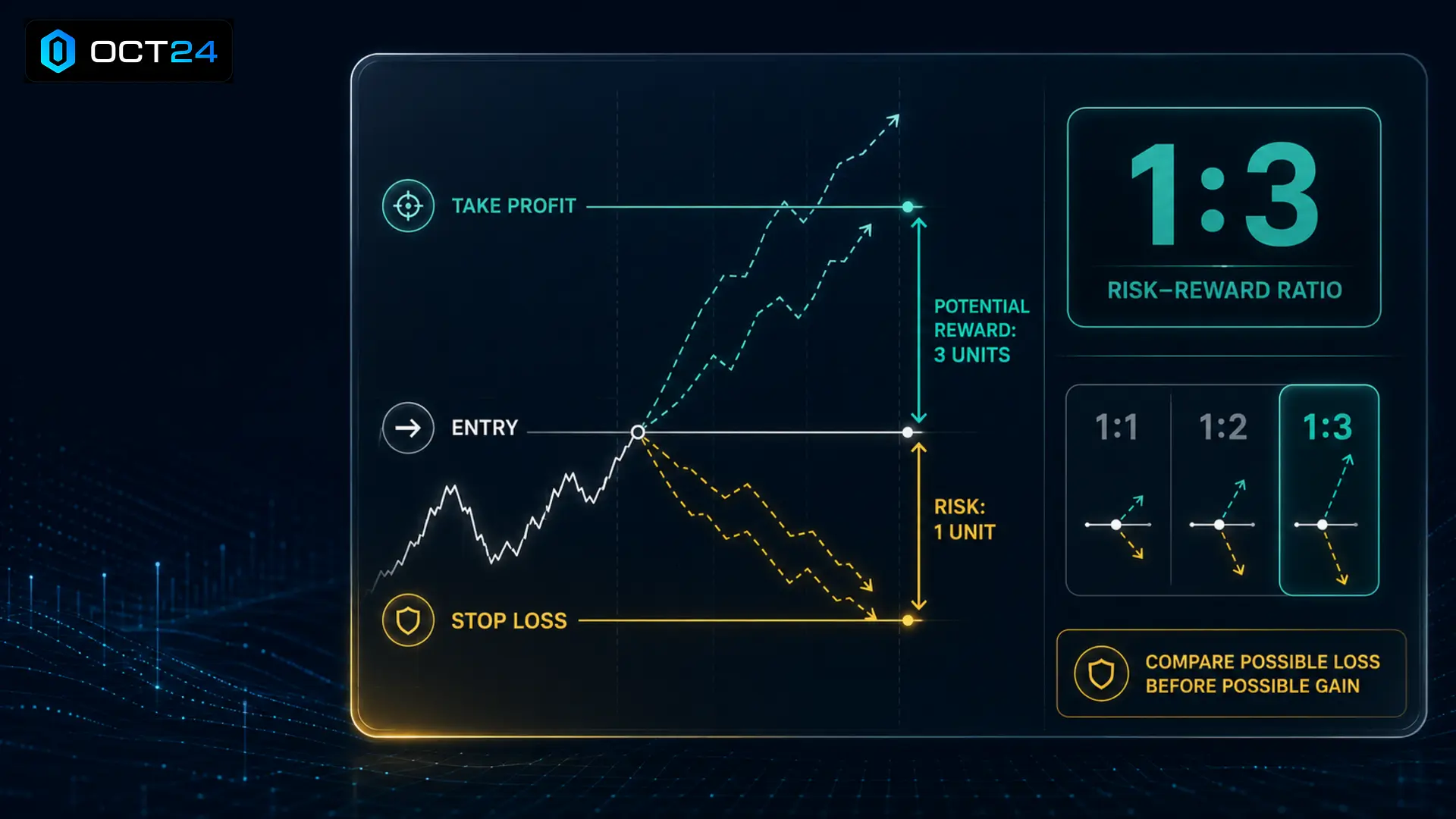
For example, imagine a trader risks $50 on a setup that could reasonably make $150. That is a 1:3 risk-reward ratio. The trader is risking one unit to potentially make three units.
Now imagine another trade where the trader risks $100 to potentially make $80. Even if the chart looks interesting, the setup may be less attractive because the possible reward is smaller than the possible loss.
This is why risk vs reward is so important for AI trading. AI can help review data, scan markets, and highlight possible setups. But the trader still needs to decide whether the possible reward makes sense compared with the risk.
If you are newer to AI trading, it helps to understand how AI trading bots work before thinking about risk-reward ratios. Bots and AI-supported tools can process information quickly, but they still need clear rules and responsible limits.
Why Risk vs Reward Matters More Than Being Right
Many beginners think successful trading means being right as often as possible. That sounds logical, but it is not the full picture.
A trader can win more than half of their trades and still lose money if the losing trades are too large. Another trader can win fewer trades and still perform better if the winning trades are much larger than the losing trades.
This is where risk vs reward becomes powerful. It helps traders focus on the quality of each setup instead of only focusing on prediction.
For example:
- A trader who risks $100 to make $100 needs a high win rate to stay ahead.
- A trader who risks $100 to make $300 can be wrong more often and still have a workable strategy.
- A trader who risks too much on one trade can damage their account even if the idea was reasonable.
This does not mean traders should chase unrealistic targets. It means every trade should have a clear reason for the risk and a realistic path to the reward.
OCT24 supports this mindset by presenting AI trading signals within a structured market-analysis workflow. The signal may identify a potential opportunity, but the trader still needs to ask whether the entry, stop area, target, and position size make sense together.
The Simple Risk-Reward Ratio
The risk-reward ratio compares the amount at risk with the potential gain. It is one of the simplest tools a trader can use before entering a trade.
Here is the basic idea:
- Risk is the distance between your entry and your planned exit if the trade fails.
- Reward is the distance between your entry and your planned target if the trade works.
- The ratio helps you compare those two numbers before you enter.
A 1:2 ratio means you are risking one unit to potentially make two units. A 1:3 ratio means you are risking one unit to potentially make three units.
The ratio does not guarantee success. It simply helps traders decide whether the trade has enough potential upside to justify the downside.
This is especially helpful when using AI-supported tools. A signal may suggest that a market is showing strength, weakness, momentum, or a possible breakout. But if the stop area is too far away or the target is too close, the trade may still be unattractive.
Good risk-reward thinking protects traders from taking trades just because something is moving. It encourages patience and selectivity.
How AI Can Support Risk-Reward Decisions
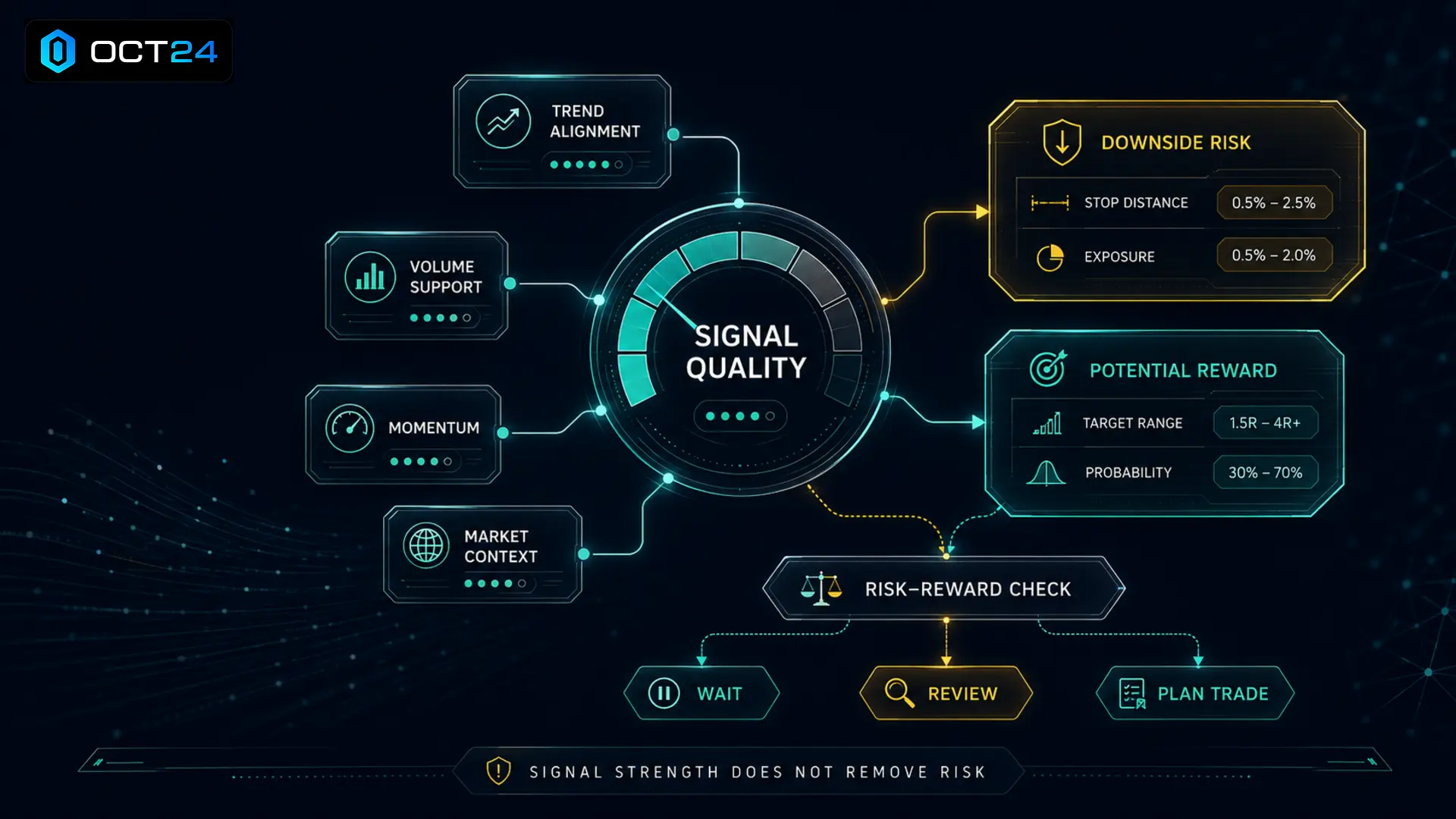
AI can support risk-reward decisions by analyzing market conditions faster than most traders can do manually. It can review price movement, volatility, momentum, and other signals across different markets.
This is one reason AI trading vs manual trading is such an important comparison. Manual traders can still make strong decisions, but they may miss changes when markets move quickly or when several assets need attention at once.
AI can help by:
- Scanning markets continuously
- Identifying potential trade setups
- Highlighting changes in volatility or momentum
- Supporting signal review before execution
- Reducing the amount of manual chart checking
- Helping traders compare multiple opportunities more efficiently
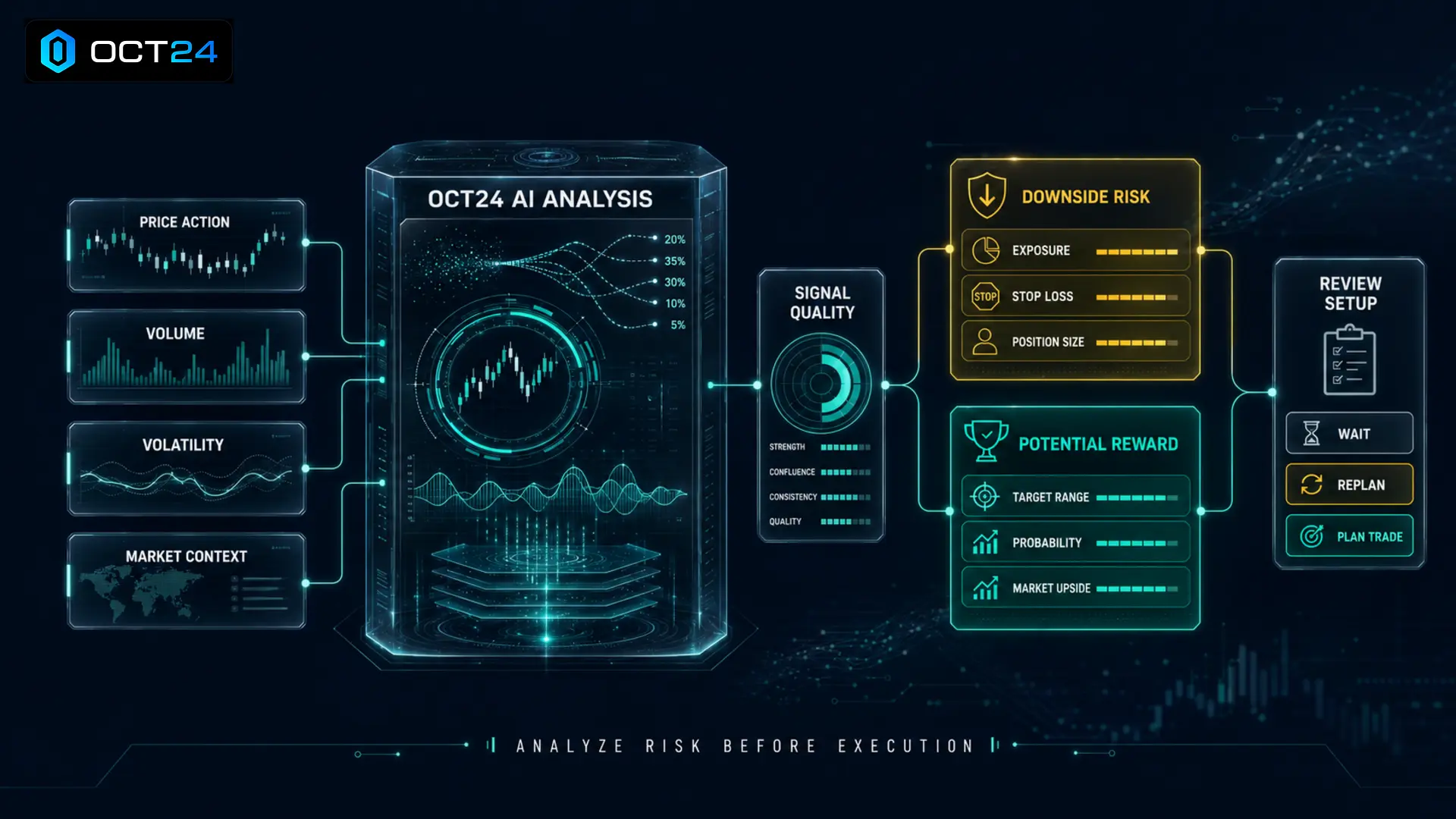
OCT24 is positioned around this workflow. It performs most of the market analysis for the user by scanning conditions, identifying potential opportunities, and presenting AI-supported trading signals.
That said, AI should not be treated as certainty. A signal is not a promise. A probability is not a guarantee. A good-looking setup can still fail.
The trader remains responsible for deciding whether the trade fits their risk plan. This includes position size, stop placement, exposure, and whether the trade should be taken at all.
What Makes a Good Risk-Reward Setup?
A good risk-reward setup is not just a trade with a large target. It is a trade where the risk is clearly defined, the reward is realistic, and the setup matches current market conditions.
Useful setups often have a few things in common:
- A clear entry area
- A clear invalidation point
- A realistic target area
- Enough potential reward to justify the risk
- Market conditions that support the idea
- Position size that keeps the possible loss manageable
The invalidation point is especially important. This is the area where the trade idea is no longer working. Without that point, the trader may hold a losing trade for too long or keep adjusting the plan emotionally.
For example, if a trader enters after a breakout, the invalidation point may be below the breakout level. If price falls back below that area, the setup may no longer be valid.
AI can help identify where momentum or market structure may be changing, but the trader still needs to define the trade plan. This is where AI trading strategies for beginners become useful. Simple strategies are easier to measure, review, and improve.
What Makes a Bad Risk-Reward Setup?
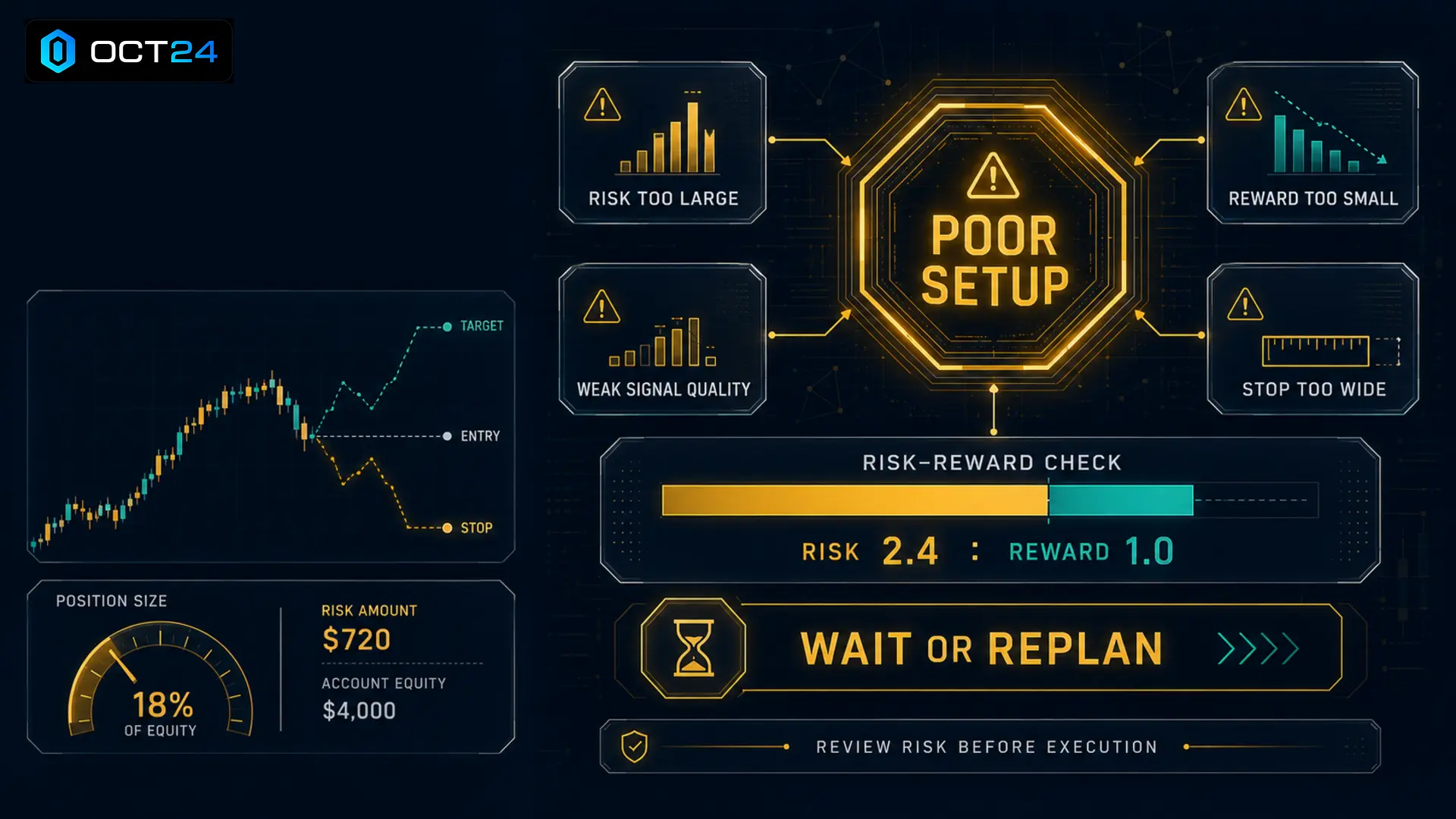
A bad risk-reward setup often looks exciting at first. The market may be moving fast. The signal may appear strong. The trader may feel pressure to enter before the move continues.
But when the trade is reviewed properly, the downside may be too large or the upside may be too small.
Warning signs include:
- The stop area is far away from the entry.
- The target is too close to justify the risk.
- The trade depends on hope instead of a clear setup.
- The market is too volatile for the planned position size.
- The trader is entering late after a large move.
- Several open trades are exposed to the same market risk.
- The trader has no clear exit plan.
These are common AI trading mistakes because traders sometimes treat an AI-supported signal as enough by itself. It is not enough by itself. The signal needs to be checked against risk, reward, and account exposure.
OCT24 can help by organizing analysis and presenting signals, but traders still need to avoid forcing trades when the risk-reward profile is weak.
How Technical Analysis Fits Into Risk vs Reward
Risk-reward planning often uses technical analysis because traders need reference points. These reference points may include support, resistance, trend lines, moving averages, breakout zones, or recent highs and lows.
If you already understand how AI uses technical analysis, the connection is straightforward. AI can scan technical conditions faster, but the trader still needs to interpret whether the setup gives enough room for reward compared with risk.
For example, if price is approaching resistance, a long trade may have limited upside unless the market breaks through that level. If price is near support, the downside may be easier to define, but the trader still needs confirmation.
Technical levels are not magic. They are planning tools. They help traders define where a trade idea may be working and where it may be failing.
OCT24 uses AI-supported analysis to help traders review market conditions and potential signals. This can reduce manual chart work, especially when markets are moving quickly or when several assets are being monitored at once.
Risk vs Reward During Volatile Markets
Volatility can make risk-reward planning more difficult. Price may move faster, spreads may widen, and stop areas may need more room.
This is why how AI handles market volatility matters for traders. Volatile markets can create opportunities, but they can also make poor risk settings more dangerous.
During high volatility, traders may need to:
- Reduce position size
- Use wider but still planned stop areas
- Avoid chasing late moves
- Wait for cleaner confirmation
- Avoid holding too many correlated trades
- Review whether the potential reward is still realistic
A setup that looks good in a calm market may not make sense in a fast market. If the risk area expands too much, the reward target may no longer justify the trade.
OCT24 can help traders recognize when conditions are changing. But the platform does not remove the need for discipline. If volatility is high, the trader must decide whether to reduce exposure, wait, or skip the trade.
Position Size: The Missing Link Between Risk and Reward
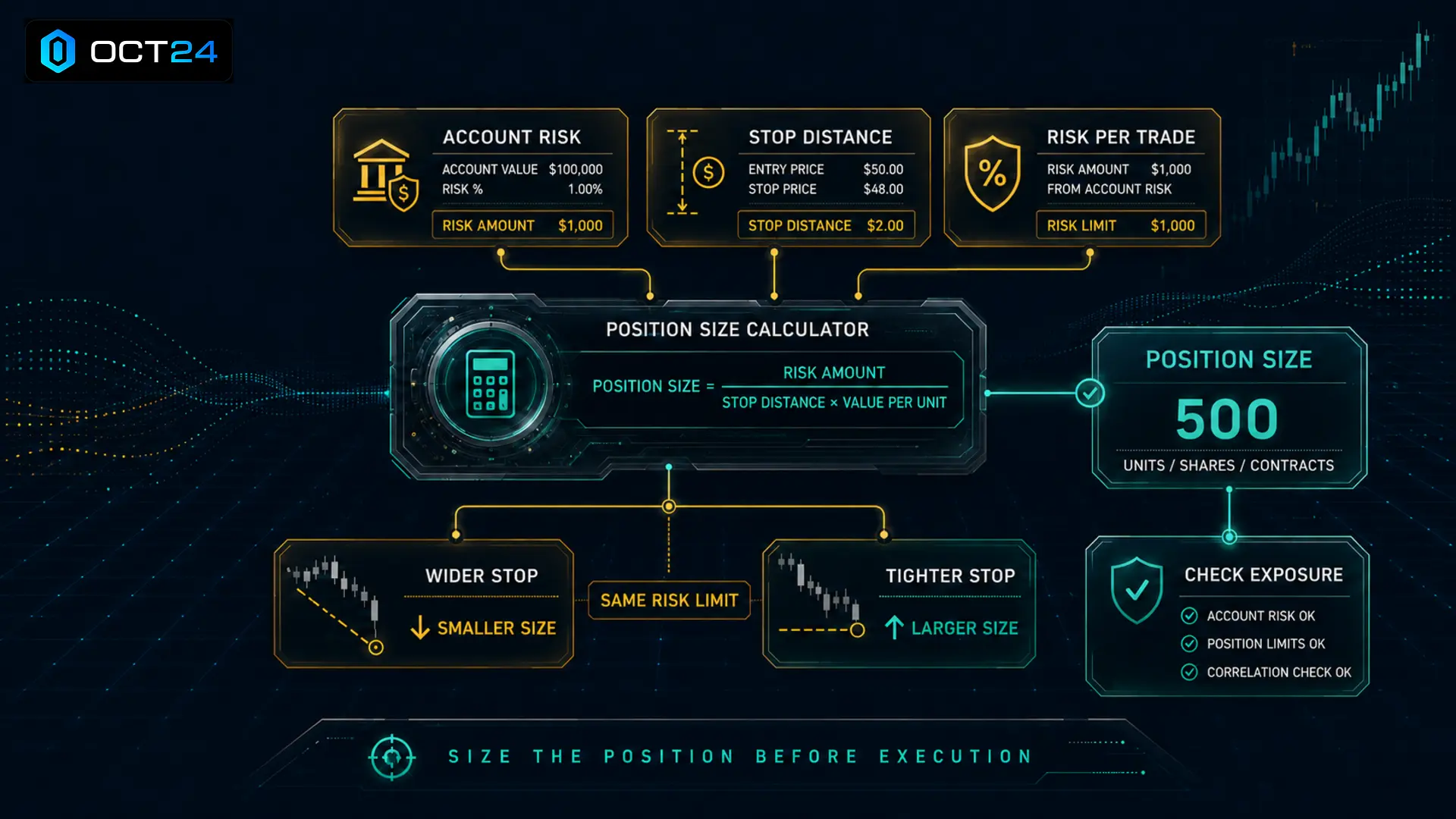
A good risk-reward ratio can still be dangerous if the position size is too large. Position size decides how much money is actually at risk.
For example, risking 1% of an account on a trade is very different from risking 10%. The chart may be the same, but the damage from being wrong is not.
This is why position sizing controls are so important. They help traders keep individual losses small enough to survive normal trading mistakes, losing streaks, and unexpected market moves.
A beginner-friendly approach is to decide the maximum acceptable loss before entering the trade. Then the position size can be adjusted to fit that limit.
For example:
- The trader decides they can risk $50 on one trade.
- The stop area shows the trade would lose $5 per unit if it fails.
- The trader can size the position so the total planned loss stays near $50.
- If the stop area becomes wider, the position size should usually become smaller.
This is one of the clearest ways to connect strategy with real account protection.
OCT24 can help traders review potential opportunities, but the trader remains responsible for capital allocation. The platform can support analysis, yet it cannot decide what level of financial risk is appropriate for each person.
Exposure: Risk Is Not Only One Trade
Many traders think about risk one trade at a time. That is useful, but it is not enough.
Exposure is the total amount of risk a trader has across open positions. A trader may have several trades that look separate but are actually connected.
For example, a trader may hold multiple crypto positions at the same time. If Bitcoin drops sharply, those positions may all move lower together. The trader may think they are diversified, but the portfolio may still be exposed to the same broad market risk.
Portfolio diversification tools can help traders think about this more clearly. The goal is not to avoid all risk. The goal is to understand when several positions may be depending on the same market condition.
This also matters when using trading bots. Trading bot risk management should include not only the settings for one trade, but the combined exposure across all active trades and tools.
OCT24 encourages a more structured workflow by helping traders review market conditions and signals before execution. Still, each trader must manage total exposure and avoid taking more risk than their account can handle.
How Risk vs Reward Changes With Strategy
Different strategies need different risk-reward expectations. A scalping strategy may look for smaller moves with tighter risk. A swing trading approach may require wider stops and larger targets.
This is why traders should avoid copying risk-reward ratios without understanding the strategy behind them.
For example:
- A breakout strategy may need room for price to retest the breakout area.
- A pullback strategy may define risk below a recent low.
- A momentum strategy may require quicker exits if momentum fades.
- A range strategy may target the opposite side of the range.
No single ratio works for every trader or every market. The risk-reward plan should fit the setup, the timeframe, and current market behavior.
This is also why can AI predict the market is the wrong question by itself. The better question is whether AI can help traders identify useful conditions, review probabilities, and manage decisions more consistently.
OCT24 can support that process by doing much of the scanning and analysis. The trader then reviews whether the opportunity fits their risk-reward rules.
Risk vs Reward and Trading Psychology
Risk-reward planning is not only a math exercise. It is also a psychology tool.
When traders do not define risk before entering, they often make emotional decisions after the trade is already moving. They may move stops, close winners too early, hold losers too long, or add to a bad position.
Trading psychology becomes harder when money is already at risk. That is why the best time to define risk and reward is before entering the trade.
A clear plan helps traders avoid emotional questions such as:
- Should I give this trade more time?
- Should I move my stop?
- Should I close now because I feel nervous?
- Should I add more because I want to recover?
- Should I chase the next signal?
The plan does not remove emotion, but it gives the trader something to follow when emotions rise.
OCT24 can reduce some of the pressure by presenting structured AI-supported analysis. But traders still need to make responsible choices, especially when the market moves against them.
How to Build a Simple Risk-Reward Plan
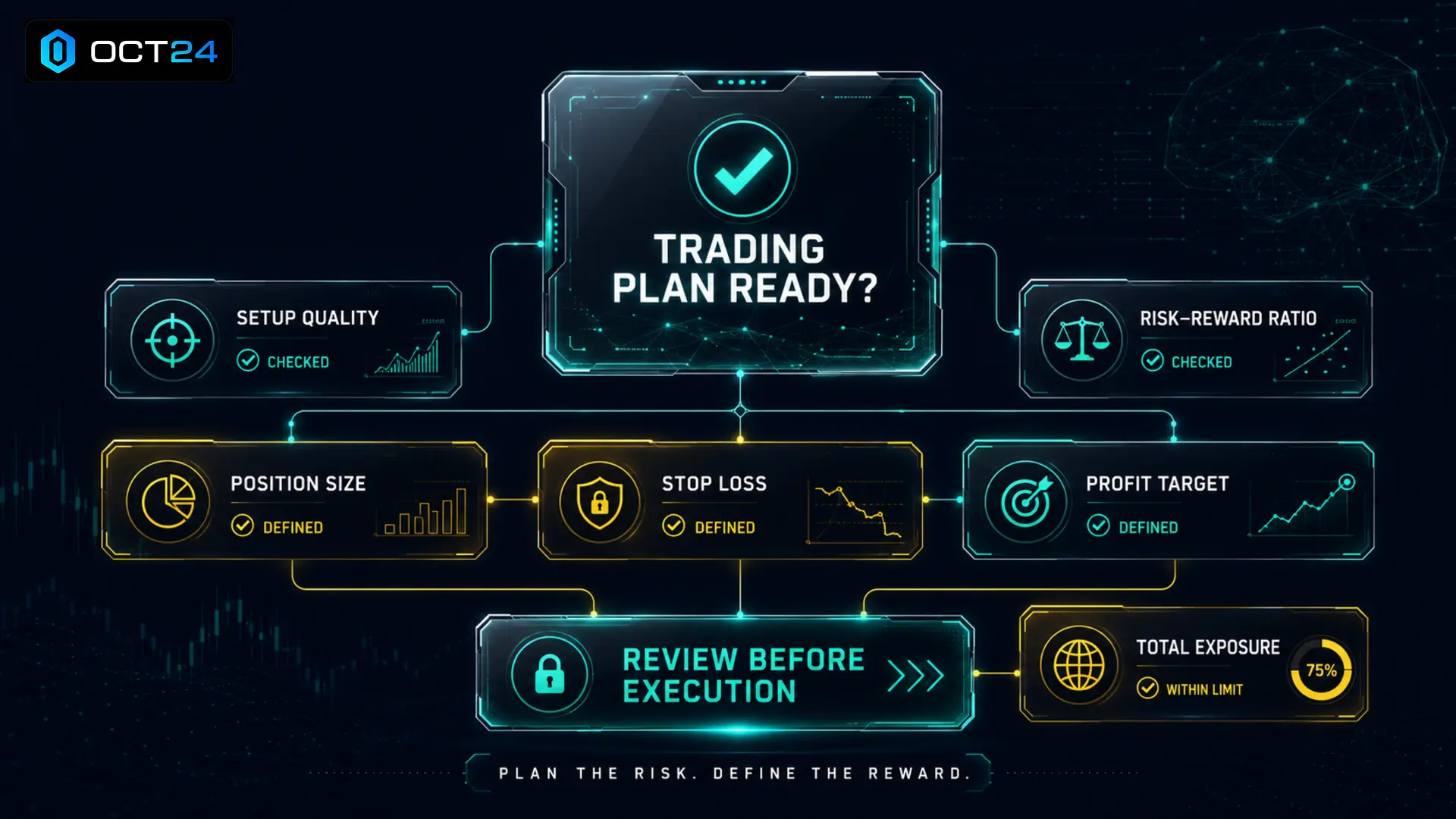
A simple plan is often better than a complicated one. The goal is to create rules that are easy to follow and easy to review.
Here is a practical structure:
- Choose the market you want to trade.
- Define the strategy you are using.
- Identify the entry area.
- Decide where the trade idea becomes invalid.
- Estimate a realistic target area.
- Compare the risk with the potential reward.
- Set position size based on the planned loss.
- Check total exposure across open trades.
- Decide whether to execute or wait.
- Review the trade after it closes.
This process works whether a trader is fully manual, using AI-supported signals, or combining both approaches.
OCT24 fits naturally into this workflow because it scans market conditions and presents AI-supported trading signals. Traders can use those signals as part of the review process while still applying their own risk settings and capital limits.
How OCT24 Supports Risk-Aware Trading
OCT24 is not designed to make traders ignore risk. It is designed to help traders approach markets with more structure.
The platform performs much of the analysis by scanning market conditions, identifying potential opportunities, and presenting AI-supported trading signals. This can help traders spend less time manually searching for setups and more time reviewing whether a setup makes sense.
For some traders, this may include reviewing signals before using one-click trading or exploring the G6 Trading Bot. These tools can support faster execution, but faster execution should still be paired with clear risk rules.
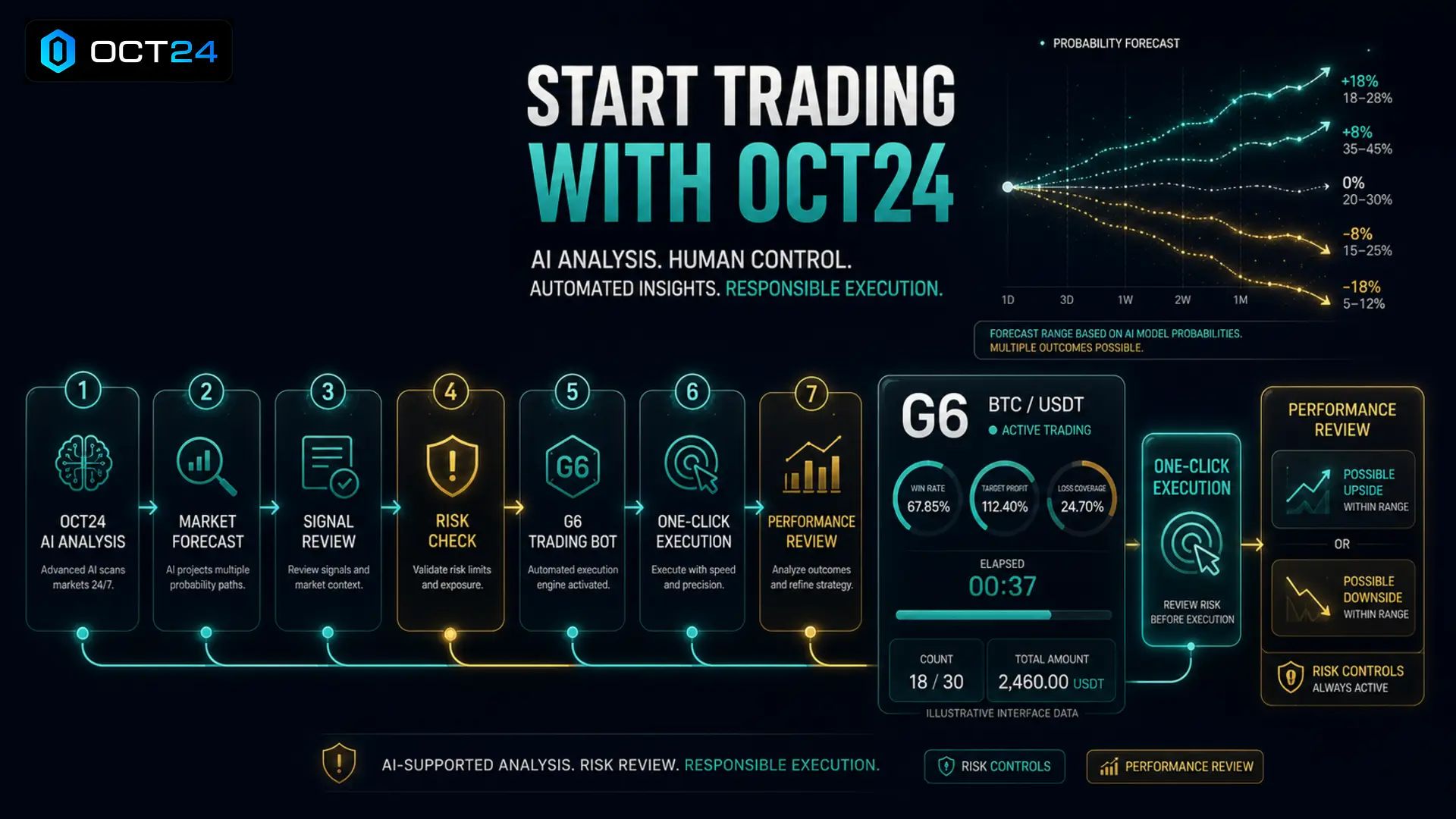
A responsible OCT24 workflow may look like this:
- OCT24 scans market conditions.
- The platform presents an AI-supported trading signal.
- The trader reviews risk, reward, volatility, and exposure.
- The trader chooses position size and risk settings.
- The trader decides whether to execute, wait, or skip the setup.
- The trader reviews performance after the trade.
This is the balance that matters. OCT24 can do much of the analysis work, but it does not guarantee outcomes. The trader remains responsible for execution decisions and risk management.
Why Risk-Reward Thinking Helps Busy Traders
Risk-reward planning is especially useful for people who do not have all day to watch charts. Busy traders need a way to quickly decide whether a setup deserves attention.
This connects closely with AI trading for busy professionals. When time is limited, traders need simple filters. Risk vs reward is one of the most useful filters because it quickly removes weak setups.
If the possible reward is too small, the trade may not be worth more time. If the risk is too large, the trade may not fit the account. If the setup is unclear, waiting may be better than forcing a decision.
OCT24 can support busy traders by scanning conditions and surfacing potential opportunities. But even when the analysis is faster, the trader should still pause long enough to ask: what am I risking, what is the realistic reward, and does this fit my plan?
Risk vs Reward Does Not Remove Risk
Risk-reward planning can improve discipline, but it cannot remove uncertainty. Markets can gap, reverse, break levels, or react to unexpected news. Even a well-planned trade can lose.
This is why AI trading myths can be dangerous. AI does not make every trade safe. It does not guarantee the best entry. It does not know the future with certainty.
The real value of AI-supported trading is not magic. It is structure, speed, scanning, and consistency. These can help traders review more information, but they do not replace responsible risk management.
If a trader treats AI as a shortcut around discipline, the risk can increase. If a trader uses AI as part of a clear process, it can support better decision-making.
FAQs
What is AI trading risk vs reward?
AI trading risk vs reward compares how much a trader may lose on a trade with how much they may gain. AI can help identify potential opportunities, but the trader still needs to decide whether the risk is worth the possible reward.
What is a good risk-reward ratio?
Many traders look for setups where the potential reward is at least twice the planned risk, such as 1:2 or better. However, the right ratio depends on the strategy, market conditions, win rate, and trader risk tolerance.
Can AI improve risk-reward decisions?
AI can support risk-reward decisions by scanning market data, identifying potential setups, and helping traders review conditions faster. It cannot guarantee that a trade will work.
Does OCT24 remove trading risk?
No. OCT24 performs much of the market analysis by scanning conditions and presenting AI-supported trading signals, but traders remain responsible for risk settings, exposure, capital allocation, and execution decisions.
Why is position size important?
Position size controls how much money is at risk. Even a strong setup can become dangerous if the position is too large for the account.
Should I take every AI trading signal?
No. AI trading signals should be reviewed before execution. Traders should consider risk, reward, volatility, exposure, and whether the setup fits their plan.
How does volatility affect risk vs reward?
Volatility can widen price swings and make stop areas larger. This can change the risk-reward profile and may require smaller position sizes or more patience.
How can beginners practice risk-reward thinking?
Beginners can start by writing down the entry, stop area, target, position size, and reason for each trade before entering. Reviewing this after each trade helps build discipline.
Final Thoughts
AI trading risk vs reward is one of the most important ideas for any trader to understand. It helps turn trading from a reaction into a plan.
The main question is not whether a signal looks exciting. The main question is whether the possible reward is worth the risk, and whether the trade fits your account, strategy, and current market conditions.
OCT24 helps by scanning the market, identifying potential opportunities, and presenting AI-supported trading signals. That can make analysis faster and more organized. But OCT24 does not remove risk or guarantee results.
The best approach is to combine AI-supported analysis with clear risk rules, sensible position sizing, and disciplined execution. If you want to learn more about the platform, visit About OCT24. If you are ready to explore AI-supported trading, you can Start Trading with OCT24.