
How to Read AI Trading Signals Before You Click
Learning how to read AI trading signals before you click is one of the simplest ways to make crypto trading more deliberate. A signal can look exciting at first glance, but the real question is whether the setup gives you enough information to make a calm decision. The goal is not to find certainty. The goal is to understand what the signal is showing, what risk may still exist, and whether the trade fits your personal limits.
OCT24 is designed to help with that review process. The platform scans crypto market conditions, identifies potential trading opportunities, and presents AI-supported signals in a simpler format. Traders can then review the signal, consider the available metrics, and decide whether the opportunity fits their risk settings, exposure, capital allocation, and execution plan. OCT24 does not remove trading risk or guarantee results. It gives structure to the decision before the click.
For beginners, this matters because crypto markets can move quickly. A coin can rise, reverse, and confuse traders within minutes. A clean signal review gives you a practical pause. Instead of clicking because a chart is green, you can ask whether the signal has enough support from win rate, target profit, loss coverage, timing, volatility, and market context.
What Is an AI Trading Signal?
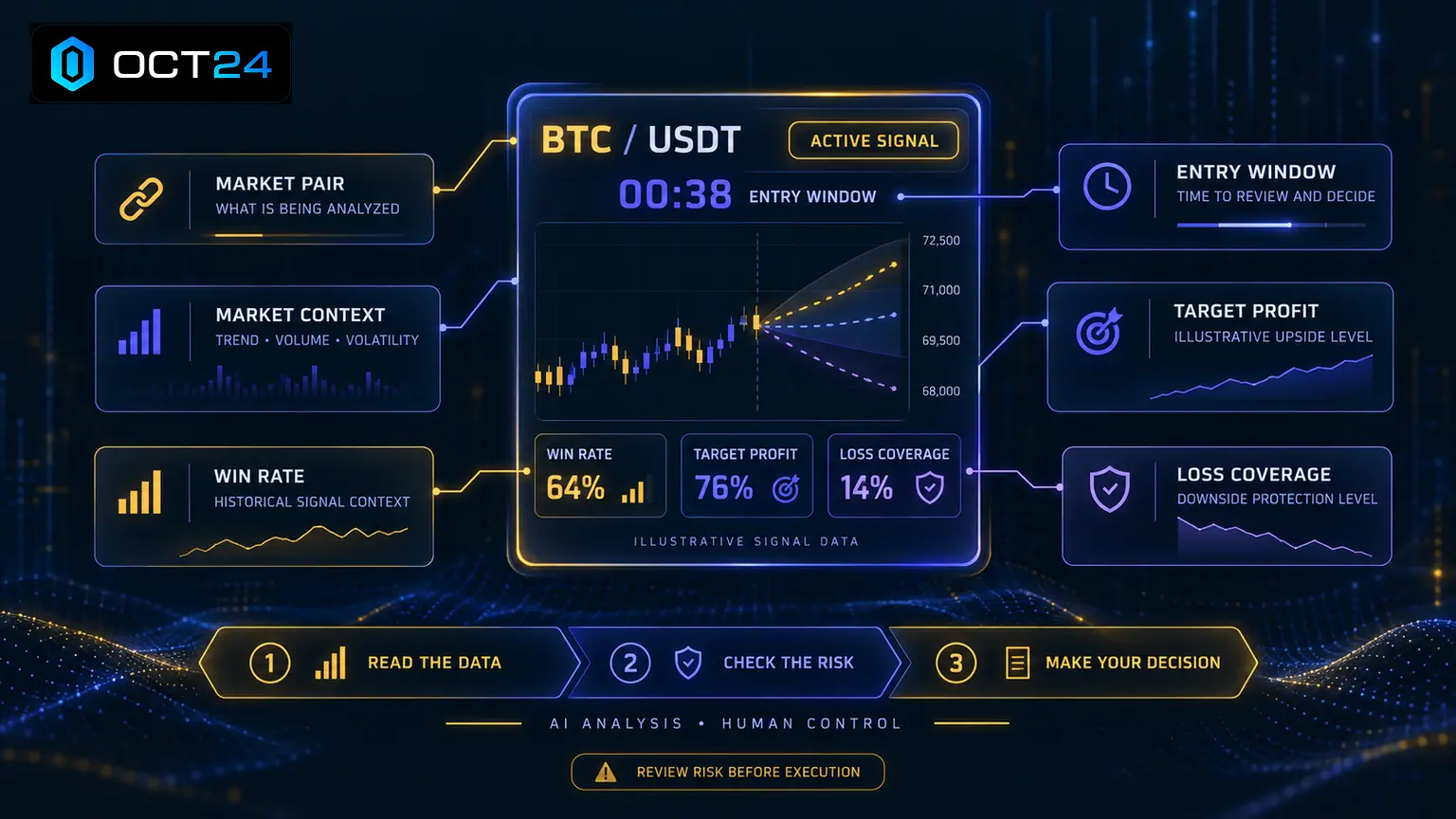
An AI trading signal is a structured trading opportunity generated or supported by software that studies market data. In crypto trading, that data may include price movement, volume, volatility, trend behavior, liquidity, and recent market conditions. The signal is not a promise. It is a possible opportunity that needs review.
A useful signal should help answer simple questions:
- What crypto asset is being considered?
- What direction or setup is being suggested?
- What is the potential target profit?
- How much loss coverage or risk buffer is involved?
- How strong is the signal compared with other available opportunities?
- Does the signal fit your account size and risk tolerance?
This is where AI Trading becomes useful for beginners and active traders. AI can process more data than most people can review manually. It can scan many crypto conditions at once and turn a noisy market into a smaller list of opportunities that may deserve attention.
Still, the trader remains responsible for the decision. A signal can support a trade idea, but it cannot know your full financial situation, emotional state, portfolio exposure, or personal limits. That is why reading the signal before you click is so important.
Why Reading the Signal Matters Before One-Click Trading
One-click trading can make execution faster, but speed should not replace judgment. A fast button is helpful only when the review process is clear. Traders should understand what they are accepting before activating any crypto trade.
On OCT24, the purpose of one-click execution is to reduce friction after the platform has already done much of the market scanning. The AI reviews market conditions, surfaces potential opportunities, and presents signal information in a way that is easier to compare. The trader still decides whether to activate the trade and remains responsible for risk settings, exposure, capital allocation, and execution decisions.
A beginner might think the fastest trader wins. In reality, the more disciplined trader often has the better process. Reading a signal first helps you avoid common mistakes such as chasing a move, ignoring risk, overloading one asset, or clicking because the market feels exciting.
If you are new to one-click trading, think of the click as the final step, not the full strategy. The work happens before activation. You review the signal, compare the important metrics, and decide whether the opportunity deserves your capital.
The Three Signal Metrics Beginners Should Check First
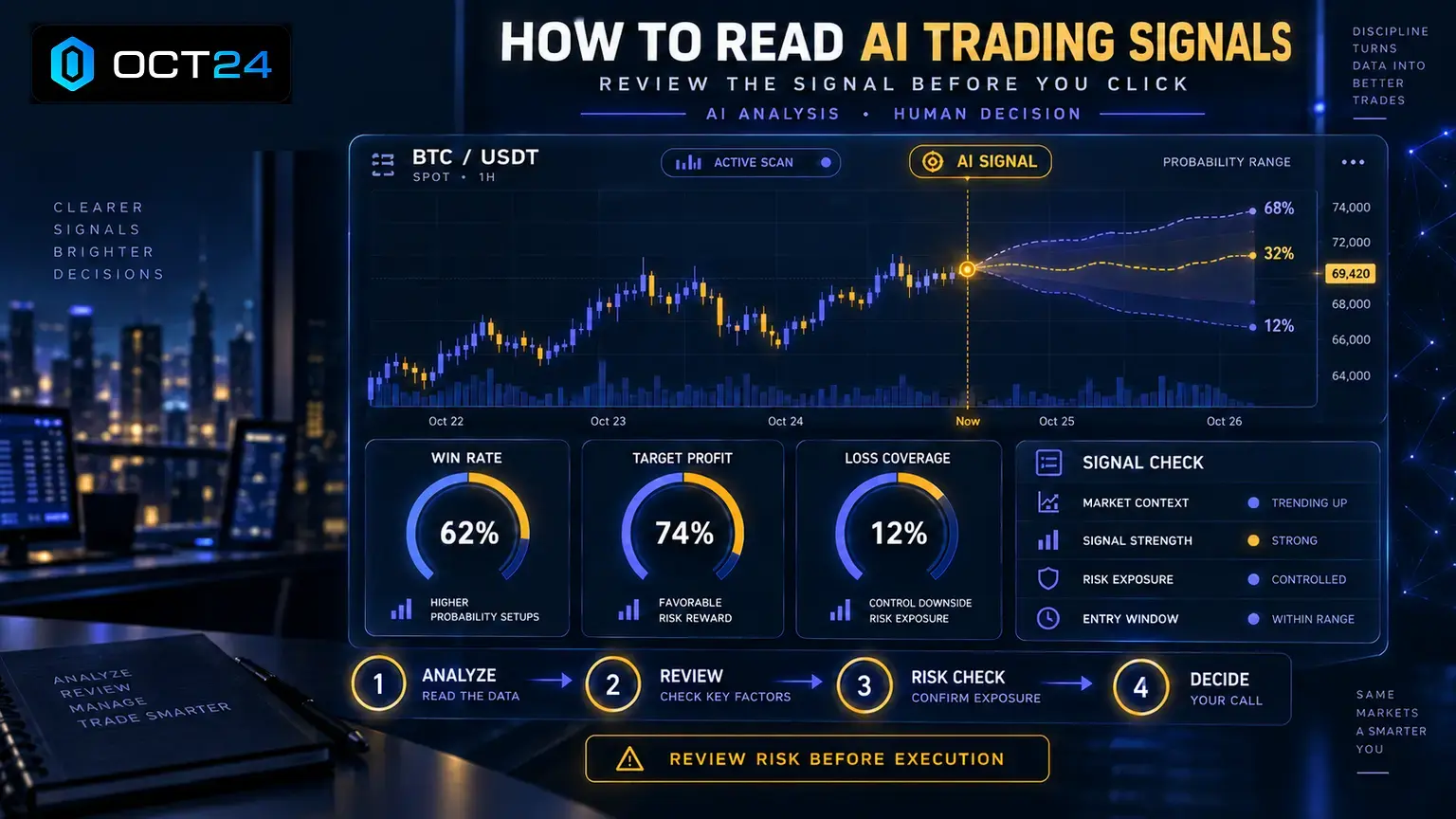
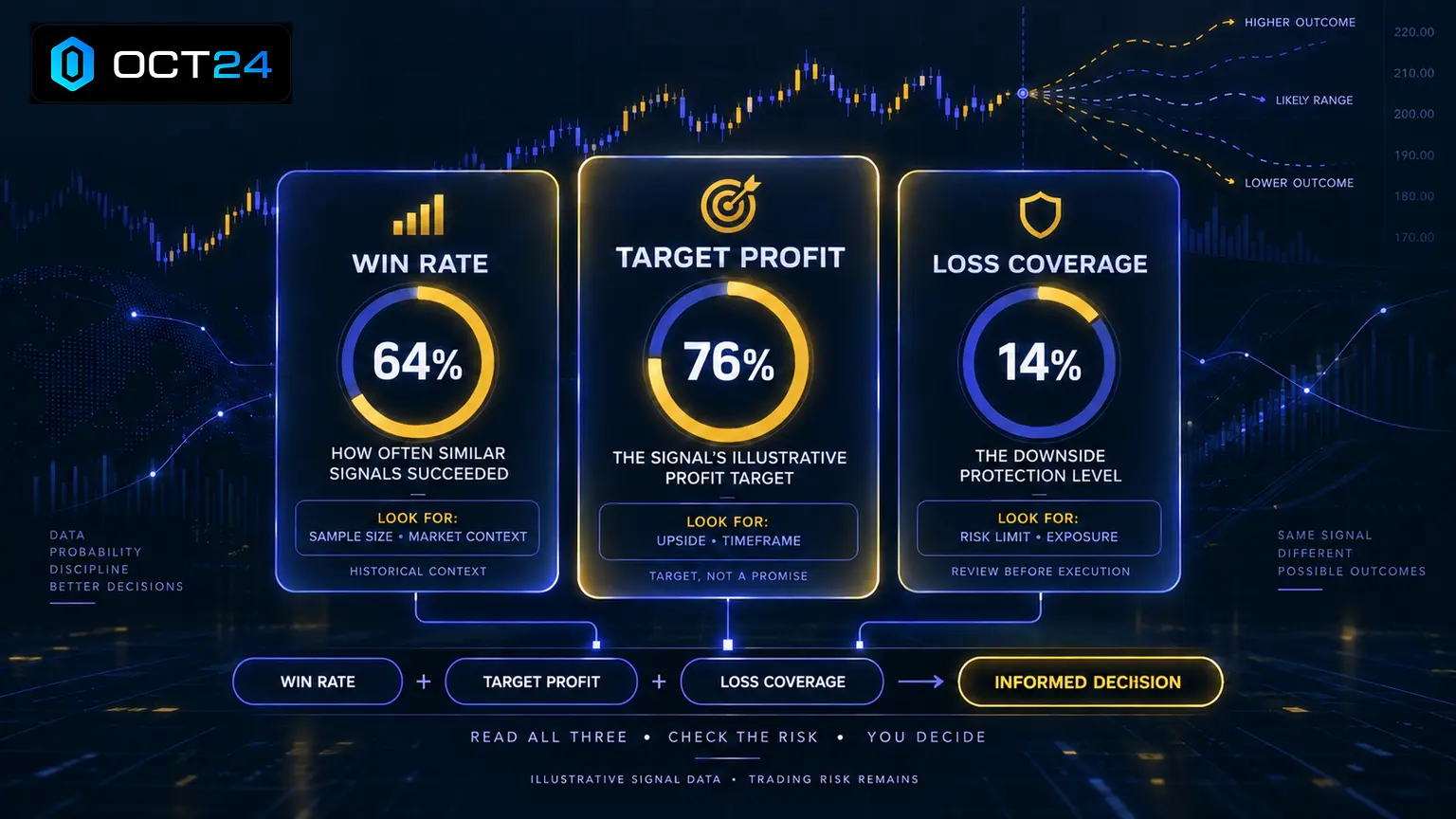
Many trading dashboards can feel crowded. Beginners may see too many numbers and struggle to know where to focus. For OCT24-style signal review, three metrics deserve special attention: win rate, target profit, and loss coverage.
These three metrics do not tell the whole story, but they give a strong first pass. They help you understand the balance between probability, potential reward, and downside protection. When they are reviewed together, the signal becomes easier to judge.
Win Rate
Win rate shows how often a strategy or signal type has produced winning outcomes under relevant conditions. A higher win rate may suggest stronger historical performance, but it should never be read alone. A signal with a high win rate can still be risky if the loss size is large or the target profit is too small.
Beginners often make the mistake of treating win rate as the whole decision. It is not. Win rate answers one question: how often has this kind of setup tended to work? It does not answer how much can be lost when it fails, whether the market is currently unstable, or whether the trade size is appropriate.
Target Profit
Target profit shows the potential upside that the signal is aiming for. It helps traders understand whether the possible reward is meaningful enough for the risk involved. A signal with a small target profit may still be useful in certain conditions, but it must be weighed against fees, volatility, and downside exposure.
Target profit is especially important in crypto because price movement can look dramatic without being efficient. A token may move quickly, but spreads, slippage, and sudden reversals can affect real outcomes. A clearly presented target profit helps keep the trade idea grounded.
Loss Coverage
Loss coverage helps explain how the setup accounts for downside movement. It is not the same as a guarantee that losses will be avoided. Instead, it gives traders a clearer view of how much room the signal has before the trade becomes unfavorable or reaches its risk boundary.
A signal with attractive target profit but weak loss coverage can be less appealing than it first appears. Strong signal review compares upside with downside. That is why OCT24 users should read loss coverage together with win rate and target profit before they click.
How to Compare Win Rate, Target Profit, and Loss Coverage
The easiest way to compare these three metrics is to avoid choosing one favorite number. A trader should look for balance. A strong signal usually makes sense across several dimensions rather than looking impressive in only one place.
Use this simple review pattern:
- Check whether the win rate is strong enough to deserve attention.
- Review whether the target profit is realistic for the current crypto market conditions.
- Look at loss coverage to understand the downside boundary.
- Compare the signal with other available opportunities instead of judging it in isolation.
- Decide whether the trade fits your risk settings and available capital.
A high win rate with a tiny target profit may not be worth the risk if loss coverage is weak. A large target profit may look exciting, but if the win rate is low and the market is volatile, the trade may require more caution. A signal with reasonable target profit, solid win rate, and stronger loss coverage may be easier to review because the pieces work together.
This is one reason AI-supported platforms can help traders stay organized. OCT24 can scan many market conditions and present opportunities in a more structured way. Instead of manually jumping across dozens of charts, traders can compare signals through a consistent review process.
Read the Market Context Around the Signal
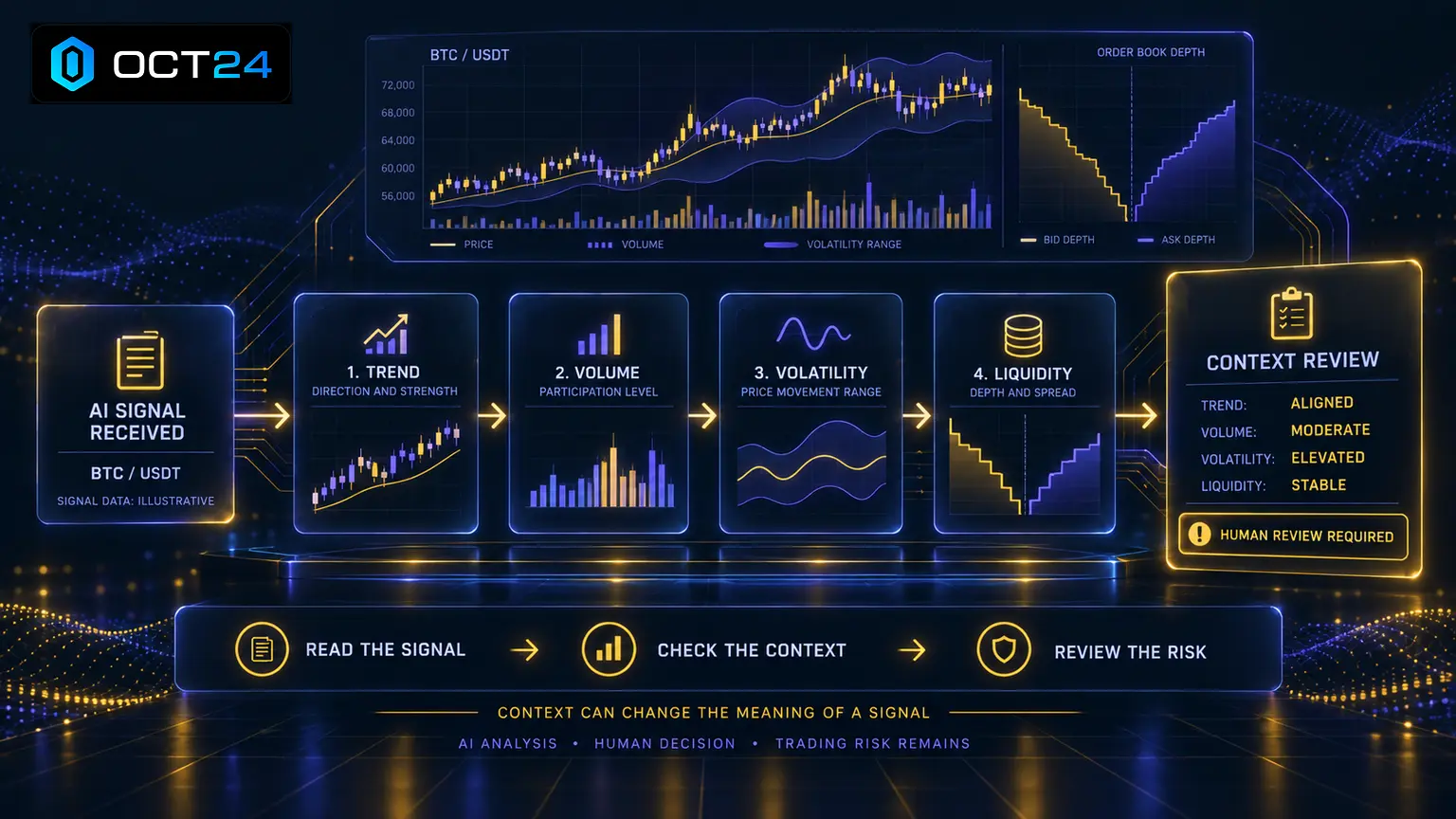
A signal does not exist in a vacuum. Crypto trading signals should be read with market context. The same signal can feel very different in a calm trend, a choppy range, or a high-volatility news event.
Before clicking, ask what the broader crypto market is doing. Is Bitcoin moving sharply? Are major altcoins following or lagging? Is liquidity strong or thin? Is the signal appearing after a major move, or near the start of a possible setup? These questions help you avoid treating every signal as equal.
OCT24 helps by performing much of the analysis needed to identify potential opportunities. It can scan market behavior and present AI-supported signals, but traders should still think about exposure and conditions. If your portfolio already has several open crypto positions, another signal in the same direction may increase concentration risk.
A basic understanding of charts can also help. You do not need to become a technical analyst to use OCT24, but knowing the basics of candles, trends, support, resistance, and volatility can make signal review easier. For extra context, the OCT24 guide on How to Read Crypto Charts can support that foundation.
How OCT24 Helps Simplify Signal Review
OCT24 is built for traders who want a cleaner process. Crypto markets are open around the clock, and many traders do not have time to monitor every asset manually. OCT24 can scan market conditions, identify potential opportunities, and present AI-supported trading signals that are easier to review before execution.
That does not mean the platform removes the need for judgment. It means the analysis starts from a more organized place. Instead of beginning with a blank chart and a flood of market noise, a trader can begin with a signal and ask whether the opportunity makes sense.
A simple OCT24 review may include:
- Reading the signal summary.
- Comparing win rate, target profit, and loss coverage.
- Checking whether the opportunity fits the current market environment.
- Reviewing personal exposure before adding another trade.
- Deciding whether to activate the opportunity through the available trading workflow.
This process may help both beginners and professionals. Beginners get a clearer structure for decision-making. More experienced traders can use OCT24 to save time, compare opportunities faster, and avoid spending every session buried in manual screening.
The key is to use OCT24 as decision support, not as a substitute for responsibility. Every trader still needs to control position size, account exposure, capital allocation, and execution decisions.
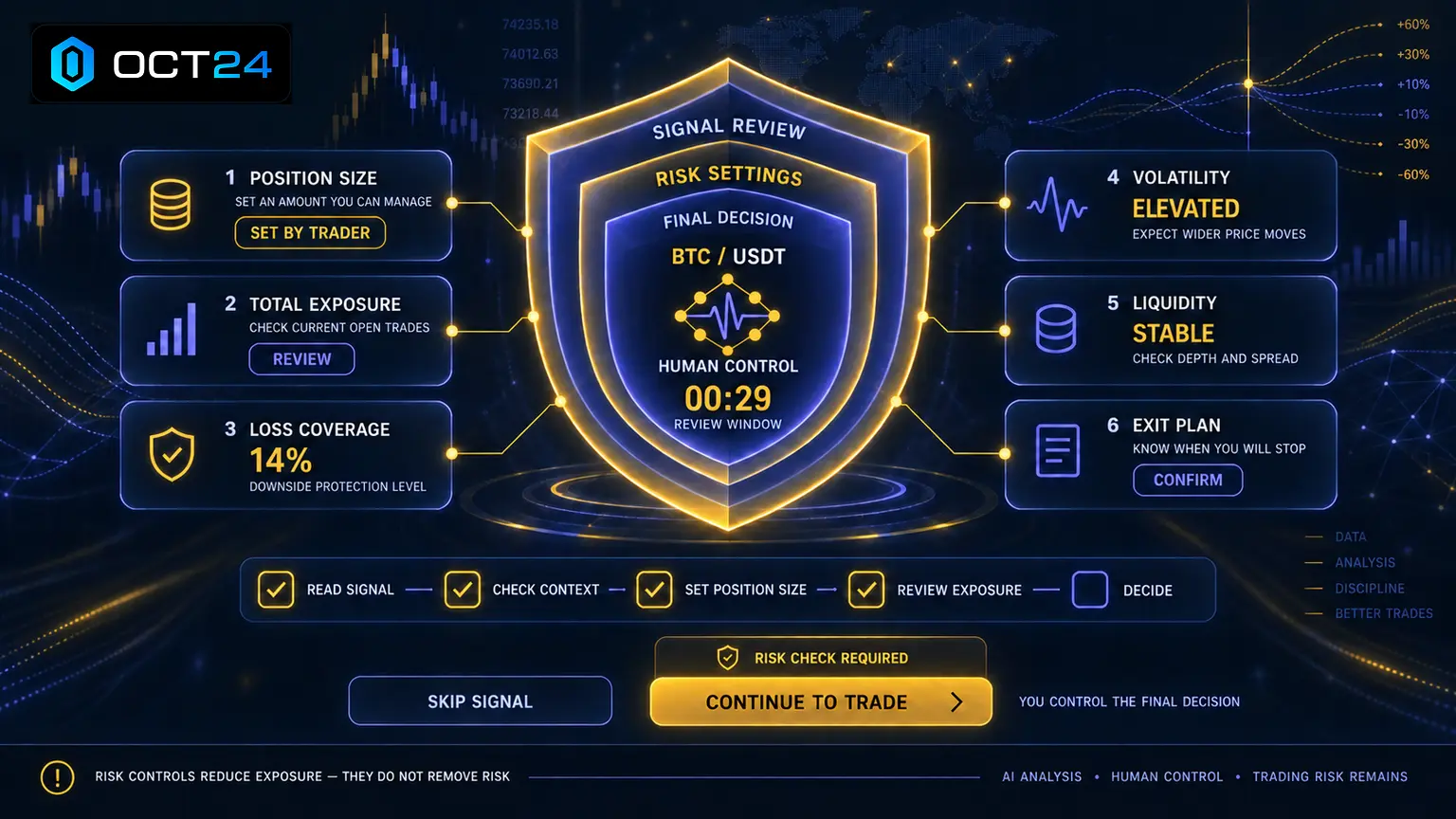
What to Check Before You Click
Before activating a signal, slow the process down for a moment. A few practical checks can prevent rushed decisions.
First, check whether the signal fits your account. A trade can be technically interesting and still be wrong for your current exposure. If the position size is too large or your account is already concentrated in similar trades, the signal may not be a good fit.
Second, check whether the signal fits the market. Some trades work better in trend conditions, while others are more sensitive to choppy price action. If the market is moving sharply after news, even a strong signal may require extra caution.
Third, check whether the signal fits your mindset. If you are clicking because you feel impatient, frustrated, or afraid of missing out, the decision may not be objective. OCT24 can make the signal easier to read, but it cannot remove emotional pressure from the trader.
Good Trading Bot Risk Management starts before the trade is active. It starts when you decide whether the signal deserves attention at all.
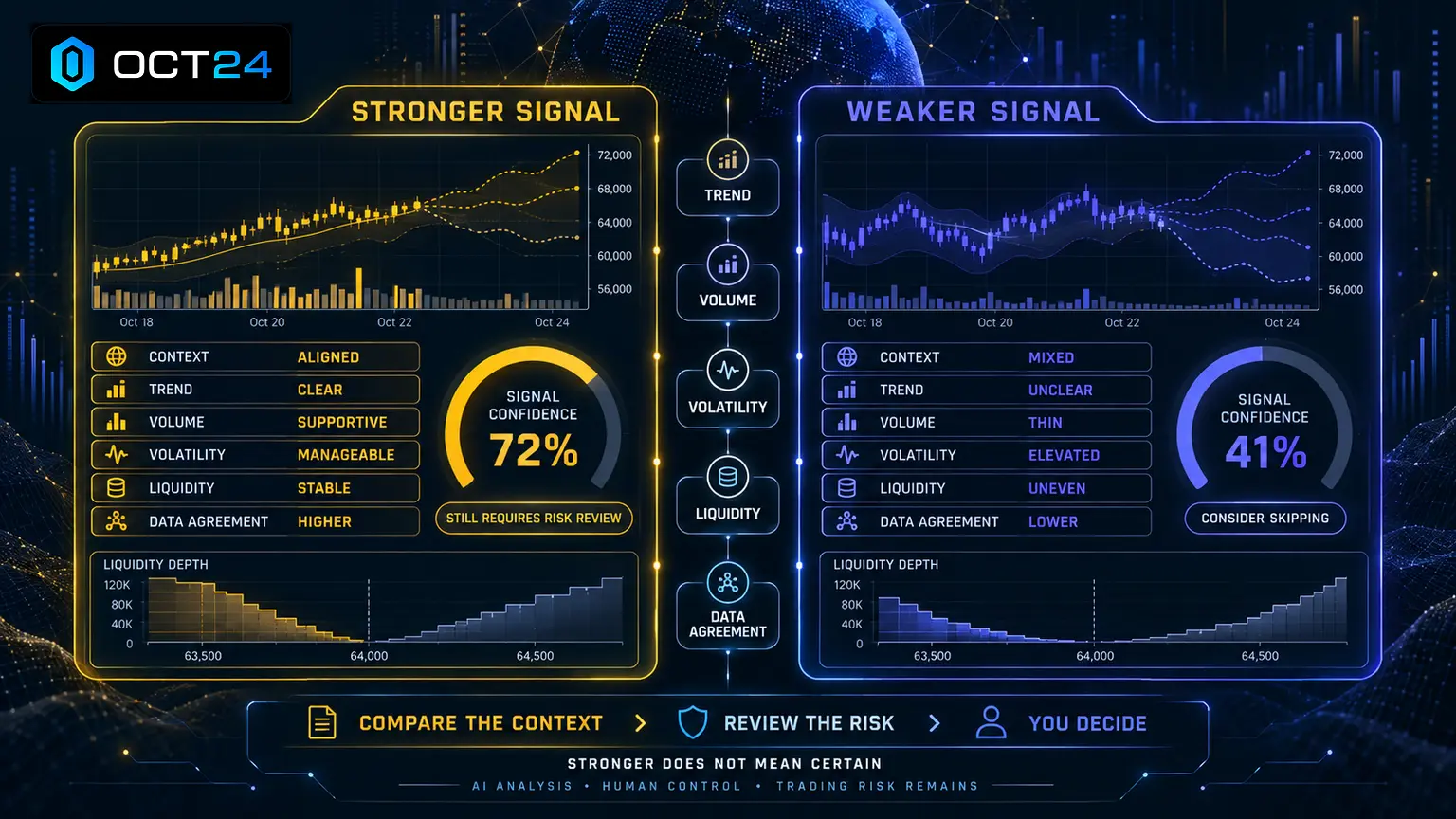
Strong Signals Versus Weak Signals
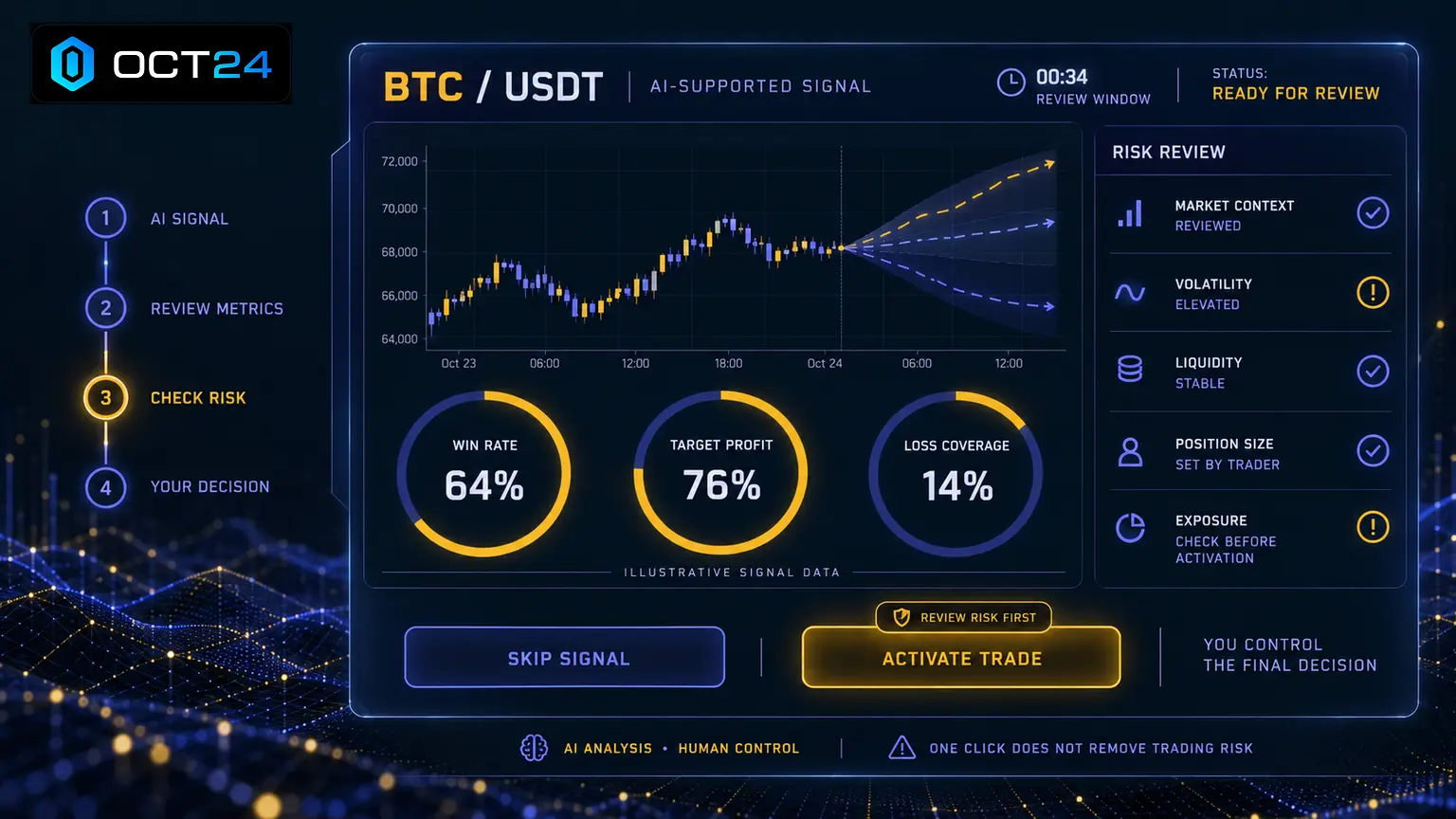
A strong AI trading signal usually has alignment. The market setup, win rate, target profit, loss coverage, and timing all point in a reasonable direction. The signal does not need to look perfect, but the main pieces should make sense together.
A weak signal often has conflict. The win rate may look appealing, but the target profit may be too small. The target profit may look attractive, but loss coverage may be thin. The setup may appear after a large move, which can increase reversal risk.
Here are simple signs of a stronger signal:
- The win rate supports the setup without being treated as a guarantee.
- The target profit appears realistic for the current market.
- Loss coverage gives enough context for downside movement.
- The signal is not crowded by too many similar open positions.
- The market environment supports the trade idea.
Here are signs that a signal may need more caution:
- The trade relies on one impressive metric while other metrics look weak.
- The signal appears during unusually thin liquidity.
- The target profit is large but the downside boundary is unclear.
- The trade would increase concentration in one asset or market direction.
- The trader feels rushed to click before reviewing the setup.
This is where comparison matters. The best available signal is not always the one with the biggest target profit. Sometimes the better choice is the opportunity with cleaner balance and more understandable risk.
How Position Size Changes the Signal Decision
A trading signal is only part of the decision. Position size changes the real impact of the trade. The same signal can be reasonable with a small position and too aggressive with a large position.
Beginners should be especially careful here. If a signal looks strong, it can be tempting to increase size too quickly. That can make one normal losing trade feel much bigger than expected. Even with AI support, losses can happen. Traders may see some take profits and some stop losses over time. The goal is not to avoid every loss. The goal is to keep risk controlled enough to keep making thoughtful decisions.
Position Sizing Controls are important because they connect the signal to the account. Win rate, target profit, and loss coverage are useful only when the trade size fits your plan. If the size is too large, even a signal with solid metrics can create unnecessary stress.
How to Avoid Overtrusting AI Signals
AI can support traders, but it should not be treated as magic. Markets are uncertain. Crypto can move on liquidity changes, news, sentiment, large wallet activity, exchange conditions, and sudden volatility. No tool can remove that uncertainty.
A healthy way to use AI is to ask better questions. What is the signal showing? What does the win rate suggest? Is the target profit reasonable? How does loss coverage compare with the possible upside? Does the opportunity fit current market conditions?
This mindset is also useful when learning about Algorithmic Trading and Automated Trading. Rules, models, and automation can create structure, but they do not turn trading into a certain outcome. The trader still needs a responsible process.
OCT24 can make the market easier to scan and the opportunity easier to review. It can help reduce manual workload and support more consistent decision-making. But the final responsibility still belongs to the trader.
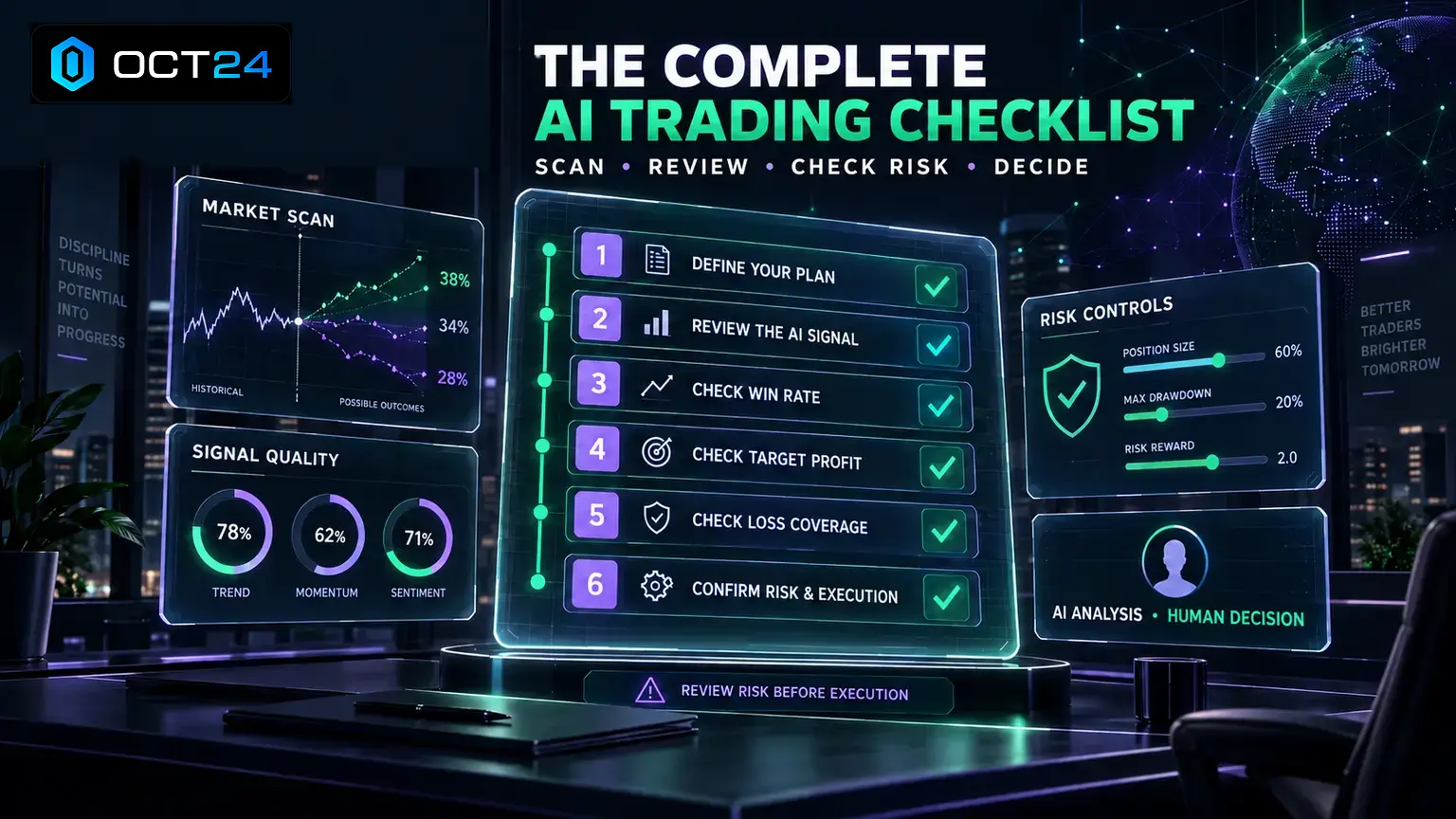
A Simple OCT24 Signal Review Routine
If you are unsure where to start, use a repeatable routine. A routine makes signal review feel less emotional and more practical. It also helps you compare opportunities the same way each time.
Try this beginner-friendly process before clicking:
- Open the opportunity and read the signal summary.
- Check the win rate and ask whether it is strong enough for the setup.
- Review the target profit and decide whether the potential upside is meaningful.
- Review loss coverage and understand the downside context.
- Check your current exposure and avoid stacking too many similar trades.
- Confirm that the opportunity fits your capital allocation plan.
- Activate only if the signal still makes sense after the review.
This routine is simple on purpose. A beginner does not need a complicated trading checklist to make better decisions. The value comes from consistency. When you review each signal the same way, it becomes easier to notice when a trade does not fit.
For traders who want to explore the platform directly, Start Trading with OCT24 is the clearest next step. The signup path should be treated as an invitation to review AI-supported crypto trading opportunities, not as a promise of results.
How Beginners and Professionals Read Signals Differently
Beginners often look for simple answers. They want to know whether the signal is good or bad. Professionals usually think in probabilities. They ask whether the opportunity is good enough for the risk, size, timing, and portfolio context.
OCT24 can support both groups because it simplifies the first layer of analysis. Beginners get a cleaner way to understand AI-supported crypto opportunities. Professionals get a faster way to scan conditions and compare potential setups before deciding where to focus.
A beginner might use OCT24 to avoid staring at complex charts all day. A professional might use it to support screening and execution discipline. Both should still review the same core ideas: win rate, target profit, loss coverage, market conditions, and account exposure.
The platform is helpful because it reduces some of the manual work. It does not remove the need to think. That distinction is important for responsible crypto trading.
Common Mistakes to Avoid Before Clicking
Even with AI support, traders can make avoidable mistakes. Most of them come from moving too quickly or focusing on only one part of the signal.
Avoid these habits:
- Clicking because the target profit looks exciting.
- Ignoring loss coverage because the win rate looks strong.
- Activating too many trades in the same market direction.
- Using the same position size for every signal.
- Treating a signal as a guarantee.
- Skipping review during volatile market conditions.
- Trading when you are tired, impatient, or emotional.
A better habit is to pause for a short review. If the signal still makes sense after that pause, the decision is likely to be more deliberate. If the signal looks weaker after review, skipping it may be the better choice.
This is also one of the practical Benefits of AI Trading. AI can help organize market information, but the trader uses that structure to make a more careful choice.
Why Portfolio Exposure Still Matters
A single signal can look reasonable by itself and still create too much total exposure. For example, if a trader already has several open long crypto trades, adding another similar position may increase risk if the whole market reverses.
That is why signal review should include portfolio context. You are not only asking whether this trade looks good. You are asking whether this trade belongs with everything else you already have active.
Portfolio Diversification Tools can help traders think about concentration, asset mix, and overall exposure. In crypto trading, this is especially important because assets can become highly correlated during sharp market moves. When Bitcoin drops quickly, many altcoins may move in the same direction.
OCT24 helps identify and present opportunities, but it is still the trader’s job to think about account-level risk. A good signal is not a reason to ignore the bigger picture.
What the Click Should Mean
The click should mean you have reviewed the signal and accepted the risk. It should not mean you are guessing, chasing, or reacting to hype.
A clean one-click workflow is powerful because it can reduce hesitation after the review is complete. But it should always come after the core questions have been answered. Do you understand the win rate? Do you understand the target profit? Do you understand loss coverage? Does the trade fit your account? Are you comfortable with the possibility of a stop loss?
When the answer is yes, one-click execution can make the process feel simple. When the answer is no, waiting may be the more disciplined decision.
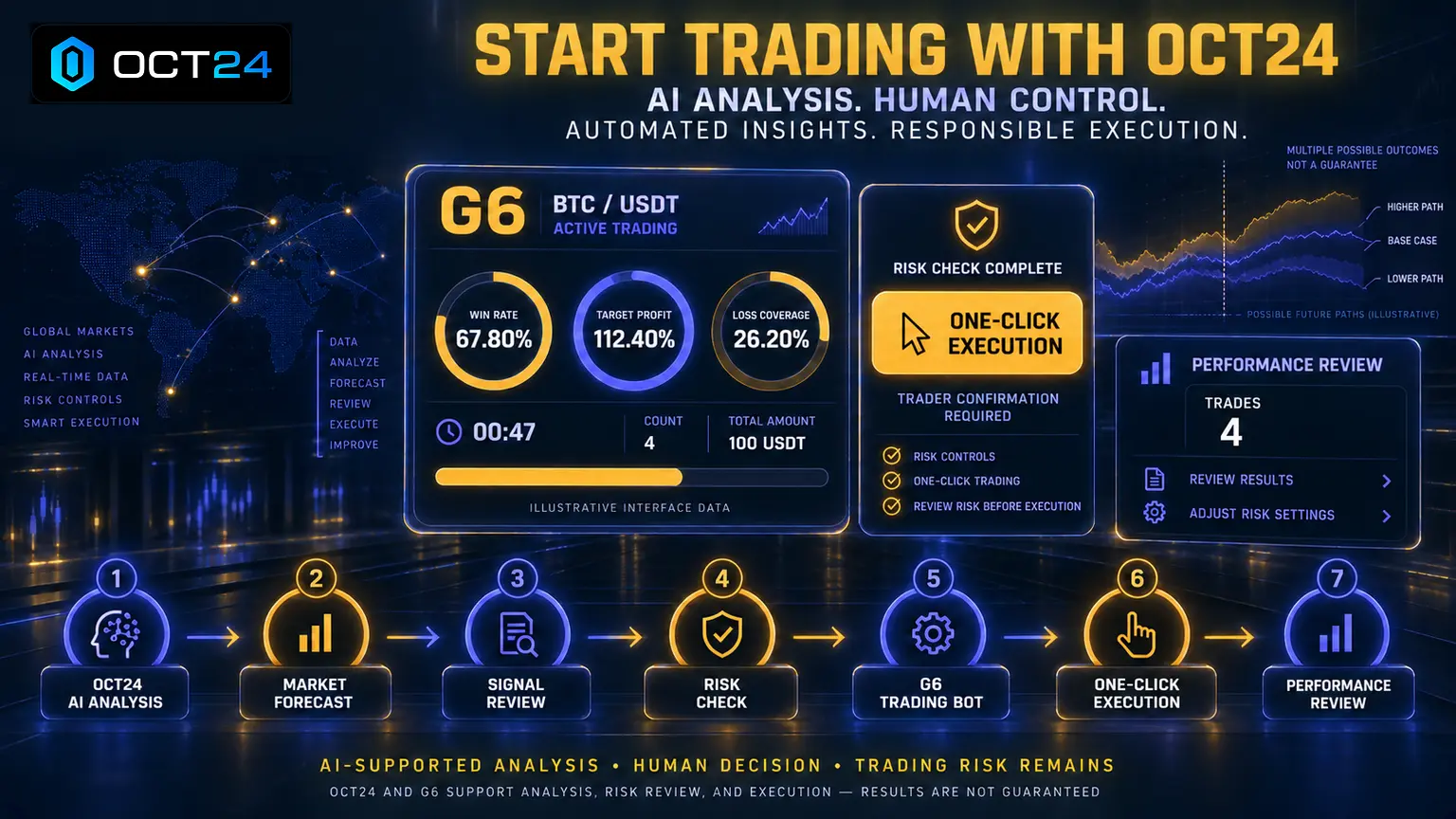
Traders interested in OCT24’s crypto-focused AI technology can review the G6 Trading Bot and compare whether the workflow fits their style. As always, no AI trading tool can guarantee profits, and every trader should stay responsible for capital allocation and execution decisions.
Final Thoughts
Learning how to read AI trading signals before you click can make crypto trading feel less rushed and more structured. The goal is not to predict every market move. The goal is to review each opportunity with enough clarity to make a more informed decision.
Focus first on win rate, target profit, and loss coverage. Then review market context, position size, portfolio exposure, and your own decision-making state. When those pieces work together, a signal is easier to understand. When they conflict, caution is usually helpful.
OCT24 can support this process by scanning crypto market conditions, identifying potential opportunities, and presenting AI-supported signals in a simpler review workflow. When you are ready to explore that process, Start Trading with OCT24 and review each opportunity with discipline before you click.
FAQs
What is an AI trading signal?
An AI trading signal is a technology-supported trade idea based on market analysis. In crypto trading, it may consider price action, trend behavior, volatility, liquidity, and other data. A signal is not a guarantee. It is a possible opportunity that still needs review.
What should I check before clicking an AI trading signal?
Start with win rate, target profit, and loss coverage. Then check market context, position size, portfolio exposure, and whether the trade fits your personal risk settings.
Does a high win rate mean the trade is safe?
No. A high win rate can be useful, but it does not remove risk. You still need to review target profit, loss coverage, volatility, and account exposure before activating a trade.
Why does target profit matter?
Target profit helps you understand the possible upside of a signal. It should be reviewed against downside risk, fees, market movement, and whether the potential reward is worth the trade.
What does loss coverage mean in signal review?
Loss coverage gives context for downside movement and risk boundaries. It does not guarantee protection from losses, but it can help traders understand how the signal accounts for unfavorable price movement.
Can OCT24 guarantee better trading results?
No. OCT24 supports market scanning and signal review, but it does not guarantee profits or remove trading risk. Traders remain responsible for risk settings, exposure, capital allocation, and execution decisions.
Is one-click trading good for beginners?
One-click trading can be helpful for beginners when it is paired with a clear review process. The click should come after the trader understands the signal, risk, and account impact.
Can professional traders use OCT24 too?
Yes. Professionals may use OCT24 to scan crypto conditions faster, compare opportunities, and support a more consistent review process. The platform can be useful for beginners and experienced traders, as long as it is used responsibly.
Should I activate every signal I see?
No. Skipping a trade can be a disciplined decision. If the signal does not fit your risk settings, capital allocation, exposure, or market view, it may be better to wait.