
Best AI Trading Tools for Beginner Crypto Traders
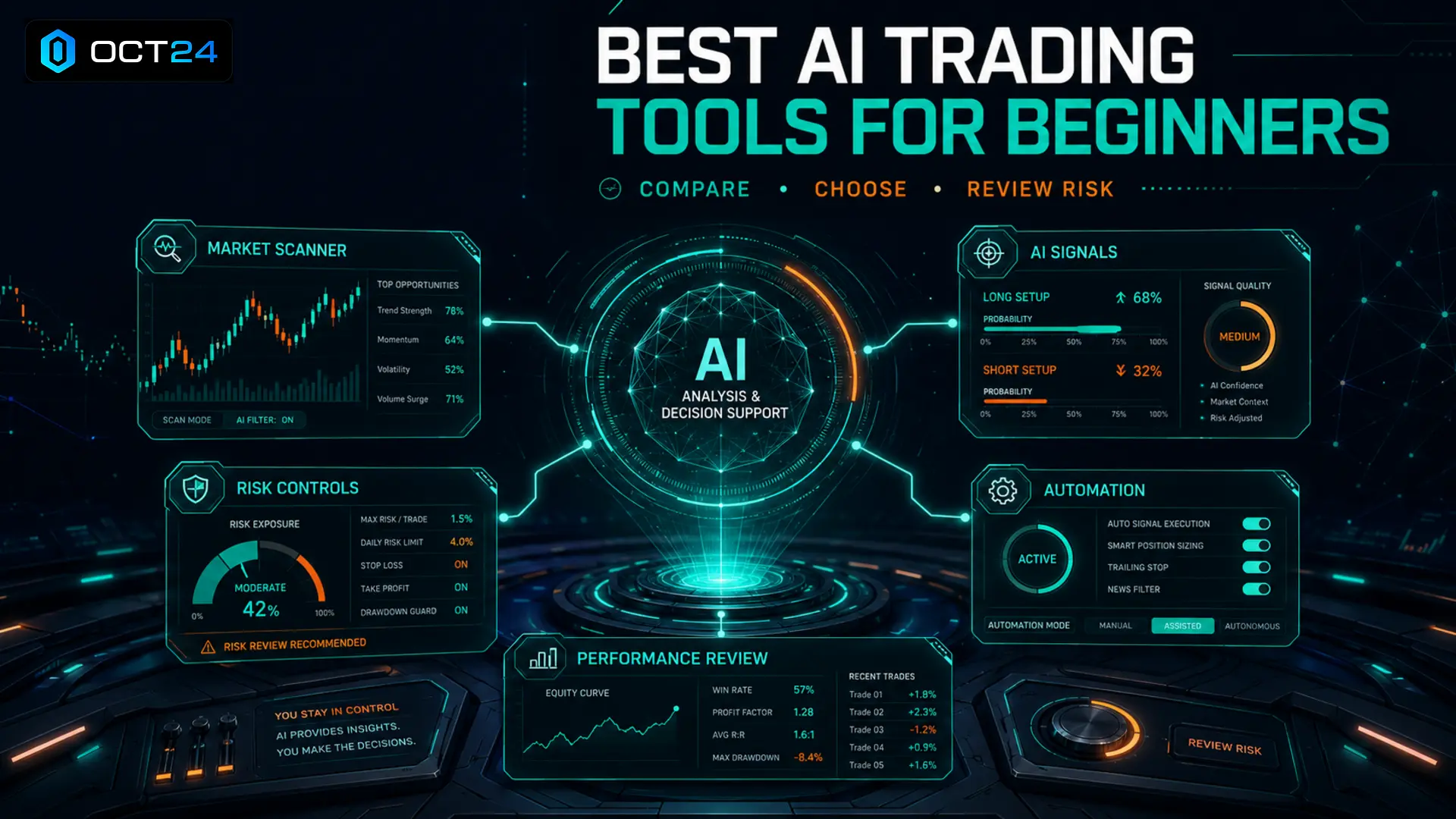
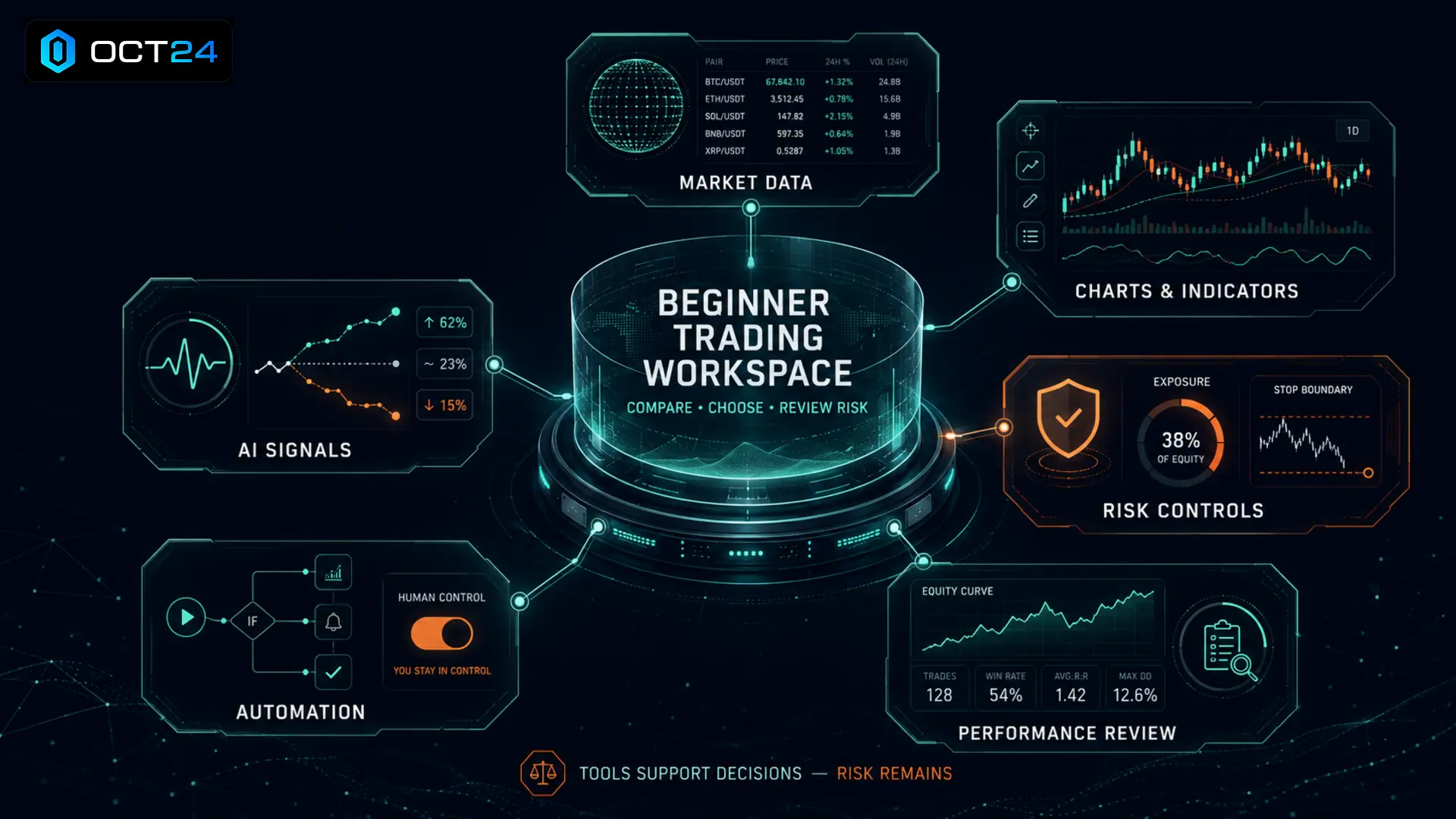
The best AI trading tools for beginner crypto traders are the tools that help new crypto traders stay organized, review opportunities more calmly, manage risk, and avoid guessing. They do not need to be complicated. A beginner toolkit should usually include a watchlist, alerts, charting, basic risk controls, a trading journal, education, and a simple way to review AI-powered trading options.
For many beginners, the hard part is not finding more information. It is knowing which information matters. Crypto markets move quickly, prices can change at any hour, and emotional decisions can happen fast.
That is why the right tool stack matters. Good tools help you slow down your decision-making, even when the market feels fast.
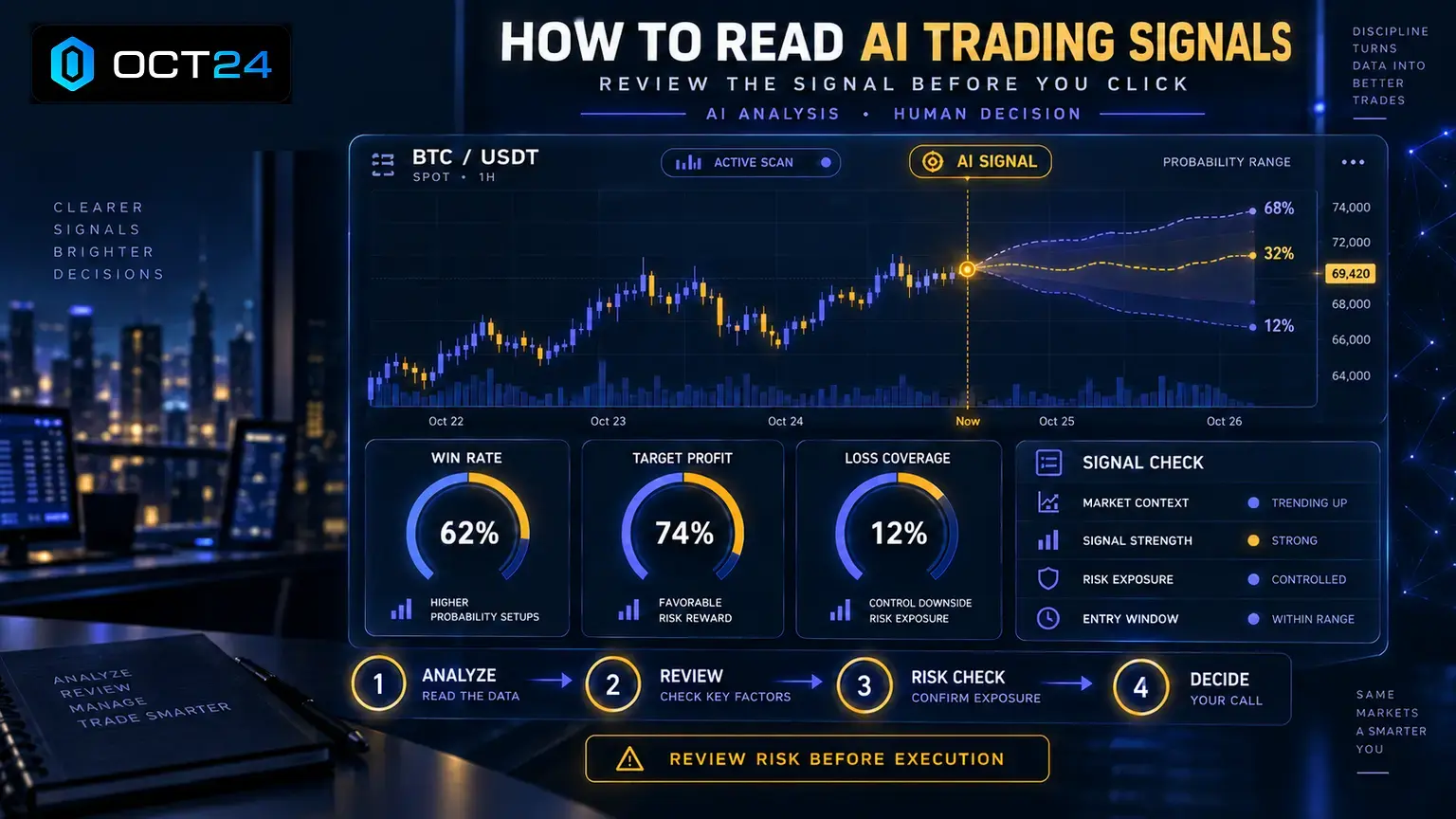
OCT24 can fit into this process as a simple AI-powered one-click trading platform. It is not a full research terminal, and it does not currently show detailed asset research, entry points, exit points, or the exact asset information behind every presented trade. Instead, users mainly review key trade or bot metrics such as target profit, loss coverage, and win rate before deciding whether to continue.
That distinction is important. OCT24 can make the trading experience simpler, but it does not remove risk. Traders still need to understand exposure, choose appropriate capital allocation, review the information available, and make their own execution decisions.
What Counts as an AI Trading Tool?
An AI trading tool is any tool that uses automation, data processing, machine learning, rules, or intelligent workflows to support trading decisions. Some tools help with research. Some help with alerts. Some help with execution. Others help traders review performance after the trade is finished.
The best tools for beginners are not always the most advanced. A beginner usually needs clarity more than complexity.
A useful crypto trading toolkit may include:
- A watchlist tool to track selected coins or tokens
- A price alert tool to avoid staring at charts all day
- A charting tool to understand market structure
- A risk calculator to control position size
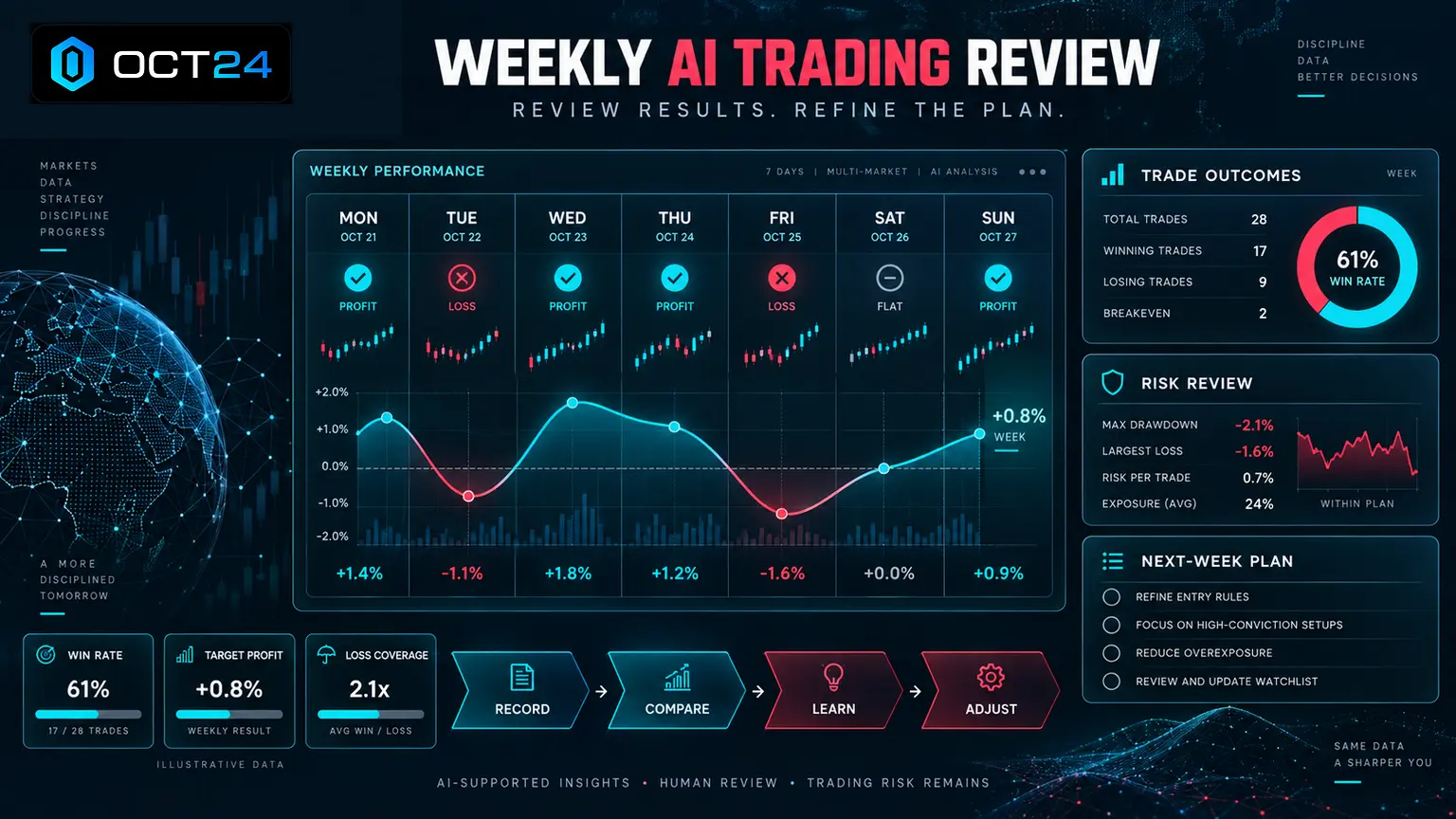
- A trading journal to record decisions
- A portfolio tracker to monitor overall exposure
- A trading bot or AI-assisted system to simplify execution choices
- An education source to build better judgment over time
This is also why beginners should think in categories, not only brand names. The goal is not to collect every possible app. The goal is to build a simple workflow that helps you make fewer rushed decisions.
If you are new to AI trading, start with the basics: know what each tool is supposed to do, what it does not do, and how it affects your risk.
Why Beginner Crypto Traders Need a Tool Stack
Crypto trading can feel simple from the outside. Open an app, pick a coin, press buy or sell, and wait. In reality, the decisions behind that action matter.
A beginner may need to answer several questions before making a trade:
- Why am I interested in this market right now?
- Is the market trending, ranging, or reacting to news?
- How much money am I willing to risk?
- What happens if the trade moves against me?
- Am I acting because of a plan or because of emotion?
- Do I understand the tool I am using?
No single tool answers all of those questions perfectly. A chart can show price movement, but it cannot manage your emotions. A bot can automate part of the process, but it cannot make risk disappear. A journal can show patterns in your behavior, but only if you actually use it.
This is where a simple tool stack helps. Each tool has a job. Together, they create a more structured routine.
Think of it like building a trading desk for beginners. You do not need a professional setup with six screens. You need a few tools that keep you organized, informed, and risk-aware.
Tool 1: Watchlist Tools
A watchlist tool helps you decide what to pay attention to before the market demands your attention. This matters because beginners often jump from one coin to another based on noise.
A good watchlist is not a random list of popular crypto assets. It should be a short, intentional list of markets you understand well enough to follow.
For example, a beginner might track Bitcoin, Ethereum, two large-cap altcoins, and one sector theme such as AI tokens or layer-2 networks. That is easier to manage than watching twenty unfamiliar assets at once.
A watchlist can help you:
- Stay focused on markets you have chosen in advance
- Avoid chasing every trending coin
- Notice repeated price behavior over time
- Prepare alerts around levels that matter
- Build a more consistent daily routine
If you want a deeper framework, a separate guide on building an AI trading watchlist can help you understand how to organize markets before trading decisions begin.
Tool 2: Alert Tools
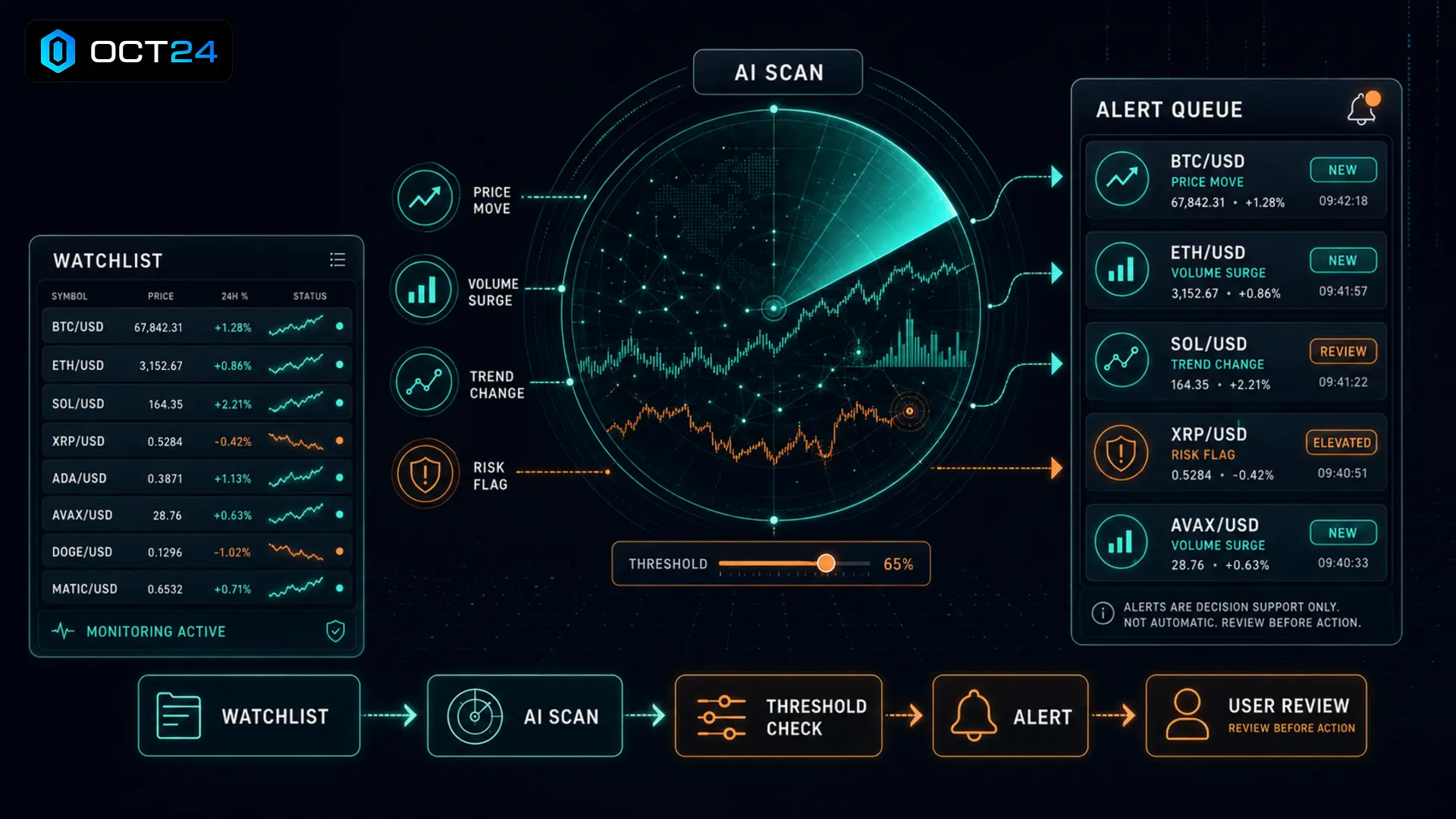
Alert tools help beginners avoid constant screen watching. Instead of checking prices every few minutes, you set conditions and let the tool notify you when something changes.
This can be helpful because many beginner mistakes happen when traders stare at charts for too long. The more you watch every small candle, the easier it becomes to overreact.
Useful beginner alerts may include:
- Price reaching a key level
- A sudden percentage move
- Unusual volume
- A breakout above resistance
- A drop below support
- A change in volatility
Alerts are not instructions to trade. They are reminders to review. That difference matters.
A strong alert should make you ask, “Is this still a good decision?” It should not make you feel forced to act immediately.
This is especially important when using AI trading alerts. A beginner should still review risk, market conditions, and available information before taking action.
Tool 3: Charting and Technical Analysis Tools
Charting tools help traders see price movement more clearly. For beginners, the point is not to become a technical analysis expert overnight. The point is to understand enough structure to avoid trading blindly.
A beginner-friendly charting setup can include:
- A clean candlestick chart
- Basic support and resistance levels
- Volume
- A moving average
- A simple trend view
- A volatility indicator if needed
It is easy to overload a chart with indicators. More indicators do not automatically mean better decisions. In many cases, a clean chart is more useful than a crowded one.
AI tools can support chart review by processing large amounts of market data, but beginners should still understand what the chart is showing at a basic level. The guide on how AI uses technical analysis explains this relationship in more detail.
The goal is not to predict every move. It is to avoid making decisions with no context at all.
Tool 4: Risk and Position Size Tools
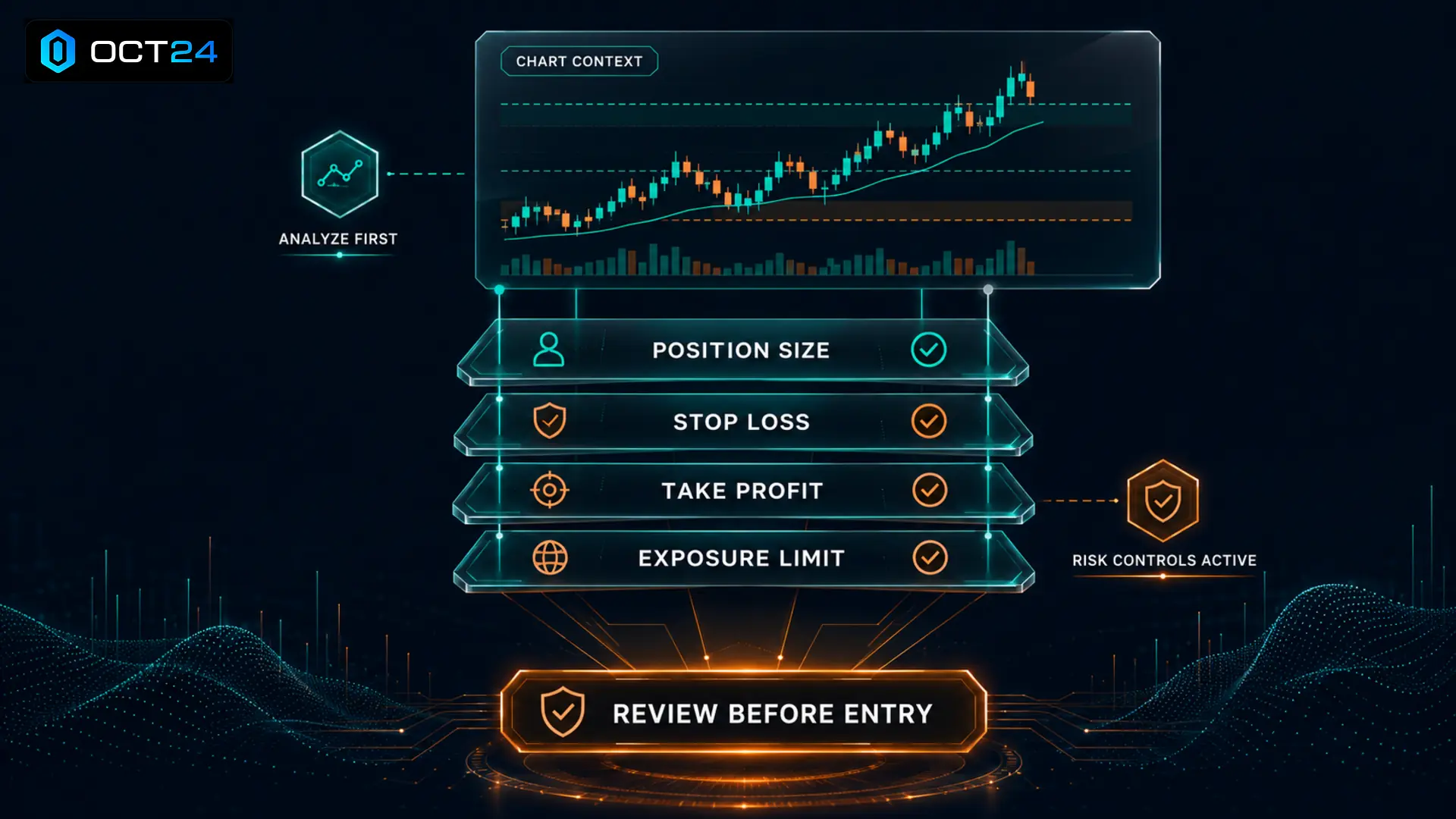
Risk tools are often more important than prediction tools. A beginner can be wrong about direction and still survive if the trade size is controlled. A beginner can also be right about direction and still lose too much if the position is too large or poorly managed.
A basic risk tool helps you estimate how much capital is exposed before you trade. This is especially useful in crypto because volatility can be sharp.
Useful risk questions include:
- How much of my account is involved in this trade?
- What is the maximum loss I am willing to accept?
- Does this trade make sense for my account size?
- Am I increasing exposure because I have a reason or because I want to recover a loss?
- What happens if the market moves quickly against me?
OCT24 users should pay close attention to the available trade or bot metrics before choosing to continue. When a trade is presented, the visible information focuses on metrics such as target profit, loss coverage, and win rate. Those metrics can help frame the decision, but they are not a complete substitute for risk discipline.
The articles on trading bot risk management, position sizing controls, and AI trading risk vs reward are useful next steps if risk is still a weak area.
Tool 5: Portfolio Tracking and Diversification Tools
Many beginners think about one trade at a time. Portfolio tools help you see the bigger picture.
This matters because several trades can look separate but still expose you to the same risk. For example, a trader might hold Bitcoin, Ethereum, and several altcoins. If the entire crypto market sells off, those positions may move together.
A portfolio tracker can help beginners see:
- Total account exposure
- How much is allocated to each asset
- Whether too much capital is concentrated in one theme
- How portfolio value changes over time
- Whether one position is becoming too large
Portfolio tracking is not exciting, but it is practical. It helps you notice when your overall risk is higher than you realized.
For a broader explanation, review Portfolio Diversification Tools. Diversification does not guarantee safety, but it can help traders avoid depending too heavily on one market idea.
Tool 6: Trading Journals
A trading journal may sound old-fashioned, but it is one of the best tools a beginner can use. It turns trading from a series of emotional decisions into a reviewable process.
A good journal does not need to be complicated. It can include:
- Date of the trade
- Reason for the trade
- Market conditions
- Tool or signal used
- Risk amount
- Result
- What you learned
The most valuable part is not the result of one trade. It is the pattern that appears after many trades.
For example, a beginner may notice they make worse decisions late at night, after losses, or during high-volatility news events. That kind of insight can be more useful than another indicator.
This is where trading psychology becomes part of the tool stack. Good trading tools should help you think more clearly, not just trade more often.
Where OCT24 Fits in a Beginner Tool Stack
OCT24 is best understood as a simplified AI-powered trading platform for users who want a faster and cleaner interaction with AI-assisted trading options. It is especially relevant for beginners who want fewer complicated screens and a more direct one-click experience.
At the same time, beginners should understand what OCT24 is not. OCT24 is not currently a full market-analysis workstation. It does not provide a traditional charting suite inside the platform, and it does not currently show detailed asset information, entry points, exit points, or the exact market being traded for every presented trade.
Instead, when a trade or bot is presented, users review simplified metrics such as target profit, loss coverage, and win rate. These metrics can make the review process easier to understand, but they do not guarantee a result.
That is why OCT24 should sit alongside other beginner tools, not replace all of them. A trader may use outside charting, watchlist, alert, and education tools to build context, then use OCT24 to review available AI-powered trading options and decide whether the risk profile fits.
The G6 Trading Bot is one example of OCT24’s focus on quick, simple trading interaction. Traders should still review the available metrics carefully and avoid treating speed as certainty.
If you are comparing platforms, the guide on choosing the right AI trading platform can help you think about usability, transparency, risk controls, and fit.
Tool 7: AI Trading Bots
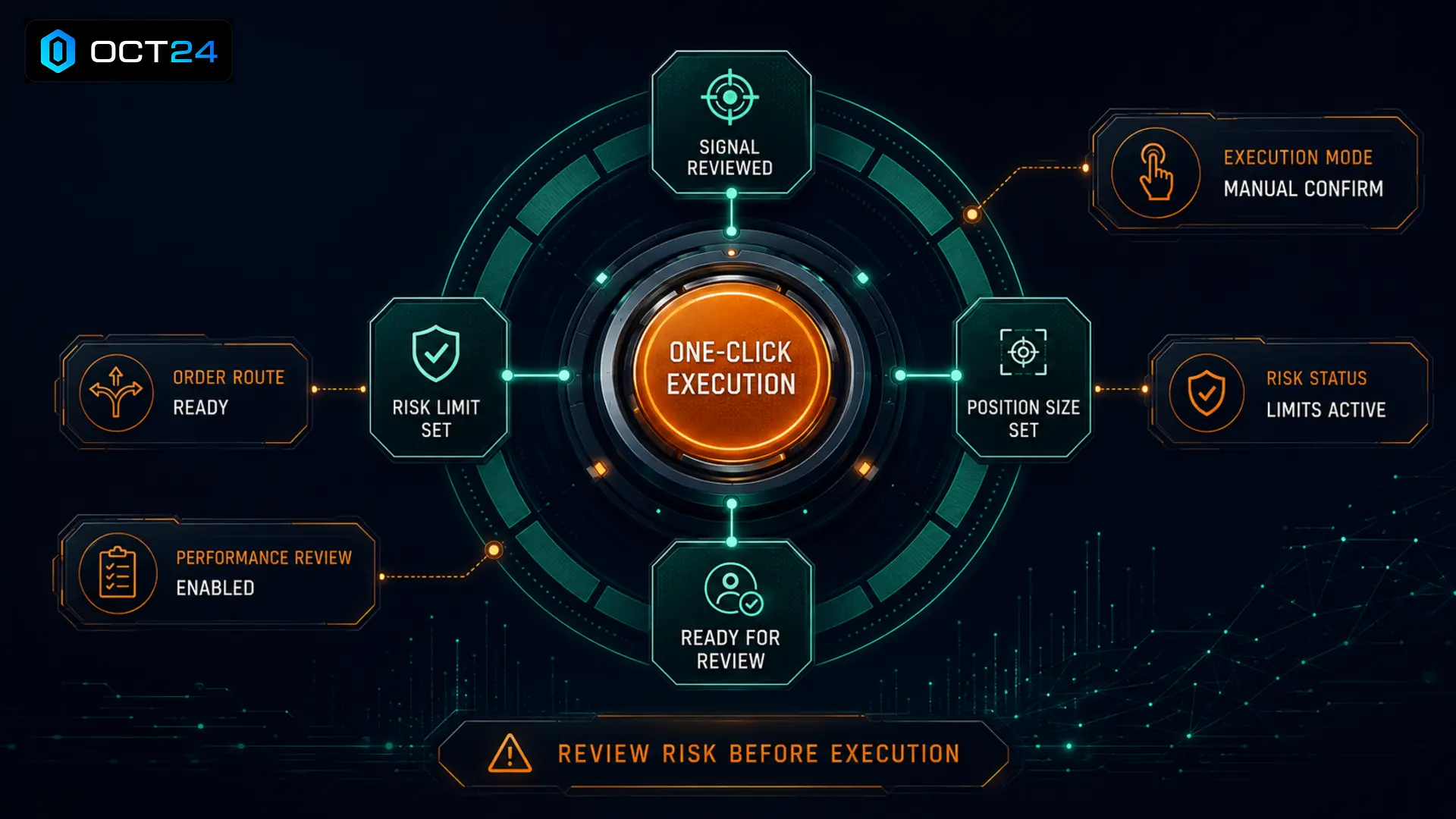
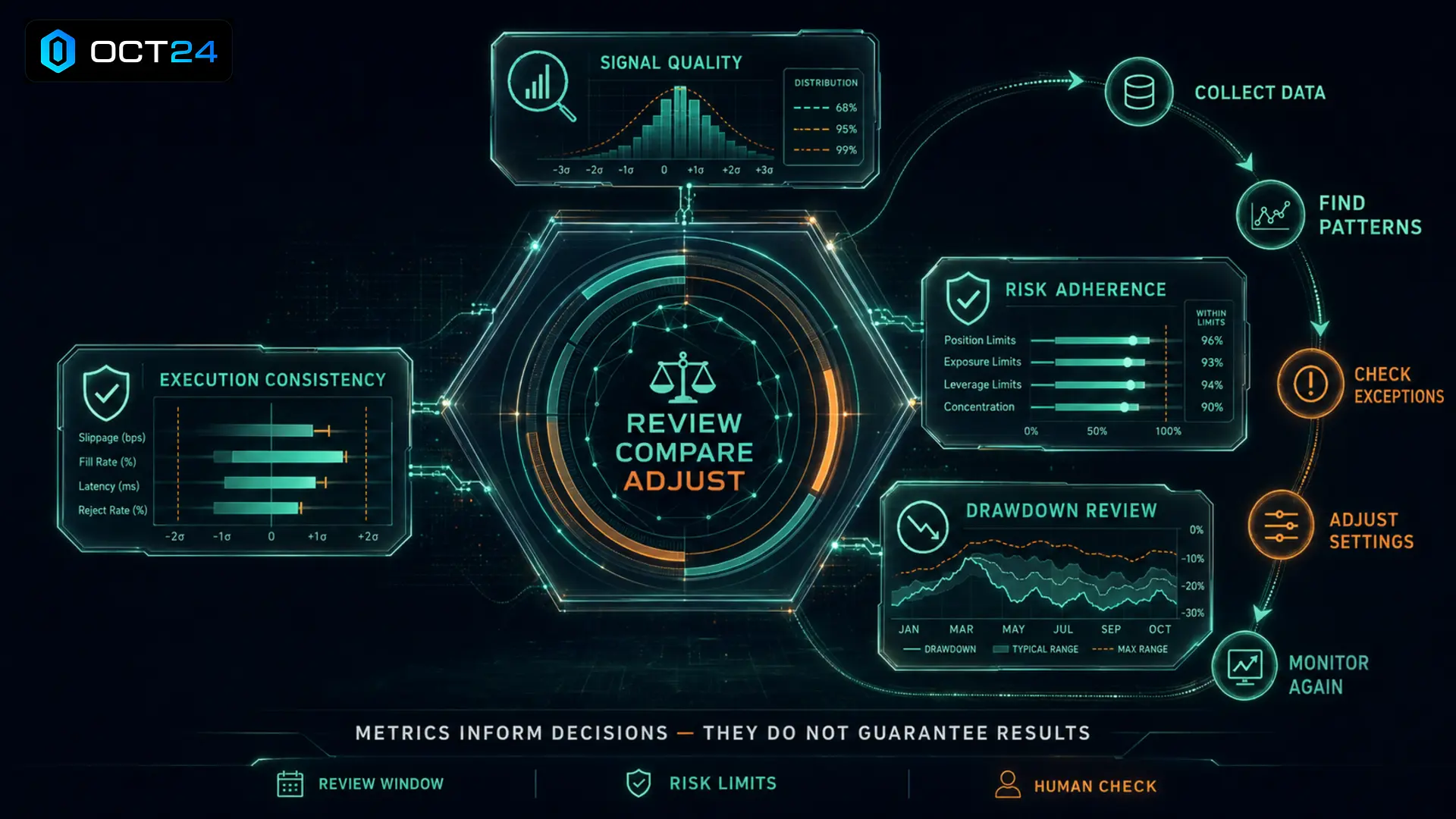
AI trading bots can help simplify parts of the trading process, but beginners need to understand them carefully. A bot is not a promise. It is a system that follows logic, automation, data, or predefined rules.
A beginner should never choose a bot only because it looks advanced. The better question is whether the bot’s risk profile makes sense.
Useful questions include:
- What information does the platform show before I trade?
- What risk metrics are visible?
- How much capital am I using?
- What happens if the outcome is negative?
- Can I understand the basic purpose of the bot?
- Am I relying on the bot because it supports my plan or because I want certainty?
The article on how AI trading bots work explains the basic mechanics, while trading bots vs human traders helps compare automation with human judgment.
For beginners, the best bot experience is usually simple enough to understand and structured enough to discourage careless overuse.
Tool 8: Education and Decision Support
Education is also a tool. In fact, it may be the most important tool for beginners because it improves how every other tool is used.
A beginner who understands the basics of risk, volatility, and trading behavior will use tools differently from someone who only wants fast results.
Good education helps you recognize:
- Why no tool can predict every market move
- Why risk settings matter more than excitement
- Why volatility can create both opportunity and danger
- Why a winning percentage does not explain the full risk picture
- Why simple routines often beat impulsive activity
Beginner traders should also separate helpful education from hype. A useful resource explains trade-offs. Hype usually avoids them.
The guides on AI trading strategies for beginners, common AI trading mistakes, and AI trading myths are helpful if you want to build a stronger foundation before using more advanced tools.
How to Choose the Best AI Trading Tools for Beginner Crypto Traders
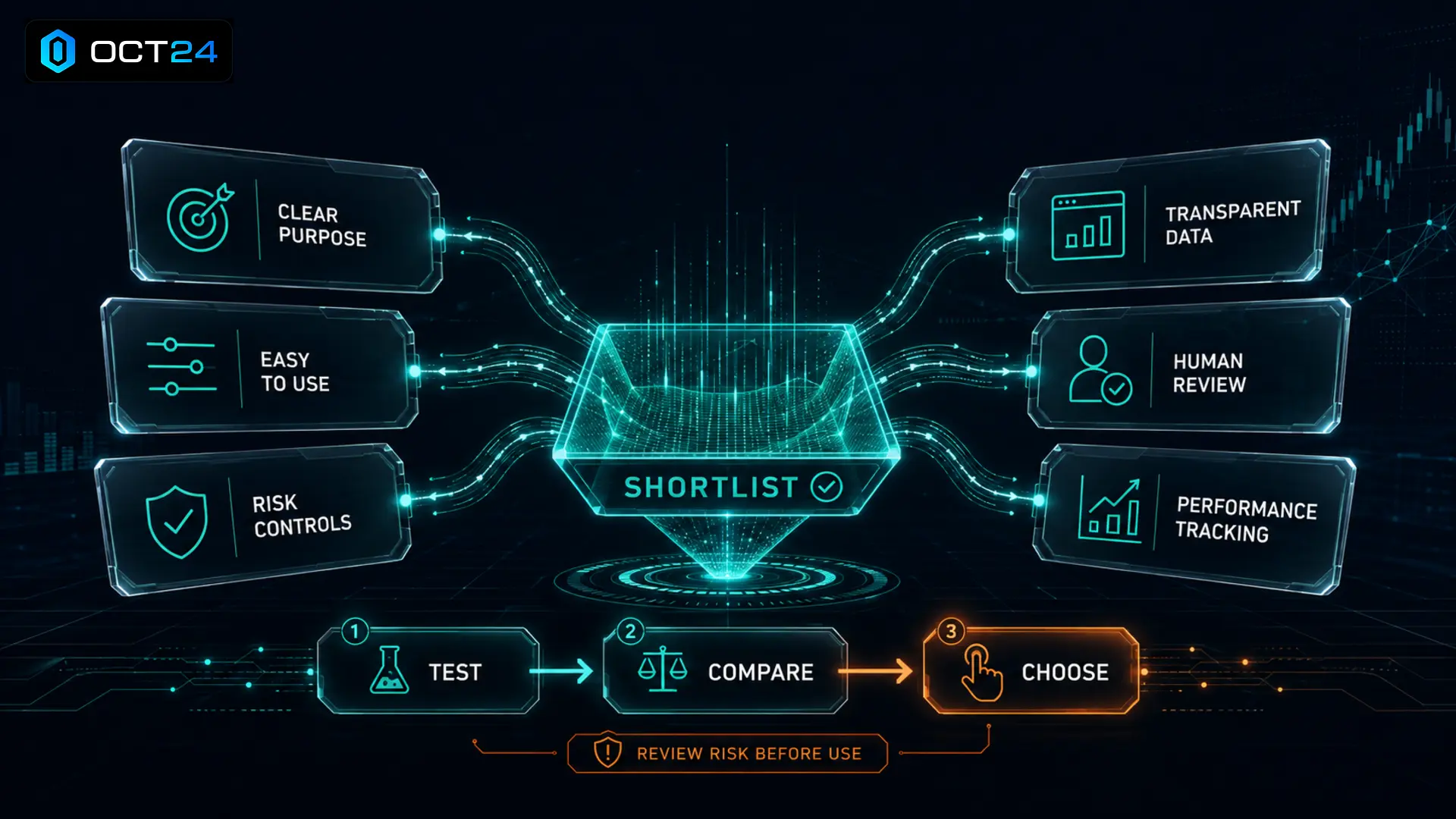
The best AI trading tools for beginner crypto traders share a few qualities. They are clear, practical, and easy to use without hiding risk.
Beginners should look for tools that support decision-making instead of creating pressure to trade.
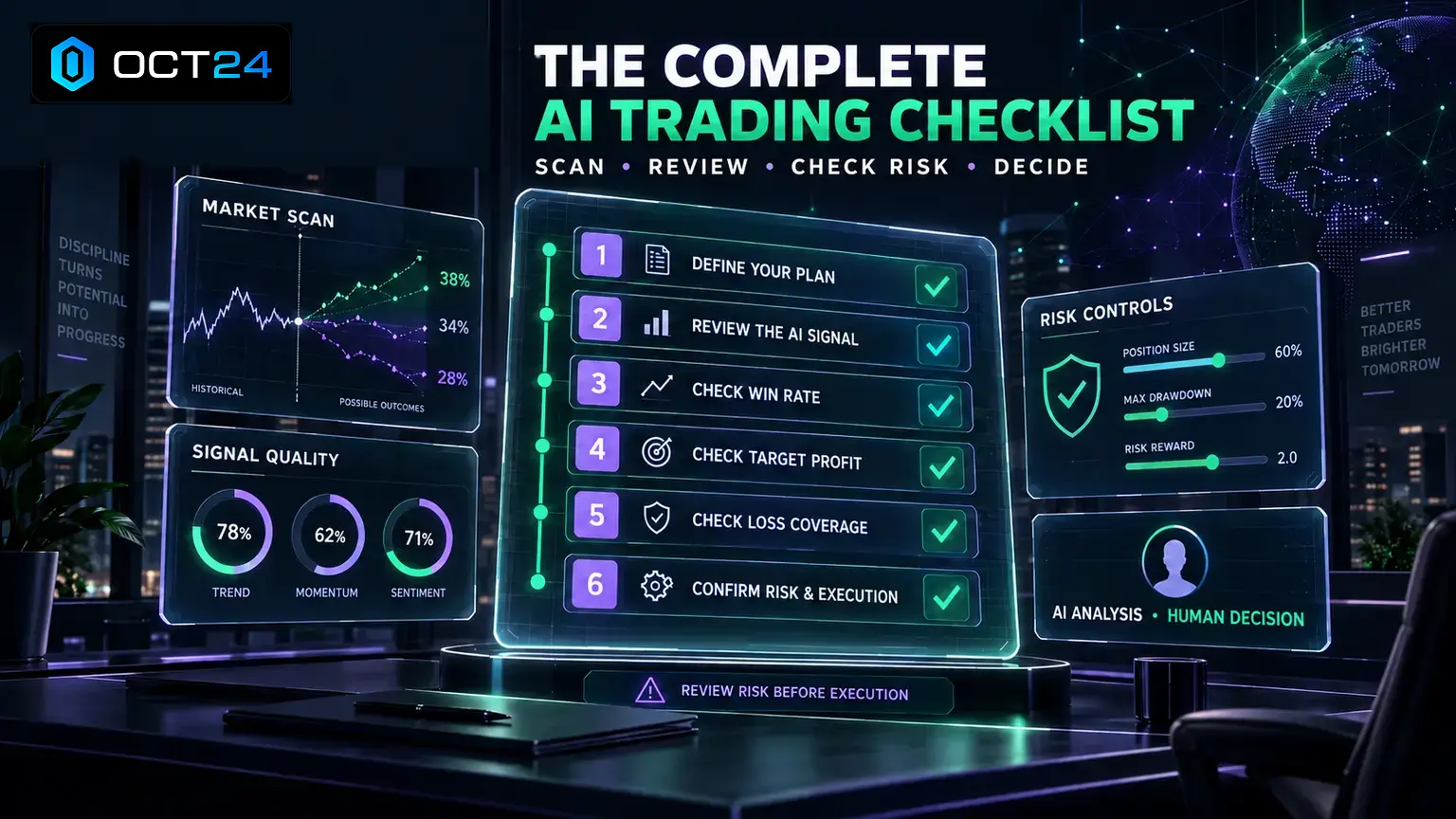
Use this simple checklist:
- Can I understand what this tool does in one sentence?
- Does it help me manage risk or only encourage action?
- Does it make my workflow clearer?
- Does it show the information I need before I make a decision?
- Does it avoid unrealistic profit claims?
- Can I use it consistently without feeling overwhelmed?
- Does it support my trading routine?
This is also where product fit matters. Some beginners want chart-heavy platforms. Some want alert-heavy platforms. Others want a simpler experience centered on one-click trading and visible trade metrics.
OCT24 fits the simpler end of that spectrum. It is designed for users who want AI-powered trading access with a cleaner workflow, while still accepting that the trader remains responsible for risk decisions.
A Simple Beginner Crypto Trading Toolkit
A beginner does not need ten apps open at once. A simple toolkit is easier to follow and easier to improve.
Here is an example:
- One watchlist tool for selected crypto assets
- One alert tool for price or volatility changes
- One charting tool for basic market structure
- One risk calculator or position size method
- One portfolio tracker
- One trading journal
- One education source
- One AI-powered trading platform such as OCT24 for simplified trade or bot review
This setup is not flashy. That is the point. Beginners usually improve faster when the workflow is simple enough to repeat.
A tool stack should help you answer three questions before trading:
- What am I looking at?
- How much risk am I taking?
- Why does this decision make sense right now?
If a tool does not help answer at least one of those questions, it may not belong in your beginner setup.
Common Mistakes Beginners Make With Trading Tools
Tools can help, but they can also create false confidence. Beginners should watch for these common mistakes.
Using Too Many Tools at Once
Too many dashboards can create more confusion, not more clarity. Start with a small setup and add tools only when they solve a real problem.
Confusing Speed With Quality
Fast execution can be useful, but it does not make a trade better by itself. Speed should support a decision, not replace one.
Ignoring Risk Metrics
A tool may look easy to use, but the trader still needs to review risk. On OCT24, that means paying close attention to visible metrics such as target profit, loss coverage, and win rate before making an execution choice.
Believing AI Can Remove Uncertainty
AI can process information and support workflows, but markets remain uncertain. The article on if AI can predict the market explains why prediction should not be confused with certainty.
Treating One Tool as the Whole Strategy
No single tool should carry the entire trading process. A better approach is to combine preparation, risk review, execution discipline, and performance tracking.
How OCT24 Supports a Simpler Trading Workflow
OCT24 is built around making AI-powered trading feel more accessible. For beginners, that matters because complicated platforms can lead to hesitation, confusion, or careless clicking.
The OCT24 experience is centered on simple interaction. Instead of asking beginners to build a complex manual strategy from scratch inside the platform, OCT24 presents a cleaner path where users can review key trade or bot metrics and decide whether to proceed.
This can be helpful for users who want a faster workflow, but it should still be treated responsibly. A one-click flow does not mean one-click certainty.
Before using any AI-powered trade option, beginners should pause and ask:
- Do I understand how much capital I am using?
- Have I reviewed the available target profit, loss coverage, and win rate information?
- Am I comfortable with the possible loss?
- Does this fit my overall exposure?
- Am I trading because it fits a plan, or because I feel pressure to act?
To learn more about the platform, visit About OCT24. When you are ready to explore the platform directly, you can Start Trading with OCT24.

FAQs
What are the best AI trading tools for beginner crypto traders?
The best tools are usually a simple mix of watchlists, alerts, charting, risk controls, portfolio tracking, a trading journal, education, and a responsible AI-powered trading platform. Beginners should focus on tools that make decisions clearer, not tools that promise certainty.
Do beginners need advanced AI tools to trade crypto?
No. Beginners usually benefit more from simple tools they can understand and use consistently. Advanced tools can be useful later, but complexity can create confusion if the basics are not clear.
Can AI trading tools guarantee profitable crypto trades?
No. AI trading tools cannot guarantee profits or remove market risk. They can support analysis, structure, automation, or execution workflows, but traders remain responsible for risk and decision-making.
Is OCT24 a full crypto charting platform?
No. OCT24 should not be treated as a full charting or research terminal. It currently focuses on a simplified AI-powered trading experience where users review trade or bot metrics such as target profit, loss coverage, and win rate.
Does OCT24 show entry and exit points?
OCT24 does not currently show detailed entry points, exit points, or full asset-level research for every presented trade. Users should understand the information available before making a decision.
What should beginners review before using a trading bot?
Beginners should review the available risk metrics, account exposure, capital amount, possible downside, and whether the bot fits their overall plan. A bot should support a decision, not replace judgment.
Are AI trading bots better than manual trading?
AI trading bots and manual trading have different strengths. Bots can support speed and structure, while human traders still provide judgment, review, and risk control. The best choice depends on the trader’s goals and understanding.
How many trading tools should a beginner use?
A beginner should start with a small number of tools and use them consistently. A simple setup is usually easier to improve than a crowded dashboard filled with tools that are rarely used well.
Why are risk tools so important for beginners?
Risk tools help beginners control exposure before a trade begins. This matters because crypto markets can move quickly, and one oversized trade can damage an account even if the trader has a good general idea.
How does OCT24 fit with other beginner trading tools?
OCT24 can fit as the AI-powered one-click trading part of a broader beginner toolkit. Traders may still use separate tools for watchlists, alerts, charting, education, and portfolio tracking.
Final Thoughts
The best tools for beginner crypto traders are not the loudest, most complex, or most exciting. They are the tools that make the trading process easier to understand.
A strong beginner toolkit should help you prepare, review risk, avoid emotional decisions, and learn from results. It should also remind you that no AI tool can remove uncertainty from the market.
OCT24 can be part of that toolkit by offering a simplified AI-powered trading experience focused on quick interaction and visible trade or bot metrics. But the trader still controls risk settings, exposure, capital allocation, and execution decisions.
If you want to explore a simpler way to interact with AI-powered crypto trading, visit OCT24 or Start Trading with OCT24.