
How AI Monitors the Market 24/7
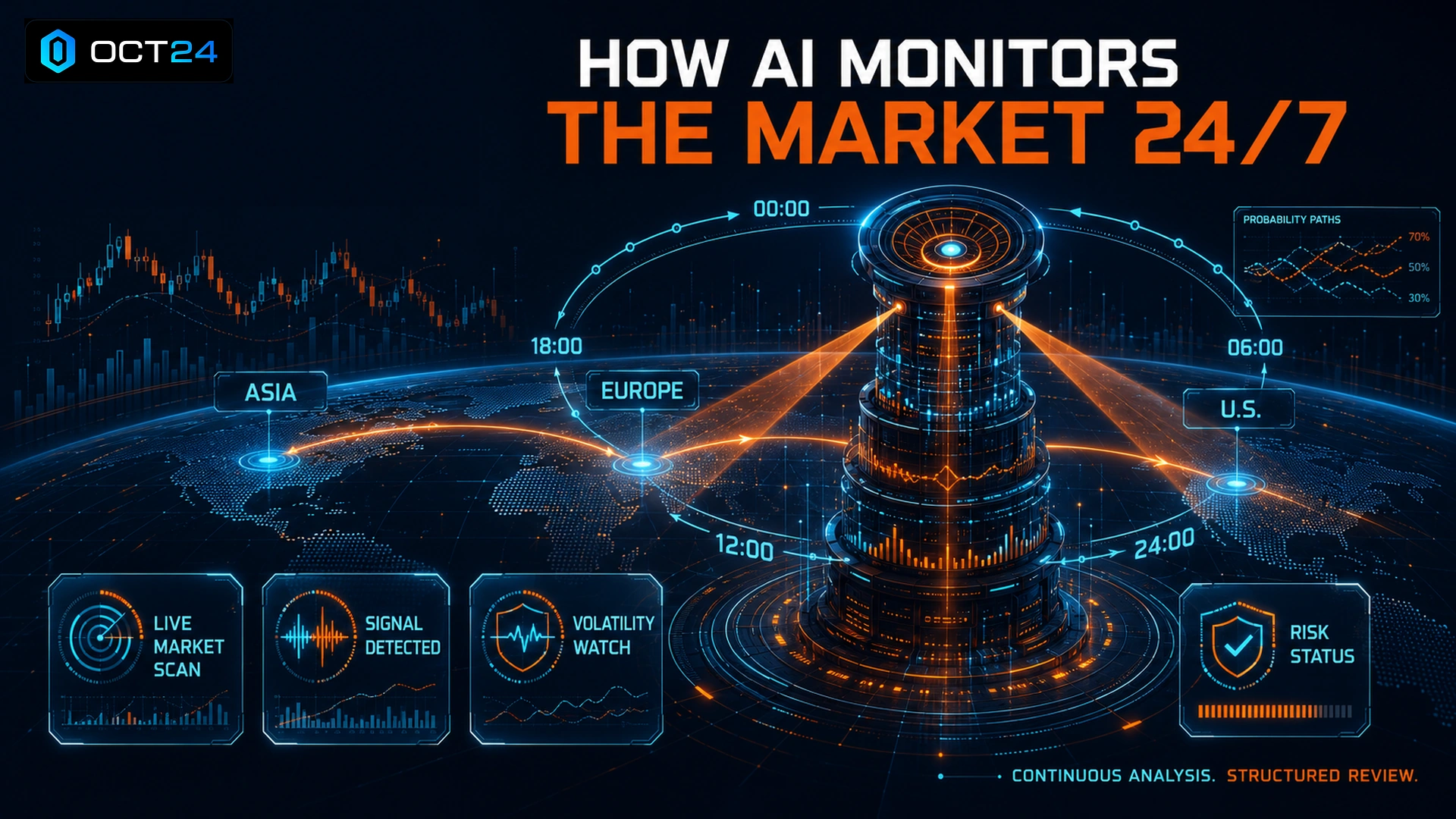
AI market monitoring means using automated systems to watch market conditions continuously, even when a trader is not sitting in front of a chart. The goal is to scan data, detect changes, and highlight potential opportunities faster than manual review alone.
This does not mean AI knows what will happen next. It means AI can keep checking market conditions, organize useful information, and present signals when certain conditions appear.
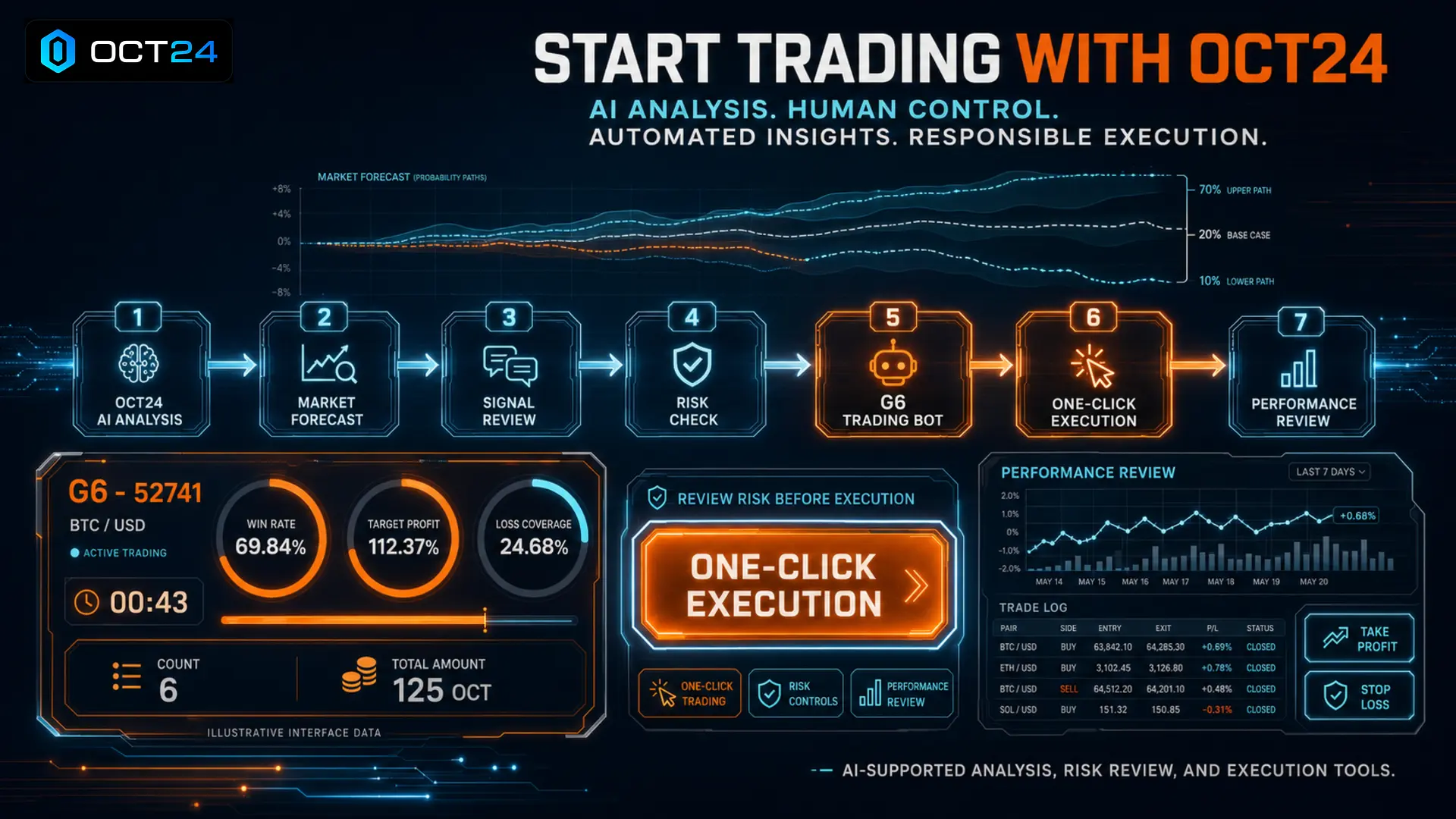
OCT24 uses this kind of workflow by performing most of the market analysis for the user. It scans market conditions, identifies potential opportunities, and presents AI-supported trading signals. Traders still need to manage risk settings, exposure, capital allocation, and execution decisions.
The value of 24/7 monitoring is not that it removes risk. The value is that it helps traders avoid missing important market changes.
What Does 24/7 Market Monitoring Mean?
Markets can move at any time. Crypto markets are especially active because they trade around the clock. News, liquidity changes, volatility, and trader behavior can all shift while a person is asleep, working, or away from the screen.
24/7 market monitoring means the system keeps watching selected data points continuously. It can track price movement, volume, volatility, momentum, and other market signals without needing a person to refresh charts manually.
This is one reason AI trading can be useful for busy traders. It can reduce the amount of manual scanning required before a trader begins reviewing opportunities.
A monitoring system may look for:
- Price changes
- Volume spikes
- Momentum shifts
- Breakouts or breakdowns
- Volatility changes
- Signal conditions
- Potential risk warnings
OCT24 turns that monitoring process into a more practical workflow by presenting AI-supported trading signals for review.
Why Manual Monitoring Is Difficult
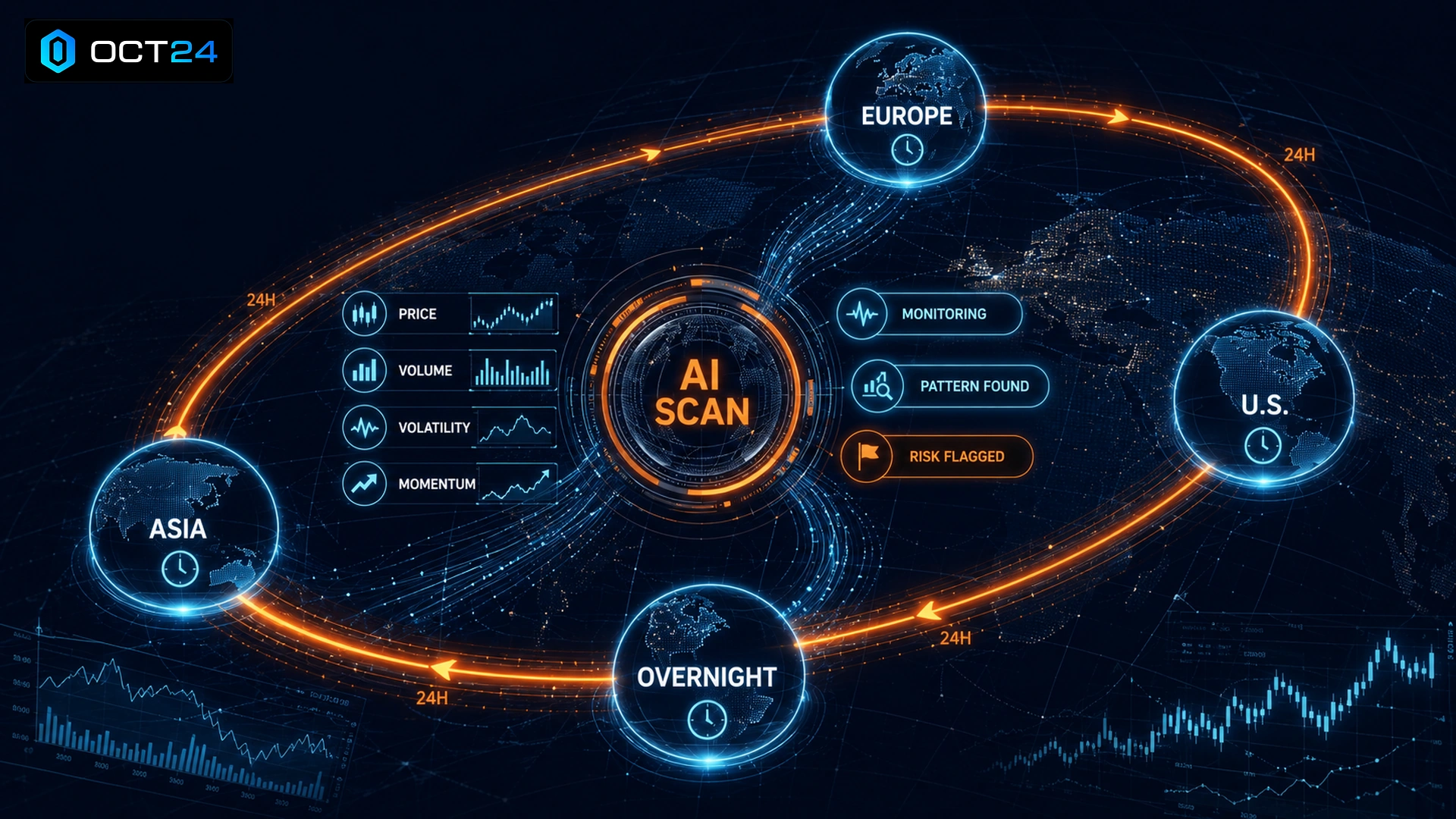
Manual monitoring takes time, energy, and focus. A trader can only watch so many markets at once before details start to slip.
Even experienced traders can miss a setup if they are watching the wrong asset, checking a different timeframe, or stepping away at the wrong moment.
This is where AI trading vs manual trading becomes practical. Manual trading gives full control, but it can be slow and tiring. AI monitoring can scan more conditions at the same time and bring potential setups to the trader's attention.
Manual monitoring is difficult because traders must deal with:
- Too many charts
- Too many timeframes
- Fast-moving markets
- Emotional pressure
- Missed opportunities
- Fatigue from constant checking
OCT24 is designed to reduce that burden. It does most of the market analysis first, so the trader can spend more time reviewing signals and managing risk.
What AI Watches in the Market
AI market monitoring is not just about watching price go up or down. A useful system looks at several types of market data together.
For example, price may rise, but volume may be weak. Momentum may look strong, but volatility may be too high. A breakout may appear, but the setup may already be late.
AI can help organize these conditions faster than manual review.
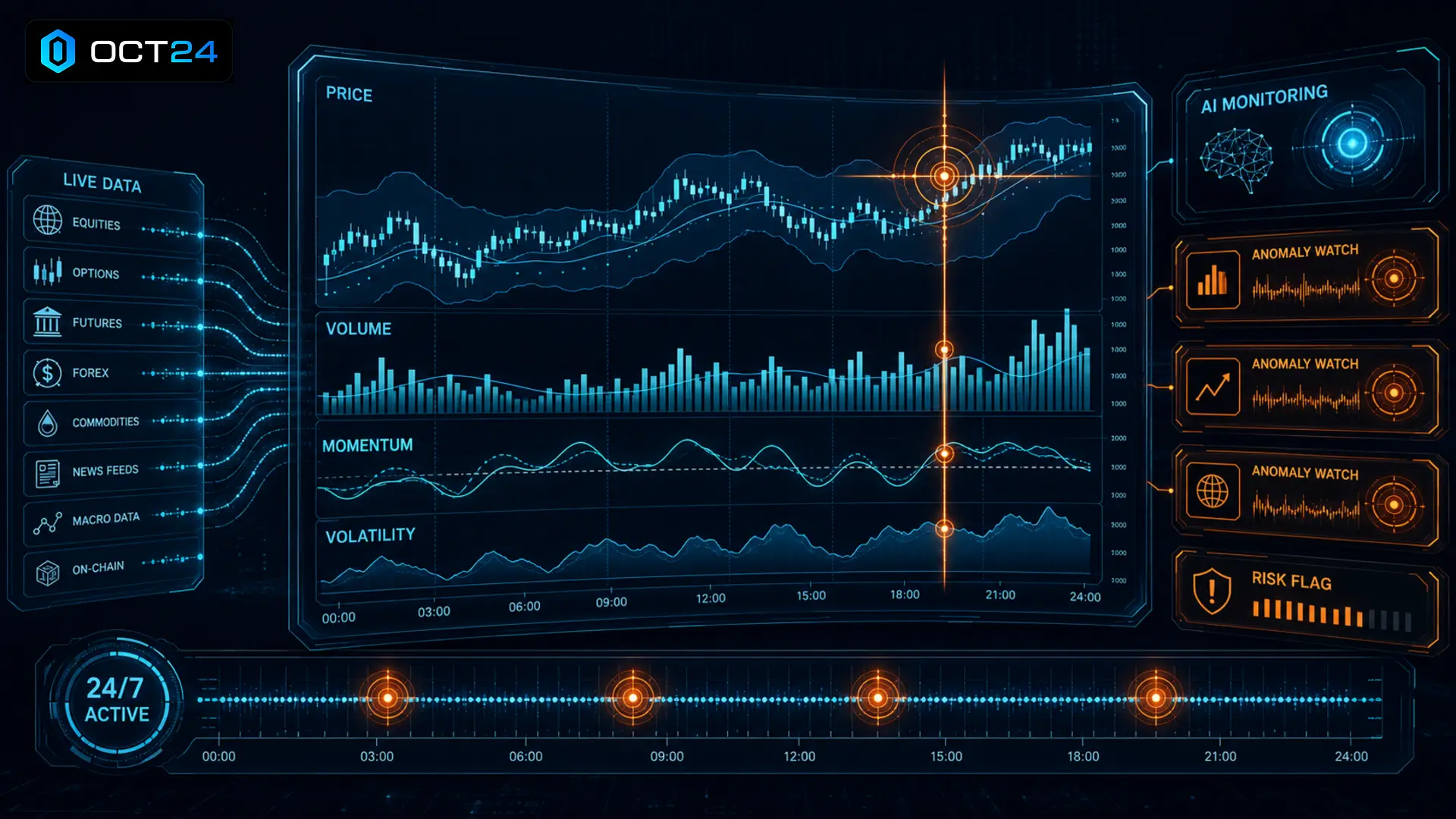
Common areas AI may monitor include:
- Price movement and trend direction
- Volume and liquidity changes
- Momentum indicators
- Support and resistance behavior
- Volatility levels
- Recent market activity
- Possible signal triggers
This connects naturally with how AI uses technical analysis. AI can review technical conditions quickly, but the trader still needs to decide whether a signal fits the plan.
From Monitoring to Trading Signals
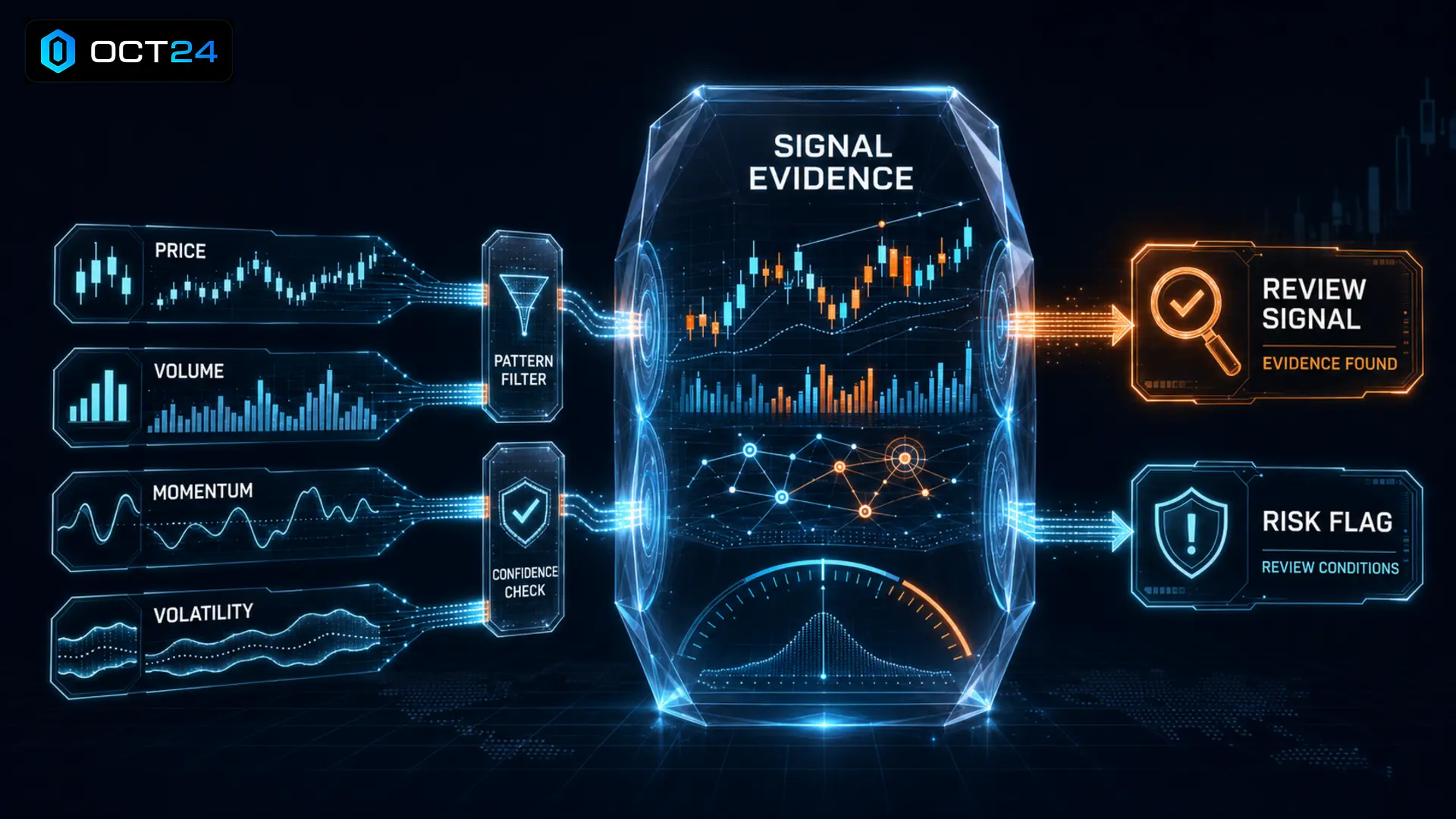
Monitoring becomes useful when it leads to clear information. That is where AI trading signals matter.
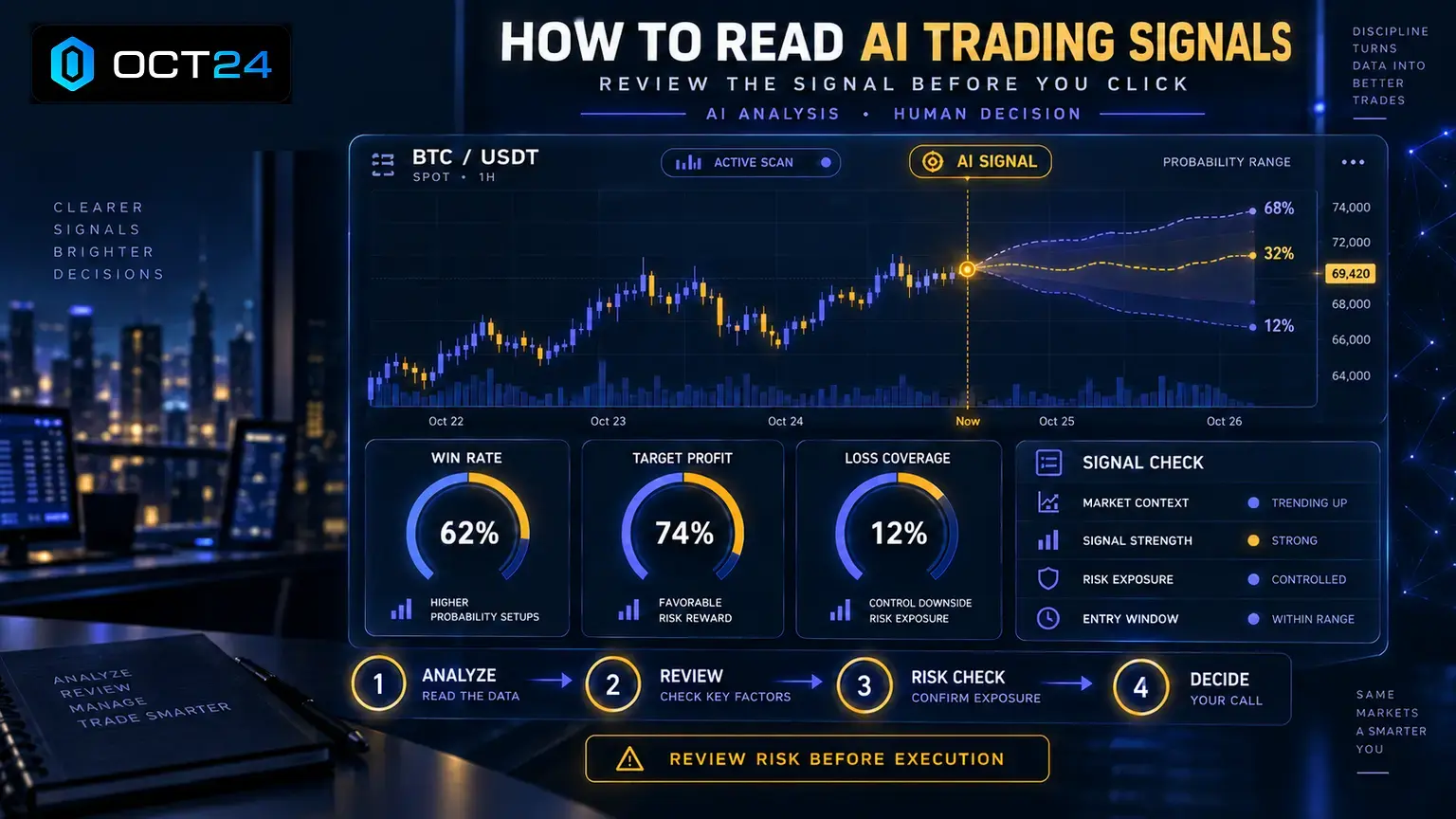
A signal is not a promise that a trade will work. It is a structured alert that certain market conditions may deserve review.
OCT24 scans market conditions and presents AI-supported trading signals when potential opportunities appear. The trader can then review the setup, check risk, and decide whether to act.
A simple signal workflow may look like this:
- The market is scanned
- A condition changes
- The AI identifies a possible opportunity
- A signal is presented
- The trader reviews risk and context
- The trader decides what to do
This is also why how AI trading bots work matters. The bot or platform workflow is only useful when monitoring, signal review, risk control, and execution are connected.
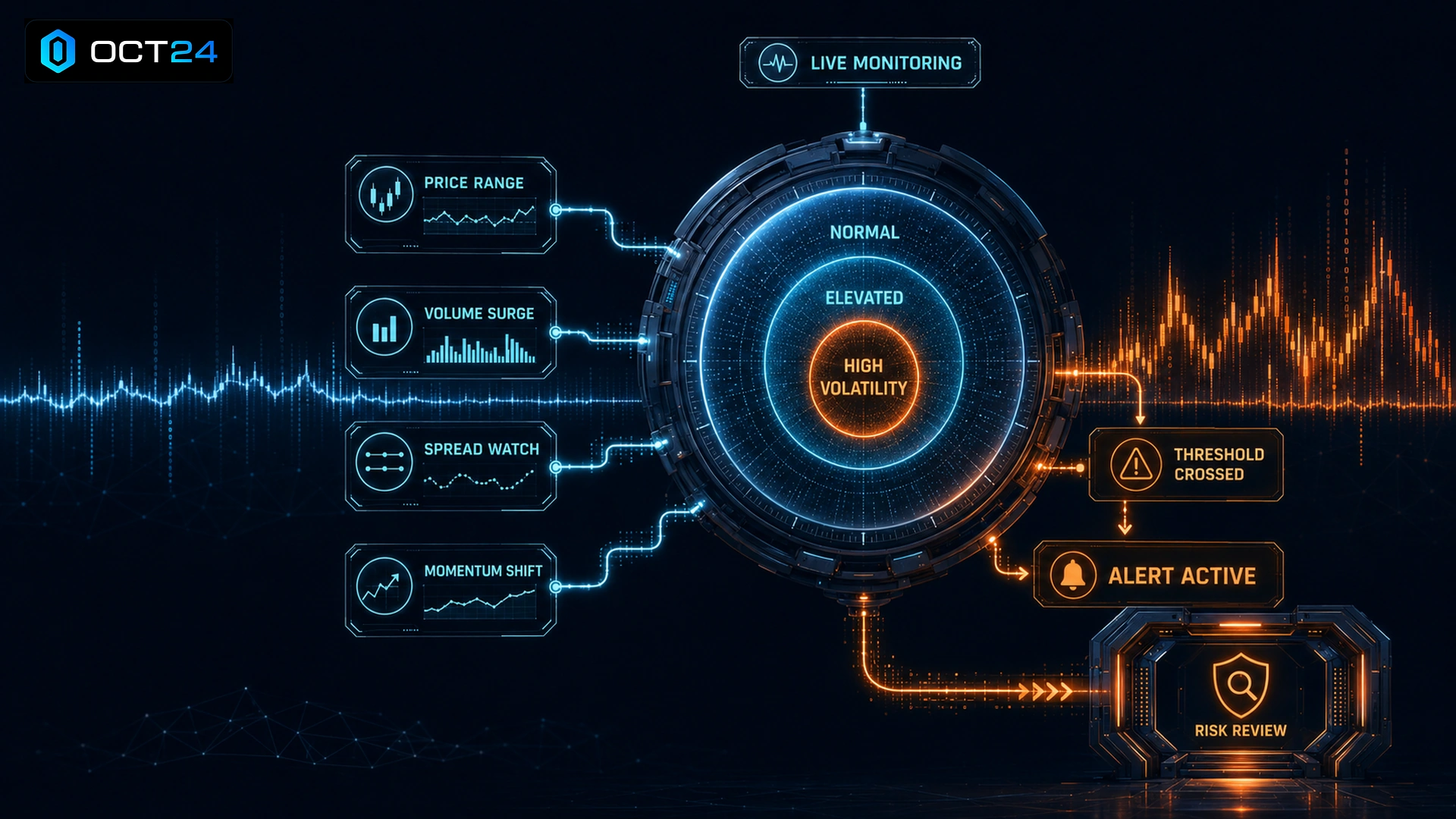
How AI Handles Volatility While Monitoring
Volatility is one of the main reasons traders use AI-supported monitoring. Fast markets can change before a person has time to check every chart.
AI can continue watching volatility changes in real time. It can help identify when a market is moving faster than normal, when momentum is changing, or when a setup may need extra caution.
This does not make volatile markets safe. It simply helps the trader see changing conditions sooner.
Understanding how AI handles market volatility is important because volatility can affect entries, exits, stop-loss planning, and position size.
OCT24 can support traders by scanning these changing market conditions and presenting AI-supported signals. The trader still decides whether the volatility makes the opportunity suitable.
24/7 Monitoring Does Not Mean 24/7 Trading
A common mistake is thinking that because AI can monitor the market all day, the trader should trade all day. That is not true.
Monitoring is about awareness. Trading is about decision-making.
A system may identify several potential opportunities, but not every signal should become a trade. Some signals may not fit the strategy. Some may appear during poor market conditions. Some may create too much exposure.
This is why common AI trading mistakes often include overtrading and blind trust in signals.
Traders should still ask:
- Does this signal fit my plan?
- Is the risk acceptable?
- Is the market too volatile?
- Do I already have similar exposure?
- Am I trading because of analysis or emotion?
OCT24 can do much of the analysis work, but it does not remove the need for disciplined execution.
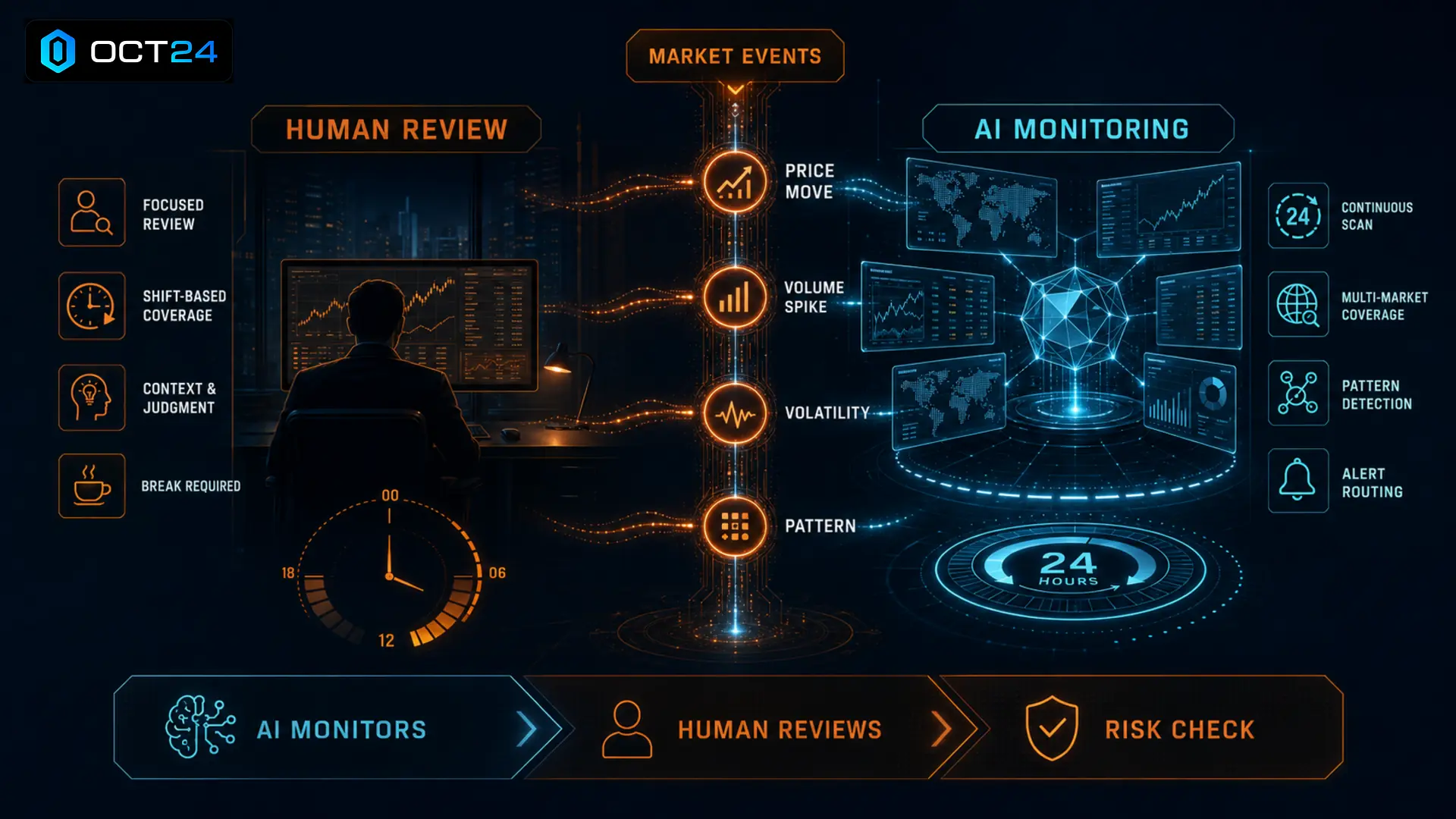
Human Monitoring vs AI Monitoring
Human traders are good at judgment, context, and strategy decisions. But humans get tired. They miss things. They can become emotional.
AI monitoring is different. It can keep scanning without fatigue. It can review many conditions at once. It can apply the same process repeatedly.
That does not mean AI replaces the trader. It means AI can support the trader's process.
AI monitoring is helpful for:
- Continuous scanning
- Faster signal detection
- Consistent condition checks
- Reducing manual chart review
- Supporting busy traders
Human review is still important for risk settings, capital allocation, exposure management, and execution decisions.
This balance is also important for trading psychology. A trader who understands the role of AI is less likely to treat every alert as an emergency.
How OCT24 Uses AI Monitoring
OCT24 uses AI monitoring to make the trading workflow more structured. Instead of asking traders to manually search through charts, OCT24 scans market conditions and identifies potential opportunities.
When the system finds a relevant setup, it can present an AI-supported trading signal. The trader can then review the signal, understand the context, and decide whether it fits their plan.
This creates a clearer workflow:
- OCT24 monitors market conditions
- OCT24 identifies potential opportunities
- OCT24 presents AI-supported signals
- The trader checks risk and exposure
- The trader chooses whether to execute
For traders using faster workflows, How One-Click Trading Works explains how execution can become simpler after signal review. The review still matters before any action.
The G6 Trading Bot may also be relevant for traders who want a more streamlined AI-supported workflow. It should still be used with appropriate risk settings and responsible capital management.
A Simple 24/7 Monitoring Checklist
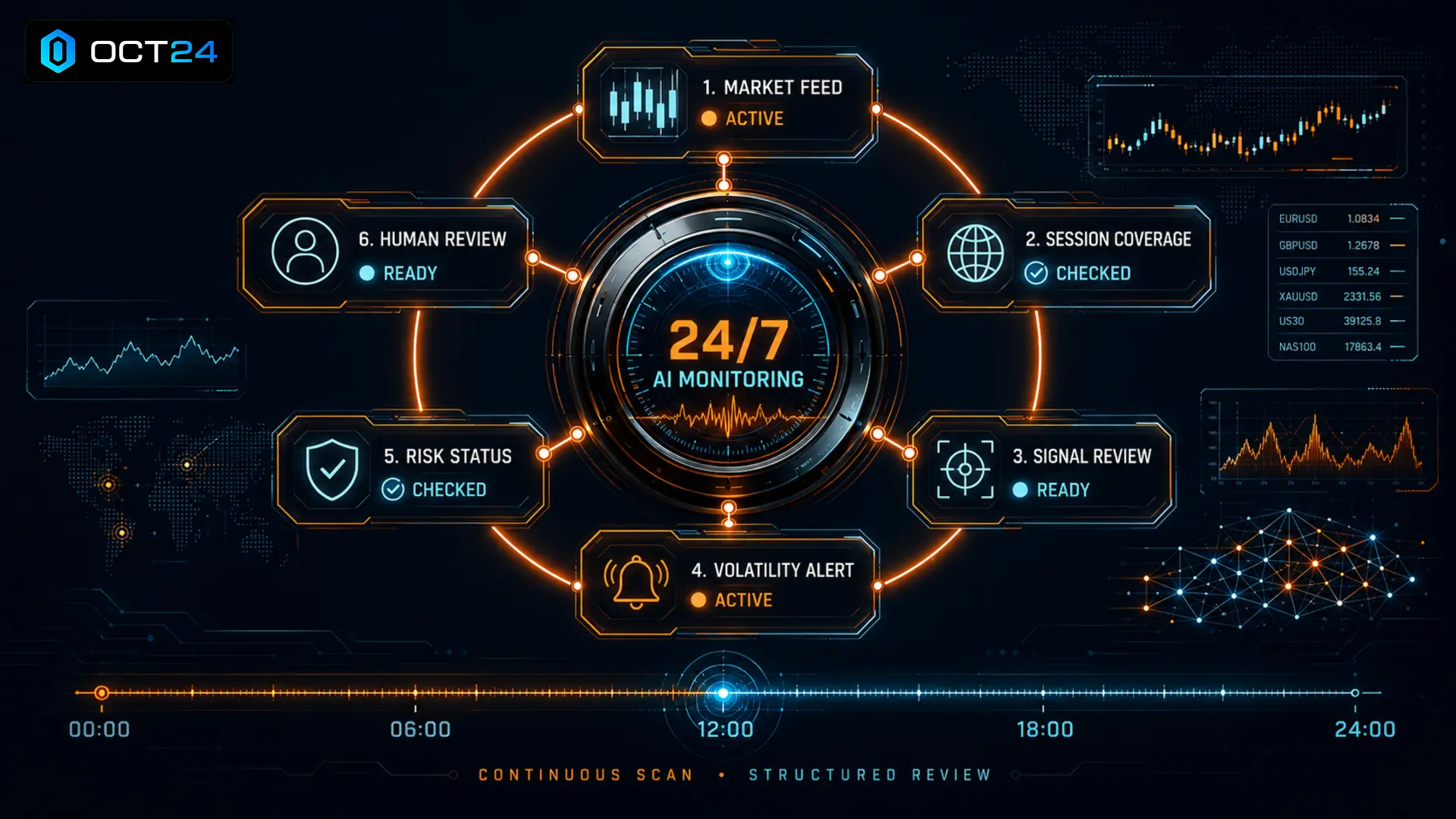
A trader does not need to watch every chart all day, but they should know how to review what the platform presents.
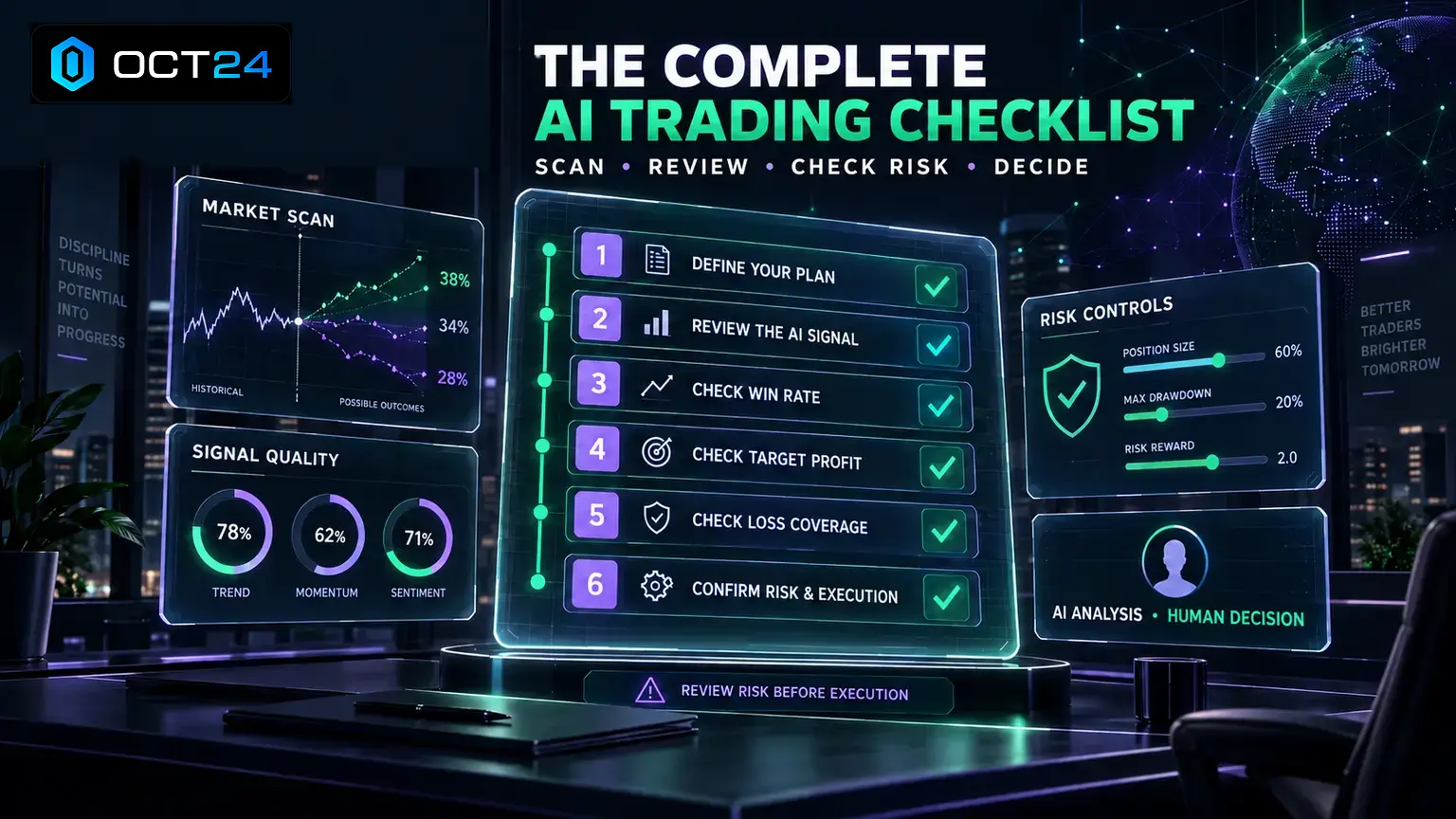
Use this checklist when reviewing AI-supported monitoring alerts:
- What changed in the market?
- Why did the signal appear?
- Is the setup still current?
- Is volatility normal or elevated?
- Does the signal fit my strategy?
- How much capital would be at risk?
- What is my total exposure?
- Do I need to act now, wait, or skip?
This checklist keeps the trader involved in the decision. OCT24 can support the analysis, but the trader remains responsible for the final choice.
How to Use 24/7 Alerts Without Overreacting
Continuous monitoring can create a new problem if the trader reacts to every alert too quickly. More information does not automatically mean better decisions.
The goal is to separate useful signals from market noise. A price move may look important for a few minutes and then fade. Volume may rise briefly without creating a strong setup. Volatility may trigger attention, but the trade may still be too risky.
A better response is to use a simple filter before acting.
When a new alert or signal appears, ask:
- Is this signal connected to my strategy?
- Is there enough confirmation?
- Is the move still early enough to consider?
- Does the risk-to-reward still make sense?
- Would I take this trade if I had found it manually?
This helps prevent alert fatigue. It also helps traders avoid chasing every movement just because the platform is always watching.
OCT24 can help organize the monitoring process, but the trader still needs a clear routine for deciding which signals deserve attention.
What to Review After Time Away From the Market
One of the biggest benefits of AI monitoring is that it can continue scanning while the trader is away. But when the trader returns, the next step should be review, not immediate action.
If you were away from the market for several hours, start by checking what changed. Look at the strongest signals, the main volatility changes, and whether any market move has already happened.
A useful return-to-market review might include:
- Which markets moved the most?
- Which signals are still active?
- Which signals are no longer useful?
- Did volatility increase while I was away?
- Do any open trades need attention?
- Does my exposure still match my risk plan?
This review is important because a signal can become outdated. A setup that looked useful earlier may no longer offer a suitable entry.
OCT24 can reduce the amount of searching required when traders return to the platform. Still, the trader should check whether each opportunity is current before making an execution decision.
What Makes a 24/7 Monitoring Signal More Useful?
Not every alert has the same value. Some alerts simply show that the market moved. Others show that several useful conditions are lining up at the same time.
A more useful signal usually has context behind it. For example, price may be moving with the trend, volume may be rising, volatility may still be manageable, and the setup may still be close enough to the review area.
A weaker signal may appear when the market is choppy, volume is thin, or price has already moved too far. The alert may still be interesting, but it may not be suitable for action.
When reviewing a 24/7 monitoring signal, traders should look for confirmation instead of reacting to the alert alone.
Useful confirmation may include:
- A clear market direction
- Volume supporting the move
- Momentum that has not already faded
- Volatility that does not make the trade too risky
- A signal that fits the trader's strategy
- A risk level that makes sense for the account
OCT24 can help by scanning conditions and presenting AI-supported trading signals, but the trader still needs to decide whether the signal is strong enough to review further.
How 24/7 Monitoring Supports Better Timing
Timing is one of the hardest parts of trading. A trader can understand a market idea but still enter too early, too late, or at a point where the risk no longer makes sense.
24/7 monitoring can support timing by helping traders notice important changes sooner. If momentum starts to build, volatility increases, or price approaches a key area, the system can bring that change to attention faster than manual review alone.
This does not mean the trader should rush. Better timing is not only about being fast. It is about seeing the setup while there is still enough time to review it properly.
For example, a trader may receive a signal after a market breaks above a key level. Before acting, the trader still needs to ask whether the entry is still reasonable, whether the move has already stretched too far, and whether the downside risk is acceptable.
OCT24 can help reduce the time spent searching for these moments. The trader still needs to decide whether the timing is good enough to act.
How AI Monitoring Can Help With Risk Awareness
Risk awareness is not only about what happens after entering a trade. It starts before the trade is placed.
AI monitoring can help traders notice when market conditions may require more caution. A signal may appear during a volatile move, during low-liquidity conditions, or after a market has already made a large move.
Those details matter because they can affect position size, stop-loss planning, and whether the setup is worth taking at all.
A risk-aware monitoring workflow should help traders think about:
- How much price has already moved
- Whether volatility is rising
- Whether liquidity looks thin
- Whether the signal conflicts with broader market conditions
- Whether the trader already has related exposure
OCT24 does not remove risk. It helps organize analysis so traders can review potential opportunities with more structure. Capital allocation, exposure, and execution choices still remain with the trader.
Why 24/7 Monitoring Helps Busy Traders
Many traders do not have time to watch charts all day. They may have work, family, travel, or other responsibilities. This does not mean they should trade blindly, but it does mean a more efficient workflow can help.
AI monitoring can give busy traders a more organized starting point. Instead of opening charts at random, they can review the signals and market changes that OCT24 has already surfaced.
This can make the process feel more manageable:
- Less time spent searching
- More time spent reviewing
- Clearer signal context
- Better awareness of changing conditions
- A more consistent trading routine
The trader still needs to avoid rushing. Monitoring helps with awareness, but execution should still be based on risk, timing, and strategy fit.
How Beginners Should Use 24/7 Monitoring
Beginners should treat 24/7 monitoring as a learning and review tool first. The goal is not to act on every signal. The goal is to understand what the platform is showing and why it may matter.
A beginner can start by watching how signals appear during different market conditions. Some signals may appear during calm trends. Others may appear during sharp volatility. Over time, this helps the trader understand the difference between a clean setup and a noisy market move.
A simple beginner routine could look like this:
- Review only a small number of signals at first
- Write down why each signal appeared
- Check whether the signal matched the market direction
- Review the risk before thinking about execution
- Track what happened after the signal
This kind of routine turns AI monitoring into education, not just alerts. It helps the trader build judgment instead of depending blindly on the platform.
OCT24 can support beginners by presenting AI-supported opportunities in a more structured way. The trader still needs to build good habits around risk and review.
How Intermediate Traders Can Use Monitoring More Strategically
Intermediate traders may use 24/7 monitoring differently. Instead of only asking whether a signal appeared, they may compare the signal with their strategy, preferred market conditions, and current exposure.
For example, a trader focused on momentum may use AI monitoring to notice when price, volume, and trend direction start to line up. A trader focused on volatility may use monitoring to identify when market conditions are becoming too fast or unstable for their normal approach.
Intermediate traders can also use monitoring to avoid unnecessary trades. If the system shows that volatility is elevated or that signals are appearing across too many related markets, the better decision may be to reduce exposure rather than add another trade.
At this level, monitoring becomes part of a broader trading process:
- Scan the market
- Filter signals by strategy
- Check risk and exposure
- Decide whether to act
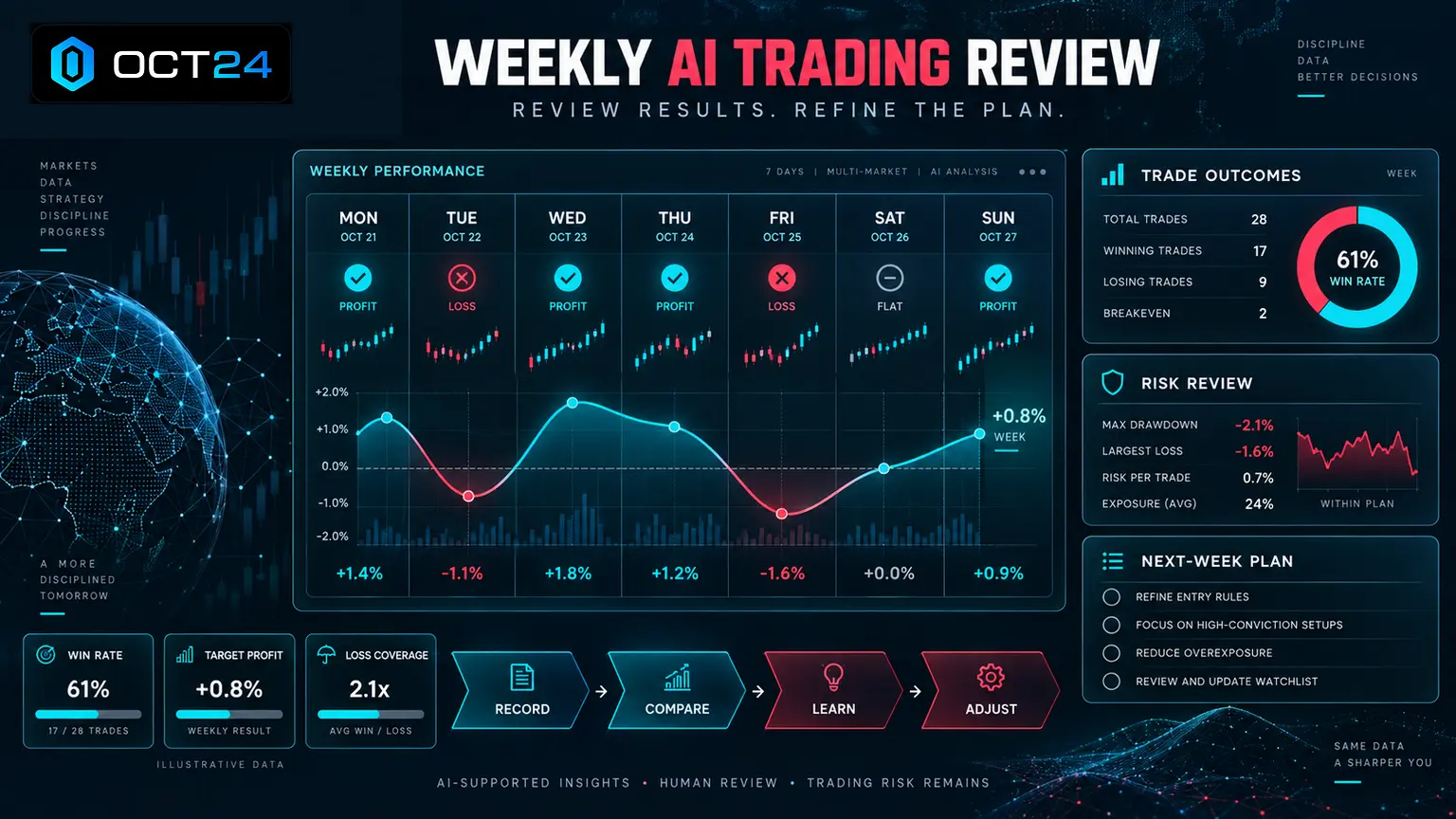
- Review outcomes later
OCT24 supports this process by doing much of the scanning and analysis work first. The trader then uses their own rules to decide whether the signal deserves action.
Why 24/7 Monitoring Still Needs Human Rules
AI monitoring is powerful because it can keep watching the market without fatigue. But a trader still needs rules for what to do with the information.
Without rules, constant monitoring can become constant temptation. Every alert may feel urgent. Every move may feel like a missed opportunity. That is how overtrading starts.
Human rules create boundaries. They tell the trader when to act, when to wait, and when to skip the setup completely.
Helpful rules may include:
- Only review signals that match one defined strategy
- Do not trade if volatility is outside your comfort zone
- Avoid adding trades when exposure is already high
- Use smaller position sizes during uncertain conditions
- Review losing trades instead of immediately taking another signal
OCT24 can scan, organize, and present opportunities, but it cannot decide what level of risk is appropriate for every trader. That decision depends on the trader's capital, experience, goals, and risk tolerance.
A Practical Example of 24/7 AI Monitoring
Imagine a trader is away from the screen for several hours. During that time, the market becomes more active. Volume rises, price moves toward a key area, and volatility increases.
Without monitoring, the trader may return later and have no clear idea what changed. They may open a chart, see a large move, and feel pressure to enter quickly.
With AI-supported monitoring, the trader has a better starting point. OCT24 can surface the relevant market change, present an AI-supported signal, and help the trader review the setup more efficiently.
The trader can then ask the right questions. Is the signal still current? Has price already moved too far? Is volatility too high? Would the position size need to be reduced? Does this trade fit the plan?
The point is not that the trader must act. The point is that the trader returns to a clearer picture of the market.
That is the practical value of 24/7 monitoring. It helps reduce blind spots, but it still leaves the final decision where it belongs: with the trader.
Frequently Asked Questions
What does AI market monitoring mean?
AI market monitoring means using automated systems to scan market conditions continuously and identify possible changes, signals, or opportunities for review.
Does AI monitoring guarantee profitable trades?
No. AI monitoring can help identify potential opportunities, but it does not guarantee profits or remove trading risk.
How does OCT24 monitor the market?
OCT24 scans market conditions, identifies potential opportunities, and presents AI-supported trading signals. Traders still review risk and decide whether to act.
Can AI monitor markets while I am away?
AI systems can continue scanning market conditions when a trader is away from the screen. The trader should still review signals and manage risk before execution.
Is 24/7 monitoring the same as 24/7 trading?
No. Monitoring means watching conditions. Trading means making an execution decision. Not every alert should become a trade.
Why is AI monitoring useful in crypto markets?
Crypto markets trade around the clock, so AI monitoring can help identify changes outside normal working hours.
What should I check before acting on a signal?
Check the signal context, volatility, position size, exposure, and whether the opportunity fits your trading plan.
Does AI replace human decision-making?
No. AI can support analysis and signal detection, but traders remain responsible for risk settings, capital allocation, and execution choices.
How AI Monitors the Market 24/7: Key Takeaways
AI market monitoring helps traders track changing conditions without manually watching every chart. It can scan price, volume, volatility, momentum, and possible signal triggers around the clock.
OCT24 uses this workflow by performing most of the market analysis, identifying potential opportunities, and presenting AI-supported trading signals.
That support can save time and make review easier, but it does not remove trading risk or guarantee results.
The trader still needs to manage risk settings, exposure, capital allocation, and execution decisions.
To explore an AI-supported market monitoring workflow, you can Start Trading with OCT24 and review each signal with a clear risk plan.