
The Future of AI Trading
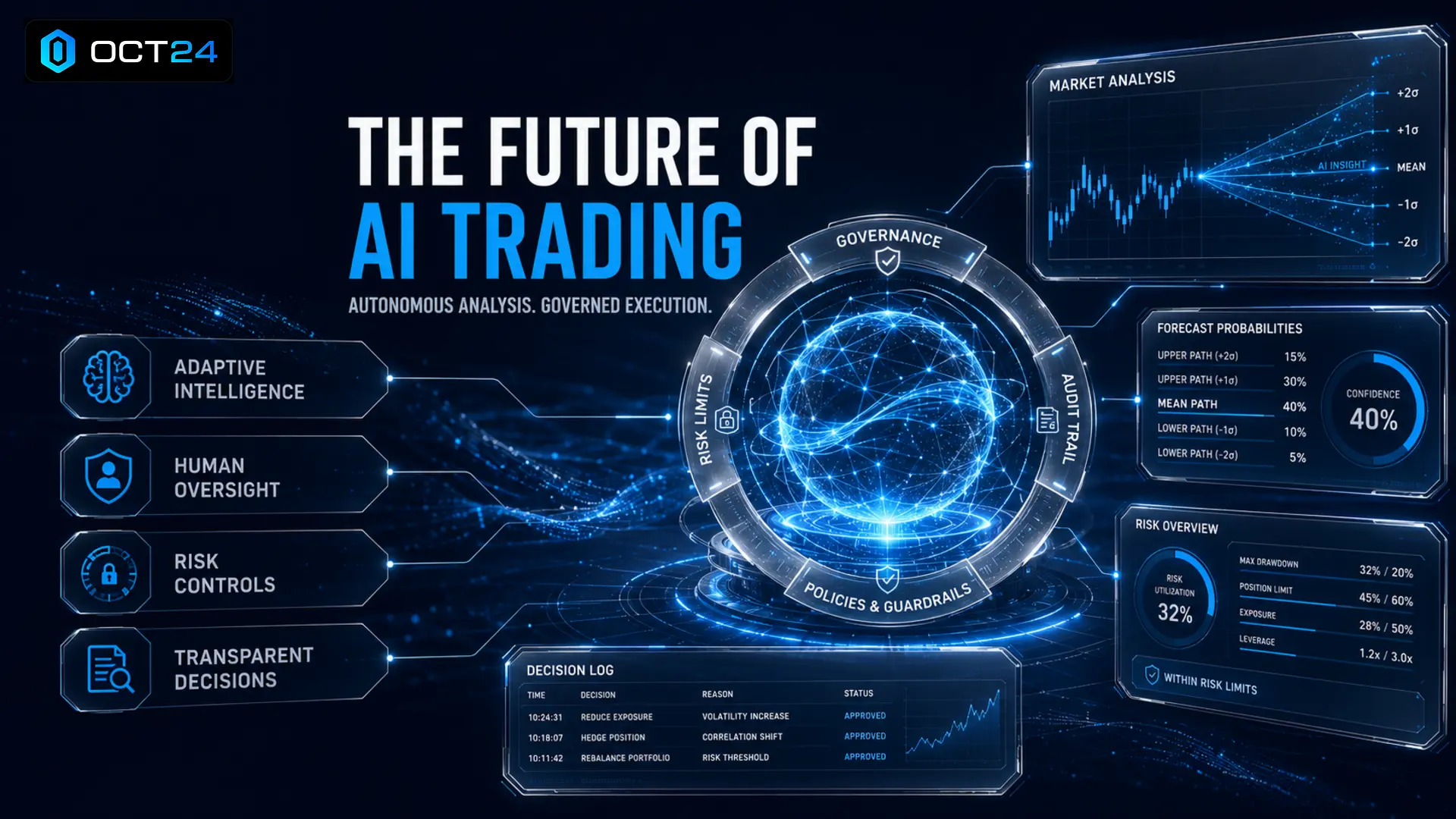
The future of AI trading will likely be more automated, more data-driven, and more focused on risk control. Traders should expect AI to perform more of the market analysis, signal scanning, and opportunity filtering, while humans remain responsible for risk settings, exposure, capital allocation, and final execution decisions.
That balance is important. AI can help traders process more information faster, but it cannot remove uncertainty. Markets can still move unexpectedly. Signals can still fail. Poor risk management can still damage an account.
OCT24 is built around this practical future. It performs most of the market analysis for the user by scanning market conditions, identifying potential opportunities, and presenting AI-supported trading signals. But OCT24 does not remove trading risk or guarantee results. Traders still need to understand what they are doing and manage their decisions responsibly.
This article explains where AI trading is going, what traders should expect, and how to prepare for a more AI-supported market without losing control of risk.
Why the Future of AI Trading Matters
AI trading matters because markets are becoming faster, more complex, and more data-heavy. Traders now deal with price charts, news, volatility, liquidity, sentiment, technical levels, and cross-market reactions all at once.
For a human trader, that can become overwhelming. Even experienced traders can miss signals when too many markets are moving at the same time.
AI can help by scanning more information than a person can manually review. It can compare conditions, identify potential opportunities, and highlight signals for trader review.
This does not mean every trader will become fully automated. It means more traders may use AI as part of their normal workflow.
The future is likely to include:
- Faster market scanning
- More personalized signal review
- Better support for risk checks
- More AI-assisted trade planning
- More automation around routine analysis
- More focus on human oversight and accountability
For beginner and intermediate traders, the big lesson is simple: AI may change how traders analyze markets, but it does not change the need for discipline.
From Manual Analysis to AI-Supported Decisions
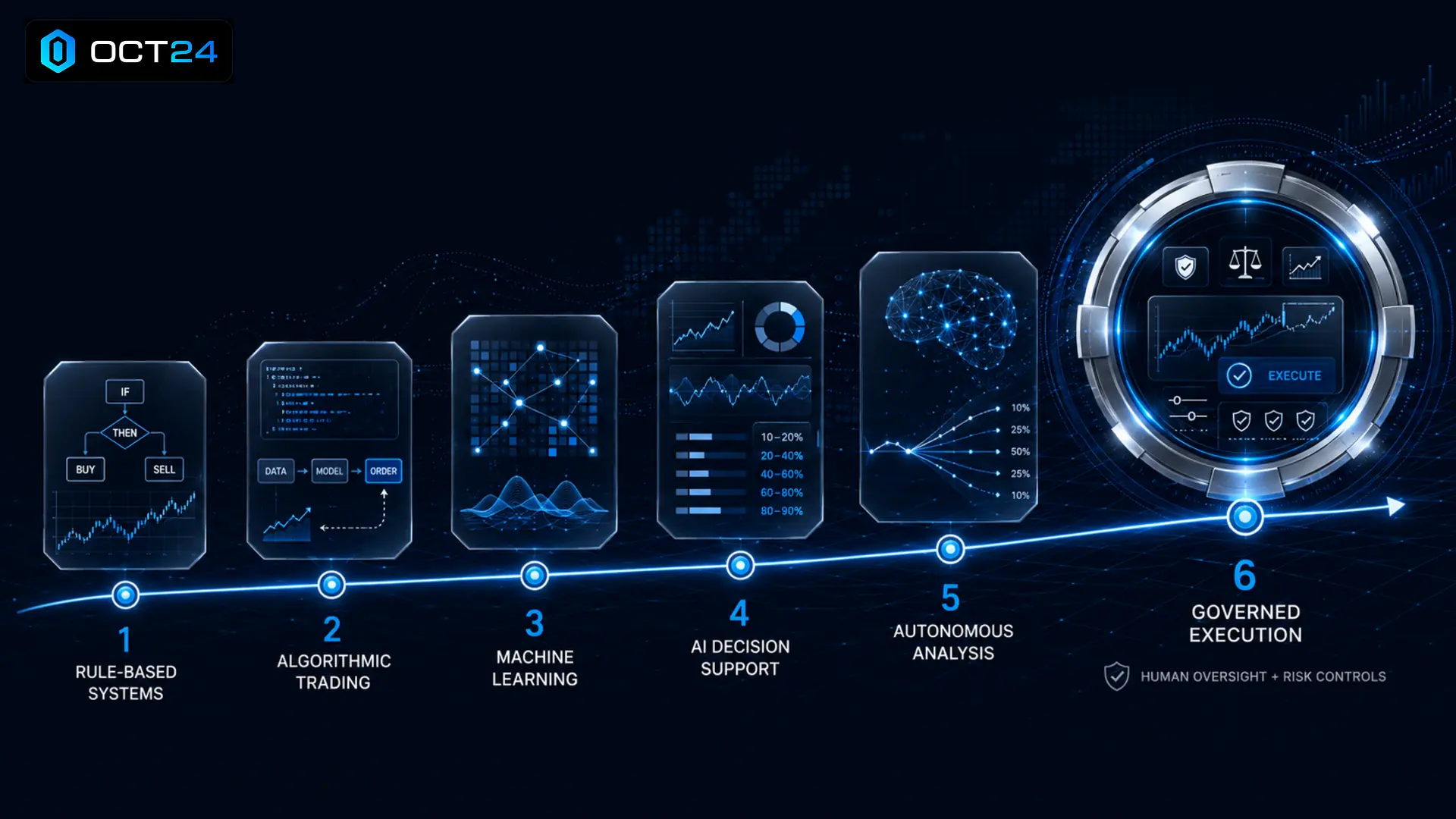
In the past, many traders manually reviewed charts, indicators, news, and price patterns. That process still matters, but AI is changing how quickly analysis can be done.
Instead of starting from a blank chart, traders can use AI-supported tools to narrow the field. The trader can then focus on the setups that appear most relevant.
This is one reason AI trading vs manual trading is such an important topic. Manual trading gives the trader full control, but it can be slow and emotionally demanding. AI-supported trading can help with speed and structure, but it still requires human review.
OCT24 sits in that middle ground. It does not simply leave traders to analyze everything alone. It scans market conditions and presents AI-supported trading signals so traders can review opportunities more efficiently.
The future of trading is not just human versus machine. It is more likely to be human plus AI, with clear risk rules around how decisions are made.
AI Will Do More of the Market Scanning
One of the biggest changes in the future of AI trading is that more of the scanning process will be automated.
Traders often waste time looking across too many markets. They check one asset, then another, then another. By the time they find something interesting, the opportunity may already be less clear.
AI can reduce this problem by reviewing market conditions continuously. It can look for movement, momentum, volatility changes, technical areas, and other possible setup conditions.
This does not mean AI should decide everything. It means AI can act like a market filter.
A good AI-supported scanning process may help traders answer:
- Which markets are active right now?
- Where is momentum changing?
- Where is volatility increasing?
- Which signals deserve review?
- Which setups do not match current conditions?
- Where might risk be too high?
This is already aligned with how OCT24 is positioned. OCT24 performs much of the market analysis by scanning conditions and identifying potential opportunities, while the trader remains responsible for the final decision.
AI Trading Signals Will Become More Important
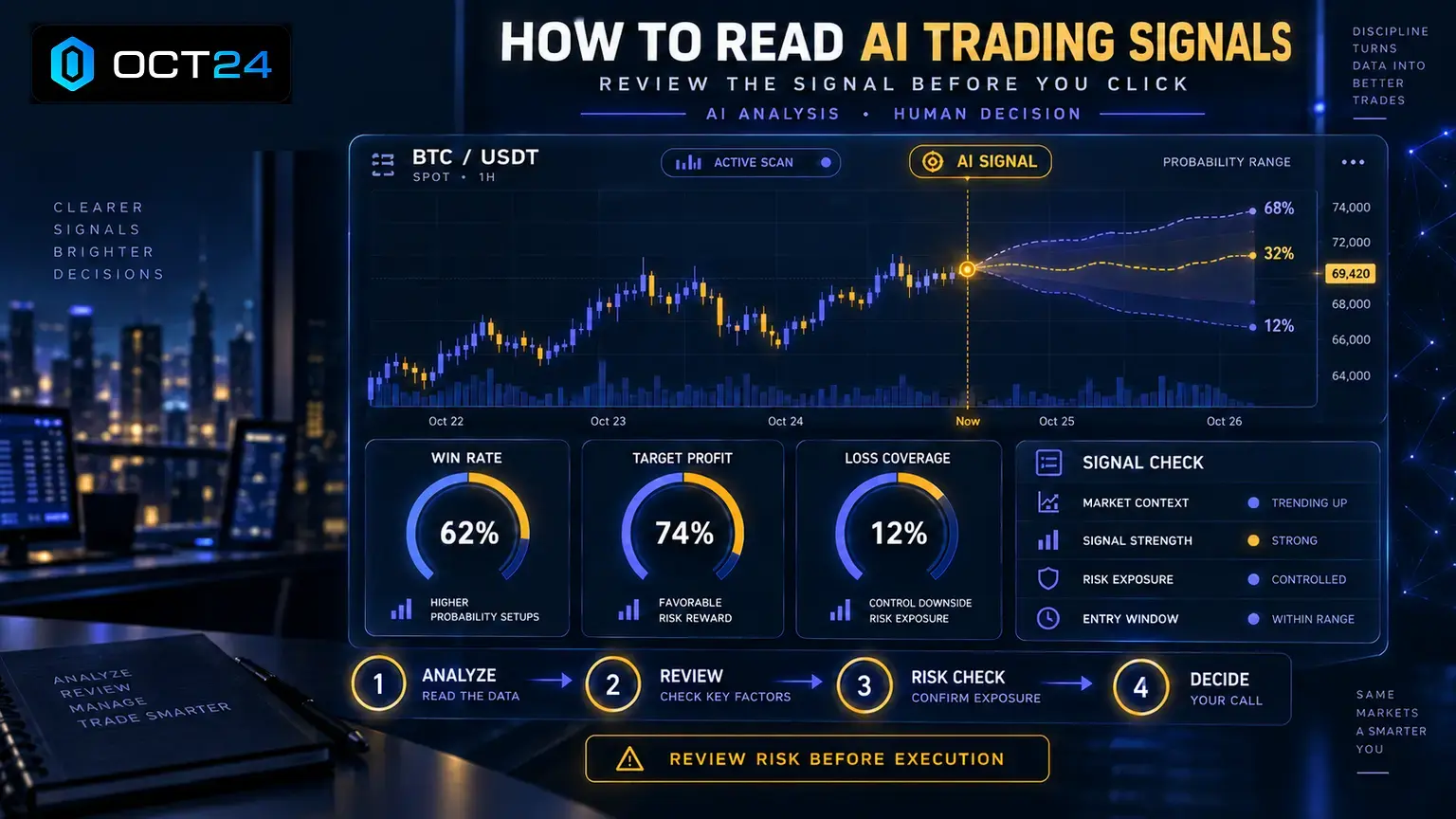
AI trading signals are likely to become a bigger part of how traders organize their decisions. A signal helps turn large amounts of market data into something easier to review.
But signals should not be treated as instructions to trade automatically. A signal is a starting point for review.
The future of signals may include more context around:
- Market direction
- Momentum strength
- Volatility conditions
- Possible entry areas
- Risk zones
- Signal confidence
- Market timing
- Trade review history
This could make signals more useful for busy traders. Instead of manually reviewing dozens of charts, a trader may focus on the most relevant signals and decide whether they fit the current plan.
OCT24 presents AI-supported trading signals as part of a structured workflow. The trader can review the signal, compare it with risk settings, and decide whether to act, wait, or skip the opportunity.
Future AI Trading Will Still Need Human Judgment
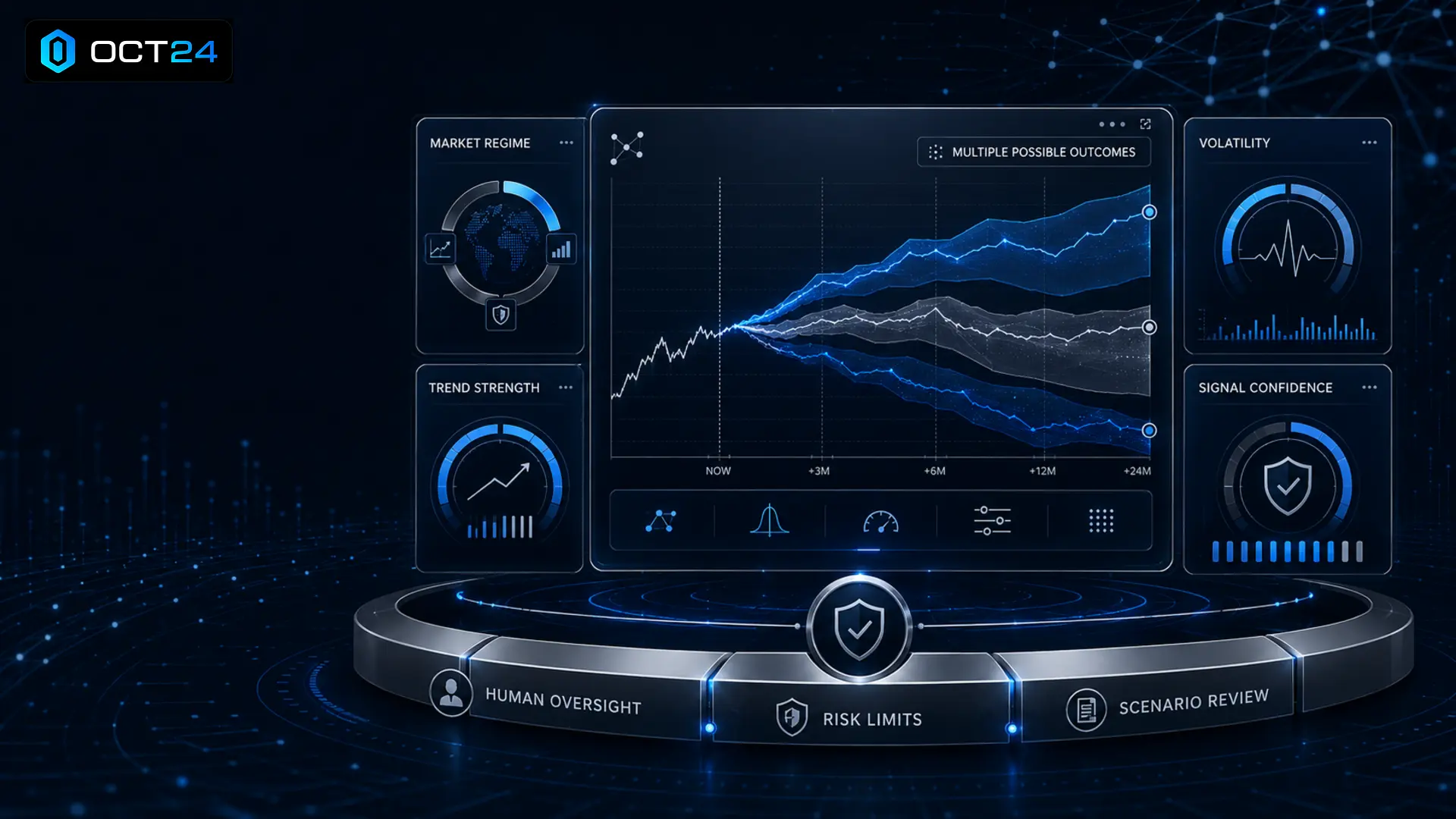
It is tempting to imagine a future where AI makes every decision perfectly. That is not realistic.
Markets are affected by news, liquidity, human behavior, sudden events, and changing conditions. AI can analyze data, but it cannot guarantee certainty.
This is why trading bots vs human traders will remain a useful discussion. Bots can be fast and consistent. Humans can apply judgment, context, caution, and responsibility.
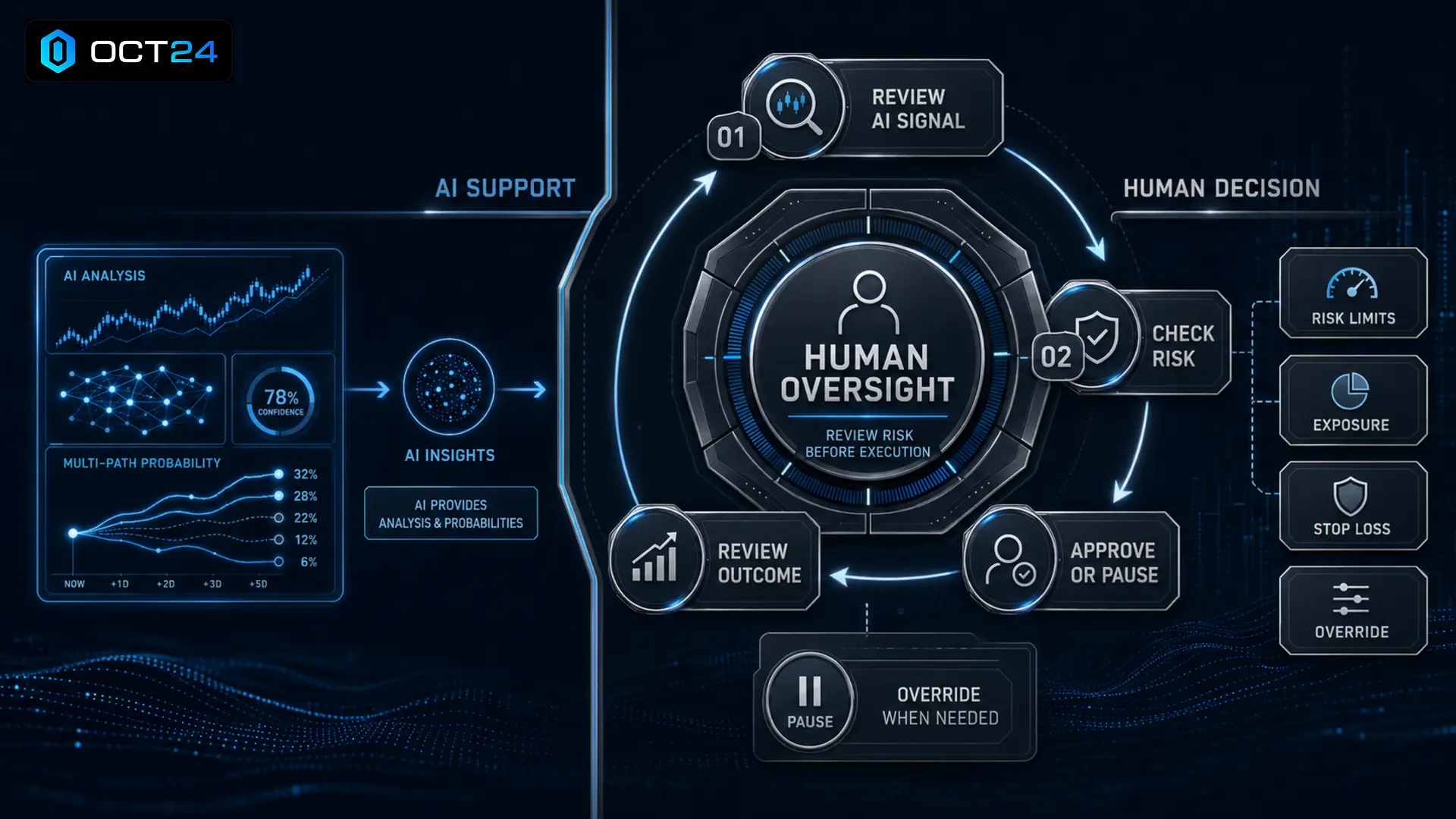
The best future may not be one where humans disappear. It may be one where humans use AI to reduce manual work and make more structured decisions.
Human judgment will still matter for:
- Choosing how much capital to risk
- Deciding whether conditions are too uncertain
- Reviewing whether a signal fits the plan
- Stopping when emotions are high
- Adjusting exposure during volatile markets
- Evaluating performance over time
OCT24 supports analysis, but it does not take away the trader’s responsibility. That distinction should remain central as AI trading becomes more advanced.
Risk Management Will Become Even More Important
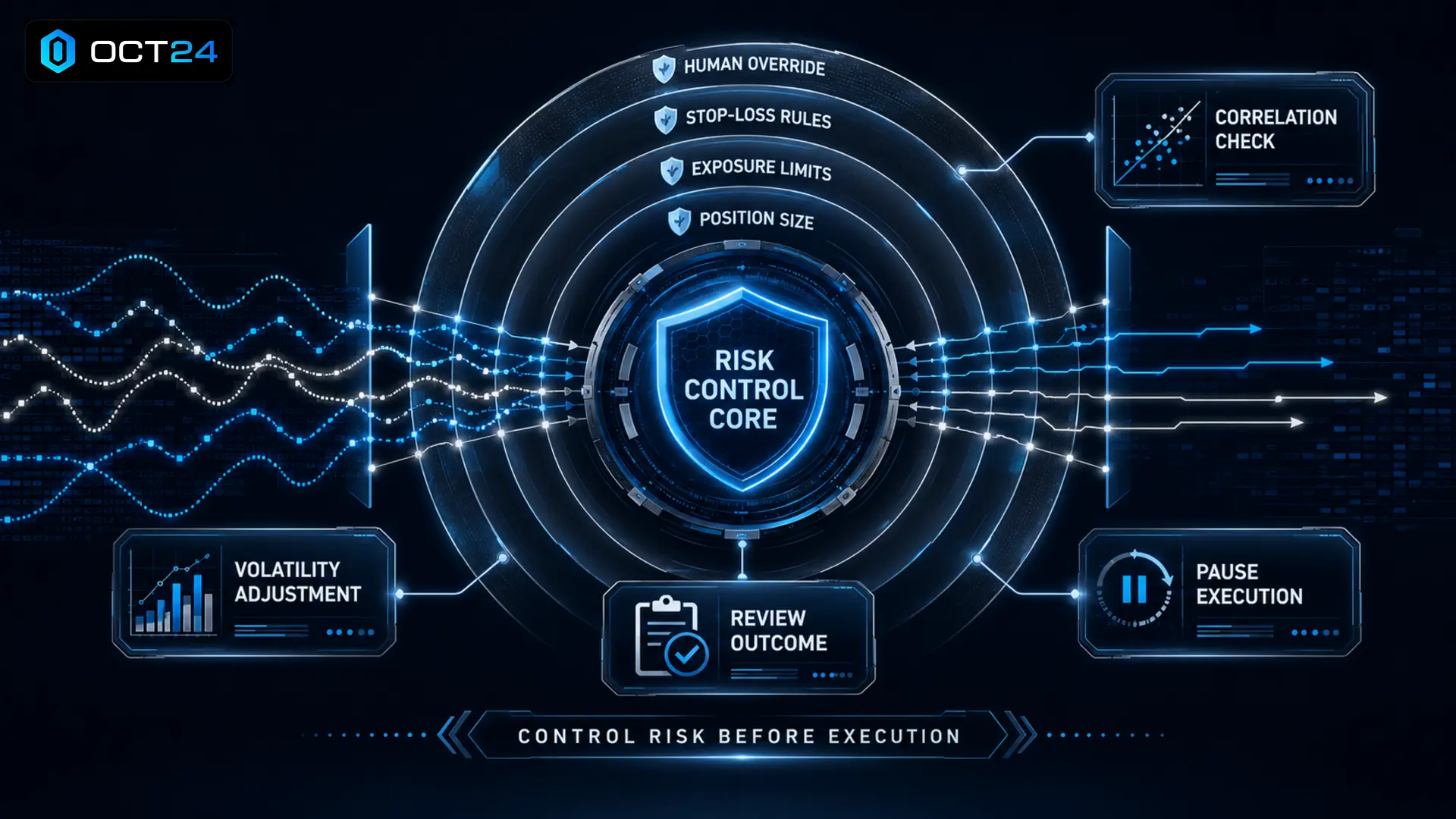
The more powerful AI trading tools become, the more important risk management becomes. Faster analysis and faster execution can help traders, but they can also make mistakes happen faster if the trader has no rules.
Trading bot risk management will likely become a major focus as AI tools become more common. Traders will need to understand settings, limits, exposure, and when to pause activity.
Risk management should include:
- Position sizing
- Stop-loss planning
- Exposure limits
- Daily or weekly loss limits
- Review of correlated positions
- Control over leverage
- Clear rules for skipping trades
- Performance review after execution
This connects directly with AI trading risk vs reward. A future trader should not only ask whether AI found an opportunity. They should ask whether the possible reward is worth the risk.
OCT24 helps by organizing market analysis and signals, but traders still need to choose risk settings and manage capital responsibly.
AI May Help Traders Handle Volatility Better
Volatility is one of the hardest parts of trading. Markets can move quickly, reverse suddenly, and trigger emotional decisions.
In the future, AI tools may become better at helping traders understand when volatility is changing and when normal trading rules may need adjustment.
This does not mean AI can remove volatility. It means AI can help traders see changing conditions faster.
For example, AI may help identify:
- Faster price movement
- Breakouts that need confirmation
- Weak momentum after a large move
- High-risk conditions near major events
- Markets where position size should be reduced
- Signals that need extra caution
This builds on the idea of how AI handles market volatility. AI can support awareness, but the trader still decides whether to trade, wait, or reduce exposure.
The Future May Bring More Personalized Trading Workflows
One likely direction for AI trading is more personalized workflows. Traders do not all need the same signals, timeframes, or risk settings.
A beginner may need a simpler view with fewer signals and clearer risk warnings. An intermediate trader may want more control, more filters, and more detailed market context.
Personalized AI trading workflows may help traders focus on what matters most for their own strategy.
This could include:
- Preferred markets
- Preferred signal types
- Risk limits
- Watchlist behavior
- Volatility filters
- Trade review habits
- Alerts based on routine or strategy
This is especially useful for AI trading for busy professionals. A trader with limited time does not need endless data. They need relevant analysis, clear signals, and a simple process for reviewing risk.
OCT24 already supports a more efficient workflow by doing much of the scanning and signal presentation. As AI trading develops, this kind of structure may become even more important.
AI Trading Platforms Will Need to Be Easier to Understand
As AI tools become more powerful, they also need to become easier to use. Traders should not need to be developers or data scientists to benefit from AI-supported trading.
The future of AI trading should make complex analysis easier to understand, not harder.
A strong platform should help traders see:
- What the signal is
- Why the setup may matter
- What market conditions are present
- Where risk may be higher
- What the trader still needs to decide
- How the trade fits into a broader routine
This is why choosing the right AI trading platform matters. A platform should not overwhelm the trader with noise. It should help the trader make more organized decisions.
OCT24 is positioned as an AI-assisted trading platform that performs much of the market analysis, presents potential opportunities, and keeps the trader responsible for risk and execution choices.
One-Click Trading Will Need Stronger Risk Awareness
As trading tools become faster, risk awareness becomes more important. One-click trading can make execution more efficient, but fast execution should not replace planning.
The future of one-click trading should be connected to signal review, risk checks, position sizing, and performance review.
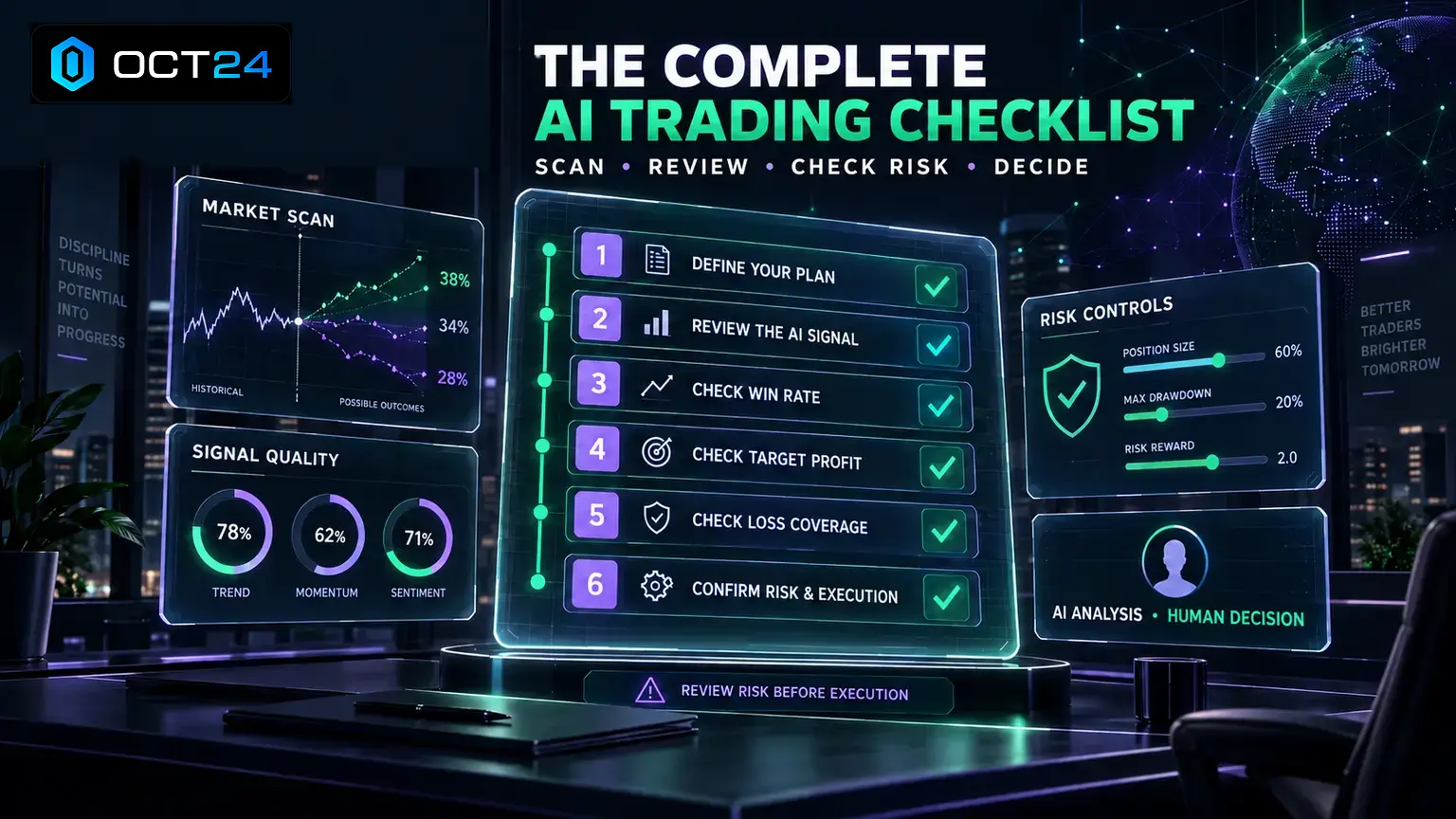
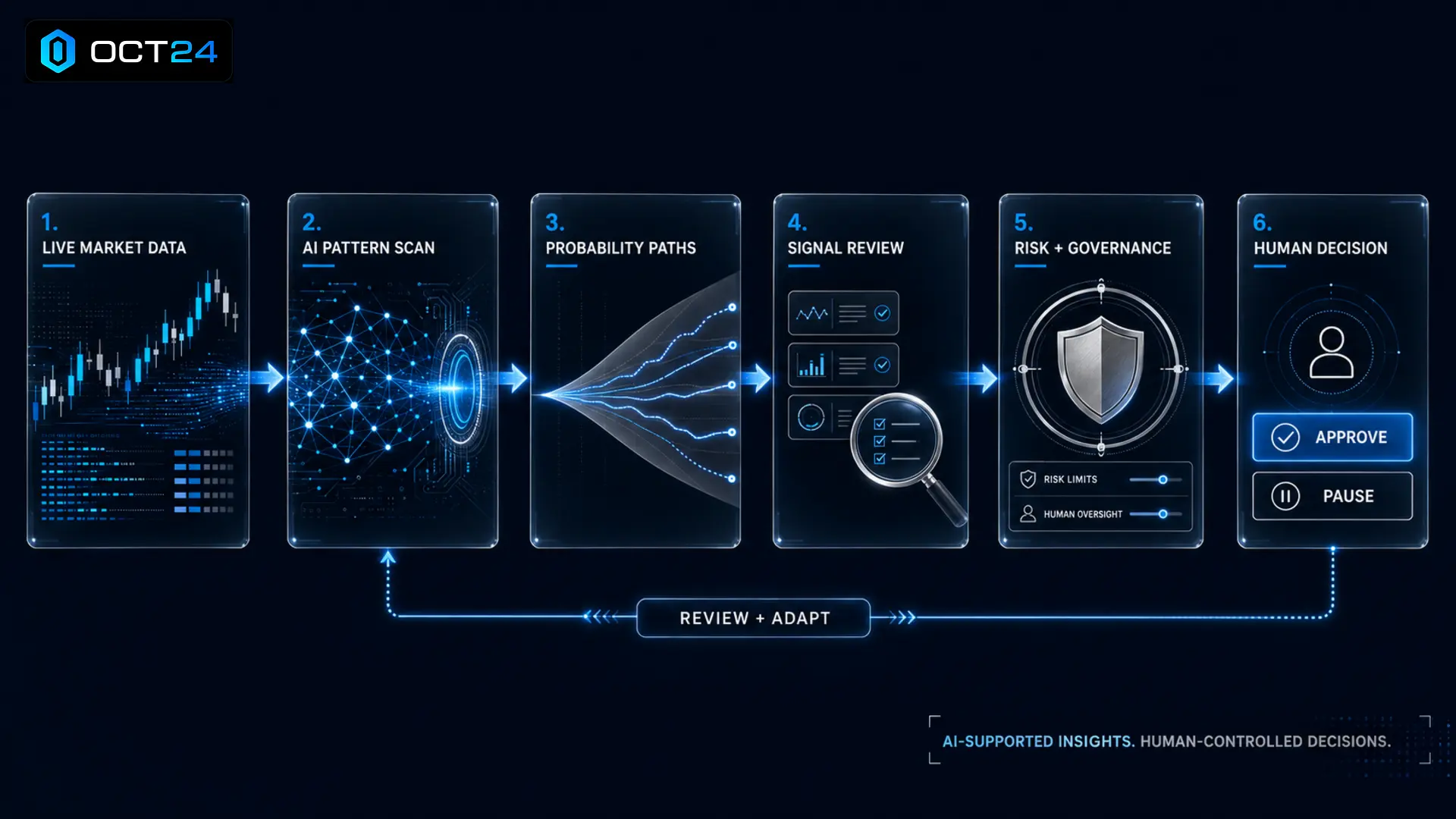
A responsible workflow may look like this:
- AI scans market conditions.
- The platform presents a signal.
- The trader reviews risk and exposure.
- The trader confirms position size and execution settings.
- The trader decides whether to execute, wait, or skip.
- The trader reviews the outcome afterward.
OCT24 can support efficient execution workflows, including tools such as the G6 Trading Bot where appropriate. But traders should still treat execution as the final step, not the first step.
Regulation and Oversight May Become More Important
As AI becomes more active in financial markets, oversight is likely to become a bigger topic. This is not only about technology. It is about accountability.
When AI systems become faster or more autonomous, traders, platforms, and regulators may pay more attention to safeguards. These can include risk limits, pause controls, monitoring, audit trails, and clearer responsibility for decisions.
For everyday traders, the message is simple: do not confuse automation with safety.
Even if AI tools become more advanced, traders should still understand:
- What the tool is designed to do
- What the tool is not designed to do
- Who controls the risk settings
- When trading should be paused
- How performance is reviewed
- How much capital is exposed
This is one reason AI trading myths should be avoided. The future of AI trading will not be risk-free. It will need better education, better controls, and better user habits.
The Future Trader Will Need Better Routines
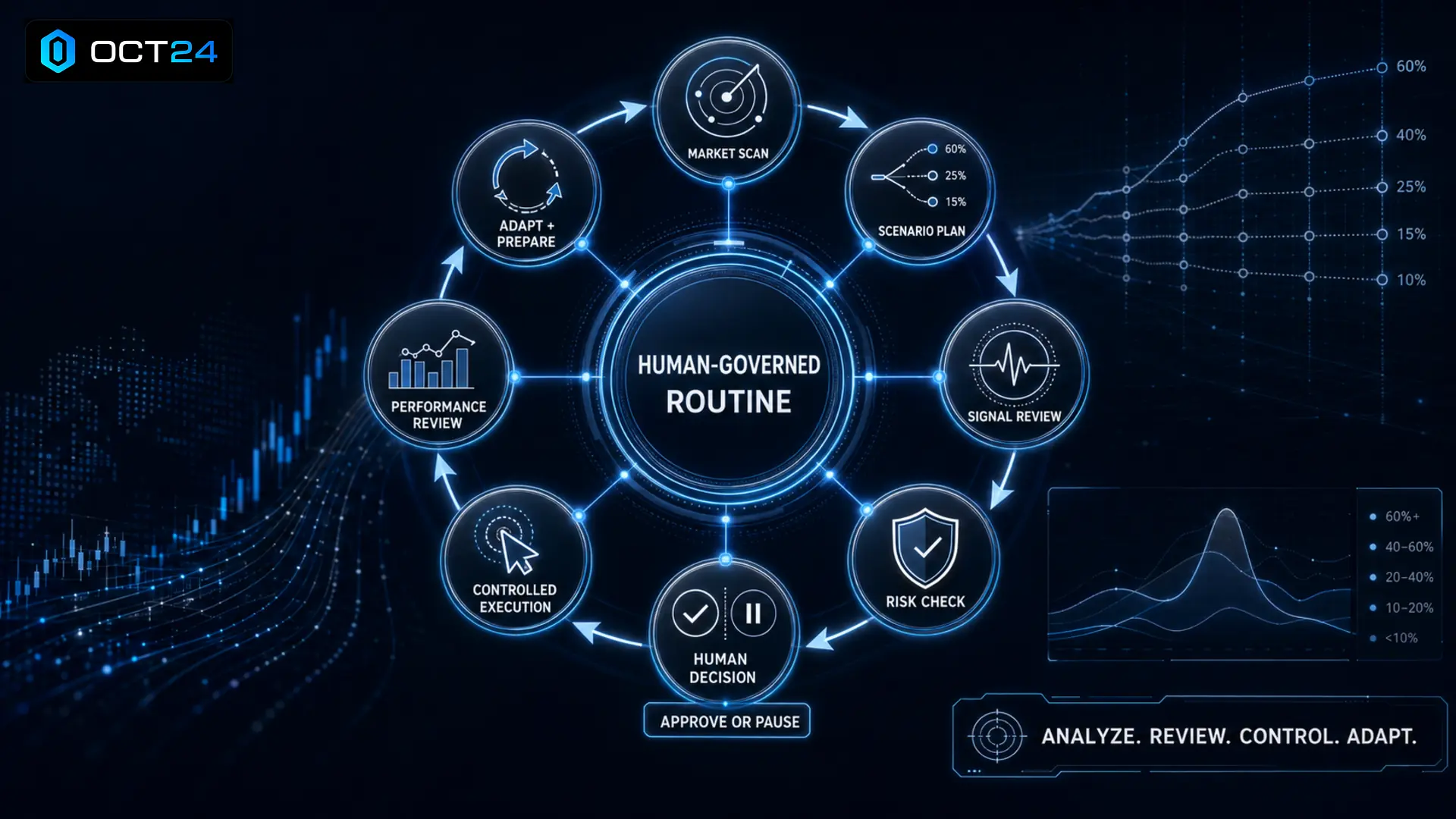
AI may make analysis faster, but traders will still need routines. Without a routine, faster tools can lead to faster mistakes.
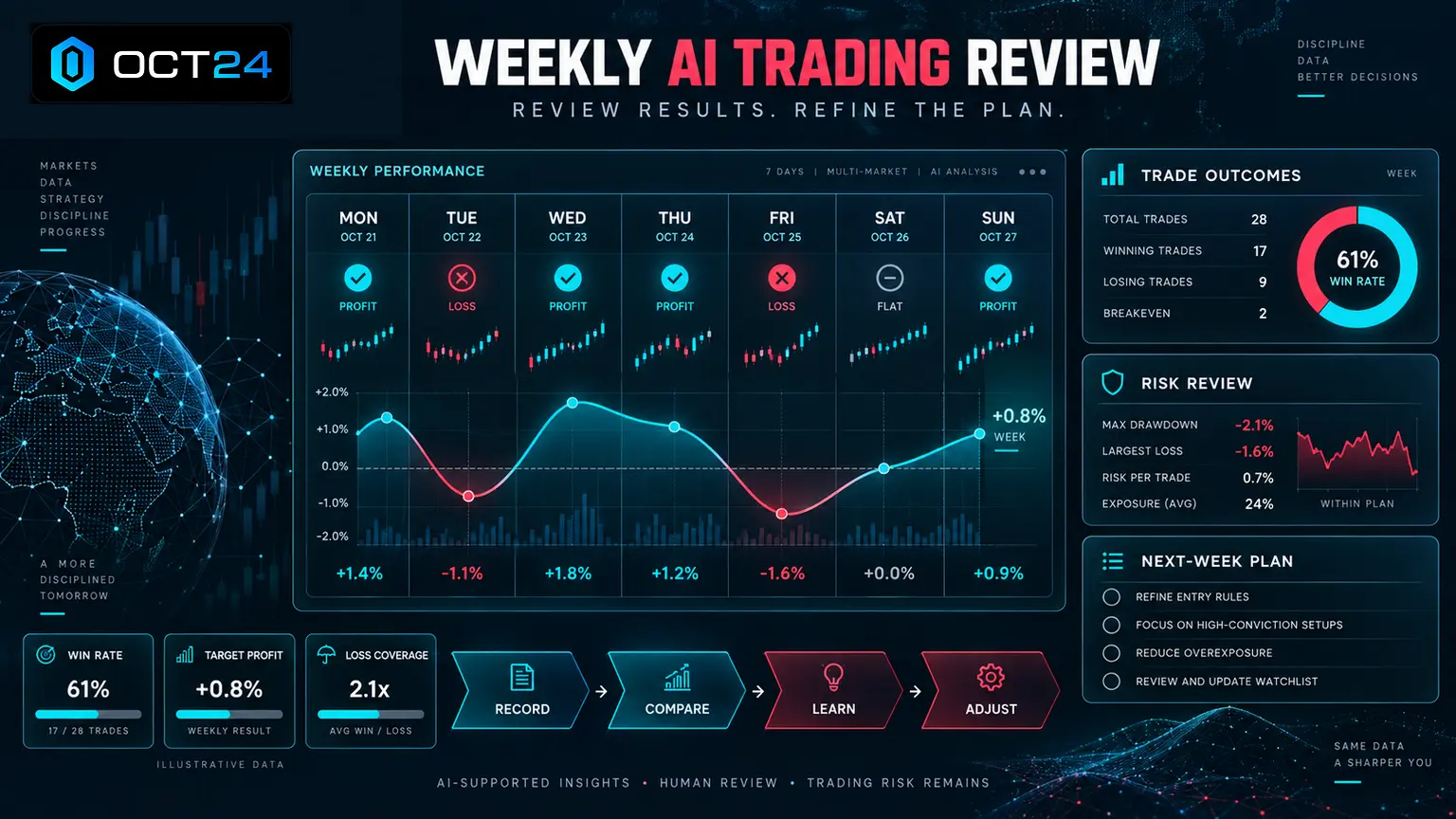
A consistent trading routine helps traders slow down at the right moments. It creates a repeatable process for checking the market, reviewing signals, managing risk, and learning from results.
Future traders may need routines that include:
- Morning market review
- Signal review checklist
- Risk and exposure check
- Execution rules
- Trade journal notes
- Weekly performance review
- Rules for pausing after losses
- Rules for reducing size during volatility
OCT24 can support this kind of routine by handling much of the market scanning and signal discovery. The trader can then focus on the human parts of trading: discipline, risk, and decision quality.
What Traders Should Prepare for Next
The future of AI trading will reward traders who know how to use AI without becoming dependent on it.
That means traders should prepare in practical ways.
Important skills include:
- Understanding basic market structure
- Reviewing AI-supported signals with caution
- Managing risk before execution
- Avoiding overtrading
- Keeping a trading routine
- Reviewing performance honestly
- Knowing when to wait
- Choosing tools that support responsible decisions
Beginners should not feel pressured to master everything at once. A good starting point is to understand how AI trading bots work, how AI uses technical analysis, and how risk settings affect every trade.
The future may be more advanced, but the foundation stays simple: analyze the market, review the setup, control risk, and learn from the result.
How OCT24 Fits Into the Future of AI Trading
OCT24 fits into the future of AI trading by helping traders use AI in a practical way. The platform scans market conditions, identifies potential opportunities, and presents AI-supported trading signals.
This gives traders a clearer starting point than manual chart checking alone. It can reduce the time spent searching for setups and help traders focus on reviewing the quality of each opportunity.
At the same time, OCT24 keeps the trader in the decision-making role. The platform does not remove trading risk. It does not guarantee outcomes. It does not replace responsible position sizing or capital management.
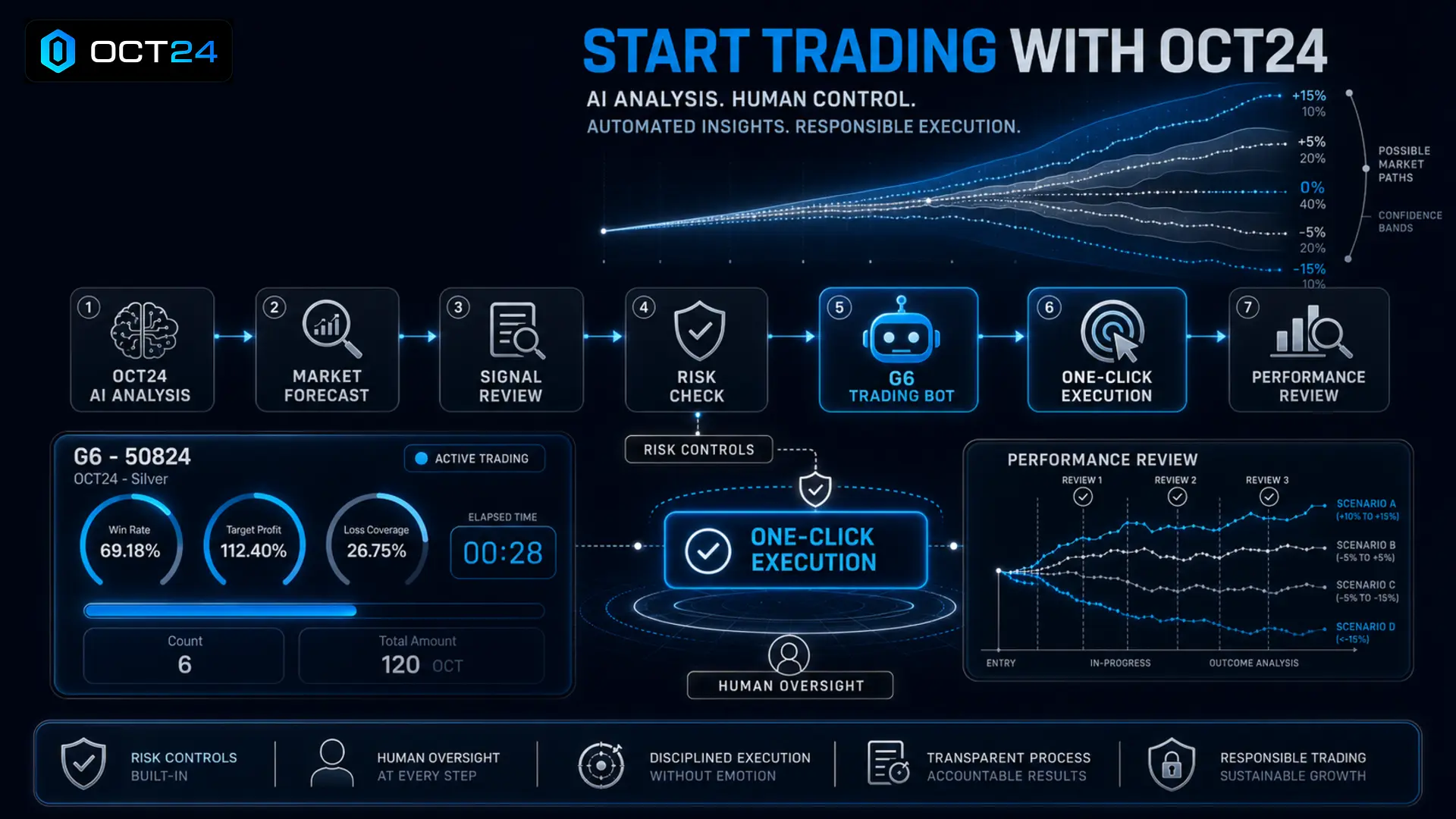
A future-focused OCT24 workflow may include:
- AI market scanning
- Opportunity identification
- AI-supported signal review
- Risk check
- Execution decision
- Performance review
- Routine improvement
That is the practical future: AI does more of the analysis, while traders become more disciplined about how they use that analysis.
A more educated trader can use AI with more confidence because they know what questions to ask before acting.
The future should make trading tools easier to use, but easier access does not remove the need for better judgment. That is why OCT24’s role is best understood as decision support, not a guarantee. It helps organize market analysis and signals so traders can make more informed choices.
Without that foundation, AI can feel more certain than it really is. A polished signal or dashboard can make a setup look safer than it is. Education helps traders remember that every trade still involves uncertainty.
A trader does not need to know how every model works behind the scenes. But they should understand the practical ideas that affect decisions: trend, volatility, risk-reward, exposure, position sizing, and trading psychology.
As AI trading grows, education will become more important, not less important. Traders who understand the basics will be better able to use AI tools carefully.
Why Education Will Still Matter
OCT24 can help with the analysis side of that process. It can scan markets, identify potential opportunities, and present signals. But the trader still needs to choose how much risk to take, whether to execute, and how to review the result.
The best traders may not be the ones who use the most advanced tools. They may be the ones who use advanced tools inside a simple, responsible process.
- A consistent routine instead of random activity
- Performance review after trades
- Human responsibility for final decisions
- Awareness of volatility and market conditions
- Signal review before action
- Position sizing that matches account size
- Clear risk limits before execution
The future of AI trading should still include:
These basics may sound simple, but they become even more important when tools become faster.
Traders should still understand what they are trading. They should still define risk before entering. They should still avoid oversized positions. They should still review results honestly. They should still know when not to trade.
Even as AI trading becomes more advanced, some trading principles should not change. Technology may improve, but discipline still matters.
What Should Not Change in the Future
OCT24 supports that practical approach by scanning market conditions and presenting AI-supported trading signals. The trader can then focus on the decision: does this setup fit my plan, my risk limits, and my current exposure?
Everyday traders should expect the future to reward patience, not constant activity. The trader who waits for clear signals, checks risk, and reviews performance may be better prepared than the trader who reacts to every alert.
That can make trading more practical for people who have jobs, families, or limited time. But it also creates a new responsibility. If AI makes opportunities easier to see, traders need stronger rules for deciding which opportunities to ignore.
For many traders, the biggest benefit will be better focus. AI can help reduce the amount of time spent searching through noisy markets. Instead of trying to manually inspect every asset, traders may start with a smaller set of AI-supported opportunities and then review each one carefully.
The future of AI trading should not only matter to professional traders or large institutions. It also matters to everyday traders who want a clearer way to understand markets without spending every hour watching charts.
What the Future Means for Everyday Traders
FAQs
What is the future of AI trading?
The future of AI trading is likely to include faster market scanning, more AI-supported signals, more personalized workflows, and stronger risk controls. Traders will still need to manage risk and make responsible decisions.
Will AI replace human traders?
AI may replace some manual tasks, but human judgment will still matter. Traders need to choose risk settings, manage exposure, review signals, and decide whether a trade fits their plan.
Will AI trading become fully automatic?
Some tools may become more automated, but full automation still requires oversight. Traders should understand settings, risk limits, and when to pause or avoid trading.
Can AI predict the market perfectly?
No. AI can analyze data and identify possible opportunities, but it cannot predict the market with certainty or remove trading risk.
How does OCT24 support the future of AI trading?
OCT24 scans market conditions, identifies potential opportunities, and presents AI-supported trading signals. Traders still remain responsible for risk settings, exposure, capital allocation, and execution decisions.
What should beginners focus on first?
Beginners should focus on understanding signals, risk management, position sizing, market conditions, and trading routines before using more advanced execution tools.
Will AI trading be safer in the future?
AI tools may become better at identifying risks, but trading will still involve uncertainty. Safety depends on responsible settings, oversight, position sizing, and trader discipline.
How can traders prepare for AI-driven markets?
Traders can prepare by learning how AI-supported signals work, building a consistent routine, managing risk carefully, and choosing platforms that support clear decision-making.
Final Thoughts
The future of AI trading is not about removing the trader. It is about giving traders better analysis, faster scanning, and more structured decision support.
AI can help traders understand market conditions, identify potential opportunities, and review signals more efficiently. But the most important trading responsibilities remain human: risk control, exposure management, capital allocation, and execution choices.
OCT24 is designed for this balance. It performs much of the market analysis and presents AI-supported trading signals, while the trader remains responsible for making informed decisions.
The traders who benefit most from the future of AI trading will likely be the ones who use AI with discipline. They will not treat AI as a guarantee. They will use it as a tool for clearer analysis, better routines, and more responsible trading decisions. To learn more about the platform, visit About OCT24. To explore AI-supported trading, Start Trading with OCT24.