
AI Trading for Busy Professionals
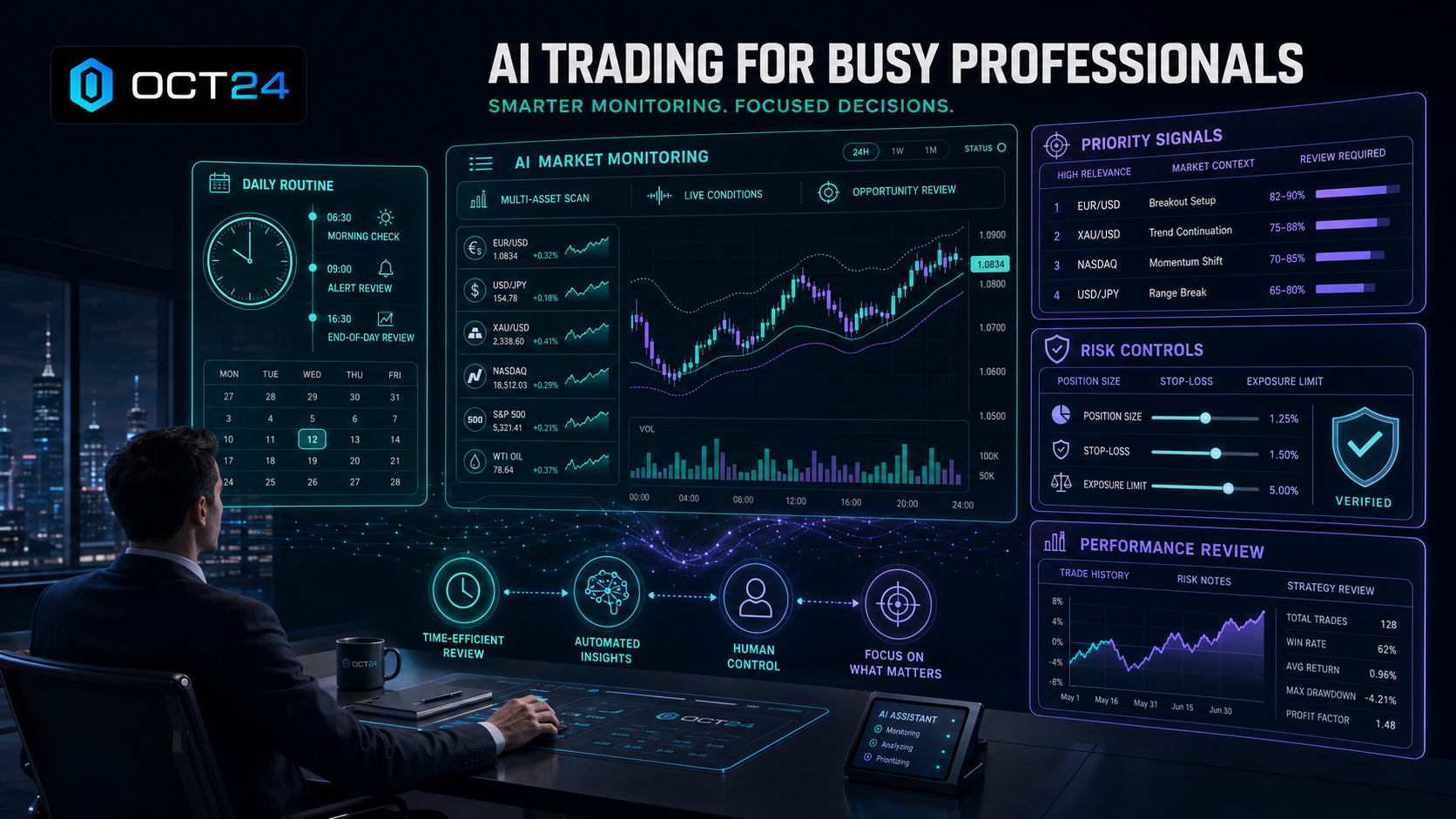
AI Trading for Busy Professionals is about using technology to reduce the time spent scanning markets, reviewing charts, and searching for possible trading setups.
Active trading can be difficult when you have a full-time job, run a business, travel regularly, or have family responsibilities. Markets do not wait until your schedule is clear.
A strong price move may happen during a meeting. A signal may appear while you are commuting. Volatility may increase when you are focused on something else.
This does not mean busy professionals need to watch charts all day.
AI can scan multiple markets, compare changing conditions, identify potential opportunities, and organize information into clearer signals. This can reduce much of the manual work involved in AI Trading.
OCT24 performs most of the market analysis by scanning market conditions, identifying potential opportunities, and presenting AI-supported trading signals in a structured workflow.
This can help busy traders review the market more efficiently.
However, saving time does not remove risk. Traders still need to choose suitable risk settings, understand their exposure, manage capital responsibly, and decide whether an opportunity fits their plan.
AI can make the process more efficient. The trader remains responsible for the decision.
Why Traditional Trading Is Difficult for Busy Professionals
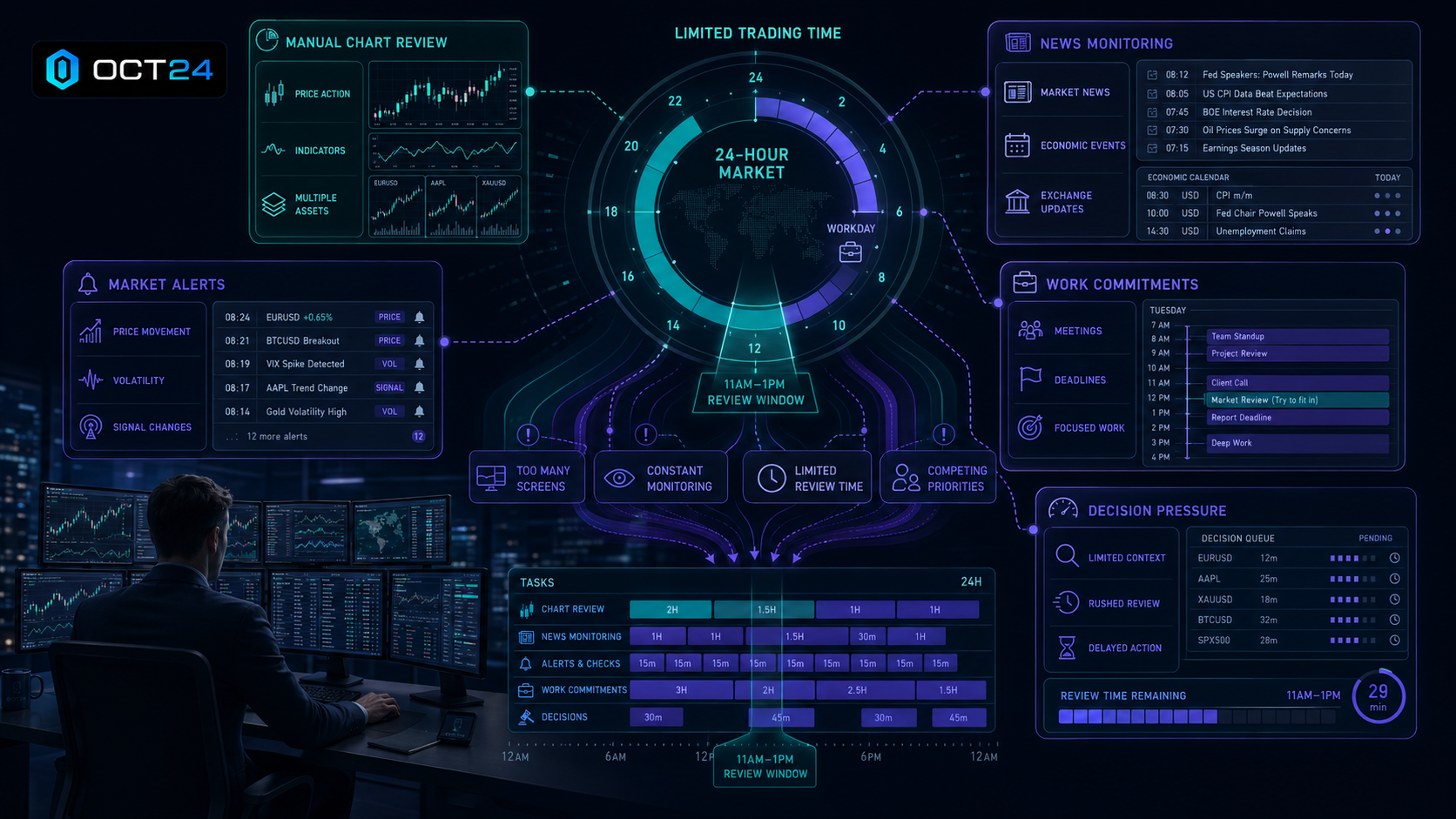
Traditional active trading can demand a lot of attention.
A trader may need to watch several charts, compare indicators, follow market news, check Market Volatility, and wait for the right setup. Doing this manually can take hours.
Busy professionals often do not have that time.
They may check the market between meetings, during lunch, or late in the evening. This can create an inconsistent routine.
Limited time can lead to several problems:
- Checking charts too often during work
- Missing potential setups
- Entering after a price move has already happened
- Making rushed decisions
- Following signals without enough review
- Trading because of FOMO
- Using too much leverage to chase faster results
- Forgetting to review earlier trades
- Switching between too many strategies
Imagine a project manager who checks Bitcoin during a busy afternoon.
The price has already moved sharply. Social media is full of excitement, and the trader feels pressure to enter immediately.
Because there is no time for a full review, they enter late and use a larger position than planned. The market then reverses.
The problem was not simply a lack of time. The problem was acting without a clear process.
These are Common AI Trading Mistakes. FOMO, rushed entries, overtrading, and weak risk controls can become more likely when trading is squeezed between other responsibilities.
A Consistent Trading Routine can help. Instead of checking charts randomly, the trader can choose specific times to review markets, signals, risk, and performance.
Trading more often is not the same as trading more effectively.
For busy professionals, a smaller number of well-reviewed decisions may be more manageable than constant market activity.
How AI Trading Saves Time
AI trading can save time by scanning markets, comparing data, identifying potential opportunities, organizing trading signals, and monitoring changing conditions faster than manual chart review.
This is one of the most practical Benefits of AI Trading.
A human trader may open one chart at a time. They may switch between timeframes, indicators, and assets while trying to remember what they saw earlier.
AI can review more information at once.
It may help reduce the time spent on:
- Scanning markets
- Switching between charts
- Comparing indicators
- Reviewing momentum
- Monitoring volatility
- Finding unusual price movement
- Organizing signals
- Repeating basic calculations
- Tracking performance information
This connects naturally to How AI Identifies Trading Opportunities.
AI can review price movement, volume, momentum, volatility, trend direction, and technical conditions across active markets. When several conditions align, it may identify a possible setup.
OCT24 performs most of this analysis for the user.
Instead of manually searching through every market, a busy professional can review the potential opportunities and AI-supported signals presented by OCT24.
This does not mean every signal should become a trade.
The time saved during analysis should be used for better review, not faster impulsive decisions.
AI helps reduce manual work. It does not guarantee better results.
What AI Can Handle—and What the Trader Must Still Decide
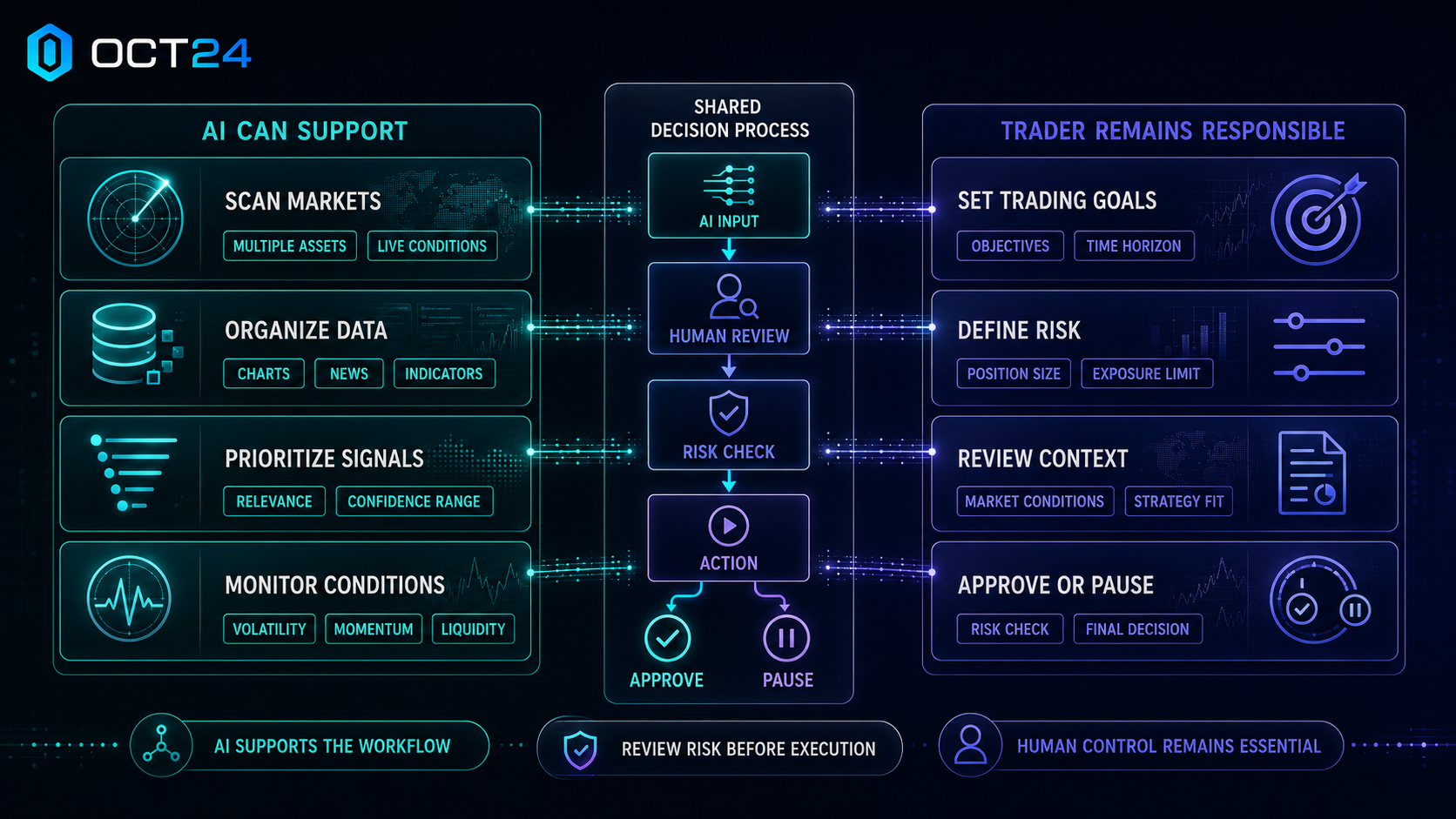
AI and traders have different responsibilities.
Understanding this difference helps busy professionals use AI without giving up control.
What AI and OCT24 Can Support
- Scanning active markets
- Reviewing changing market conditions
- Comparing price, volume, momentum, and volatility
- Identifying potential opportunities
- Organizing AI-supported signals
- Reducing manual chart review
- Monitoring several assets
- Supporting faster execution
- Collecting information for performance review
What the Trader Must Still Decide
- Which strategy to use
- How much capital to allocate
- How much to risk on one trade
- Whether leverage is appropriate
- Whether the signal fits the strategy
- What position size is suitable
- Where the stop-loss should be placed
- Whether total exposure is too high
- Whether to execute the trade
- When trading should stop
This is why AI Trading vs Manual Trading is not simply a choice between technology and human control.
AI is stronger at speed, scanning, and repeated analysis. Humans remain responsible for judgment, risk tolerance, capital decisions, and final accountability.
The same principle applies to Trading Bots vs Human Traders.
A bot can monitor markets and follow rules without becoming tired or distracted. The trader still needs to choose those rules and decide whether they remain suitable.
OCT24 performs most of the analysis while supporting trader control.
The platform can organize the opportunity. The trader decides how much risk is acceptable and whether execution makes sense.
A Time-Efficient Trading Routine for Busy Professionals
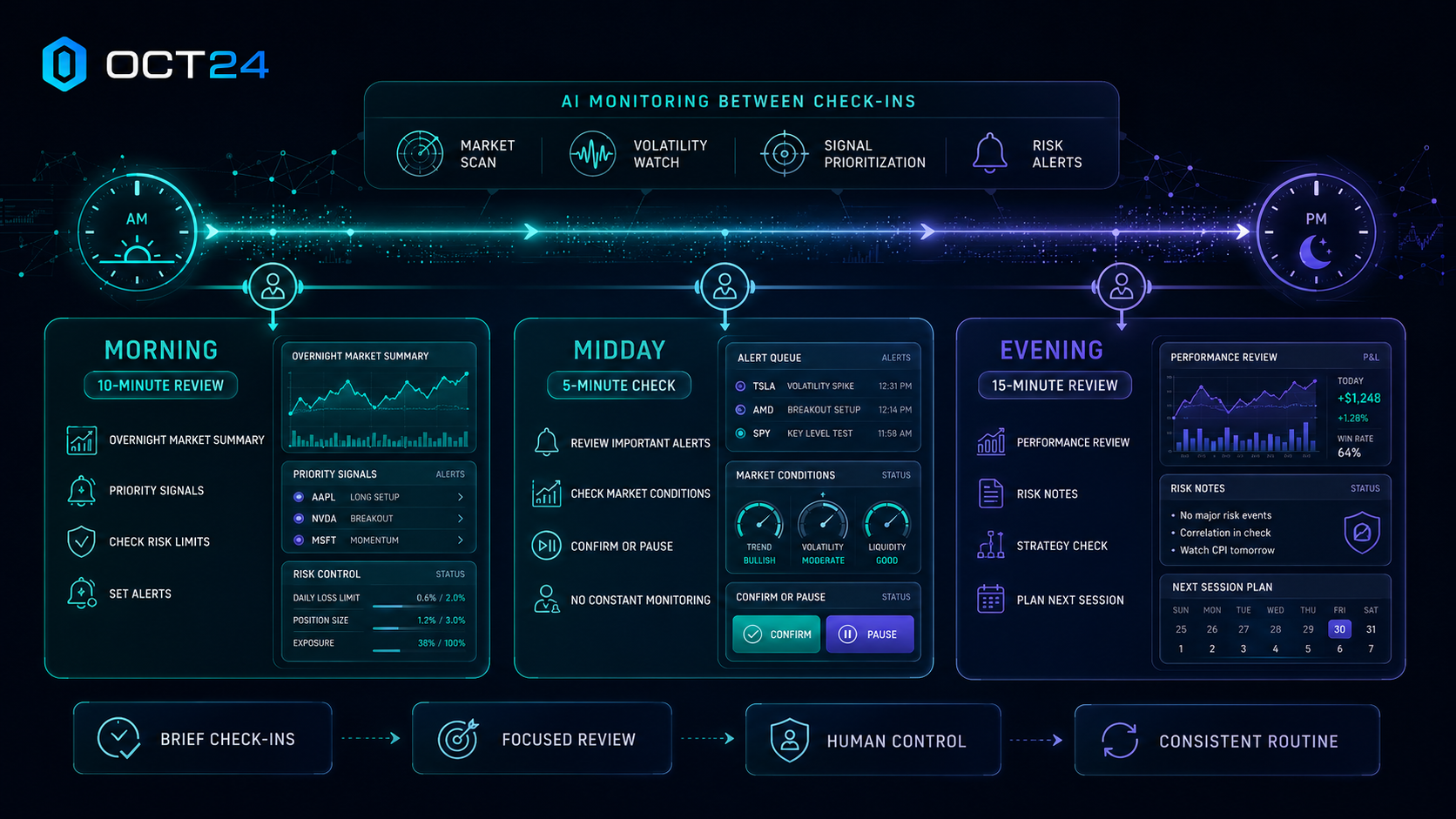
A simple routine can help busy traders avoid checking markets constantly.
The following schedule is an example. It should be adjusted to the trader’s strategy, market, time zone, and availability.
Morning Market Review: 10–15 Minutes
Start by reviewing what happened while you were away from the market.
Check:
- Major overnight price movement
- Changes in market momentum
- Unusual volatility
- Important scheduled news or events
- Current open positions
- Total exposure
- New potential opportunities on OCT24
- AI-supported trading signals that require review
The goal is not to predict the entire day.
The goal is to understand the current conditions and decide which markets deserve attention.
If a major event is expected, the trader may choose smaller positions, stricter limits, or no new trades until conditions become clearer.
Midday Signal Check: 5–10 Minutes
Use a scheduled break to check whether market conditions have changed.
Review new signals, but do not assume that every notification requires action.
Ask whether the setup still fits the strategy. Check the trend, volatility, position size, stop-loss, and current exposure.
If the opportunity requires more attention than you can give it, waiting may be the better choice.
A missed trade is not the same as a trading loss.
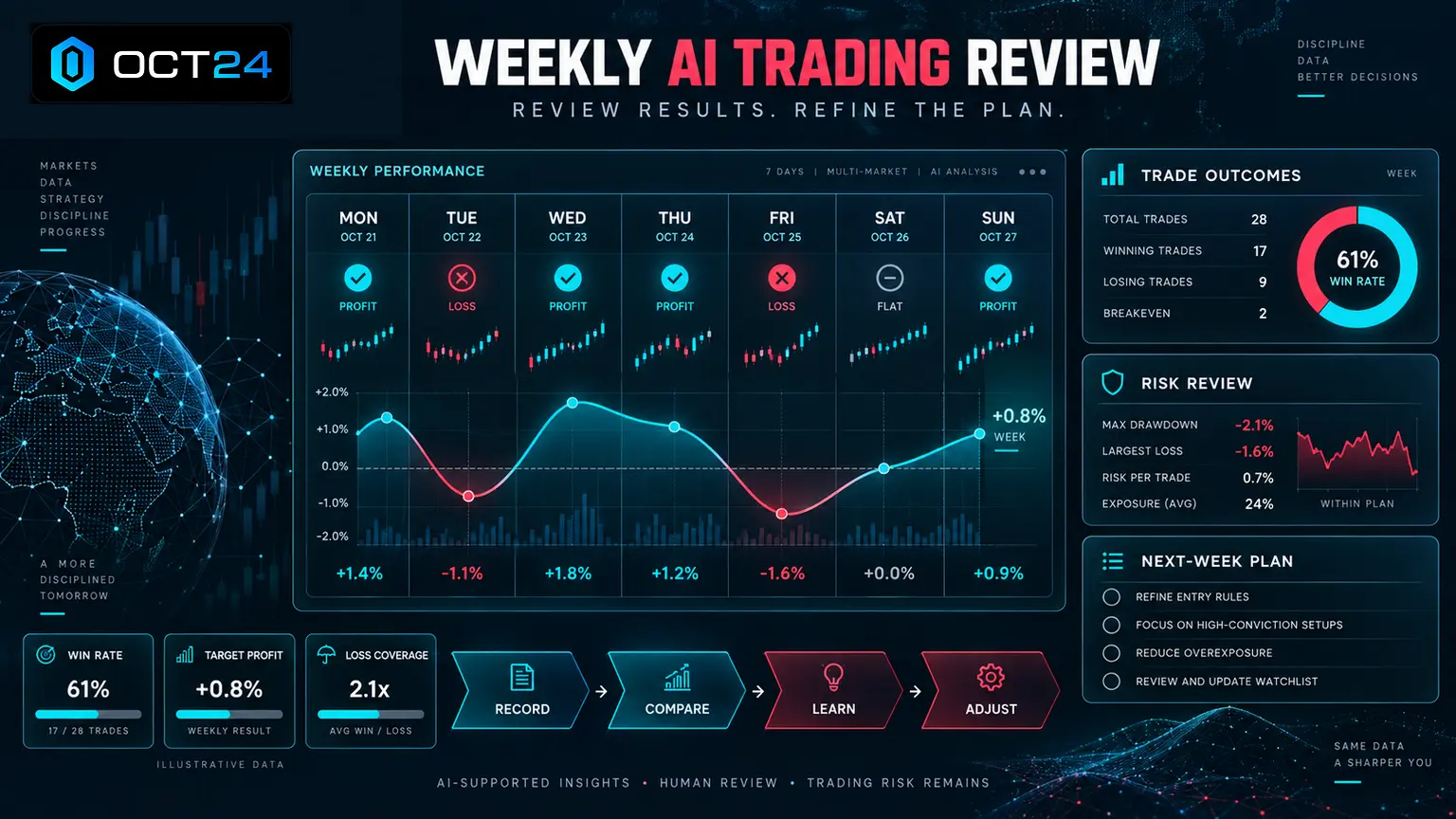
Evening Performance Review: 10–15 Minutes
Review open and closed positions after the working day.
Check whether risk rules were followed. Note any emotional decisions, missed checks, or changes in market conditions.
Do not judge the entire strategy from one winning or losing trade.
Review:
- Entry quality
- Exit quality
- Position size
- Stop-loss use
- Fees and slippage
- Total exposure
- Whether the trade followed the plan
- Whether the signal was reviewed properly
Prepare the risk limits and priorities for the next session.
The routine should match the trader’s AI Trading Strategies. A swing trader may need fewer checks than a short-term trader using a faster approach.
The purpose is consistency, not constant activity.
How to Review AI Trading Signals Quickly but Responsibly
Busy traders need an efficient review process.
They do not need to study every market for hours, but they should not follow signals blindly.
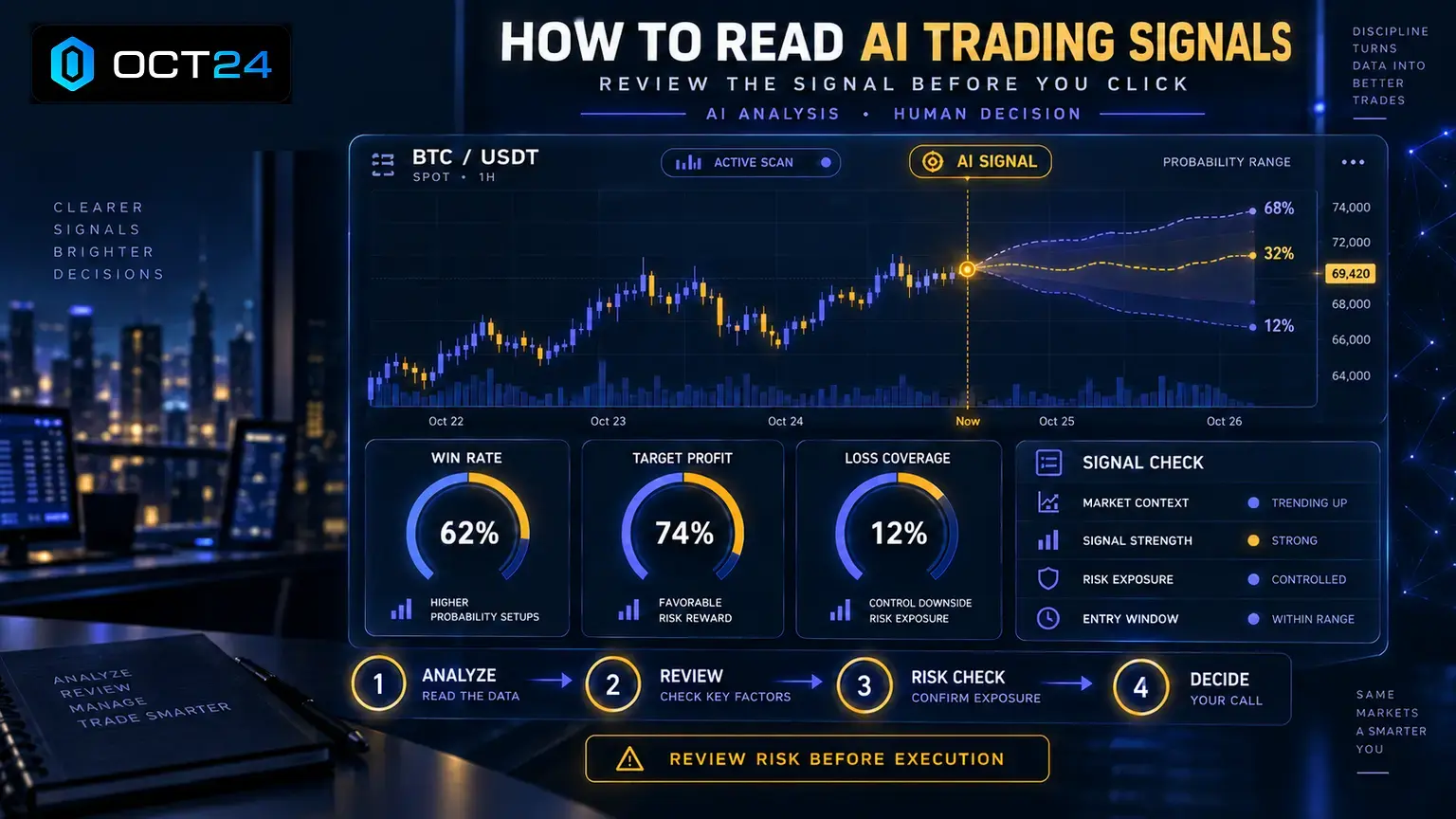
AI Trading Signals are decision support. They organize market information and highlight a possible opportunity.
They are not automatic instructions or guaranteed predictions.
Before acting on a signal, ask:
- What market is involved?
- What is the current trend?
- Is volume supporting the move?
- Is volatility unusually high?
- Does the signal fit my strategy?
- What is the possible upside?
- What is the possible downside?
- Where is the stop-loss?
- What position size is appropriate?
- How much exposure is already open?
- Am I following the plan or reacting to FOMO?
This checklist can be completed quickly when the trader already has clear rules.
OCT24 helps by organizing market conditions, potential opportunities, and AI-supported signals into a more structured workflow.
The trader can focus on reviewing the opportunity instead of manually finding it.
If the signal does not fit the plan, the trader can wait.
The purpose of AI is to make good review more efficient, not to remove review completely.
Using Trading Bots Without Losing Control
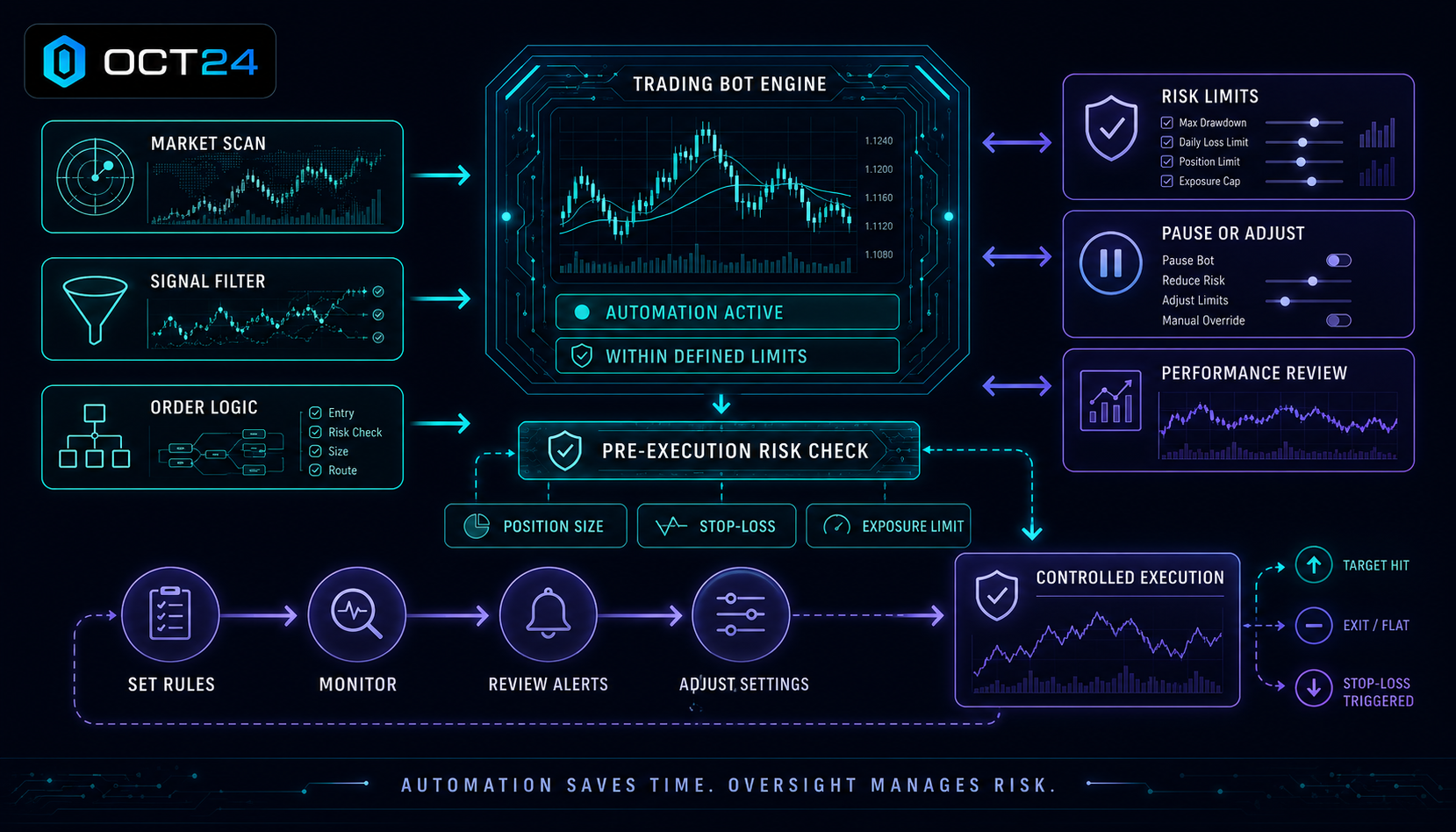
AI Trading Bots can be useful for professionals who cannot monitor markets continuously.
Bots can follow set rules, monitor several assets, and react faster than a person who is busy with other work.
This can reduce repetitive tasks.
However, bots do not understand a trader’s personal risk tolerance, financial situation, or changing schedule.
Poor settings can still create losses.
In Automated Trading, the system follows the rules it has been given. If trade-frequency limits are weak, the bot may trade too often. If position sizes are too large, the account may become overexposed quickly.
Market conditions also change.
A strategy that works during a clear trend may struggle when the market becomes choppy or unusually volatile.
This is why Trading Bot Risk Management matters.
Busy professionals should review:
- Position limits
- Stop-loss settings
- Drawdown controls
- Leverage
- Trade frequency
- Total exposure
- Recent performance
- Conditions that should pause the bot
The question Are Trading Bots Worth It? depends on how responsibly they are used.
Bots can improve monitoring and consistency. They cannot make poor settings safe.
The G6 Trading Bot can support automation within the OCT24 workflow. OCT24 performs most of the market analysis, while the trader remains responsible for settings, capital allocation, risk, and execution choices.
Automation should support discipline. It should not become a “set and forget” approach.
Risk Management for Time-Limited Traders
Clear risk rules become even more important when a trader cannot watch a position constantly.
The trade should not depend on the trader checking the market every few minutes.
Busy professionals should pay close attention to:
- Position sizing
- Stop-loss placement
- Drawdown limits
- Leverage control
- Trade-frequency limits
- Exposure limits
- Risk-to-reward
- Portfolio concentration
- Performance review
Position Sizing Controls help traders decide how much capital to allocate to a trade.
For example, a busy professional may identify a possible setup before starting work.
Instead of using a large position that requires constant attention, the trader chooses a smaller position and sets a clear stop-loss based on the strategy.
The smaller position does not remove risk. It may make the possible loss more manageable if the market moves against the trade while the trader is unavailable.
Portfolio Diversification Tools can also help traders understand whether too much capital depends on one asset, one market direction, or one trading idea.
Several crypto positions may appear different but still move together when the wider market falls.
Risk Management Strategies should be chosen before execution.
Traders should know:
- How much they can lose on one trade
- How much total exposure is acceptable
- When the setup is no longer valid
- When to stop opening new trades
- How leverage changes the possible loss
Limited time is not a reason to increase risk.
It is a reason to make risk rules clearer.
How One-Click Trading Fits a Busy Workflow
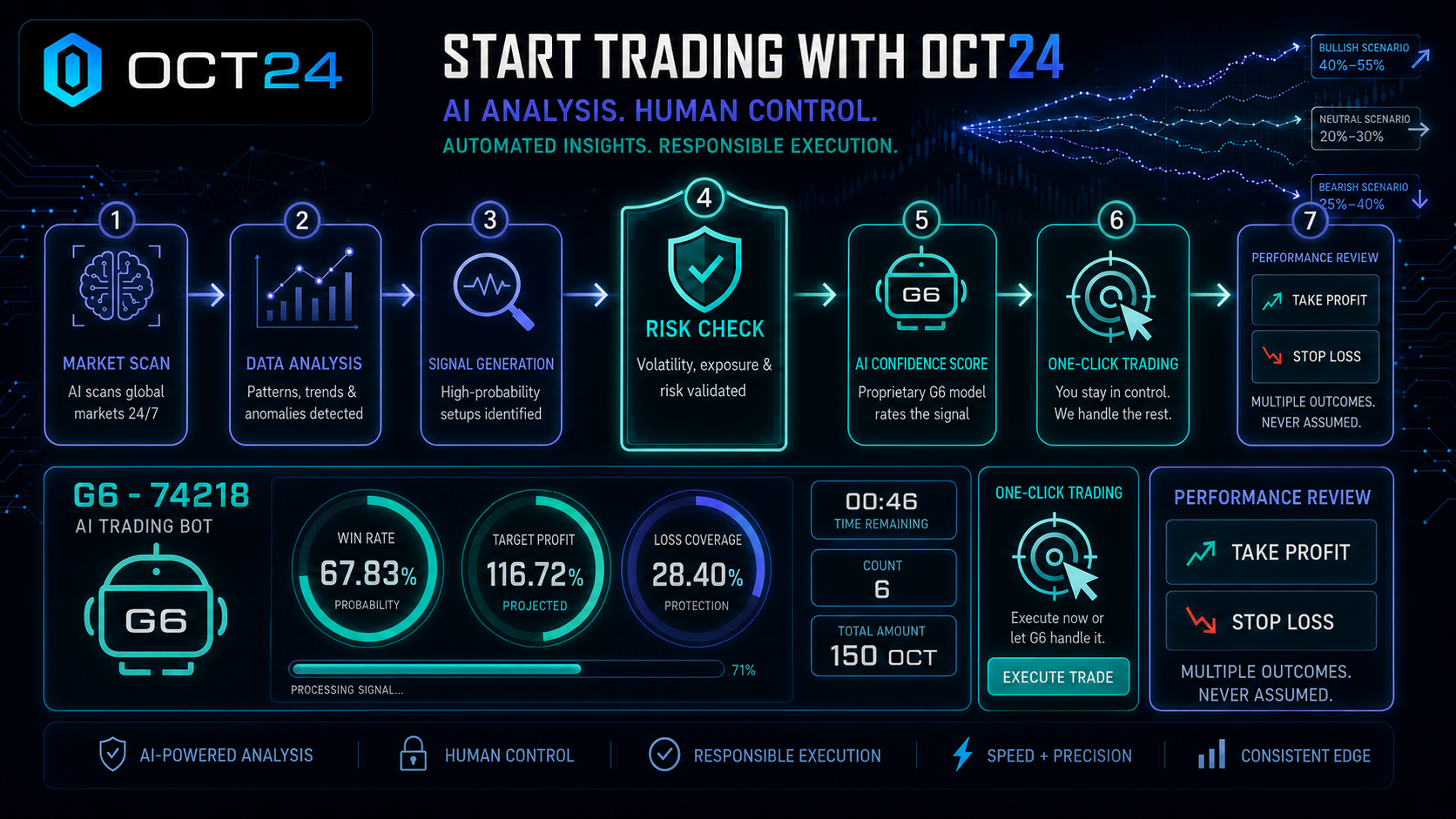
One-Click Trading can reduce the time between a completed review and execution.
This may be useful when a professional has only a short window to act.
However, one-click execution should come near the end of the process—not at the beginning.
The workflow should be:
- Market analysis
- Signal review
- Strategy check
- Position sizing
- Exposure review
- Risk check
- Execution decision
OCT24 can perform most of the market analysis and present the potential opportunity.
The trader then reviews the signal, settings, and exposure.
If the setup fits the plan, one-click execution can make the final action more efficient.
If the setup does not fit the plan, speed does not make it better.
One-click trading saves time. It does not replace thinking.
Common Mistakes Busy Professionals Should Avoid
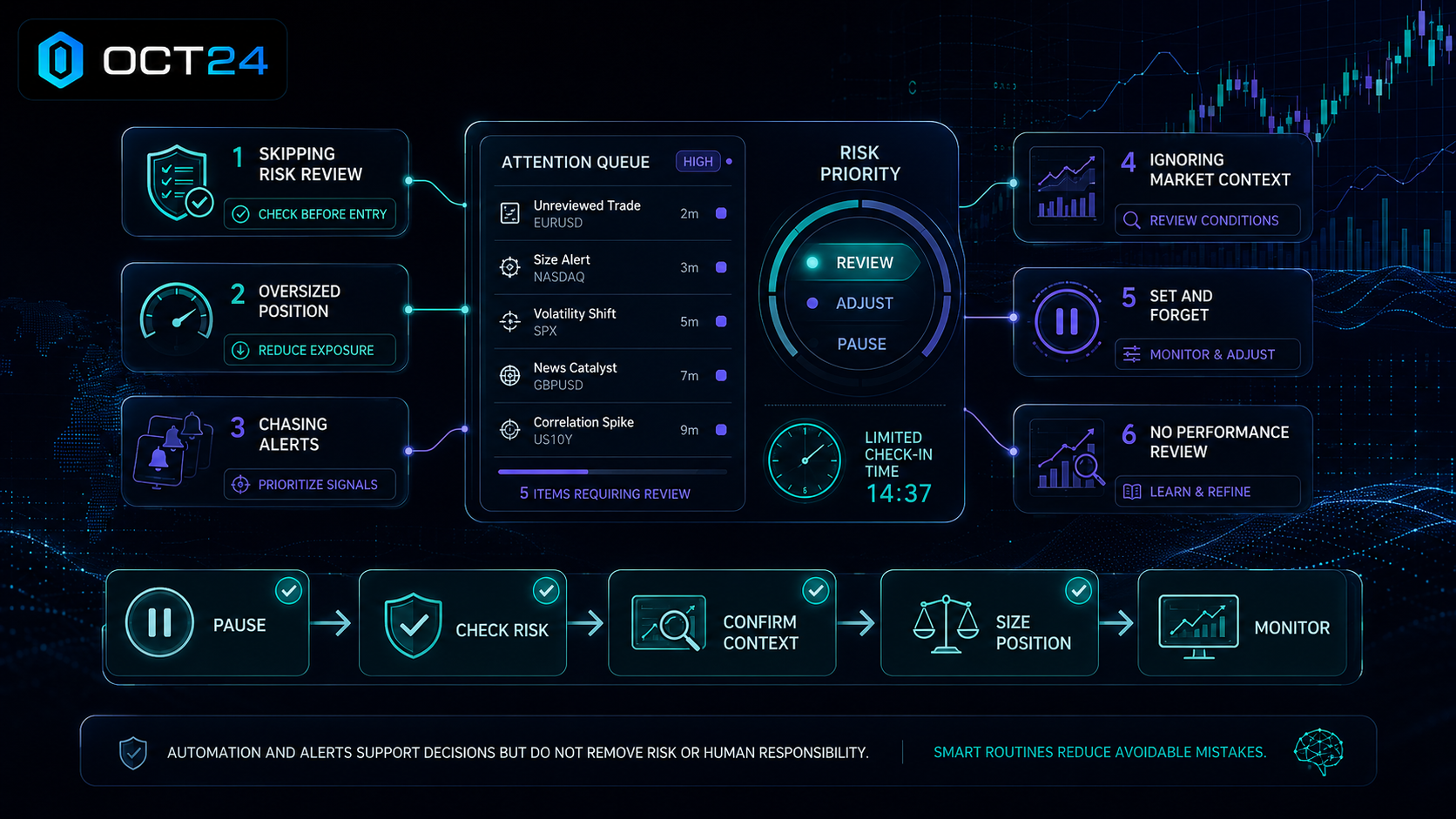
Busy schedules can create pressure to make quick decisions.
The following mistakes can make trading harder:
Checking Charts Constantly During Work
Frequent checking can reduce focus without improving the quality of the decision.
Use planned review times unless the strategy genuinely requires closer monitoring.
Trading Every Alert
An alert is information, not an instruction.
Review whether the signal fits the strategy and risk plan.
Increasing Leverage to Chase Faster Results
Leverage magnifies losses as well as gains.
Limited trading time does not make higher leverage safer.
Entering Late Because of FOMO
If a move has already happened, entering late may create a poor balance between risk and possible reward.
Missing one trade is better than forcing an unsuitable entry.
Using Too Many Strategies
Several strategies can create conflicting signals and make reviews more complicated.
Busy traders often benefit from a smaller number of clear rules.
Running Bots Without Reviewing Settings
Automation still needs oversight.
Review performance, limits, exposure, and changing market conditions regularly.
Ignoring Total Exposure
Several small positions can combine into one large risk.
Check the total account exposure before opening another trade.
Changing Settings After Every Loss
Every strategy can have losing trades.
Review a meaningful group of results instead of reacting emotionally to one outcome.
Treating AI as a Guaranteed System
AI Trading Myths can create unrealistic expectations about profit, prediction, and automation.
AI can support better analysis. It cannot guarantee the result.
How to Choose an AI Trading Platform for a Busy Schedule
The right platform should make the workflow clearer and more manageable.
Busy professionals should look for:
- A clear dashboard
- Fast market scanning
- Simple signal presentation
- Easy-to-review risk settings
- Multi-asset monitoring
- A reliable execution process
- Performance history
- Clear limitations
- Remote or mobile access where available
- Useful information without excessive alerts
Good AI Trading Software should reduce unnecessary manual work without hiding important risk information.
This is why Choosing the Right AI Trading Platform matters.
The platform with the most features is not always the best choice.
A complicated dashboard may slow the trader down. Too many alerts may create more noise instead of better decisions.
The best platform is one that supports a clear, repeatable, and risk-aware process.
Traders should understand what the platform analyzes, what the signals mean, and which decisions remain their responsibility.
How OCT24 Supports Busy Professionals
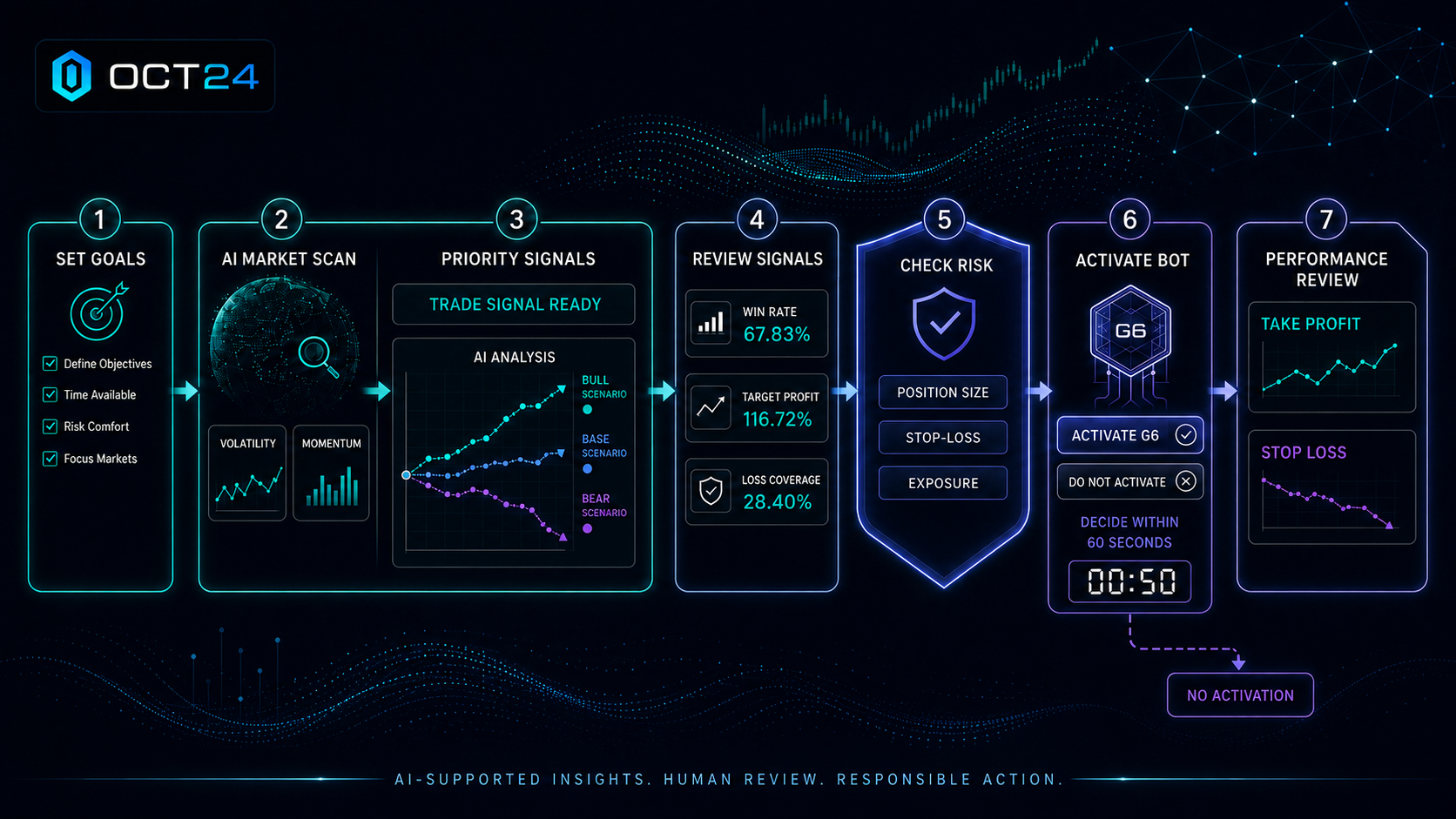
OCT24 is designed to reduce the manual workload involved in active trading.
The platform performs most of the market analysis by:
- Scanning market conditions
- Identifying potential trading opportunities
- Reviewing market momentum
- Monitoring volatility
- Reviewing technical signals
- Presenting AI-supported trading signals
- Supporting faster execution
- Helping traders review performance over time
This can help busy professionals spend less time switching between charts.
Instead of manually searching for every setup, traders can review potential opportunities that OCT24 has identified and organized.
OCT24 can help traders:
- Reduce manual market scanning
- Review opportunities more efficiently
- Follow a more consistent routine
- Check risk before execution
- Use automation more thoughtfully
- Support one-click execution after review
- Avoid reacting to every market movement
- Build a more disciplined process
The G6 Trading Bot can support automation within this workflow.
However, OCT24 does not guarantee results.
Traders still need to choose suitable settings, understand exposure, manage capital responsibly, review signals, and decide whether a trade fits their plan.
OCT24 performs most of the analysis. The trader remains responsible for risk and execution.
Readers who want to understand the platform’s wider approach can visit About OCT24.
Practical Example: A Busy Professional Using OCT24
Imagine a marketing manager who has only three short periods available for trading each day.
Before work, the trader completes a 10-minute market review.
They check overnight price movement, current exposure, scheduled market events, and potential opportunities presented by OCT24.
During the working day, OCT24 continues scanning active market conditions.
The platform identifies a possible opportunity and presents an AI-supported signal.
The trader does not leave a meeting to chase the signal.
During a scheduled break, they review the trend, momentum, volatility, position size, stop-loss, leverage, and total exposure.
They ask whether the setup fits the chosen strategy.
If the risk is acceptable and the opportunity still makes sense, the trader may use one-click execution.
If the signal no longer fits the plan, they do not trade.
In the evening, the trader reviews the decision and checks whether the risk rules were followed.
This workflow does not require constant chart monitoring.
OCT24 performs most of the analysis and organizes the potential opportunity. The trader remains responsible for capital, risk, and execution.
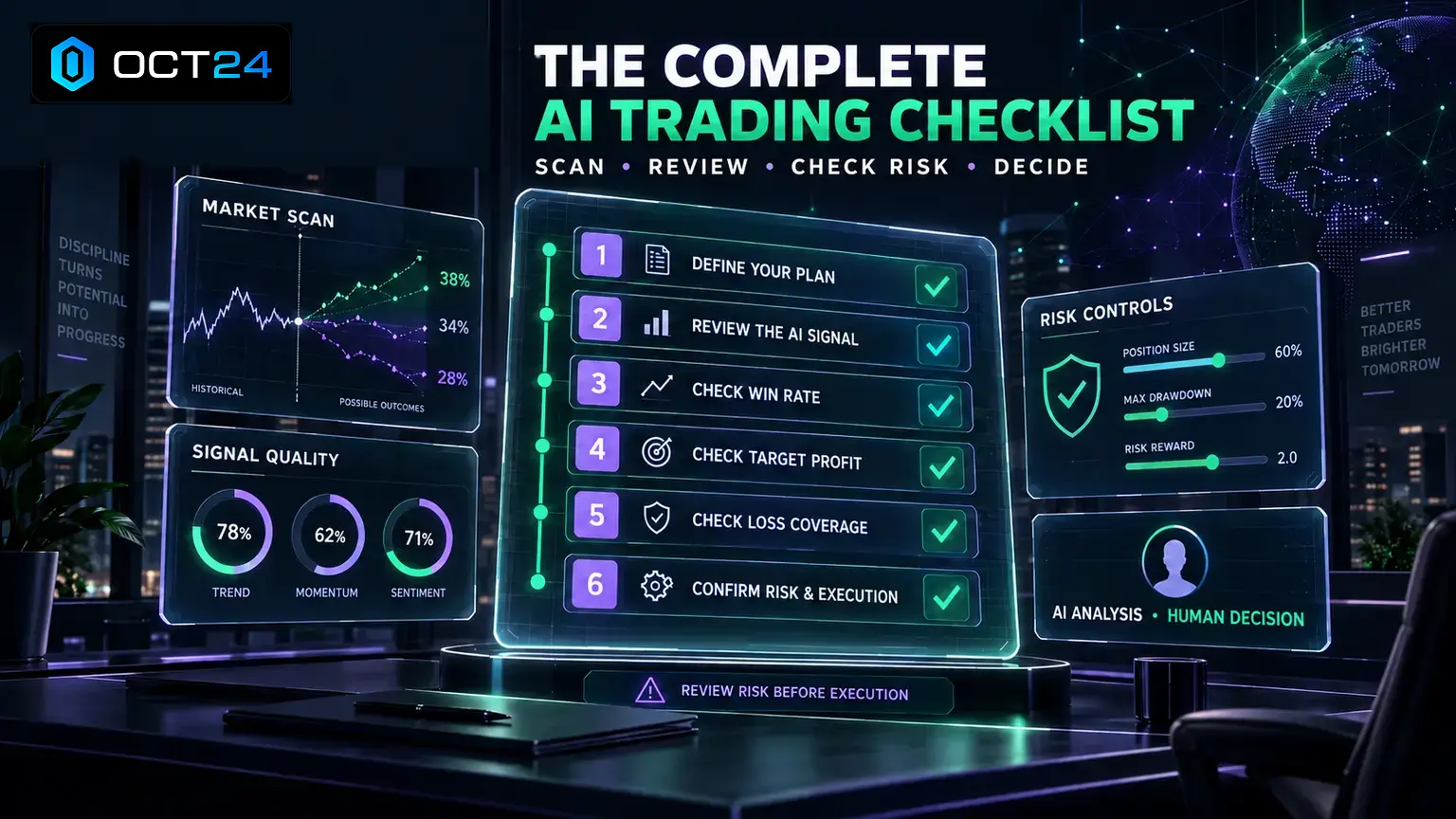
AI Trading for Busy Professionals Checklist
Before trading, ask:
- Do I have a defined strategy?
- Have I set a daily trading schedule?
- Am I reviewing signals at planned times?
- Does this signal fit my strategy?
- Is my position size appropriate?
- Is my stop-loss clear?
- Is leverage controlled?
- Do I understand my total exposure?
- Am I following the plan or reacting to FOMO?
- Can I monitor this position appropriately?
- Have I reviewed recent performance?
- Do I know when to stop trading?
A checklist cannot remove risk.
It can help a busy trader avoid rushed decisions.
Frequently Asked Questions
What is AI Trading for Busy Professionals?
AI Trading for Busy Professionals uses AI-supported tools to reduce manual market scanning, organize potential opportunities, and make trading reviews more time-efficient.
Can AI trading save time?
Yes. AI can scan markets, compare changing data, identify potential opportunities, and organize signals faster than manual chart review.
Do busy professionals need to watch charts all day?
Not always. The required monitoring depends on the strategy. Many traders can use scheduled reviews, alerts, risk limits, and AI-supported analysis instead of checking constantly.
Can OCT24 perform market analysis automatically?
OCT24 performs most of the market analysis by scanning conditions, identifying potential opportunities, and presenting AI-supported signals. The trader still controls risk and execution decisions.
Should traders execute every AI trading signal?
No. A signal is decision support. Traders should check strategy fit, market conditions, risk, position size, stop-loss, and exposure before execution.
Are AI trading bots suitable for busy professionals?
They may be useful for monitoring and repeated tasks. However, bots still need suitable settings, risk limits, oversight, and performance review.
How much time should a busy trader spend reviewing markets?
There is no fixed amount. It depends on the strategy and market. A simple routine might include short morning, midday, and evening reviews.
Does one-click trading remove the need for signal review?
No. One-click execution should come after market analysis, signal review, position sizing, exposure checks, and a risk decision.
What risk controls are most important for busy traders?
Important controls include position sizing, stop-losses, leverage limits, total exposure, drawdown limits, trade-frequency limits, and regular performance review.
Can AI trading guarantee profits?
No. AI can support faster analysis and more consistent workflows, but markets remain uncertain and every trade can lose.
How does the G6 Trading Bot support busy professionals?
The G6 Trading Bot can support automation within OCT24’s structured workflow. Traders still remain responsible for settings, exposure, capital, and execution decisions.
How does OCT24 help traders build a consistent routine?
OCT24 reduces manual scanning, organizes potential opportunities, presents AI-supported signals, and supports a review-first workflow that can fit planned trading times.
AI Trading for Busy Professionals: Key Takeaways
AI can help busy professionals:
- Reduce manual chart review
- Scan more markets
- Identify potential opportunities
- Organize trading signals
- Monitor changing conditions
- Follow a consistent routine
- Execute more efficiently after review
- Track performance over time
AI does not:
- Guarantee profits
- Remove market risk
- Make every signal reliable
- Replace risk management
- Make poor settings safe
- Remove trader responsibility
OCT24 brings these elements together by performing most of the market analysis while supporting trader control, risk management, and structured execution.
The platform can reduce the time spent searching for opportunities and switching between charts.
The trader still chooses risk settings, manages capital, reviews exposure, and decides whether to execute.
Busy professionals do not need to trade constantly.
They need a clear routine, realistic expectations, and a process they can follow consistently.
To explore a more structured and time-efficient AI-assisted trading workflow, Start Trading with OCT24.