
How AI Helps Identify Strong Market Trends
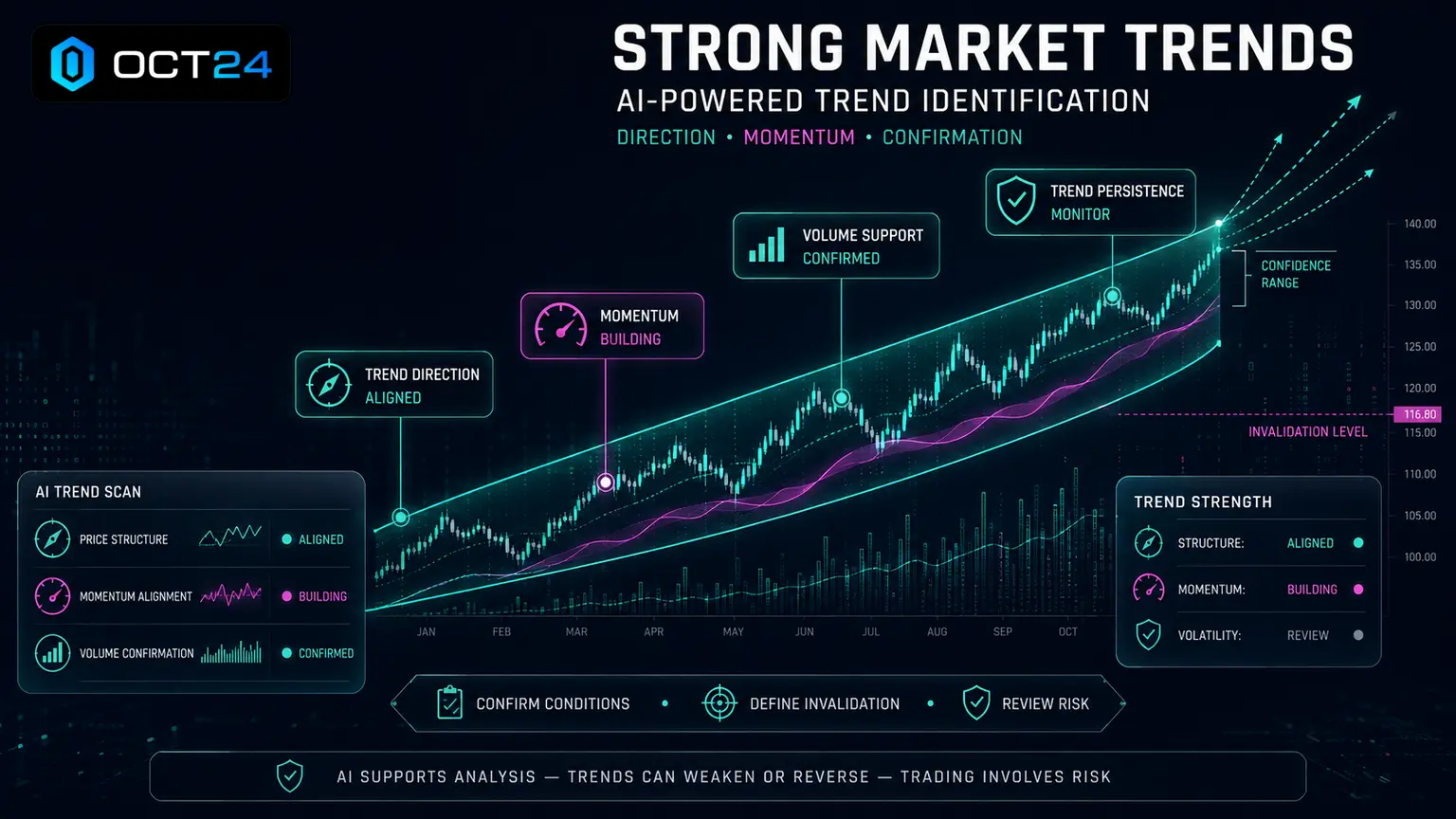
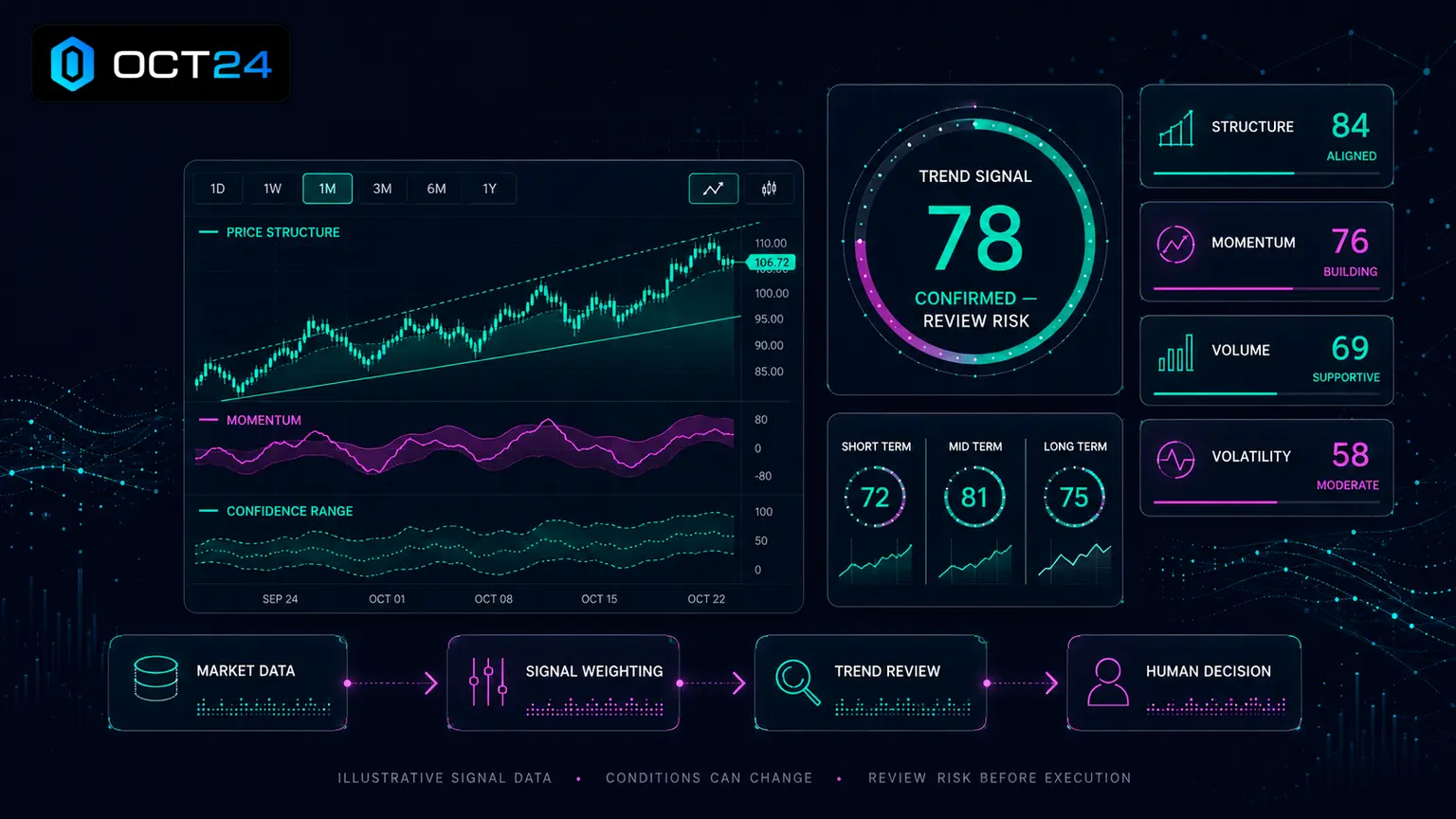
AI market trend identification helps traders understand whether price movement is becoming stronger, weaker, or too noisy to trust. Instead of reacting to one candle, one headline, or one sudden move, AI can scan broader market conditions and look for patterns that may suggest a stronger trend is forming.
This matters because strong market trends can create clearer trading opportunities, while weak or messy conditions can lead to false signals. For beginner and intermediate traders, the challenge is not just spotting movement. The challenge is knowing whether that movement has enough structure to deserve attention.
OCT24 is designed to perform much of this market scanning behind the scenes. It can identify potential opportunities and present AI-supported trading signals in a simplified way, so traders can review key metrics without manually analyzing every chart.
That does not make trading risk-free. OCT24 does not guarantee results, and traders remain responsible for risk settings, exposure, capital allocation, and execution decisions.
The goal is simple: use AI to help recognize stronger market direction, then use disciplined review before acting.
Why Strong Market Trends Matter
A market trend is the general direction of price over time. A strong trend means price is not just moving randomly. It is showing repeated behavior in one direction with enough momentum to attract trader attention.
Trends matter because they can help traders avoid guessing. When a market is clearly moving higher or lower, traders can review signals with more context. When a market is choppy, a signal may be more likely to fail or reverse quickly.
This is why trend quality matters as much as trend direction. A market can move up for a few minutes and still be weak. A market can dip briefly and still remain in a larger uptrend.
AI can help by comparing more information than a person can comfortably process at once. It can scan price movement, momentum shifts, volatility changes, and relative strength across different assets.
For traders, this can make trend review faster and more structured.
What Makes a Trend Strong?
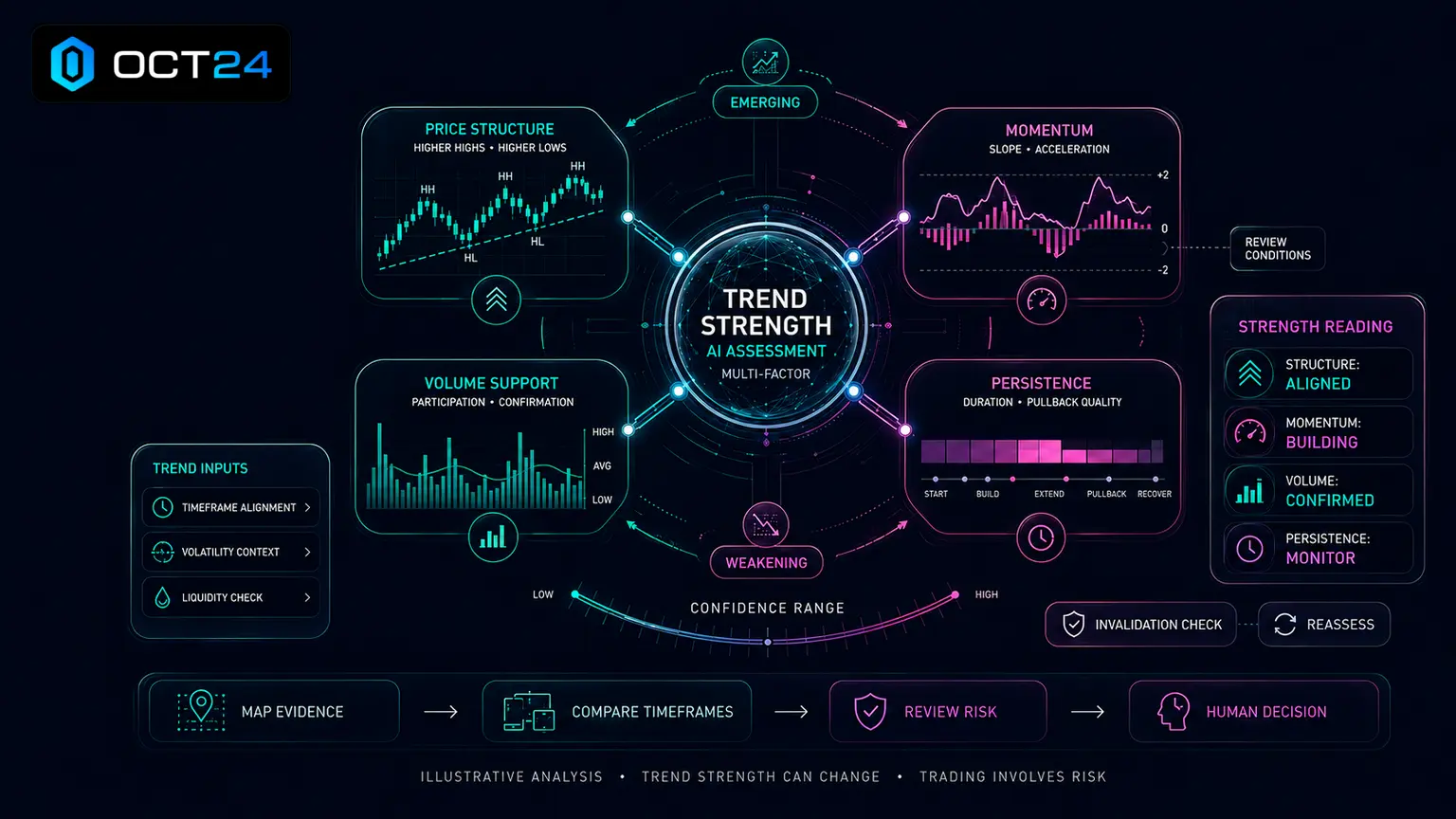
A strong trend usually has several clues working together. Price direction is only one piece. Traders also need to think about momentum, consistency, volatility, and whether other assets are confirming or disagreeing with the move.
For example, a coin that rises quickly and then immediately falls back may not be trending strongly. It may simply be reacting to short-term noise.
A stronger trend often shows repeated buying or selling pressure. It may continue making higher highs and higher lows in an uptrend, or lower highs and lower lows in a downtrend.
That said, no trend is perfect. Even strong trends pull back, pause, and create confusing moments.
This is where how AI uses technical analysis becomes useful. AI can help organize multiple signals at once instead of relying on one chart pattern or one indicator.
The Problem With Manual Trend Spotting
Manual trend spotting sounds simple, but it can become difficult in real markets. Charts move quickly, indicators can disagree, and traders may see what they want to see.
A beginner may look at a rising market and assume the trend is strong. An experienced trader may ask a better question: is the move supported by enough evidence?
Emotions also make manual review harder. When a market is moving fast, traders may feel pressure to act. When a market has already moved, they may chase the trend late.
This is one of the common AI trading mistakes traders should avoid. AI can support better review, but the trader still needs discipline.
If a signal appears after a large move, the right question is not whether the trend looks exciting. The right question is whether the risk still makes sense.
How AI Filters Trend Noise
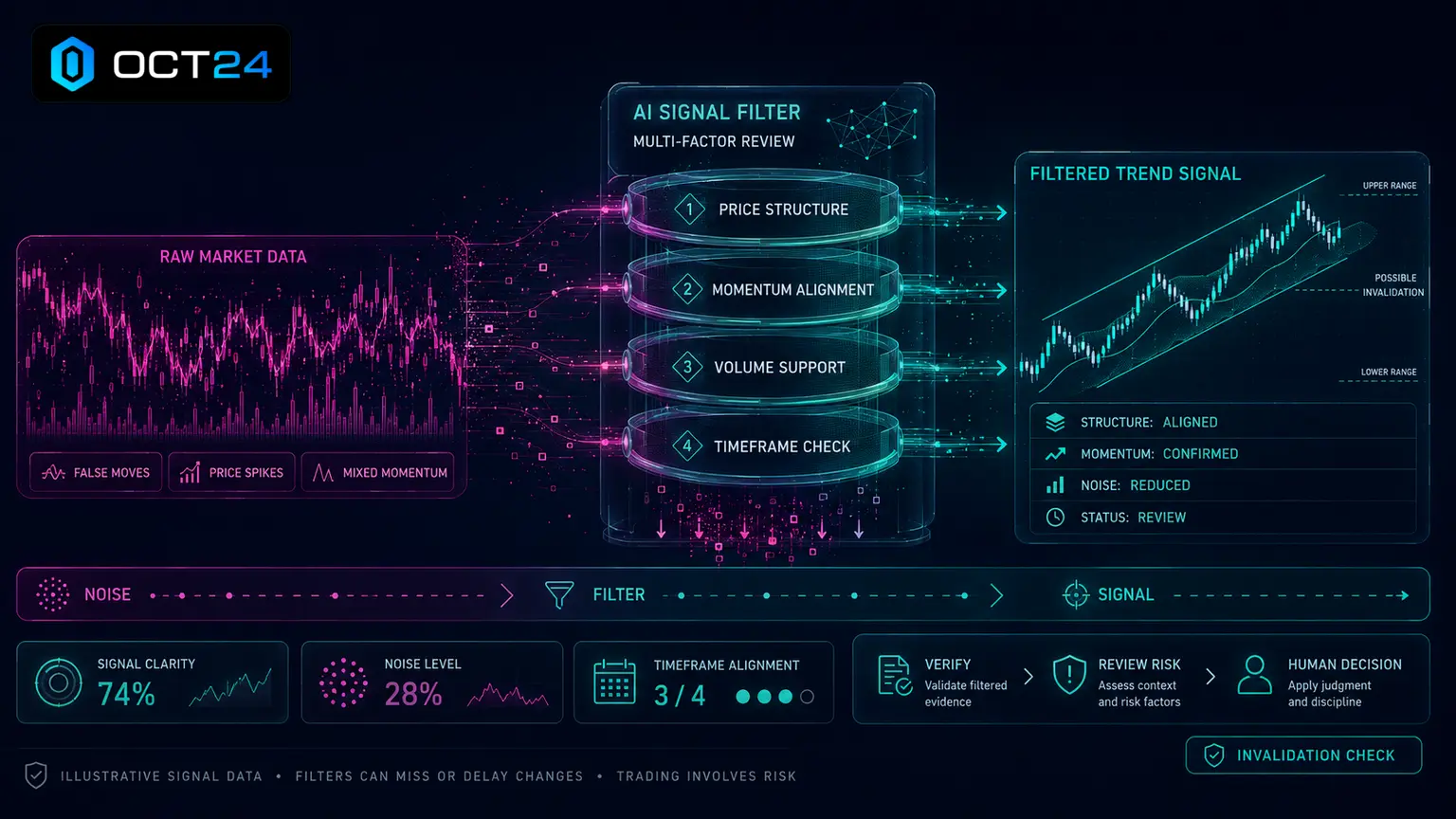
Market noise is short-term movement that can look important but may not reflect a real trend. Noise can come from temporary volatility, low liquidity, sudden news reactions, or emotional trading.
AI can help filter noise by comparing movement across more than one signal. Instead of judging a trend from a single price move, AI can look for repeated behavior and broader confirmation.
For example, AI may review whether momentum is increasing, whether volatility is supporting the move, and whether similar assets are moving in the same direction.
This does not mean AI can predict the market with certainty. It means AI can help separate stronger setups from weaker ones more consistently than a trader reacting emotionally.
That difference is important. A trader does not need every move. A trader needs clearer opportunities that fit their risk plan.
Momentum and Trend Confirmation
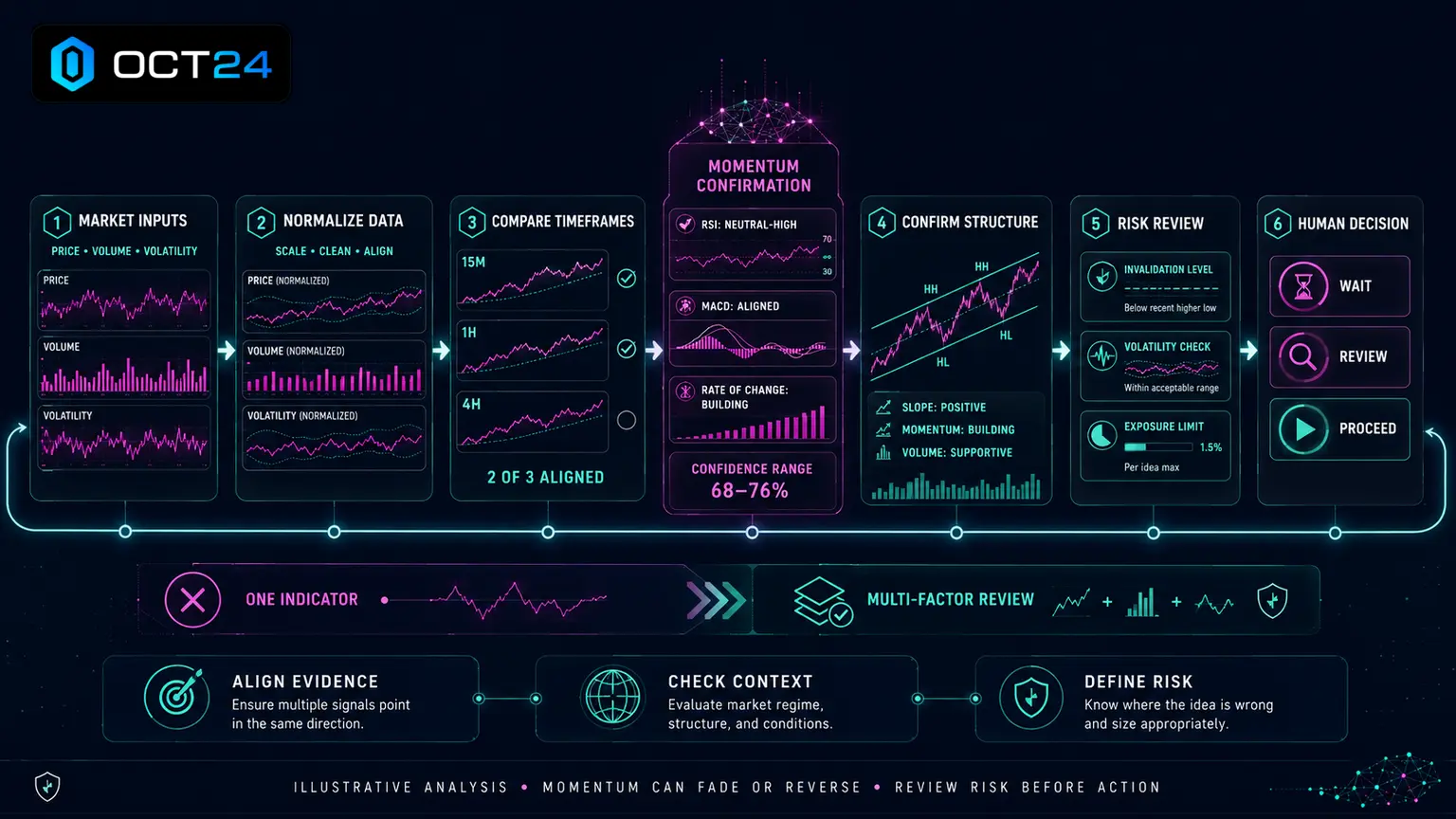
Momentum shows how strongly price is moving. A trend with rising momentum may deserve more attention than a trend that is drifting slowly without follow-through.
Confirmation means the trend has more than one reason to be taken seriously. For example, price direction, volume behavior, relative strength, and broader market sentiment may all support the same idea.
AI trading signals can be useful because they help organize these clues into a simpler review process. Instead of staring at many screens, traders can focus on whether the signal and the displayed metrics fit the situation.
On OCT24, the user-facing review is intentionally simple. Traders are not shown a full breakdown of every asset detail or exact entry and exit explanation for each presented trade.
Instead, the review focuses on key metrics such as target profit, loss coverage, and win rate.
How AI Compares Trends Across Assets
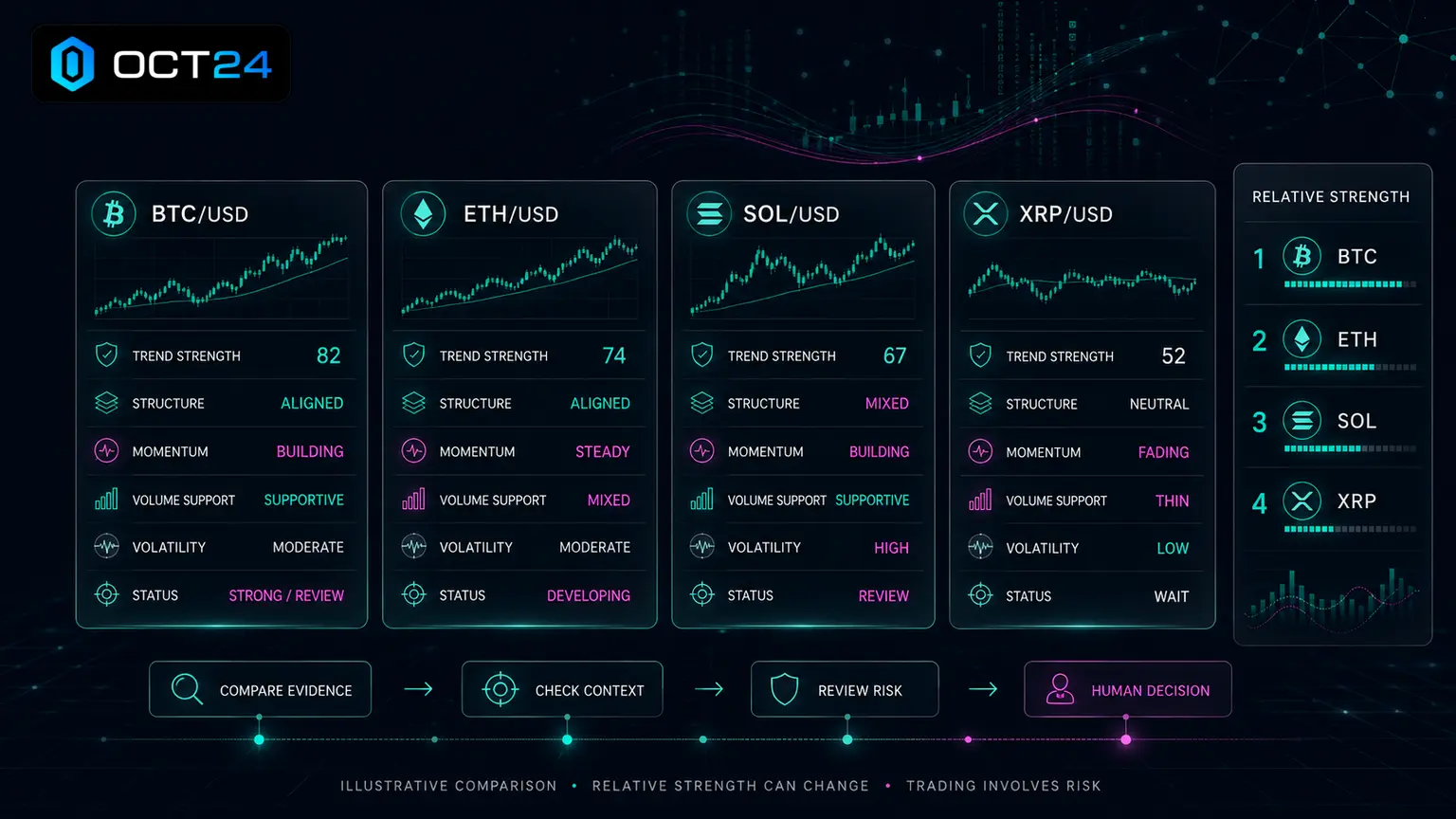
A single asset can look strong by itself, but the broader market may tell a different story. This is why comparing assets matters.
For example, Bitcoin may be moving slowly while Ethereum or altcoins show stronger momentum. Or Bitcoin may be leading the market while smaller assets remain weak. These differences can reveal whether risk appetite is expanding or narrowing.
AI can help compare Bitcoin, Ethereum, and altcoins more efficiently than manual review alone. It can scan multiple assets and identify where stronger movement may be developing.
This can also help traders understand crypto market rotation. When capital moves from one group of assets to another, trend strength may shift quickly.
A trend signal becomes more useful when traders understand whether it is isolated or supported by wider market behavior.
What OCT24 Does With Trend Signals
OCT24 is designed to make AI-supported trading easier to access. The platform performs much of the market analysis behind the scenes by scanning conditions, identifying potential opportunities, and presenting signals for trader review.
It is important to be accurate about what the user sees. OCT24 currently does not provide a full on-platform research dashboard where traders inspect every market detail, asset reason, chart explanation, or exact entry and exit point for each presented trade.
Instead, the user-facing experience focuses on simplified signal review. When a trade or bot is presented, traders can review key information such as target profit, loss coverage, and win rate.
This can help reduce complexity. It also means traders should not assume all underlying trend details are visible on screen.
The trader still decides whether the displayed opportunity fits their risk tolerance, account size, and trading plan.
Target Profit in a Trending Market
Target profit can feel more attractive when a trend looks strong. If price is moving clearly in one direction, traders may expect the move to continue.
That expectation can be dangerous if it turns into overconfidence. Strong trends can still reverse, pause, or become crowded.
When reviewing target profit, traders should ask whether the potential upside still makes sense after considering current market conditions. A target that looks exciting may not be suitable if the trend has already moved too far.
OCT24 presents target profit as one of the key review metrics. The trader’s job is to compare that target with loss coverage, win rate, and account exposure.
A trend signal should not make traders ignore downside. It should help them review the opportunity with better structure.
Loss Coverage and Trend Risk
Loss coverage matters because trends do not move in straight lines. Even a strong trend can pull back sharply before continuing, and sometimes the pullback becomes a full reversal.
Traders who focus only on the trend may underestimate the loss side of the trade. This is especially common when the market feels obvious.
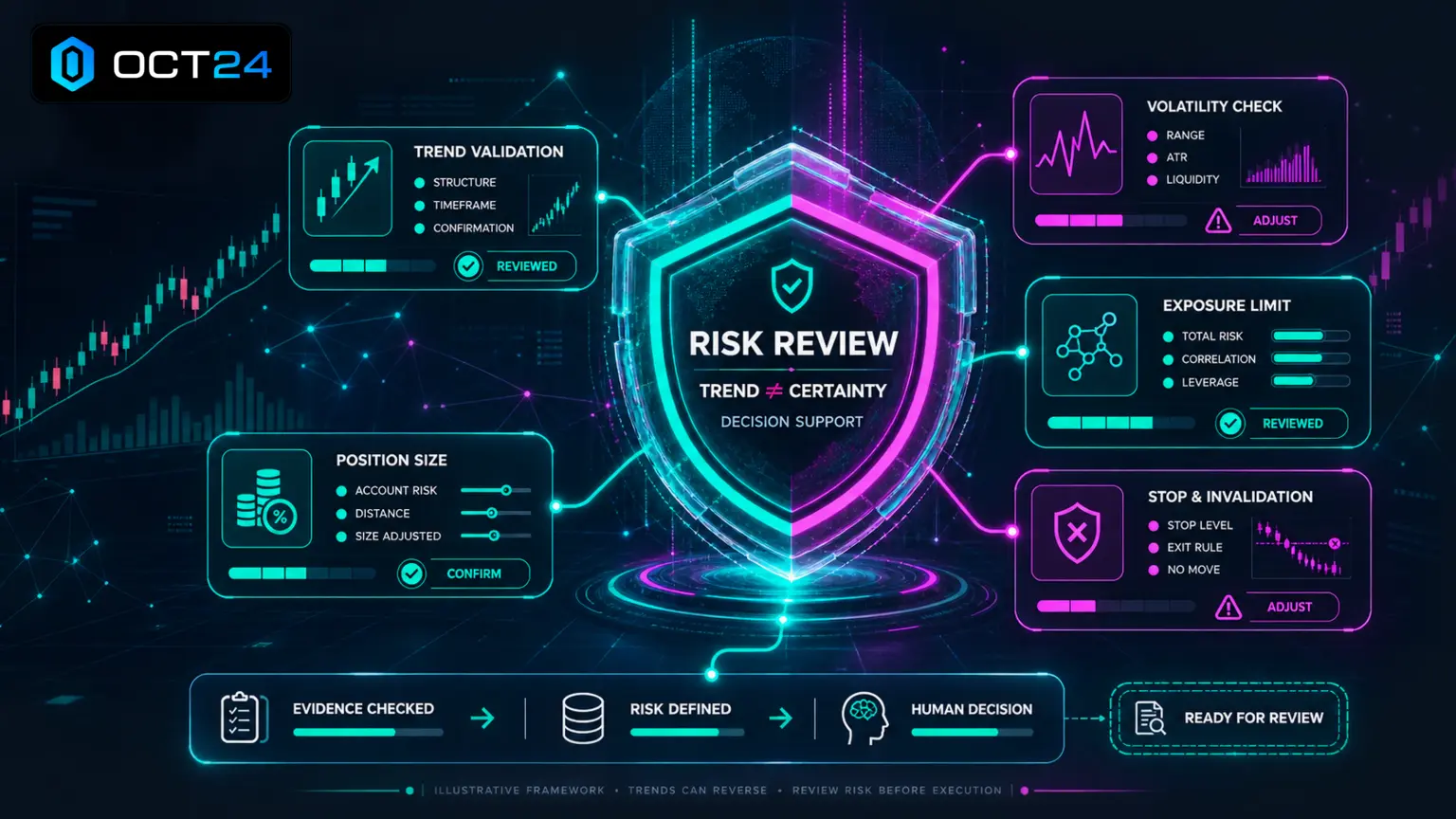
Trading bot risk management is important because it reminds traders that signal quality and risk control must work together.
Before acting on a trend signal, traders should ask whether the possible downside is acceptable. If the risk is too large, the trend may be strong but the trade may still be unsuitable.
This is a simple but powerful distinction. A good-looking market is not automatically a good trade for every account.
Win Rate and Trend Confidence
Win rate can help traders understand how a signal or bot has performed, but it should not be treated as certainty. A higher win rate does not mean the next trade will win.
In trending markets, win rate can create extra confidence because the market direction may look clear. That confidence can be useful if it stays disciplined, but risky if it turns into careless execution.
Traders should review win rate alongside target profit and loss coverage. These metrics work best together, not separately.
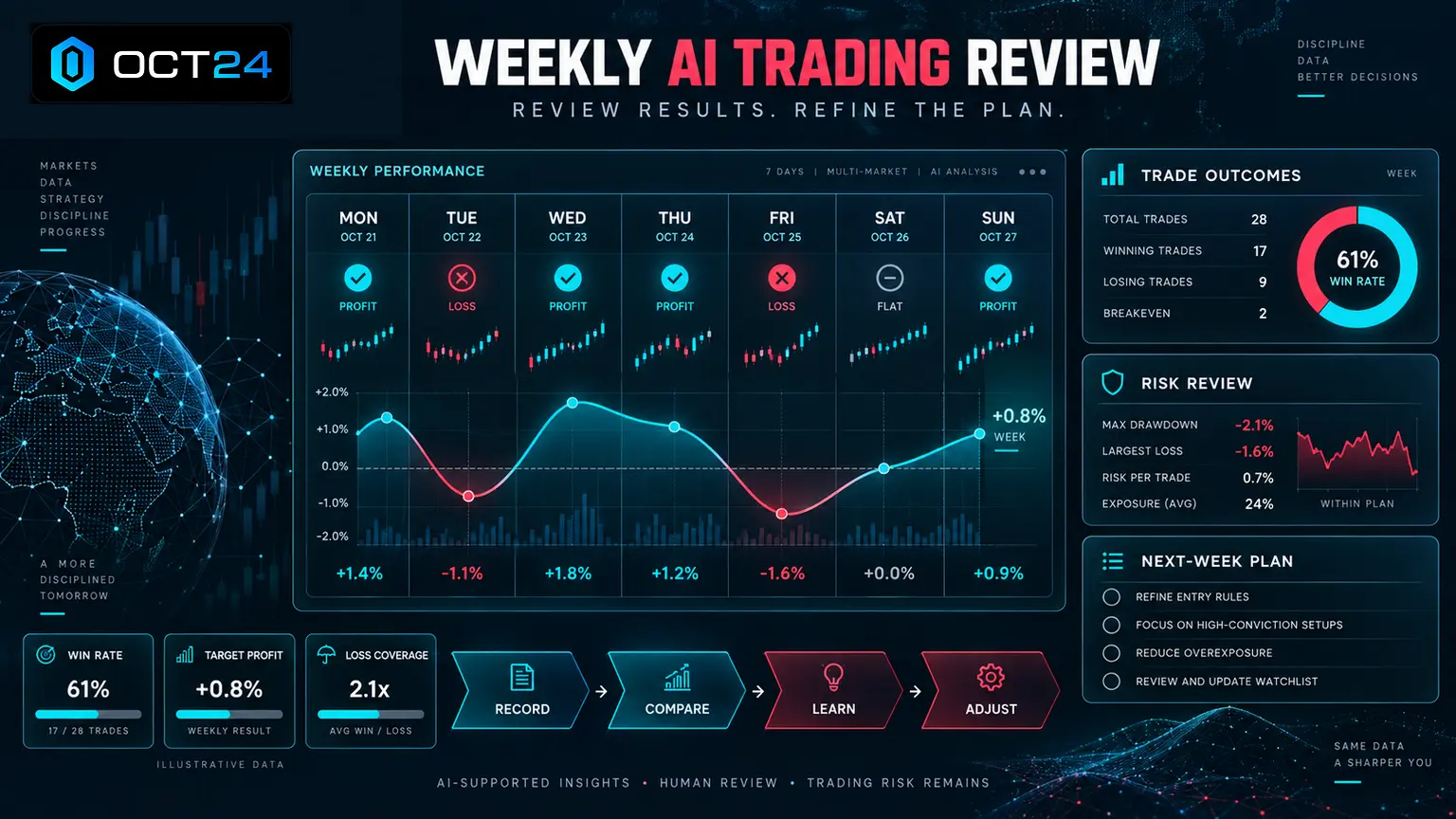
AI trading performance should also be reviewed over time. One strong result does not prove that every future signal will behave the same way.
The better habit is to treat each signal as a fresh decision with its own risk profile.
Trends During Volatile Markets
Volatile crypto markets can make trends look stronger than they really are. A sharp move may look like the start of a major trend, but it may also be a short-term reaction.
AI can help by scanning whether the move has broader support. It may look for whether momentum is continuing, whether related assets are moving too, and whether the market is becoming more directional.
That said, volatility always increases uncertainty. A trend signal during high volatility should be reviewed more carefully, not less carefully.
Traders should avoid assuming that speed equals strength. Fast markets can create opportunity, but they can also create false confidence.
This is where AI trading signals without chasing the market becomes a useful mindset.
Trends During Sideways Markets
Sideways markets can be frustrating because they often produce weak signals. Price moves up, then down, then back into the same range.
AI trading during sideways markets can help traders become more selective. If the market is not showing enough trend strength, the best decision may be to wait.
A sideways market does not mean there are no opportunities. It means traders need to be careful about confusing temporary movement with a real trend.
Trend identification is especially useful here because it can help traders avoid forcing trades in unclear conditions.
When the market is sideways, discipline often matters more than speed.
How to Review a Trend Signal Step by Step
A simple trend signal review does not need to be complicated. It should help traders slow down just enough to avoid emotional decisions.
First, ask whether the market is actually trending or simply moving quickly. Then review whether momentum appears to be supported by broader conditions.
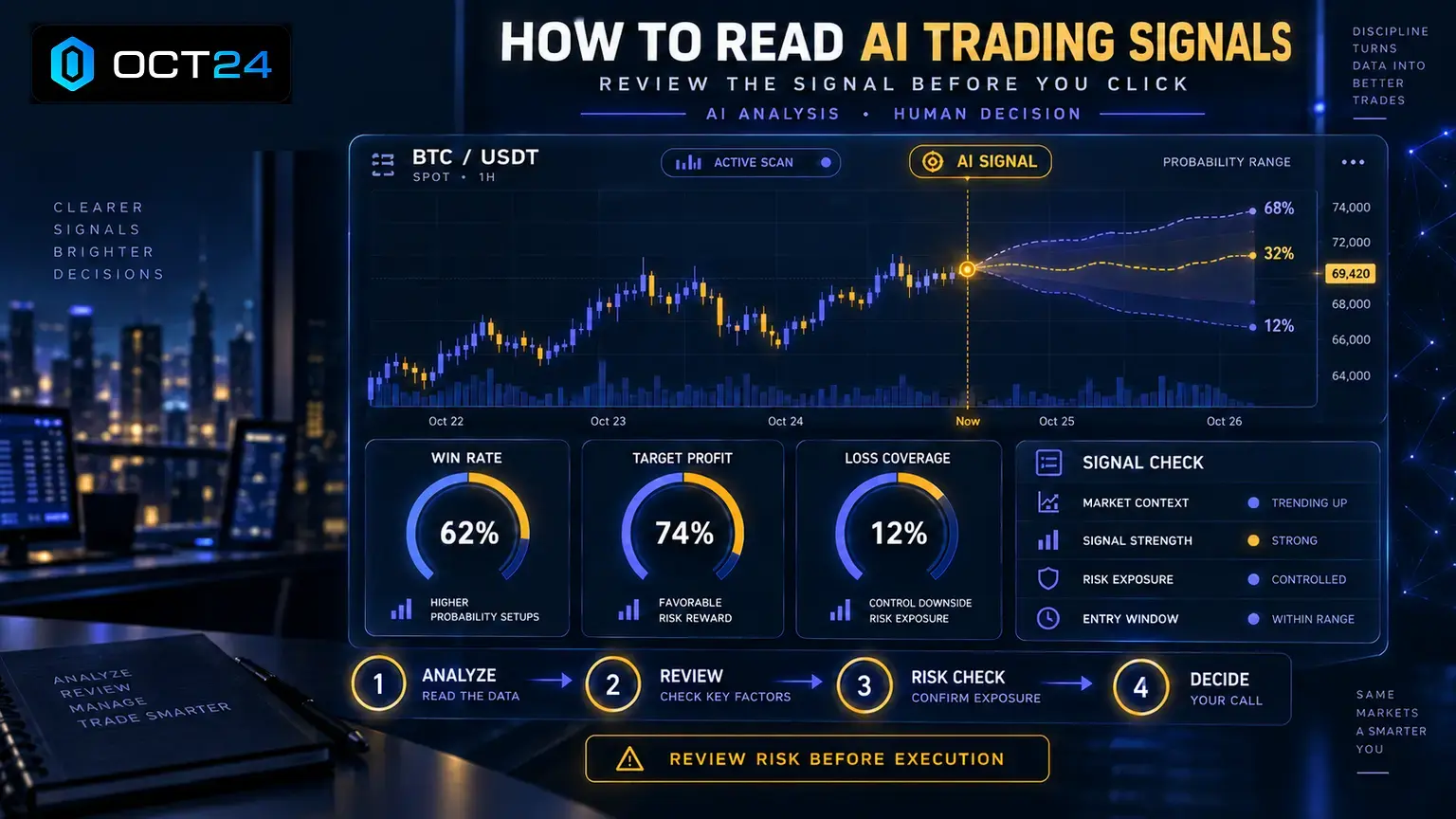
Next, check the metrics shown. On OCT24, that means reviewing target profit, loss coverage, and win rate before deciding whether to act.
Then compare the signal with your own risk plan. Position size, account exposure, and recent trading activity all matter.
Finally, decide whether the signal fits your plan. If the answer is unclear, skipping the trade can be the responsible choice.
Trend Review Checklist
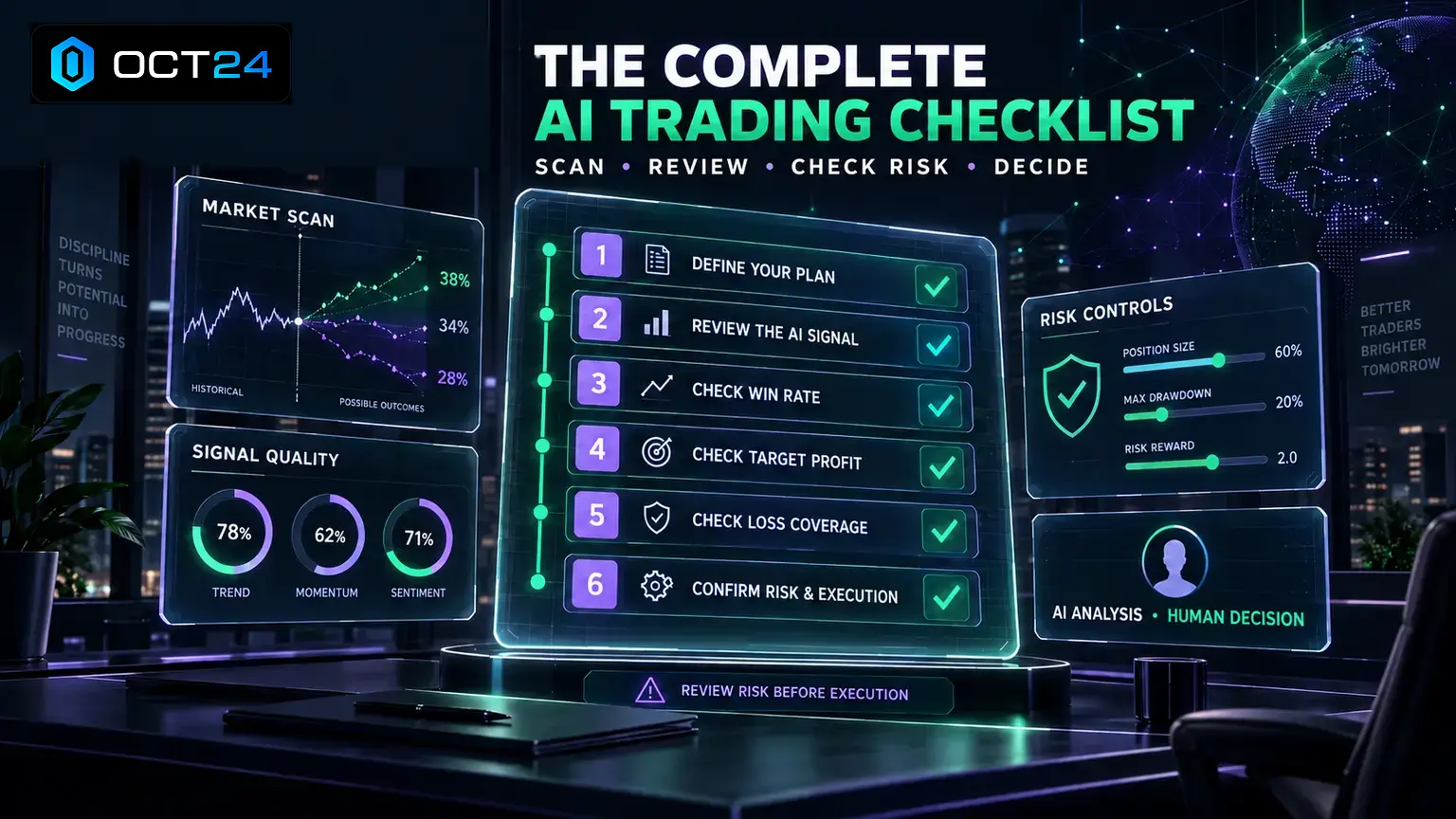
A checklist can help traders review trend signals consistently. It reduces the chance of acting only because the market feels exciting.
Before acting on a trend signal, ask:
- Is the market showing real direction or short-term noise?
- Does the trend have momentum behind it?
- Are related assets confirming or disagreeing with the move?
- Is the target profit realistic for current conditions?
- Does the loss coverage fit my risk tolerance?
- Am I already exposed to a similar trend?
- Am I taking this trade because of a plan or because of urgency?
- Can I accept the outcome if the trade loses?
Trend Exhaustion and False Strength
A trend can look strong near the end of a move. This is one of the hardest lessons for beginners because the market often looks most convincing after many traders have already entered.
Trend exhaustion happens when price keeps moving but the quality of the move starts to weaken. Momentum may slow, pullbacks may become sharper, or the market may stop responding as strongly as it did earlier.
AI can help by scanning whether market behavior is still supportive or whether the trend is becoming less reliable. It can look for changes in momentum, volatility, and broader confirmation.
This does not mean AI can always identify the exact end of a trend. Markets can stay strong longer than expected, and weak trends can suddenly recover.
The practical lesson is to avoid entering only because a trend looks obvious. When a move already feels crowded, review the risk even more carefully.
Market Leadership and Trend Quality
Strong trends often have leadership. In crypto, leadership may come from Bitcoin, Ethereum, a group of altcoins, or a specific market theme.
When leadership is clear, traders can better understand what is driving the move. When leadership is scattered, the trend may be less reliable.
For example, if one small group of assets is rising while the rest of the market is weak, the move may be narrower than it appears. If several major assets are moving together, the trend may have broader support.
AI can help traders review this faster by comparing behavior across assets and identifying where stronger movement may be concentrated.
OCT24 keeps the user experience simple, so traders do not need to manually inspect every asset before reviewing a signal. Still, the trader should remember that a simplified signal is not the same as a guarantee. It is a starting point for responsible review.
How the G6 Trading Bot Fits Into Trend-Based Trading
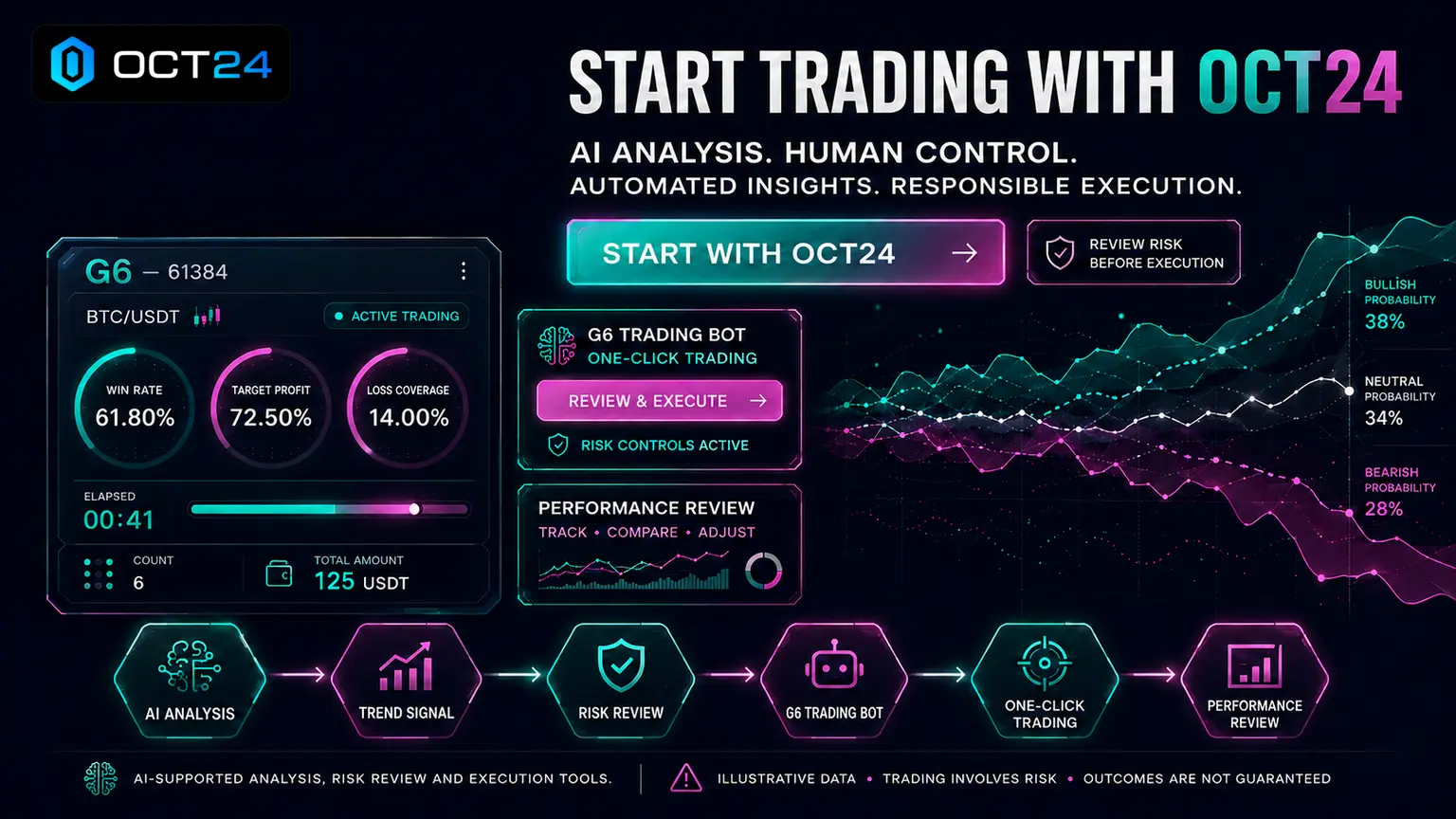
The G6 Trading Bot is relevant for users who want a faster and simpler OCT24 trading experience. It fits the broader idea of using AI-supported tools to reduce manual workload and support quicker signal review.
For trend-based trading, the benefit is not that the bot removes uncertainty. It does not. The benefit is that the process can feel more structured than manually scanning charts for long periods.
Traders still need to review the available metrics before acting. Speed is useful only when it follows risk review.
This is also why one-click trading should not become one-second thinking. A faster workflow should still include a pause for target profit, loss coverage, win rate, and exposure review.
The strongest trend in the world can still produce a losing trade if risk is not managed.
Beginner Mistakes When Reading Trends
Beginners often make the same mistakes when trying to read trends. The first mistake is assuming that any upward move is a strong trend.
The second mistake is entering too late because the move already looks obvious. By the time a trend feels comfortable, the risk may already be higher.
The third mistake is ignoring drawdown in trading. A trend can be correct in direction but still create uncomfortable pullbacks along the way.
The fourth mistake is taking too many similar trades. If several trades depend on the same market trend, the trader may be more exposed than they realize.
The fifth mistake is treating AI as a guarantee. AI can support decision-making, but it cannot remove market risk.
FAQs
What is AI market trend identification?
AI market trend identification is the use of AI to scan market data and help identify whether price movement is becoming stronger, weaker, or too noisy to trust.
Can AI identify strong market trends with certainty?
No. AI can help scan market conditions and identify potential trend signals, but it cannot guarantee future price movement or remove trading risk.
How does OCT24 help traders review market trends?
OCT24 performs much of the market scanning behind the scenes and presents AI-supported signals through a simplified review process focused on target profit, loss coverage, and win rate.
Does OCT24 show exact trend analysis for every trade?
OCT24 currently does not show a full research dashboard, exact asset explanation, or exact entry and exit breakdown for every presented trade. The user-facing review focuses on simplified metrics.
Are strong market trends always good trading opportunities?
No. A strong trend can still be risky if the trade is late, the downside is too large, or the trader is already overexposed.
What should beginners check before acting on a trend signal?
Beginners should review target profit, loss coverage, win rate, market conditions, account exposure, and whether the signal fits their risk plan.
Can trend signals help reduce overtrading?
Yes, trend signals can support more selective decision-making, especially when traders use them with a consistent trading routine and avoid overtrading habits.
How are trend signals different from alerts?
AI trading alerts may notify traders about activity, while trend signals help traders review whether market direction appears strong enough to deserve attention.
Where can I learn more about OCT24?
You can read About OCT24 to understand the platform approach, or Start Trading with OCT24 when you are ready to explore AI-supported trading tools.
Final Thoughts
AI can help traders identify strong market trends by scanning more conditions than most people can review manually. It can compare movement, momentum, volatility, and broader market behavior to help surface more structured trading signals.
OCT24 supports this process by performing much of the market scanning behind the scenes and presenting AI-supported opportunities in a simplified way. Traders can then review target profit, loss coverage, and win rate before deciding whether to act.
That simple review process can help reduce noise, but it does not remove responsibility. Traders still need to manage risk settings, exposure, capital allocation, and execution decisions.
The best way to use AI for trend identification is to stay disciplined. Review the signal. Check the metrics. Respect your limits. Avoid chasing. Then decide whether the opportunity fits your plan.
To explore the platform, visit OCT24, read About OCT24, or Start Trading with OCT24 when you are ready to review AI-supported trading signals with a clear risk-first mindset.