
How to Use AI Trading Signals Without Chasing the Market
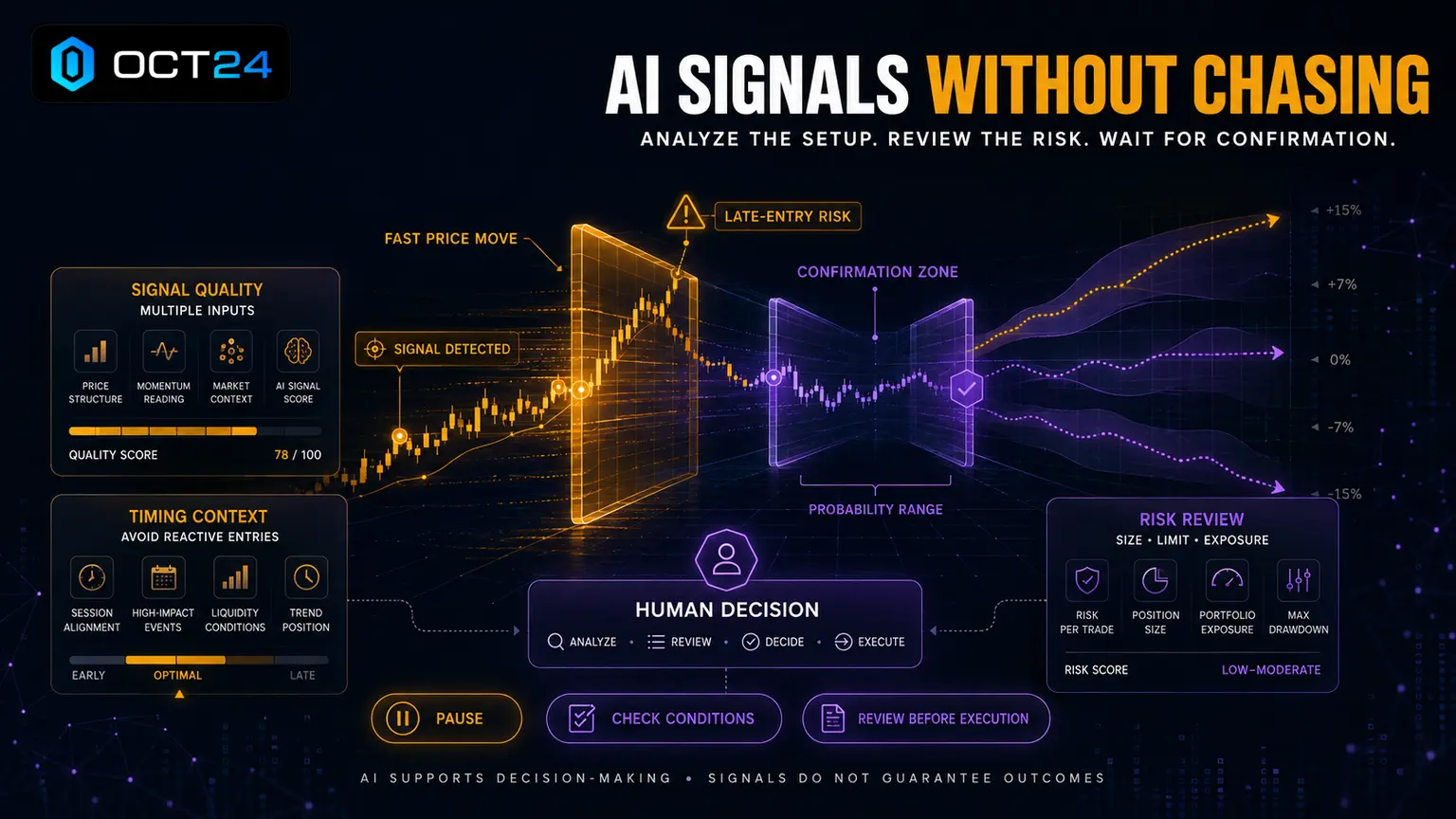
AI trading signals without chasing the market means using signals as structured decision support, not as a reason to rush into every fast-moving trade. The goal is to slow down the decision, review the risk, understand what the signal is trying to show, and only act when the setup fits your plan.
This matters because many traders do not lose discipline during quiet markets. They lose it when price suddenly moves, social media gets loud, or a chart makes them feel as if they are already late.
AI can help by scanning market conditions faster than a person can. OCT24 is designed to perform much of that market scanning in the background, identify potential opportunities, and present AI-supported trading signals in a simpler format.
That simplicity is useful, but it does not remove risk. OCT24 does not guarantee results, and traders still need to manage risk settings, exposure, capital allocation, and execution decisions.
The skill is not just finding signals. The skill is learning how to use them without turning every signal into an emotional chase.
Why Traders Chase the Market
Chasing the market usually starts with a feeling. A trader sees a candle move quickly, notices a coin trending online, or watches a potential trade appear after price has already moved.
The thought is simple: if I wait, I might miss it.
That pressure can lead to rushed entries, oversized positions, and poor timing. It can also make traders ignore the same risk rules they promised to follow earlier in the day.
Chasing is not always obvious. Sometimes it looks like a logical decision because the market really is moving. The problem is that the trader is reacting to speed instead of reviewing quality.
A trader may be chasing when they:
- Increase position size because the move feels urgent
- Enter without checking risk settings
- Ignore loss coverage or downside exposure
- Act because other people are excited
- Take a trade they would have skipped ten minutes earlier
- Try to recover from a missed move by jumping into the next one
What It Means to Use AI Trading Signals Without Chasing the Market
Using AI trading signals without chasing the market means building a review habit around every signal. The signal may point to a potential opportunity, but the trader still decides whether the risk is acceptable.
A useful signal should help you pause, not panic. It should give you a reason to evaluate the setup with more structure.
This is where AI trading can be helpful for beginners and busy traders. Instead of manually scanning every chart, the system can narrow attention toward selected opportunities. That can reduce noise, but it should not replace judgment.
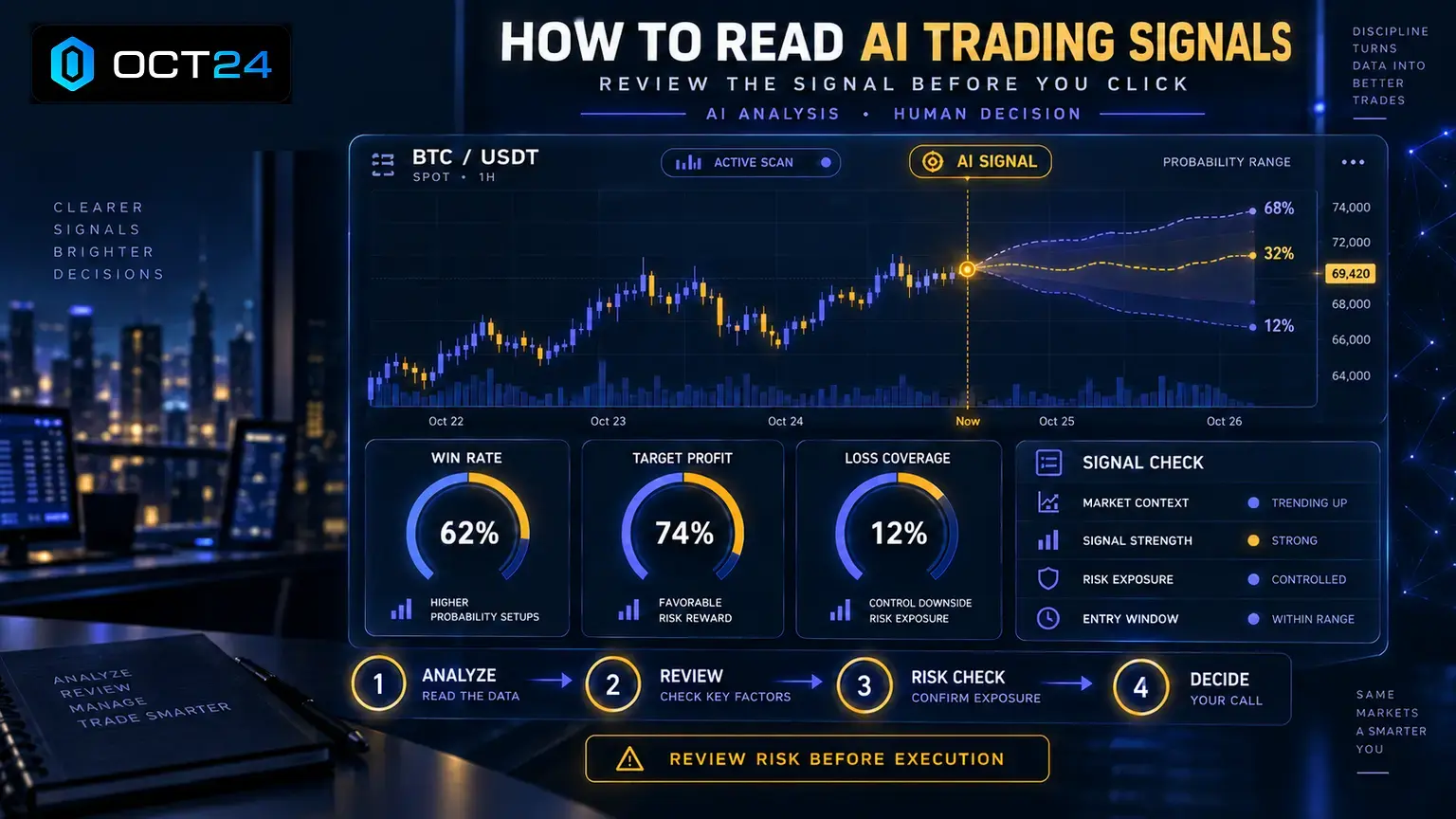
OCT24’s signal experience is intentionally simple. Traders are not shown a full market-analysis dashboard with every chart, asset detail, or exact entry and exit explanation for each trade. Instead, the platform focuses attention on key trade or bot metrics such as target profit, loss coverage, and win rate.
That means the trader’s responsibility is very clear. You are not being asked to become a full-time analyst before every decision, but you still need to decide whether the displayed risk and reward profile makes sense for your account.
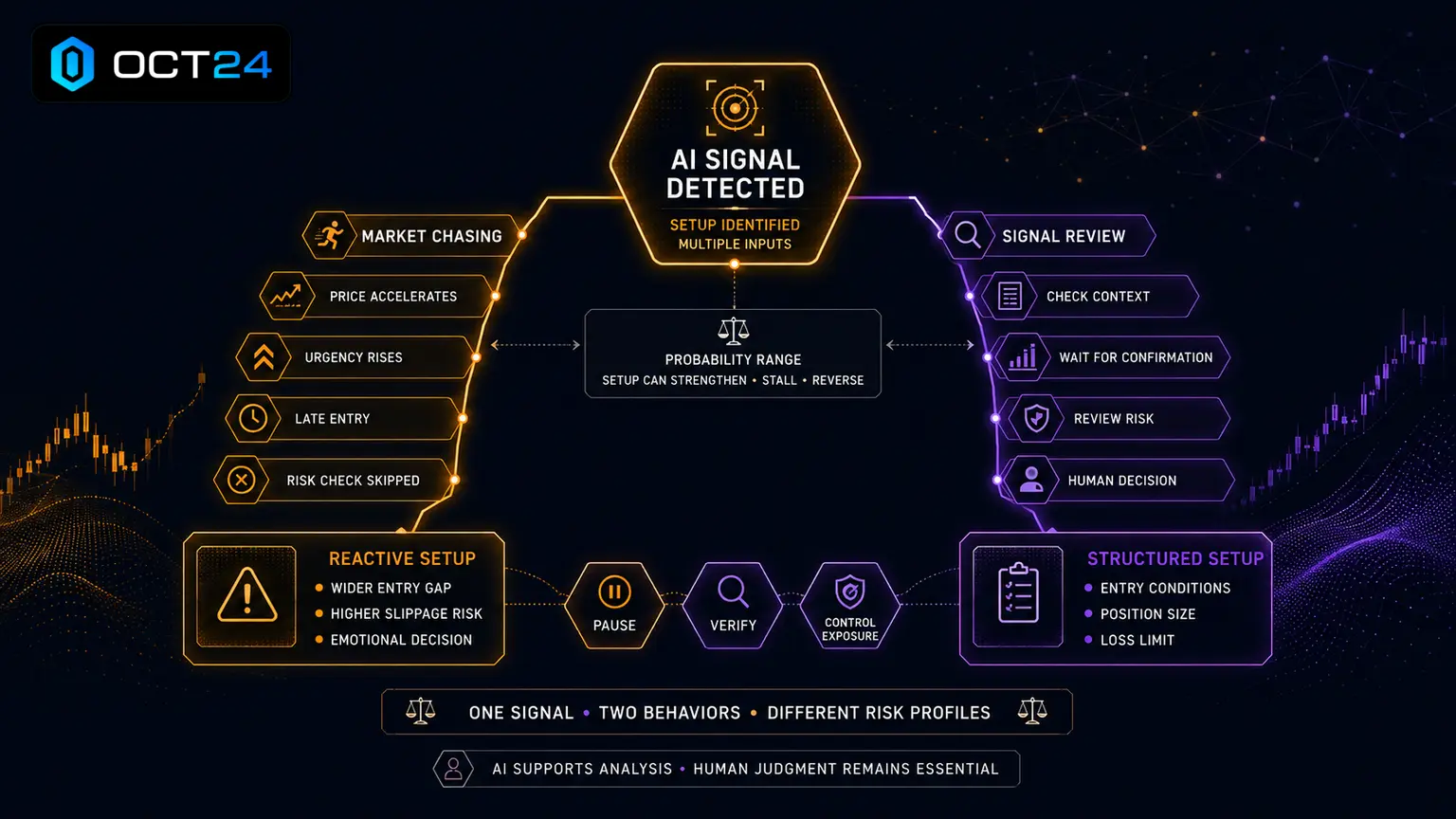
Signals Are Review Points, Not Orders
One of the biggest AI trading myths is that a signal should be treated like an instruction. That is not how responsible trading works.
A signal is a review point. It tells you that the system has identified conditions that may be worth attention. It does not tell you that the trade must be taken, that the result is certain, or that your capital is protected from loss.
This mindset is especially important when using one-click trading. Fast execution can be useful, but speed should sit after review, not before it.
A simple way to think about it is this: the signal starts the review, the trader approves the risk, and execution comes last.
That order helps traders avoid the most common mistake: clicking because the market feels active, then trying to justify the decision after the fact.
How AI Helps Filter Noise Before You Act
Crypto markets move all day. Prices shift, volume changes, narratives rotate, and sudden volatility can make almost anything look important for a few minutes.
AI can help because it is built to process more market activity than a human trader can comfortably monitor. It can scan conditions, identify patterns, and surface potential signals without getting tired or distracted.
This does not mean AI can predict the market with certainty. It means AI can help organize information faster and more consistently than manual review alone.
For example, a trader manually watching Bitcoin, Ethereum, and several altcoins may miss changes in relative strength or volatility. An AI system can monitor broader conditions and present opportunities when selected criteria appear to line up.
That kind of filtering can support better discipline. Instead of searching endlessly for a trade, the trader can review signals as they appear and decide whether the risk profile fits.
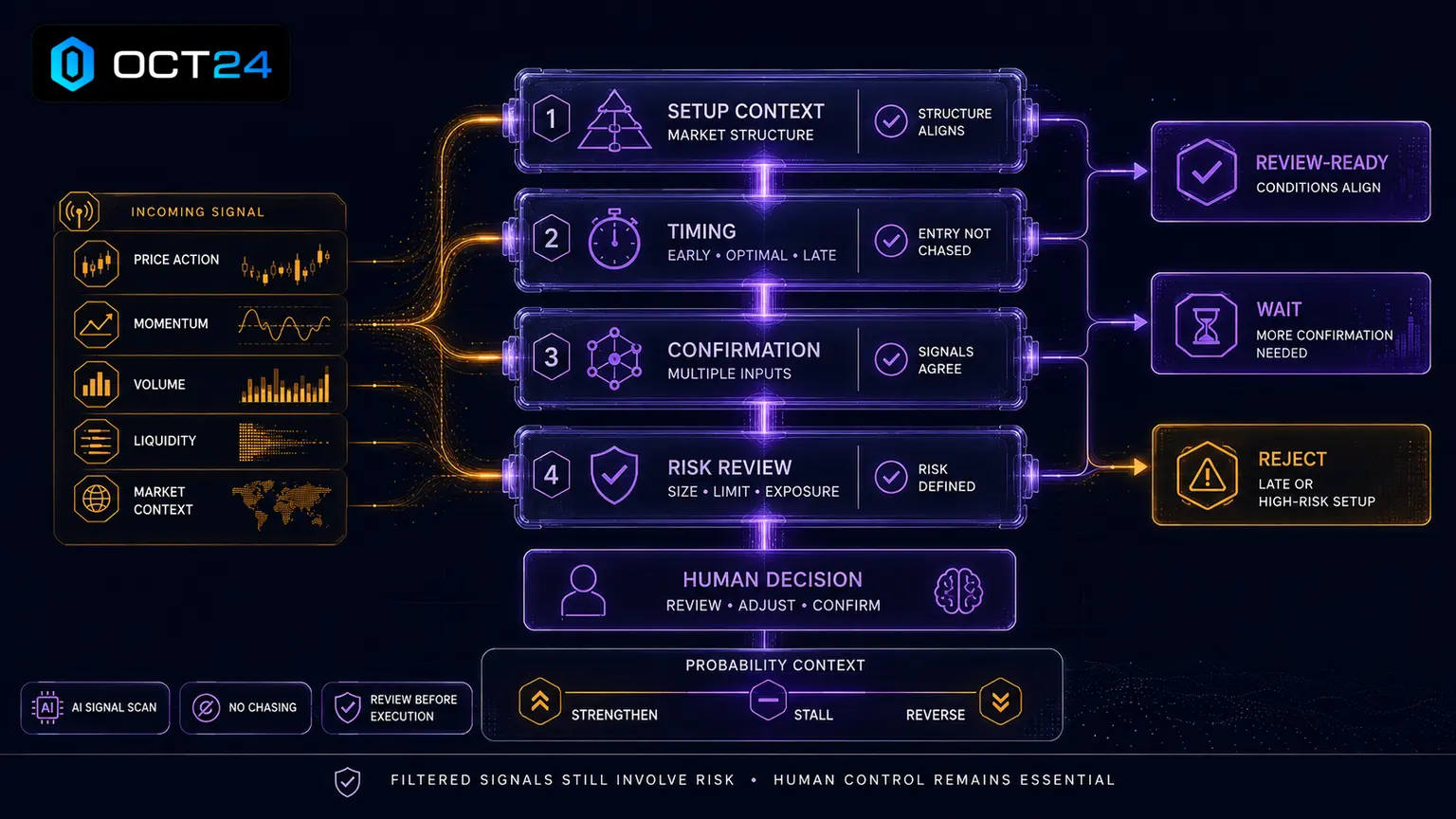
How to Tell a Signal From a Chase
A signal and a chase can look similar from the outside. Both may happen during fast markets. Both may involve price movement. Both may feel time sensitive.
The difference is the decision process.
A signal-based decision is reviewed before action. A chase-based decision is usually emotional first and rational second.
Before acting, ask yourself three questions:
- Would I still consider this trade if the market were quieter?
- Does the risk fit my normal position size and account plan?
- Am I acting because the signal makes sense, or because I feel late?
Risk Comes Before Excitement
Excitement is not a risk-management system. A trade can look attractive and still be unsuitable for your account.
This is why trading bot risk management and position sizing controls matter. A signal only becomes useful when it is paired with rules for how much capital you are willing to expose.
Before acting on any AI-supported signal, review the downside first. Beginners often focus on what they might make. More disciplined traders start with what they could lose.
The most basic review should include:
- How much of your balance is at risk
- Whether the target profit is realistic for the setup
- Whether loss coverage fits your tolerance
- Whether recent performance supports confidence without creating overconfidence
- Whether you are taking too many similar trades at once
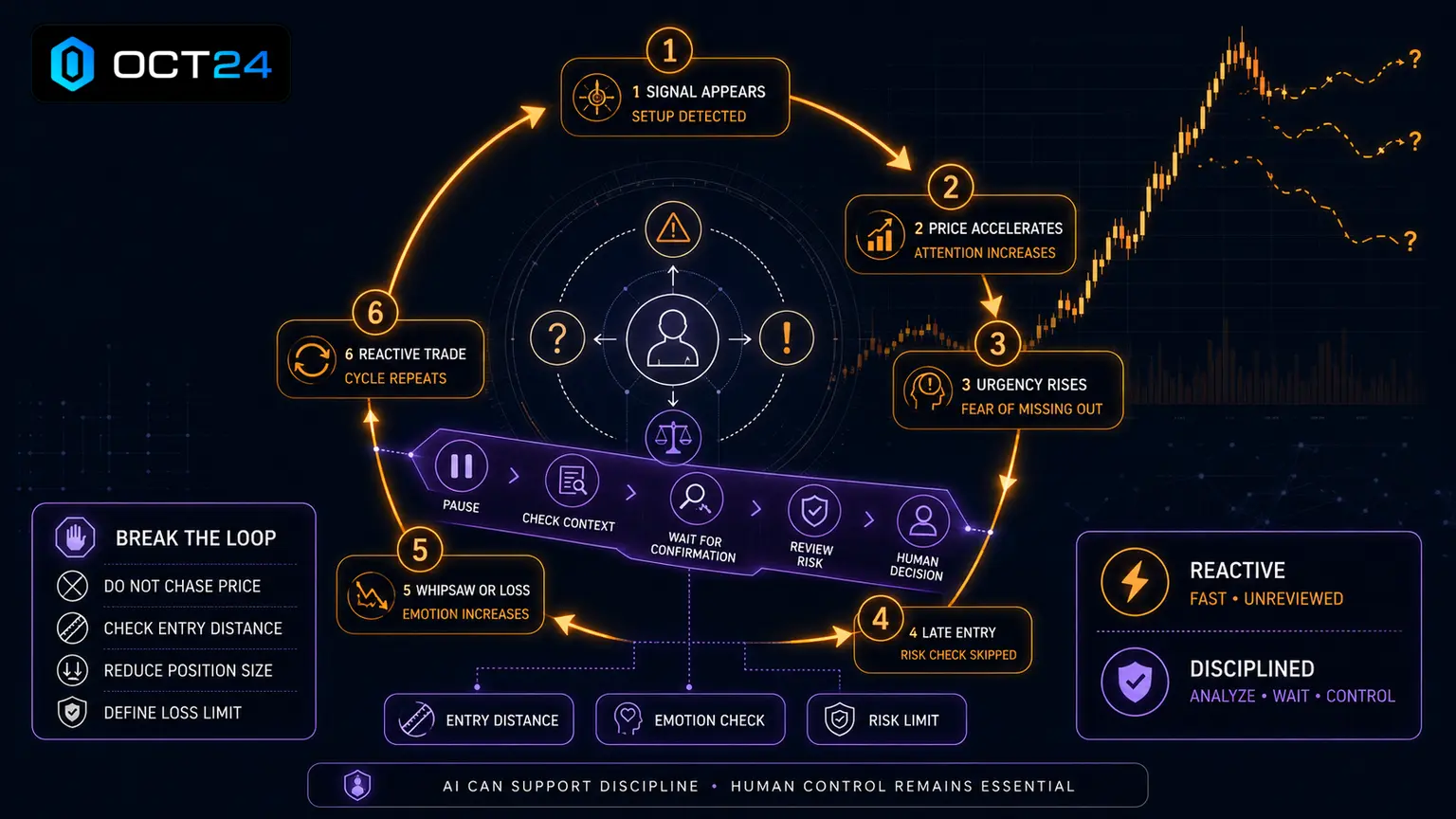
How OCT24 Presents Signals in a Simpler Way
OCT24 is built around making AI-supported trading easier to access. The platform performs much of the analysis process behind the scenes by scanning market conditions and identifying potential opportunities.
At the user level, OCT24 keeps the signal review focused. When a trade or bot is presented, traders are not shown detailed asset research, a full chart breakdown, or exact entry and exit levels inside the platform experience.
Instead, the review is centered on simple decision metrics such as target profit, loss coverage, and win rate. This gives traders a clearer way to evaluate the opportunity without turning the process into a long technical-analysis session.
That design can be helpful for beginner-to-intermediate traders who want a simpler workflow. It also means users should not assume they have seen every underlying market detail.
The responsible approach is to treat OCT24’s simplified signal metrics as a decision checkpoint. Review the information shown, decide whether the exposure fits your account, and only execute if the risk is acceptable.
Using Target Profit Without Getting Greedy
Target profit is one of the easiest metrics to misunderstand. A higher target can look more attractive, but it does not automatically mean the trade is better.
When traders chase the market, they often focus on the largest possible gain. That can lead them to ignore whether the trade has enough risk coverage or whether the setup fits their normal routine.
A target profit should answer one simple question: what is the planned upside of this trading cycle?
It should not make you increase your risk just because the number looks exciting. It should also not make you expect a result. The target is a goal within the setup, not a guarantee.
OCT24 can make this easier by displaying target profit clearly as part of the signal or bot review. The trader’s job is to compare that target against risk tolerance and account size before acting.
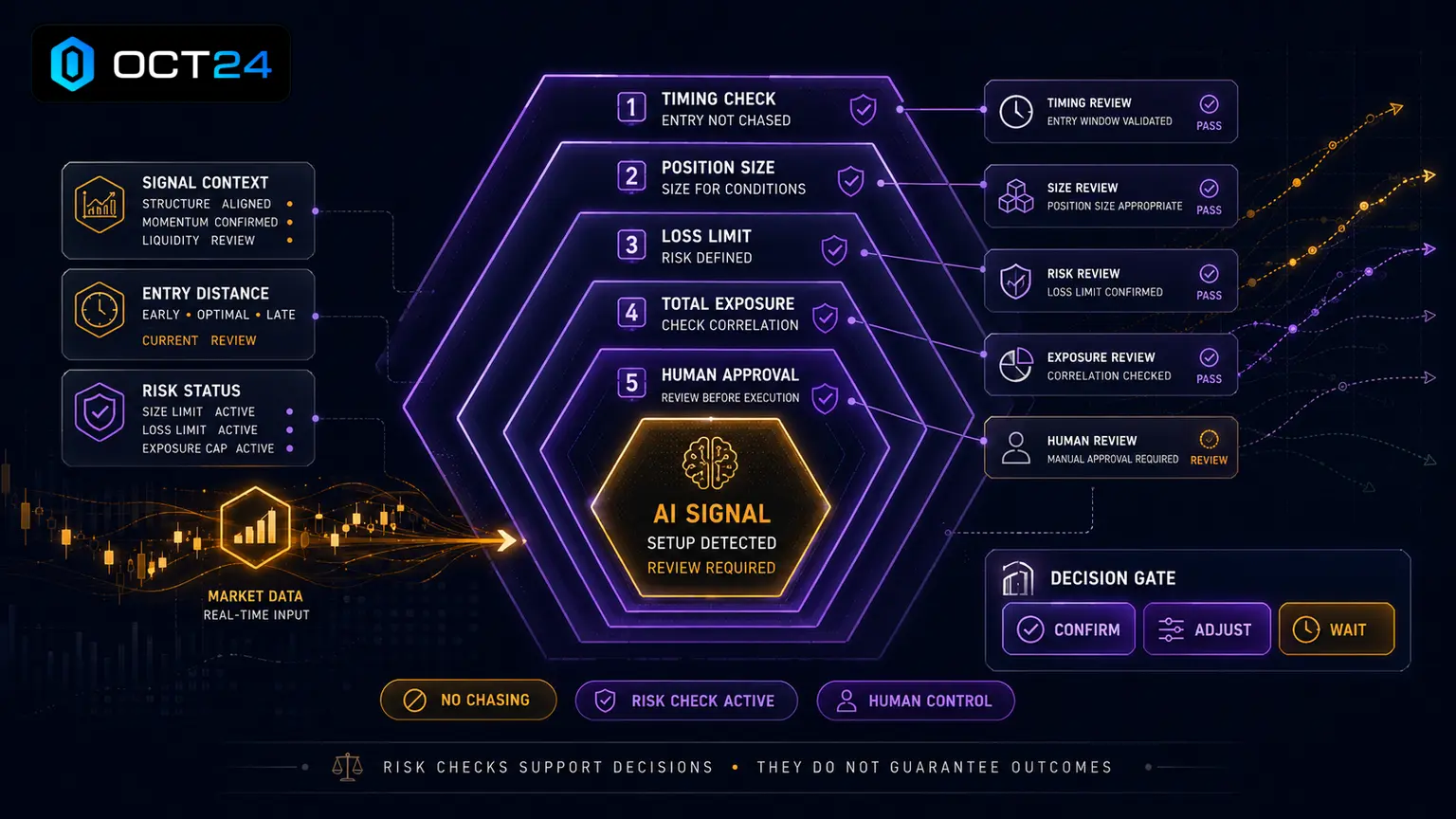
Using Loss Coverage Without Ignoring Risk
Loss coverage is another important metric because it helps traders think about downside before execution. That is useful because chasing usually begins when the trader stops thinking about downside at all.
Loss coverage should not be misunderstood as risk removal. Market outcomes can still be unfavorable, and trading always involves the possibility of loss.
Instead, loss coverage should be viewed as part of the risk structure shown to the trader. It gives another point of review before deciding whether to proceed.
A practical review might sound like this: if the trade does not work, does the downside profile still fit my plan?
That question is simple, but it can prevent poor decisions. It moves the trader away from emotional speed and back toward capital protection.
Using Win Rate Without Becoming Overconfident
Win rate is helpful, but it can also create false comfort. A high win rate does not mean every trade will win. A lower win rate does not mean every trade should be ignored.
Win rate is a performance metric, not a promise. It should be reviewed alongside target profit, loss coverage, trade frequency, market conditions, and your own account limits.
This is especially important when reviewing AI trading performance over time. One result does not prove a system is good or bad. Patterns matter more than isolated outcomes.
Beginners often make the mistake of treating win rate as the only decision metric. A better approach is to ask how the win rate fits with the possible reward and the downside structure.
When OCT24 presents win rate as part of the signal or bot view, use it as one input in the decision. Do not use it as permission to ignore risk.
One-Click Trading Still Needs a Pause
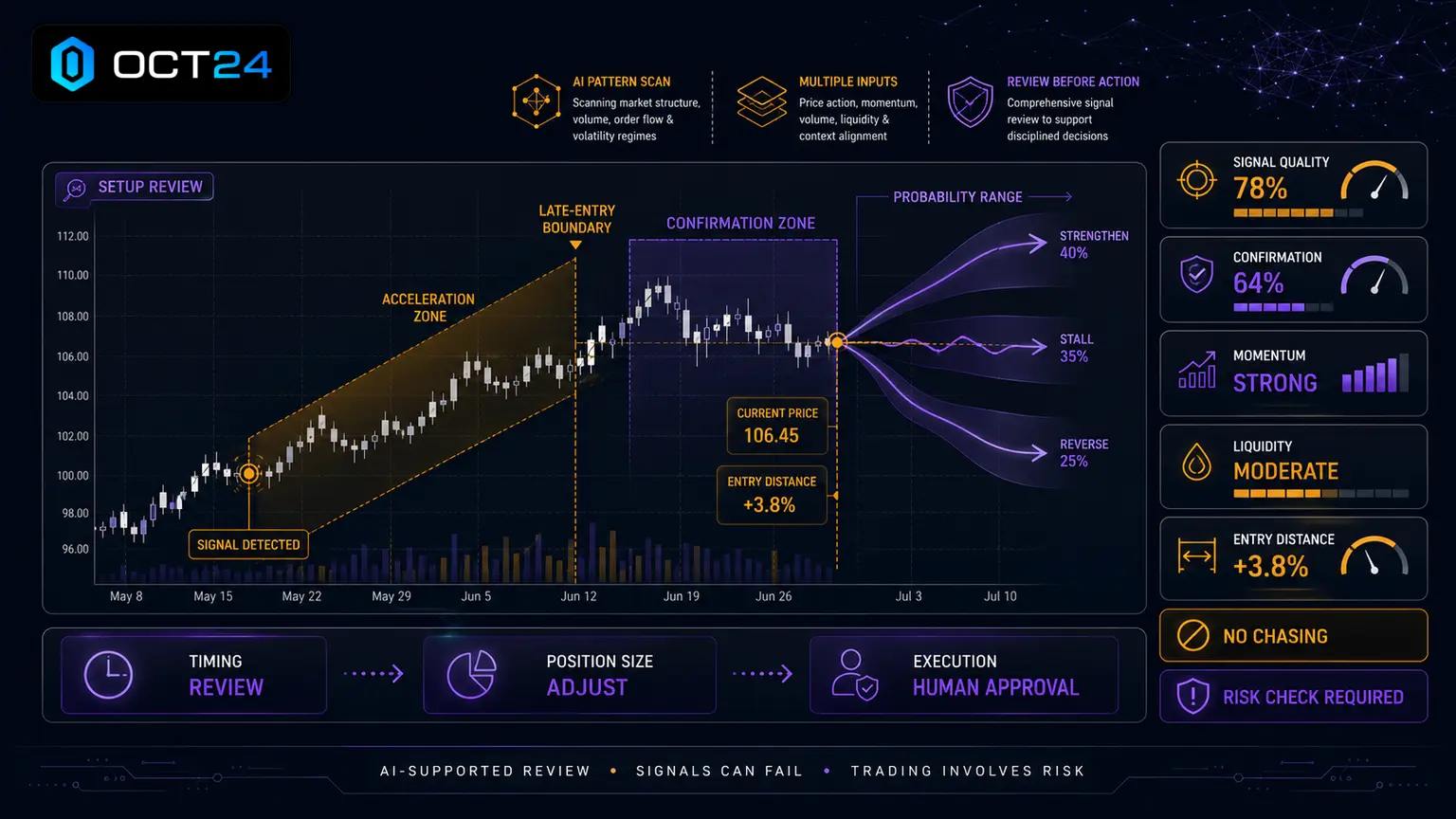
One-click trading is designed to make execution faster. That can be valuable when a trader has already reviewed the opportunity and is ready to act.
But one-click trading should not become one-second thinking.
The healthiest habit is to create a short pause before clicking. Even a brief review can make a major difference in decision quality.
Before using one-click execution, check:
- The signal or bot metrics
- Your available balance
- Your risk limit for this trade
- Whether you are already exposed to similar market conditions
- Whether you are acting from a plan or from urgency
Where the G6 Trading Bot Fits
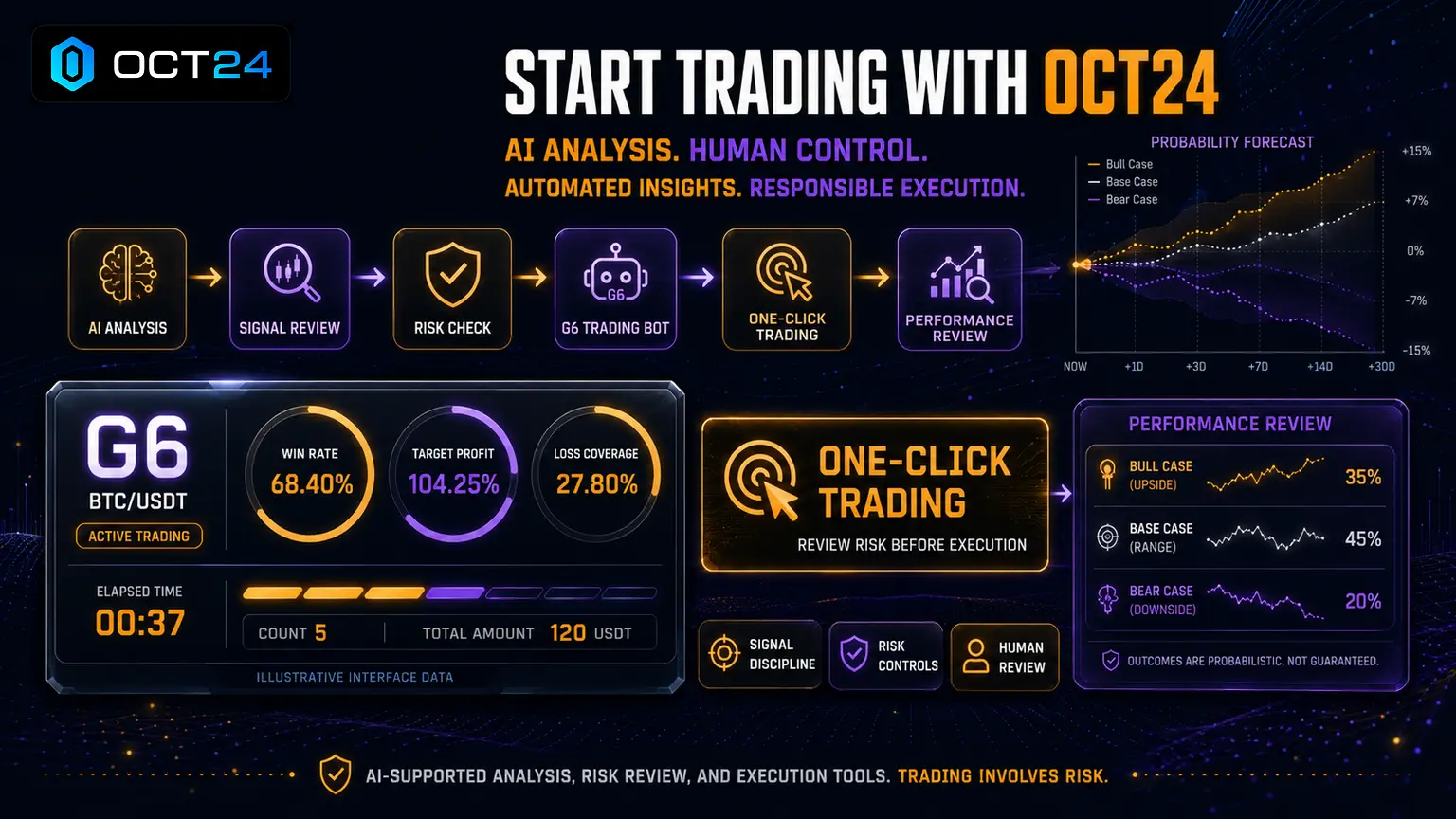
The G6 Trading Bot is relevant for traders who want a faster, simpler OCT24 experience. It fits the broader idea of AI-supported trading because the system helps surface a structured trading opportunity while the user reviews the available metrics.
For users, the appeal is speed and simplicity. The process is designed to reduce friction compared with manual chart scanning and long decision workflows.
Still, speed should never be confused with certainty. A faster trading process can help users act efficiently, but it also makes discipline more important.
If you review the G6 Trading Bot, focus on the same core questions: What is the target profit? What is the loss coverage? What win rate is shown? Does the trade fit your risk tolerance today?
That keeps the decision grounded in review instead of emotion.
Avoiding Chasing in Volatile Markets
Volatile crypto markets can make signals feel more urgent. Price moves quickly, spreads can change, and traders may feel pressure to act before the opportunity disappears.
This is exactly when discipline matters most. AI can help identify potential opportunities during volatility, but it cannot make the market calm. The trader still needs to decide whether the current environment is suitable.
If the market is moving too quickly for you to think clearly, that is a sign to reduce speed, not increase it.
A simple rule helps: never use volatility as your only reason for action. Volatility may create opportunity, but it also increases uncertainty.
When reviewing volatile crypto markets, compare the signal metrics with your normal rules. If the risk feels too large, passing on the trade is still a valid decision.
Avoiding Chasing in Sideways Markets
Sideways markets create a different problem. Instead of chasing a breakout, traders may chase activity because they are bored.
When price is not moving clearly, every small move can start to look like the beginning of something bigger. This can lead to overtrading and weak entries.
AI trading during sideways markets can help by reducing the need to stare at charts and force trades. A signal-based workflow can make traders more selective, but only if they are willing to skip weak setups.
The key is to remember that not every signal needs action. Some signals may be worth watching, while others may not fit your current risk plan.
A patient trader does not need constant activity to feel productive. Sometimes the best decision is to wait for a cleaner setup.
Build a Signal Review Routine
A consistent trading routine can help remove pressure from the moment of decision. Instead of asking what you feel like doing, you follow the same review process each time.
This is especially helpful when using AI trading signals. The more consistent your review process becomes, the less likely you are to chase price movement.
A simple routine might include:
- Check the signal or bot metrics
- Review target profit, loss coverage, and win rate
- Compare the trade with your account risk limit
- Check whether you already have similar exposure
- Decide whether the trade fits your plan
- Execute only if the answer is clear
- Record the result for later review
Common Mistakes to Avoid
Many common AI trading mistakes come from treating technology as a shortcut around discipline. AI can support trading decisions, but it does not remove the need for judgment.
The first mistake is taking every signal. More signals do not automatically mean better trading. Quality and fit matter more than quantity.
The second mistake is changing risk size after seeing a trade you like. If your normal risk limit is small, do not increase it simply because the target profit looks attractive.
The third mistake is ignoring recent results. If you have taken several losing trades, you may be emotionally tempted to recover quickly. That is when chasing becomes most dangerous.
The fourth mistake is assuming AI removes uncertainty. Even strong systems operate in uncertain markets. Every trade still needs responsible exposure and capital management.
The fifth mistake is using speed as a substitute for clarity. Fast execution is useful only when the decision has already been reviewed.
A Beginner-Friendly Checklist Before Acting on a Signal
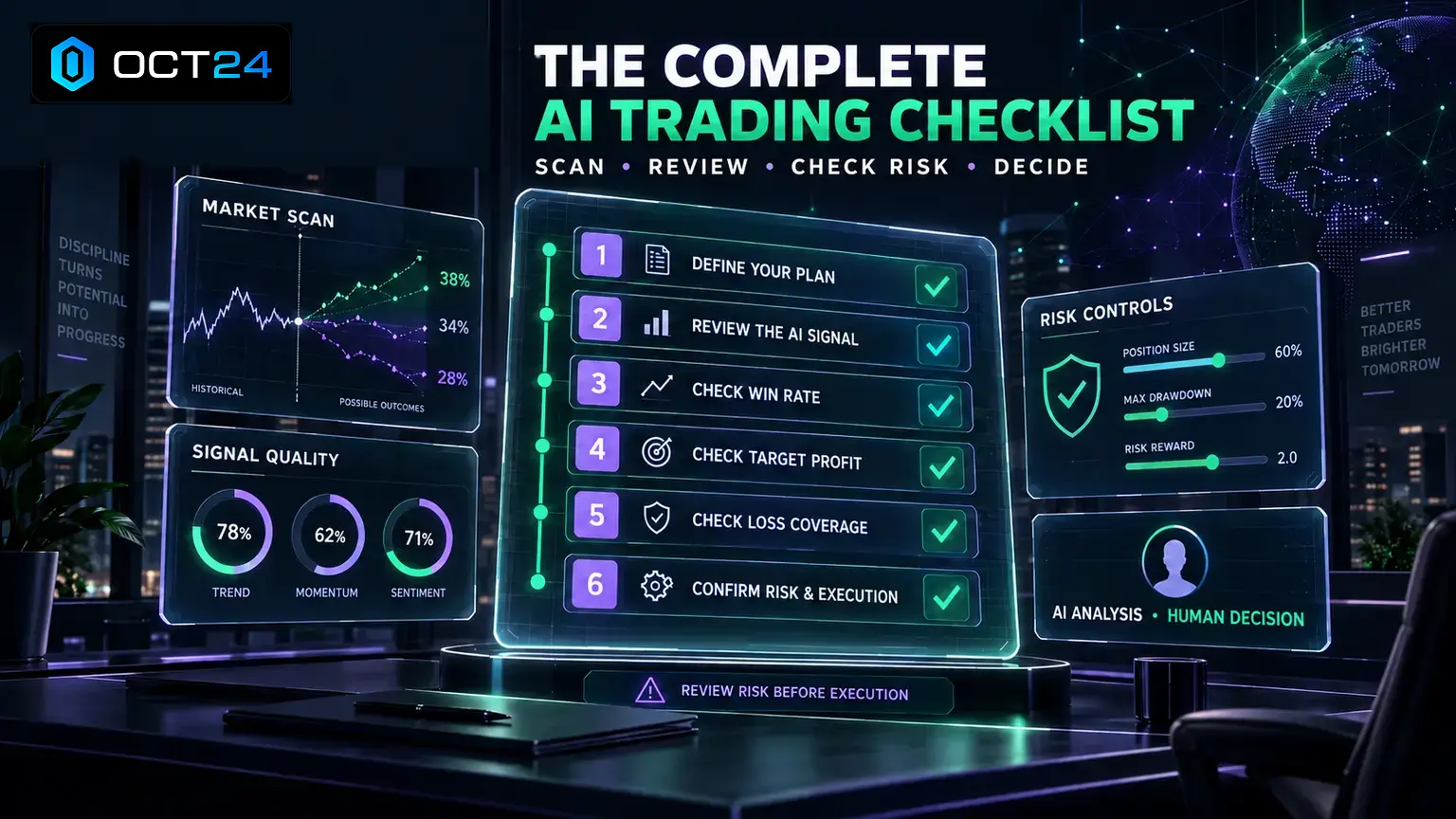
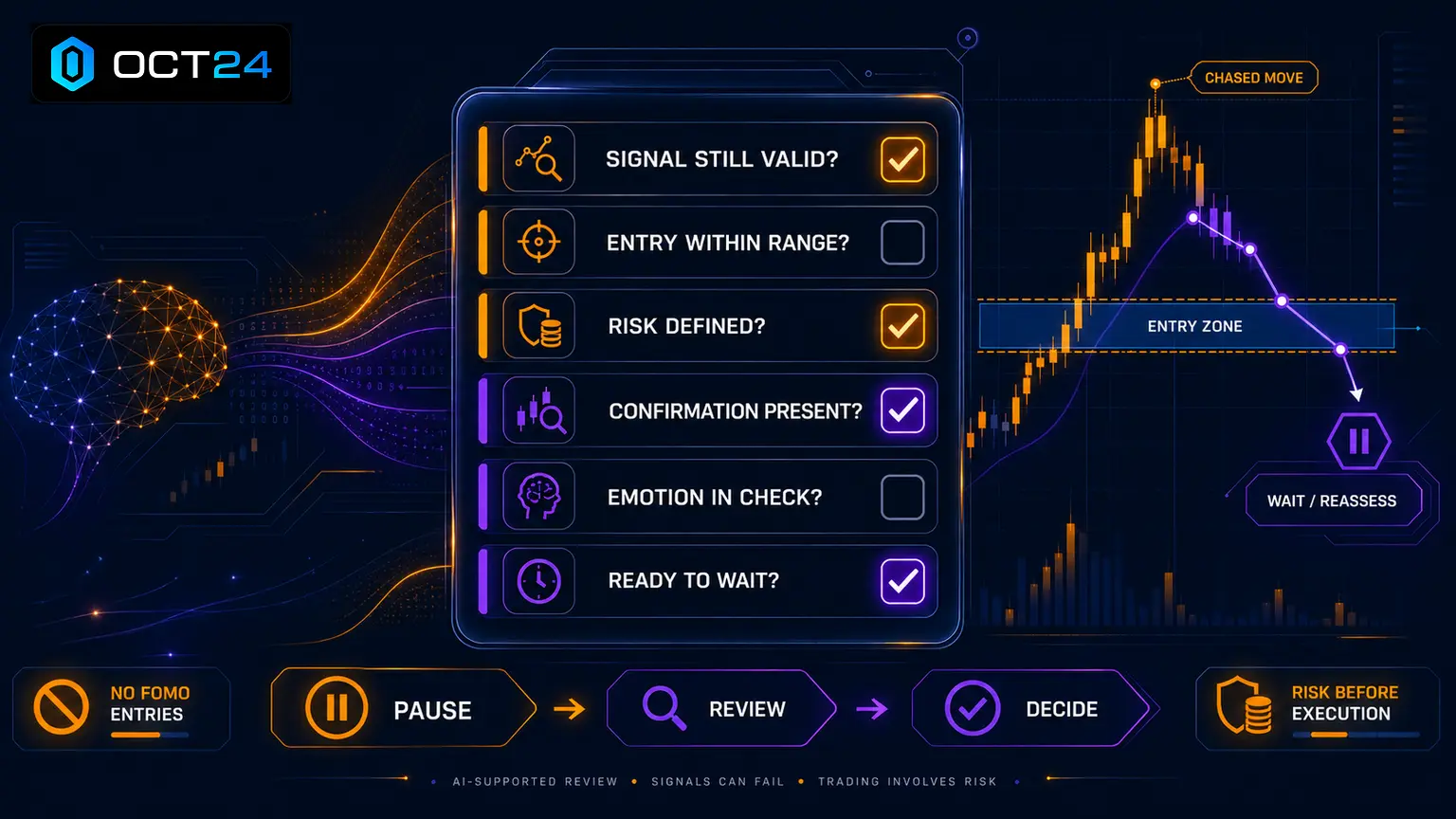
Before acting on an AI-supported signal, use a short checklist. It does not need to be complicated. It just needs to interrupt emotional decision-making.
Ask yourself:
- Do I understand the displayed target profit?
- Do I understand the displayed loss coverage?
- Have I reviewed the win rate without treating it as a guarantee?
- Does this trade fit my account size?
- Am I risking more than I normally would?
- Am I reacting to market speed or following a plan?
- Would I be comfortable if this trade lost?
- Have I taken too many trades today?
How This Supports Busy Traders
AI trading for busy professionals is not about replacing every decision. It is about reducing the amount of time needed to find and review potential opportunities.
A busy trader may not have hours to scan charts, compare assets, and monitor every market rotation. OCT24’s simplified signal experience can help by bringing selected opportunities into view without requiring constant manual analysis.
That does not mean the trader should click automatically. It means the trader can spend less time searching and more time reviewing whether the opportunity fits their risk plan.
This distinction is important. The benefit is not mindless speed. The benefit is a simpler decision workflow.
When Passing on a Signal Is the Right Decision
Passing on a signal can feel frustrating, especially if the trade later works. But discipline is not measured by whether one missed trade would have won.
Discipline is measured by whether your decisions match your rules over time.
There are many valid reasons to skip a signal. You may already have enough exposure. The loss coverage may not fit your comfort level. The win rate may not be enough to justify the risk. Or you may simply feel too emotional to make a calm decision.
Skipping a trade is not failure. It is part of trading.
This is one reason OCT24’s simplified metrics can be useful. They give the trader a faster way to say yes or no, but the choice still belongs to the trader.
How to Review Results Without Chasing the Next Trade
After a trade ends, the next risk is emotional reaction. A winning trade can create overconfidence. A losing trade can create urgency to recover.
Both reactions can lead to chasing.
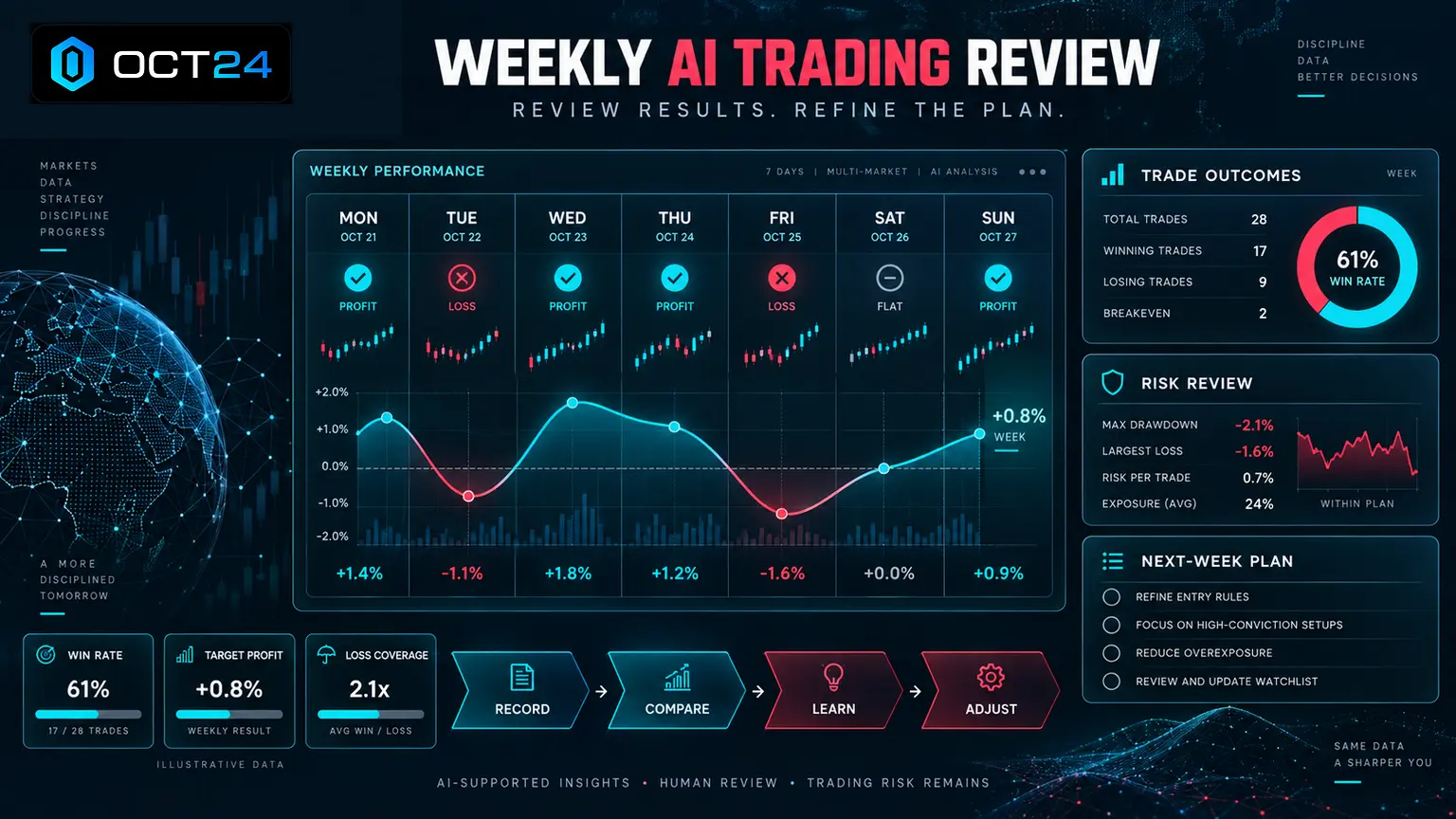
Review each result as data. Ask whether the decision followed your plan, not just whether the result was positive or negative.
This is where AI trading performance review becomes useful. Over time, you want to understand whether your signal review process is improving your discipline.
Track simple notes such as:
- Did I follow my risk rules?
- Did I enter because of the signal or because of emotion?
- Did the target profit and loss coverage fit my account?
- Did I take too many trades in one session?
- Did I feel rushed?
FAQs
What does it mean to use AI trading signals without chasing the market?
It means using signals as structured decision support instead of reacting emotionally to fast price movement. The trader reviews the risk, metrics, and account fit before deciding whether to act.
Can AI trading signals stop me from making emotional trades?
AI trading signals can help reduce noise and support a more structured process, but they cannot control your behavior. You still need rules, position sizing, and discipline.
Does OCT24 show exact entry and exit points for every trade?
OCT24 currently presents a simplified user experience focused on key metrics such as target profit, loss coverage, and win rate. It does not show a full asset breakdown or detailed entry and exit explanation for each trade inside the platform experience.
Are AI trading signals guaranteed to be profitable?
No. AI trading signals are not guaranteed. They may help identify potential opportunities, but trading always involves risk and uncertain outcomes.
How should beginners review an AI trading signal?
Beginners should review target profit, loss coverage, win rate, account size, risk tolerance, and current exposure before acting. If the setup does not fit the plan, skipping the trade is reasonable.
Can one-click trading make chasing worse?
It can if the trader clicks before reviewing risk. One-click trading is most useful when the trader has already made a clear, responsible decision.
How does OCT24 help with signal review?
OCT24 performs much of the market scanning and opportunity identification behind the scenes, then presents AI-supported signals through a simplified review format. Traders still decide whether the displayed risk and reward profile fits their plan.
Should I take every AI trading signal?
No. Taking every signal can lead to overtrading and poor risk control. A signal should be reviewed, not automatically followed.
Where can I learn more about OCT24?
You can visit About OCT24 to understand the platform’s approach, or Start Trading with OCT24 when you are ready to create an account and explore the platform.
Final Thoughts
AI trading signals can make trading feel faster and more organized, but they work best when paired with patience. The goal is not to chase every move. The goal is to review opportunities with more structure and less emotion.
OCT24 supports this process by scanning market conditions, identifying potential opportunities, and presenting AI-supported trading signals through simplified metrics such as target profit, loss coverage, and win rate.
That simplicity can help traders focus, but it does not remove risk. The trader still controls risk settings, exposure, capital allocation, and execution decisions.
The best way to use signals is to slow the decision down just enough to make it responsible. Review the metrics. Check your exposure. Respect your limits. Then decide whether the trade deserves action.
Used this way, AI-supported signals can become part of a more disciplined trading routine instead of another reason to chase the market.
To learn more about the platform, visit OCT24, review About OCT24, or Start Trading with OCT24 when you are ready to explore AI-supported one-click trading with a clear risk-first mindset.