
AI Trading and Stop-Loss Planning
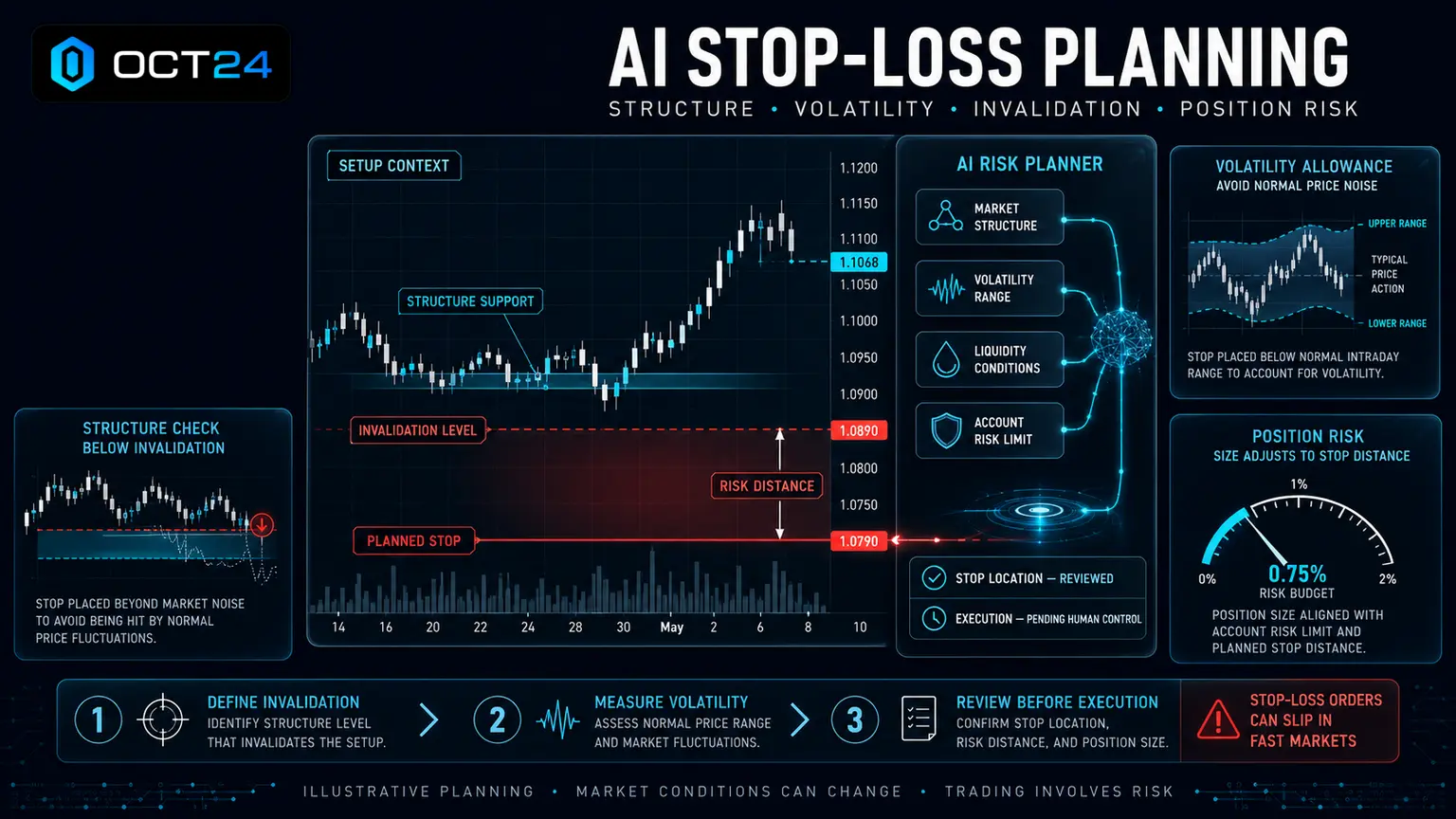
AI trading and stop-loss planning are closely connected because every trade needs a clear way to manage downside risk before the result is known. A stop-loss is not about predicting failure. It is about deciding how much risk is acceptable if the market moves against the setup.
In traditional manual trading, the trader usually chooses where a stop-loss should sit. On OCT24, users do not manually plan stop-loss levels themselves. The AI bot handles stop-loss planning as part of the trade structure, while the user reviews the available information, including target profit, loss coverage, and win rate.
That distinction matters. OCT24 performs most of the market analysis by scanning market conditions, identifying potential opportunities, and presenting AI-supported trading signals. It does not remove trading risk or guarantee results. Traders still need to manage exposure, capital allocation, and execution decisions responsibly.
What Stop-Loss Planning Means in AI Trading
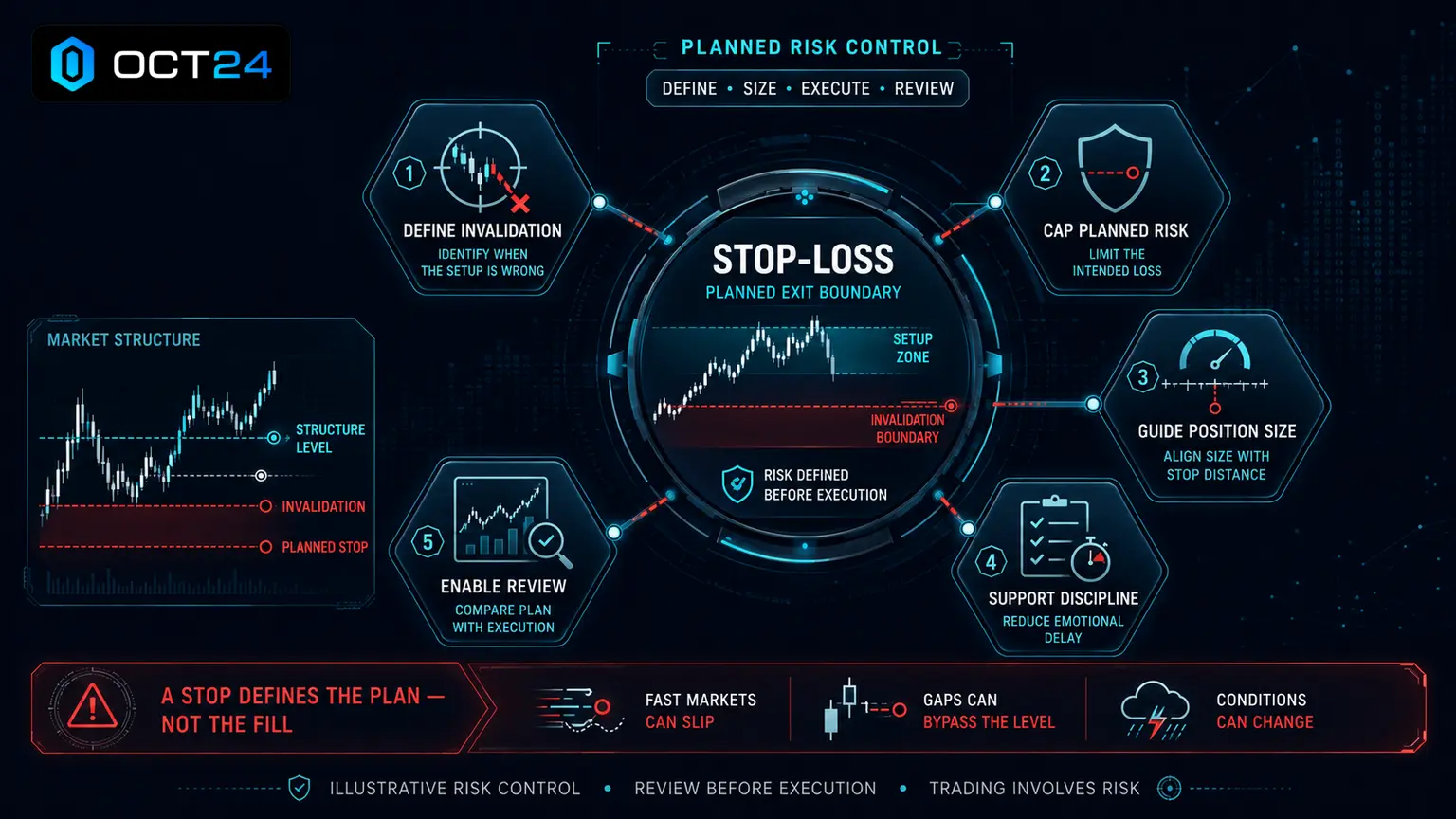
Stop-loss planning is the process of deciding how a trade should respond if price moves the wrong way. It is one of the most important parts of trading risk management because it keeps a single trade from becoming an uncontrolled problem.
A stop-loss does not make a trade safe. It simply creates a risk boundary. That boundary may be based on price structure, volatility, strategy rules, or a bot’s internal logic.
In AI trading, stop-loss planning can be handled by automated systems rather than by the trader drawing a level on a chart. This is useful for beginners who may not know where a stop-loss should go, but it also means users need to understand what information is visible to them.
With OCT24, the user is not manually choosing the stop-loss level. Instead, the AI bot plans the risk structure behind the trade. The user sees simplified decision information, including target profit, loss coverage, and win rate.
The practical point is simple: the bot may handle the stop-loss planning, but the trader still decides whether the trade fits their balance, comfort level, and risk tolerance.
Why Stop-Loss Planning Matters Before Any Trade
Many traders focus first on potential profit. That is natural. A trade becomes exciting because of what it might gain.
Risk planning asks a different question: what happens if the idea is wrong? This question is less exciting, but it is often more important.
Good stop-loss planning helps traders avoid emotional decisions after the trade starts. Without a risk plan, a trader may hold too long, add more capital at the wrong time, or close the trade too early because of fear.
This is one reason trading bot risk management has become such an important topic. Automated systems can apply rules consistently, while human traders often struggle when real money and fast market movement are involved.
A stop-loss plan gives the trade a defined structure. It does not guarantee the best outcome, but it reduces the chance that one trade becomes a decision made purely by emotion.
Manual Stop-Loss Planning vs AI Bot Stop-Loss Planning
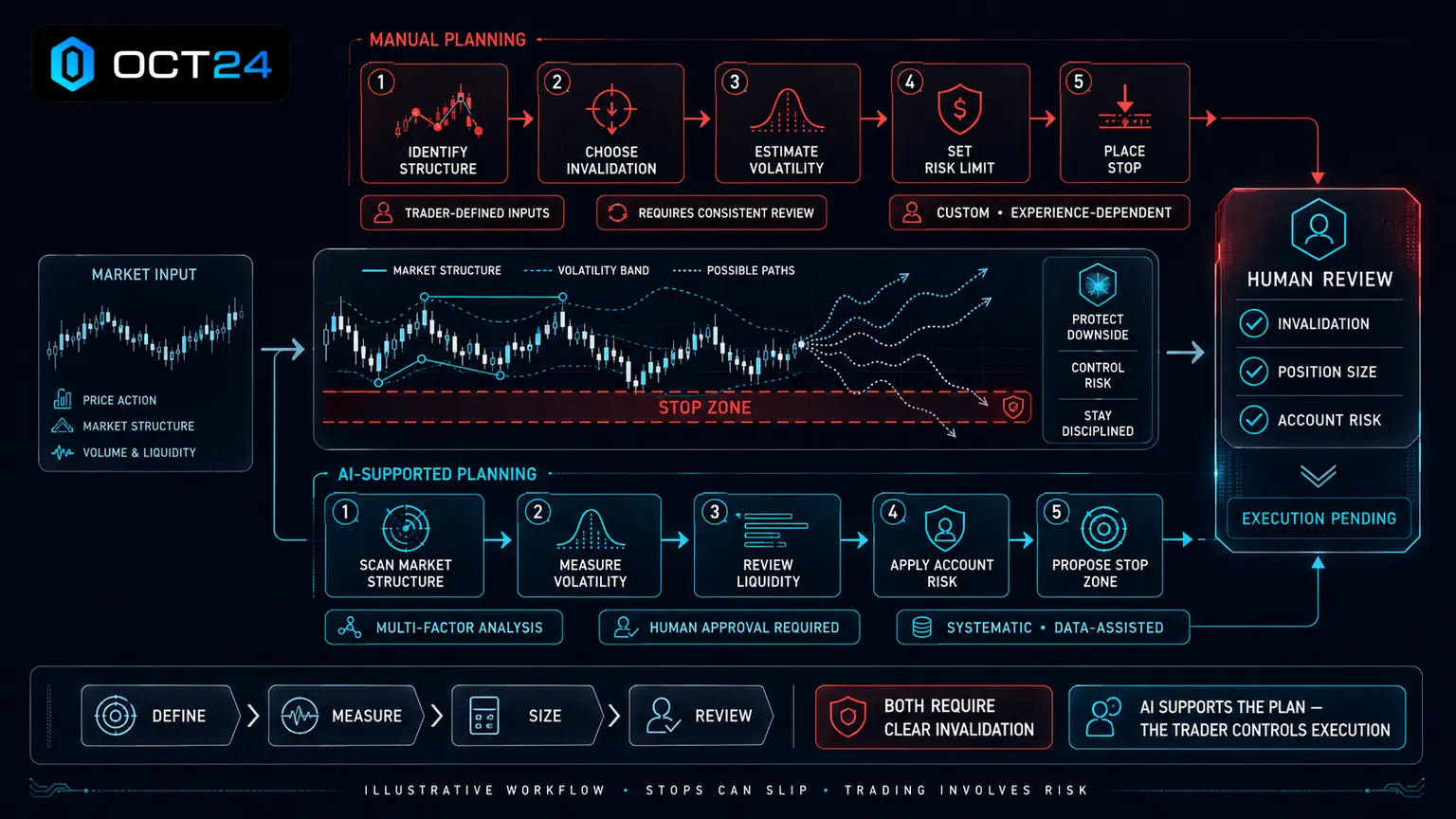
Manual stop-loss planning usually requires chart reading. A trader may look for support, resistance, recent volatility, candle structure, or a fixed percentage loss limit.
This can work well for experienced traders, but it can be difficult for beginners. A stop-loss that is too tight may be triggered by normal market movement. A stop-loss that is too wide may create too much loss if the trade fails.
AI bot stop-loss planning uses a more automated process. Instead of asking the user to choose the exact level, the bot applies its own risk logic as part of the trade structure.
This is one of the differences between AI trading vs manual trading. Manual trading gives the user more direct control over every detail. AI-supported trading can simplify the workflow by handling analysis and risk structure automatically.
OCT24 fits into the second category. The user does not plan the stop-loss manually. The bot handles that planning, and the user reviews the trade through available metrics before deciding whether to proceed.
How OCT24 Handles Stop-Loss Planning
OCT24 is designed to make AI-supported trading easier to access. The platform does most of the market scanning and analysis for the user, then presents trading opportunities through its bot experience.
When a trade or bot opportunity is presented, the user does not receive a full manual trading ticket with detailed asset research, exact entry levels, and exact exit levels. The experience is more simplified.
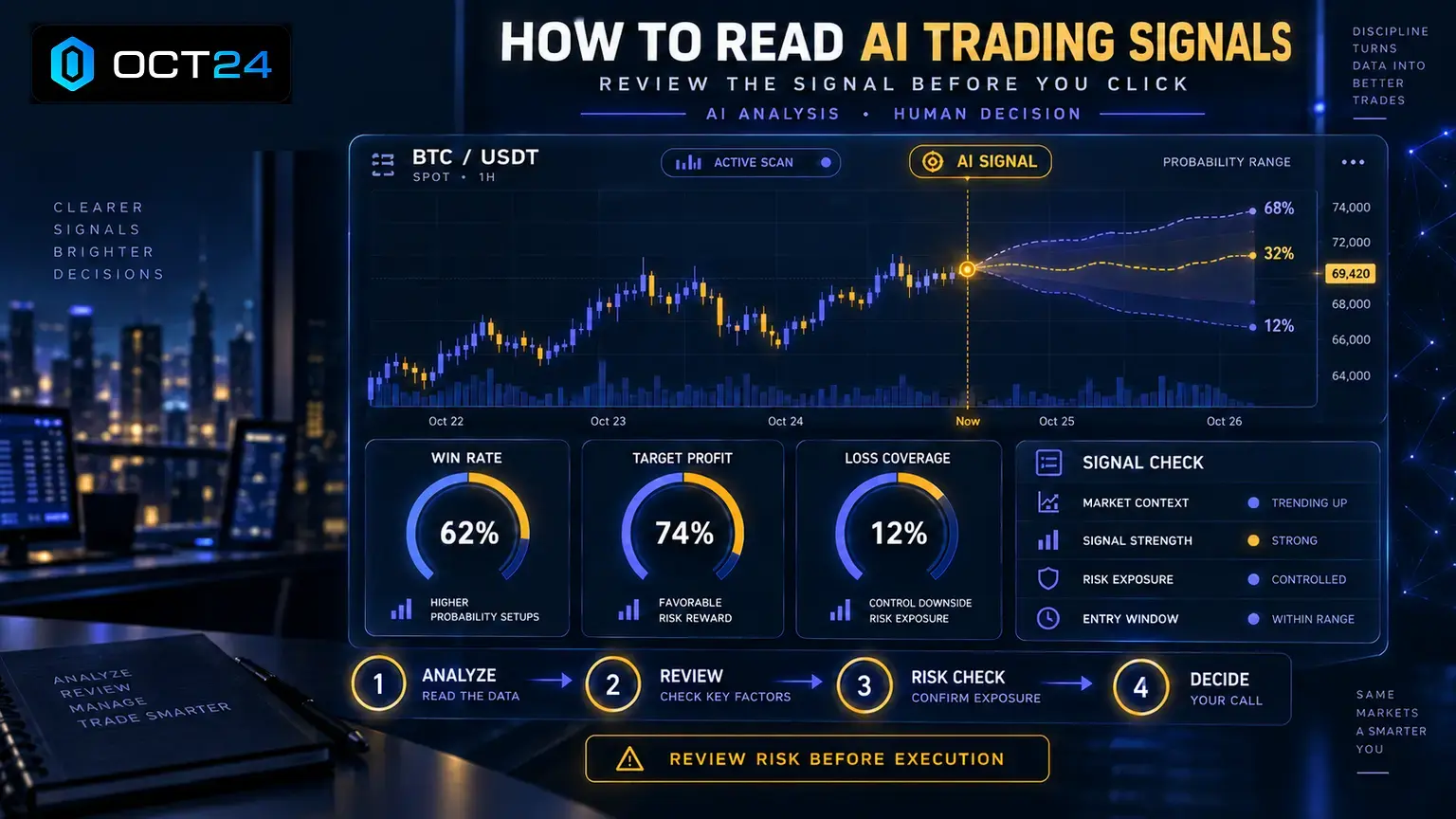
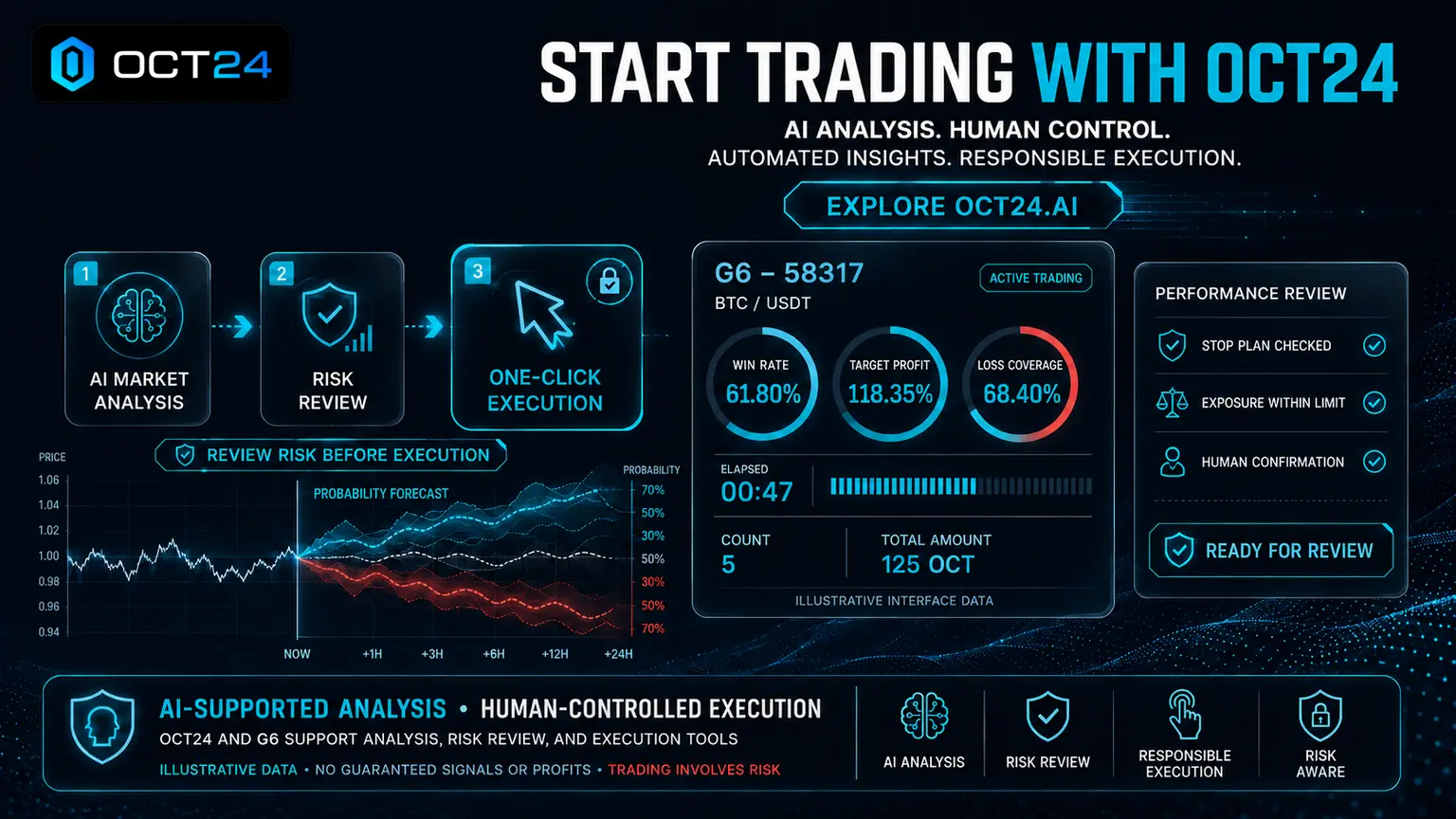
The key information users can review includes target profit, loss coverage, and win rate. These details help the user think about potential reward, downside coverage, and the trade or bot’s stated performance profile.
For stop-loss planning specifically, the important detail is that OCT24’s AI bot handles the stop-loss structure. Users are not expected to manually choose a stop-loss level inside the platform.
This can make the process easier, but it should not make users careless. A bot-planned stop-loss does not remove market risk. It only means the stop-loss planning is handled inside the bot’s structure rather than manually by the user.
What Loss Coverage Tells the Trader
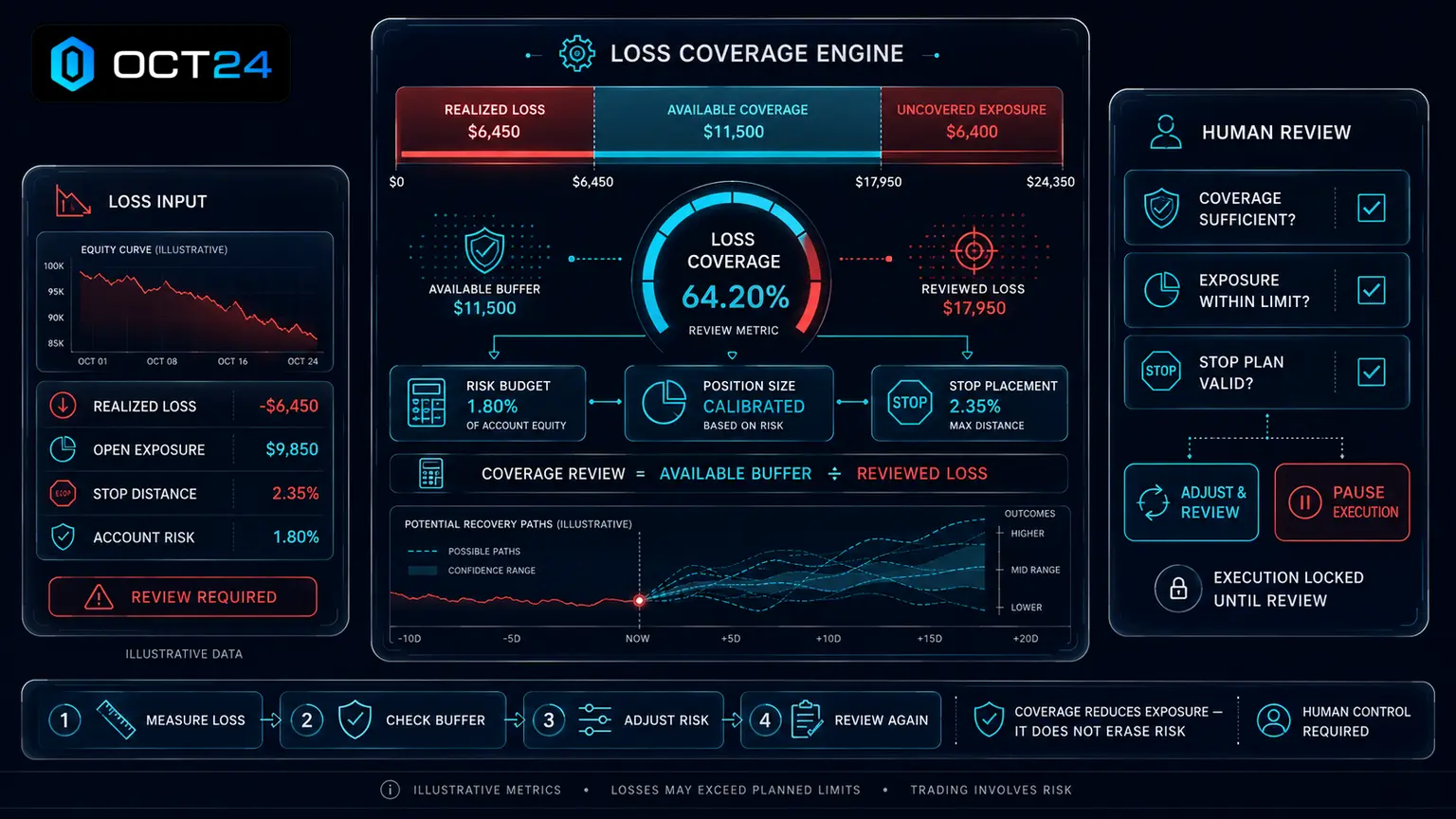
Loss coverage is one of the most important details for OCT24 users to review because it gives context around downside handling. It helps users understand how the trade or bot presents risk protection within its structure.
Loss coverage should not be read as a guarantee that losses cannot happen. Markets can move quickly, and trading always carries uncertainty.
A better way to think about loss coverage is this: it is part of the trade’s risk information. It helps the user decide whether the available setup fits their own account and comfort level.
For example, two traders may see the same OCT24 opportunity. One trader may feel the risk is acceptable for their balance. Another may decide the exposure is too large. Both decisions can be reasonable because risk tolerance is personal.
The bot handles the stop-loss planning, but the user still decides how much capital to commit and whether the trade makes sense for them.
Target Profit Should Be Reviewed With Risk
Target profit is often the number that attracts the most attention. It tells the user what the trade is aiming for if the setup works.
The mistake is looking at target profit alone. A trade with an appealing target can still be unsuitable if the risk is too large, the user is overexposed, or the trader is acting out of impatience.
This is where AI trading risk vs reward becomes important. Traders should compare the potential outcome with the possible downside and the size of their account.
On OCT24, target profit should be reviewed alongside loss coverage and win rate. Those three details give a cleaner picture than any single number.
A target profit is not a promise. It is the trade’s objective. The trader still needs to decide whether the objective is worth the risk.
Win Rate Does Not Replace Stop-Loss Thinking
Win rate can be useful, but it can also create a false sense of security. A high win rate does not mean a trade is risk-free.
A strategy may win often but still experience sharp losses when conditions change. Another strategy may win less often but manage downside better.
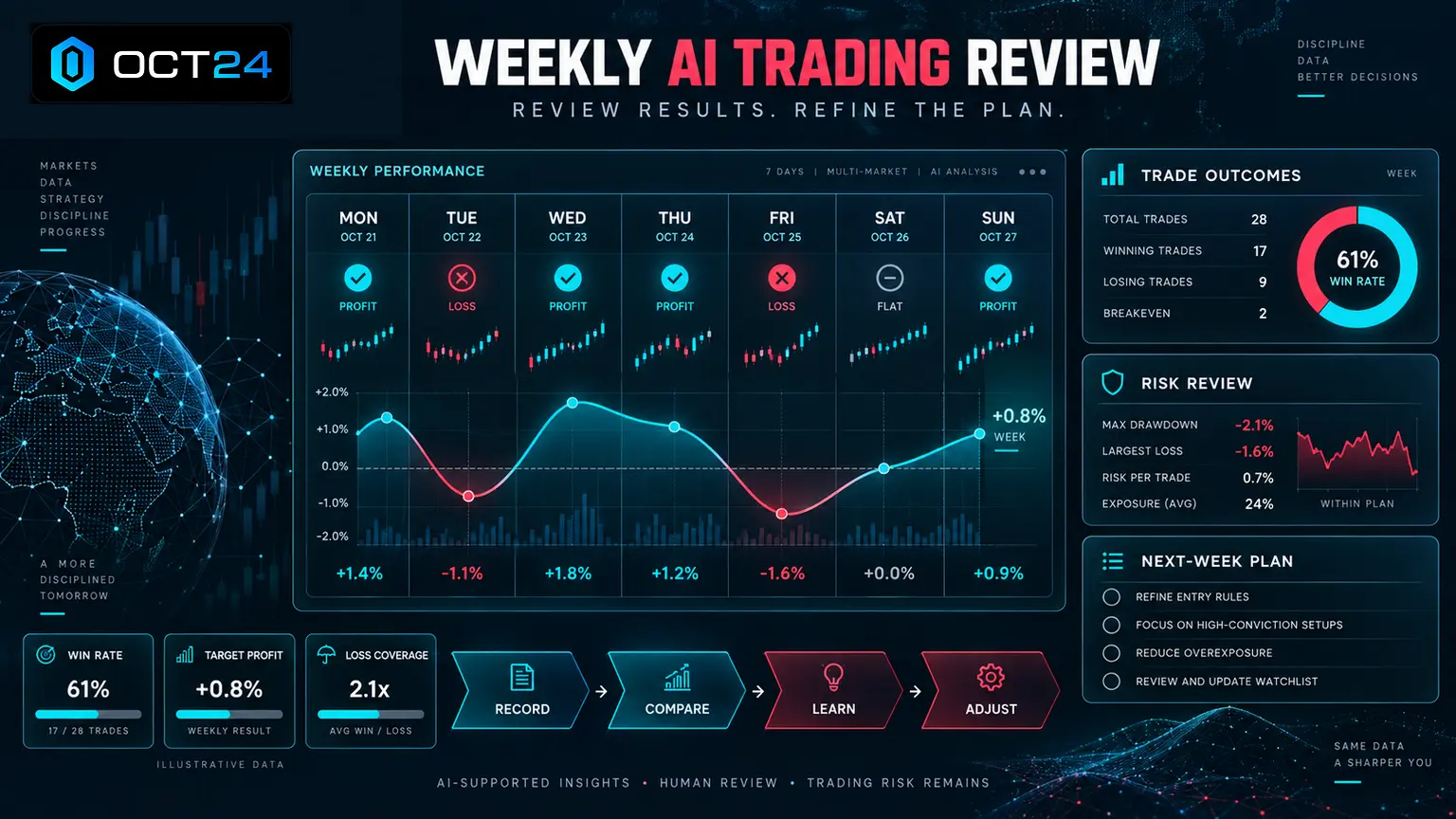
This is why AI trading performance should be reviewed over time. Traders should look at consistency, drawdowns, risk exposure, and whether the trade style fits their own account plan.
Win rate is one part of the decision. Loss coverage, target profit, account size, and emotional discipline also matter.
When users treat win rate as the only decision point, they may ignore the real purpose of stop-loss planning, which is to manage what happens when a trade does not work.

How AI Uses Market Conditions to Support Risk Planning
AI systems can scan market behavior faster than most people can. They can compare price movement, volatility, trend quality, and other conditions when assessing a trading opportunity.
This connects with how AI uses technical analysis. AI does not need to stare at one chart at a time. It can process multiple signals and look for patterns that may support or weaken a trade idea.
In stop-loss planning, market conditions matter because different environments need different risk logic. A calm market does not behave like a volatile market. A trending market does not behave like a sideways market.
OCT24 uses AI-supported analysis to help present opportunities without requiring the user to manually scan the market. The bot handles the internal trade structure, including stop-loss planning.
The user still needs to understand that AI can support decision-making, but it cannot guarantee that the market will behave as expected.
Stop-Loss Planning During Volatile Markets
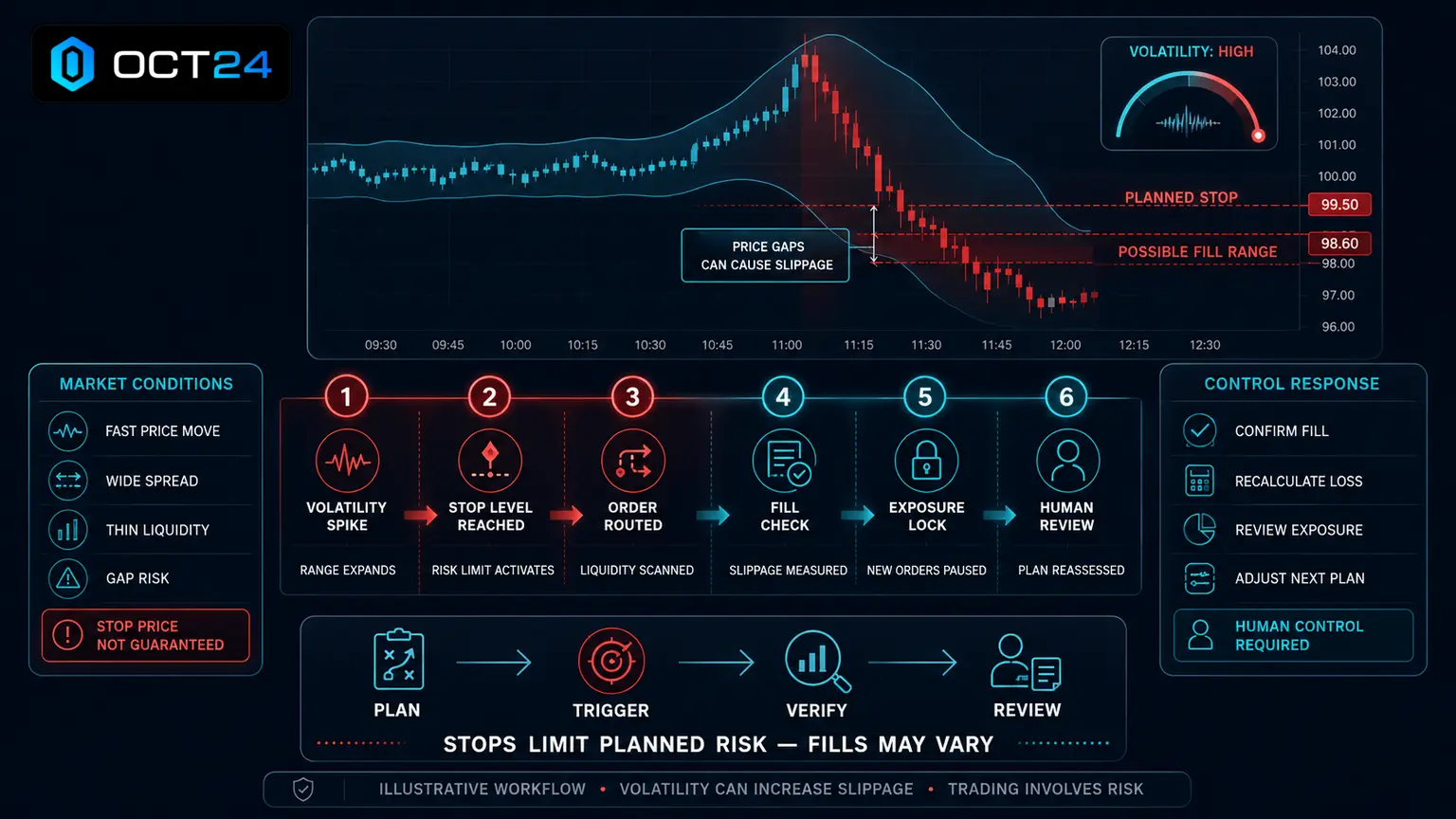
Volatility makes stop-loss planning more important because prices can move quickly in both directions. A trade may look strong, then reverse sharply after news, liquidation activity, or sudden changes in market sentiment.
In volatile crypto markets, a stop-loss that is too tight may be triggered by ordinary noise. A stop-loss that is too wide may expose the trader to more downside than they expected.
AI can help by adapting its analysis to changing market conditions. This is related to how AI handles market volatility. The system can scan market behavior and identify opportunities based on conditions that may change quickly.
On OCT24, the bot handles the stop-loss planning, so users are not manually adjusting levels during volatile conditions. Even so, users should still be careful with exposure because volatility can make outcomes less predictable.
A responsible trader does not assume that automation removes risk. They review the available trade information and decide whether the trade still fits their risk comfort.
Stop-Loss Planning During Sideways Markets
Sideways markets create a different risk problem. Price may move back and forth without clear direction, which can trigger weak signals and short-lived moves.
AI trading during sideways markets requires selectivity because not every movement deserves action. A trade can appear active without having enough follow-through.
In a manual trading environment, a trader might place a stop-loss near the edge of a range. But if the market keeps moving sideways, the trade may be stopped out before any real trend begins.
With OCT24, users are not manually setting the stop-loss. The bot handles that structure. The user’s job is to review whether the opportunity, target profit, loss coverage, and win rate make sense for their own risk plan.
Sometimes the best decision is to skip a trade if the available setup does not feel clear enough.
How Stop-Loss Planning Helps Manage Drawdowns
Drawdown is the decline from a previous account high to a lower point. Every trader experiences drawdowns at some stage because not every trade can win.
Understanding drawdown in trading helps users think about risk beyond one single trade. A stop-loss plan may reduce the damage from one position, but repeated losses can still affect the account.
AI can help manage drawdowns by applying structure and reducing emotional decision-making. That does not mean drawdowns disappear. It means the trader may have a more organized process for dealing with them.
OCT24’s bot-planned stop-loss structure can support this process, but users still need to control how much capital they put at risk. Overexposure can turn normal losses into larger account stress.
The goal is not to avoid every drawdown. The goal is to manage drawdowns before they become difficult to recover from.
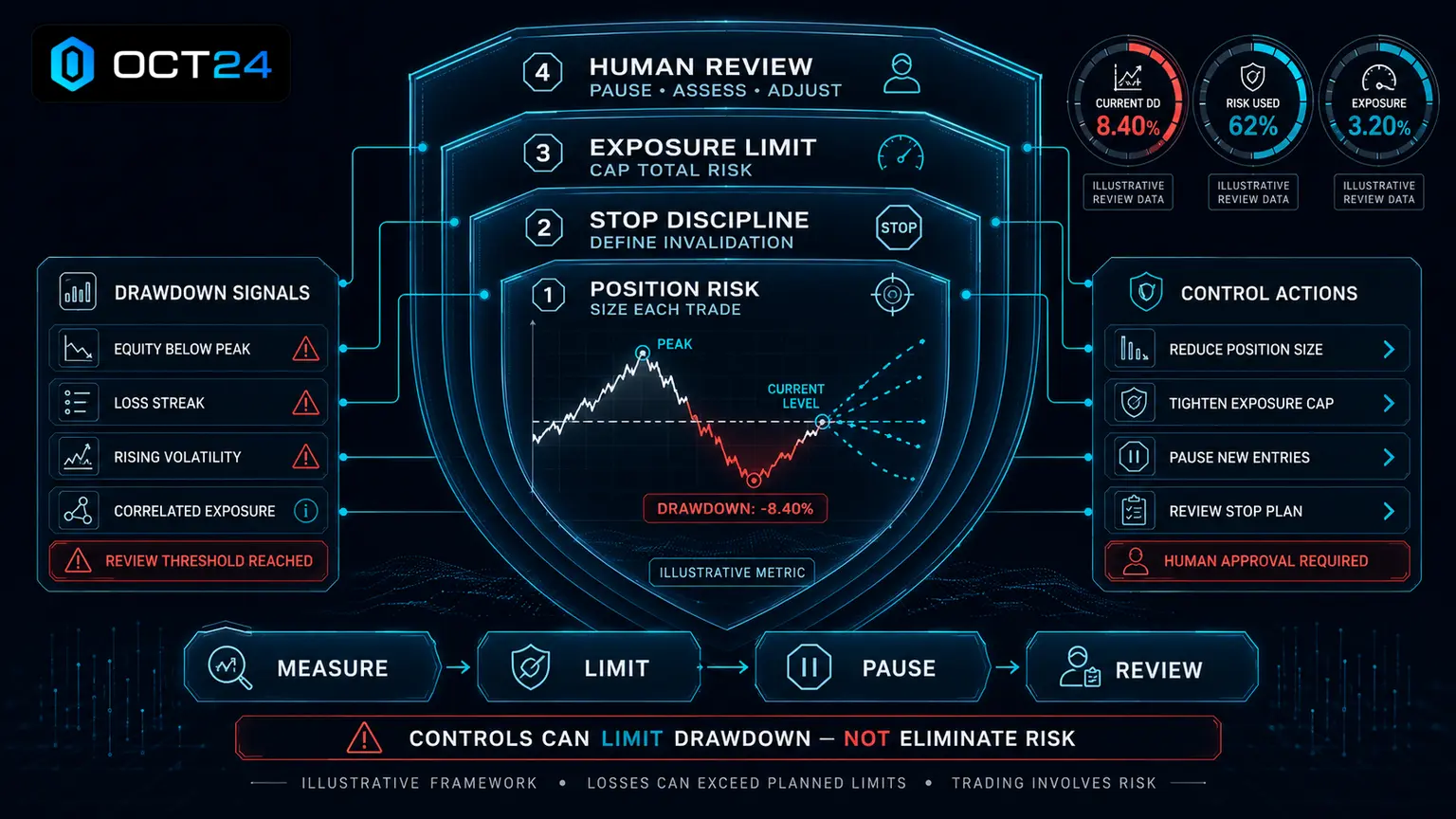
Position Size Still Matters When the Bot Plans the Stop-Loss
Some traders assume that if a bot handles stop-loss planning, position size becomes less important. That is a mistake.
Position size decides how much money is affected by the trade. Even a well-structured stop-loss can produce uncomfortable results if the trader commits too much capital.
This is why risk settings, exposure, and capital allocation remain user responsibilities. OCT24 can simplify analysis and trade structure, but it cannot decide what level of account risk is personally suitable for every user.
A beginner-friendly approach is to start smaller, observe how trades behave, and avoid increasing exposure just because one opportunity looks attractive.
Stop-loss planning is only one part of risk control. Position size decides how meaningful that stop-loss becomes to the user’s account.
How Stop-Loss Planning Reduces Emotional Trading
Emotional trading often starts when there is no clear risk plan. If the market moves against a trader, they may freeze, hope, or make a rushed decision.
AI-supported stop-loss planning can reduce some of this pressure because the trade has a built-in structure. The user does not need to manually decide where to cut risk after the trade is already moving.
This is one reason traders study avoid overtrading. When people feel emotional, they often enter too many trades or increase risk after a loss.
OCT24’s simplified bot experience can help reduce decision fatigue by presenting structured trade information. But discipline still matters. A user can still overcommit capital, take too many trades, or ignore their own account limits.
The best use of automation is not to trade without thinking. It is to make the decision process more structured and less reactive.
Where the G6 Trading Bot Fits
The G6 Trading Bot is part of the OCT24 trading bot experience. It is designed around simple, fast user interaction with AI-supported trading opportunities.
For stop-loss planning, the key point is that the bot handles the internal risk structure. Users do not manually select a stop-loss level before execution.
That can make the process easier for beginners, but it also makes review discipline important. The user should look at target profit, loss coverage, and win rate before deciding whether the trade fits their risk tolerance.
The G6 Trading Bot should not be treated as a guarantee of profit. It is a tool within the OCT24 experience, and trading risk remains part of every decision.
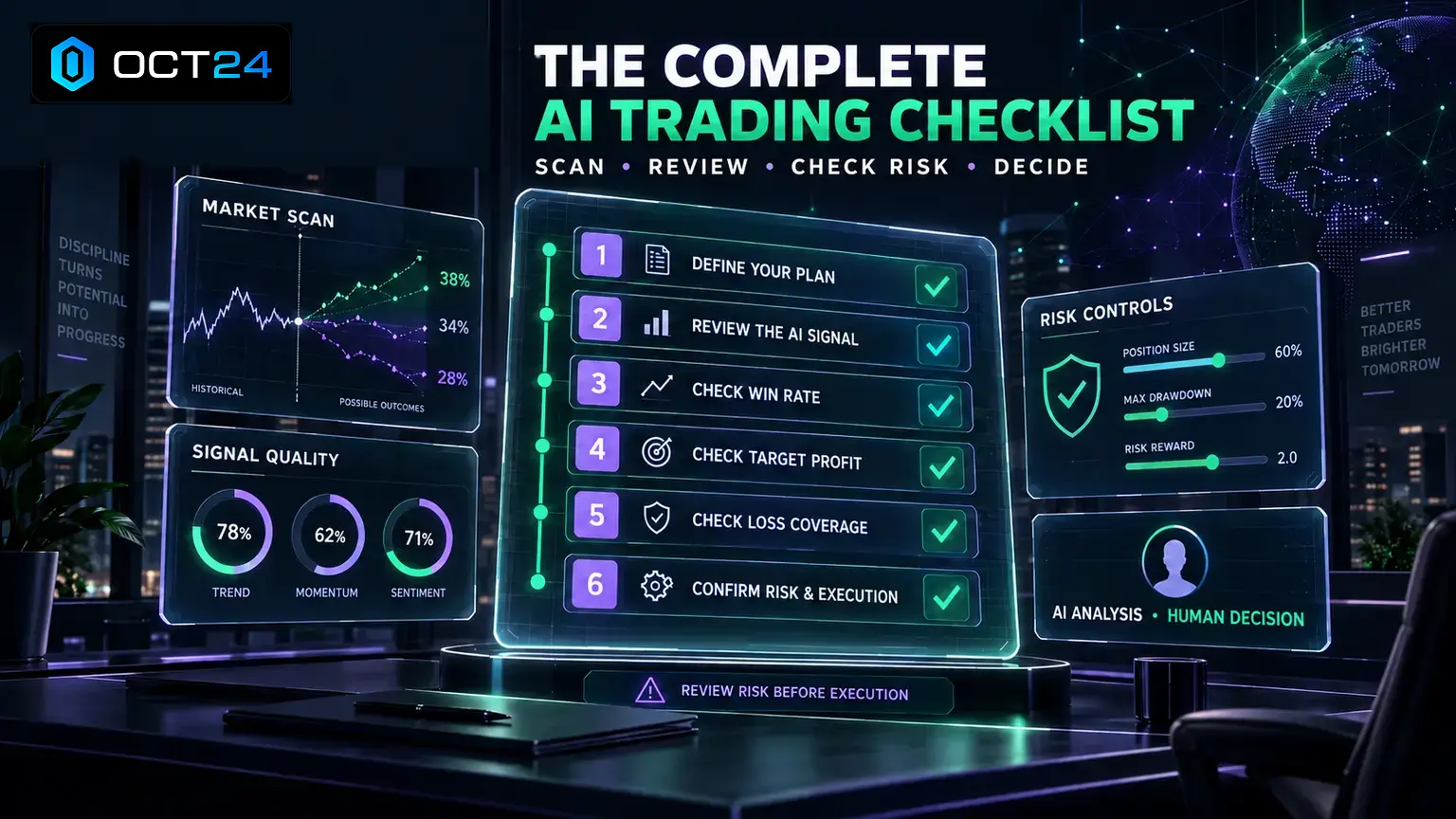
A Simple OCT24 Stop-Loss Planning Checklist
Because OCT24 users do not manually set stop-loss levels, the review process should focus on the information users can actually see and control.
Before acting on an OCT24 trading opportunity, review these questions:
- Do I understand the target profit?
- Have I reviewed the loss coverage?
- Does the win rate fit the risk profile?
- Is my exposure reasonable for my account?
- Am I comfortable with the possible downside?
- Am I taking this trade because it fits my plan, not because I feel rushed?
- Would I still accept this risk after a previous loss?
- Do I understand that the bot handles stop-loss planning, but I still control execution?
This checklist keeps the focus on practical decision-making. The user is not choosing the stop-loss level. The user is deciding whether the bot-planned trade structure is suitable for their own risk comfort.
Common Mistakes With AI Stop-Loss Planning
The biggest mistake is assuming that AI removes the need for risk judgment. It does not.
Another mistake is treating loss coverage as a guarantee. Loss coverage is useful information, but users should still think carefully about capital allocation and exposure.
Traders also need to avoid common AI trading mistakes such as overtrusting automation, ignoring account size, increasing risk after a win, or taking trades without reviewing the available details.
A third mistake is assuming that faster execution always improves decision quality. One-click trading can make execution easier, but it should still be used with a clear risk-aware mindset.
Speed is useful when the trade review is disciplined. It is risky when the user clicks because they feel impatient.
How Beginners Should Think About Stop-Loss Planning
Beginners do not need to become technical experts before learning the purpose of stop-loss planning. The basic idea is simple: every trade should have a way to manage downside risk.
AI trading strategies for beginners should always include risk awareness. A strategy is not complete if it only explains how to enter trades and ignores what happens when a trade fails.
OCT24 makes the process simpler because the bot handles stop-loss planning internally. This can reduce complexity for users who do not want to manually calculate stop-loss levels.
But simpler does not mean risk-free. Beginners should start by understanding target profit, loss coverage, win rate, and exposure before using larger amounts of capital.
A good beginner mindset is to treat every trade as uncertain. The goal is not to be right every time. The goal is to keep risk controlled enough to continue learning.
How Stop-Loss Planning Fits Into a Consistent Routine
A consistent trading routine helps traders review risk the same way each time. This prevents random decisions based on mood, recent wins, or fear of missing out.
With OCT24, a routine may be simple. The user reviews the presented opportunity, checks target profit, checks loss coverage, checks win rate, decides exposure, and then chooses whether to execute.
This connects with building a consistent trading routine. The more consistent the review process becomes, the less likely the trader is to make emotional decisions.
Because the bot handles stop-loss planning, the user does not need to add a manual stop-loss workflow. The user’s routine should focus on reviewing the bot’s trade information and managing account-level risk.
That is a practical way to use automation without becoming careless.
FAQs
Does OCT24 allow users to manually plan stop-losses?
No. OCT24 users do not manually plan stop-loss levels inside the platform. The AI bot handles stop-loss planning as part of the trade structure, while users review target profit, loss coverage, win rate, exposure, and execution decisions.
Is AI stop-loss planning risk-free?
No. AI stop-loss planning can help structure risk, but it does not make trading risk-free. Markets can still move unexpectedly, and traders remain responsible for capital allocation and exposure.
What should OCT24 users review before executing a trade?
OCT24 users should review target profit, loss coverage, win rate, account exposure, and whether the trade fits their own risk tolerance before execution.
Does a bot-planned stop-loss guarantee a smaller loss?
No. A bot-planned stop-loss is part of the risk structure, but it cannot guarantee a specific outcome in every market condition.
Why is loss coverage important?
Loss coverage helps traders understand how downside is presented within the trade or bot structure. It should be reviewed as part of the full risk picture, not as a guarantee.
Can beginners use AI trading with stop-loss planning?
Beginners may find AI-supported stop-loss planning easier than manual stop-loss placement, but they still need to understand risk, start carefully, and avoid overexposure.
How does stop-loss planning relate to drawdown?
Stop-loss planning can help limit the impact of individual trades, while drawdown measures the broader decline in an account over time. Traders need to monitor both.
Should win rate be the main decision factor?
No. Win rate should be reviewed alongside target profit, loss coverage, exposure, account size, and personal risk tolerance.
Where can I learn more about OCT24?
You can learn more about the platform through About OCT24 or review AI-supported trading opportunities when you Start Trading with OCT24.
Final Thoughts
Stop-loss planning is not only a technical trading feature. It is a risk discipline. It helps define what happens when a trade does not work as expected.
In manual trading, the trader usually chooses the stop-loss level. With OCT24, the AI bot handles stop-loss planning for the user as part of the trade structure. The user reviews simplified trade information, including target profit, loss coverage, and win rate.
This makes the experience easier, but it does not remove responsibility. The trader still controls exposure, capital allocation, and execution decisions.
Used carefully, OCT24 can help traders interact with AI-supported trading opportunities in a simpler, more structured way. The platform does much of the analysis and presents signals, while the trader stays responsible for managing risk at the account level.
The best approach is balanced. Let the bot handle the stop-loss planning, but do not let automation replace risk judgment.
Learn more at OCT24, read more on About OCT24, or Start Trading with OCT24 when you are ready to review AI-supported trading opportunities with a risk-aware mindset.