
Portfolio Diversification Tools
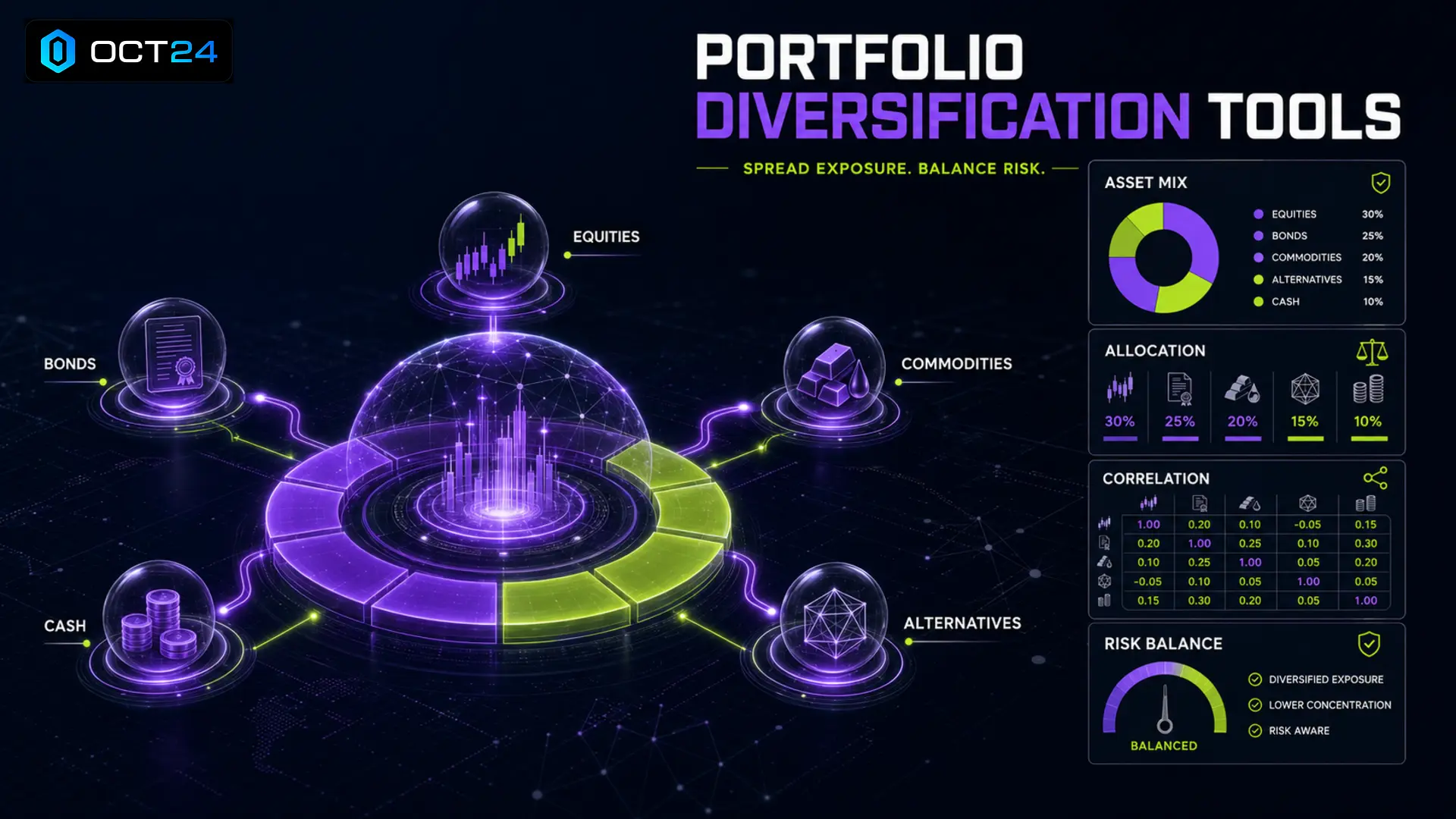
Portfolio diversification tools help traders see how their capital, risk, and trading ideas are spread across different assets, strategies, timeframes, and market conditions. For AI-supported traders, these tools are useful because they make it easier to avoid depending too heavily on one coin, one setup, one bot, or one market trend.
A diversified portfolio is not automatically a safe portfolio. It can still lose money. But when diversification is planned properly, it may help reduce the impact of one weak position, one failed strategy, or one sudden market move.
OCT24 supports this process by scanning market conditions, identifying potential opportunities, and presenting AI-supported trading signals. The platform performs much of the analysis work, while the trader remains responsible for risk settings, exposure, capital allocation, and execution decisions.
What portfolio diversification tools do
Portfolio diversification tools are systems, dashboards, calculators, or platform features that help traders understand where their money is exposed. They show whether a portfolio is balanced or too concentrated in one area.
In simple terms, diversification tools help answer one question: “Am I relying on too few things to go right?”
A trader may think they are diversified because they hold several assets. But if all those assets move in the same direction during a market selloff, the portfolio may still be highly concentrated.
Good diversification is not only about owning more assets. It is about understanding how different parts of a portfolio behave under different conditions.
- A portfolio may be diversified by asset type.
- It may be diversified by trading strategy.
- It may be diversified by timeframe.
- It may be diversified by risk level.
- It may be diversified by market condition.
For example, a trader who only trades high-volatility crypto pairs may have several positions open, but the portfolio may still depend on the same type of market behavior. If momentum suddenly fades, many positions could weaken at the same time.
This is where portfolio diversification tools become useful. They help traders look beyond individual trades and review the bigger picture.
Why diversification matters in AI trading
AI trading can make market analysis faster and more structured, but it does not remove the need for portfolio control. Even when a system identifies strong setups, traders still need to decide how much capital to allocate and how much risk to accept.
If you have already learned the basics of AI trading, the next step is understanding how those signals fit together across your wider account. A strong signal on one asset may be useful. Ten similar signals on highly correlated assets may create hidden concentration.
This matters because markets often move in groups. Crypto assets may rise together during strong risk-on periods and fall together when sentiment weakens. Tech stocks may react to the same macro news. Risk assets may all become more volatile when liquidity changes.
A trader using OCT24 may receive AI-supported trading signals across different opportunities. The value of those signals increases when the trader also understands how each idea affects total portfolio exposure.
That does not mean every trader needs a complex institutional dashboard. Beginner and intermediate traders can start with simple checks.
- How much of my account is exposed to one asset?
- How many open positions depend on the same market direction?
- Am I using similar strategies in every trade?
- Could one sudden market event affect most of my portfolio?
- Do my risk settings match my account size?
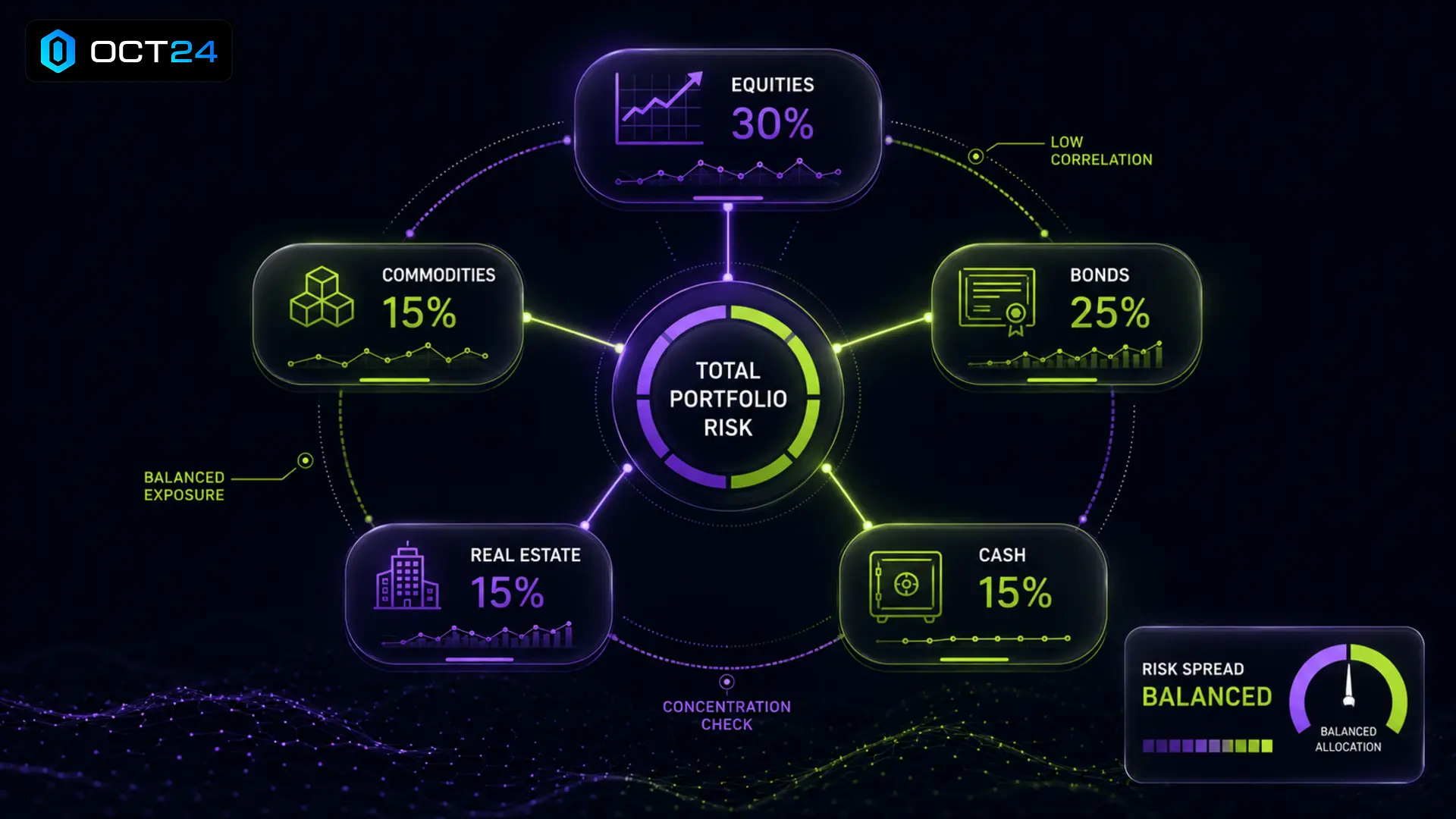
These questions are practical. They also help traders avoid one of the most common AI trading mistakes: treating each signal as separate without reviewing total exposure.
Diversification does not mean trading everything
A common misunderstanding is that diversification means adding more and more positions. That can create the opposite problem. Too many positions can become hard to manage, especially for newer traders.
Diversification is not about collecting trades. It is about building a portfolio where each position has a clear reason to exist.
A trader may be better served by three well-planned positions than by twelve positions that all depend on the same trend. More trades can also increase fees, emotional pressure, and execution mistakes.
This is especially important when using trading bots. A bot can help automate part of the trading process, but the trader still needs to understand whether multiple bot settings are creating overlapping exposure.
For example, if a trader runs several bot strategies that all favor fast-moving bullish setups, the account may be highly exposed during a sudden reversal. The tools may look active, but the portfolio may not be balanced.
OCT24 helps reduce some of the manual analysis burden by scanning market conditions and presenting AI-supported signals. Still, traders should decide which signals fit their current portfolio rather than accepting every opportunity as equally suitable.
The main types of portfolio risk
Before using portfolio diversification tools well, it helps to understand the main types of risk they can reveal.
Asset concentration risk
Asset concentration happens when too much capital is tied to one asset or one small group of similar assets.
For example, a trader may hold Bitcoin, Ethereum, Solana, and several smaller crypto assets. That may look diversified at first. But if the entire crypto market falls, those positions may all lose value together.
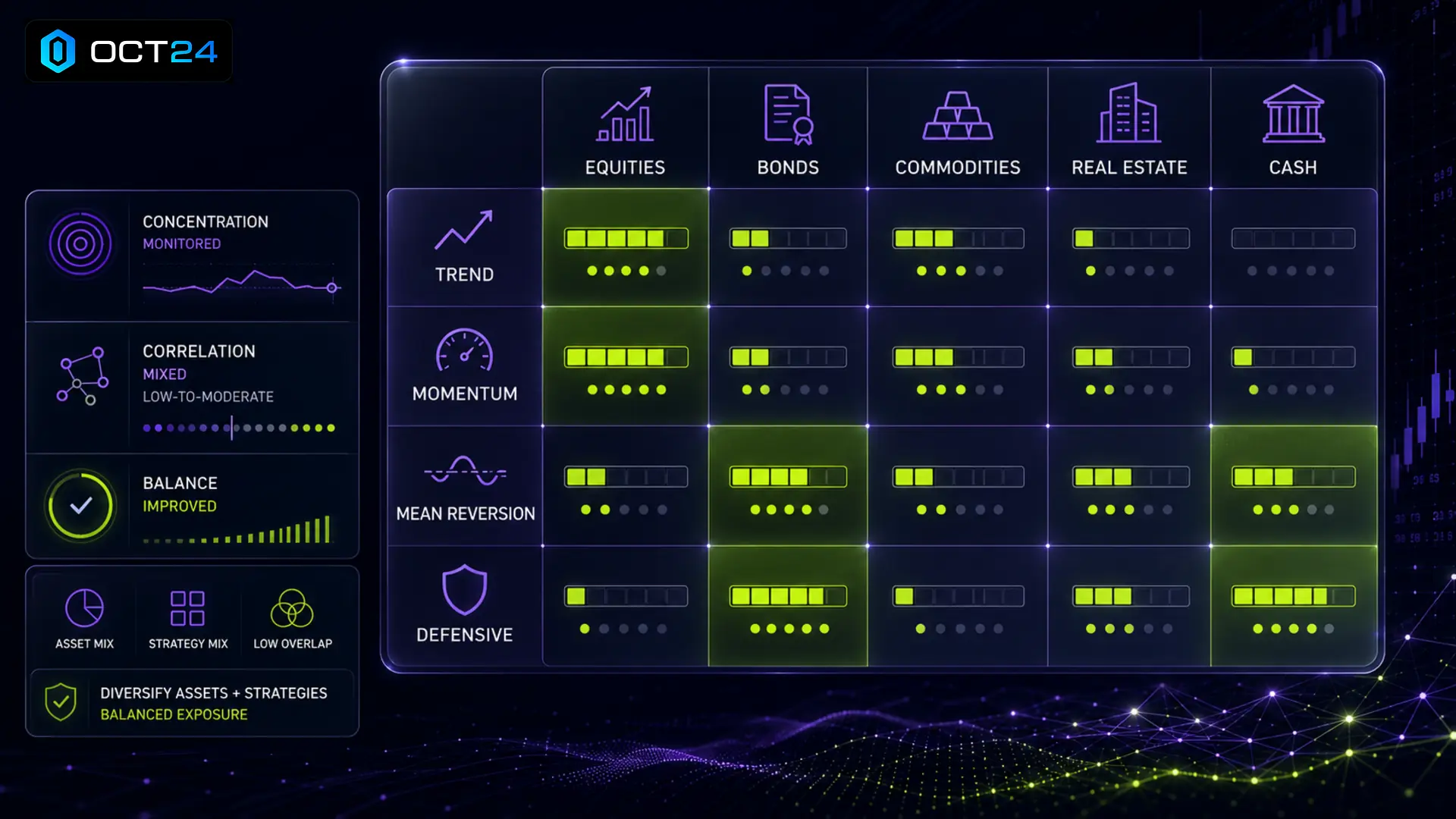
Strategy concentration risk
Strategy concentration happens when most trades depend on the same trading logic. A trader might use breakout setups, momentum entries, or short-term trend-following across many assets.
Even if the assets are different, the portfolio may still be exposed to one type of market behavior.
Timeframe concentration risk
Timeframe concentration happens when every position is built around the same holding period. A trader who only uses short-term setups may react differently to volatility than someone who mixes shorter and longer decision windows.
Market-condition risk
Some strategies perform better in trending markets. Others may work better during range-bound periods. If all positions depend on one environment, the portfolio can struggle when conditions change.
This is why how AI handles market volatility matters. AI-supported tools can help scan changing conditions, but traders still need to review whether their active exposure fits the current market.
How AI can support portfolio diversification
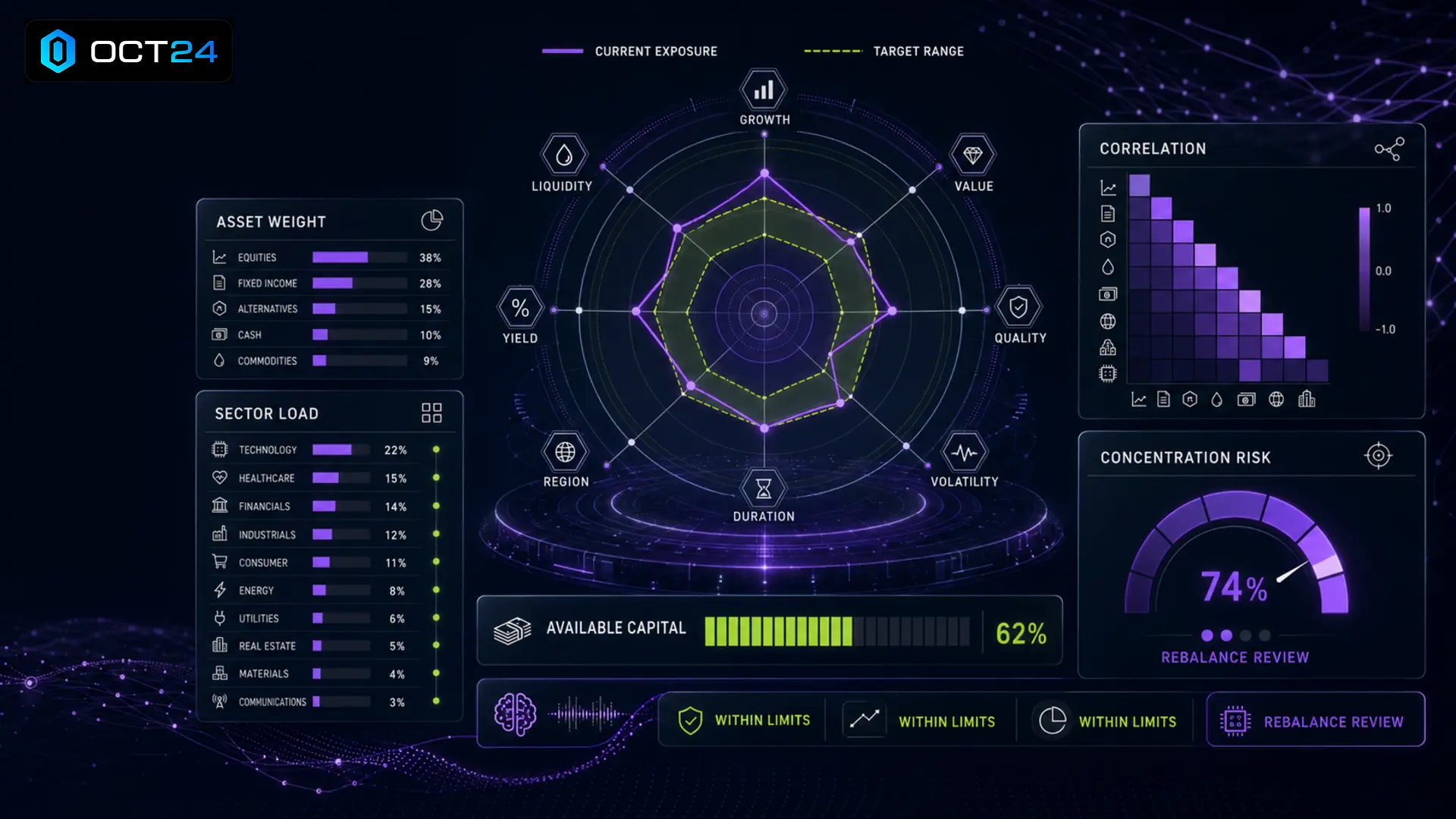
AI can support portfolio diversification by processing more market information than most traders can review manually. It can scan multiple assets, compare price behavior, identify potential setups, and present structured signals for review.
This does not mean AI can perfectly predict the market. The question of can AI predict the market is more nuanced. AI can analyze data and identify patterns, but markets remain uncertain.
For diversification, the main benefit is not prediction. The main benefit is organization.
AI can help traders organize information such as:
- Which assets are showing similar movement.
- Which opportunities appear strongest under current conditions.
- Which signals may overlap with existing exposure.
- Which markets are showing unusual volatility.
- Which setups may require more cautious position sizing.
OCT24 performs much of this analysis by scanning market conditions and identifying potential opportunities. Instead of manually reviewing dozens of charts, traders can use OCT24 to focus on the signals and risk decisions that matter most.
This is especially useful for traders who do not have time to watch markets all day. AI trading for busy professionals is often about reducing analysis overload, not removing responsibility.
A busy trader may use OCT24 to review signals, check whether the opportunity fits their portfolio, set appropriate risk parameters, and then decide whether to act.
Portfolio diversification tools and AI trading signals
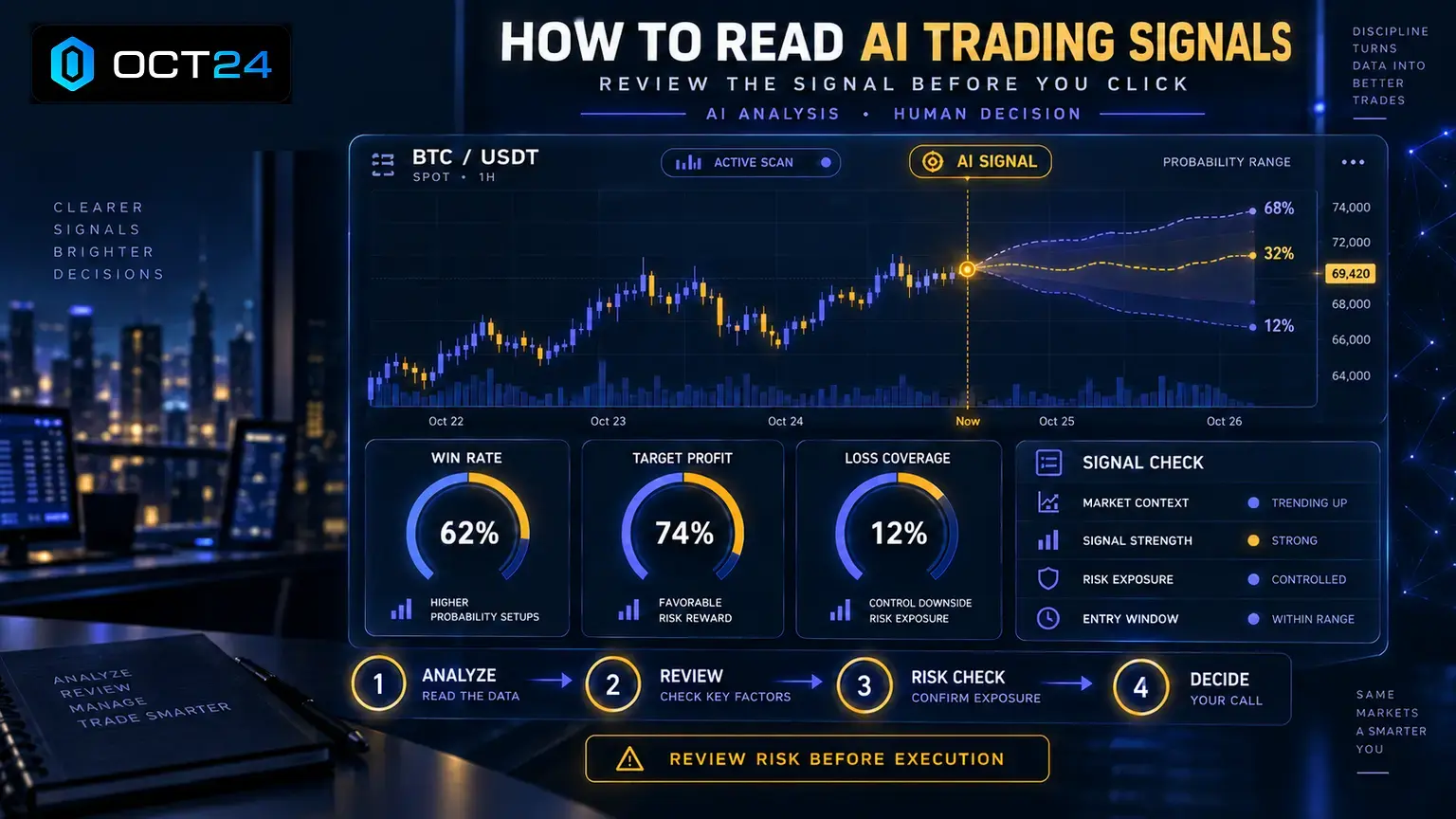
AI trading signals can be helpful, but they should not be reviewed in isolation. A signal tells a trader that an opportunity may exist. A diversification review asks whether that opportunity belongs in the current portfolio.
For example, imagine OCT24 presents AI-supported signals across three crypto assets. Each signal may look reasonable on its own. But if all three assets are highly sensitive to the same market move, taking all three may increase portfolio risk more than expected.
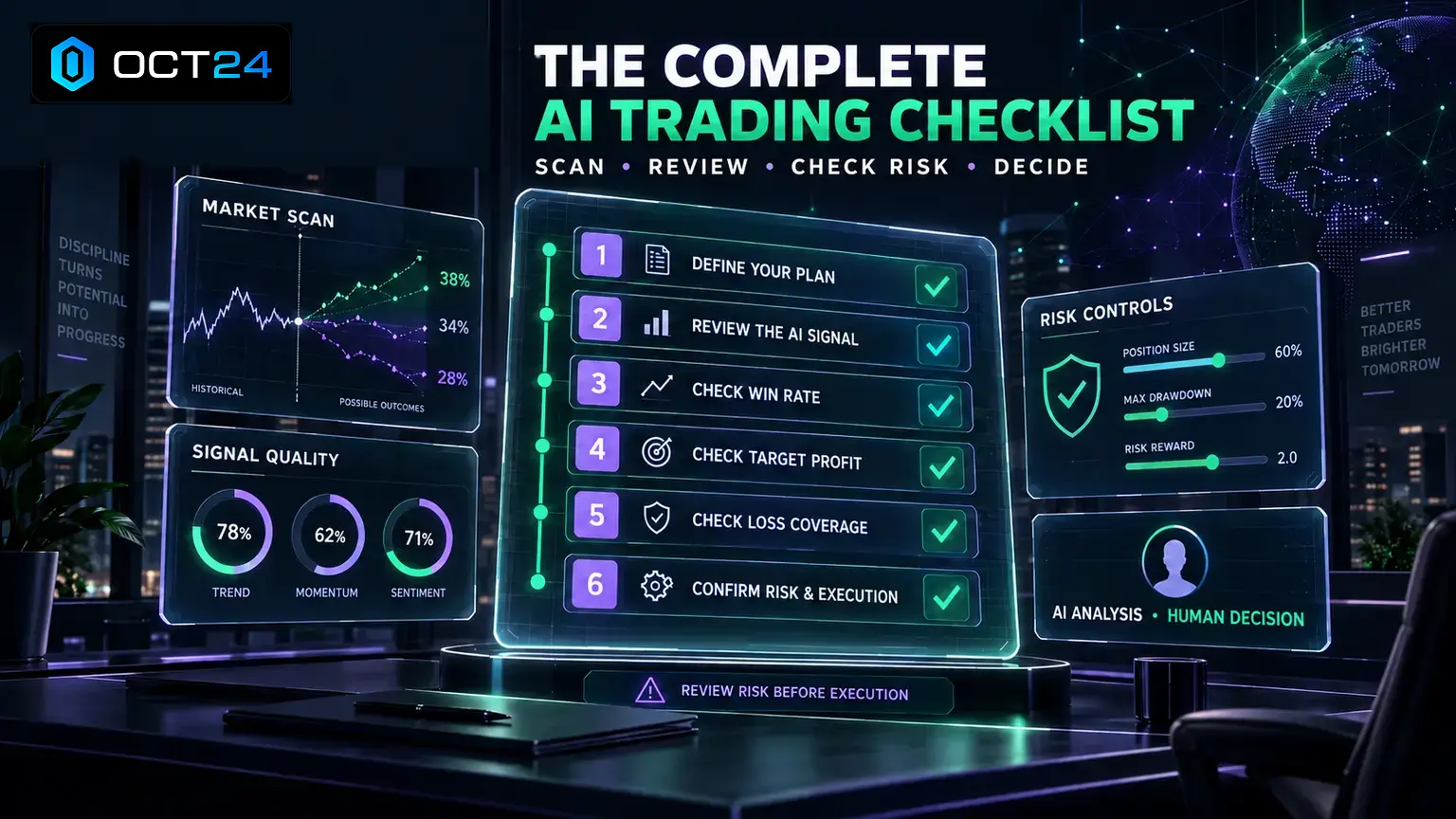
A smarter workflow is to ask:
- Does this signal add something different to my portfolio?
- Does it increase exposure to a risk I already have?
- Does the position size fit my account?
- Would this trade still make sense if the market moves against me quickly?
- Am I taking the trade because it fits my plan, or because I do not want to miss out?
This is where trading psychology becomes important. Traders often feel pressure to act when several signals appear at once. Diversification tools encourage a more measured approach.
They help the trader slow down enough to compare opportunities, choose carefully, and avoid stacking too much risk in one direction.
How OCT24 supports diversification decisions
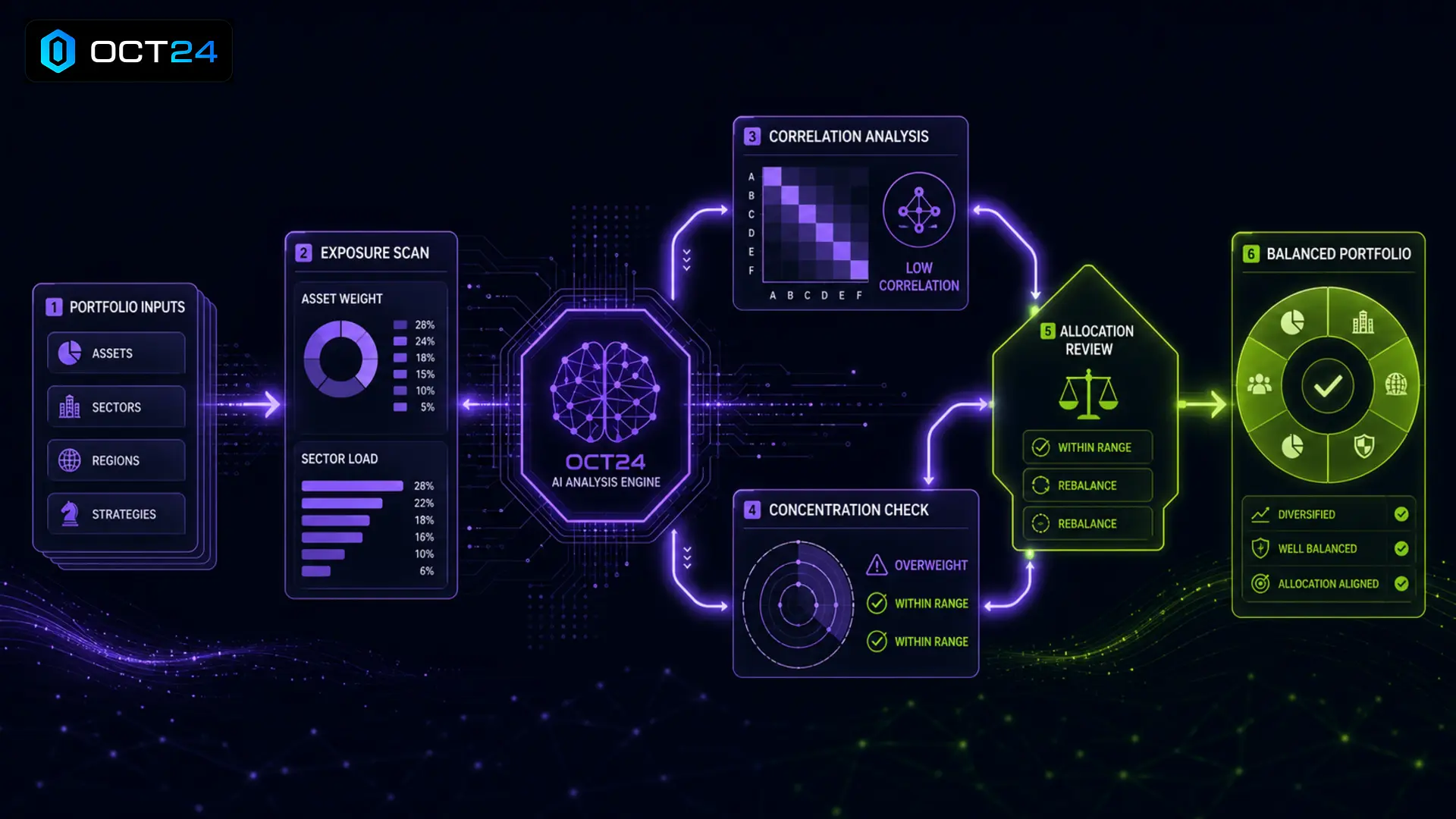
OCT24 is designed to perform the market analysis for the user. It scans market conditions, identifies potential opportunities, and presents AI-supported trading signals in a structured way.
That matters for diversification because traders need clear information before they can make sensible allocation decisions. If the trader has to manually search every market, compare every chart, and track every possible setup, diversification can become confusing quickly.
With OCT24, the trader can focus on the decisions that still require human judgment.
- Which signals fit the current portfolio.
- Which opportunities should be skipped.
- How much capital to allocate.
- Which risk settings to use.
- Whether execution makes sense under current conditions.
OCT24 does not remove trading risk. It does not promise that a signal will work. It also does not decide how much capital a trader should risk. Those choices remain with the trader.
This balance is important. OCT24 can do the heavy analysis work, but the trader still manages exposure, account risk, and execution.
Traders who want to understand the company and platform more broadly can visit About OCT24 for a wider view of the OCT24 approach.
Diversification across assets
Asset diversification is the most familiar form of diversification. It means avoiding too much dependence on one asset.
In trading, this can include exposure across different crypto assets, currency pairs, sectors, or market themes. But the goal is not simply to hold more names. The goal is to understand how they behave together.
A portfolio with five crypto assets may still be risky if all five tend to fall at the same time. A portfolio with fewer positions may be more balanced if those positions have different drivers.
For beginners, a simple asset review can help.
- List every open position.
- Write down the asset or market for each one.
- Group similar assets together.
- Check whether one group dominates the portfolio.
- Reduce or avoid new trades that add too much concentration.
This process does not need to be complicated. Even a simple review can reveal when a portfolio is leaning too far in one direction.
Diversification across strategies
Strategy diversification means using different types of trading logic instead of relying on one setup in every market.
For example, a trader may use trend-following signals in strong markets and more cautious setups during uncertain conditions. Another trader may focus on fewer strategies but adjust position size based on market quality.
The goal is not to use every strategy available. That can create confusion. The goal is to avoid depending entirely on one market behavior.
This connects naturally with AI trading strategies for beginners. A beginner does not need ten strategies. They need a small number of understandable approaches that can be reviewed consistently.
OCT24 can support this by presenting signals based on market analysis, while the trader decides which setups fit their strategy mix.
Diversification across timeframes
Timeframe diversification means not building every decision around the exact same holding period.
Some traders focus on short-term opportunities. Others prefer slower setups. Many beginner and intermediate traders benefit from understanding the difference, even if they choose to specialize in one timeframe.
Short-term trades can create more frequent decisions. Longer-term trades may require more patience and wider risk controls. Both can be affected by market volatility.
The key is consistency. A trader should avoid mixing timeframes randomly. For example, entering a short-term trade and then turning it into a long-term hold because it moved against them is not diversification. It is usually poor discipline.
A better approach is to define the intended timeframe before entering the trade.
- What signal triggered the trade?
- How long is the setup expected to remain valid?
- What would invalidate the trade idea?
- What risk setting should be used?
- How does this position affect total exposure?
Position sizing and portfolio diversification
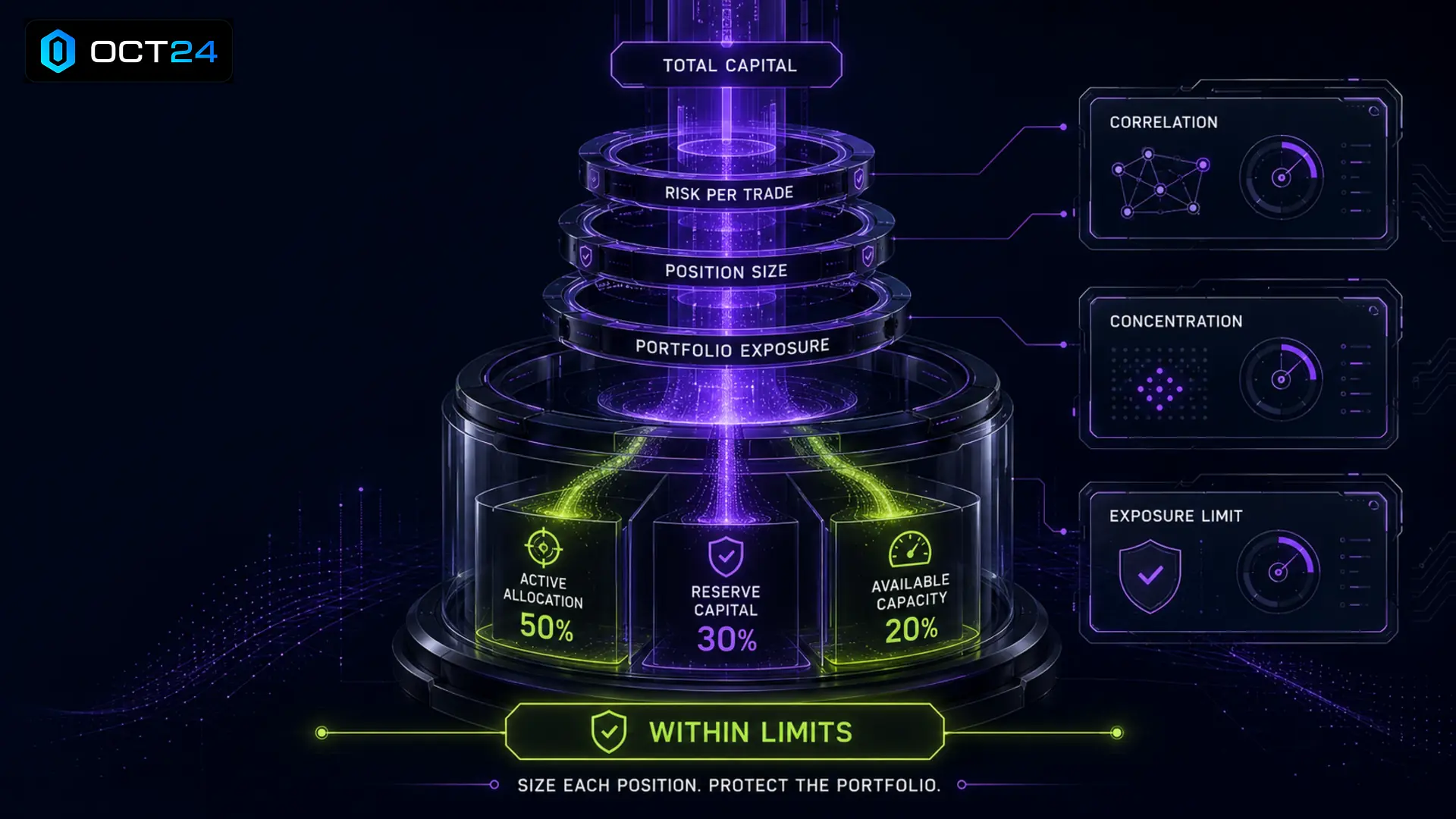
Position sizing may be the most important part of diversification. A portfolio can look diversified on paper but still be risky if one position is much larger than the rest.
For example, a trader may hold six different positions. If one position represents half the account, that one trade can still dominate results.
This is why position sizing controls matter. They help traders decide how much capital to place behind each idea and how much loss they are willing to accept if the trade fails.
Good position sizing supports diversification by keeping one trade from controlling the entire portfolio.
A practical beginner framework is:
- Decide the maximum account risk per trade.
- Set position size before entering.
- Use risk settings that match the trade idea.
- Avoid increasing size just because a signal looks exciting.
- Review total open exposure before adding another position.
OCT24 can present AI-supported trading signals, but the trader still chooses position size and exposure. This is where responsible capital allocation becomes essential.
Trading bots, the G6 Trading Bot, and diversification
Trading bots can make execution more efficient, but they should still be used within a wider portfolio plan. A bot is not a substitute for risk management.
The G6 Trading Bot can be part of an OCT24 trading workflow for users who want AI-supported analysis and structured execution tools. The important point is that bot usage should be reviewed through the same diversification lens as any other trading method.
A trader should ask whether the bot setup adds a useful role to the portfolio or simply increases exposure to the same market behavior.
For example, if a trader already has several bullish crypto positions, adding another bot-driven bullish exposure may not improve diversification. It may simply increase concentration.
This is also where trading bots vs human traders becomes useful to understand. Bots can process and act within predefined systems, while human traders remain responsible for the broader judgment around capital, risk, and suitability.
OCT24 helps by doing much of the analysis and presenting structured signals. The trader still needs to decide how much exposure is appropriate.
How to build a simple diversification routine
A diversification routine does not need to take hours. In fact, the best routine is usually simple enough to repeat.
A trader using OCT24 could build a practical routine around three moments: before trading, during active exposure, and after closing positions.
Before trading
Before taking a new trade, review your current open positions. Ask whether the new signal adds meaningful variety or increases the same risk.
If OCT24 presents several AI-supported signals, compare them against your current portfolio instead of treating them as separate decisions.
During active exposure
While positions are open, monitor whether market conditions are changing. If volatility rises or several assets begin moving together, the portfolio may be more concentrated than it looked earlier.
This is where 24/7 market monitoring can support traders. AI tools can continue scanning conditions even when the trader is not watching every chart manually.
After closing trades
After trades close, review what happened. Did losses come from one asset, one strategy, one timeframe, or one market condition? This review can reveal where diversification needs improvement.
A consistent trading routine helps turn diversification from a vague idea into a repeatable habit.
Common diversification mistakes to avoid
Diversification sounds simple, but traders often make mistakes when applying it.
Mistake 1: Owning many similar assets
Holding many assets does not help much if they all move together. Traders should review correlation and market sensitivity, not just position count.
Mistake 2: Taking every signal
AI-supported signals can be useful, but not every signal belongs in every portfolio. Traders should filter opportunities through their own risk plan.
Mistake 3: Ignoring position size
A portfolio with many small positions and one oversized trade is still concentrated. Size matters as much as asset count.
Mistake 4: Confusing activity with balance
More trades do not automatically create a stronger portfolio. Sometimes the best decision is to skip a trade because exposure is already high.
Mistake 5: Forgetting market conditions
A portfolio can be balanced in calm markets and vulnerable during volatility. Review diversification again when conditions change.
These mistakes are part of a wider group of common AI trading mistakes. The solution is usually a clearer process, not more complexity.
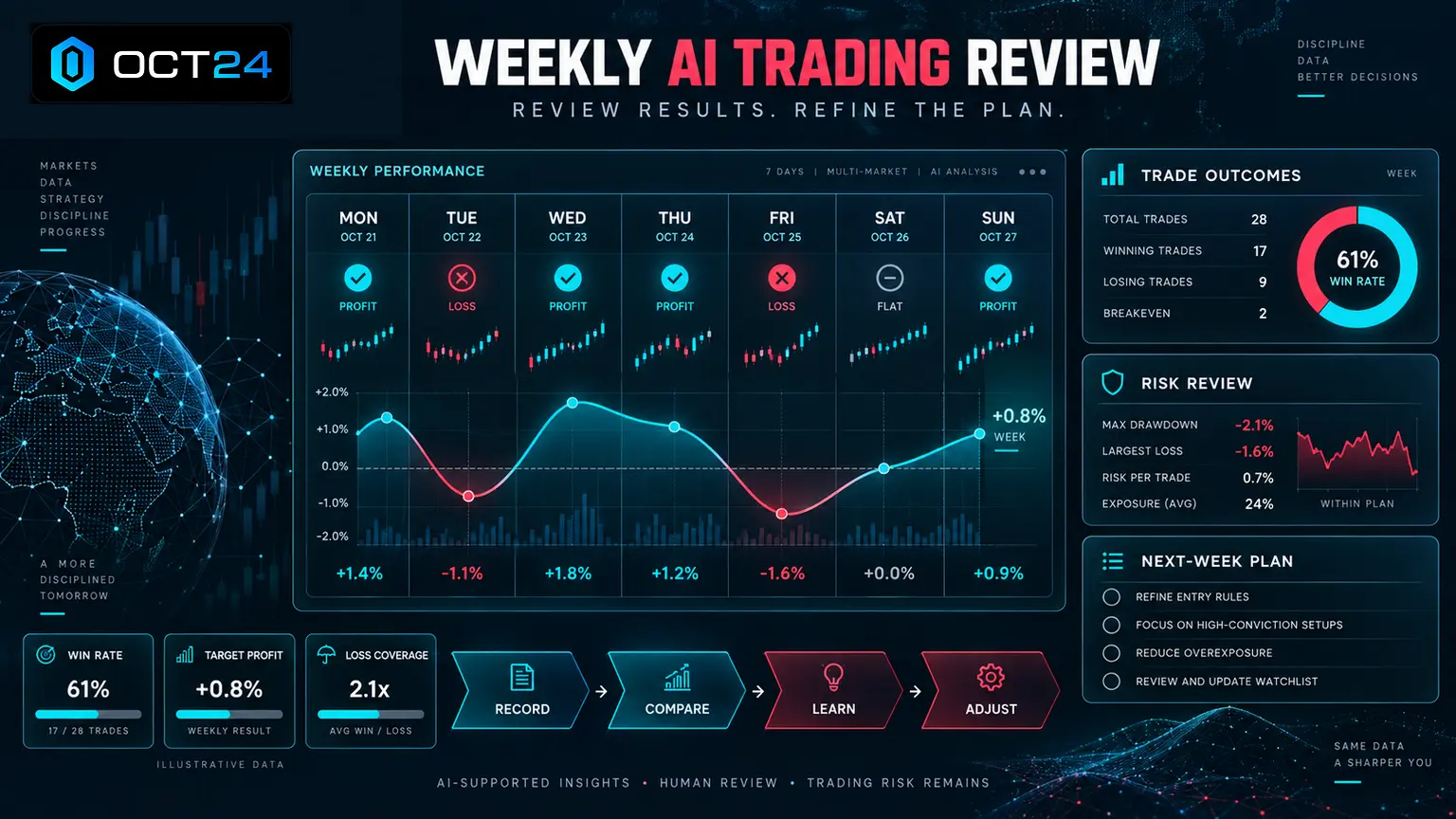
How to review diversification over time
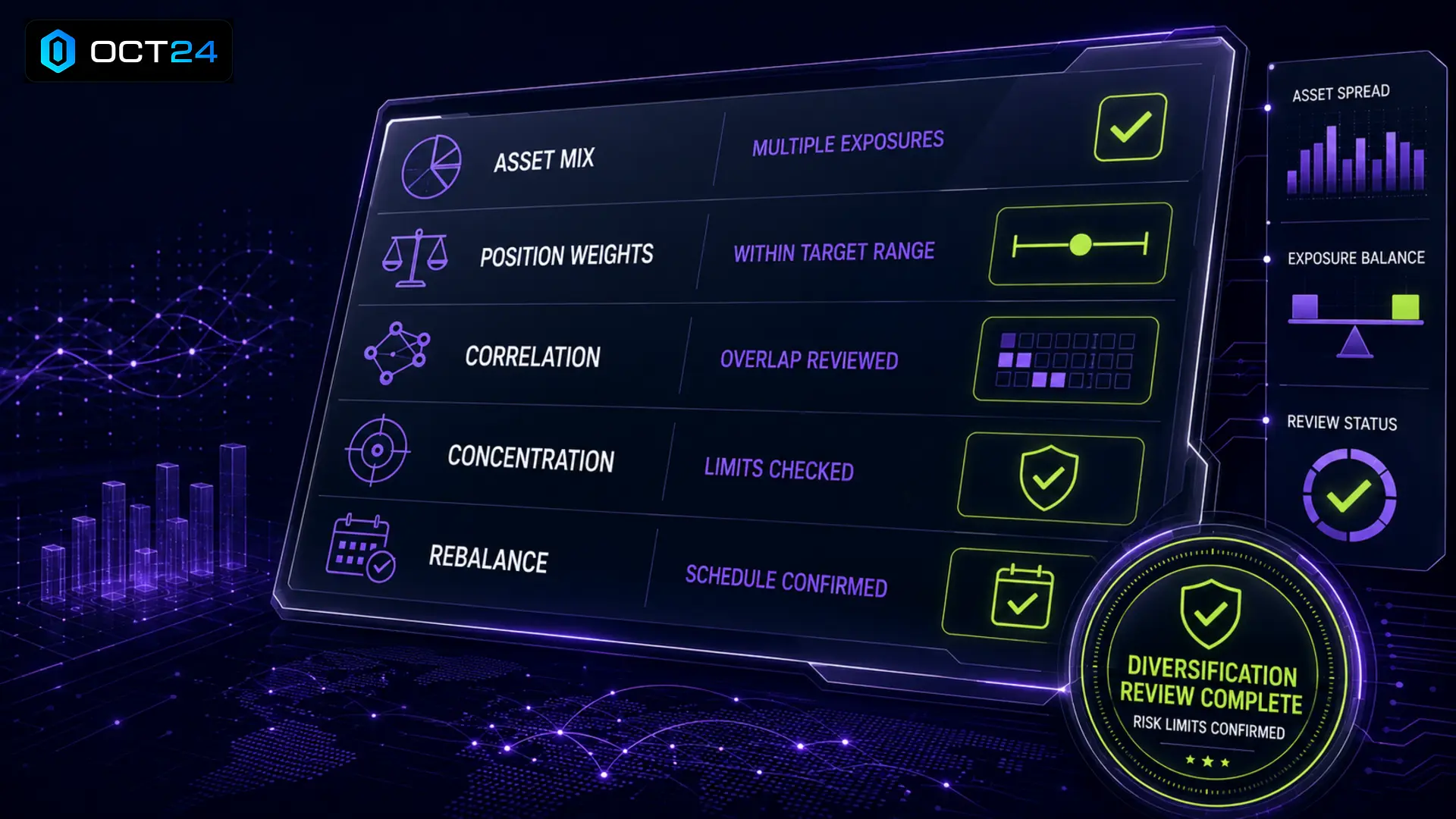
Diversification is not a one-time setup. It needs review because markets change, strategies change, and trader behavior changes.
A weekly review can help beginner and intermediate traders stay grounded.
- Which assets contributed most to gains or losses?
- Was one position too large?
- Did several trades fail for the same reason?
- Were signals accepted too quickly?
- Did risk settings match the market environment?
- Does the next week require lower exposure, higher selectivity, or no change?
This type of review also helps traders avoid overconfidence. A winning period can make concentrated risk feel harmless. A losing period can make every signal feel dangerous. A review process keeps decisions more objective.
OCT24 can support this by helping traders focus on current market conditions and AI-supported opportunities. But the trader still needs to review results and decide how to adjust risk.
A practical example of portfolio diversification
Imagine a trader has a $5,000 account and is reviewing several opportunities. OCT24 has scanned the market and presented AI-supported trading signals across multiple assets.
The trader sees potential setups in Bitcoin, Ethereum, Solana, and another high-volatility crypto asset. Each signal may look interesting. But the trader notices that all four positions would depend on the same broad market move.
Instead of taking every trade, the trader chooses one or two signals that best fit their plan. They reduce position size because market volatility is elevated. They also avoid adding another position that would create too much exposure to the same theme.
This is diversification in practice. It is not complicated. It is a series of sensible questions before capital is committed.
The trader is still using OCT24 for market analysis and signal discovery. But they are also using their own judgment to manage exposure.
How diversification supports risk and reward decisions
Every trade has a risk and reward profile. Diversification helps traders think about how those profiles combine across the account.
A trade may offer attractive potential reward, but if it increases exposure to a risk the trader already has, the overall portfolio may become less balanced.
This connects directly with AI trading risk vs reward. A trader should not only ask whether one trade has potential. They should ask whether the trade improves the overall portfolio or makes it more fragile.
OCT24 can help identify potential opportunities. The trader then needs to decide whether the risk-reward profile fits their total account.
Portfolio diversification tools and platform choice
Choosing the right AI trading platform matters because diversification depends on clear information. If a platform presents signals without enough structure, traders may find it harder to understand exposure.
A useful platform should make it easier to review opportunities, compare signals, think through risk, and avoid emotional decision-making.
OCT24 is built around AI-supported market analysis and signal presentation. That makes it useful for traders who want a more structured way to find and review potential opportunities.
Still, no platform can remove trading risk. Traders should use risk settings carefully and avoid over-allocating capital to any one idea.
If a signal fits the trader’s plan, one-click trading may help make execution more efficient. But speed should never replace risk review.
Frequently asked questions
What are portfolio diversification tools?
Portfolio diversification tools help traders review how their capital and risk are spread across assets, strategies, timeframes, and market conditions. They help identify concentration that may not be obvious from individual trades.
Do diversification tools prevent losses?
No. Diversification tools do not prevent losses or promise better results. They may help traders understand exposure and avoid over-concentration, but trading always involves risk.
Can AI help with portfolio diversification?
Yes. AI can help scan market conditions, compare opportunities, and present structured signals. OCT24 performs much of this analysis for users, while traders remain responsible for risk settings and execution decisions.
Is holding more assets always better?
No. Holding more assets is not always better. If those assets move together, the portfolio may still be concentrated. Quality of diversification matters more than the number of positions.
How does position sizing affect diversification?
Position sizing affects how much influence each trade has on the account. Even a portfolio with many assets can be risky if one position is much larger than the others.
Should beginners use portfolio diversification tools?
Yes, but they should keep the process simple. Beginners can start by reviewing asset exposure, position size, strategy overlap, and total open risk before adding new trades.
How often should traders review diversification?
Many traders benefit from reviewing diversification before each new trade and again during a weekly performance review. Reviews are especially important when volatility changes.
How does OCT24 fit into portfolio diversification?
OCT24 scans market conditions, identifies potential opportunities, and presents AI-supported trading signals. Traders can then decide which signals fit their portfolio, risk settings, and capital allocation plan.
Final thoughts
Portfolio diversification tools help traders see the bigger picture. They show whether risk is spread thoughtfully or concentrated in ways that could create problems during volatility.
For AI-supported traders, diversification is especially important because signals can appear across many markets at once. The goal is not to take every opportunity. The goal is to choose the opportunities that fit the portfolio, risk plan, and current market conditions.
OCT24 performs most of the market analysis by scanning conditions, identifying potential opportunities, and presenting AI-supported trading signals. The trader still controls risk settings, exposure, capital allocation, and execution decisions.
Used responsibly, portfolio diversification tools can help traders become more selective, more organized, and more aware of total account risk.
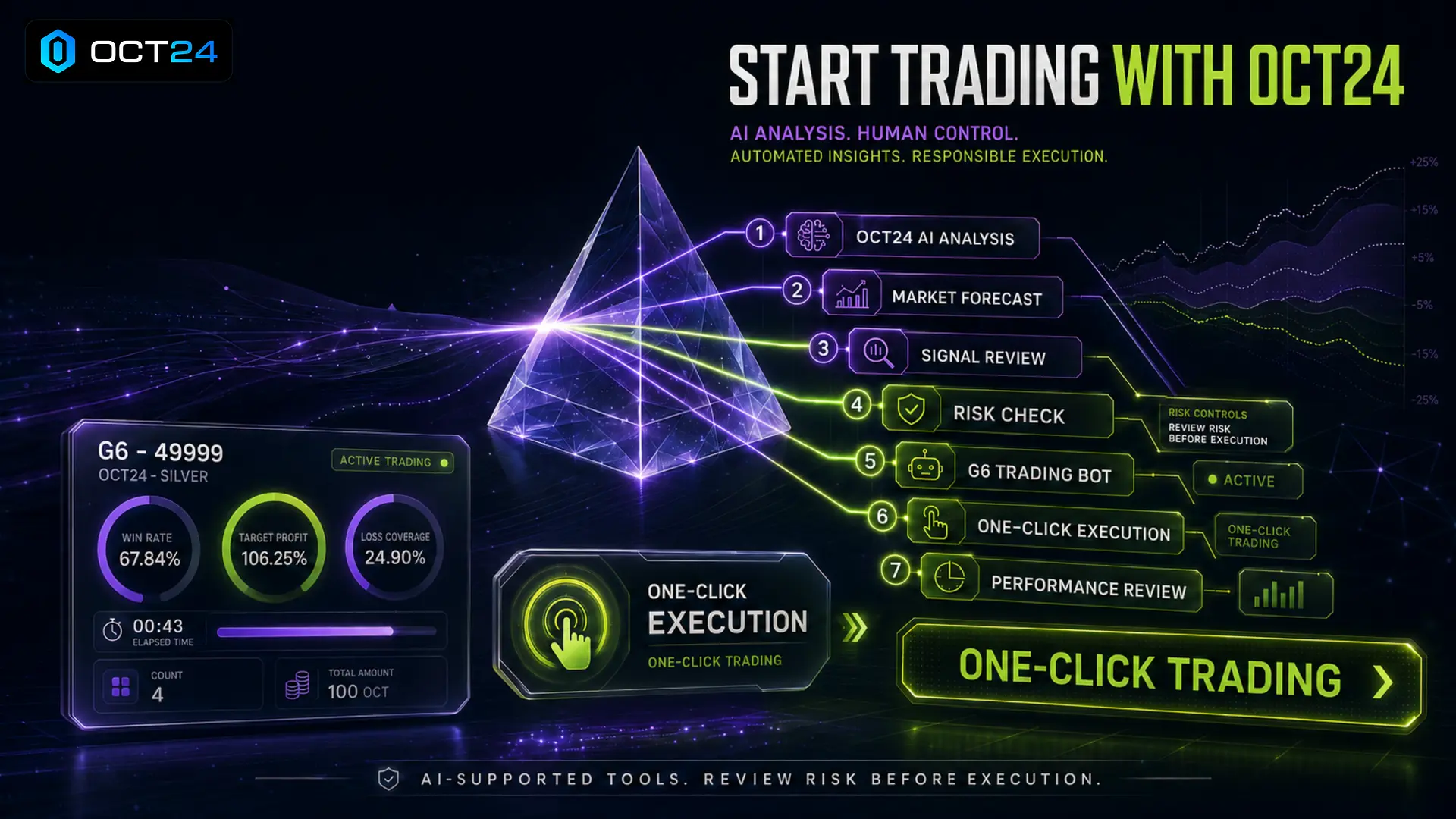
To explore AI-supported market analysis and signal review, Start Trading with OCT24.