
Why Speed Matters in AI Trading
A market can change while you are still checking charts. You may open Bitcoin, then Ethereum, then Solana, compare a few indicators, look at volume, and return to the first chart only to find that the setup has already moved. That is why Speed in AI Trading matters.
Price, volume, momentum, liquidity, and volatility can change in seconds.
OCT24 helps by performing most of the market analysis for the trader. It scans market conditions, identifies potential opportunities, and presents AI-supported trading signals so the user can review them in a more structured way.
That speed can improve efficiency. It can help traders notice important changes sooner.
But speed does not remove risk. It does not guarantee a profitable trade, a perfect entry, or execution at a specific price. The trader still needs to review risk settings, exposure, position size, leverage, and whether the signal still makes sense before acting.
Why Does Speed Matter in AI Trading?
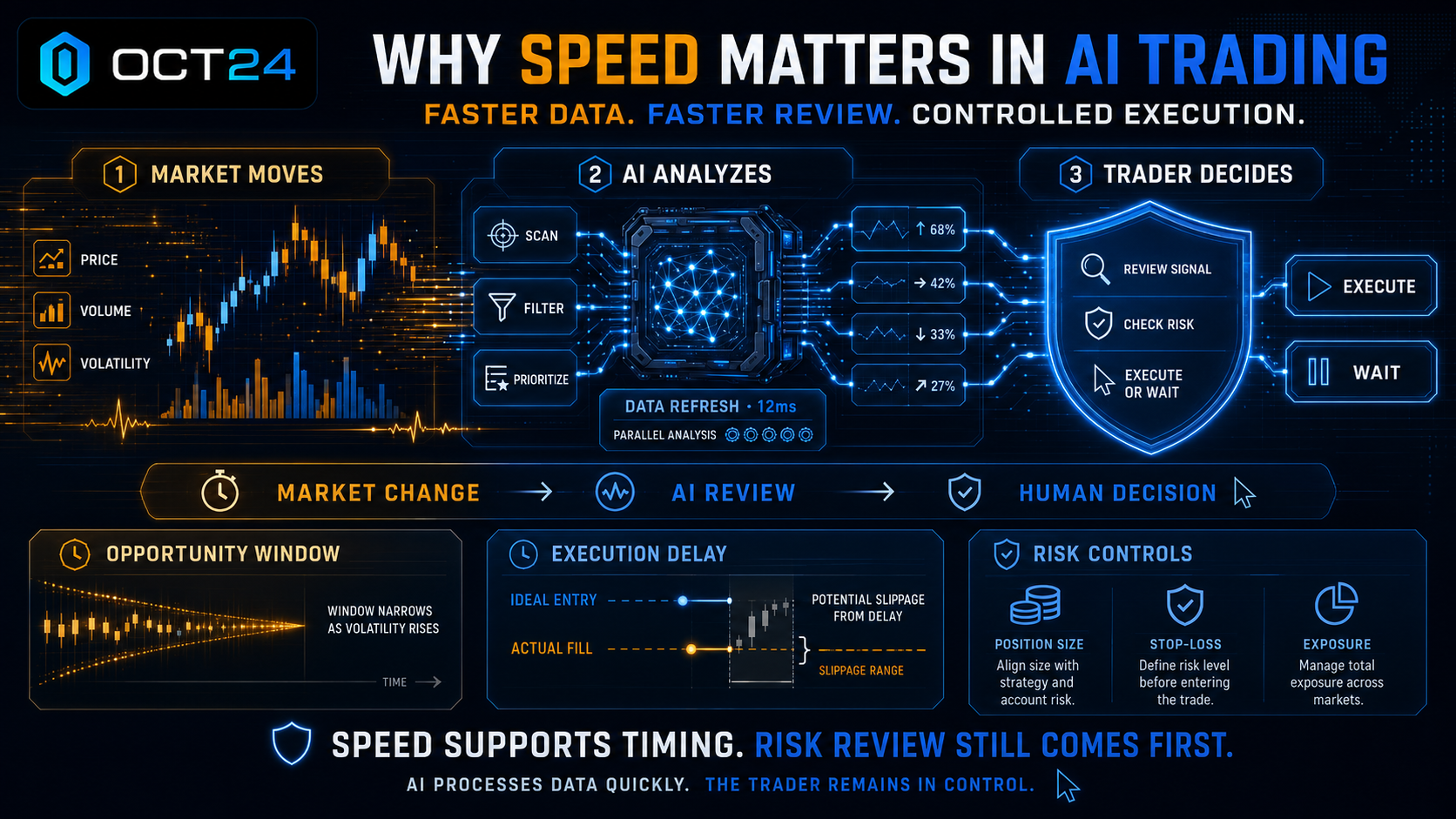
Speed matters in AI trading because market information can change faster than a person can collect and compare it manually. Faster systems can process current data, identify changing conditions, and present potential opportunities sooner. However, faster analysis or execution does not guarantee a profitable trade.
Speed helps with reaction time.
It does not create certainty.
A faster trading workflow may help traders:
- Recognize market changes sooner
- Review opportunities while they are still relevant
- Monitor several markets at once
- Reduce repetitive chart-checking
- Receive signals more efficiently
- Leave more time for risk review
- Reduce avoidable execution delay
This is one of the clearest differences between AI trading vs manual trading.
A manual trader may need several minutes to scan multiple charts, compare timeframes, and check technical conditions. An AI-supported workflow can scan those conditions faster and organize potential opportunities for review.
The benefit is not that the trader should rush.
The benefit is that the trader may have more time to think clearly before deciding whether to act.
What Speed in AI Trading Actually Means
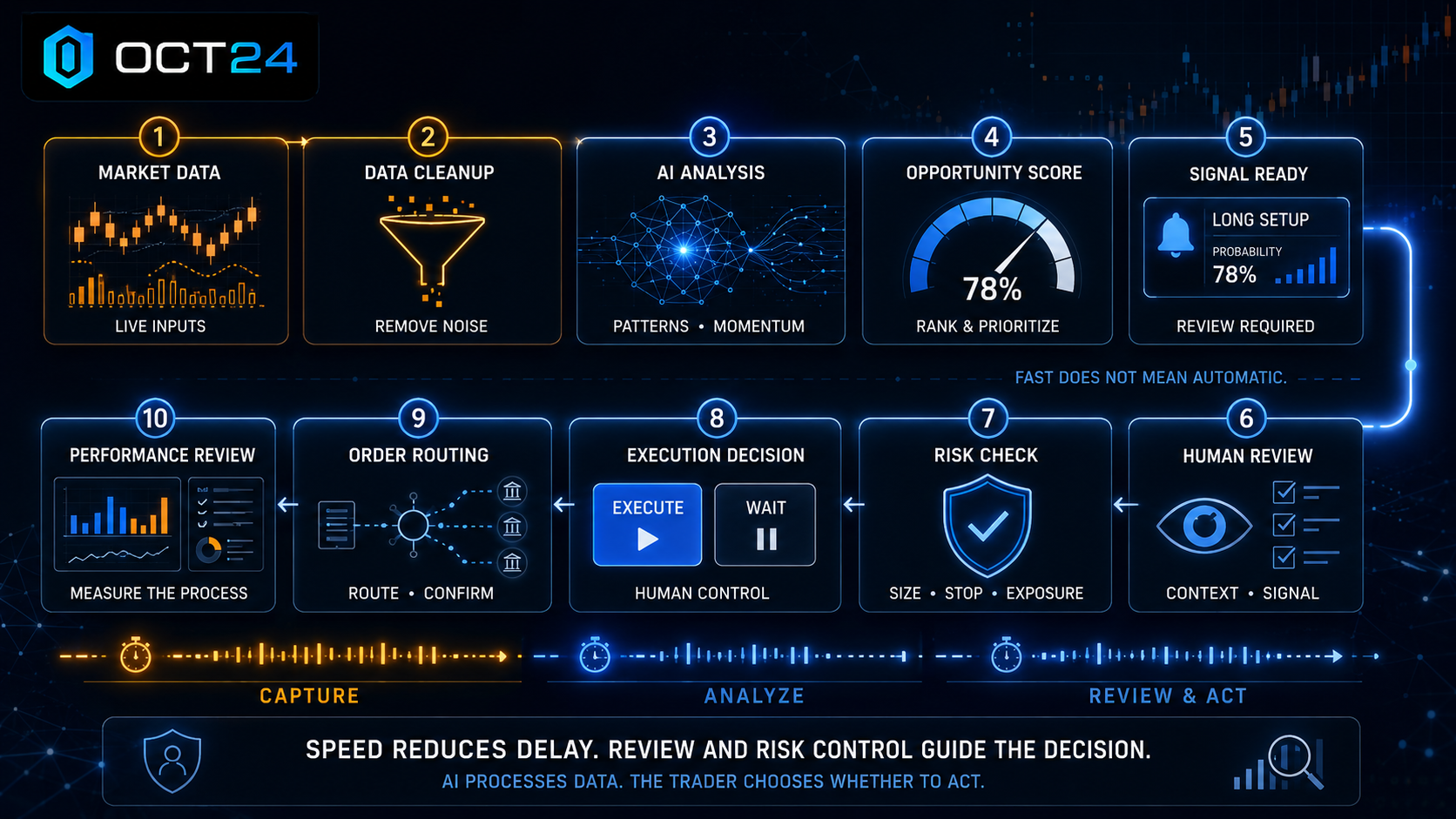
AI trading speed is not one single thing.
Many traders think speed only means placing an order quickly. In reality, speed affects the full trading process before an order ever reaches the market.
The workflow includes:
- Market data collection
- Data processing
- Market analysis
- Opportunity identification
- Signal creation
- Signal delivery
- Trader review
- Risk checks
- Execution decision
- Order submission
A delay at any stage can change the final result.
A signal may be created quickly, but reviewed too late. An order may be submitted quickly, but based on outdated market information. A signal may also appear strong, but become unsuitable because the trader already has too much exposure.
This is why understanding how AI trading bots work is useful, even if you do not need a technical explanation of the full system.
AI trading speed is not only about fast orders. It is about moving from market information to informed decision-making with less unnecessary delay.
Why Financial Markets Can Change So Quickly
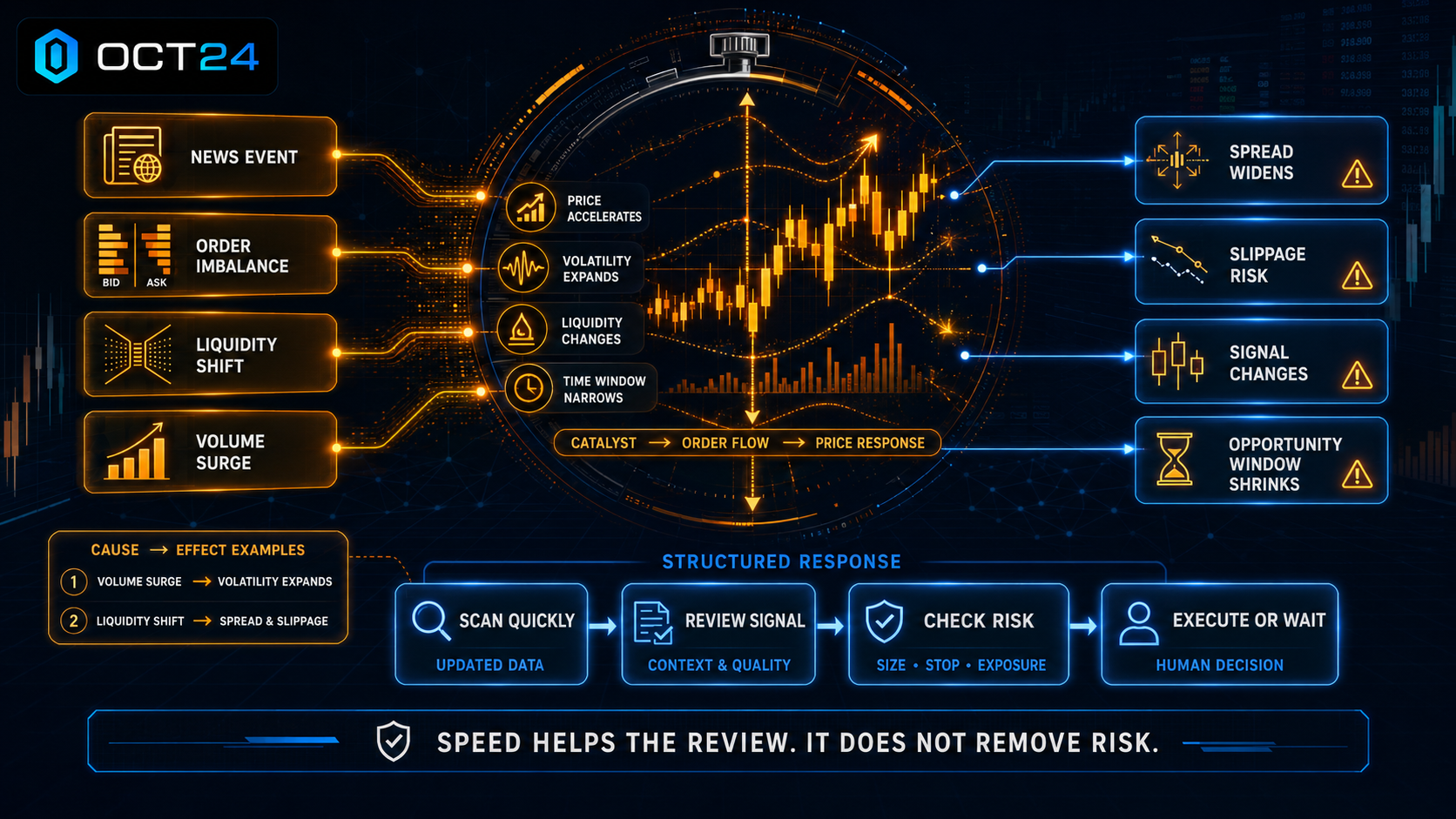
Markets move because buyers and sellers are constantly updating their decisions.
Every new order can affect price. Every shift in volume can affect momentum. Every change in liquidity can affect how easy it is to enter or exit a trade.
Market conditions can change quickly because of:
- New buy and sell orders
- Breaking news
- Economic announcements
- Sudden changes in trading volume
- Shifts in liquidity
- Large market orders
- Breakouts and reversals
- Liquidations in leveraged markets
- Changes in wider market sentiment
- Related assets moving together
For example, imagine Bitcoin is testing resistance near a key price level.
At first, the setup may look controlled. Price is near resistance, volume is rising, and momentum is improving.
Then price breaks above the level.
Breakout traders may start buying. Short sellers may close positions. Leveraged traders may get liquidated. Other crypto assets may begin moving in the same direction.
In a short period of time, the entry area, stop-loss distance, and risk-to-reward profile can all change.
The original idea may still be valid, but the trade may no longer be attractive. A trader who reacts late may end up chasing a move instead of entering with a clear plan.
Speed can help traders see that change sooner. It cannot make every fast-moving setup worth taking.
The Stages Where Speed Matters
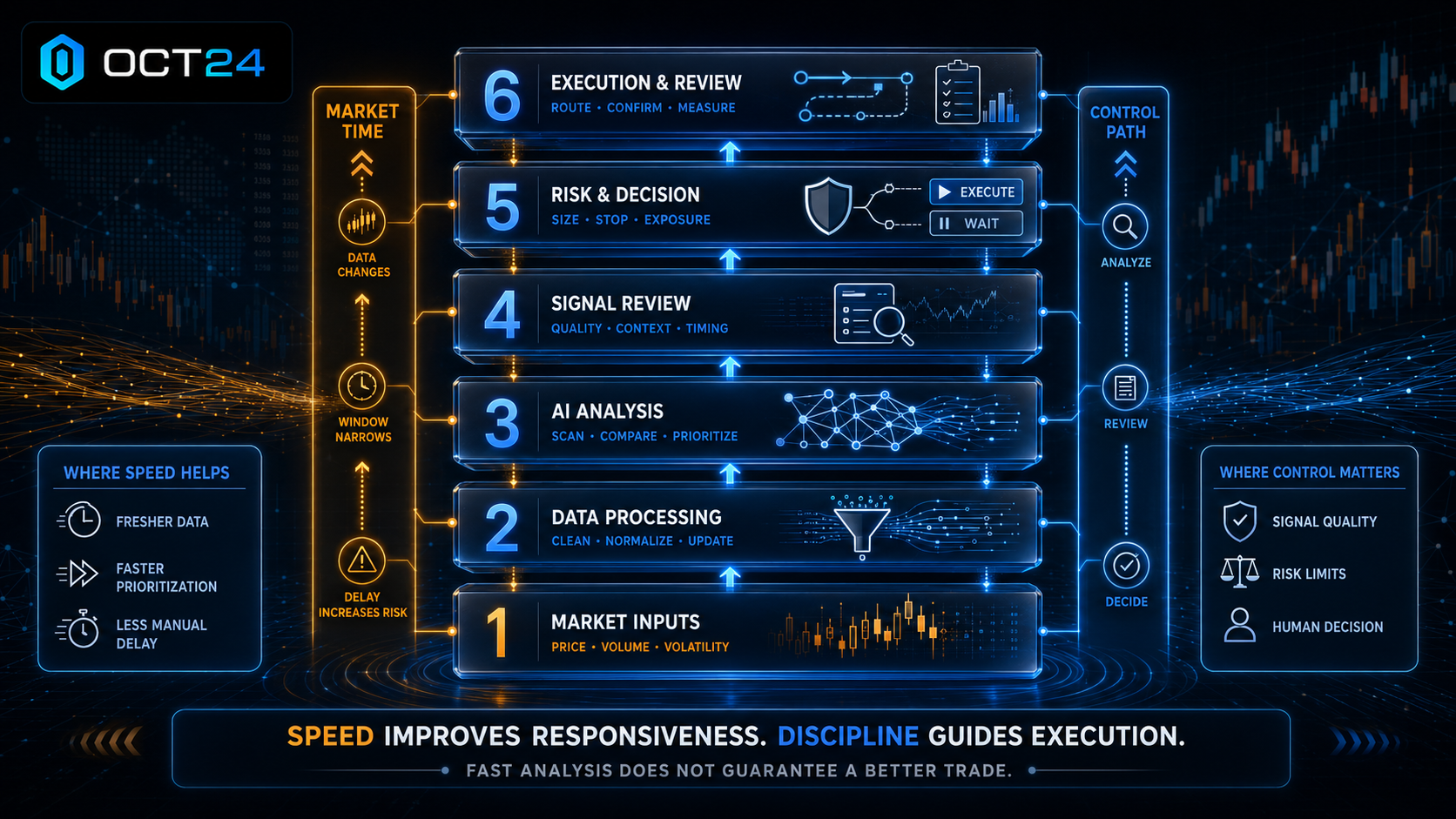
Speed matters at several points in the trading workflow.
Each stage has a different purpose. A faster system is only useful when the information is current, the signal is clear, and the risk review is still disciplined.
Market Data Collection
Analysis should begin with current information.
Price shows where the market is trading now. Volume shows how much activity is behind the move. Momentum shows whether movement is strengthening or weakening. Volatility shows how wide and unstable price swings are. Liquidity shows how easily orders may be filled.
Fast analysis cannot fix outdated or unreliable data.
If the market information is stale, the signal may already be behind the market.
Market Analysis
AI can compare several conditions faster than a person checking them one by one.
It can review price action, trend, volume, momentum, and volatility across multiple markets at the same time. This is where how AI uses technical analysis becomes relevant.
The goal is not to repeat a basic technical analysis lesson.
The important point is simple: AI can apply defined rules consistently and quickly across more markets than a person can comfortably monitor alone.
Opportunity Identification
An opportunity is only useful while it is still relevant.
If price has already moved far beyond the original entry area, the trade may require a wider stop-loss or a worse risk-to-reward setup. That can make the trade less attractive, even if the market direction was identified correctly.
Timely identification may give the trader more room to review the setup calmly.
Signal Delivery
A clear signal is more useful than a fast but confusing alert.
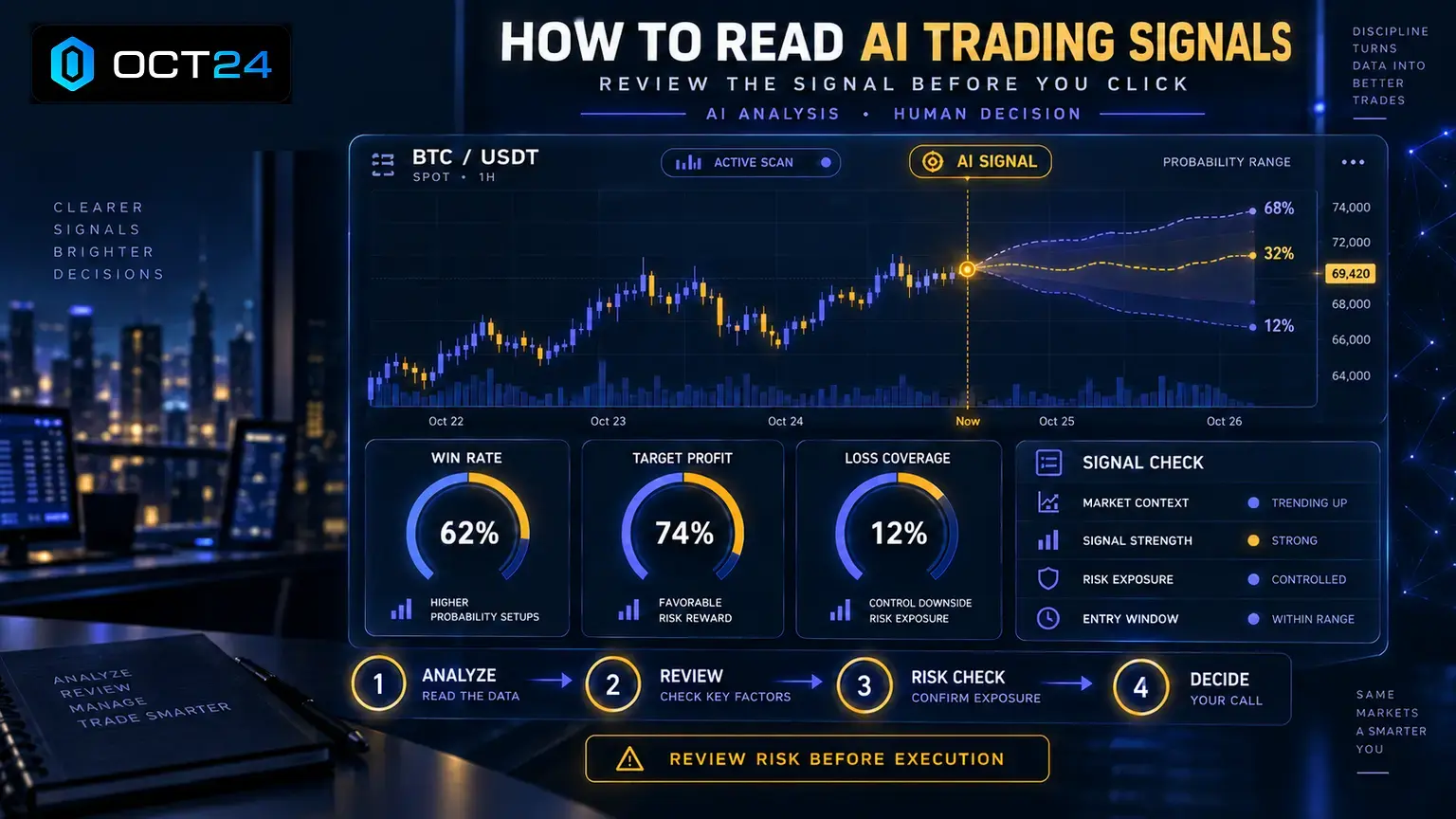
Good signal delivery should help the trader understand what is being presented and why it matters. AI trading signals should support a decision, not replace judgment.
A signal is not an instruction that must be followed.
It is decision support. The trader still needs to decide whether the setup fits the strategy, risk rules, and current market conditions.
Risk Review
Speed should not skip risk review.
Before execution, the trader should check position size, stop-loss planning, leverage, and total exposure. This is especially important when several signals appear close together.
A fast signal can be useful.
A fast signal with poor risk settings can be dangerous.
Order Execution
Efficient execution matters only after analysis and risk review are complete.
Features such as one-click trading can reduce friction once the trader has already reviewed the signal. But faster execution should not become impulsive execution.
The trader still needs to ask: “Would I take this trade if it were not so easy to enter?”
If the answer is no, speed may be encouraging the wrong behavior.
How AI Analyzes Information Faster Than Manual Traders
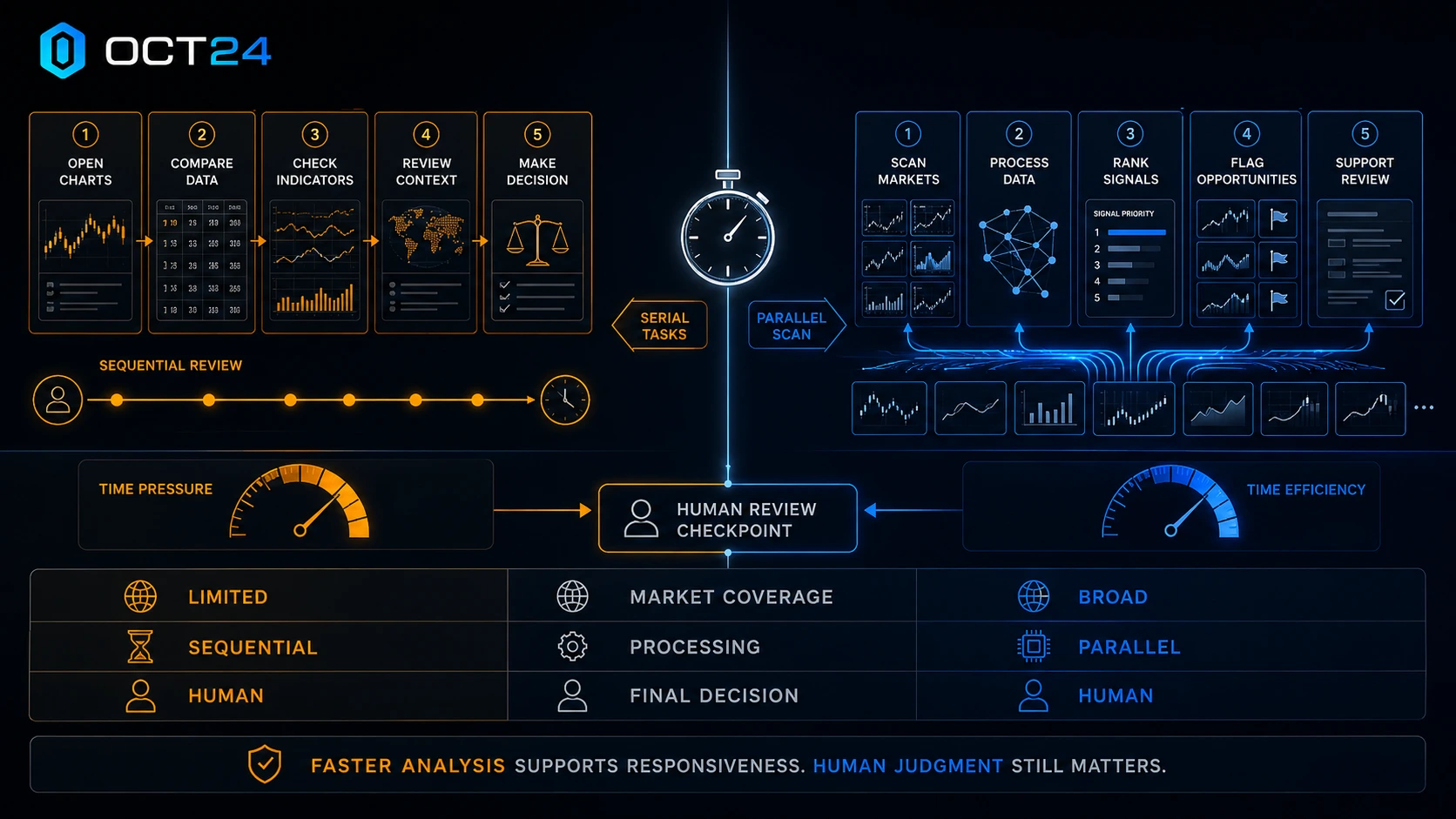
A manual trader usually works one market at a time.
They open a chart, check the trend, review volume, look at momentum, compare timeframes, and then move to the next market. That process can be thoughtful, but it is slow.
Manual Trader
The trader may need to:
- Open one chart
- Check the trend
- Review volume
- Check momentum
- Look at volatility
- Move to the next market
This creates a natural delay.
By the time the trader finishes reviewing several markets, the first setup may have changed.
AI-Supported Process
An AI-supported system can:
- Monitor several markets
- Compare the same conditions consistently
- Identify markets that meet defined criteria
- Organize findings into potential opportunities
- Present signals for trader review
This can reduce the searching process.
Instead of spending most of their time looking for possible setups, the trader can spend more time reviewing whether a setup is worth taking.
That matters for anyone with limited time. It is especially relevant for AI trading for busy professionals, where the trader may not be able to watch charts throughout the day.
Speed works best when the trader has clear setup criteria. This is why AI trading strategies for beginners should focus on simple rules before trying to trade faster.
Without defined criteria, faster technology may only create more alerts and more confusion.
How Faster Analysis Can Improve Decision Efficiency
Good technology should not make traders feel rushed.
It should create a cleaner decision process.
When OCT24 performs most of the market analysis, the trader can spend less time jumping between charts and more time asking better questions:
- Does the setup fit my strategy?
- Is the signal still current?
- Has price already moved too far?
- What is the possible downside?
- Is the position size appropriate?
- How much exposure is already open?
- Is volatility unusually high?
- Am I reacting to evidence or FOMO?
That final question matters.
Speed can trigger emotion if the trader feels they must act immediately. A fast alert can create urgency, hesitation, fear of missing out, or overconfidence.
This is where trading psychology becomes part of the speed discussion.
Useful speed gives traders more structure. Harmful speed makes traders feel like every signal is a race.
The goal is not to act faster on every idea.
The goal is to review better information sooner.
Signal Speed vs Execution Speed
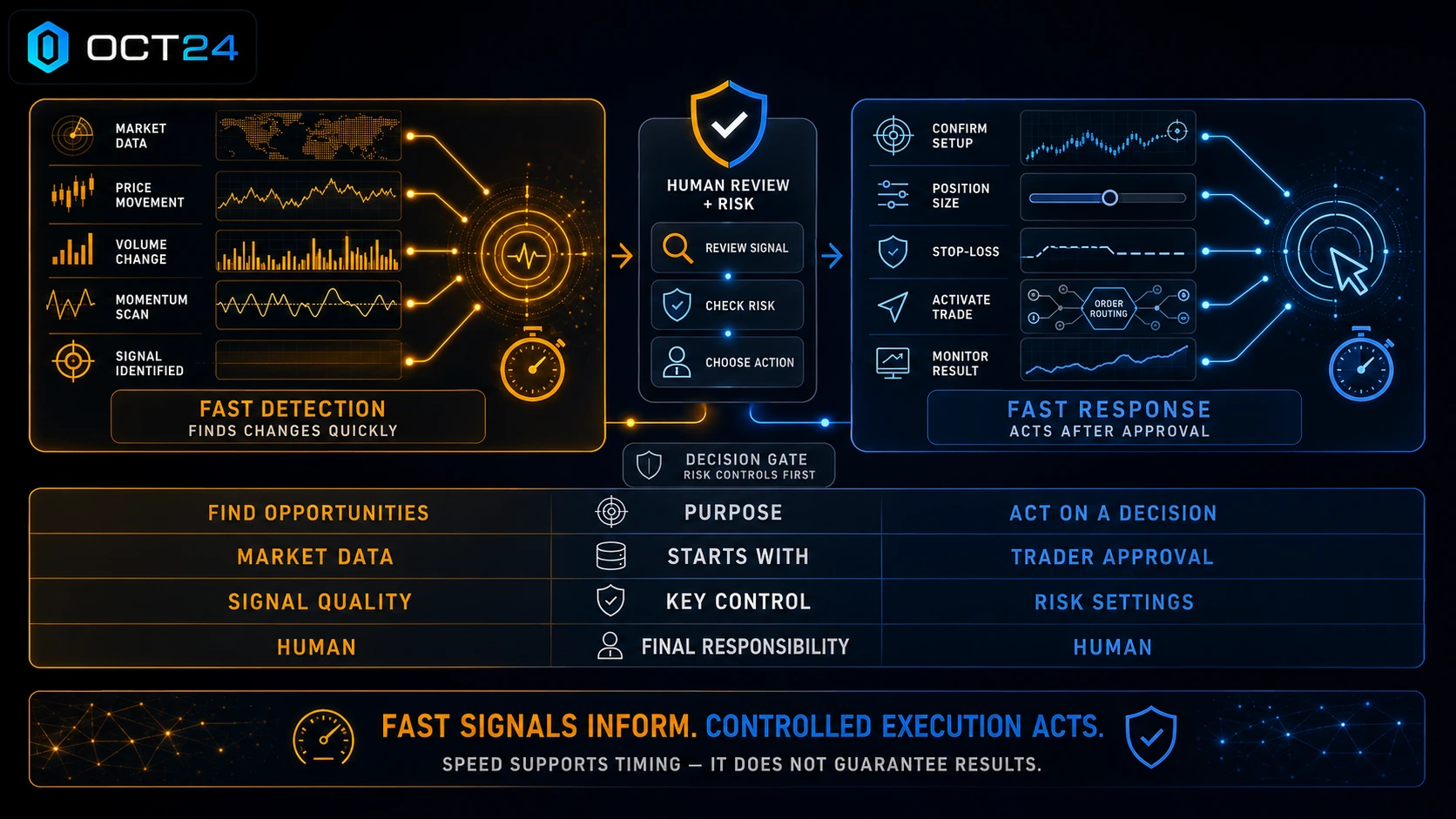
Signal speed and execution speed are different.
Signal speed is how quickly a system recognizes and presents a potential trading opportunity.
Execution speed is how quickly an order reaches the market after the trader decides to act.
Both can matter, but they solve different problems.
A fast signal can become outdated before review. A fast order can still be based on a weak signal. Signal quality matters as much as delivery speed. Execution speed matters only after strategy and risk checks.
A simple trading workflow looks like this:
- Current market data
- AI-supported analysis
- Potential opportunity
- Signal delivery
- Strategy review
- Risk review
- Execution decision
- Order submission
If the early steps are weak, a fast final step does not fix the trade.
For example, clicking quickly on a poor signal does not make the signal better. It only gets the trader into the trade faster.
This is why speed should support discipline, not replace it.
What Is Execution Latency?
Execution latency is the short delay between a trading decision and the order reaching the market. It can be affected by the platform, internet connection, exchange response, order type, and market activity. Lower latency may reduce avoidable delay, but it cannot guarantee a particular execution price.
Most beginner and intermediate traders do not need a deep lesson on institutional trading infrastructure.
They do not need to study server locations, network architecture, or high-frequency trading systems to understand the practical issue.
The simple point is this: after a trader decides to act, delay can affect the final order price.
In calm markets, a small delay may not matter much.
In fast-moving markets, the difference can be more noticeable. Price may move, spreads may widen, or available liquidity may change.
Reducing unnecessary friction can help.
But latency is not the only issue. Slippage can still happen, especially during volatility. Slippage means the final execution price is different from the expected price.
A fast workflow can reduce avoidable delay. It cannot control every market condition.
Why Speed Matters During Market Volatility
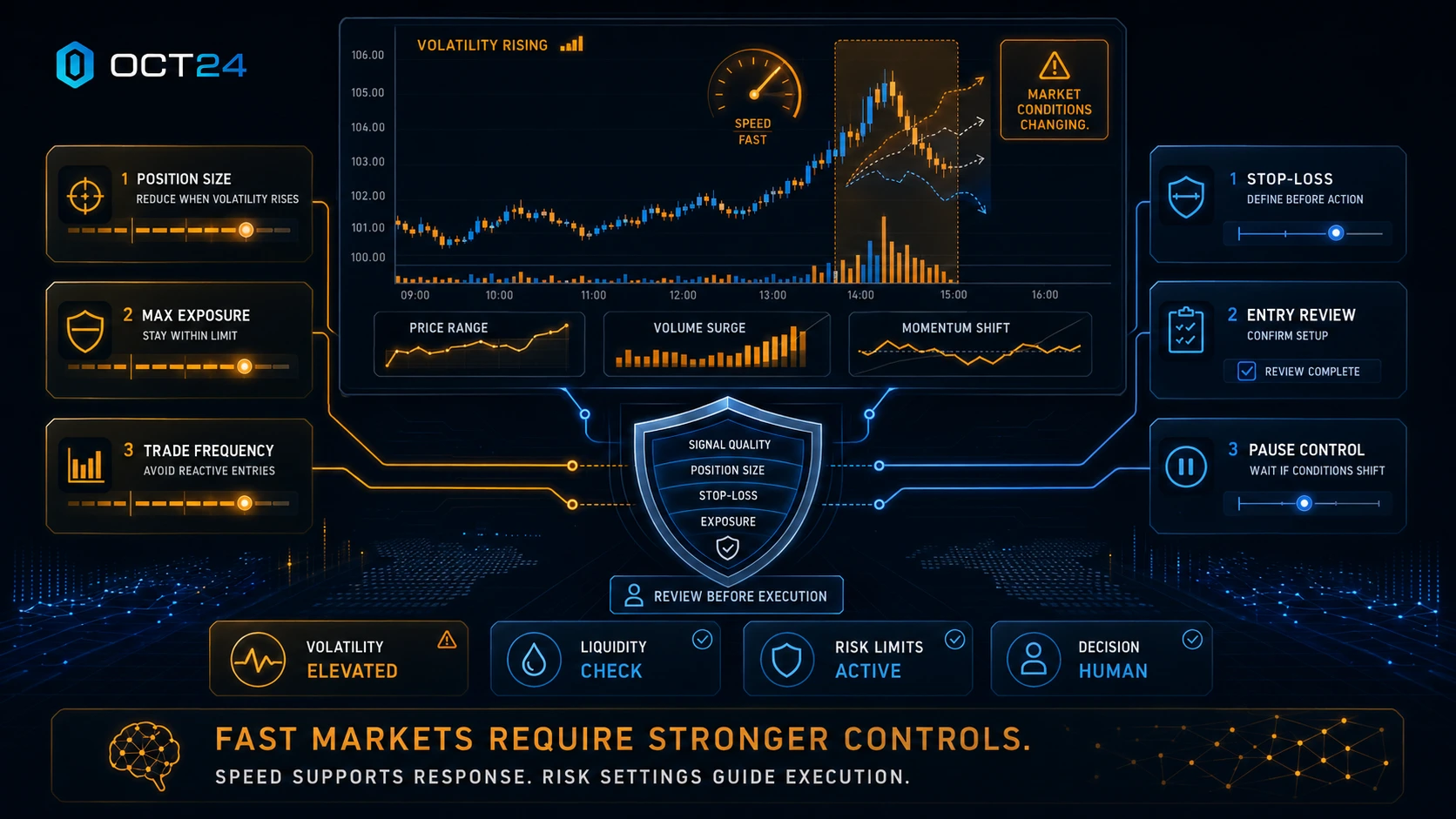
During volatile markets, price, volume, and momentum can change quickly. AI can monitor those changes and present updated information faster than manual chart review. However, volatility can also increase slippage, widen risk, and make a previously suitable entry less attractive.
Volatility creates both opportunity and danger.
A market may move quickly enough to create a strong signal. The same movement may also make the trade harder to manage.
This is why how AI handles market volatility matters.
Imagine a crypto asset breaks out sharply after a period of sideways trading. OCT24 identifies changing momentum and presents an AI-supported signal.
The trader reviews the setup and notices several problems:
- Price has already moved far from the original area
- The stop-loss would need to be unusually wide
- The planned position creates too much risk
- Existing exposure is already high
- Liquidity has weakened
In this case, speed helped the trader see the opportunity sooner.
But the disciplined decision may still be to reject the trade, reduce position size, or wait for a better setup.
Speed can reveal changing conditions sooner. It does not make every fast setup suitable.
Are Faster Trading Bots Always Better?
Faster trading bots are not always better. Their value also depends on data quality, strategy rules, signal filters, platform reliability, risk controls, and execution conditions. A bot that reacts instantly to weak information may simply make poor decisions faster.
This is one of the most important lessons in AI trading.
Speed is only useful when the system is working with strong inputs and sensible rules.
Speed can become a disadvantage when it encourages:
- Too many trades
- Weak signal filters
- Overreaction to market noise
- Oversized positions
- Poor exposure control
- Blind trust in automation
- Constant strategy changes
- Execution without review
Trade frequency is not the same as trade quality.
A trader who takes ten rushed trades is not automatically more advanced than a trader who takes one well-reviewed trade.
Many common AI trading mistakes happen when traders confuse faster action with better decision-making.
When choosing the right AI trading platform, traders should look beyond speed claims. They should consider the full workflow: data quality, signal clarity, risk tools, usability, transparency, activity tracking, and whether the system supports responsible decisions.
A platform should help traders move faster through the repetitive parts of analysis.
It should not encourage blind automation or oversized risk.
Speed Does Not Mean Prediction
Fast data processing does not mean AI knows the future.
AI may recognize patterns faster. It may compare more information. It may update probabilities as conditions change. It may identify momentum shifts sooner than a manual trader.
But markets are still uncertain.
Unexpected news can change direction. Liquidity can disappear. Large orders can move price. A signal that looked useful can fail.
This is why can AI predict the market should be answered carefully.
AI can support analysis. It can identify changing conditions. It can help traders work with more information at greater speed.
But it cannot guarantee what the market will do next.
One of the most common AI trading myths is that faster technology creates certainty. It does not.
Speed improves the timing of information.
It does not remove uncertainty.
Why Fast Trading Still Requires Risk Controls
Risk management is important in fast trading because losses can develop as quickly as opportunities. Position sizing, stop-loss planning, exposure limits, leverage controls, and daily loss limits help define acceptable risk before an order is placed.
Speed can make good habits more effective.
It can also make bad habits more expensive.
Fast trading still requires:
- Position sizing
- Stop-loss planning
- Exposure limits
- Correlated position checks
- Leverage control
- Daily loss limits
- Trade-frequency limits
- Conditions that pause trading
- Performance review
This connects directly to trading bot risk management.
Risk rules should be defined before the market becomes active. If the trader waits until the moment of execution, emotion can take over.
Strong risk management strategies help the trader decide what is acceptable before a signal appears.
For example, imagine a trader has already reached their daily risk limit.
OCT24 presents another AI-supported signal during a fast-moving session. The setup looks interesting, and the trader feels tempted to take it.
But the risk rule is already clear.
The disciplined decision is not to trade.
The signal may be fast. The opportunity may look exciting. The market may continue moving.
None of that changes the risk limit.
Trading Bots vs Human Traders on Speed
Trading bots and human traders are good at different things.
Bots can process information quickly and consistently. Humans must define the plan, review the risk, and decide whether action is appropriate.
Trading Bots Can
- Monitor markets continuously
- Compare several conditions at once
- Repeat the same rules without fatigue
- Deliver signals quickly
- Track activity consistently
Human Traders Must
- Set appropriate risk limits
- Decide whether the strategy fits their goals
- Choose capital allocation
- Review total exposure
- Assess unusual market conditions
- Decide whether to execute
- Pause when the workflow is no longer suitable
This is the practical difference in trading bots vs human traders.
The best use of speed is to reduce repetitive analysis.
It is not to remove the trader from responsibility.
Even when OCT24 performs most of the market analysis, the trader still needs to understand their exposure, choose suitable risk settings, and make informed execution decisions.
How OCT24 Supports Faster Market Analysis
OCT24 supports a faster trading workflow by performing most of the market analysis for the user.
It scans market conditions, identifies potential opportunities, reviews market momentum, monitors volatility, evaluates technical signals, and presents AI-supported trading signals for review.
This can help traders reduce manual chart review and monitor several markets more efficiently.
Instead of spending all their time searching for possible setups, traders can focus on whether a signal fits their plan.
OCT24 can support:
- AI-powered market scanning
- Real-time market monitoring
- Opportunity identification
- AI-supported trading signals
- Reduced manual chart review
- Market momentum review
- Volatility awareness
- Risk checks
- Faster execution after review
- Real-time activity visibility
- Performance review over time
This does not mean OCT24 removes risk.
It does not prevent slippage in every condition. It does not guarantee ideal execution. It does not guarantee profits.
The trader still needs to choose suitable settings, understand exposure, manage capital, control leverage, and decide whether a trade fits their plan.
For readers who want to understand the platform more broadly, About OCT24 provides more context about the company and its approach.
The important point is that OCT24 is not simply a passive charting tool.
It performs much of the analysis work, while the trader remains responsible for risk, capital, and execution choices.
The Role of the G6 Trading Bot
The G6 Trading Bot is relevant to speed because it fits into a faster OCT24 workflow.
It supports timely market scanning, short-interval signal generation, efficient signal processing, real-time activity tracking, and a streamlined dashboard experience.
That can help traders review opportunities more efficiently.
But more frequent signals also create more decisions to manage.
Before acting, traders still need to review:
- Risk settings
- Capital allocation
- Total exposure
- Recent activity
- Market conditions
- Whether trading should continue or pause
The G6 Trading Bot should not be treated as a guarantee of the best entry, a way to remove delay completely, or a tool that prevents slippage.
It also does not make unsuitable risk settings safe.
The value is in a more structured and timely workflow, not in removing the trader’s responsibility.
Practical Example: Slow Manual Review vs a Faster Structured Process
Consider a trader watching a fast-moving crypto opportunity.
Price begins moving above a key level. Volume increases. Momentum improves. Several related assets also start to move.
The opportunity may still be real, but the window is changing quickly.
Slow Manual Response
The trader notices price beginning to move.
They open several charts, check indicators one by one, change between timeframes, and try to review exposure manually.
By the time they finish, price has moved far from the original entry area.
Now the trader feels pressure.
They enter late because they do not want to miss the move.
The problem is not only that they were slow. The larger problem is that the delayed process created emotional pressure.
The trade may now have a weaker entry, a wider stop-loss, and a less attractive risk-to-reward setup.
Structured OCT24-Supported Response
In a more structured process, OCT24 performs most of the market analysis first.
The trader reviews the AI-supported signal, checks whether the signal is still current, and looks at trend, momentum, volume, and volatility.
Then they ask whether the setup fits their strategy.
They review position size, stop-loss planning, leverage, and total exposure.
If the risk is unsuitable, they reject the trade.
If the setup still fits, they may choose to execute after review.
This process does not guarantee the trade will win.
The advantage is that the decision is faster, clearer, and more controlled.
Speed is useful when it reduces confusion.
It becomes risky when it creates pressure to act without review.
A Simple Process for Using Speed Responsibly
Speed works best when it is built around a repeatable process.
Here is a simple structure traders can use.
1. Define the Setup First
Know which conditions matter before a signal appears.
If you do not know what you are looking for, faster signals may only create more noise.
2. Set Risk Limits in Advance
Choose position-size rules, exposure limits, leverage limits, and daily loss limits before the market becomes active.
Risk settings should not be invented in the middle of a fast-moving trade.
3. Review the Full Signal
Do not act only because an alert appeared quickly.
Review the market context, signal details, volatility, and whether the setup fits your plan.
4. Check Whether the Signal Is Still Current
Compare the current market price and conditions with the original signal.
If price has already moved too far, the trade may no longer offer the same risk-to-reward profile.
5. Review Total Exposure
Check whether current positions already depend on the same market direction.
Several different assets can still expose you to the same broad risk.
6. Make an Informed Execution Decision
Act only if the setup and risk remain suitable.
Fast execution should come after review, not before it.
7. Review Performance
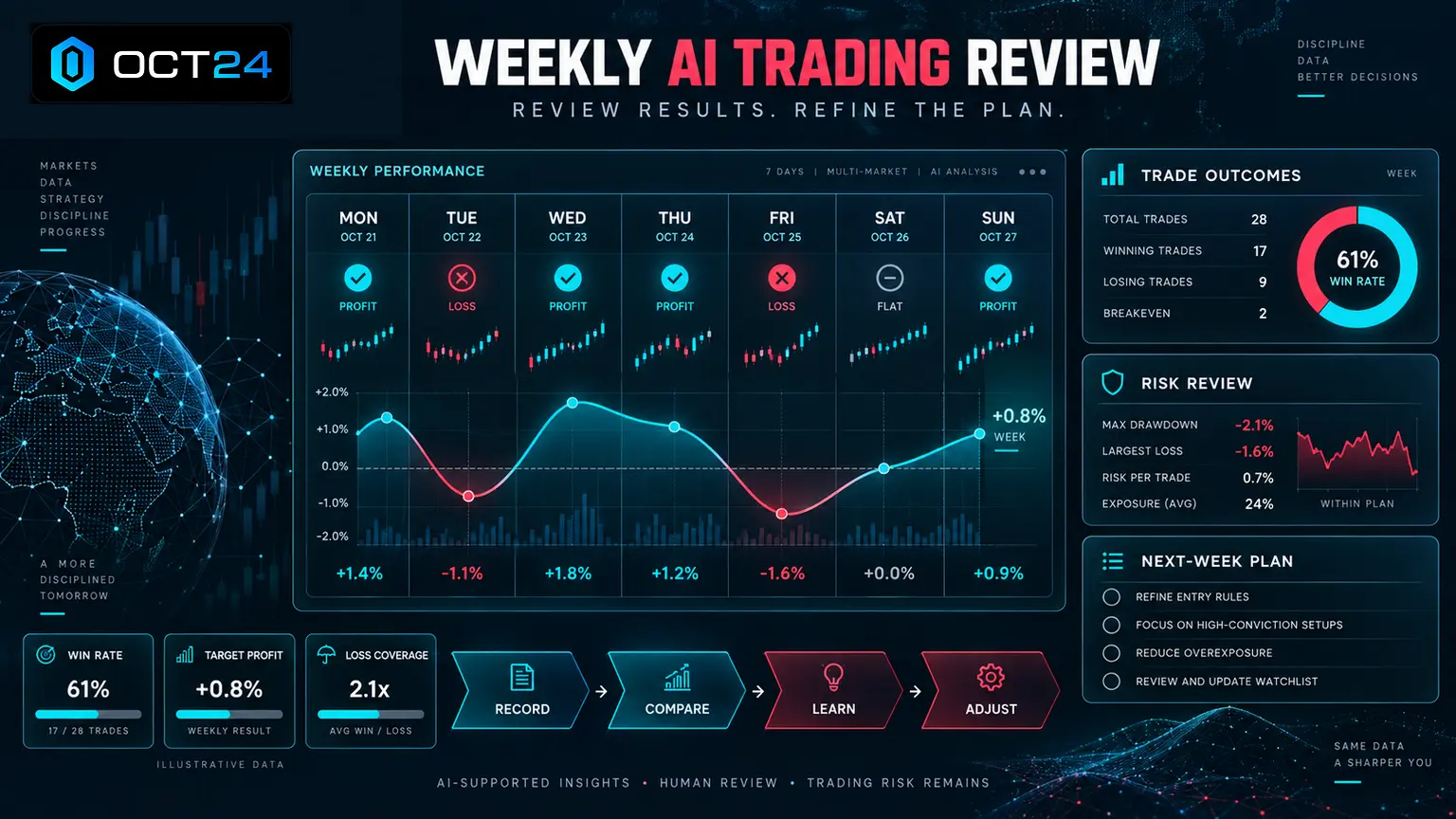
Track signal quality, execution quality, slippage, trade frequency, risk, and results across a meaningful sample.
One trade does not prove whether a workflow is effective.
Performance review shows whether speed is actually helping.
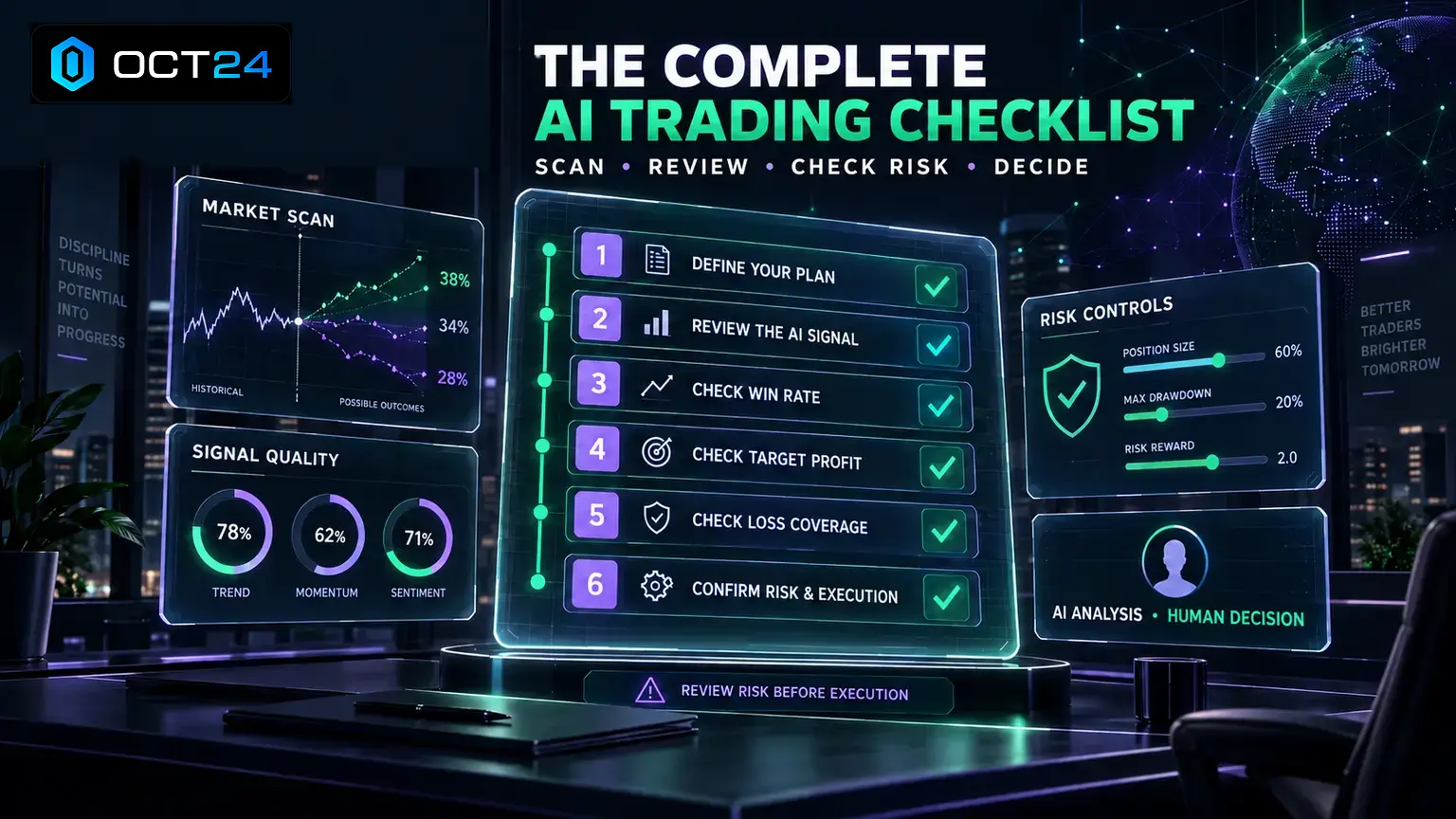
Speed and Risk Checklist
Before acting on a fast signal, traders can ask:
- Is the market information current?
- Does the signal fit my strategy?
- Has price already moved too far?
- Is volatility unusually high?
- Is liquidity suitable?
- Is the position size appropriate?
- Is the stop-loss clear?
- Is leverage controlled?
- Do I understand my total exposure?
- Have I reached a daily risk limit?
- Am I acting because of evidence or urgency?
- Would I still take this trade if execution were not instant?
- Can I accept the planned loss?
- Will I review the decision afterward?
This checklist is simple by design.
In fast markets, complicated rules are easy to ignore. A short checklist can help keep the trader focused on what matters.
Frequently Asked Questions
Why does speed matter in AI trading?
Speed matters because market data can change faster than a trader can review it manually. AI can scan markets, compare conditions, and present potential opportunities sooner. This may improve decision efficiency, but it does not guarantee a profitable trade.
The real value is not rushing into more trades.
It is having current information earlier so the trader can review risk with more structure.
What does AI trading speed mean?
AI trading speed refers to how quickly a system collects data, processes information, identifies opportunities, delivers signals, and supports the move from review to execution. It includes more than order speed.
A fast trading workflow should help with both analysis and decision-making.
If only the final click is fast, but the signal is outdated or unclear, the workflow is still weak.
How quickly can AI analyze market data?
AI can analyze market data much faster than a person reviewing charts manually because it can compare several markets and data points at the same time. The exact speed depends on the platform, data source, strategy rules, and market conditions.
The practical benefit is faster organization of information.
The trader still needs to decide whether the opportunity is suitable.
What is execution latency in trading?
Execution latency is the short delay between a trading decision and the order reaching the market. It can be affected by the trading platform, internet connection, exchange response, order type, liquidity, and market activity.
Lower latency can reduce avoidable delay.
It cannot guarantee a specific fill price.
Does faster execution guarantee better results?
No. Faster execution does not guarantee better results because the trade still depends on signal quality, market conditions, risk settings, liquidity, slippage, and the trader’s decision. A poor trade entered quickly is still a poor trade.
Execution speed matters most after the analysis and risk review are complete.
Are faster trading bots always better?
Faster trading bots are not always better. A bot also needs reliable data, clear strategy rules, useful filters, stable technology, and strong risk controls. A bot that reacts instantly to weak information may simply make bad decisions faster.
Traders should evaluate the full workflow, not speed alone.
Can AI eliminate trading delays completely?
No. AI can reduce some delays by scanning markets and presenting information quickly, but it cannot eliminate every delay. Platforms, exchanges, internet connections, liquidity, and market activity can still affect execution.
The realistic goal is to reduce unnecessary friction.
It is not to remove every delay in every market condition.
How does speed affect slippage?
Speed may reduce some avoidable delay, but it cannot prevent slippage in every condition. Slippage can happen when price moves quickly, liquidity changes, spreads widen, or the final execution price differs from the expected price.
Fast markets can increase this risk.
That is why traders should review volatility and order conditions before acting.
Why does speed matter during market volatility?
Speed matters during volatility because price, volume, and momentum may change quickly. AI can monitor those changes and present updated information faster than manual review. However, volatility can also increase slippage and make risk harder to control.
During volatile periods, fast information is useful.
But risk review becomes even more important.
Can fast AI trading predict the market?
No. Fast AI trading cannot predict the market with certainty. AI may recognize patterns, compare data, and update analysis quickly, but unexpected news, liquidity shifts, and new orders can still change the outcome.
Speed improves access to information.
It does not remove uncertainty.
Why is risk management important in fast trading?
Risk management is important because losses can develop quickly when trades are entered quickly. Position sizing, stop-loss planning, exposure limits, leverage controls, and daily loss limits help define acceptable risk before execution.
Fast trading without risk rules can magnify mistakes.
Should beginners prioritize trading speed?
Beginners should prioritize understanding, risk control, and a simple process before speed. Faster tools can help, but only when the trader knows what kind of setup they are looking for and how much risk they are willing to take.
Speed should support discipline.
It should not replace learning.
How does OCT24 support faster market analysis?
OCT24 supports faster market analysis by scanning market conditions, identifying potential opportunities, reviewing momentum and volatility, and presenting AI-supported trading signals. This can reduce manual chart review and help traders follow a more structured decision process.
OCT24 does most of the analysis work.
The trader still remains responsible for risk settings, capital allocation, exposure, and execution decisions.
What is the G6 Trading Bot?
The G6 Trading Bot is an OCT24 trading bot designed to support a faster, more streamlined trading workflow. It can help with timely market scanning, short-interval signal generation, efficient signal delivery, and real-time activity tracking.
It does not guarantee profits, prevent slippage, or remove the need for trader review.
Does OCT24 guarantee profitable trades?
No. OCT24 does not guarantee profitable trades, risk-free results, ideal execution prices, or perfect predictions. It performs most of the market analysis and presents AI-supported trading signals, but the trader remains responsible for risk settings, exposure, capital management, and execution choices.
Responsible trading still matters.
Why Speed Matters in AI Trading: Key Takeaways
Speed in AI trading can help traders work with market information more efficiently.
It can support:
- Market data collection
- Real-time analysis
- Market monitoring
- Opportunity identification
- Signal delivery
- Volatility awareness
- Efficient execution
- Performance tracking
But speed has limits.
It cannot:
- Guarantee profits
- Guarantee accuracy
- Predict the market with certainty
- Remove market risk
- Prevent slippage in every condition
- Correct weak data or poor strategy rules
- Make oversized positions safe
- Replace risk management
- Remove trader responsibility
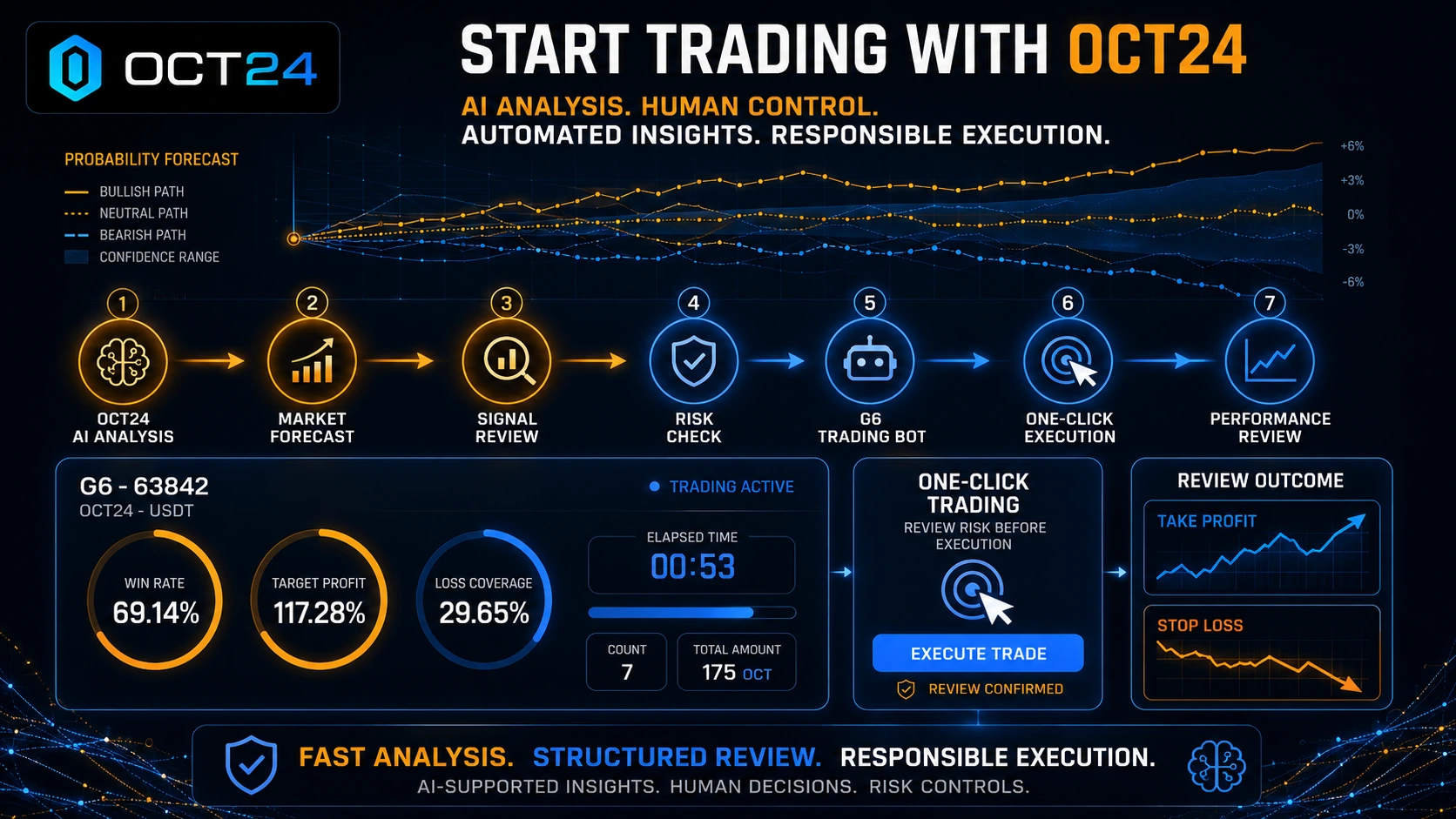
OCT24 helps by performing most of the market analysis, identifying potential opportunities, and presenting AI-supported trading signals in a faster, more structured workflow.
That can help traders reduce manual chart review and respond to changing conditions more efficiently.
Still, the trader must choose suitable risk settings, understand exposure, manage capital responsibly, and make informed execution choices.
Speed is valuable when it supports better decisions.
It becomes risky when it encourages rushed decisions.
If you want to use a faster AI-supported workflow while staying responsible for risk, you can Start Trading with OCT24 and review each signal with a clear plan before execution.