
How to Avoid False Signals in AI Trading
Learning how to avoid false signals in AI trading is one of the most important skills for beginner crypto traders. A false signal can look like a good opportunity at first, but the setup may be weak, rushed, or too risky once you review the full picture.
A false signal does not always mean the AI is broken. In trading, false signals happen because markets are noisy. Crypto prices can move sharply, reverse quickly, react to news, or create short-lived moves that do not continue.
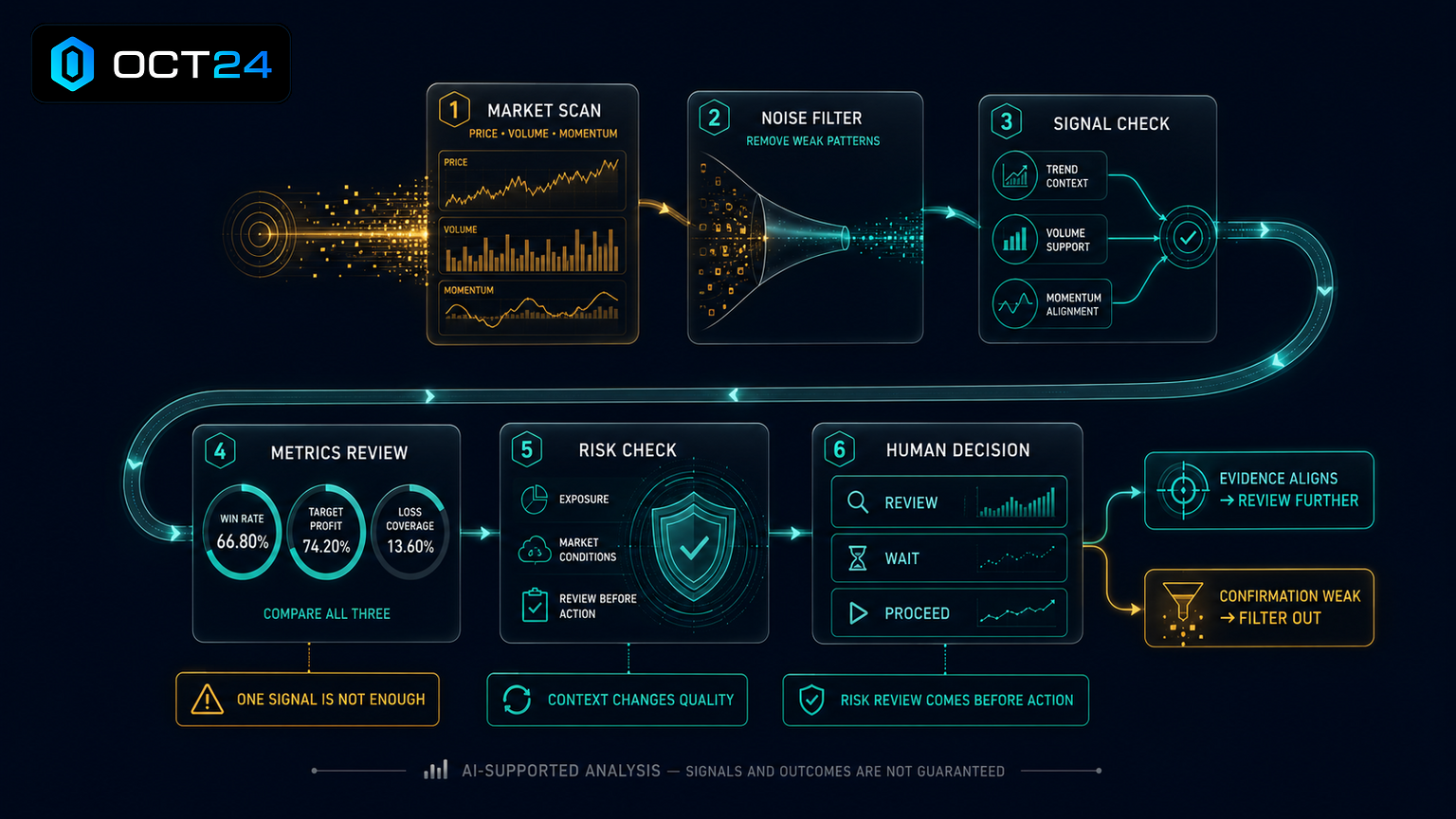
OCT24 helps simplify this process by scanning crypto market conditions, identifying potential opportunities, and presenting AI-supported trading signals. The trader then reviews the key signal information, especially Win Rate, Target Profit, and Loss Coverage, before deciding whether to activate the trade.
The goal is not to find a perfect signal. No trading signal is perfect. The goal is to avoid treating every signal as equal and to build a simple process for spotting when a trade may not fit your risk comfort.
What Is a False Signal in AI Trading?
A false signal in AI trading is a trade alert or AI-supported setup that appears useful but does not develop as expected. The market may move briefly in the expected direction and then reverse. Or the setup may look strong on one metric but weak when you compare the full signal profile.
For beginner traders, this can be confusing. A signal may look clean, the market may look active, and the trade may still fail. That does not automatically mean the system was useless. It means the market changed, the setup was weaker than it looked, or the trader focused too much on one piece of information.
False AI trading signals are common in fast markets because price action can change quickly. This is especially true in crypto, where liquidity, news, leverage, and emotion can all move prices in a short period.
A trader who wants to avoid false signals needs a review process. The process does not need to be complicated. It should be simple enough to use before every trade.
How to Avoid False Signals in AI Trading
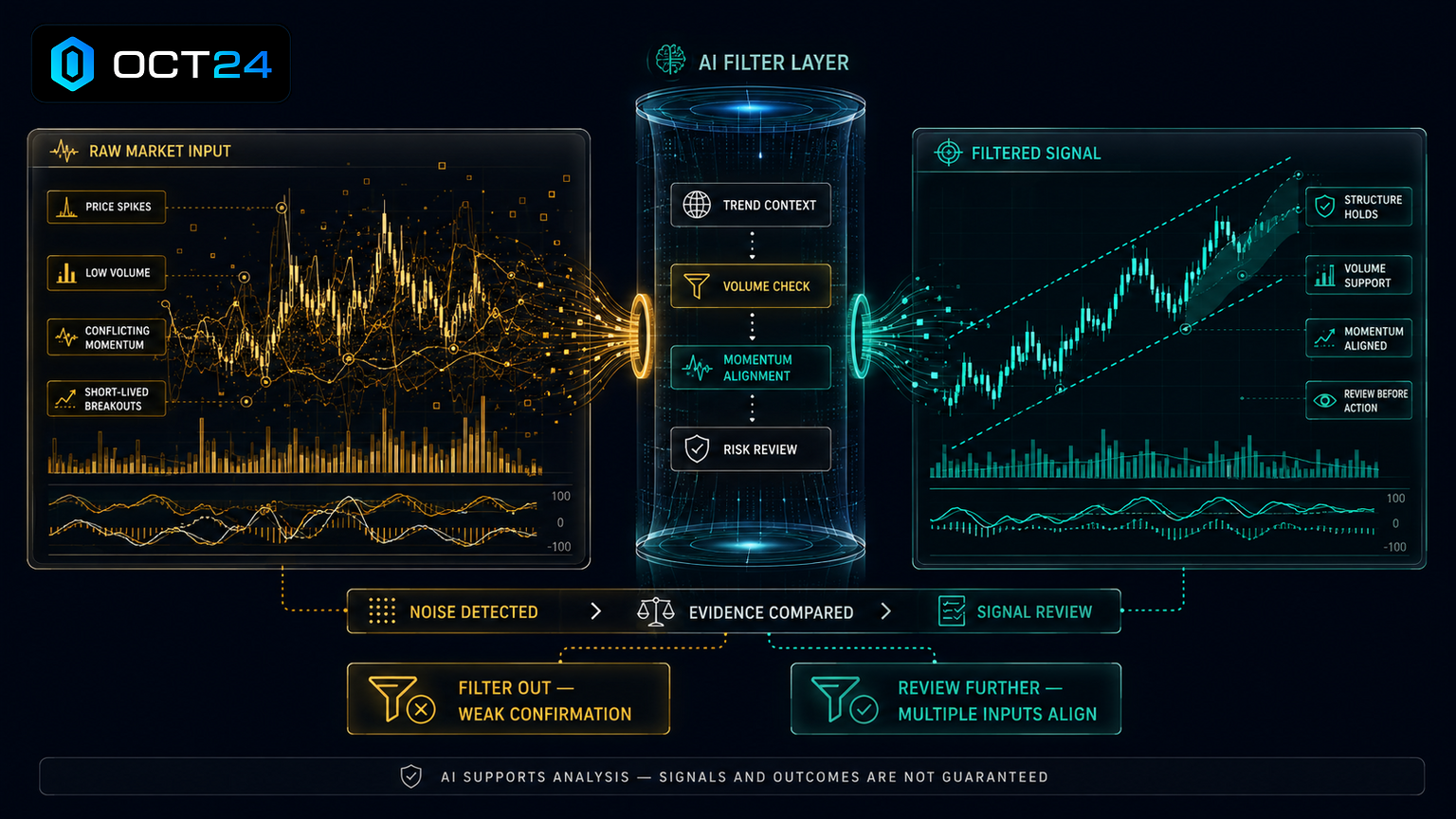
The simplest way to avoid false signals in AI trading is to compare the signal before entering. Do not rely on one number, one candle, one headline, or one feeling. Review the full setup and ask whether the opportunity still makes sense after checking risk and reward together.
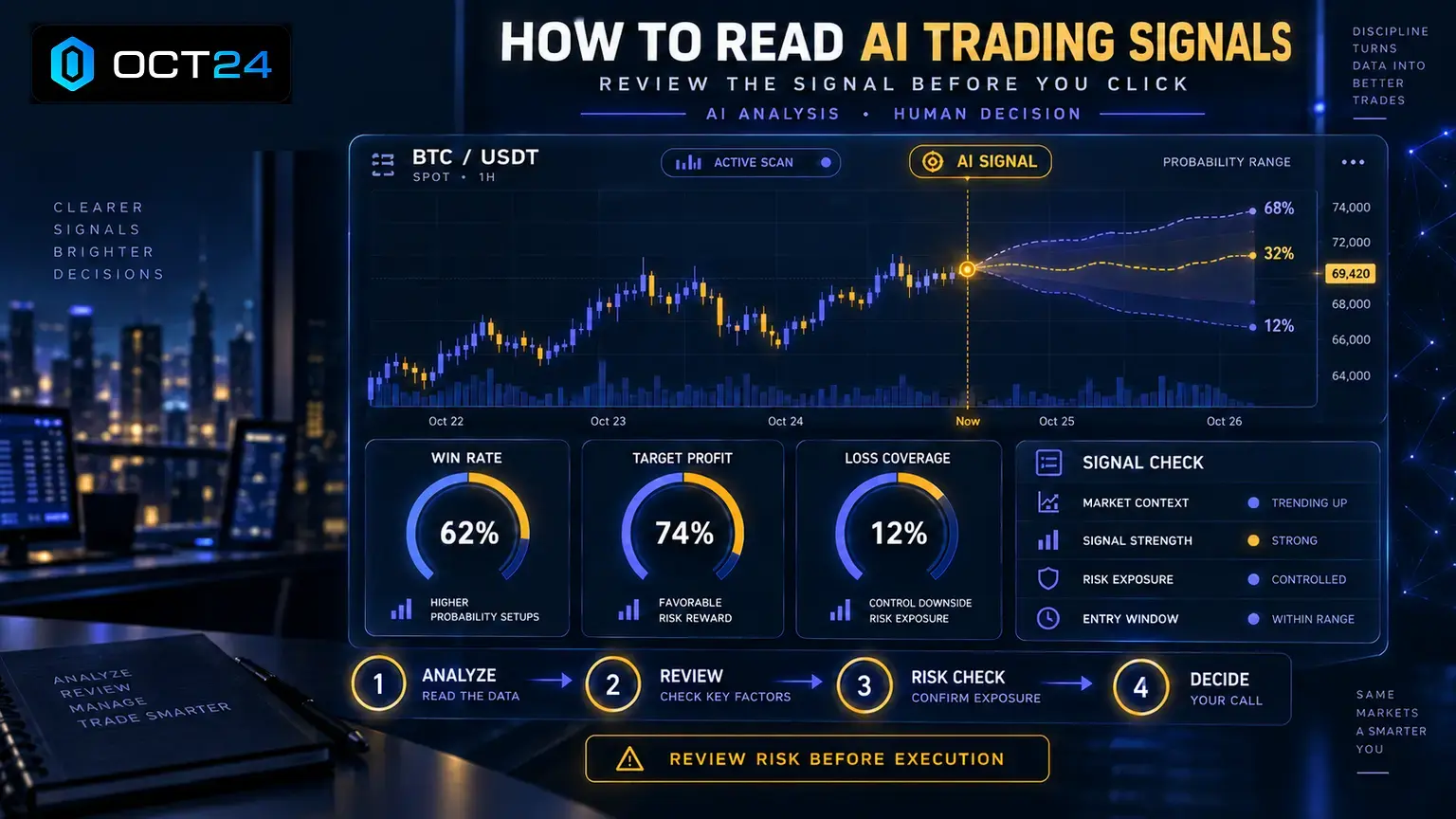
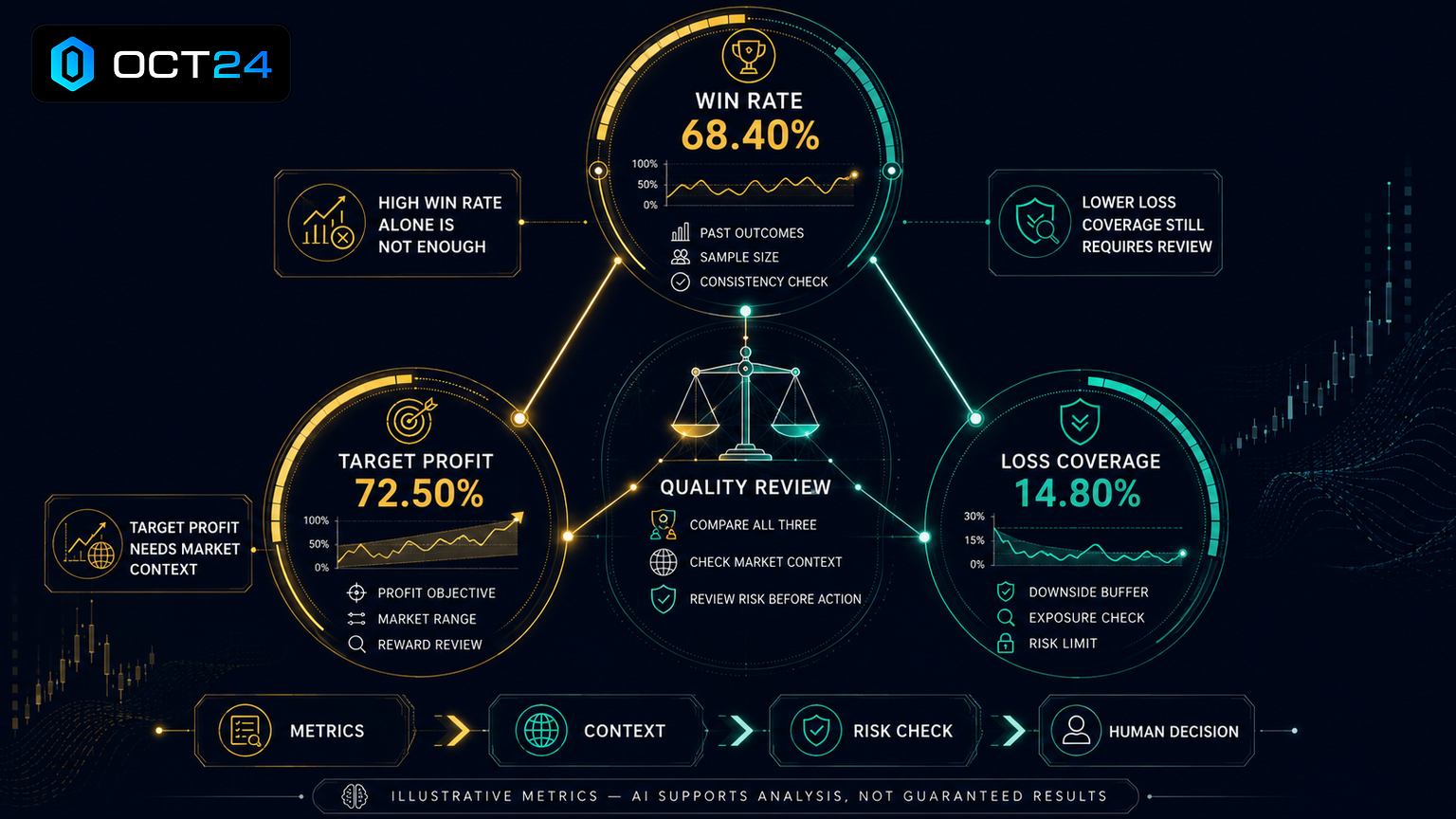
On OCT24, the most important review points are Win Rate, Target Profit, and Loss Coverage. These three signals give the trader a clearer way to judge the opportunity before activation.
Win Rate helps you think about probability. Target Profit helps you understand the potential reward. Loss Coverage helps you think about possible downside and risk comfort.
A signal may look attractive on one of these numbers and less attractive on another. That is why comparison matters.
Why False Signals Happen in Crypto Markets
Crypto markets are active almost all the time. Prices can move quickly because traders around the world are reacting to charts, news, liquidity, funding rates, token updates, and broader risk sentiment.
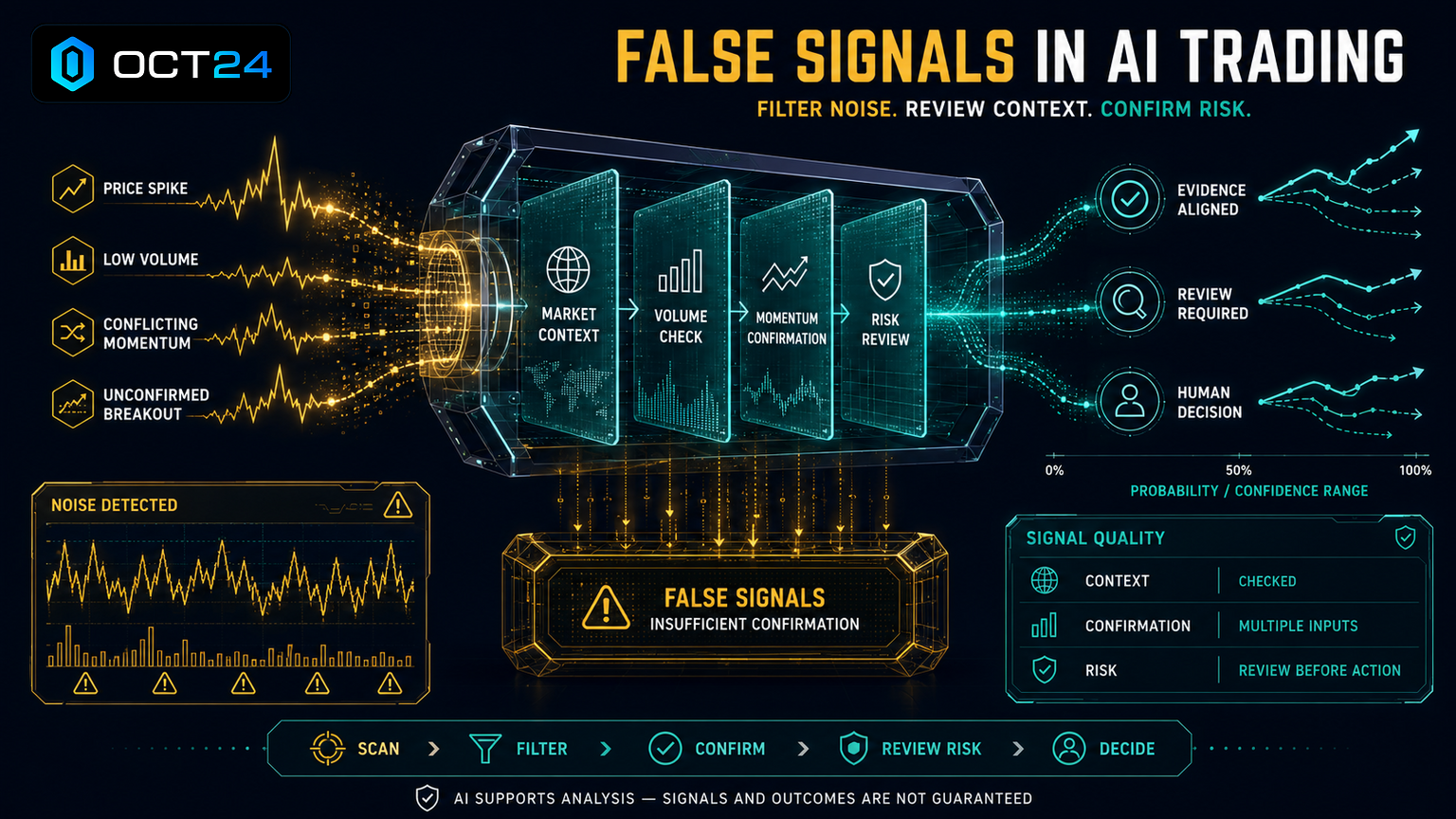
This creates market noise. Market noise is short-term price movement that may look meaningful but does not always lead to a real trend.
A false signal can appear during a quick pump, a sudden drop, or a choppy sideways range. The trade may look interesting for a moment, but the conditions may not be strong enough to support a clean move.
This is why how AI handles market volatility matters. AI can scan more information faster than a person can manually review many charts, but volatility can still create uncertainty. AI can support better decisions, but it cannot remove risk.
Why One Signal Is Not Enough
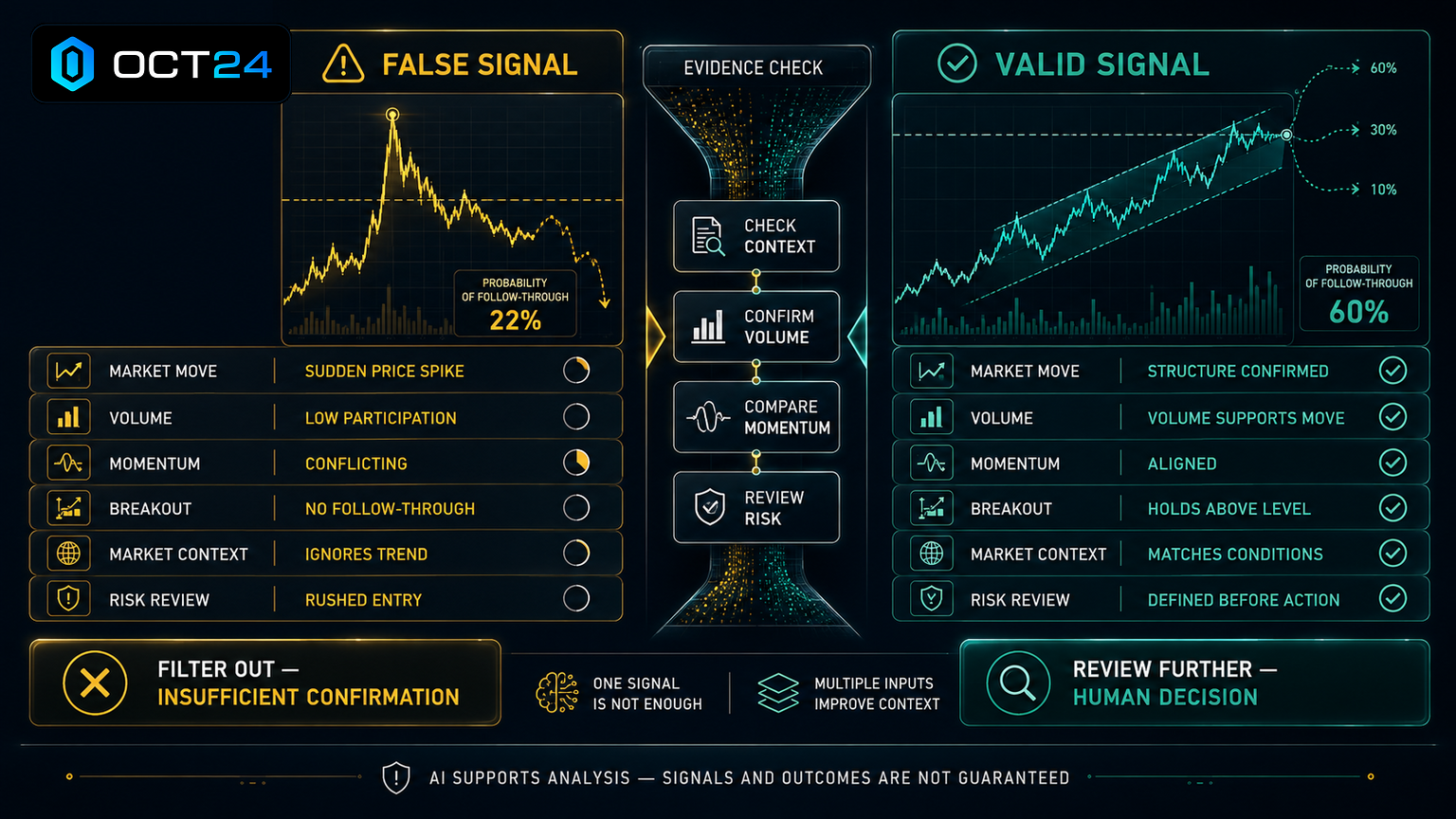
One of the biggest mistakes traders make is trusting one signal by itself. A high Win Rate may feel reassuring. A high Target Profit may feel exciting. Strong Loss Coverage may feel safer. But none of these signals should be judged alone.
A trade with a strong Win Rate may still have a Target Profit that does not fit the market conditions. A trade with a larger Target Profit may also carry more uncertainty. A trade with Loss Coverage may still lead to an uncomfortable result if the trader uses too much capital.
This is where AI trading signals need context. A signal is most useful when the trader reviews how the numbers work together.
OCT24 gives users a simplified signal review process. The platform does not ask the user to manually choose the crypto market, study every asset, or calculate every technical indicator. It presents the trade opportunity and the key metrics the trader needs to review.
That simplicity is useful, but it also means the trader should be careful not to rush. Simple does not mean careless.
How Win Rate Helps Filter False Signals
Win Rate is often the first number traders notice. It gives a quick sense of how often a type of setup may be expected to work based on the system’s signal logic.
A stronger Win Rate can help filter out weaker trades, but it should not be treated as a guarantee. No Win Rate can promise that the next trade will win.
When using Win Rate to avoid false signals, ask simple questions.
- Is the Win Rate strong enough to consider the trade?
- Does the Win Rate make sense with the Target Profit?
- Does the Loss Coverage still feel comfortable?
- Am I taking this trade because the signal looks balanced or because I want action?
This kind of review keeps the trader from entering only because the number looks attractive.
How Target Profit Can Reveal Weak Signals
Target Profit shows the potential upside of the trade. It helps traders understand what the bot is aiming for if the trade develops as expected.
Target Profit is useful, but it can also tempt traders into chasing. A high Target Profit may feel exciting, especially for beginners who want fast results. But bigger potential reward does not automatically mean better signal quality.
A false signal may look attractive because the Target Profit is high while the rest of the setup is less convincing. If the Win Rate is weaker or the Loss Coverage feels uncomfortable, the trade may not fit the trader’s plan.
A more careful trader asks whether the Target Profit looks realistic in relation to the other metrics. If the reward looks exciting but the full signal does not feel balanced, it may be better to skip the trade.
How Loss Coverage Helps Traders Stay Risk-Aware
Loss Coverage is important because false signals often become dangerous when traders focus only on upside. If the trade fails, the downside matters more than the number that first looked exciting.
OCT24 presents Loss Coverage so users can review the risk side before activating the bot. This does not make the trade risk-free. It simply helps make downside information visible before the decision.
A trader should ask whether the Loss Coverage fits their account size, current exposure, and comfort level. If the possible downside feels too large, the trade may not be suitable, even if the Win Rate or Target Profit looks appealing.
This is closely connected to trading bot risk management. AI can help organize the decision, but the trader still has to manage capital responsibly.
False Signals During Breakouts
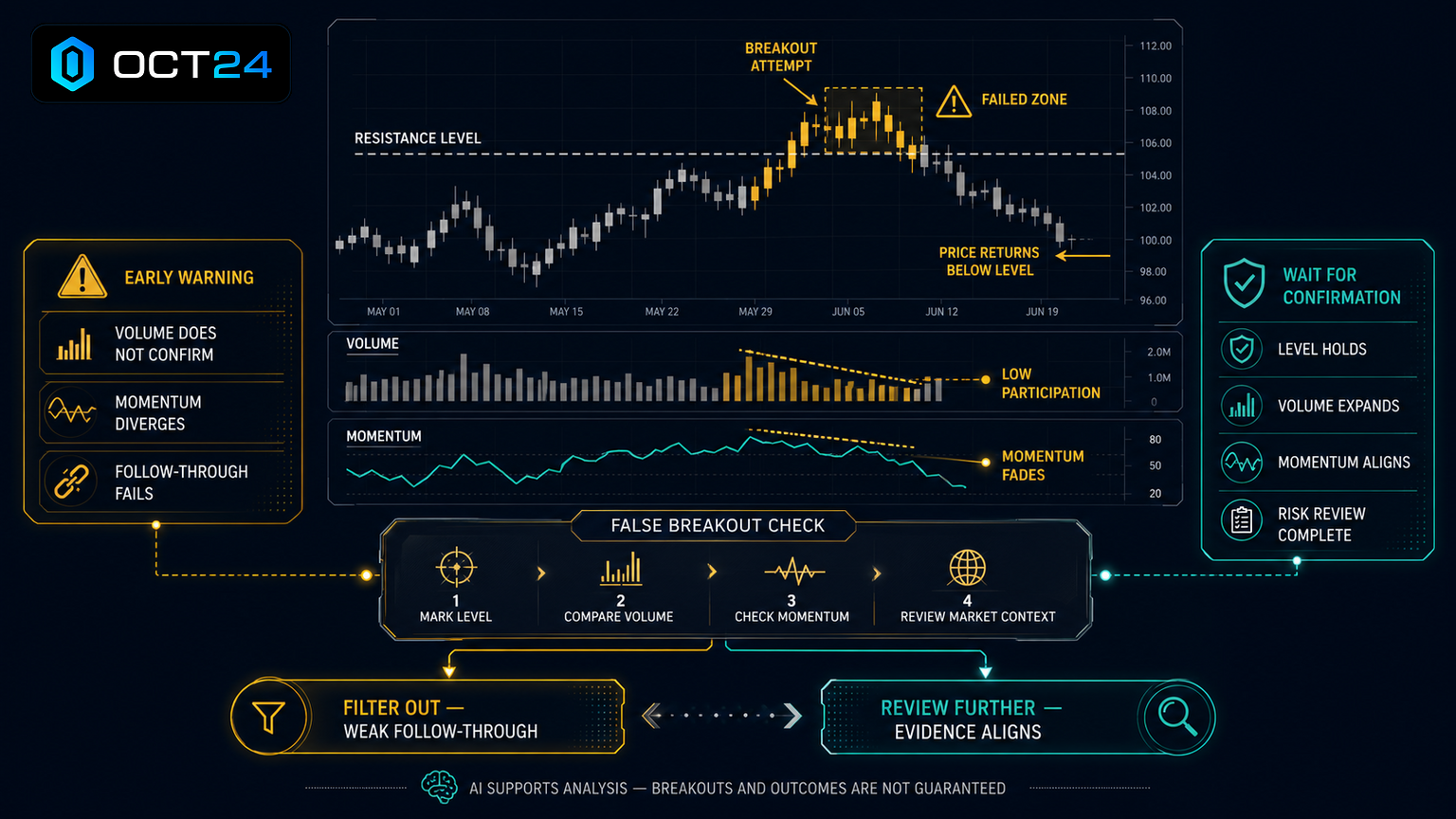
False breakouts are one of the most common sources of false crypto trading signals. A breakout happens when price moves beyond a visible level, such as a recent high, recent low, or trading range.
Sometimes that move continues. Other times it quickly reverses. Traders who enter too late or too emotionally can get caught near the worst point of the move.
AI can help detect potential opportunities around changing market conditions, but the trader still needs to review the signal quality. If the Target Profit looks attractive but the Win Rate or Loss Coverage does not support the trade, the breakout may be too risky.
This is why how AI uses technical analysis is useful background. Technical analysis can help identify structure, momentum, and levels, but no technical signal is perfect.
False Signals During Sideways Markets
Sideways markets can create many weak signals because price moves back and forth without clear direction. A trader may see movement and assume a trend is starting, only for the market to return to the same range.
AI trading during sideways markets requires patience. A signal may appear during a range, but the trader should still compare Win Rate, Target Profit, and Loss Coverage before entering.
If the Target Profit is too ambitious for a quiet market, the setup may be less realistic. If the Loss Coverage does not fit the trader’s risk comfort, the trade may not be worth taking.
The best decision is not always to enter. Sometimes the best decision is to let the opportunity pass.
How OCT24 Helps Filter Market Noise
OCT24 is designed to reduce the amount of manual analysis a beginner has to perform before seeing a potential trade. The platform scans crypto market conditions, identifies possible opportunities, and presents AI-supported trading signals in a simplified way.
This is different from asking the user to manually choose a market, open a chart, compare indicators, and decide everything from scratch. OCT24 performs most of the analysis and brings the opportunity to the user.
At the same time, OCT24 does not show every detail behind each trade. Users currently review simplified trade information, mainly Win Rate, Target Profit, and Loss Coverage. The platform does not present full asset research, exact entry details, or exact exit details for every opportunity.
That makes the review process simple, but it also makes discipline important. The trader should use the available metrics carefully and avoid activating a trade just because it appears quickly.
A Simple False Signal Checklist
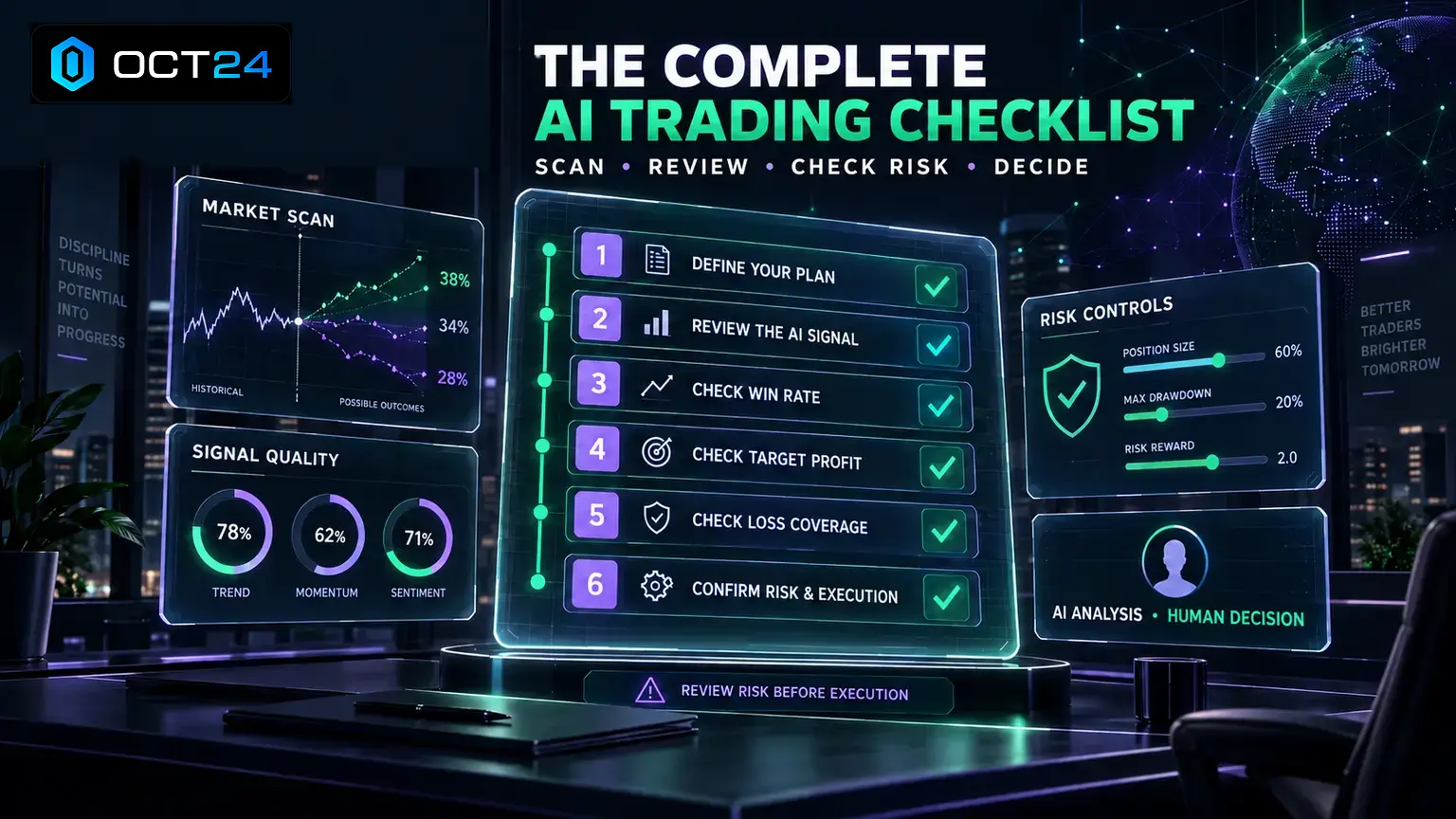
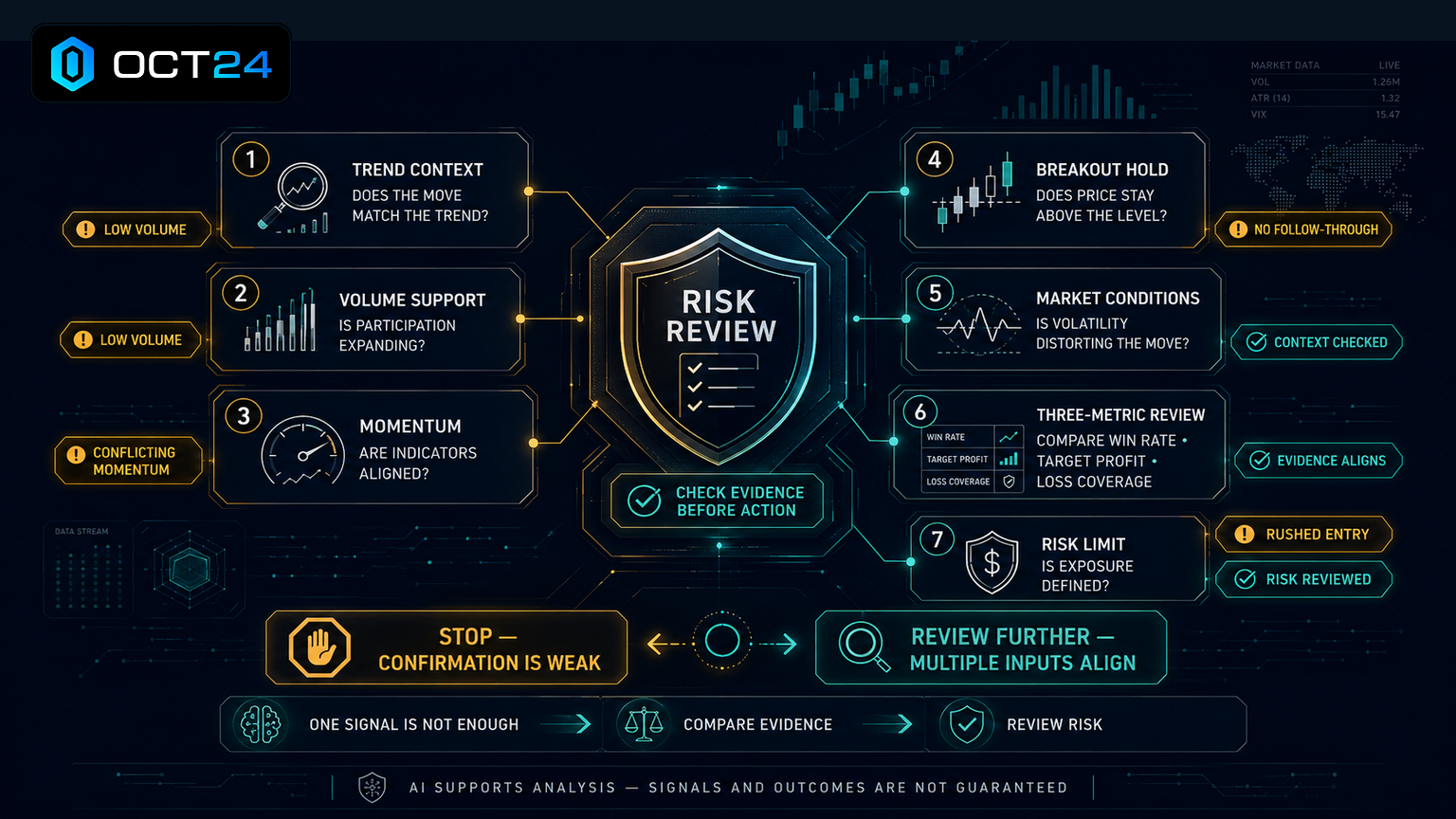
A simple checklist can help traders avoid false signals without making the process too technical. Before activating a trade, ask these questions.
- Does the Win Rate look strong enough?
- Does the Target Profit feel realistic?
- Does the Loss Coverage fit my account?
- Do the three signals support each other?
- Am I entering because the signal is balanced?
- Am I chasing a move that already happened?
- Would I still take this trade after a loss?
- Can I accept the outcome if the trade fails?
This checklist is not a guarantee. It is a way to slow the decision down and reduce emotional trading.
How AI Helps Traders Avoid Emotional False Signals
Many false signal problems are not only technical. They are emotional. A trader may see a fast-moving market and convince themselves that any signal is worth taking.
This is where trading psychology becomes important. Fear of missing out, revenge trading, impatience, and overconfidence can all make weak signals look better than they really are.
AI can help by giving the trader a more structured review process. Instead of reacting to emotion, the trader reviews signal metrics. Instead of chasing, the trader compares the setup. Instead of guessing, the trader follows a routine.
This does not make the trader emotionless. It simply gives them a better process to lean on when markets feel noisy.
How to Avoid Overtrading False Signals
False signals can become more damaging when traders take too many of them. One weak trade may be manageable. Several weak trades in a row can create frustration, drawdown, and poor decision-making.
AI can help traders avoid overtrading by reducing the need to constantly search for setups manually. With OCT24, the bot presents opportunities for the user to review. The user does not need to force trades from a blank chart.
However, the user still needs to choose carefully. If every opportunity is activated without review, the trader is not really filtering signals. They are simply reacting faster.
A consistent trading routine can help. Traders can decide in advance how they will review Win Rate, Target Profit, and Loss Coverage before entering.
How to Review False Signals After a Trade
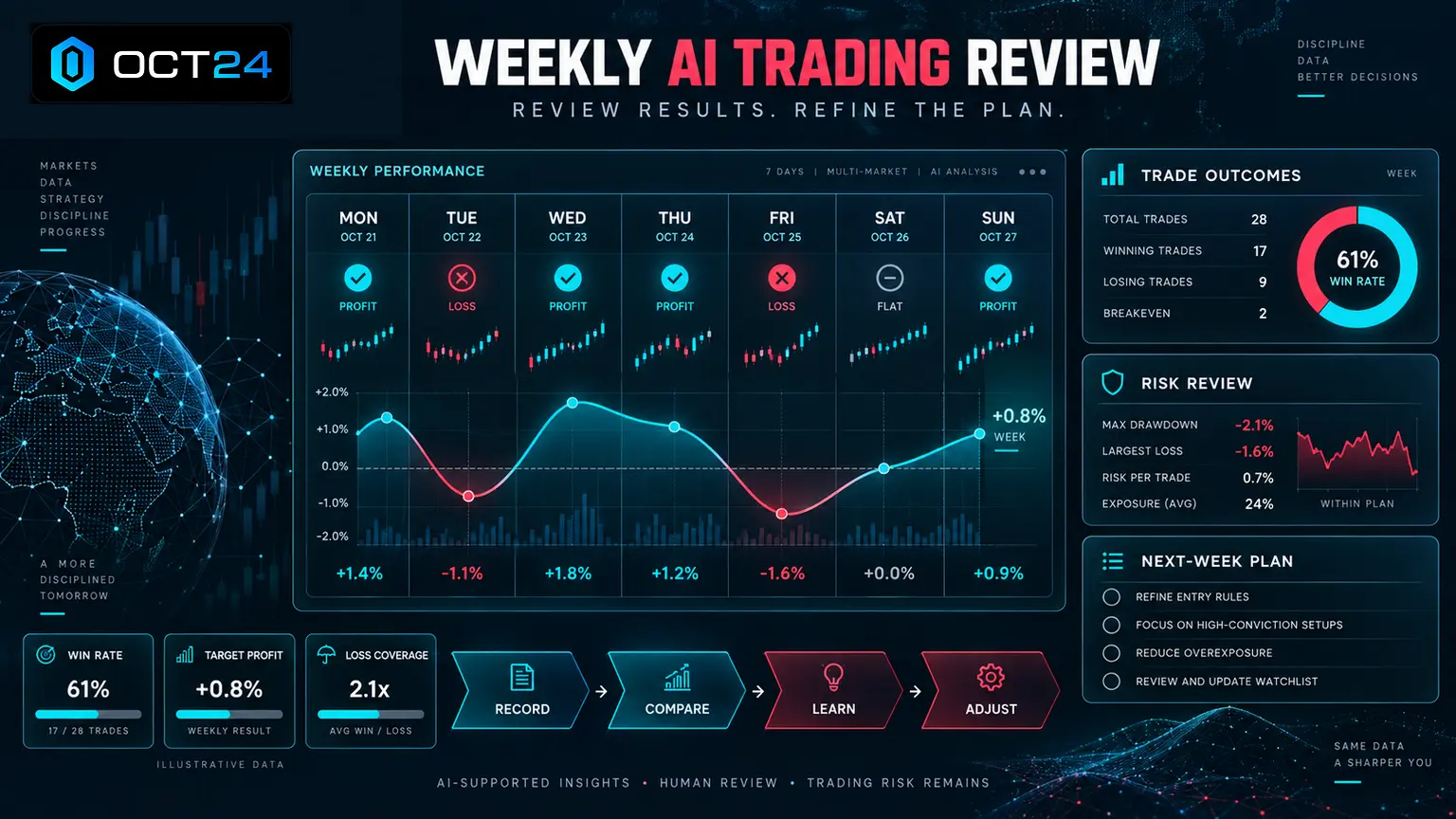
False signals are easier to understand after the trade is finished. That is why performance review matters.
After a losing trade, the trader should avoid blaming one number immediately. Instead, review the setup calmly. Was the Win Rate strong enough? Was the Target Profit realistic? Was the Loss Coverage comfortable? Did the trader enter because the setup made sense or because they felt rushed?
This connects with AI trading performance. A single trade does not prove that a signal process works or fails. The goal is to review patterns over time.
If many losing trades came from similar conditions, the trader may learn to be more selective. If the trader often entered because of excitement, the real problem may be behavior rather than the signal itself.
Why Beginners Should Keep the Process Simple
Beginner traders often think they need more indicators, more dashboards, and more information to avoid false signals. Sometimes that helps. But too much information can also create confusion.
For beginners, the better approach is usually simple. Focus on the most important decision points and repeat the same process each time.
On OCT24, that means reviewing Win Rate, Target Profit, and Loss Coverage before activation. It also means accepting that the AI bot chooses the crypto market and presents the opportunity. The trader is not manually selecting the asset or planning the exact entry and exit.
This is why choosing the right AI trading platform matters. A good beginner-friendly platform should make the decision easier to understand without making unrealistic promises.
Where the G6 Trading Bot Fits
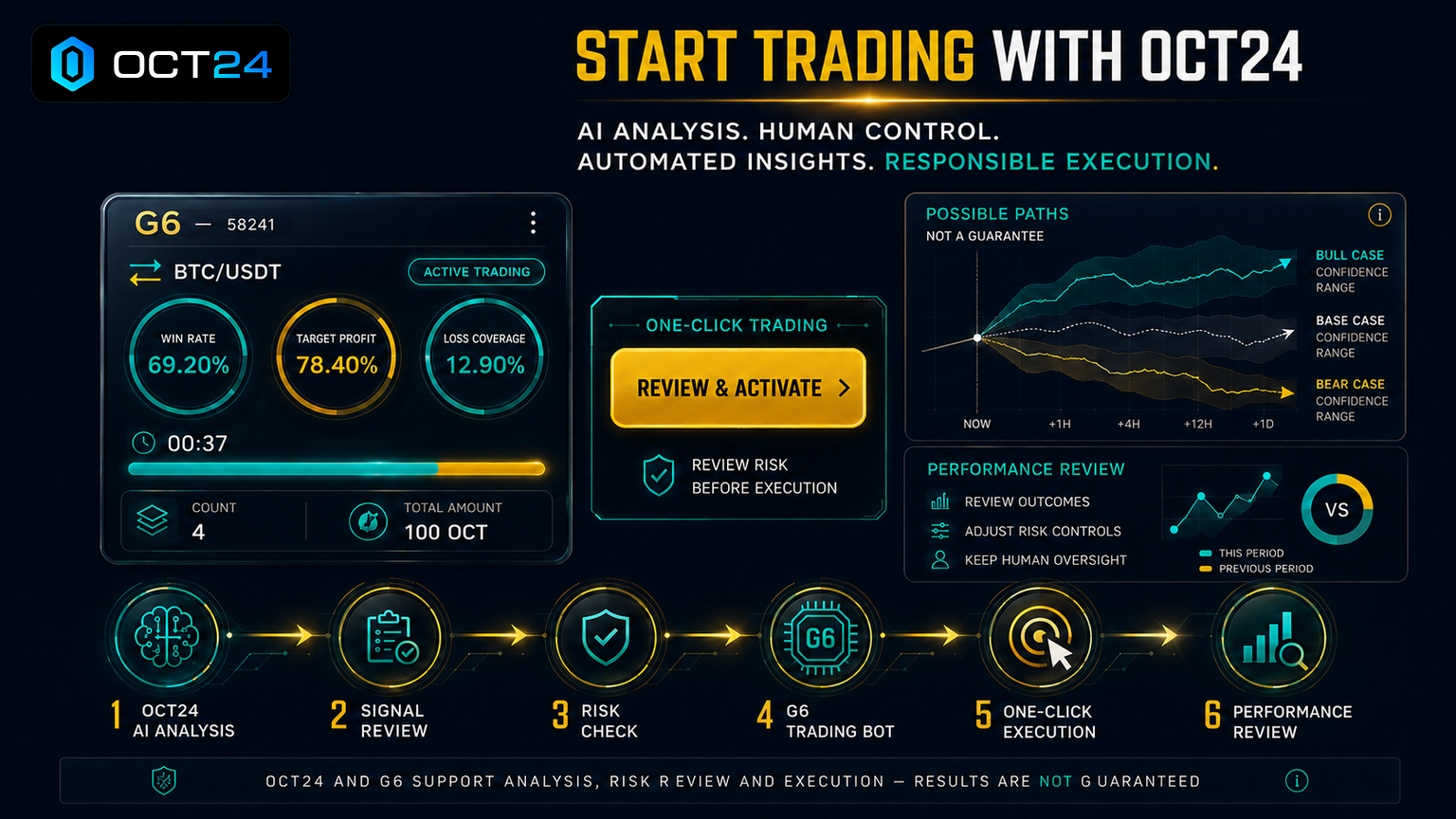
The G6 Trading Bot fits this topic because it is built around a fast, simplified trading experience. The user reviews the key signal information, then decides whether to activate the bot during the available entry window.
This speed can be useful, but it also makes signal discipline important. If a trader clicks without reviewing the metrics, they may still make emotional decisions.
The better approach is to use the bot as part of a clear process. Review the Win Rate. Review the Target Profit. Review the Loss Coverage. Then decide whether the opportunity fits your risk comfort.
A fast system should still be used carefully.
How to Build Better Signal Habits
Avoiding false signals is not about finding one perfect trick. It is about building better habits.
A good habit is to compare every signal the same way. Another good habit is to skip trades that do not feel balanced. A third habit is to review results without becoming too emotional after one win or one loss.
This is where AI trading strategies for beginners should stay practical. Beginners do not need to predict every move. They need a clear way to decide whether a signal deserves attention.
Strong habits help traders avoid common AI trading mistakes such as overtrading, chasing, ignoring risk, or trusting a single number too much.
What AI Cannot Do About False Signals
AI can help filter market noise, but it cannot remove false signals completely. Markets are uncertain. Crypto can move quickly. News can change sentiment. Liquidity can shift. A trade that looked reasonable can still fail.
This is one of the most important AI trading myths to avoid. AI does not create guaranteed trades. It supports analysis and decision-making, but it does not remove risk.
OCT24 is designed to make AI-supported crypto trading easier to review. It does not guarantee profit. Traders remain responsible for risk settings, exposure, capital allocation, and execution decisions.
The safest mindset is simple: use AI as support, not certainty.
How to Use OCT24 to Review Signal Quality
To use OCT24 more effectively, treat each opportunity as a signal review, not an automatic entry.
Start with Win Rate. Then look at Target Profit. Then review Loss Coverage. If the three signals feel balanced, the opportunity may be worth considering. If one part of the setup feels uncomfortable, it may be better to skip it.
The user does not need to manually choose the crypto market or perform deep asset research inside the platform. OCT24 does most of the market scanning and presents the opportunity. The trader’s role is to review the available signal information and decide whether activation makes sense.
This keeps the process simple, modern, and beginner-friendly while still respecting trading risk.
FAQs
What is a false signal in AI trading?
A false signal in AI trading is a setup that appears useful but does not develop as expected. The market may reverse, lose momentum, or behave differently from what the signal suggested.
How can traders avoid false AI trading signals?
Traders can reduce false signal risk by reviewing Win Rate, Target Profit, and Loss Coverage together before entering. OCT24 presents these key metrics so users can make a more structured decision before activation.
Does a high Win Rate prevent false signals?
No. A high Win Rate can be useful, but it does not guarantee that the next trade will win. Traders should compare it with Target Profit, Loss Coverage, and their own risk comfort.
Can a high Target Profit be a warning sign?
Sometimes. A high Target Profit may be attractive, but traders should check whether the Win Rate and Loss Coverage still support the trade. Bigger potential reward does not automatically mean a better signal.
Does Loss Coverage remove trading risk?
No. Loss Coverage helps traders review downside risk, but it does not make a trade risk-free. Crypto trading still involves uncertainty and possible losses.
Does OCT24 show full asset analysis for every trade?
OCT24 currently presents simplified trade information focused on key bot metrics. The user does not manually choose the crypto market and does not receive full asset research, exact entry details, or exact exit details for every opportunity.
Can AI remove false signals completely?
No. AI can help filter market noise and support better signal review, but false signals can still happen because market conditions can change quickly.
Is one-click trading safe from false signals?
One-click trading can make activation faster, but it does not remove risk. Traders should still review the signal metrics carefully before choosing to enter.
Where can I learn more about OCT24?
You can learn more on the About OCT24 page or create an account through Start Trading with OCT24 when you are ready to explore AI-supported crypto trading.
Final Thoughts
Learning how to avoid false signals in AI trading starts with one simple idea: do not treat every signal as equal.
A stronger process compares Win Rate, Target Profit, and Loss Coverage before entering. This helps traders avoid chasing exciting numbers, reacting to market noise, or entering trades that do not fit their risk comfort.
OCT24 supports this process by scanning crypto market conditions, identifying potential opportunities, and presenting AI-supported trading signals. The platform performs most of the analysis, while the trader remains responsible for reviewing the opportunity and deciding whether to activate the trade.
False signals cannot be removed completely. But with a simple review process, traders can become more selective, more disciplined, and more aware of risk.
Learn more about OCT24, or Start Trading with OCT24 when you are ready to explore a more structured way to review AI-supported crypto trading opportunities.