
Crypto Markets Enter Low-Volatility Mode: What Traders Should Watch Next
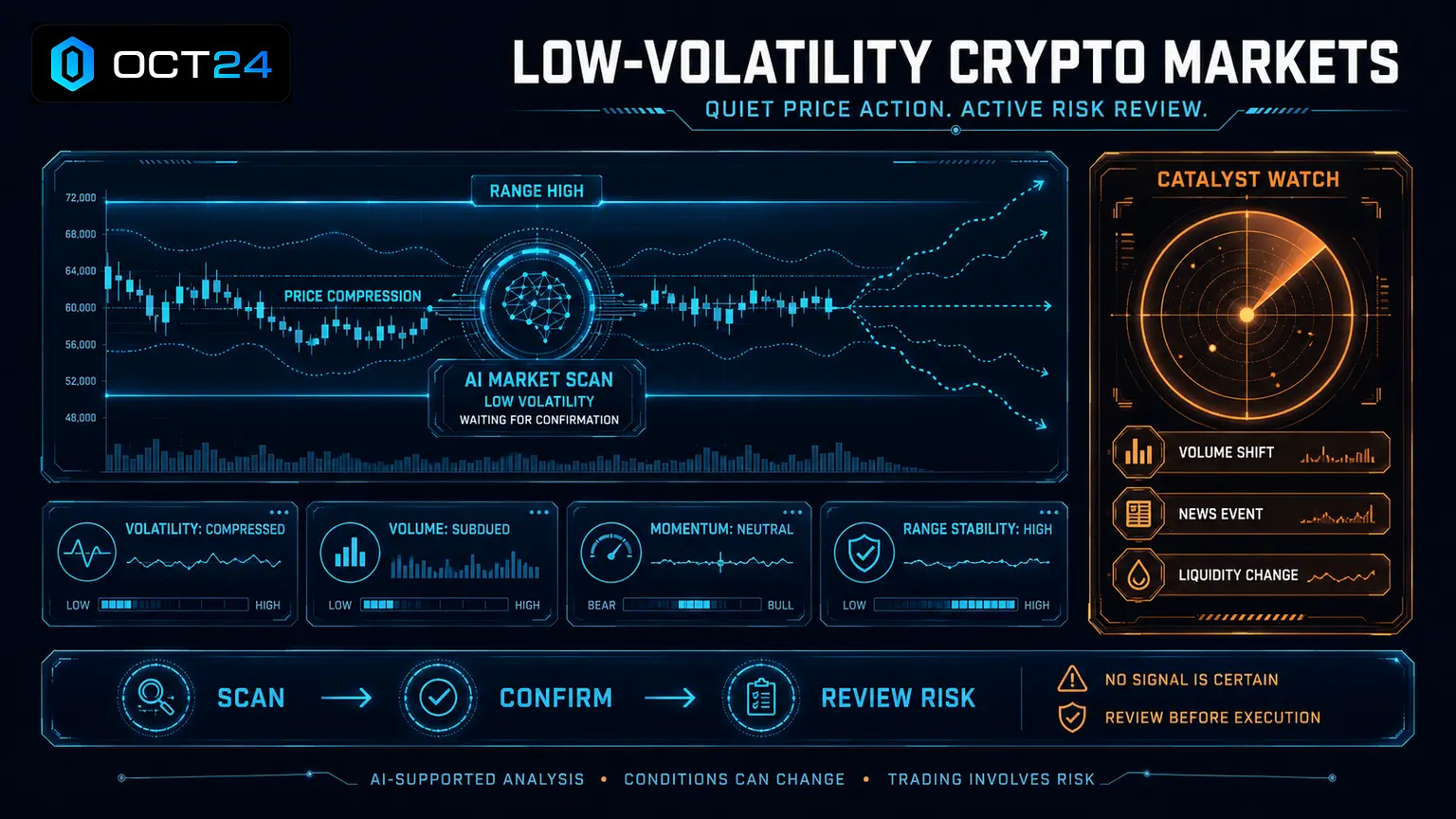
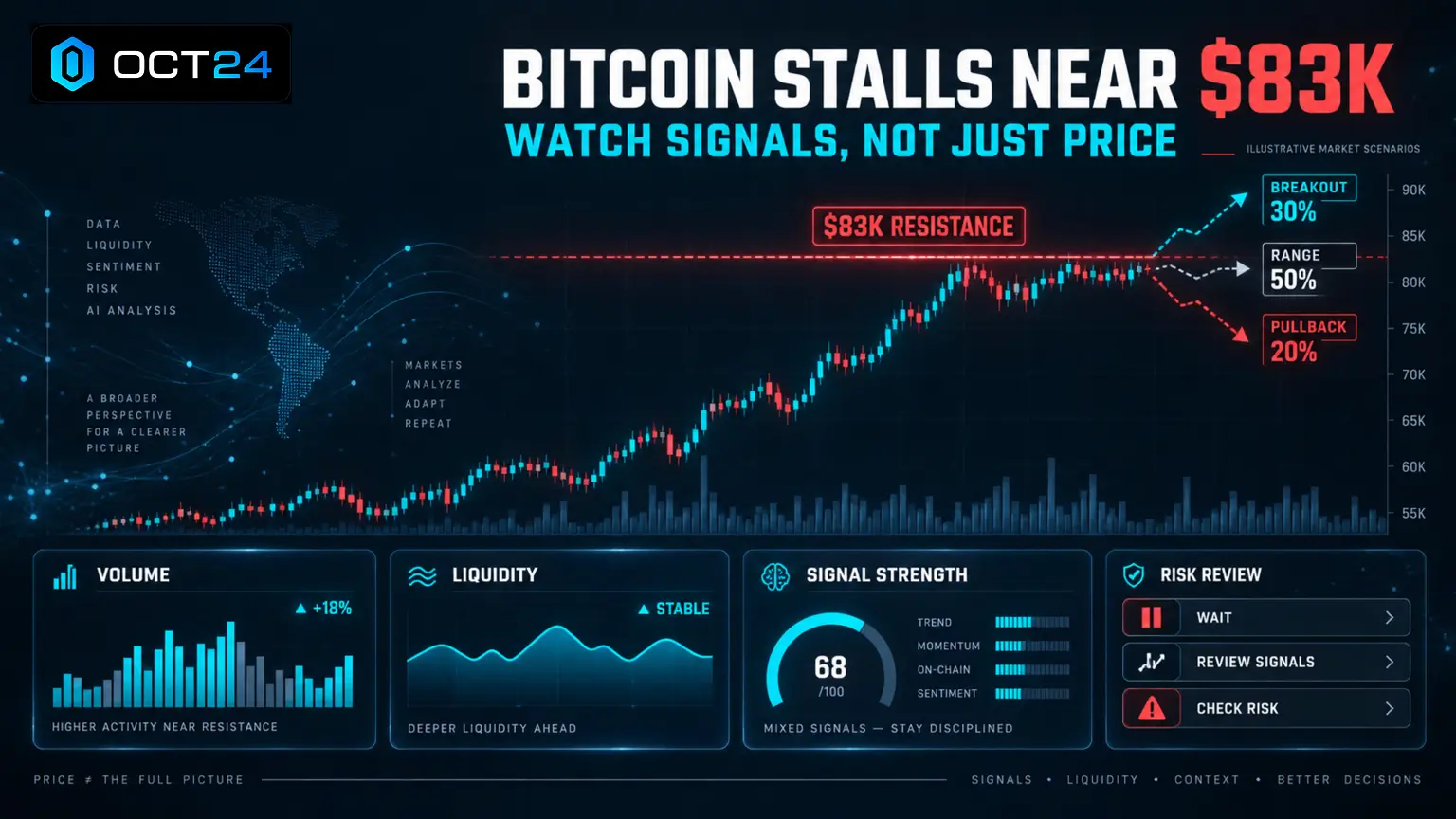
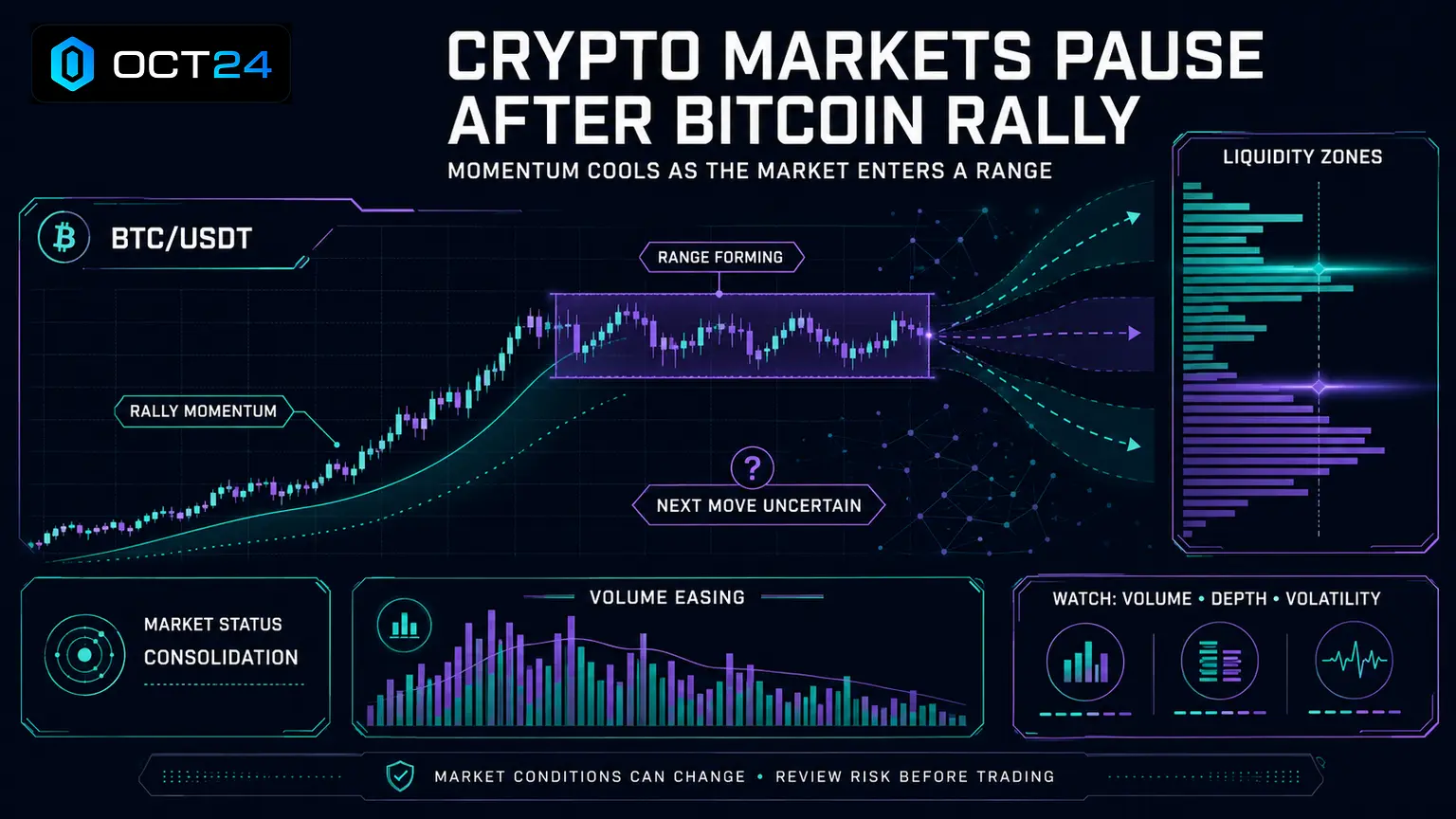
The low volatility crypto market has become the main story for traders this week. Bitcoin has been moving in a tighter range, liquidity has looked thinner, and traders are waiting for the next catalyst before making larger directional bets.
That does not mean the market is quiet in a way traders can ignore. Low volatility often feels calm on the surface, but it can create important setup conditions. Range-bound markets can build pressure, reduce participation, and then move quickly when a new catalyst arrives.
Recent market updates point to several themes behind the slower environment: Bitcoin trading near key support and resistance areas, weaker ETF demand, regulatory uncertainty after delayed U.S. crypto rulemaking discussions, and continued attention on corporate Bitcoin sales.
For traders, the question is simple: what should you watch when the market slows down?
OCT24 is designed to help by scanning market conditions, identifying potential opportunities, and presenting AI-supported trading signals in a simplified way. OCT24 does not remove trading risk or guarantee results. Traders still need to review risk settings, exposure, capital allocation, and execution decisions.
Why Low Volatility Matters Now
Low volatility means price is moving less aggressively than usual. It can happen after a strong rally, before a major announcement, during a liquidity slowdown, or when traders are uncertain about the next clear direction.
In crypto, low volatility can be tricky. It may look like nothing is happening, but the market may be preparing for a larger move. Traders who become bored may overtrade. Traders who become too cautious may miss early signals when momentum returns.
This week, Bitcoin has been moving around a narrow area while traders weigh regulatory delays, ETF demand, corporate treasury activity, and broader risk appetite. Ethereum and altcoins have also shown mixed behavior, with some areas holding up better than others.
That creates a market where patience matters. Instead of forcing trades, traders need to watch whether price stays range-bound, breaks lower, or starts building strength again.
AI can help because it can monitor these conditions continuously instead of relying on a trader to stare at charts all day.
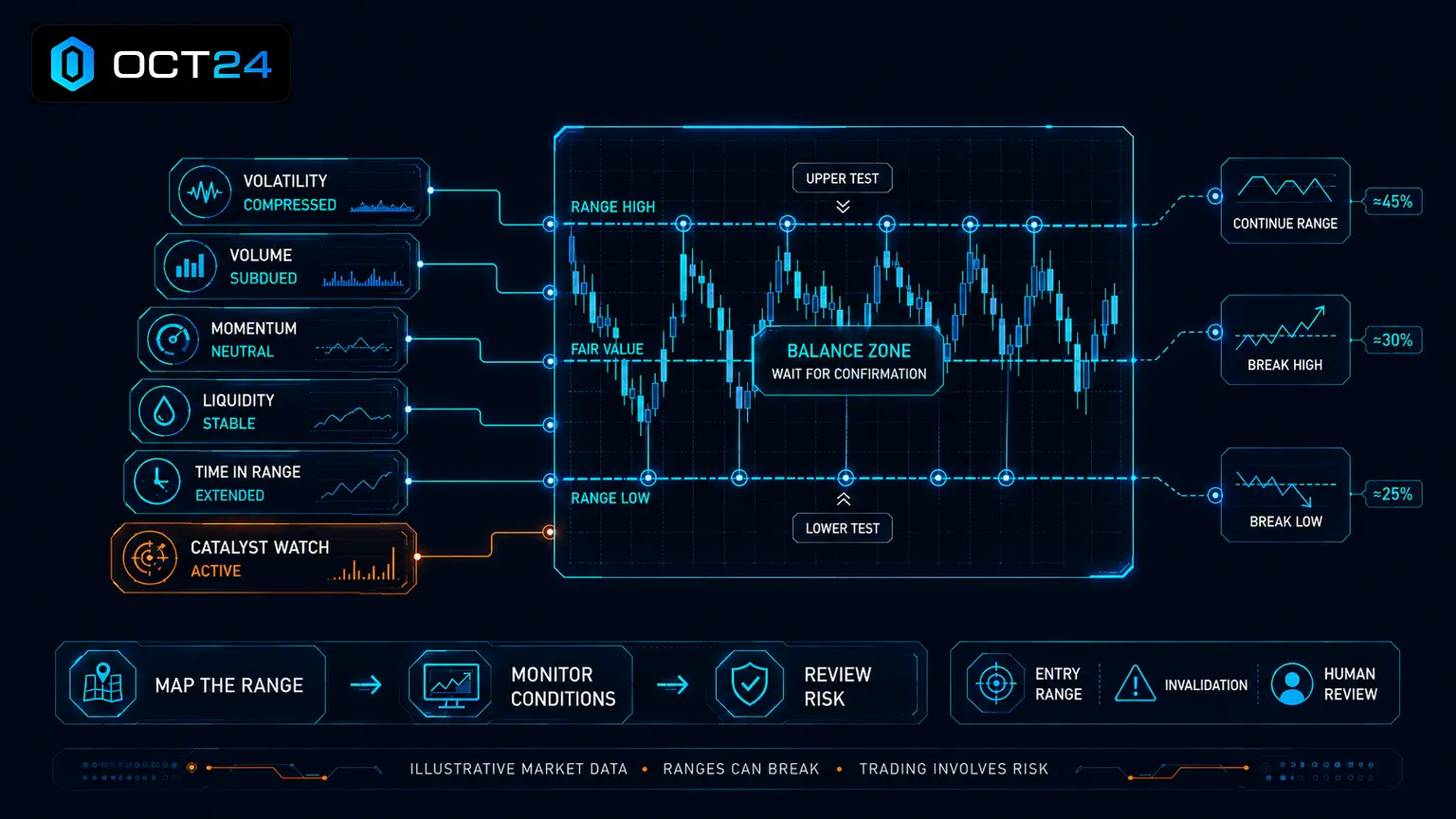
What Low Volatility Usually Tells Traders
Low volatility does not automatically mean bullish or bearish. It simply means the market is not moving with strong directional force at that moment.
This can happen for several reasons. Traders may be waiting for news. Large players may be reducing activity. Leverage may be lower. Or the market may be digesting a previous move before choosing a new direction.
For beginners, the danger is assuming that quiet markets are safe markets. That is not always true. Low volatility can be followed by sharp breakouts or sudden breakdowns when a catalyst appears.
This is why how AI handles market volatility matters. AI can help watch changes in momentum, trend quality, and volatility conditions before they become obvious to manual traders.
The goal is not to predict the exact breakout. The goal is to be more prepared when market behavior starts to change.
The Bitcoin Range Is the First Thing to Watch
Bitcoin remains the main reference point for the crypto market. When Bitcoin is range-bound, the rest of the market often becomes more cautious too.
This week, Bitcoin has been trading near important short-term levels while traders wait for stronger direction. Reports have pointed to pressure from weaker ETF demand, regulatory uncertainty, and corporate Bitcoin sales.
For traders, the exact number is less important than the behavior around the range. Is Bitcoin holding support with confidence? Is it failing to reclaim resistance? Is volume improving or fading?
AI trading signals can help traders review whether a move looks structured or noisy. A move out of a range may matter more if it comes with stronger momentum and broader confirmation.
OCT24 can support this process by presenting AI-supported signals for review, but traders still need to decide whether the displayed target profit, loss coverage, and win rate fit their own risk plan.

Why Liquidity Matters in Quiet Markets
Liquidity is the ease with which assets can be bought or sold without causing large price changes. When liquidity is weaker, even smaller trades can have a bigger effect on price.
Low-volatility markets can sometimes hide liquidity risk. Price may look calm until a sudden order, news event, or liquidation wave pushes the market quickly in one direction.
This is why traders should pay attention to volume, order flow, and how quickly price responds near key levels. Weak liquidity can make breakouts less reliable and reversals sharper.
For beginner traders, the practical lesson is simple. Do not assume that a slow market gives you unlimited time to react. When liquidity is thin, the shift from quiet to fast can happen quickly.
AI trading alerts can be useful because they can help traders notice when market conditions begin changing instead of waiting until the move is already obvious.
Regulatory Delays Add to Market Caution
Another reason traders are watching carefully is regulatory uncertainty. Recent reports noted that a planned U.S. SEC meeting related to crypto rules was canceled, while progress on broader crypto legislation has slowed during the August recess.
Regulatory uncertainty does not always create immediate volatility. Sometimes it does the opposite. Traders step back, wait for clarity, and reduce risk until the next update arrives.
That can contribute to low volatility because fewer participants are willing to make aggressive bets. But it can also create conditions for a sharper move if the next regulatory headline surprises the market.
This is where can AI predict the market needs to be understood carefully. AI can help scan conditions and identify potential opportunities, but it cannot know what regulators will do next or guarantee how price will react.
Traders should treat regulatory headlines as catalysts to watch, not as reasons to abandon risk management.
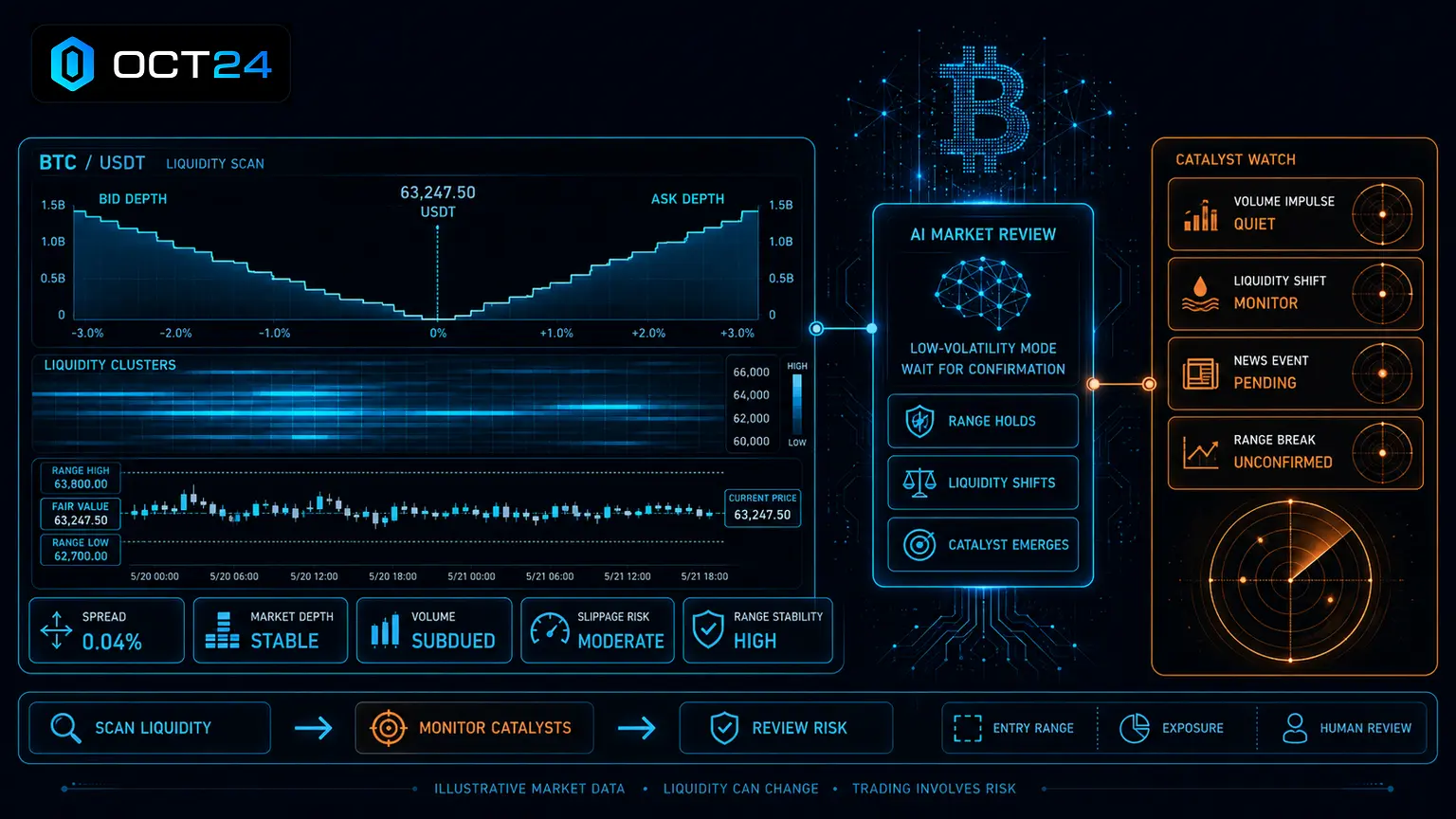
Corporate Bitcoin Sales Are Also in Focus
Corporate Bitcoin activity is another theme traders are watching. Reports this week noted continued Bitcoin sales by Strategy, a company closely associated with large Bitcoin treasury holdings.
For the market, this kind of news matters because it can affect sentiment. If a well-known Bitcoin holder is selling, some traders may become more cautious, even if the sales are tied to company-specific capital decisions rather than a broad bearish view.
That does not mean corporate selling automatically causes a larger decline. It simply becomes part of the market backdrop.
In a low-volatility environment, traders often pay extra attention to these signals because fewer major catalysts are available. A single piece of news can feel more important when the market is waiting for direction.
The key is not to overreact. News should be reviewed alongside price behavior, liquidity, and risk metrics.
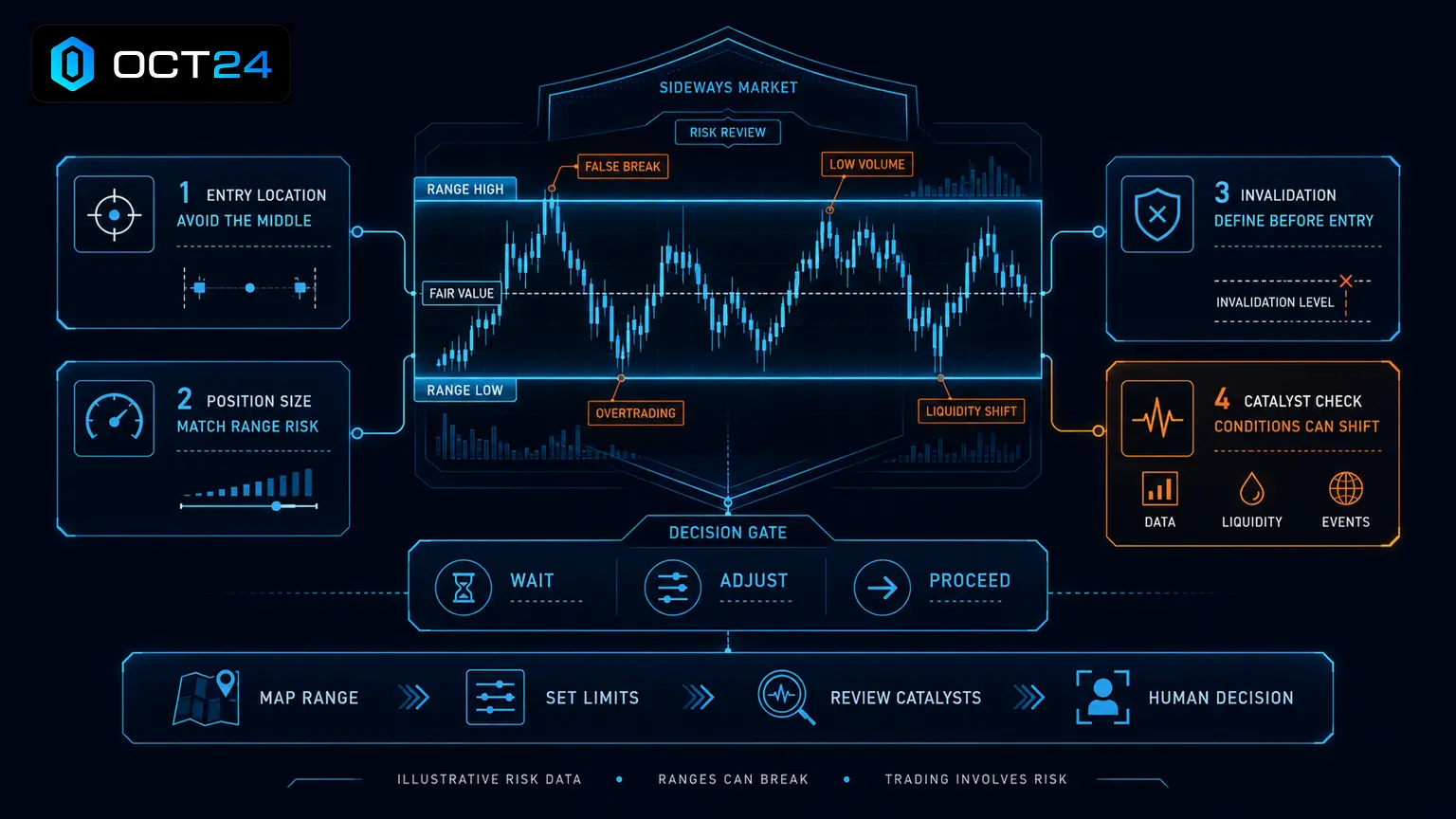
Sideways Markets Can Lead to Overtrading
One of the biggest risks in a low-volatility crypto market is overtrading. When price moves sideways, traders may start forcing trades because they want activity.
This is especially common after a more exciting market period. If traders are used to larger moves, a quiet range can feel frustrating. That frustration can lead to weaker entries and poor risk control.
AI trading during sideways markets can help traders become more selective. Instead of chasing every small move, AI can help filter market conditions and highlight when a setup may be more meaningful.
Even then, the trader has to stay disciplined. Not every signal needs action. Sometimes the best decision is to wait until the market shows clearer direction.
OCT24 can reduce the need for constant manual scanning, but the trader still controls whether to execute.
What Traders Should Watch Next
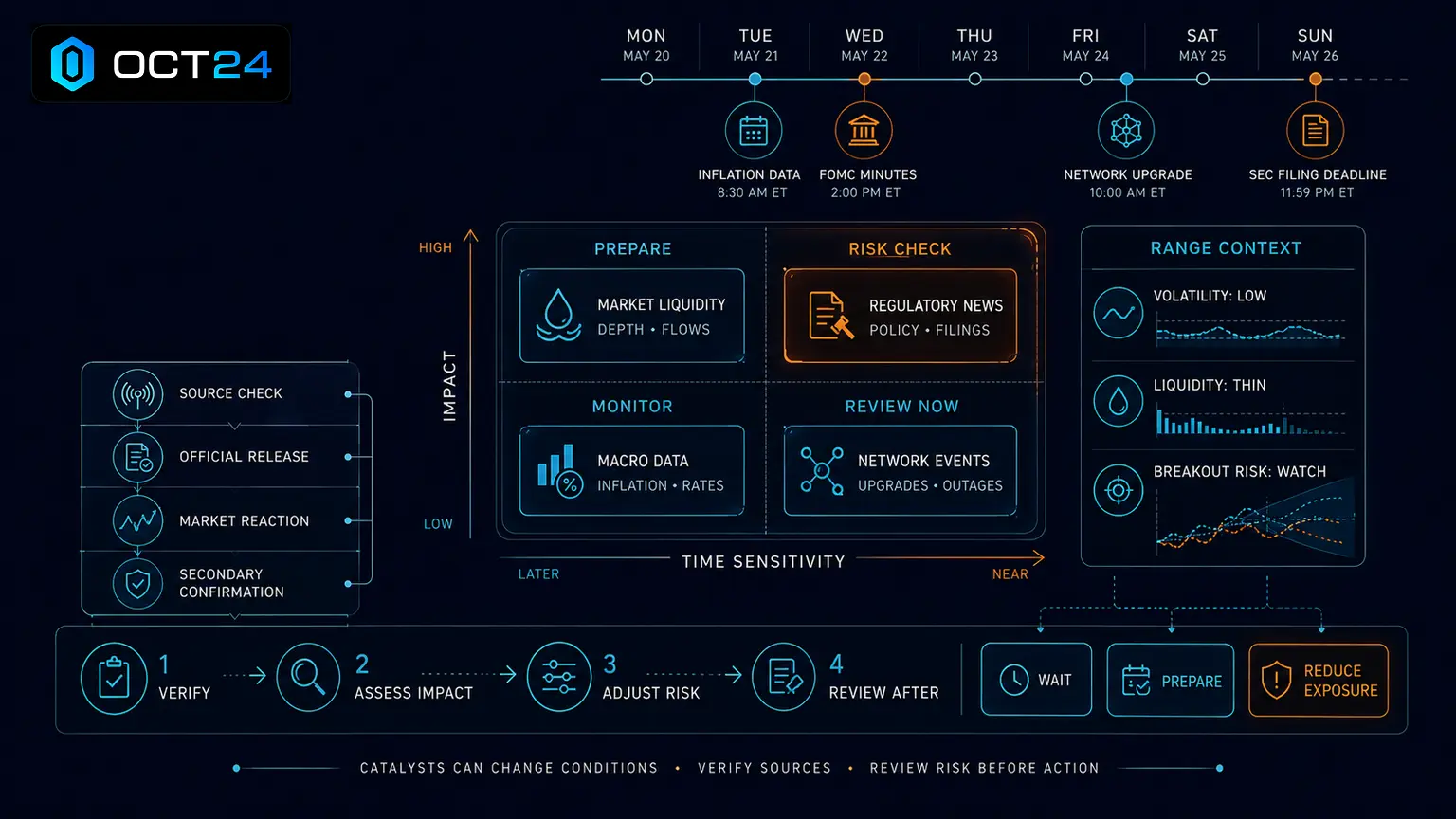
Traders should watch for signs that the current low-volatility phase is changing. The first sign is a clean break from the recent trading range. A breakout or breakdown becomes more important if it is supported by volume and broader market participation.
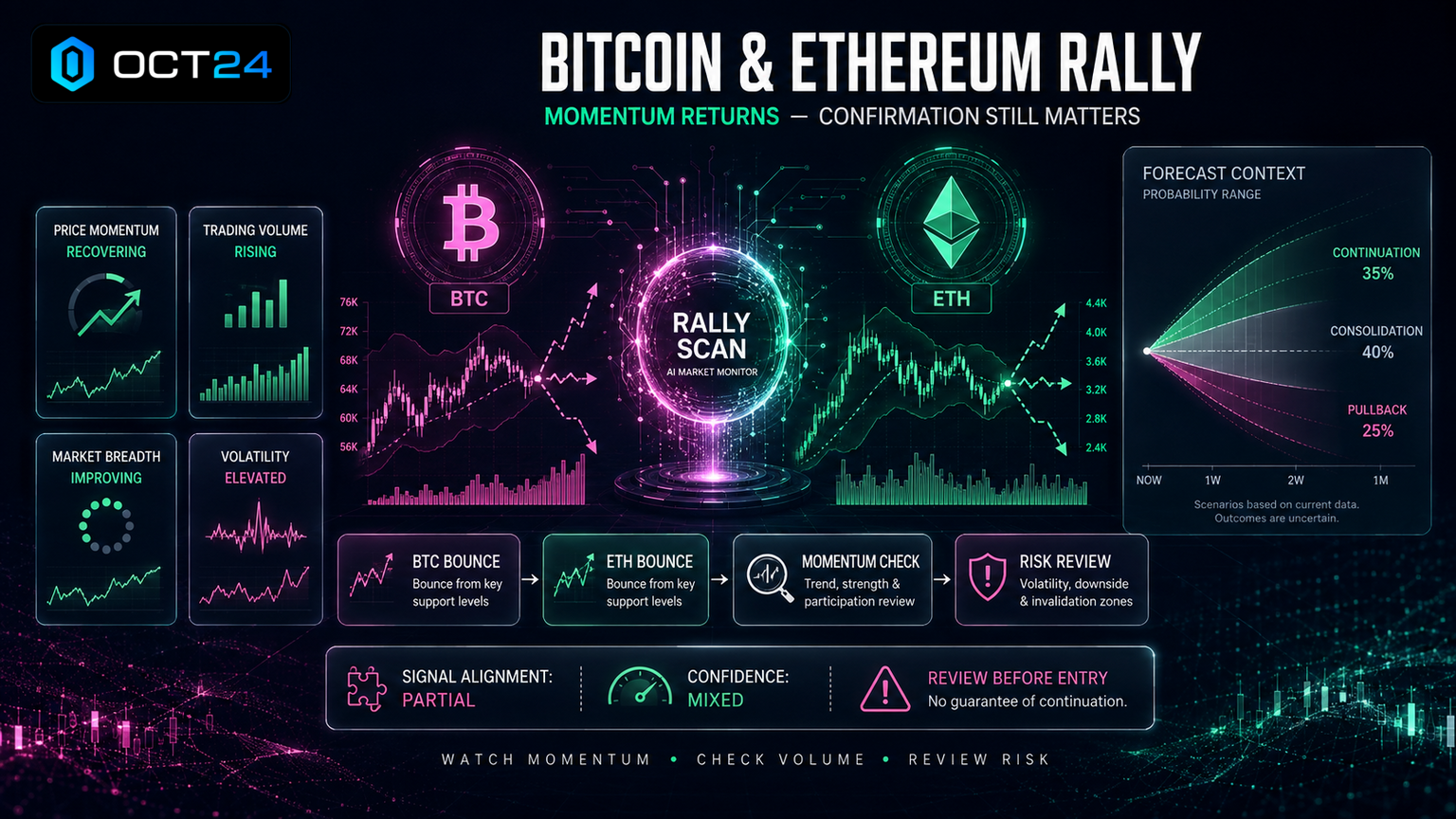
The second sign is stronger relative performance between major assets. If Ethereum, Bitcoin, or selected altcoins begin outperforming clearly, that may show where attention is moving.
The third sign is a change in news flow. Regulatory updates, ETF demand, macro data, corporate treasury moves, and risk appetite in AI stocks can all influence crypto sentiment.
The fourth sign is a change in liquidity. If volume returns and price begins responding more strongly, traders may need to adjust their expectations quickly.
A consistent trading routine can help traders review these signals without rushing.
How AI Can Help During Low Volatility
AI can be useful during low-volatility markets because quiet conditions still produce a lot of information. Price ranges, failed breakouts, weak momentum, and relative strength shifts can all matter.
Manual traders may miss those details because the market feels boring. AI does not get bored. It can keep scanning for changes in conditions even when price action looks slow.
This does not mean AI should be treated as automatic certainty. AI trading myths often come from assuming that technology removes uncertainty. It does not.
The better way to think about AI is as a filter. It can help organize market behavior, identify potential opportunities, and present signals for review.
The trader still decides whether the opportunity fits their account.
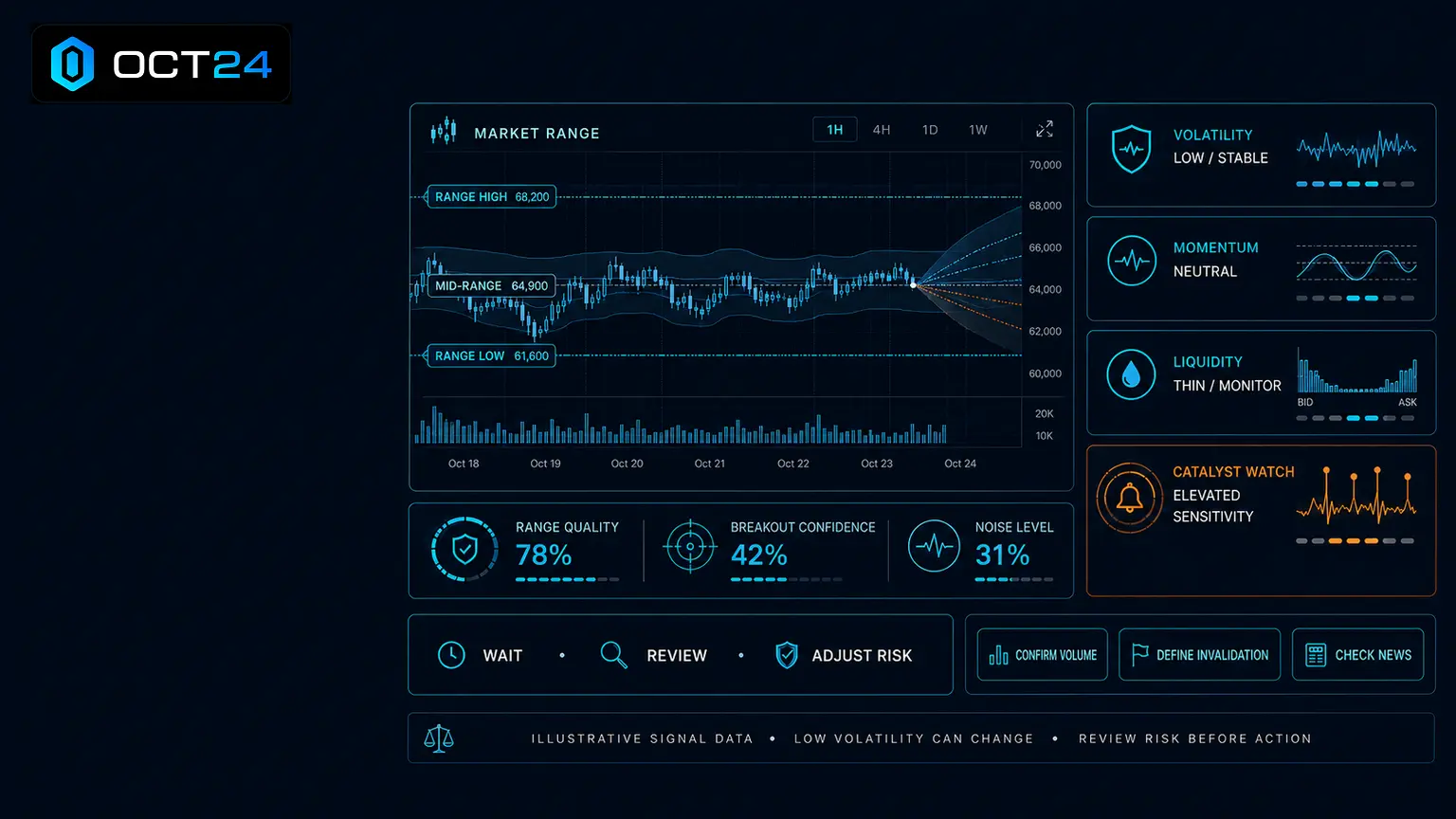
How OCT24 Fits Into This Market
OCT24 is designed for traders who want a simpler way to interact with AI-supported trading signals. Instead of requiring users to manually analyze every chart, OCT24 performs much of the market scanning behind the scenes and presents potential opportunities through a simplified review process.
It is important to be accurate about what the platform shows. OCT24 currently does not provide a full market-analysis dashboard with detailed asset research, exact entry and exit explanations, or a complete chart breakdown for each presented trade.
Instead, traders review key visible metrics such as target profit, loss coverage, and win rate. These metrics can help simplify the decision, especially when markets are quiet and traders are unsure whether a signal is worth attention.
That simplicity does not remove risk. Traders still need to manage exposure, capital allocation, and execution decisions.
In a low-volatility market, the main benefit is structure. OCT24 can help traders spend less time manually searching and more time reviewing whether the signal fits their plan.
Target Profit, Loss Coverage, and Win Rate Matter More in Slow Markets
When markets are moving quickly, traders often focus on momentum. When markets are slow, the quality of the risk and reward profile becomes even more important.
Target profit helps traders understand the intended upside of the opportunity. Loss coverage helps traders think about the downside before acting. Win rate gives another review point, but it should never be treated as a guarantee.
These metrics work best together. A signal with an attractive target may still be unsuitable if the downside is too large. A signal with a strong win rate may still fail if market conditions change.
This is why trading bot risk management remains important in low-volatility conditions. Quiet markets can still produce losses, especially if traders oversize positions or overtrade small moves.
The goal is to review every signal with the same discipline, whether the market is active or quiet.
Where the G6 Trading Bot Fits
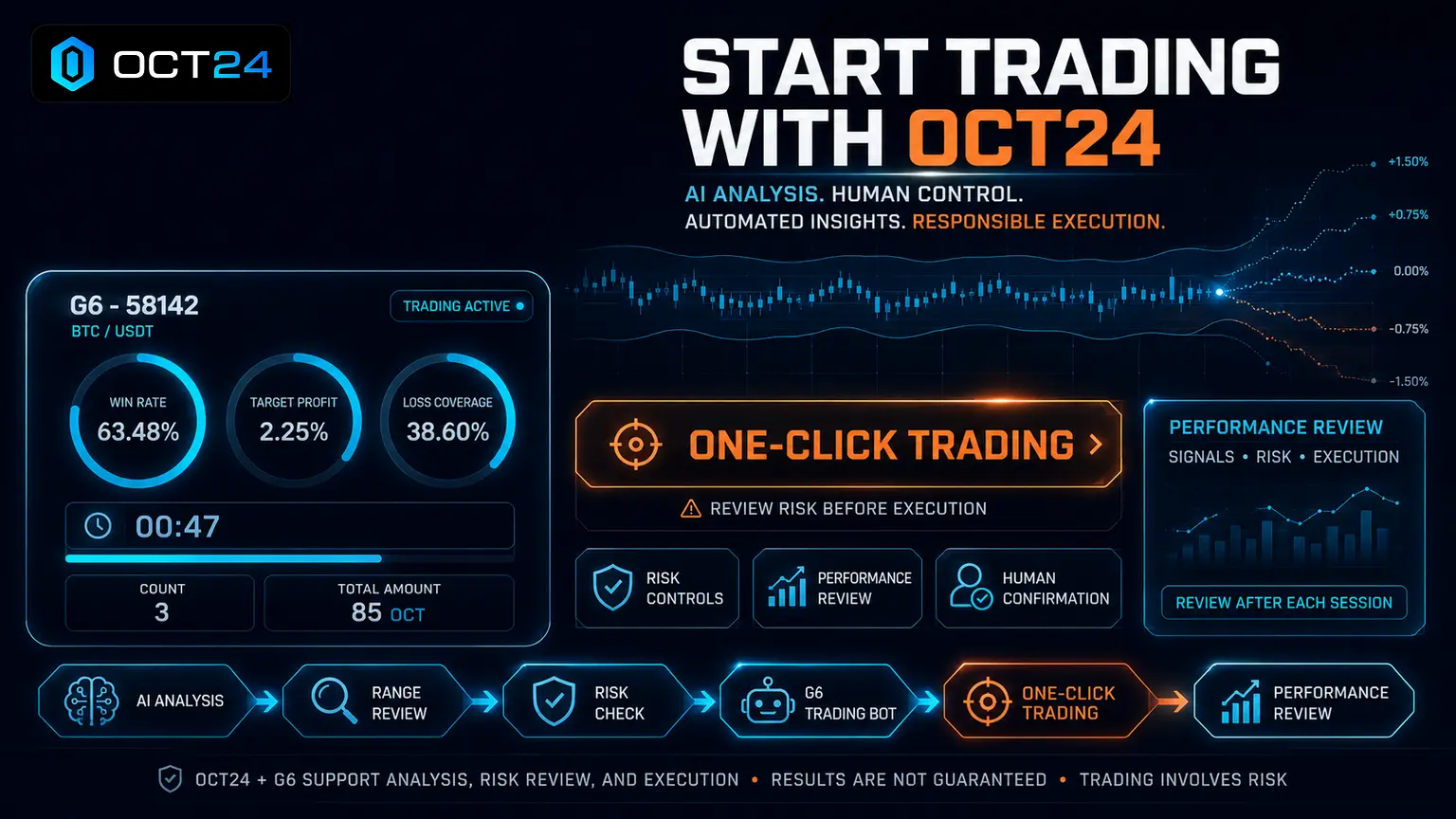
The G6 Trading Bot may be relevant for traders who want a faster and simpler OCT24 experience. It fits the broader idea of using AI-supported systems to reduce manual workload and create a more structured signal review process.
In a low-volatility market, speed is useful only when paired with patience. A faster workflow should not push traders into weaker setups just because the market feels slow.
This is especially important with one-click trading. A simpler execution process should still include a pause for target profit, loss coverage, win rate, and account exposure review.
The G6 Trading Bot does not remove uncertainty or guarantee results. It should be reviewed like any other trading tool, with risk controls at the center of the decision.
That mindset can help traders avoid turning a quiet market into a series of unnecessary trades.
Risk Checklist for the Week Ahead
Before acting on any signal in a low-volatility market, traders should review a short checklist. This can help prevent emotional decisions during quiet conditions.
Ask yourself:
- Is the market still range-bound?
- Has price broken a key level with real follow-through?
- Is volume improving or fading?
- Are Bitcoin, Ethereum, and altcoins confirming the move?
- Is the signal based on structure or boredom?
- Does the target profit fit current market conditions?
- Does the loss coverage fit my account risk?
- Am I already overexposed to the same market direction?
How to Review OCT24 Metrics When the Market Is Quiet
Quiet markets can make traders focus too much on small differences. A target profit may look attractive because there are fewer obvious opportunities. A win rate may feel more persuasive because the trader wants a reason to act.
This is why the review process matters. On OCT24, traders should look at target profit, loss coverage, and win rate together instead of isolating one number.
If the target profit is attractive but the market is still range-bound, ask whether there is enough follow-through to justify the trade. If the loss coverage looks acceptable, still ask whether your overall exposure is already too high. If the win rate looks strong, remember that it is not a guarantee.
The best habit is to treat the displayed metrics as a decision checkpoint. They help simplify review, but they do not replace judgment.
In low volatility, the strongest traders are often the ones who stay selective. They do not turn every small signal into a trade.
What Could Wake the Market Up?
Low-volatility markets do not stay quiet forever. Traders should watch for catalysts that could bring activity back.
Possible catalysts include regulatory updates, ETF flow changes, macroeconomic data, corporate crypto treasury moves, major exchange developments, and shifts in broader risk appetite.
Crypto can also react to developments outside crypto. If AI stocks, tech shares, or broader risk assets move sharply, crypto traders may respond as well.
This is why crypto market rotation matters. When capital moves between Bitcoin, Ethereum, altcoins, AI-related assets, or risk-off positions, the market can shift faster than expected.
AI market trend identification can help traders review whether a new move is becoming strong enough to matter.
How Traders Should Think About Patience
Patience is not the same as doing nothing. In trading, patience means waiting for better information before risking capital.
Low-volatility markets test patience because they often produce small moves that look tradable but lack follow-through. Traders may feel as if they should be doing something, even when the market is not offering a strong setup.
That pressure can lead to avoidable mistakes. Traders may increase size to make small moves feel worthwhile. They may enter late after a minor breakout. Or they may take several weak trades instead of waiting for one clearer signal.
AI can help by keeping the review process more structured. OCT24 can support this by presenting AI-supported signals, but the trader still decides whether to act.
The best traders do not need constant action. They need clear decision rules.
FAQs
What does a low volatility crypto market mean?
A low volatility crypto market means prices are moving in a smaller range than usual. It often happens when traders are waiting for a catalyst or when liquidity and participation are lower.
Is low volatility bullish or bearish for crypto?
Low volatility is not automatically bullish or bearish. It means the market is quiet. The next move depends on range behavior, liquidity, news catalysts, and trader positioning.
Why can low volatility be risky for traders?
Low volatility can lead to overtrading, false breakouts, and poor timing. Traders may force trades because the market feels slow.
How can AI help in a low-volatility market?
AI can scan market conditions, monitor changes in momentum, and help identify potential opportunities when quiet markets begin to shift.
Does OCT24 show exact entry and exit points for each signal?
OCT24 currently focuses on simplified signal review through metrics such as target profit, loss coverage, and win rate. It does not show a full chart explanation or exact entry and exit breakdown for every presented trade.
Should traders use smaller positions in quiet markets?
Many traders choose to reduce risk when conditions are unclear. Position size should always depend on account size, risk tolerance, and the quality of the setup.
Can low volatility lead to a breakout?
Yes. Quiet ranges can build pressure before a breakout or breakdown. Traders should watch for volume, momentum, and broader confirmation before reacting.
How does OCT24 support signal review during slow markets?
OCT24 performs much of the market scanning behind the scenes and presents AI-supported trading signals in a simplified format, helping traders review potential opportunities without constant manual chart watching.
Where can I learn more about OCT24?
You can read About OCT24 to understand the platform approach, or Start Trading with OCT24 when you are ready to explore AI-supported trading tools.
Final Thoughts
Crypto markets entering low-volatility mode does not mean traders should stop paying attention. It means the market is waiting for stronger direction.
Bitcoin’s range, weaker liquidity, regulatory uncertainty, corporate treasury activity, and changing risk appetite are all worth watching. Any of these could become a catalyst if market conditions shift.
OCT24 can support traders by scanning market conditions, identifying potential opportunities, and presenting AI-supported trading signals through simplified metrics such as target profit, loss coverage, and win rate.
That support does not remove risk. Traders still need to manage capital responsibly, understand exposure, review the displayed metrics, and make informed execution decisions.
The best approach in a quiet market is simple: stay patient, watch for confirmation, avoid overtrading, and only act when the signal fits your plan.
To explore the platform, visit OCT24, read About OCT24, or Start Trading with OCT24 when you are ready to review AI-supported trading signals with a clearer risk-first process.