
How AI Uses Volume and Liquidity in Trading
AI volume and liquidity trading is the use of artificial intelligence to review how much trading activity exists in a crypto market and how easily a position may be entered or exited.
Volume shows how active the market is. Liquidity shows how smoothly orders can be filled without large price disruption. Together, they help traders understand whether a potential trading opportunity has enough market support.
For beginners, this matters because a price move alone does not tell the full story. A crypto asset can move quickly on weak volume, then reverse when real buyers do not follow.
Another asset may move more slowly but have stronger liquidity, tighter spreads, and cleaner execution conditions. AI can help compare these details faster than a trader scanning charts manually.
OCT24 is designed around this type of structured market review.
OCT24 scans crypto market conditions, identifies potential opportunities, and presents AI-supported trading signals so traders can review the setup before deciding whether to activate it.
The platform can help simplify market analysis, but it does not remove trading risk or guarantee results. Traders remain responsible for risk settings, exposure, capital allocation, and execution decisions.
Why Volume and Liquidity Matter in Crypto Trading
Volume and liquidity are two of the most important market conditions in crypto trading. They are also two of the easiest ideas for beginners to overlook.
Many new traders focus on price first because price is visible and exciting. They see a coin moving up and assume the opportunity is strong.
The problem is that price can move for different reasons. A strong move with healthy volume may show real market interest. A sharp move with low volume may be easier to reverse.
A market with deep liquidity may allow smoother execution. A thin market may move against a trader quickly if orders are limited.
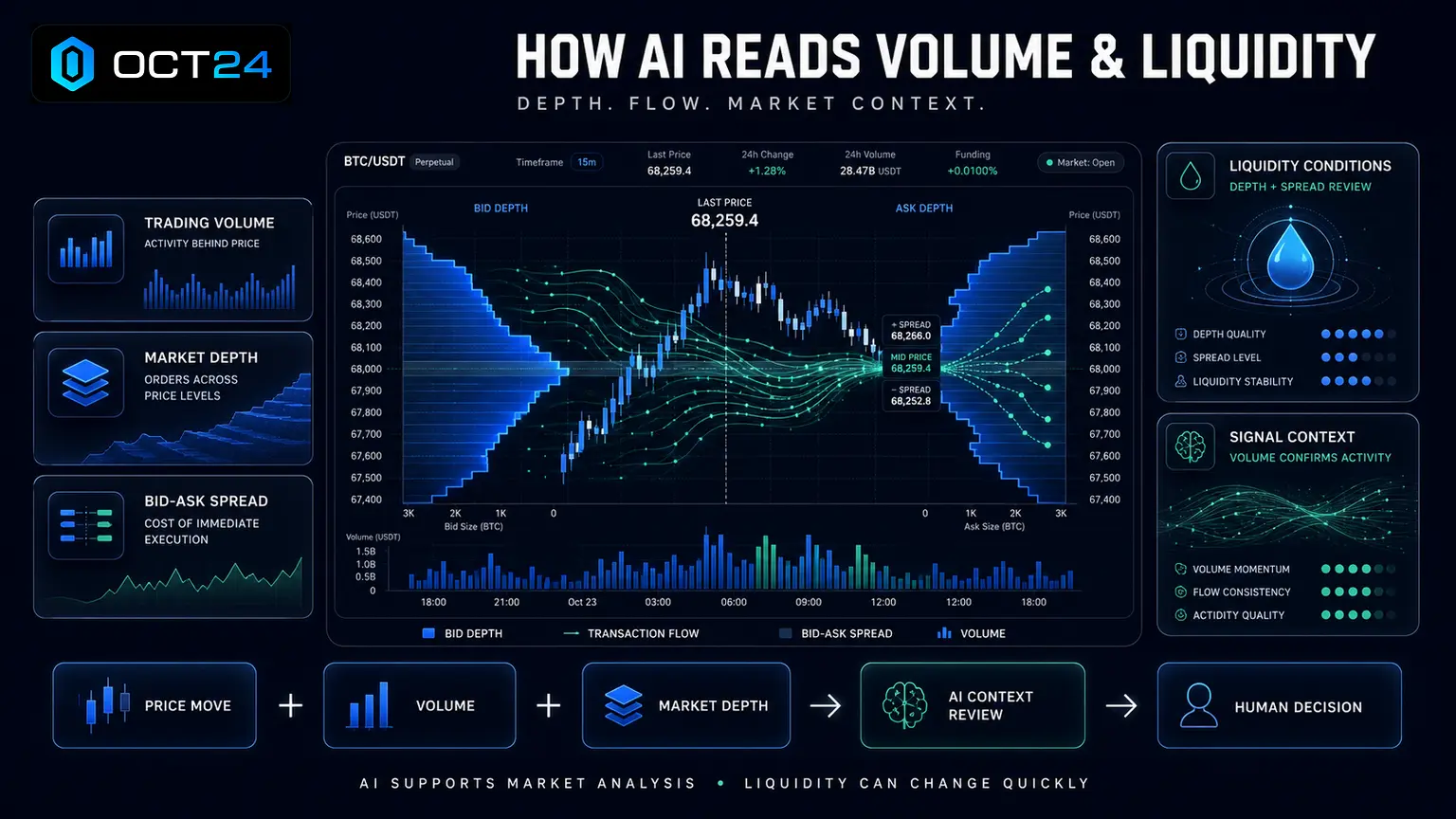
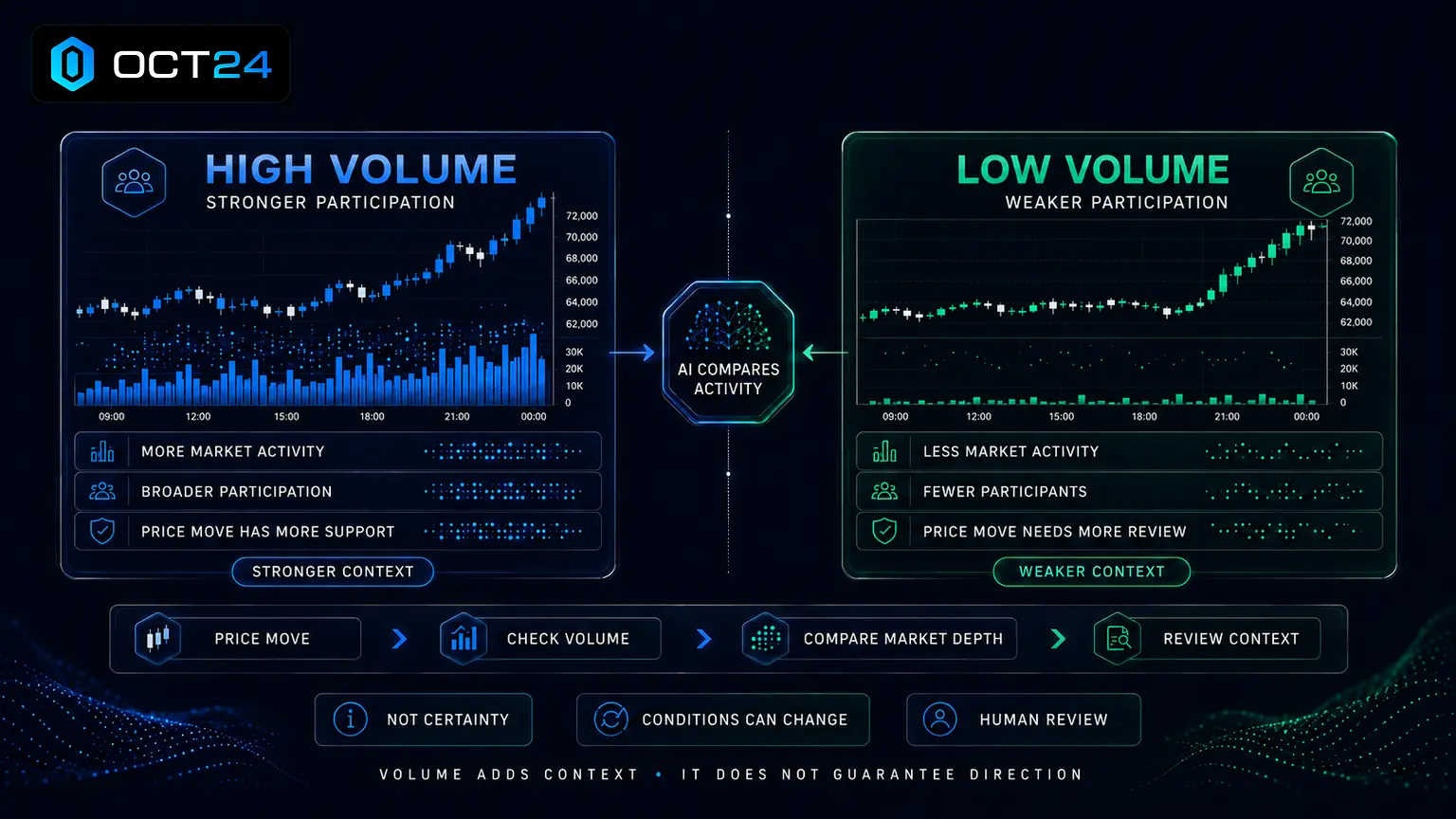
Volume tells traders how much of an asset is being traded over a period of time. Higher volume often suggests stronger participation.
Liquidity tells traders how easily that asset can be bought or sold near the expected price. Strong liquidity usually means tighter spreads, better order depth, and less slippage risk.
In simple terms, volume asks, 'Is there activity here?' Liquidity asks, 'Can trades happen smoothly here?' AI-supported systems can review both questions at the same time, which is useful in fast-moving crypto markets.

What Trading Volume Actually Shows
Trading volume shows how much buying and selling activity is happening in a market.
In crypto, volume can be measured across different time frames, such as one minute, one hour, one day, or one week.
The time frame matters because short-term traders care about immediate activity, while longer-term traders may care more about broader participation.
High volume can suggest that many traders are interested in the asset. It may support a breakout, confirm a trend, or show that a move has real attention behind it.
Low volume can suggest weak participation, uncertainty, or a market that may be easier to push around.
This does not mean high volume always leads to a good trade. Sometimes high volume appears during panic selling. Sometimes it appears when traders are taking profit after a large move.
Sometimes it appears during news events when the market is noisy and unpredictable.
That is why volume should not be reviewed alone. It should be compared with price movement, volatility, liquidity, signal quality, and risk.
AI Trading can help by processing these conditions together instead of asking traders to make decisions from one metric.
What Liquidity Means for Beginners
Liquidity is the ability to buy or sell an asset without causing a major change in price. In a liquid crypto market, there are enough buyers and sellers close to the current price.
This makes execution smoother and helps reduce the risk of entering far away from the expected level.
In a less liquid market, the gap between buyers and sellers can be wider. The order book may be thin. Price may jump quickly when larger orders appear.
For beginners, this can be surprising because the chart may look tradable until the actual order is placed.
Liquidity is especially important in crypto because markets trade around the clock and conditions can change quickly. A coin may look active during one session and become thin later.
A strong move may attract attention, but liquidity can still dry up if traders step away.
OCT24 helps by scanning market conditions and presenting opportunities through a simplified review process. That does not mean every signal is safe.
It means traders can look at the opportunity with more structure before deciding whether it fits their risk comfort.
How AI Reads Volume and Liquidity Together
AI can review volume and liquidity together because the two metrics often tell a more complete story when combined.
Volume may show interest, while liquidity may show whether that interest is deep enough to support smoother trading conditions. A market with high volume but weak liquidity can still be risky.
A market with decent liquidity but fading volume may lack momentum.
AI systems can compare current activity with recent market behavior.
They can look for changes in volume, shifts in order book depth, spread movement, volatility patterns, and whether price action is supported by real participation. This helps identify setups that may deserve closer review.
For example, if Bitcoin or another crypto asset starts moving higher, AI can check whether volume is increasing with the move. It can also check whether liquidity is strong enough to support cleaner execution.
If volume is weak or liquidity is thin, the setup may need more caution.
OCT24 uses AI-supported analysis to scan crypto market conditions and identify potential trading opportunities. The value is not that AI knows the future.
The value is that it can process many conditions quickly and present the trader with a cleaner signal review experience.
Why Price Alone Can Mislead Traders
Price is important, but price alone can be misleading. A chart may show a strong candle, but that candle does not automatically mean the move has support.
Without volume and liquidity context, traders may enter late, chase a weak move, or underestimate execution risk.
A low-liquidity move can look dramatic because small orders can move price more easily. This can create the illusion of strong momentum.
If new buyers do not continue entering the market, the move can fade quickly.
A high-volume move can also be tricky if the volume comes from forced liquidations, panic selling, or short-term news reactions. In those cases, the market may be active but unstable.
Traders need to understand whether the activity supports a clean opportunity or simply reflects chaos.
This is one reason AI Trading Signals can be useful. Signals can help organize market information into a clearer review point.
They do not guarantee success, but they can help traders avoid making decisions from a chart pattern alone.

Volume Spikes: Helpful Signal or Warning Sign?
A volume spike happens when trading activity rises sharply compared with recent levels. Volume spikes can be useful because they often show that something has changed.
More traders may be entering the market, reacting to news, or defending an important price level.
However, a volume spike is not automatically bullish or bearish. It depends on what price does next. If price breaks higher and holds, the spike may support the idea that buyers are active.
If price spikes and quickly reverses, the volume may show exhaustion instead of strength.
AI can help by comparing the volume spike with the surrounding market structure.
It can look at whether the move happened near support or resistance, whether volatility expanded too much, whether liquidity improved or worsened, and whether the signal still looks balanced.
OCT24 can support this process by scanning for potential crypto trading opportunities and presenting AI-supported signals. The trader can then review the opportunity instead of reacting only because volume suddenly increased.
Liquidity Depth and Spread: The Quiet Details That Matter
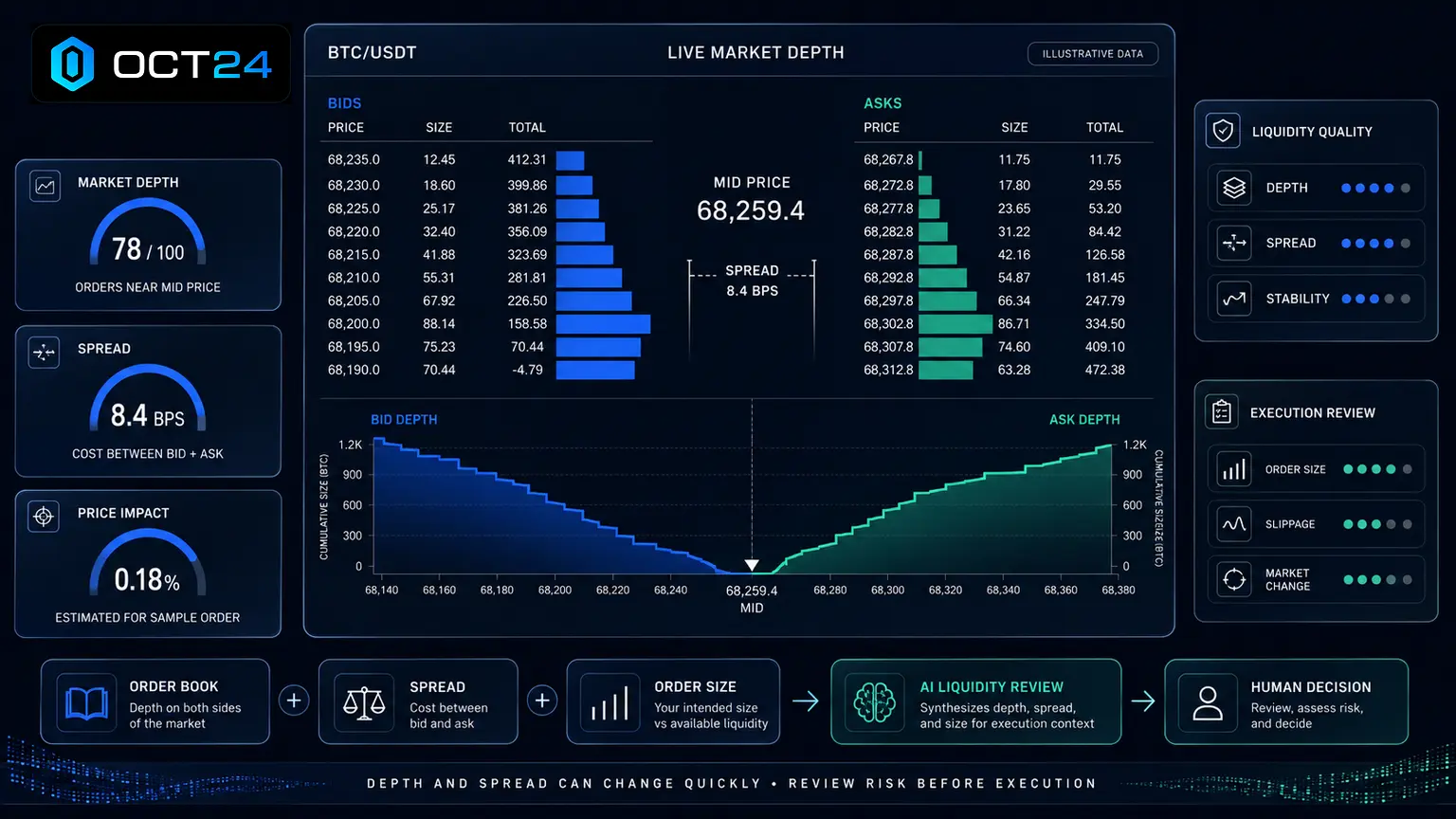
Liquidity is not only about whether people are trading. It is also about market depth and spread. Market depth refers to the amount of buy and sell orders available around the current price.
Spread is the gap between the best available buy price and sell price.
A tight spread usually means buyers and sellers are close together. This can make execution cleaner. A wide spread may make trading more expensive or unpredictable, especially for short-term opportunities.
Deep order books can absorb orders more smoothly, while thin order books can create sudden price movement.
Beginners do not need to become order book experts to understand the basic point. Better liquidity can make a setup easier to review. Weak liquidity can increase risk, even when the chart looks interesting.
Algorithmic Trading and Automated Trading systems often pay close attention to these details because execution quality matters.
OCT24 simplifies the experience for users by doing much of the market scanning and signal filtering, then presenting opportunities in a way that is easier to understand.
How Volume and Liquidity Affect Signal Quality
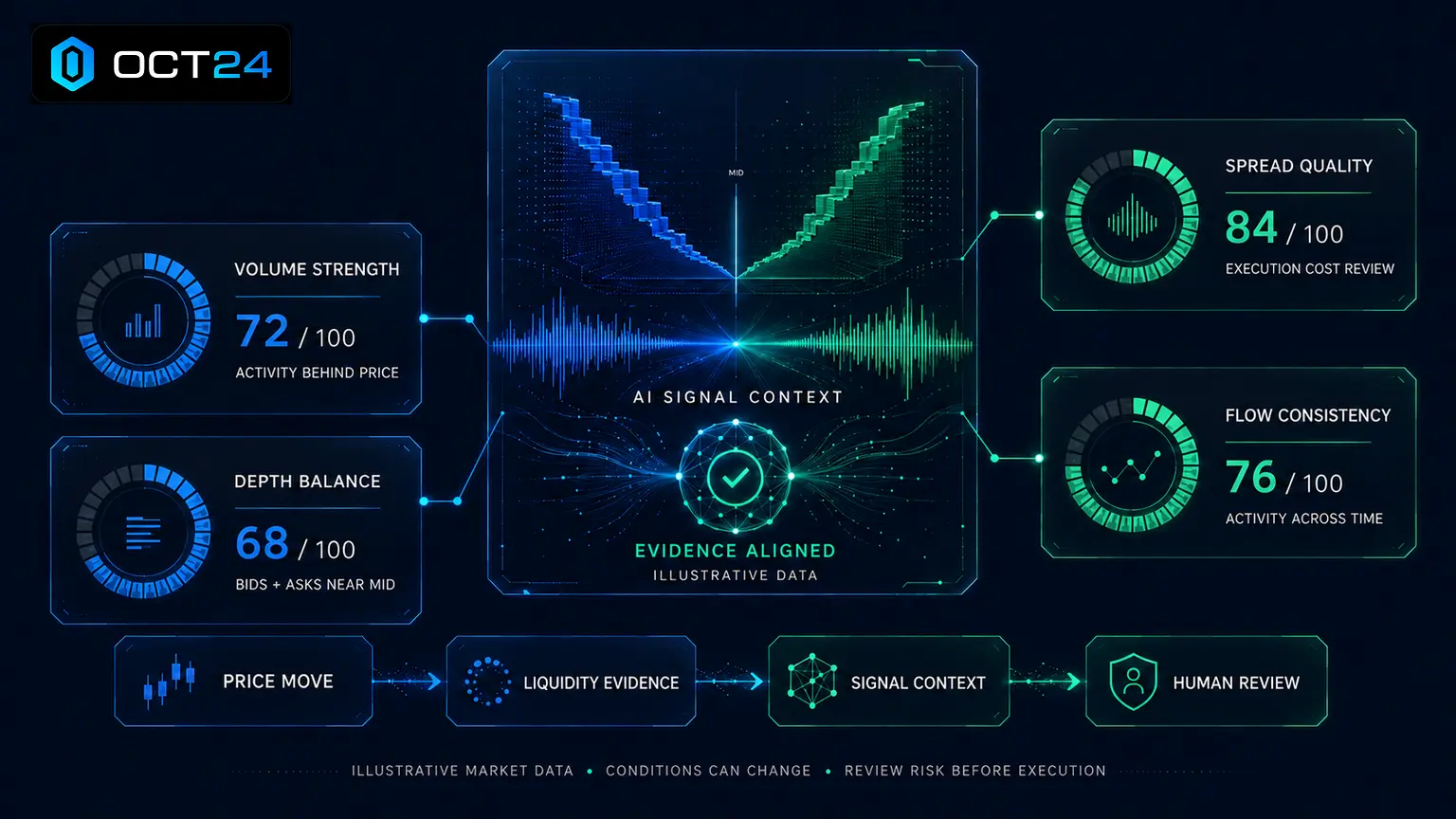
Signal quality depends on more than direction. A trade idea may look good on price movement, but weak volume or poor liquidity can reduce confidence in the setup.
Stronger volume and better liquidity can make a potential opportunity easier to review, but they still do not guarantee a result.
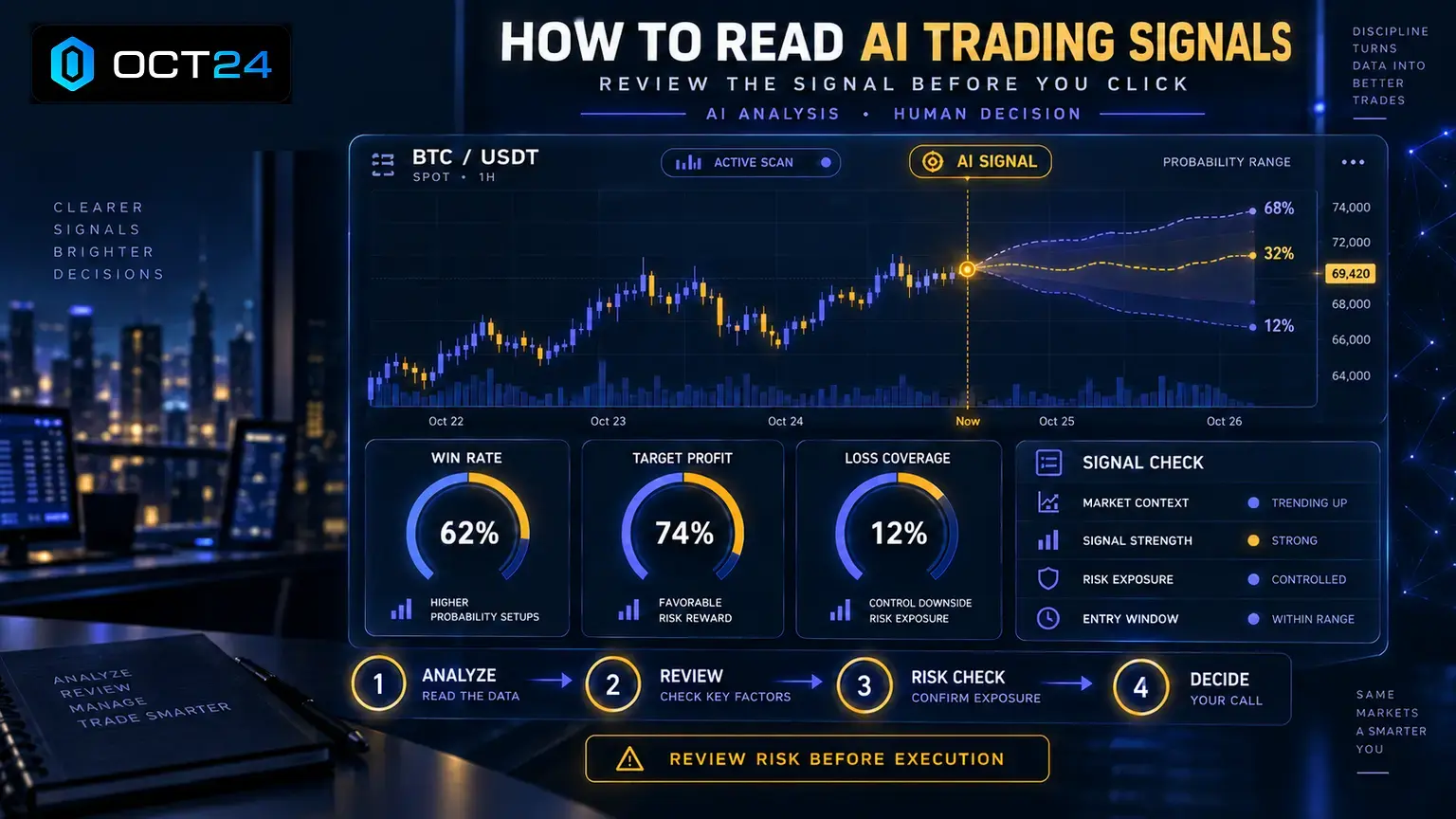
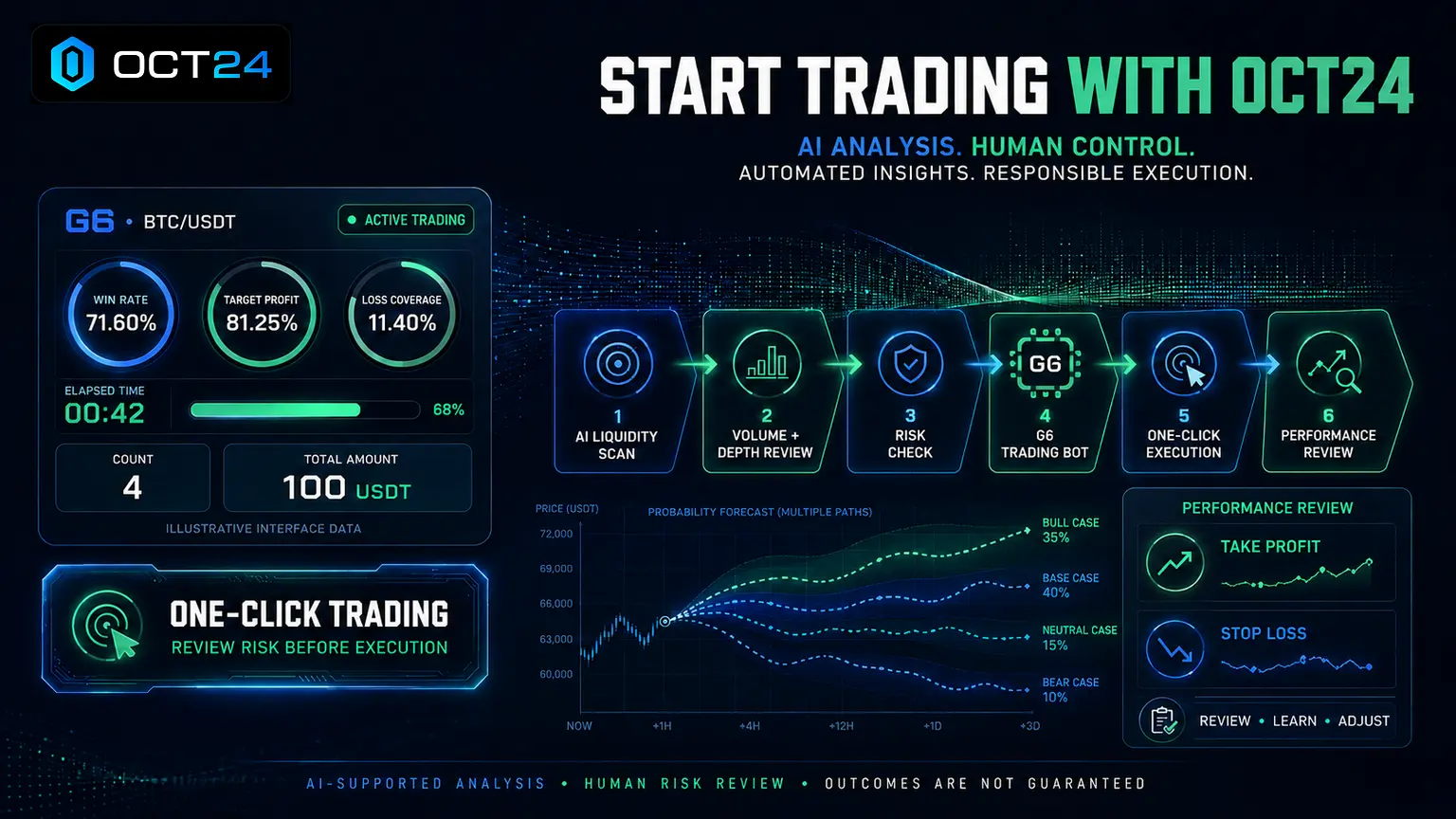
OCT24 users often review opportunities through practical signal information such as win rate, target profit, and loss coverage.
Volume and liquidity can support those signals by helping the system understand whether the market has enough activity and execution depth.
Win rate may be more meaningful when market conditions are stable enough to support the setup. Target profit may be more realistic when liquidity and volatility allow room for movement.
Loss coverage may be more important when liquidity is thin or price is moving fast.
This is why traders should compare the whole signal rather than focusing on one number. A setup with exciting upside but poor liquidity may not fit every trader.
A setup with moderate target profit but cleaner market support may be easier for a beginner to understand.
How OCT24 Uses AI-Supported Market Scanning
OCT24 is built to reduce the amount of manual analysis required before reviewing a crypto opportunity. The platform scans market conditions, identifies potential opportunities, and presents AI-supported trading signals.
This can help beginners avoid spending hours switching between charts, indicators, and market commentary.
The workflow is simple. OCT24 performs much of the market analysis. The trader reviews the signal. The trader considers their own exposure, capital allocation, and risk comfort.
If the opportunity makes sense, the trader can decide whether to activate the bot.
This is especially useful for readers who are interested in AI Trading for Busy Professionals. Busy traders may not have time to monitor volume shifts, liquidity changes, and volatility patterns all day.
AI support can make the review process faster and more organized.
Still, OCT24 is not a guarantee engine. It does not remove risk. It does not promise that a signal will work.
It gives traders a structured way to review AI-supported opportunities in the crypto market.
Why Volume and Liquidity Matter for One-Click Trading
One-click trading works best when the trader has a clear review process before taking action. Speed is useful, but speed without context can be risky. Volume and liquidity help provide that context.
With One-Click Trading, a trader should not activate a trade simply because the process is fast. They should review whether the opportunity has enough support.
That includes checking the signal information, understanding the potential target profit, considering loss coverage, and making sure the exposure fits their plan.
OCT24 can help make this review faster by presenting AI-supported trading signals. The platform does much of the scanning, which helps users avoid manually searching through markets.
But the final decision still belongs to the trader.
This balance is important for beginners. A simple interface can make trading easier to access, but it should still be used with discipline.
Volume and liquidity are part of that discipline because they help traders understand whether a market is active and tradable enough for the setup being reviewed.
Common Mistakes Traders Make With Volume
One common mistake is assuming that high volume always means a strong trade. High volume can confirm interest, but it can also appear during panic, exhaustion, or short-term news reactions.
Traders should ask why volume is rising, not just whether it is rising.
Another mistake is ignoring low volume. A quiet market can sometimes lead to a clean breakout later, but it can also produce false moves.
If price moves without enough volume, the move may lack support.
A third mistake is comparing volume without context. Volume on one coin cannot always be compared directly with volume on another coin. Market size, exchange activity, trading pair, time frame, and liquidity all matter.
OCT24 helps reduce these mistakes by using AI-supported analysis to review broader market conditions. The goal is not to remove responsibility from the trader.
The goal is to make the signal review process clearer and less emotional.
Common Mistakes Traders Make With Liquidity
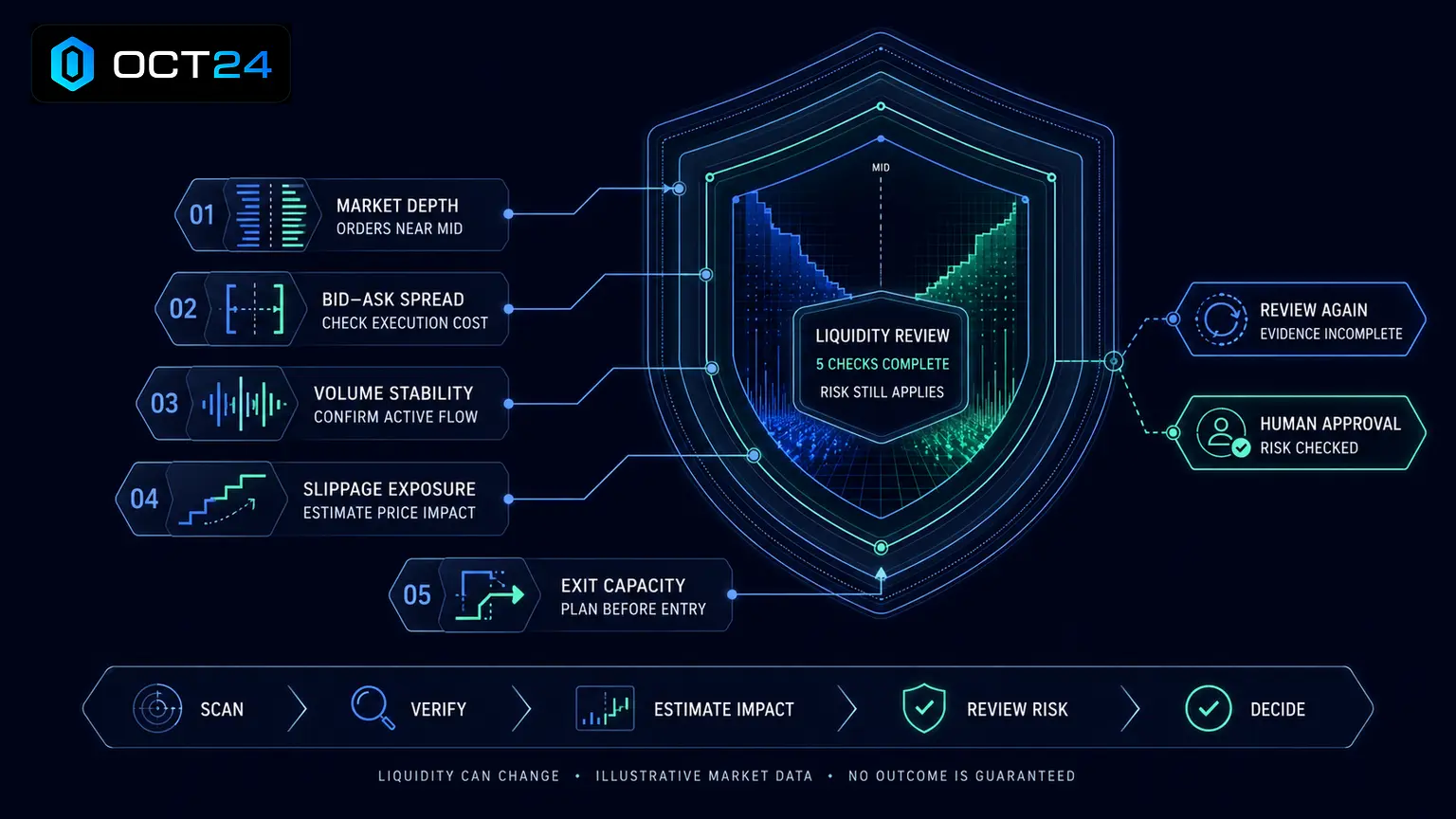
Many beginners ignore liquidity because it feels less obvious than price movement. They may see a chart moving and assume they can enter or exit easily.
In crypto, that assumption can be dangerous, especially in smaller or more volatile markets.
One mistake is trading thin markets with too much size. Even if the signal looks interesting, a larger position can be harder to manage when liquidity is weak.
This is where Position Sizing Controls can help traders think more carefully about exposure.
Another mistake is ignoring portfolio concentration. If several positions depend on similar liquidity conditions, the trader may be taking more risk than they realize.
Portfolio Diversification Tools can help beginners understand why spreading exposure matters.
A third mistake is assuming that liquidity stays the same all day. Crypto trades 24/7, but activity can still rise and fall depending on session, news, volatility, and market sentiment.
Liquidity review should be part of the trading routine, not a one-time thought.
How to Review an AI Signal With Volume and Liquidity
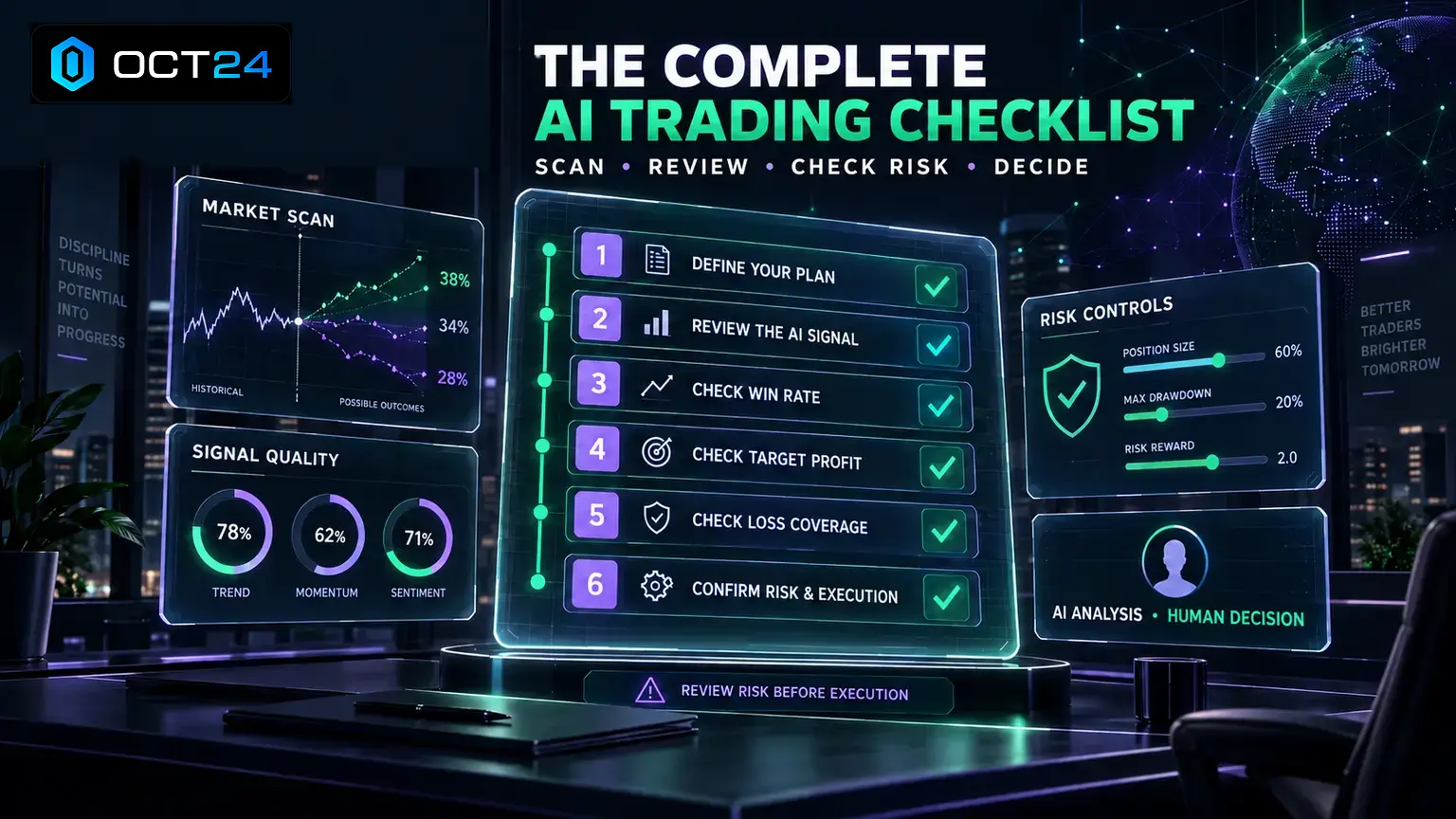
A simple signal review can help beginners stay focused. First, look at the main opportunity. What market is being presented, and what does the signal suggest?
Then look at the win rate, target profit, and loss coverage. These metrics help frame the opportunity before any action is taken.
Next, think about volume. Is the market active enough to support the move? Is volume rising with price, or is price moving on weak participation? Then think about liquidity.
Does the market appear deep enough for smoother execution, or does it look thin and unstable?
After that, check personal risk. Even a strong signal may not fit if the trader already has too much exposure or is uncomfortable with the possible loss.
Trading Bot Risk Management is not only about settings; it is also about whether the trader understands what they are activating.
OCT24 supports this process by doing much of the market scanning and presenting AI-supported opportunities. The trader still needs to decide whether the opportunity fits their own capital allocation and risk comfort.
How Volume and Liquidity Connect to Volatility
Volume and liquidity also affect how traders experience volatility. A market can be volatile because many traders are active and price is moving quickly.
It can also be volatile because liquidity is thin and smaller orders are moving price more than expected.
These two situations can look similar on a chart, but they can feel very different when a trader is trying to enter or exit.
This is why How AI Handles Market Volatility is closely connected to volume and liquidity. AI can look for signs that volatility is supported by real participation or made worse by weak depth.
That context can help traders avoid assuming that every fast move is a clean opportunity.
For beginners, the key idea is simple. Volatility is not automatically good or bad. It depends on whether the market has enough structure behind the move.
A volatile market with strong volume and better liquidity may be easier to review than a volatile market with thin order books and sudden price gaps.
OCT24 can help by scanning these conditions and presenting potential opportunities through AI-supported signals. The trader still needs to review the signal carefully, especially when the market is moving quickly.
How Trader Psychology Affects Volume and Liquidity Decisions
Volume and liquidity are market metrics, but the way traders react to them is often emotional. A sudden volume spike can make a trader feel like they are late.
A fast-moving chart can create fear of missing out. A thin market can look exciting because price is moving quickly, even when the setup is risky.
This is where Trading Psychology matters. Beginners may know that they should wait for better confirmation, but emotional pressure can still push them into a rushed decision.
AI support can help because it gives traders a more consistent review process when the market feels noisy.
OCT24 is useful here because it brings the trader back to structured signal review.
Instead of reacting to a candle, a headline, or a social post, the trader can review win rate, target profit, loss coverage, and the broader market environment.
That does not guarantee a better outcome, but it may support a more disciplined decision.
This is one of the Benefits of AI Trading for beginner traders. AI can help organize market information and reduce some of the pressure of manual analysis.
The trader still remains responsible for the decision, but the decision can be based on a clearer process.
Why Chart Reading Still Helps
AI support can reduce the workload, but basic chart reading is still helpful.
Traders do not need to become professional technical analysts, but they should understand how price, volume, and liquidity relate to each other.
This makes it easier to review an AI-supported signal with common sense.
For example, if price is rising while volume fades, the move may need more caution. If price breaks a level with stronger volume and better liquidity, the setup may be easier to review.
If the spread widens while price jumps, execution risk may be higher than the chart first suggests.
Readers who want a simple foundation can review How to Read Crypto Charts. That article can help beginners understand basic price structure before they compare AI-supported opportunities.
The goal is not to manually replace the AI scan. The goal is to understand enough to review the signal responsibly.
OCT24 performs most of the market analysis, but a trader who understands the basics can make calmer choices.
That is especially important in crypto, where markets can move at any time and sentiment can change quickly.
Final Thoughts
Volume and liquidity may sound technical at first, but the basic idea is simple. Volume shows whether a market has activity. Liquidity shows whether trading can happen smoothly.
When AI reviews both together, traders can get a clearer picture of whether a crypto opportunity has enough support.
OCT24 helps make this easier by scanning market conditions, identifying potential opportunities, and presenting AI-supported trading signals.
Traders can review win rate, target profit, loss coverage, and the broader market environment before deciding whether to activate the bot.
OCT24 does not remove trading risk or guarantee results. Crypto markets can move quickly, liquidity can change, and even strong-looking signals can fail.
Traders remain responsible for risk settings, exposure, capital allocation, and execution decisions.
To explore a simpler way to review AI-supported crypto trading opportunities, visit OCT24 or Start Trading with OCT24 when you are ready.
FAQs
What is volume in crypto trading?
Volume is the amount of a crypto asset traded during a certain period. It helps traders understand how much market activity exists behind a price move.
What is liquidity in crypto trading?
Liquidity is how easily a crypto asset can be bought or sold without causing a large price change. Higher liquidity usually supports smoother execution.
Why does AI review volume and liquidity together?
AI reviews volume and liquidity together because activity and execution quality both matter. A market can have movement, but weak liquidity or poor participation may make the setup riskier.
Can high volume confirm a trading opportunity?
High volume can support a trading opportunity, but it does not guarantee success. Traders still need to review liquidity, volatility, target profit, loss coverage, and personal risk.
Does strong liquidity make a trade safe?
No. Strong liquidity may support smoother execution, but it does not remove market risk. Prices can still move against the trader.
How does OCT24 use volume and liquidity?
OCT24 uses AI-supported analysis to scan crypto market conditions and identify potential opportunities. Volume and liquidity can help support the signal review process.
Should beginners trade low-liquidity crypto markets?
Beginners should be careful with low-liquidity markets because price can move quickly and execution can be less predictable. Lower exposure or waiting for clearer conditions may be more suitable.
What OCT24 signal metrics should traders review?
Traders should review win rate, target profit, and loss coverage, then consider whether the opportunity fits their risk settings, exposure, and capital allocation.