
Position Sizing Controls
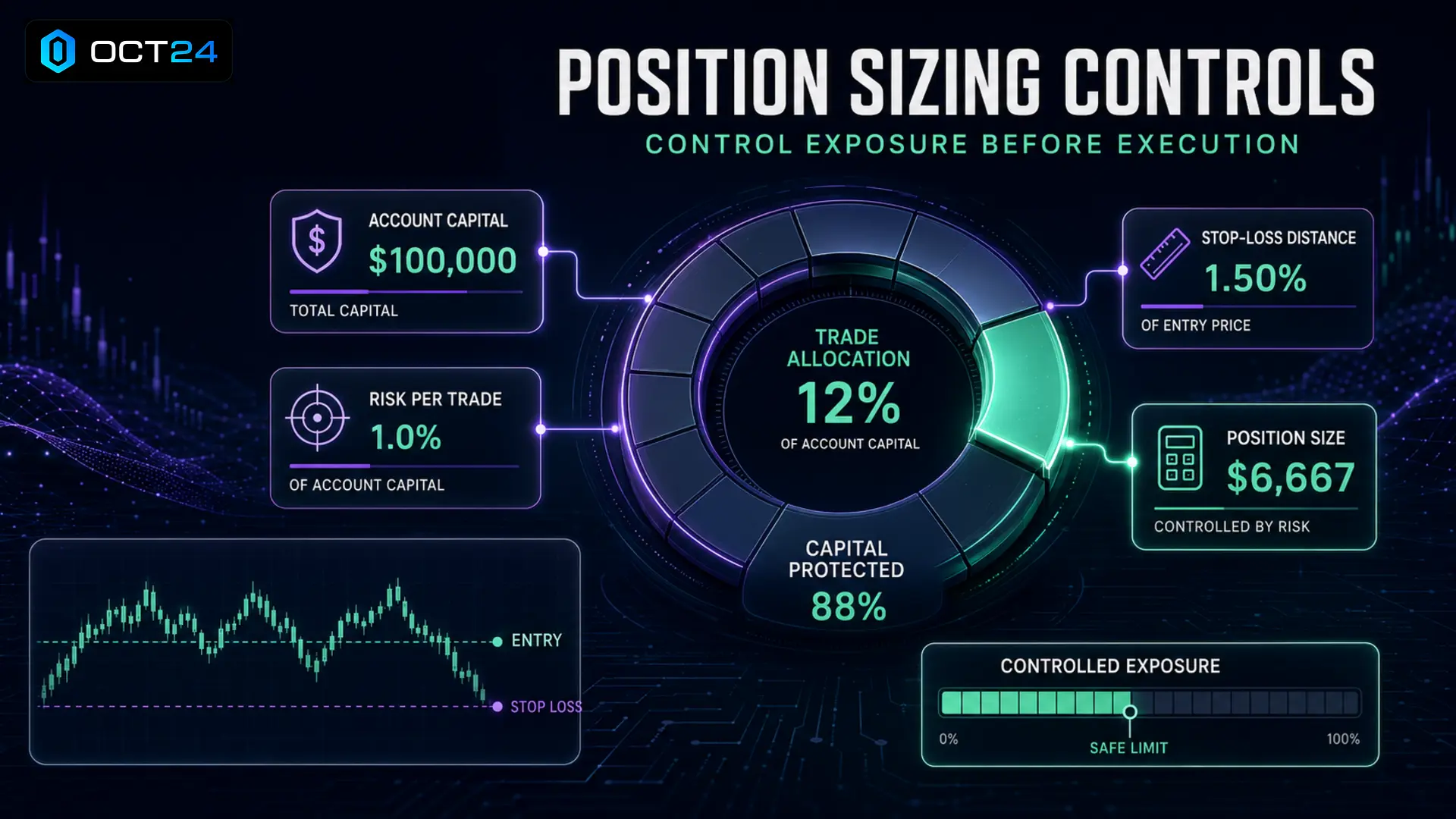
Position sizing controls help traders decide how much capital to place behind each trade before the trade is opened. In AI trading, this matters because a strong signal can still lead to a losing trade if the position is too large for the account, the market, or the trader’s risk tolerance.
OCT24 performs most of the market analysis by scanning market conditions, identifying potential opportunities, and presenting AI-supported trading signals. Position sizing controls are where the trader turns that analysis into a responsible execution decision.
That distinction is important. AI can help you find cleaner opportunities, but it should not decide how much of your capital you are comfortable putting at risk without your input.
This guide explains position sizing controls in simple terms. You will learn why trade size matters, how position size connects to stop loss distance, how exposure builds across several trades, and how to use OCT24 signals with a more disciplined risk process.
What Are Position Sizing Controls?
Position sizing controls are rules or settings that help determine the size of a trade. They answer one practical question: how much should you trade?
A trade idea is only one part of the decision. The other part is the size of the position. Two traders can take the same signal and experience very different outcomes because one trades with a small, controlled position and the other risks too much.
Position sizing controls usually consider:
- Account balance
- Risk per trade
- Stop loss distance
- Market volatility
- Current open positions
- Maximum exposure limits
- Leverage or margin settings, if used
For beginner and intermediate traders, position sizing is one of the most useful risk habits to build. It keeps one trade from becoming too important.
In AI trading, this becomes even more important because signals can arrive quickly. OCT24 may scan the market, highlight potential opportunities, and present useful context, but the trader still needs to decide whether the position size fits their account and risk plan.
Why Position Size Matters More Than Many Traders Think
Many traders spend most of their time asking whether a trade is right or wrong. That question matters, but it is incomplete.
A better question is: if this trade is wrong, can I handle the loss?
That is what position sizing controls are designed to help with. They do not make every trade successful. They help keep the cost of being wrong within a planned range.
For example, imagine two traders both follow the same AI-supported signal. Trader A risks 1% of account capital. Trader B risks 15% because the signal looks strong. If the trade fails, Trader A can review it calmly and continue. Trader B may feel pressure, frustration, or the need to win back the loss immediately.
The signal was the same. The risk experience was completely different.
This is why position sizing sits at the center of responsible trading. It affects:
- How long you can stay active in the market
- How emotionally manageable each trade feels
- How much damage a losing streak can cause
- How consistent your process becomes over time
OCT24 can help reduce the analysis burden by scanning conditions and presenting AI-supported signals, but it does not remove uncertainty. Position sizing controls help you respect that uncertainty.
The Simple Formula Behind Position Sizing
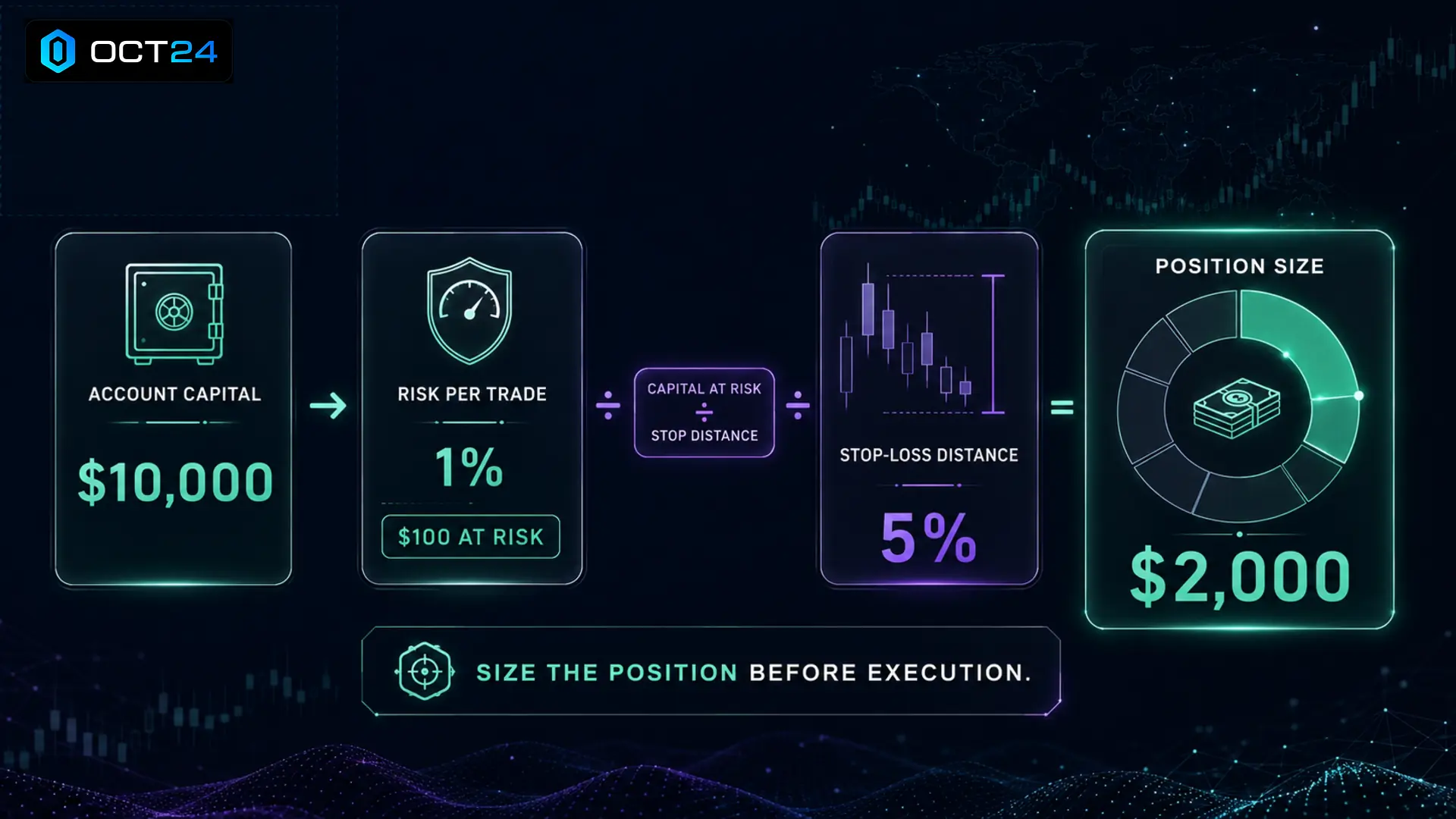
Position sizing may sound technical, but the basic idea is simple. You decide how much you are willing to risk, then size the trade around that limit.
A simple version looks like this:
Position size is based on the amount you are willing to risk divided by the distance between your entry and stop loss.
Here is a practical example.
A trader has a $2,000 account and decides to risk 1% on a trade. That means the planned risk is $20. If the trade setup requires a stop loss that is $0.50 away from the entry price, the trader sizes the position so that a stop loss hit would equal roughly $20, before fees and slippage.
This approach changes the way traders think. Instead of starting with how much they want to buy, they start with how much they can afford to lose if the setup fails.
That is a healthier order of operations.
The process can be broken into four steps:
- Choose the maximum account risk for the trade.
- Identify the entry area and stop loss area.
- Measure the distance between entry and stop.
- Calculate a position size that keeps the potential loss within the planned limit.
This does not guarantee that the final loss will be exact. Fast markets, gaps, fees, spreads, and execution delays can change outcomes. But it gives the trader a clear plan before entering.
How OCT24 Fits Into the Position Sizing Process
OCT24 is designed to perform the market analysis for the user. It scans market conditions, identifies potential opportunities, and presents AI-supported trading signals so traders do not have to monitor every chart manually.
That can save time and improve focus. It can also help traders avoid chasing random setups because they have a more structured signal review process.
But OCT24 should not be treated as a substitute for risk decisions. The platform can surface potential opportunities, but the trader remains responsible for choosing risk settings, reviewing exposure, allocating capital, and deciding whether to execute.
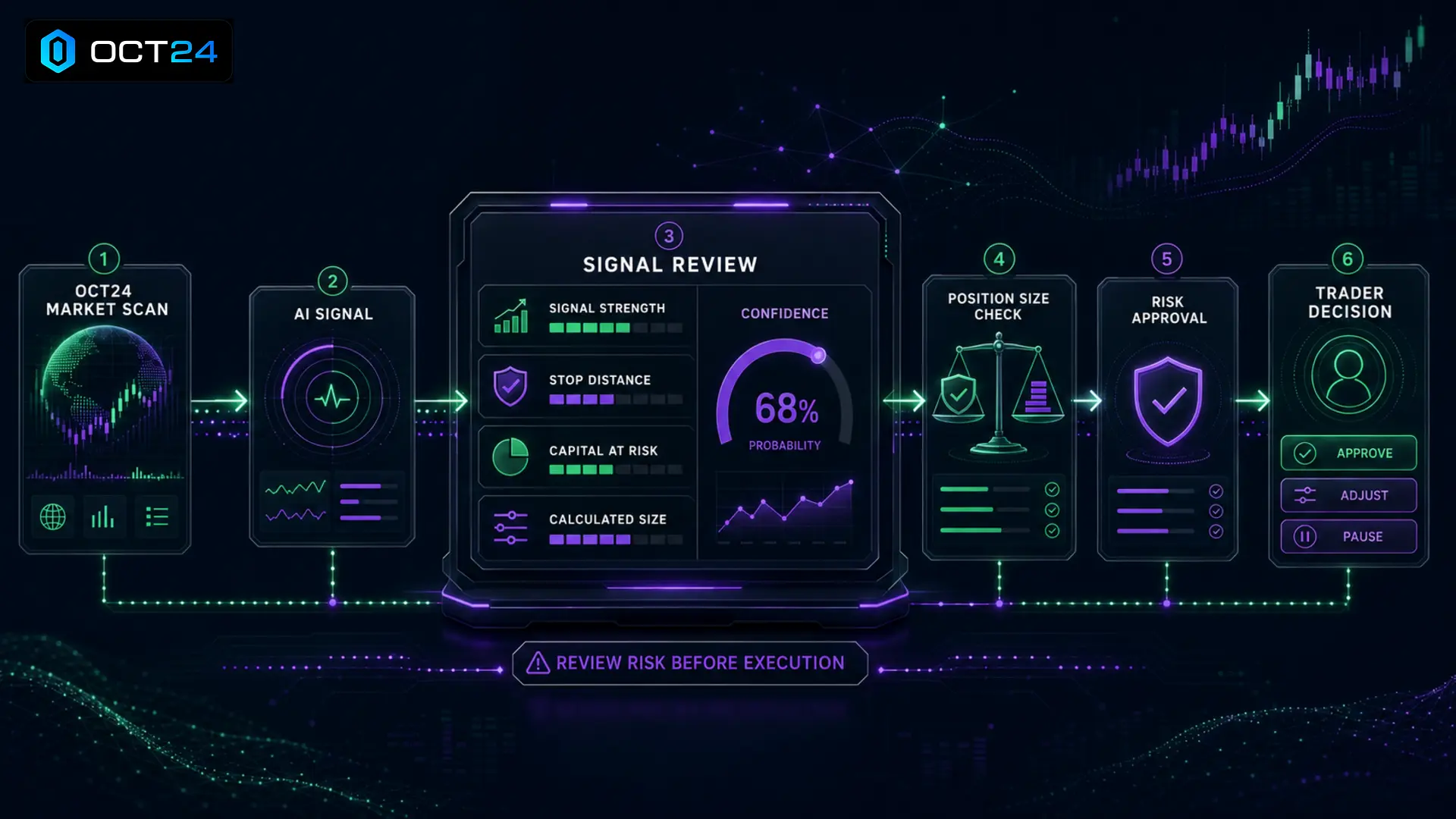
A practical OCT24 workflow may look like this:
- Review the AI-supported signal.
- Decide whether the setup fits your plan.
- Choose a position size that matches your account risk limit.
- Confirm your stop loss, take profit, and exposure before execution.
This keeps OCT24 in the right role. It does most of the analysis work, while the trader controls the risk decision.
That balance matters because even a well-supported signal can fail. Markets move on news, liquidity, sentiment, and sudden volatility. Position sizing controls help make sure one failed idea does not damage the entire account plan.

Position Sizing and Stop Losses Work Together
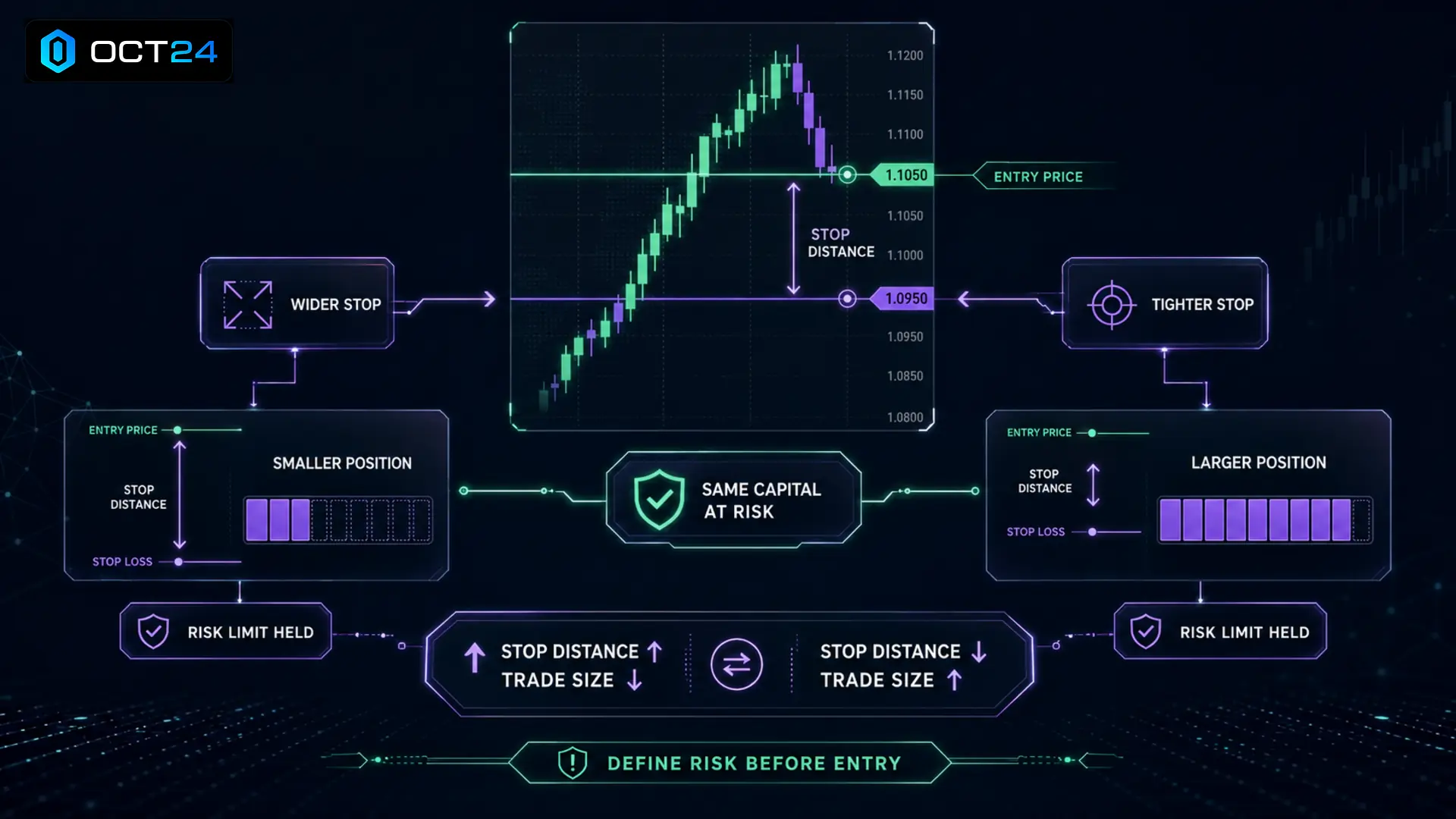
Position size and stop loss distance should not be separated. They are two sides of the same risk decision.
If the stop loss is far from the entry, the position size usually needs to be smaller. If the stop loss is closer, the position size may be larger while keeping the same planned risk. The key is that the dollar amount at risk stays controlled.
This is where many traders make mistakes. They choose a position size first, then place a stop loss wherever it feels convenient. That can create too much risk without the trader realizing it.
A better approach is to define the stop area based on the trade setup, then size the trade around that stop.
For example, a volatile asset may require a wider stop loss because normal price movement is larger. If the trader uses the same position size as a calmer asset, the potential loss may become much bigger than planned.
This is especially relevant when reviewing AI-supported signals. OCT24 may identify an opportunity during active market conditions, but the trader still needs to ask:
- Is the stop loss distance reasonable?
- Does the position size match that distance?
- Would this trade still be acceptable if it loses?
- Does this increase my exposure too much?
These questions are simple, but they can prevent many avoidable problems.
Why Fixed Dollar Sizes Can Be Risky
Some traders use the same dollar amount for every trade. For example, they may decide to enter every position with $500 regardless of the asset, setup, or stop loss.
This feels simple, but it can be risky.
A $500 position in a calm asset with a tight stop is not the same as a $500 position in a highly volatile asset with a wide stop. The dollar position may be identical, but the actual risk can be very different.
Position sizing controls are more useful when they focus on risk, not just trade value.
Instead of asking, “How much should I buy?” a trader can ask, “How much am I willing to lose if this trade does not work?”
That shift supports more consistent decision-making. It also helps traders compare opportunities more fairly.
OCT24 can present trading signals across changing market conditions. Some setups may appear cleaner than others, but every setup still needs to pass through the same risk filter. Position sizing controls help create that filter.
A Beginner-Friendly Position Sizing Example
Let’s walk through a simple example.
A trader has a $5,000 account. They decide they do not want to risk more than 1% on a single trade. That means the maximum planned risk is $50.
OCT24 presents an AI-supported signal on an asset. The trader reviews the setup and sees that a logical stop loss would be about 2% below the entry.
The trader does not simply put $5,000 into the trade. They work backward from risk.
If the stop loss is 2% away and the trader only wants to risk $50, the position size needs to be around $2,500 before considering fees, spreads, and slippage. If that position feels too large for the account or creates too much exposure, the trader can reduce it further.
Now imagine the stop loss needed to be 5% away instead of 2%. To keep the planned risk near $50, the position size would need to be much smaller.
This is the main lesson: wider risk distance usually means smaller position size.
That is why position sizing controls are useful. They help traders adapt trade size to the setup instead of treating every opportunity the same.
Position Sizing Helps Control Emotional Trading
Risk is not only mathematical. It is emotional too.
When a trade is too large, normal price movement can feel stressful. A small pullback may feel like a crisis. A normal loss may feel personal. This can lead to impulsive decisions, such as moving stop losses, closing trades too early, adding to losing positions, or chasing a quick recovery.
Good position sizing controls reduce that pressure.
When the size of the trade is reasonable, traders are more likely to follow their plan. They can review OCT24 signals with a calmer mindset because the outcome of one trade does not control their entire account.
This connects directly with trading psychology. Traders often know what they should do, but emotions become stronger when too much capital is exposed. Smaller, planned risk can make discipline easier.
A useful test is simple: if you cannot sleep, work, or think clearly while a trade is open, the position may be too large for your current tolerance.
How Position Sizing Supports AI Trading Signals
AI trading signals can help traders focus on opportunities that meet certain market conditions. OCT24 scans the market and presents AI-supported signals so users can spend less time searching and more time deciding how to act responsibly.
But a signal is not a command. It is information that needs to be reviewed.
Position sizing controls help turn that information into a plan. They make the trader ask whether the opportunity fits their account, risk limit, and current exposure.
This is important because signals can differ in strength, timing, volatility, and market environment. A signal in a calm market may need different sizing from a signal during a fast-moving selloff or breakout.
A practical review process could include:
- What is the signal suggesting?
- What market conditions are present?
- How volatile is the asset right now?
- Where would the trade idea be invalidated?
- How much account risk would this position create?
- Does this trade overlap with other open positions?
This process helps traders use OCT24 more responsibly. The platform does most of the analysis, but the trader still controls how much risk to accept.
Position Size, Leverage, and Margin
Leverage can make position sizing more complicated. It allows traders to control a larger position with less capital, but it can also magnify losses.
For beginners, the safest mindset is to treat leverage as a risk amplifier, not a shortcut. A small price movement can have a larger effect when leverage is involved.
Position sizing controls should become stricter when leverage is used. Traders should consider not only the entry and stop loss, but also liquidation risk, margin requirements, fees, and whether they could handle sudden volatility.
OCT24 does not remove these risks. Even when AI-supported analysis identifies a potential opportunity, leveraged trades can move quickly against the trader.
Before using leverage, traders should be able to answer:
- What is my maximum planned loss?
- Where is my stop loss?
- Could this position be liquidated before my plan plays out?
- How much margin is required?
- What happens if volatility increases suddenly?
If those answers are unclear, the position size is probably too large or the trade is not ready.
Watch Total Exposure, Not Just One Trade
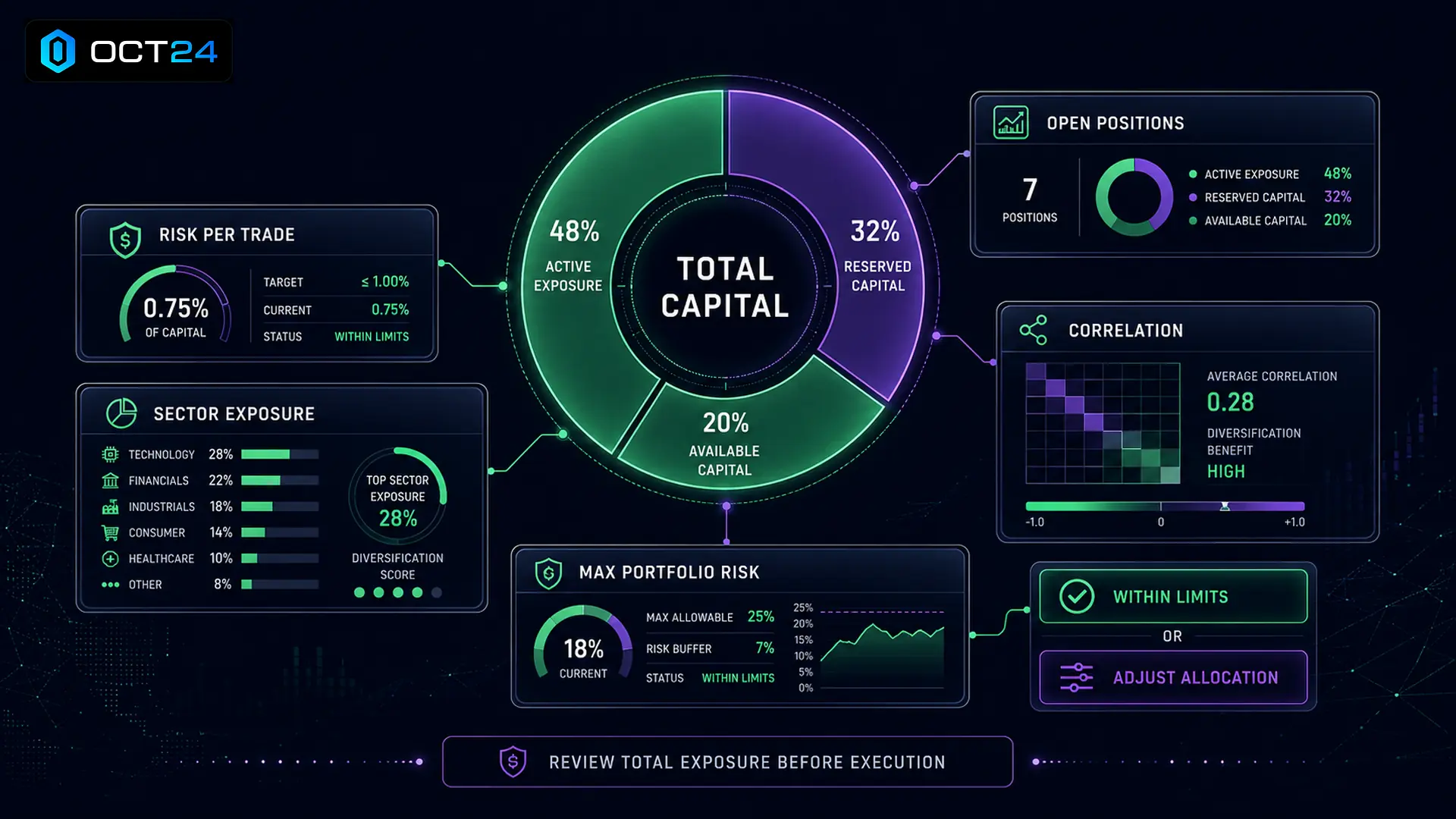
Position sizing controls should also look beyond a single trade. A trader may risk a small amount on each position, but still create too much total exposure if several trades are open at the same time.
For example, a trader might risk 1% on five different trades. That sounds controlled, but if all five trades are tied to the same market theme, the real exposure may be larger than it appears.
This is common in crypto and tech-related markets. Several assets can move together when risk sentiment changes. If the market turns, multiple positions may lose at once.
That is why capital allocation matters. Traders should think about how each new trade affects the whole account.
Questions to ask before opening another position include:
- How many trades are already open?
- Are they exposed to the same asset, sector, or market theme?
- What is the total account risk if several trades fail?
- Would this new position make the portfolio too concentrated?
- Am I adding risk because the setup is strong or because I feel impatient?
OCT24 can help identify opportunities across the market, but traders still need to manage overlap. More signals do not automatically mean more trades should be opened.
Position Sizing During Volatile Markets
Volatility changes the meaning of trade size. During fast markets, price can move farther and faster than expected. Stops may trigger more often, spreads can widen, and execution may happen at a worse price than planned.
In these conditions, position sizing controls become even more important.
A trader may choose to reduce position size, require stronger confirmation, widen stop areas carefully, or avoid lower-quality setups. The goal is not to predict every move. The goal is to avoid letting volatility create losses that are larger than planned.
OCT24 scans changing market conditions and can help traders see potential opportunities when markets are active. But active markets are not automatically better markets. They can create opportunity and risk at the same time.
A simple volatility rule can help: when uncertainty increases, reduce size before increasing confidence.
That rule keeps traders from confusing movement with opportunity. A fast-moving market may look exciting, but position sizing controls help keep decisions grounded.

Common Position Sizing Mistakes
Position sizing mistakes are often simple, but they can be expensive. Many happen because traders focus too much on the potential gain and not enough on the possible loss.
Here are common mistakes to avoid:
- Using the same position size for every setup without considering stop distance.
- Increasing size after a loss to try to recover quickly.
- Risking too much because an AI-supported signal looks strong.
- Ignoring total exposure across several open trades.
- Using leverage without understanding liquidation risk.
- Moving stop losses because the position size feels too large.
- Taking too many trades because signals are available.
These mistakes are not only technical. They are behavioral. Traders often know they should manage risk, but excitement or frustration can push them away from the plan.
This is why position sizing controls should be decided before execution. Once a trade is open, emotions can make simple decisions harder.
OCT24 can help organize the analysis side of trading. The trader’s job is to keep the risk side organized too.
How Position Sizing Fits Into a Consistent Trading Routine
A consistent trading routine helps traders make decisions in the same order each time. Position sizing should be part of that routine, not something decided at the last second.
A simple routine may look like this:
- Review market conditions.
- Check OCT24 AI-supported signals.
- Decide whether the setup fits your strategy.
- Define the stop loss and invalidation area.
- Calculate position size based on planned risk.
- Check total exposure.
- Execute only if the trade still fits the plan.
- Review the result after the trade closes.
This routine does not need to be complicated. It just needs to be repeatable.
Busy traders can especially benefit from this structure. If you only have limited time, a clear process helps you avoid rushed decisions. OCT24 reduces the amount of manual scanning needed, while position sizing controls help keep execution responsible.
Over time, this can make trading feel less reactive. You are not just responding to each signal. You are applying the same risk framework to every opportunity.
How to Choose a Position Size That Fits You
There is no single position size that works for every trader. The right size depends on account balance, experience, strategy, market conditions, and emotional tolerance.
A beginner may choose to risk a very small percentage per trade while learning. An intermediate trader may use a more defined risk model. A professional trader may use different sizing rules depending on volatility, setup quality, and portfolio exposure.
The important point is that the position size should be planned, not guessed.
A practical starting point is to choose a maximum risk per trade that feels manageable even during a losing streak. Then test whether that risk level still feels reasonable in real market conditions.
If losses feel too stressful, reduce size. If you keep ignoring stop losses, reduce size. If one trade can damage your account or decision-making, reduce size.
Position sizing controls are not about being afraid of risk. They are about choosing risk clearly.
Using OCT24 With Position Sizing Controls
OCT24 is built for traders who want AI-supported market analysis without spending all day scanning charts. The platform helps identify potential opportunities and present trading signals based on market conditions.
That can make the research process more efficient. It can also help traders stay focused on structured opportunities instead of jumping between random ideas.
The best way to use OCT24 is to combine its analysis with your own risk process. Review the signal, understand the setup, decide whether it fits your plan, then apply position sizing controls before execution.
This means asking:
- How much am I willing to risk on this trade?
- Where would the setup be invalidated?
- What position size keeps the risk acceptable?
- Does this trade increase my total exposure too much?
- Am I making this decision calmly?
OCT24 can do most of the analysis work, but it should not be treated as a promise of results. Markets remain uncertain. Traders remain responsible for risk settings, exposure, capital allocation, and execution choices.
OCT24 supports risk-aware trading by scanning market conditions, identifying potential opportunities, and presenting AI-supported trading signals. Traders can then review the setup, decide whether the position size fits their risk plan, and make informed execution choices. To learn more about the platform, visit About OCT24. If you are ready to explore AI-supported trading tools, you can Start Trading with OCT24.
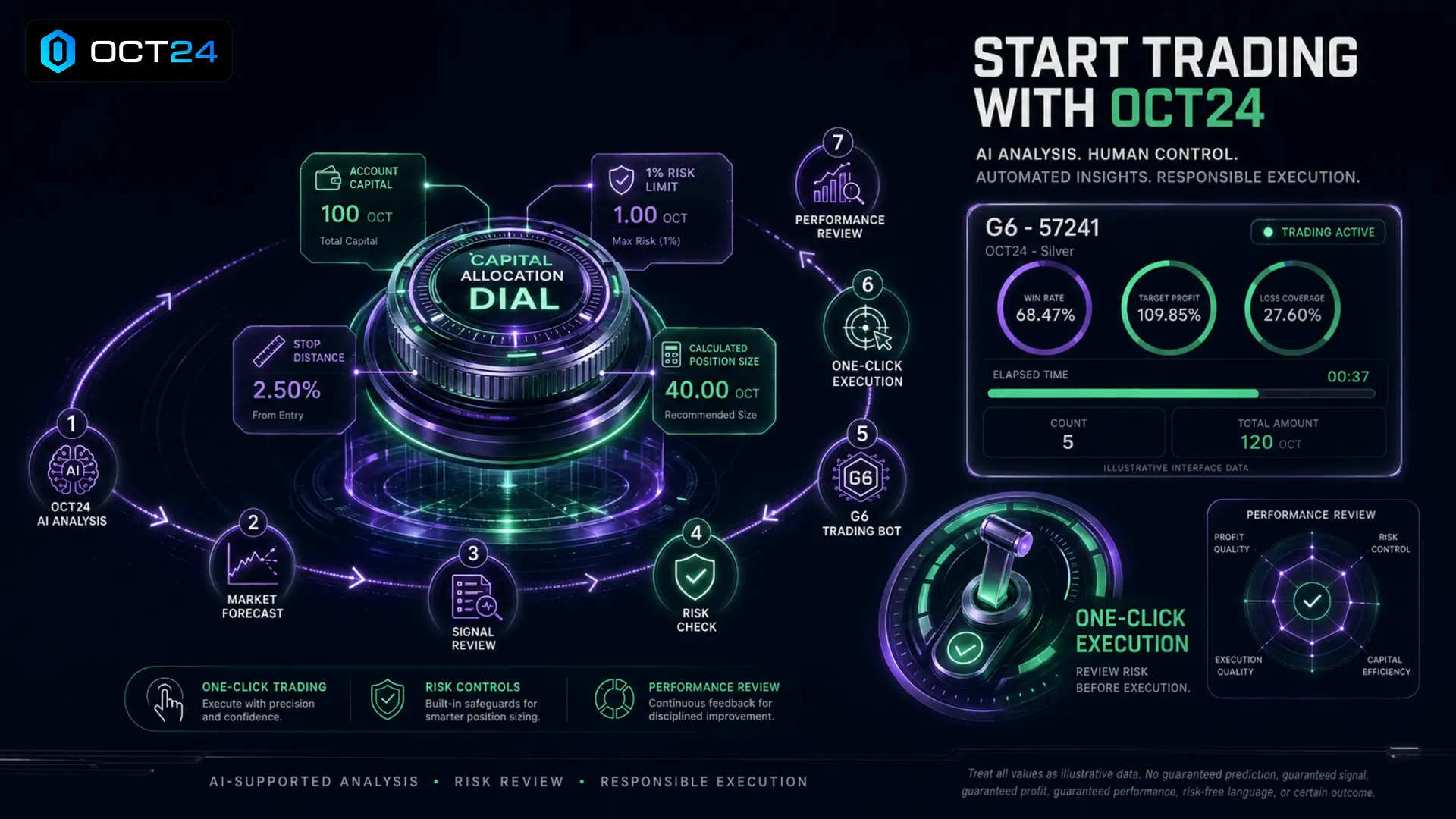
Position Sizing Controls and One-Click Trading
One-click trading can make execution faster, but speed should never replace preparation. A fast trade is only useful when the risk plan is already clear.
Before using one-click execution, traders should already know the intended position size, stop loss, risk amount, and exposure impact. Otherwise, speed can lead to mistakes.
This is where position sizing controls add discipline. They help traders prepare the trade before the final click. The goal is not to make trading more impulsive. The goal is to reduce hesitation after the risk decision has already been made.
When using OCT24 signals with faster execution tools, traders should slow down at the planning stage and only speed up at the execution stage. That is a more balanced approach.
A Simple Position Sizing Checklist
Before opening a trade, use this checklist:
- I understand the trade idea.
- I know where the setup is invalidated.
- I have chosen a maximum risk amount.
- My position size matches my stop loss distance.
- I have checked fees, spread, and possible slippage.
- I understand my total exposure across open trades.
- I am not increasing size because of emotion.
- I accept that the trade can lose even if the signal looks strong.
This checklist is short by design. It gives traders a practical pause before execution.
If one item is unclear, the trade may need more review. If several items are unclear, the trade may not be ready.
OCT24 helps bring opportunities to the surface. Position sizing controls help you decide whether those opportunities fit your account.
Final Thoughts
Position sizing controls are one of the clearest ways to manage trading risk. They help traders decide how much capital to place behind each trade, how much they are willing to lose if the setup fails, and whether the trade fits their overall account plan.
In AI trading, this is especially important. OCT24 can scan market conditions, identify potential opportunities, and present AI-supported trading signals, but it does not remove trading risk or guarantee outcomes.
The trader still controls risk settings, exposure, capital allocation, and execution decisions.
For traders using tools such as the G6 Trading Bot, position sizing should still come before execution. The bot can support a more structured workflow, but the trader remains responsible for deciding how much capital to risk on each trade.
That is the core lesson. AI can improve the way traders analyze the market, but position sizing controls help decide how much risk belongs in each trade.
When those two pieces work together, trading becomes more structured. Signals become easier to review. Losses become easier to contain. Decisions become less emotional.
You do not need a complicated formula to begin. Start with a clear risk limit, size each trade around that limit, watch your total exposure, and treat every signal as an opportunity to review rather than a command to act.
That is how position sizing controls support more responsible AI trading.