
Bitcoin vs Ethereum Trading Signals: What’s the Difference?
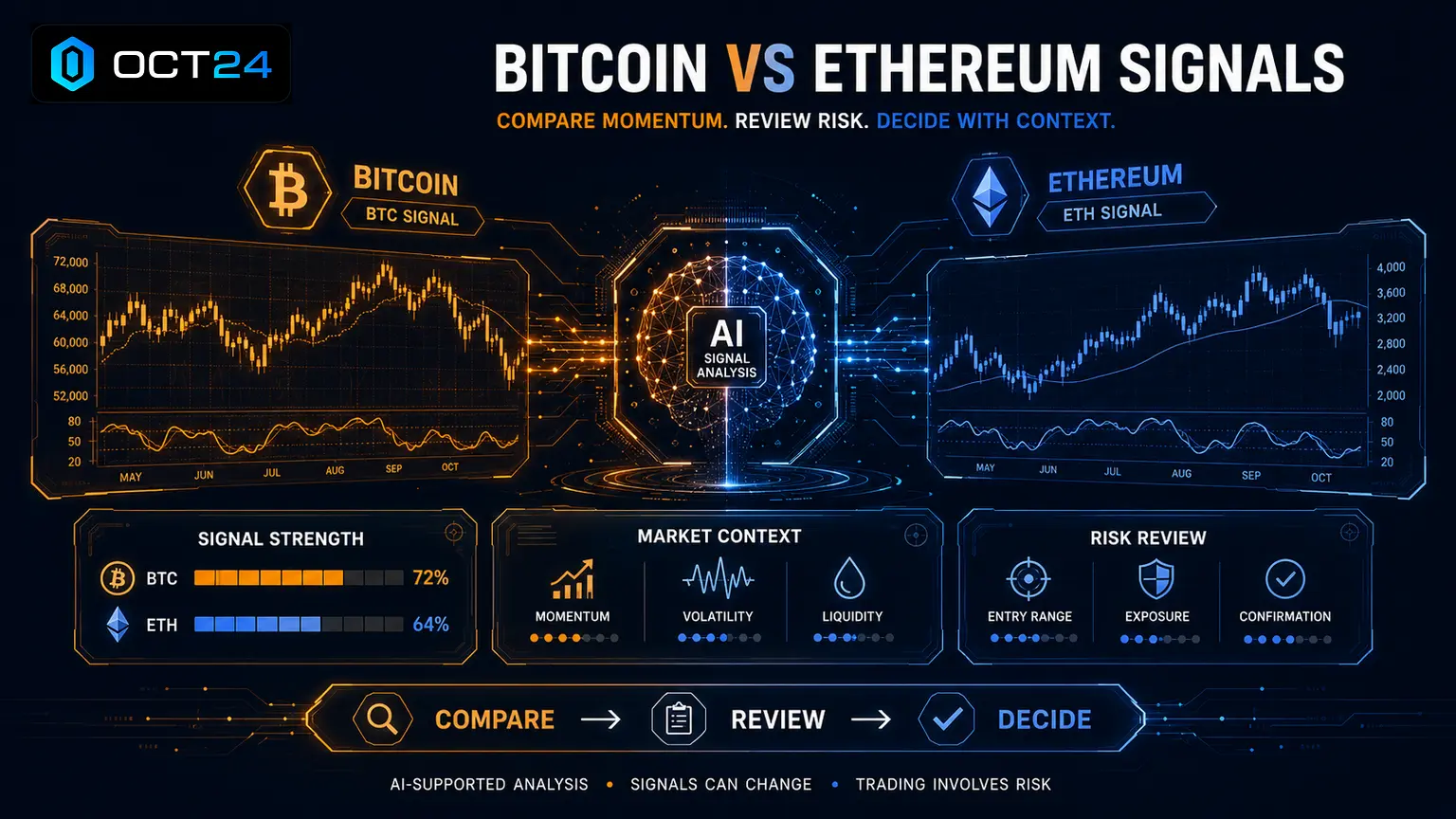
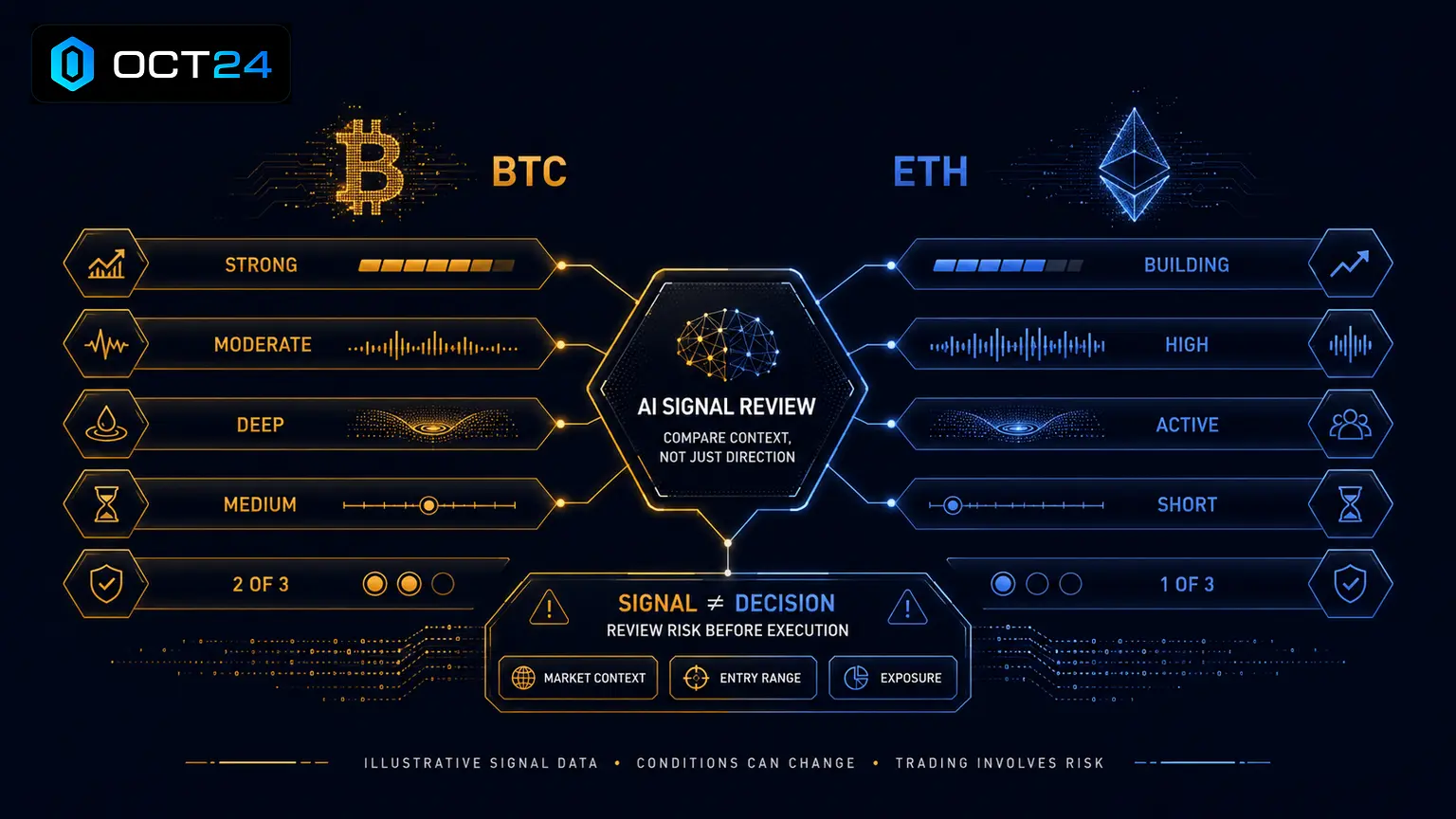
Bitcoin vs Ethereum trading signals can look similar at first, but they often tell traders different things. Bitcoin signals usually reflect broad market direction, risk appetite, and large-cap crypto sentiment, while Ethereum signals often reflect network activity, relative strength, altcoin rotation, and faster changes in market leadership.
For beginner and intermediate traders, the difference matters because a signal on Bitcoin may not mean the same thing as a signal on Ethereum. A Bitcoin move may show that the wider market is becoming more confident. An Ethereum move may show that traders are rotating into a different type of opportunity.
AI can help make this easier to understand by scanning market conditions, comparing patterns, and presenting AI-supported trading signals in a more structured way. OCT24 is designed to perform much of that market scanning behind the scenes, identify potential opportunities, and present simplified signal information for traders to review.
That does not make trading risk-free. OCT24 does not guarantee results, and traders remain responsible for risk settings, exposure, capital allocation, and execution decisions.
The goal is not to guess which coin will always perform better. The goal is to understand how Bitcoin and Ethereum signals can behave differently, so you can review each signal with more patience and less confusion.
Why Bitcoin and Ethereum Signals Are Not the Same
Bitcoin and Ethereum are both major crypto assets, but traders often watch them for different reasons. Bitcoin is usually treated as the main benchmark for the crypto market. Ethereum is often watched as both a major asset and a signal for broader crypto activity.
That means a Bitcoin trading signal may say something about overall market strength. An Ethereum trading signal may say something about whether traders are becoming more willing to take risk beyond Bitcoin.
This is why many traders compare Bitcoin and Ethereum before acting. They want to know whether Bitcoin is leading the market, Ethereum is gaining relative strength, or both assets are moving together.
The simplest way to think about it is this: Bitcoin often shows the market’s foundation, while Ethereum often shows whether risk appetite is spreading into more active crypto opportunities.
Neither asset is better in every condition. They simply behave differently, and those differences can change how traders read signals.
What Bitcoin Trading Signals Often Show
Bitcoin trading signals often carry more weight because Bitcoin is the largest and most watched crypto asset. When Bitcoin moves strongly, the rest of the market often pays attention.
A Bitcoin signal may suggest that traders are becoming more confident or more defensive. If Bitcoin is rising while other assets are weak, traders may be favoring the most established crypto asset. If Bitcoin is falling sharply, it may show that risk appetite is fading across the market.
This does not mean Bitcoin is easy to trade. Bitcoin can still move quickly, reverse suddenly, and create false confidence when price looks strong for only a short time.
For AI trading signals, Bitcoin can be useful because it often helps frame the market environment. If Bitcoin is stable, some traders may become more open to Ethereum or altcoin opportunities. If Bitcoin is unstable, traders may need to be more cautious with every signal.
A responsible Bitcoin signal review should focus on context. Is the signal appearing during a broad market move, a volatility spike, a sideways range, or a sudden news-driven reaction?
What Ethereum Trading Signals Often Show
Ethereum trading signals can behave differently because Ethereum often reacts to both broad crypto sentiment and its own market drivers. Traders may watch Ethereum for network-related narratives, decentralized finance activity, staking themes, and whether capital is rotating beyond Bitcoin.
When Ethereum starts outperforming Bitcoin, some traders see it as a sign that the market is becoming more comfortable with risk. That does not guarantee a larger crypto rally, but it can suggest that market attention is widening.
Ethereum can also move faster than Bitcoin during certain market phases. That speed can create attractive opportunities, but it can also increase the chance of emotional decision-making.
This is where trading psychology matters. A fast Ethereum move can make traders feel late. That feeling can lead to chasing, oversized positions, or ignoring risk controls.
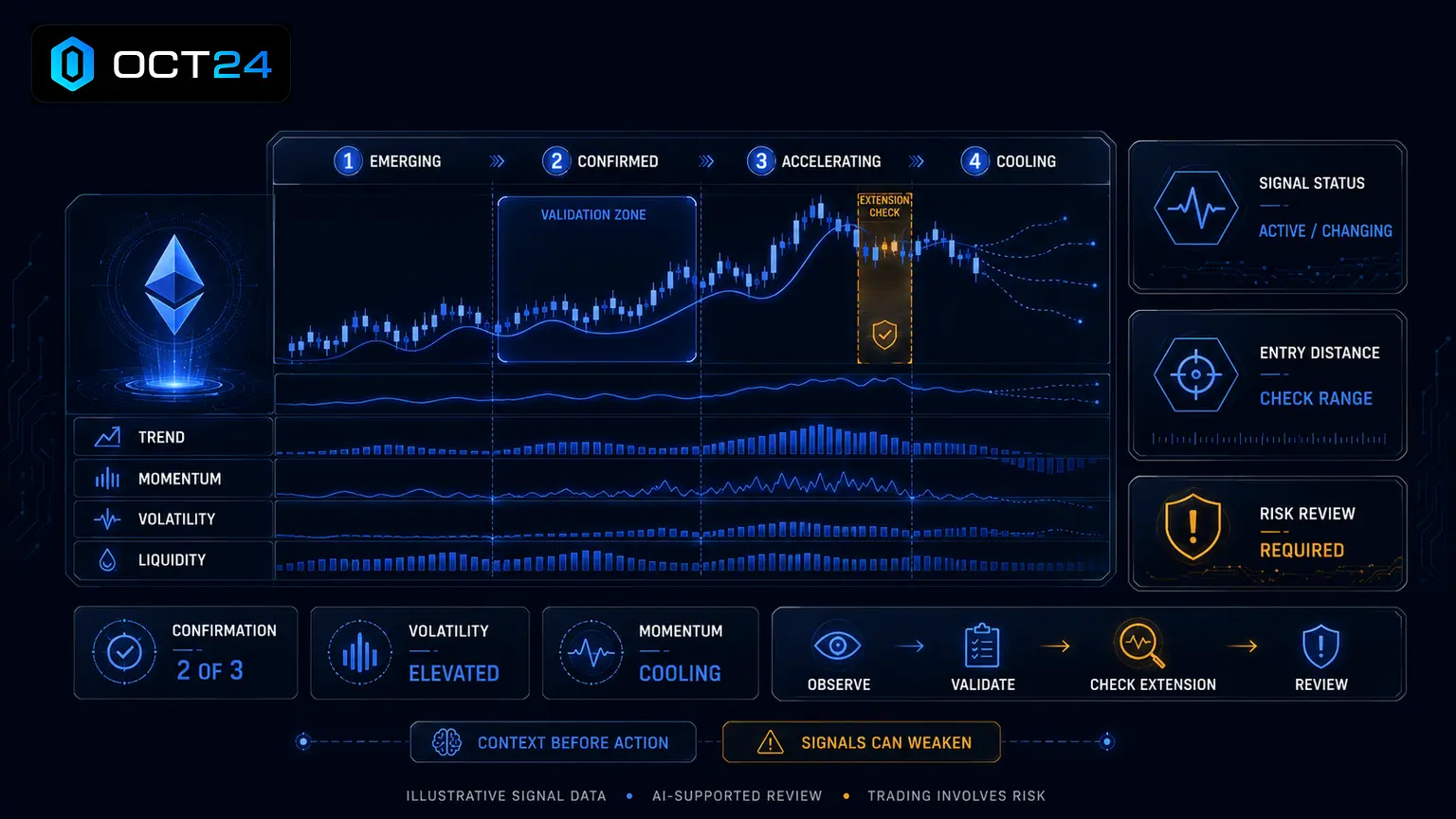
A good Ethereum signal review should ask whether the signal is supported by broader market conditions or whether the move is already stretched.

The Role of Relative Strength
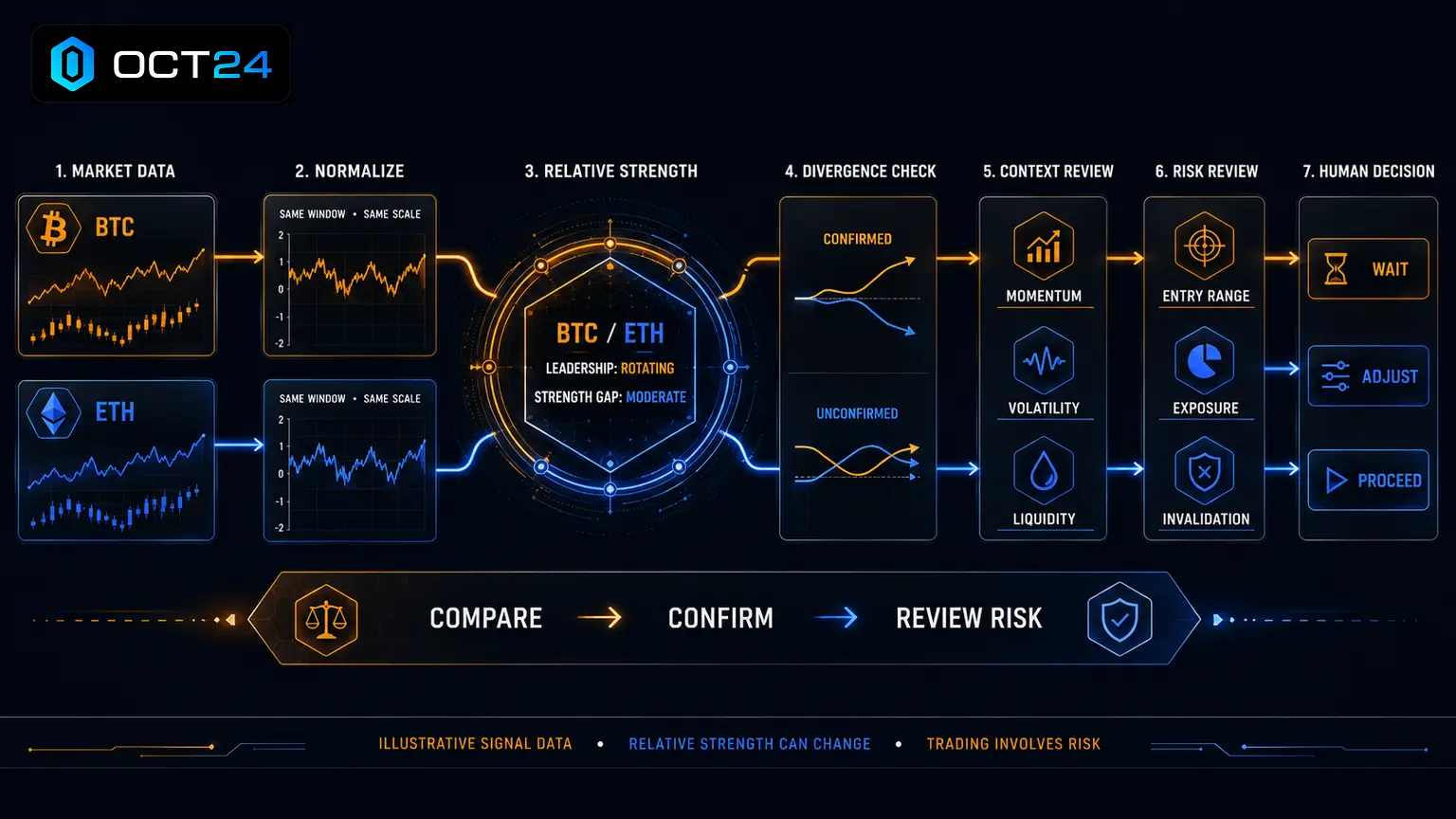
Relative strength is one of the simplest ways to compare Bitcoin and Ethereum. It asks which asset is performing better over the same period.
If Bitcoin is rising 2 percent and Ethereum is rising 5 percent, Ethereum is showing stronger short-term relative strength. If Bitcoin is holding steady while Ethereum falls, Bitcoin may be acting as the stronger asset in that moment.
Relative strength does not tell traders what will happen next. It gives context. It can help traders see whether capital is concentrating in Bitcoin, moving into Ethereum, or avoiding both.
This is useful because crypto market rotation can happen quickly. Sometimes Bitcoin leads first, then Ethereum follows. Other times Ethereum gains strength while Bitcoin slows down. In weaker markets, both may struggle at the same time.
AI can help by comparing more information faster than a manual trader can. The trader still needs to decide whether the signal fits the risk profile shown and whether it makes sense for their account.
How AI Can Compare Bitcoin and Ethereum Signals
AI trading systems can review market information across multiple assets, timeframes, and conditions. This can help traders compare Bitcoin and Ethereum without manually checking every chart movement throughout the day.
The value is not that AI can predict the market with certainty. The value is that AI can scan, filter, and organize market activity more consistently than most people can do manually.
For example, AI may help identify when Bitcoin is showing strength while Ethereum is lagging. It may also help identify when Ethereum is gaining momentum while Bitcoin is moving sideways.
This kind of comparison can support better signal review. Instead of treating every signal as isolated, traders can ask what the signal means inside the wider crypto environment.
OCT24 supports this simpler workflow by performing much of the scanning and opportunity identification behind the scenes. The user-facing experience remains focused on simplified metrics rather than a full technical-analysis dashboard.
How OCT24 Presents Crypto Signal Information
OCT24 is designed to make AI-supported trading easier to access. The platform scans market conditions, identifies potential opportunities, and presents signals in a simplified format for trader review.
It is important to understand what this means in practice. OCT24 currently does not provide a full on-platform market analysis workspace where users inspect every asset detail, chart reason, or exact entry and exit point for each presented trade.
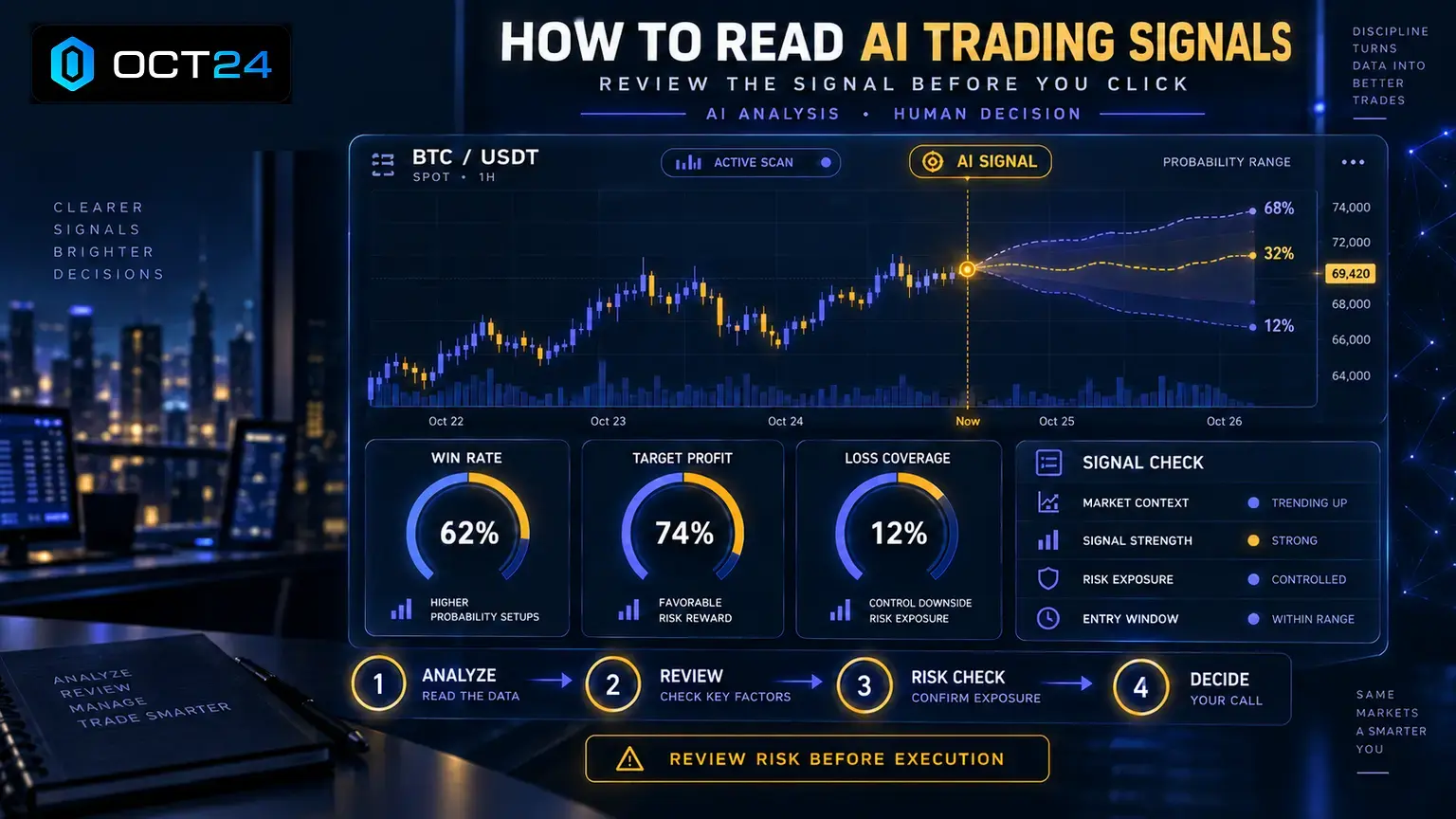
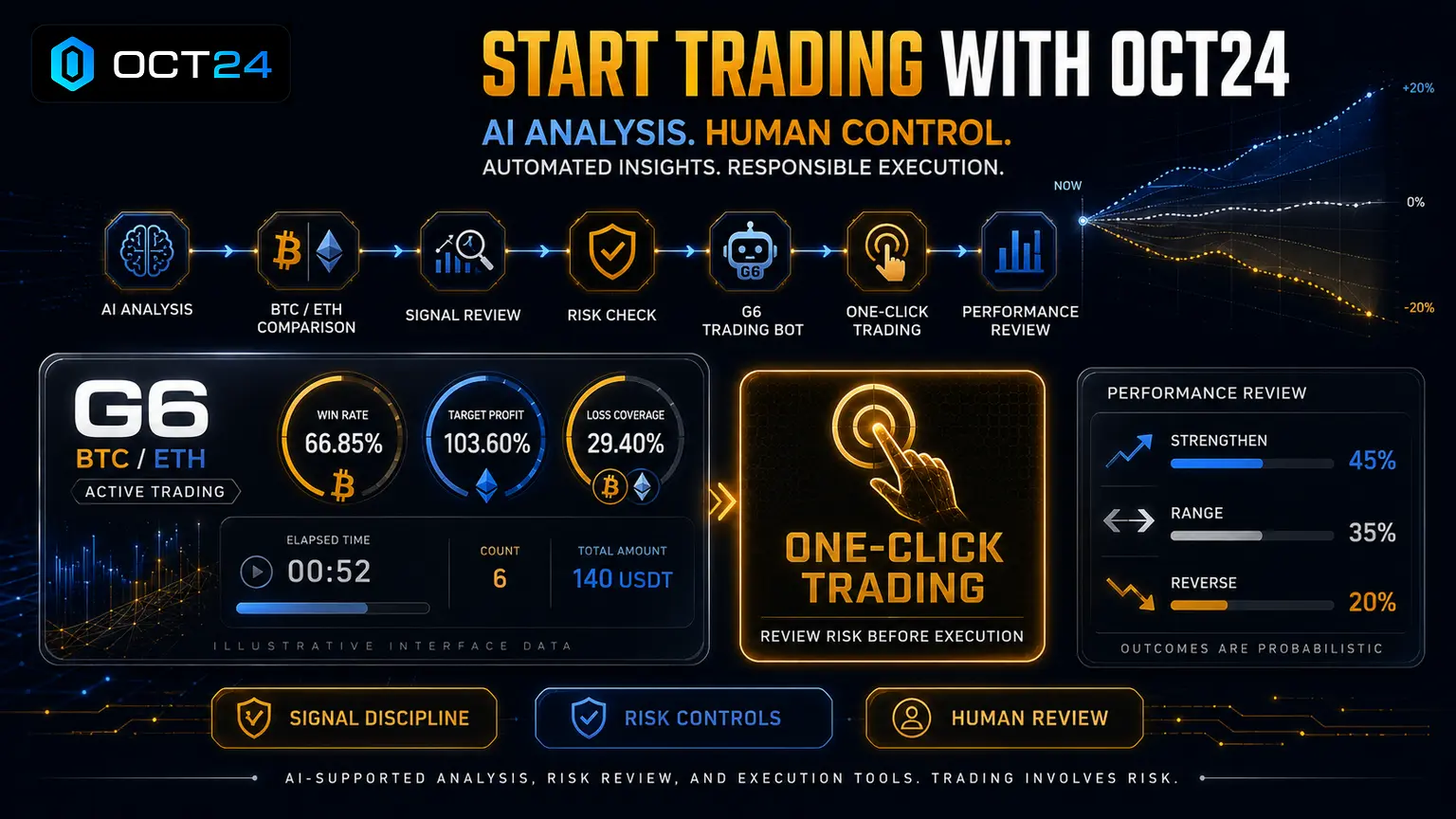
Instead, when a trade or bot is presented, the visible review focuses on key metrics such as target profit, loss coverage, and win rate. This can help traders make faster sense of an opportunity without being buried in technical detail.
That simplicity can be helpful, especially for users who want a cleaner process. It also means traders should not assume every underlying detail has been shown on screen.
The trader still needs to decide whether the displayed metrics fit their own risk tolerance, balance size, and trading plan.
Target Profit Can Mean Different Things for Bitcoin and Ethereum
Target profit is easy to focus on because it shows the possible upside of a trade or bot cycle. But target profit should always be reviewed in context.
A Bitcoin signal may have a different feel from an Ethereum signal because Bitcoin and Ethereum can move with different volatility profiles. Ethereum may sometimes offer faster movement, while Bitcoin may sometimes offer broader market confirmation.
This does not mean one target is automatically better than the other. A larger target may also come with more uncertainty. A smaller target may still be attractive if the risk profile is cleaner.
When reviewing target profit on OCT24, avoid judging the trade only by the upside number. Compare the target profit with loss coverage, win rate, and your own exposure.
The better question is not simply how much the trade could make. The better question is whether the displayed opportunity fits your risk plan.
Loss Coverage Matters More Than Excitement
Loss coverage helps traders think about downside before action. This is especially important when comparing Bitcoin and Ethereum signals because traders may become more excited by whichever asset is moving faster.
A strong Ethereum move can feel more exciting than a slower Bitcoin move. A strong Bitcoin move can feel safer because Bitcoin is more established. Both feelings can mislead traders if they ignore risk.
Loss coverage should be reviewed as part of the overall trade structure. It should not be treated as a guarantee that loss cannot happen.
This is where trading bot risk management becomes practical. A signal is only useful if the trader can handle the risk attached to it.
Before acting, traders should ask whether the potential downside still fits their account. If the answer is no, passing on the signal is a disciplined decision.
Win Rate Is Helpful, but It Is Not the Whole Signal
Win rate can help traders understand how a bot or signal has performed, but it should never be treated as certainty. A high win rate does not mean the next trade will win. A lower win rate does not automatically mean the setup is useless.
When comparing Bitcoin and Ethereum trading signals, win rate should be reviewed alongside target profit and loss coverage. A signal with a stronger win rate may still be unsuitable if the downside is too large for your account.
This matters because common AI trading mistakes often come from focusing on one metric too heavily. Traders may see a strong win rate and forget to review position size, current exposure, or recent market volatility.
OCT24 helps by presenting key metrics in a simple format. The trader’s job is to review them together, not in isolation.
A better decision usually comes from asking how the metrics work as a group.

Bitcoin Signals During Volatile Markets
Bitcoin signals during volatile crypto markets can carry extra importance because Bitcoin often sets the tone for the rest of the market. If Bitcoin is moving sharply, traders may become more cautious across crypto.
A Bitcoin signal during volatility should be reviewed slowly. Fast movement can make a signal feel urgent, but urgency is not the same as quality.
Traders should be careful when Bitcoin breaks out after a large move has already happened. A late entry can increase risk, especially if the market quickly reverses.
This is why AI trading signals without chasing the market is such an important habit. A signal should start a review process, not end it.
If Bitcoin is highly unstable, traders may want to reduce exposure, wait for cleaner conditions, or skip the signal entirely.
Ethereum Signals During Volatile Markets
Ethereum signals during volatility can move quickly because Ethereum often reacts strongly when market sentiment changes. This can create opportunity, but it can also increase emotional pressure.
When Ethereum outperforms Bitcoin, some traders may assume they need to act immediately. That is where overtrading can begin.
Ethereum strength is useful information, but it should still be reviewed through risk settings. A fast move may already include much of the opportunity by the time the signal appears.
A practical review is simple: does the signal still make sense if you remove the excitement from the move?
If the trade only feels attractive because Ethereum is moving fast, it may be a chase rather than a clean decision.
Sideways Markets Can Change the Signal Quality
Bitcoin and Ethereum signals can also behave differently in sideways markets. Bitcoin may trade inside a narrow range while Ethereum shows brief bursts of activity, or Ethereum may stay quiet while Bitcoin slowly drifts.
AI trading during sideways markets can help traders avoid forcing trades during weak conditions. Still, a signal in a sideways market needs careful review because price can reverse often inside a range.
In these conditions, target profit may be harder to reach if momentum is limited. Loss coverage and win rate become even more important to review.
A sideways market can tempt traders to act out of boredom. That is one reason a consistent trading routine is useful.
The goal is to avoid treating every small movement as a major signal.

How to Review a Bitcoin Signal Step by Step
A simple Bitcoin signal review should begin with market context. Ask whether Bitcoin is leading the wider market, reacting to sudden volatility, or moving inside a range.
Next, review the metrics shown. On OCT24, this means looking at the visible target profit, loss coverage, and win rate before making a decision.
Then compare the signal with your account plan. Position sizing controls matter because even a strong-looking Bitcoin signal can be risky if the trade size is too large.
Finally, decide whether the signal fits your current exposure. If you already have several crypto positions open, another Bitcoin-related signal may increase concentration risk.
The process should be calm and repeatable. You are not trying to react faster than everyone else. You are trying to make a better decision.
How to Review an Ethereum Signal Step by Step
An Ethereum signal review should also start with context, but the questions may be slightly different. Ask whether Ethereum is moving with Bitcoin, outperforming Bitcoin, or reacting to a separate market theme.
Then review the signal metrics. Target profit may look attractive when Ethereum is moving quickly, but the trade still needs acceptable downside structure.
Next, consider whether Ethereum strength is part of broader market rotation. If Ethereum is strong while Bitcoin is weak, the signal may need extra caution because the wider market may not be fully supportive.
After that, check your own behavior. Ethereum moves can feel exciting, and excitement can lead to poor timing.
A clean Ethereum signal should make sense after the excitement fades.
What the G6 Trading Bot Adds to the Workflow
The G6 Trading Bot is relevant for traders who want a faster and simpler way to interact with OCT24’s AI-supported trading experience. It fits the broader idea of using AI to reduce manual workload and support quicker decision-making.
For Bitcoin and Ethereum signals, the key benefit is not that the bot removes risk. It does not. The benefit is that the process can feel more structured and less dependent on constant manual chart watching.
The trader still needs to review the available metrics and decide whether the trade or bot fits their account. Speed is useful only when the decision process stays responsible.
This is especially important with one-click trading. A simpler click path should still include a pause for risk review.
Before using any fast execution workflow, review target profit, loss coverage, win rate, and your current exposure.
Risk Checklist Before Acting on BTC or ETH Signals
A good risk checklist can help traders compare Bitcoin and Ethereum signals without getting pulled into emotion. It also helps avoid overtrading when both assets are active.
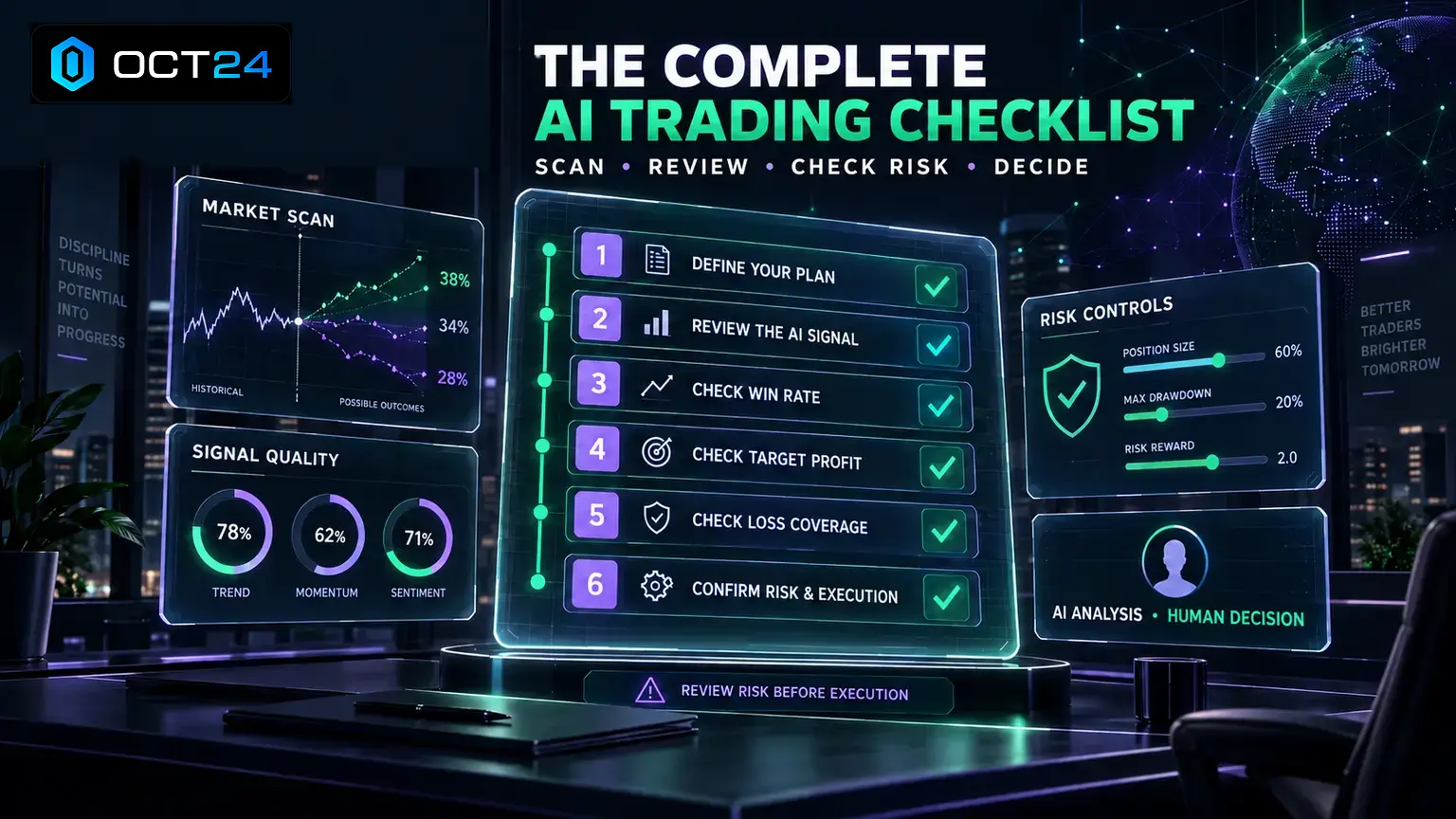
Before acting on a signal, ask:
- Does the signal fit my account size?
- Is the target profit reasonable for current market conditions?
- Does the loss coverage fit my risk tolerance?
- Am I relying too heavily on win rate?
- Am I already exposed to Bitcoin, Ethereum, or similar crypto risk?
- Am I acting because the setup makes sense or because the market is moving fast?
- Would I still take this trade if I were not afraid of missing out?
- Can I accept the outcome if the trade loses?
When Bitcoin Signals May Deserve More Attention
Bitcoin signals may deserve more attention when the entire crypto market appears to be waiting for direction. Because Bitcoin often acts as the benchmark, its movement can influence how traders feel about other assets.
If Bitcoin begins showing stronger behavior after a weak period, traders may become more willing to review crypto opportunities. If Bitcoin breaks down, even strong Ethereum signals may need extra caution.
Bitcoin can also be important when market sentiment is defensive. Some traders may prefer Bitcoin exposure over smaller assets during uncertain conditions.
Still, attention does not mean automatic action. A Bitcoin signal should still be reviewed through the same risk framework.
The signal may be important, but the decision must still fit your plan.
When Ethereum Signals May Deserve More Attention
Ethereum signals may deserve more attention when traders are looking for signs of expanding risk appetite. If Ethereum is outperforming Bitcoin, it may show that capital is becoming more active beyond the main crypto benchmark.
This can be useful for understanding market rotation. Ethereum strength can sometimes appear before broader interest in other crypto assets.
However, Ethereum signals can also become crowded or emotional. When traders rush into the same move, late entries can become risky.
A useful Ethereum signal should still be evaluated against loss coverage, win rate, target profit, and your own account exposure.
Ethereum can help show where energy is building, but energy alone is not a trading plan.
How Beginners Should Think About BTC vs ETH Signals
Beginners do not need to make Bitcoin versus Ethereum complicated. Start with the basic question: what is each signal trying to tell me about market behavior?
A Bitcoin signal may tell you something about broad crypto confidence. An Ethereum signal may tell you something about relative strength, rotation, or faster market activity.
Then compare the signal with the metrics shown. On OCT24, that means reviewing target profit, loss coverage, and win rate in a simple way before deciding whether to act.
Do not assume that more movement means a better trade. Do not assume that a familiar asset means lower risk.
The best beginner habit is to review slowly, use smaller exposure, and skip trades that do not make sense.
FAQs
What is the main difference between Bitcoin and Ethereum trading signals?
Bitcoin signals often reflect broad crypto market direction and overall risk sentiment. Ethereum signals often reflect relative strength, market rotation, and faster shifts in crypto activity.
Are Ethereum trading signals riskier than Bitcoin signals?
Not always. Ethereum may sometimes move faster, but risk depends on market conditions, trade structure, position size, and the metrics shown. Both Bitcoin and Ethereum signals can lose money.
Can AI compare Bitcoin and Ethereum signals?
AI can help compare market behavior across Bitcoin, Ethereum, and other assets by scanning conditions and identifying potential opportunities. It still cannot guarantee outcomes.
Does OCT24 show the exact asset and entry or exit points for every signal?
OCT24 currently focuses the user-facing review on simplified metrics such as target profit, loss coverage, and win rate. It does not show a full asset research view or exact entry and exit explanation for each presented trade.
Should beginners trade Bitcoin signals before Ethereum signals?
Beginners should not choose based only on the asset name. They should review the signal metrics, risk profile, market context, and their own account limits before acting.
How does OCT24 help with Bitcoin and Ethereum signal review?
OCT24 performs much of the market scanning and opportunity identification behind the scenes, then presents AI-supported trading signals through a simplified review process.
Can Bitcoin and Ethereum signals disagree?
Yes. Bitcoin may show strength while Ethereum lags, or Ethereum may outperform while Bitcoin moves sideways. That disagreement can be useful context for reviewing risk.
What should I check before acting on a BTC or ETH signal?
Review target profit, loss coverage, win rate, account exposure, position size, and whether the signal fits your trading plan.
Where can I learn more about OCT24?
You can read About OCT24 to understand the platform approach, or Start Trading with OCT24 when you are ready to explore AI-supported trading tools.
Final Thoughts
Bitcoin and Ethereum trading signals can both be useful, but they do not always mean the same thing. Bitcoin often gives traders a clearer view of broad crypto sentiment. Ethereum often helps traders understand relative strength, rotation, and faster shifts in market attention.
AI can help make these differences easier to review by scanning conditions and presenting structured signals. OCT24 supports this by doing much of the market scanning behind the scenes and showing simplified signal metrics such as target profit, loss coverage, and win rate.
That simple format can help traders avoid information overload, but it does not remove responsibility. Traders still need to manage risk settings, exposure, capital allocation, and execution decisions.
The best approach is to treat every signal as a review point. Compare Bitcoin and Ethereum calmly. Check the metrics. Respect your limits. Avoid chasing. Then decide whether the trade fits your plan.
To explore the platform, visit OCT24, or Start Trading with OCT24 when you are ready to review AI-supported crypto trading signals with a clearer risk-first mindset.