
What Makes a Crypto Trading Signal Strong?
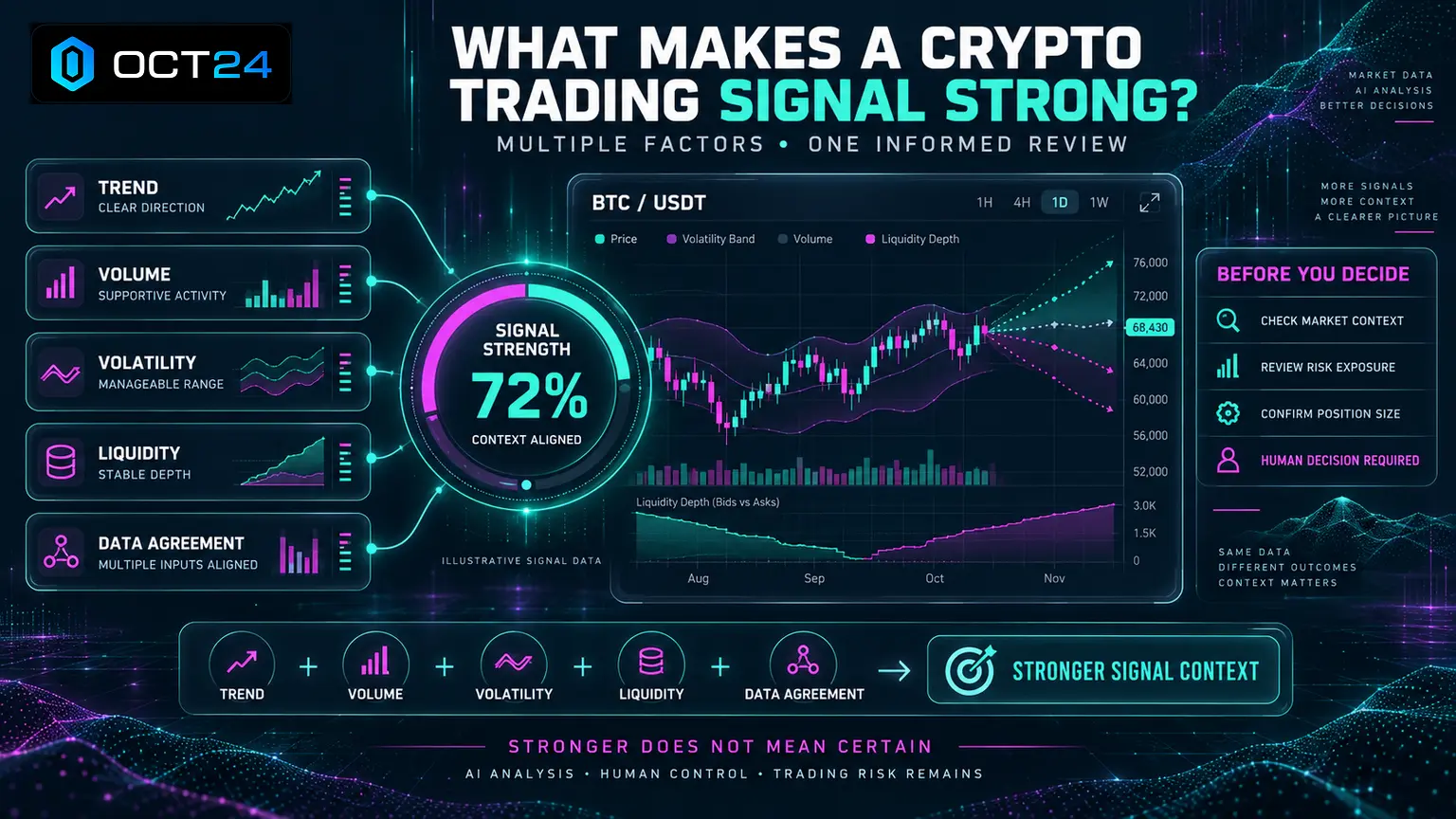
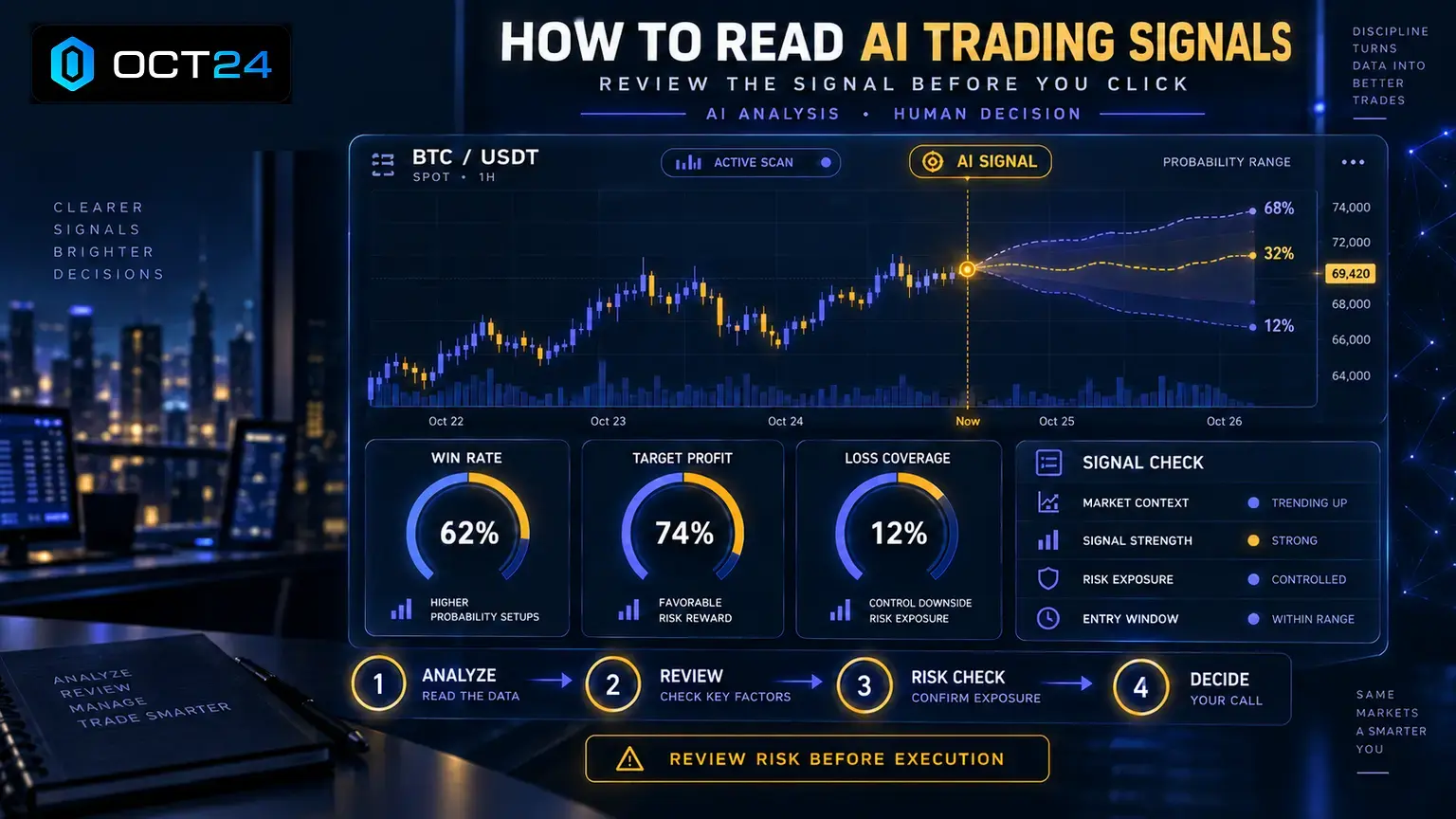
A strong crypto trading signal is not just a signal that looks exciting. It is a trading opportunity where the main pieces support each other. The win rate should make sense, the target profit should be realistic, the loss coverage should be clear, and the market conditions should support the setup.
OCT24 helps traders review these pieces in a simpler way. The platform scans crypto market conditions, identifies potential opportunities, and presents AI-supported trading signals. That can make the review process faster and clearer, but it does not remove trading risk or guarantee results. Traders still remain responsible for risk settings, exposure, capital allocation, and execution decisions.
This guide explains what makes a crypto trading signal strong in plain English. It is written for beginners who want a simple review process and for more experienced traders who want a cleaner way to compare signal quality before clicking into a trade.
What Is a Strong Crypto Trading Signal?
A strong crypto trading signal is a trade idea that has enough supporting evidence to deserve attention. It does not mean the trade will definitely win. It means the opportunity appears more complete than a random price move, social media rumor, or emotional guess.
A strong signal usually has four qualities. It has a clear setup, useful probability context, realistic upside, and visible downside planning. It also fits the current crypto market environment. If those pieces are missing, the signal may still be interesting, but it needs more caution.
A simple way to think about signal strength is this: a strong signal should answer the trader’s most important questions before the trade is activated. What is the opportunity? Why might it work? What could go wrong? How much exposure does it create?
This is where AI trading signals can help. AI can scan more crypto data than most traders can check manually. It can compare price movement, volatility, liquidity, trend behavior, and related market conditions. The trader then reviews the signal before deciding whether to act.
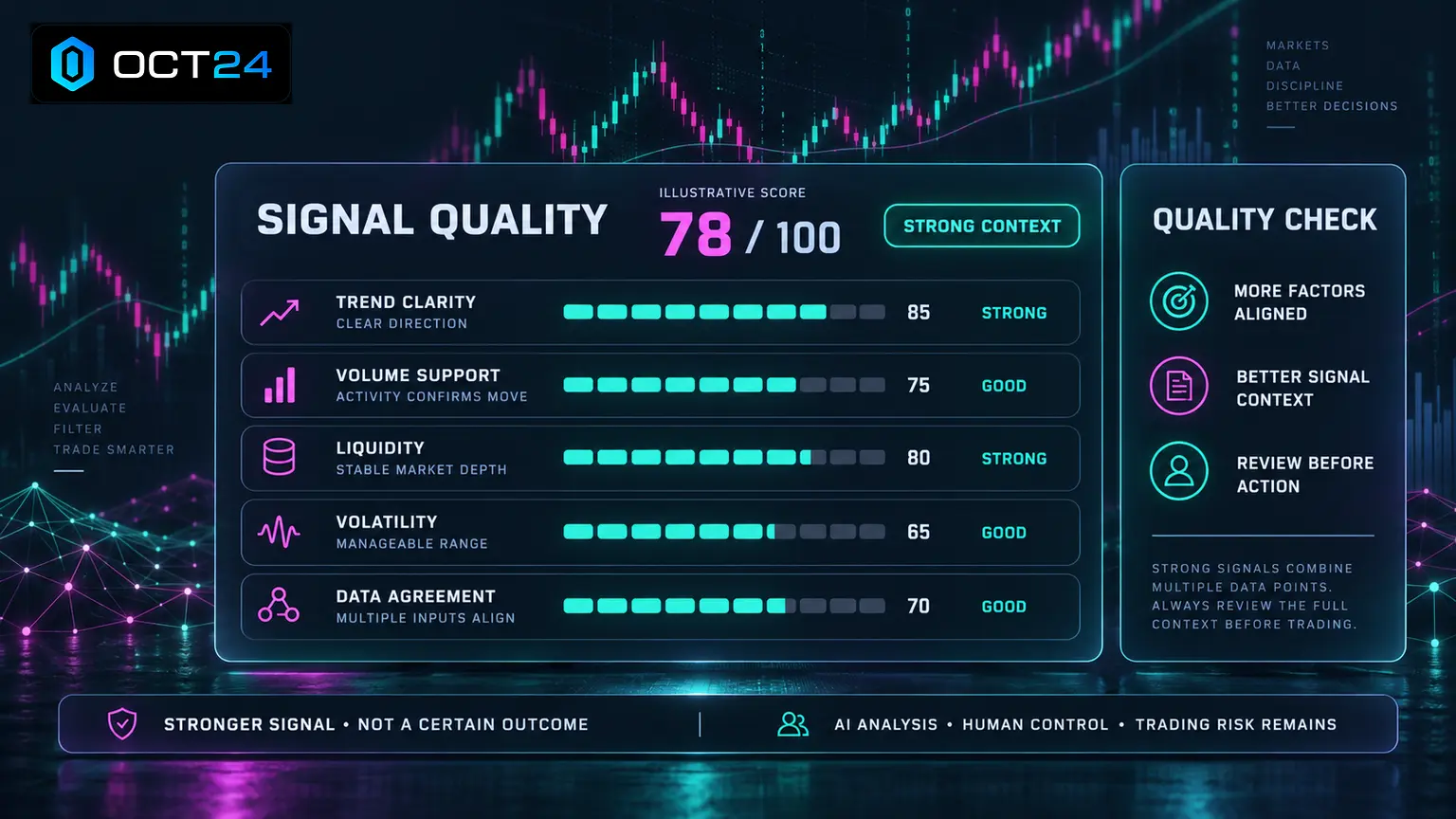
Strong Signals Are Built on More Than One Metric
Beginners often look for one number that tells them what to do. In trading, that is rarely enough. A signal can show a high win rate but weak target profit. Another signal can show an attractive target profit but poor loss coverage. A third signal can look good on the dashboard but appear during unstable market conditions.
A stronger signal usually has balance. The metrics do not need to be perfect, but they should not be fighting each other. When win rate, target profit, loss coverage, and market context point in the same general direction, the opportunity becomes easier to understand.
OCT24 is useful because it can bring those pieces into a cleaner review flow. Instead of forcing traders to scan every chart manually, OCT24 performs much of the market analysis and presents potential opportunities through AI-supported signals. The trader still decides whether the signal is appropriate.
Signal strength should never be treated as certainty. Crypto trading can change quickly. A strong signal can still reach a stop loss. A weak-looking signal can still win. The point is to make decisions from structure, not impulse.
Win Rate: The Probability Clue
Win rate is one of the first metrics many traders check. It shows how often a similar signal type or strategy has produced winning outcomes under relevant conditions. A higher win rate can be encouraging, but it should not be read as a promise.
A strong crypto trading signal uses win rate as a clue, not as the entire decision. Win rate helps answer the probability question. It does not answer the size question, the downside question, or the portfolio question.
For example, a signal with a high win rate may still be less attractive if the target profit is very small and the possible loss is much larger. A lower win rate signal may still deserve attention if the target profit is meaningful and the loss coverage is clear.
This is why OCT24 signal review should start with win rate but not stop there. The metric can help identify potential strength, but it becomes more useful when compared with target profit and loss coverage.
Target Profit: The Upside Check
Target profit shows the upside the signal is aiming for. It helps traders understand whether the potential reward is worth reviewing further. A signal can have a decent win rate, but if the target profit is too small, the trade may not be worth the risk, fees, or market movement needed to reach it.
A strong target profit is realistic. It should make sense for the asset, the current volatility, and the market structure. If the target looks too ambitious for the current conditions, the signal may be leaning too heavily on hope.
The best signals do not just offer large upside. They offer upside that fits the market. In crypto, this matters because price can move fast, but fast movement does not always mean clean opportunity. Slippage, spreads, liquidity, and sudden reversals can affect real outcomes.
A trader should ask a simple question: does the target profit make sense compared with the setup? If the answer is unclear, the signal may need more review.
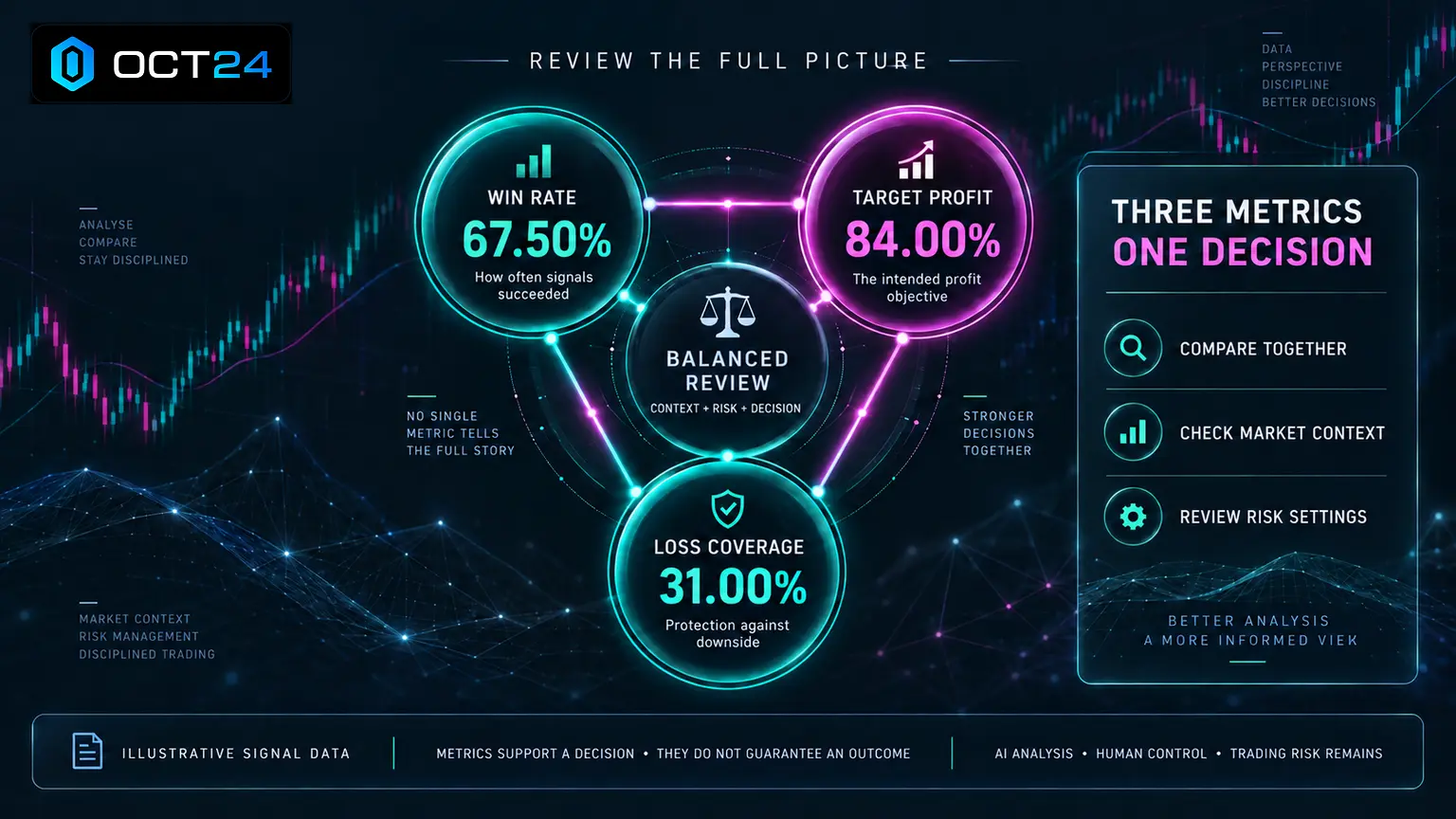
Loss Coverage: The Downside Reality Check
Loss coverage is the part of the signal that helps traders understand downside context. It does not guarantee protection from loss. It shows how the setup accounts for unfavorable movement and helps the trader see whether the downside is reasonable compared with the possible reward.
A signal with attractive upside but weak loss coverage can be dangerous for beginners. It may look exciting because the target profit is large, but the trade may not give enough room for normal crypto volatility. It may also expose the account to a loss that feels too large for the trader’s plan.
Strong signals are easier to trust when downside planning is visible. This does not mean the trade is safe. It means the trader can review the risk before activation instead of discovering it after the market moves.
This connects directly to AI trading risk vs reward. A signal becomes stronger when the potential reward and possible downside are both clear enough to compare.
Market Context Can Make or Break Signal Strength
A signal can look strong by itself and still be weak in the wrong market. Crypto market context matters because assets often move together, especially during high volatility. Bitcoin can influence altcoins. Liquidity can change quickly. News can shift sentiment.
Before clicking, traders should ask what the broader market is doing. Is the market trending, ranging, or reacting to news? Is volume supporting the move? Is liquidity deep enough for clean execution? Is the signal appearing after a large move, where reversal risk may be higher?
OCT24 helps by scanning market conditions and identifying potential opportunities, but traders should still consider the broader environment. The platform can support the review process, but it cannot remove uncertainty from the market.
A basic chart foundation can make this easier. Traders who understand candles, support, resistance, volume, and trend behavior can review signals with more confidence. The OCT24 guide on How to Read Crypto Charts can help beginners build that background.
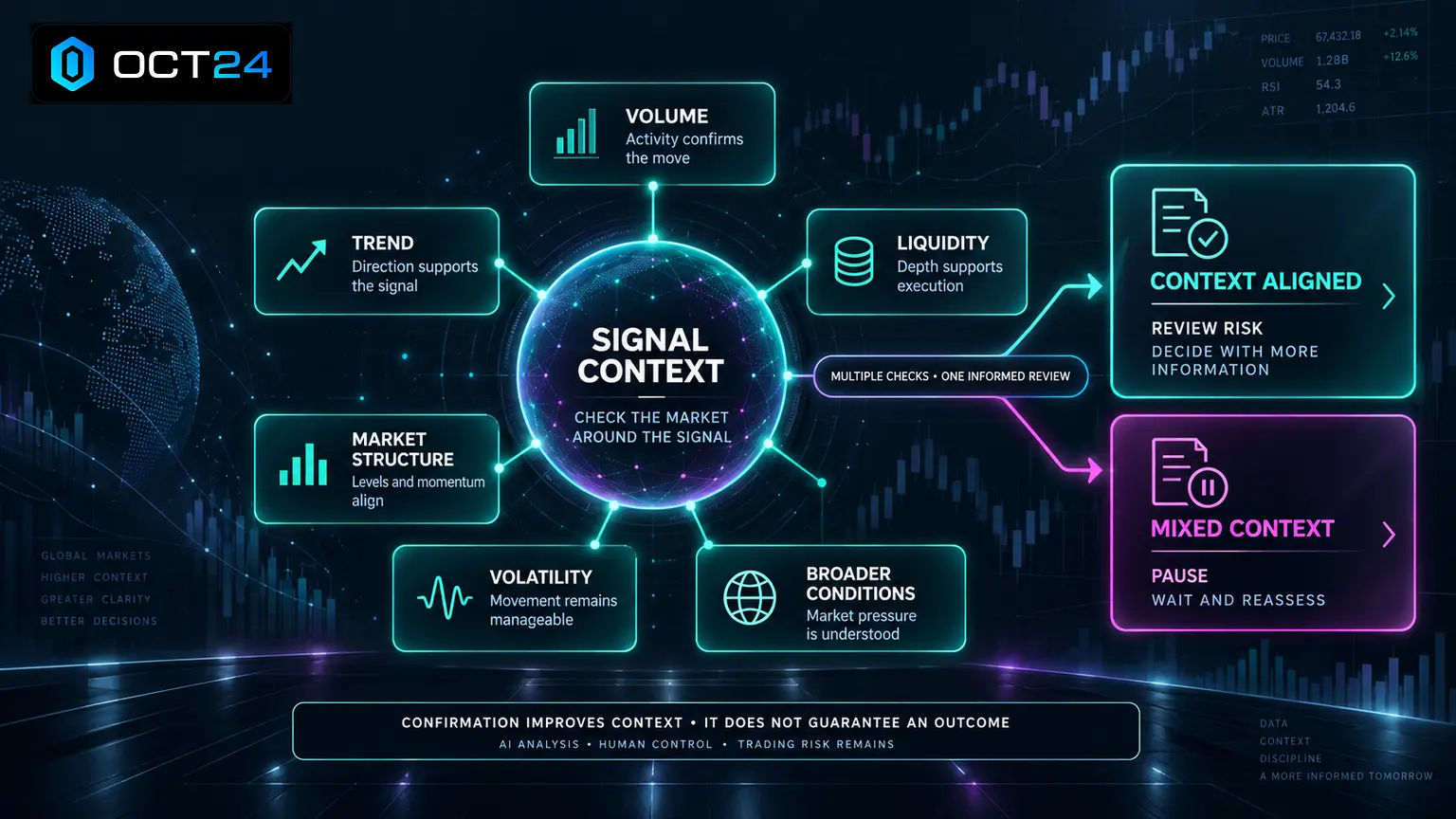
A Strong Signal Should Be Easy to Explain
One of the simplest tests is whether the signal can be explained clearly. If a trader cannot say why the signal looks strong, the decision may be too rushed. A strong signal should have a plain-language reason behind it.
For example, a trader might say: the win rate is solid, the target profit is realistic, loss coverage is clear, the market is trending, and the position size fits my account. That explanation does not guarantee success, but it shows the decision is structured.
A weak signal often sounds vague. It may rely on phrases like “it looks ready,” “everyone is talking about it,” or “I do not want to miss this move.” Those are emotional reasons, not signal reasons.
OCT24 can help reduce that confusion by presenting AI-supported trading opportunities in a more consistent format. Traders can compare signals using the same basic questions instead of changing their process every time the market gets noisy.
Strong Signals Versus Weak Trading Setups
A strong signal and a weak setup can look similar at first if the trader only checks price movement. Both may appear during a fast move. Both may involve a popular asset. Both may seem urgent. The difference is what happens when the trader reviews the details.
A stronger signal usually has support from several areas. A weak setup often depends on one attractive feature while hiding problems somewhere else.
Signs of a stronger signal include:
- Win rate supports the setup without being treated as certainty.
- Target profit appears realistic for current crypto conditions.
- Loss coverage gives clear downside context.
- The market environment supports the signal.
- The trade fits the trader’s exposure and position size limits.
Signs of a weaker setup include:
- The signal depends on hype or fear of missing out.
- The target profit is large but not realistic for the market.
- Loss coverage is unclear or too thin.
- The asset is moving on low liquidity.
- The trade would create too much concentration in one direction.
OCT24 has already covered how AI can detect weak trading setups. That same idea applies here. A strong signal should survive a basic quality check. If it does not, skipping the trade may be the more disciplined choice.

How AI Helps Identify Stronger Opportunities
AI can support signal strength by scanning more data than a trader can reasonably review alone. A trader might check a few charts manually. OCT24 can scan many crypto market conditions and surface potential opportunities that fit the platform’s analysis process.
This does not mean AI knows the future. It means AI can help organize information. It can compare patterns, market behavior, volatility, and potential opportunity quality faster than a manual workflow. The trader then reviews the signal before deciding whether to activate it.
This is the core idea behind how AI identifies trading opportunities. AI can help narrow the market from too many possible trades into a smaller set of signals that may deserve attention.
For beginners, that can reduce overwhelm. For professionals, it can save time. In both cases, OCT24 should be used as decision support. The trader still controls exposure, capital allocation, and execution decisions.
Signal Strength and Entry or Exit Logic
A strong signal should also make sense around entry and exit logic. Traders should understand why the signal is appearing now and how the trade is expected to behave if the market moves favorably or unfavorably.
OCT24 users do not need to manually build a complex exit plan inside the platform. The AI-supported workflow presents the opportunity and the related signal details. The trader’s role is to review the information, decide whether the trade fits their risk settings and exposure, and choose whether to activate.
This is why AI trading entry and exit signals are helpful to understand. Even when technology simplifies the workflow, traders benefit from knowing how entry timing, target profit, and possible loss outcomes connect.
A strong signal should not feel like a mystery button. The more clearly a trader can understand the setup, the easier it becomes to decide whether the click makes sense.
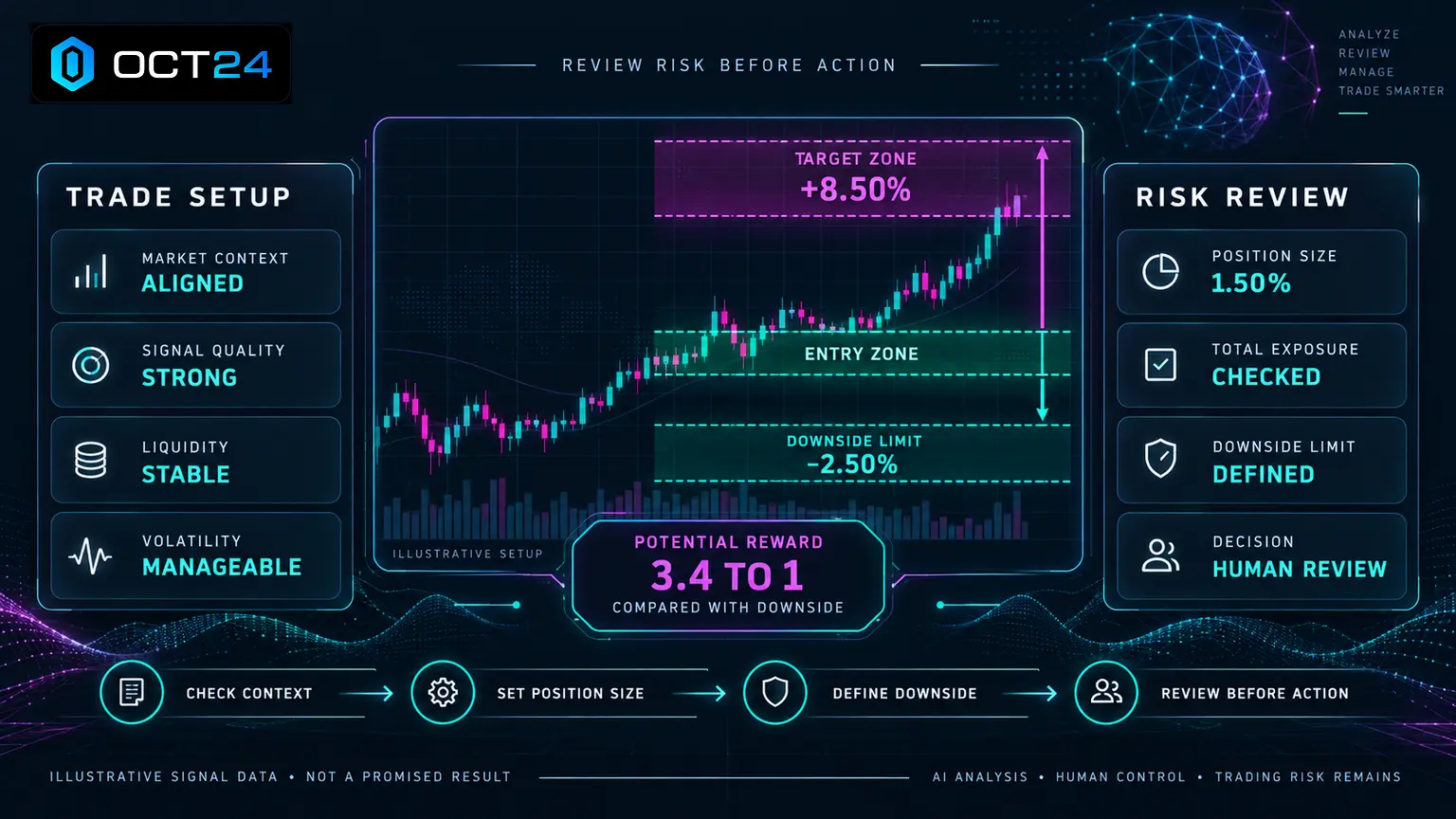
Why One-Click Trading Still Needs Review
One-click trading can make crypto trading feel simpler, but it should not make the decision careless. The click should happen after the trader has reviewed signal strength. It should not happen because the market feels exciting.
On OCT24, one-click execution is useful because the platform has already done much of the scanning and opportunity identification. That can reduce manual workload. Still, the user decides whether to activate a trade and remains responsible for risk settings, exposure, capital allocation, and execution decisions.
A beginner-friendly process is to pause before the click and ask three questions. Is the win rate useful? Is the target profit realistic? Is loss coverage clear? If the answer is no, the signal may need more caution.
When the answer is yes, the trader can still lose money. Strong does not mean certain. It means the signal has enough structure to be reviewed seriously.
Position Size Can Turn a Good Signal Into a Bad Decision
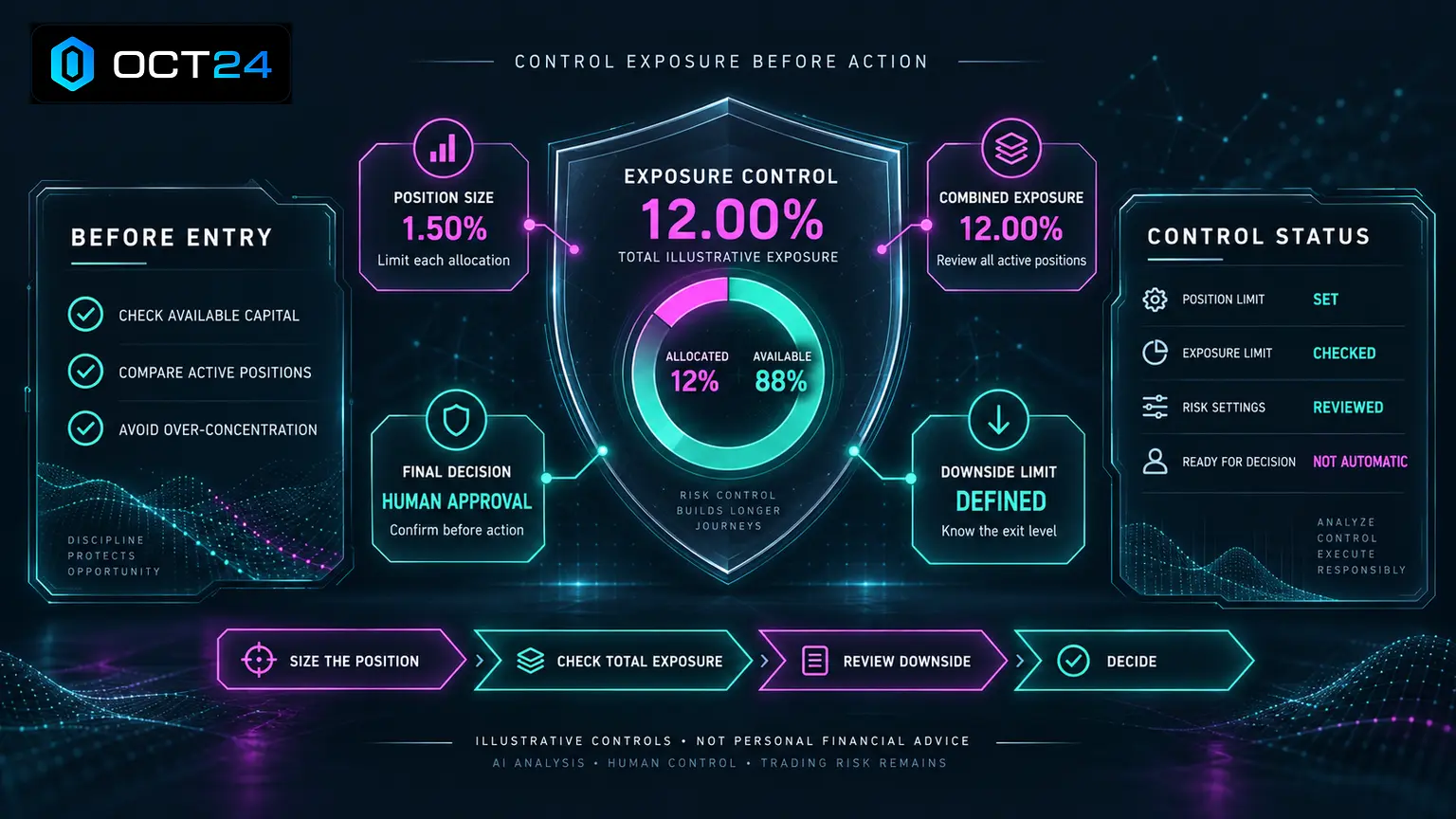
Position size is one of the easiest parts of trading to underestimate. A signal can look strong, but if the position size is too large, the trade can create more risk than the account can comfortably handle.
This is especially important for beginner crypto traders. A normal stop loss can feel stressful if the trade size is too large. Even a good signal can become a poor decision when it does not fit the trader’s capital allocation plan.
Position Sizing Controls help connect signal quality to account risk. Before activating any signal, traders should consider whether the position size fits their balance, risk tolerance, and current exposure.
OCT24 can present AI-supported crypto trading signals, but it cannot decide how much risk is appropriate for every individual trader. That responsibility stays with the user.
How to Review Signal Strength Without Chasing
Chasing happens when a trader clicks because the market is already moving. It can feel urgent, especially in crypto, where prices can jump quickly. But urgency is not the same as signal strength.
A strong review process slows the trader down just enough to think. The goal is not to wait forever. The goal is to avoid clicking before understanding the opportunity.
A simple anti-chasing review looks like this:
- Read the signal summary first.
- Check win rate, target profit, and loss coverage.
- Look at the broader crypto market context.
- Check whether the trade adds too much exposure.
- Only activate if the signal still makes sense after review.
The OCT24 article on AI trading signals without chasing the market covers this mindset in more detail. The key idea is simple: a strong signal should still make sense after the first rush of excitement fades.
How to Compare Two Strong-Looking Signals
Sometimes the hardest decision is not choosing between a strong signal and a weak signal. It is choosing between two signals that both look reasonable. This is where beginners can slow down and compare the details instead of clicking the first opportunity that appears.
Start by comparing the three core metrics side by side. Which signal has the cleaner win rate? Which target profit looks more realistic for the current market? Which signal gives clearer loss coverage? If one signal has a slightly lower win rate but much better downside context, it may deserve more attention than a signal that only looks strong on the surface.
Then compare exposure. If both signals point in the same direction or rely on the same part of the crypto market, activating both may create more concentration than expected. A trader does not need to take every good-looking trade. Choosing the cleaner fit can be more disciplined than stacking similar positions.
Finally, compare how easy each signal is to explain. A signal that makes sense in plain language is usually easier to manage emotionally. If the reason for the trade sounds vague, rushed, or based mainly on hype, the signal may not be as strong as it first appears.
A Beginner-Friendly Signal Strength Checklist
A checklist can make signal review easier. It gives beginners a simple process to follow and gives experienced traders a way to stay consistent.
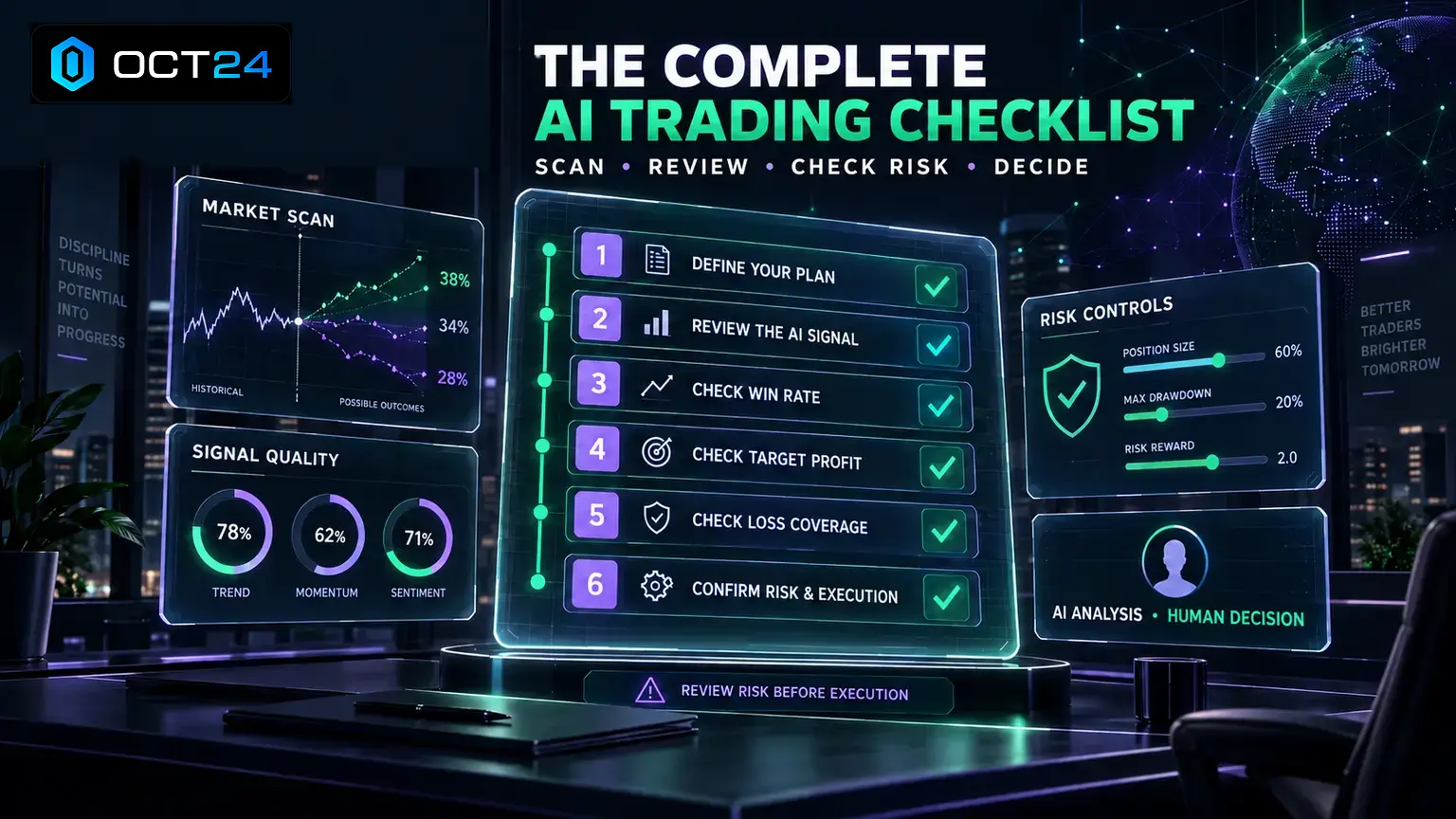
Before activating a crypto trading signal, ask:
- Is the setup clear?
- Does the win rate support the opportunity?
- Is the target profit realistic?
- Is loss coverage clear?
- Does the market environment support the signal?
- Does the trade fit my account exposure?
- Is the position size reasonable?
- Am I clicking from review rather than emotion?
If several answers are unclear, the signal may not be strong enough. That does not mean the trade cannot work. It means the trader may not have enough confidence in the setup to risk capital responsibly.
This is also where Trading Bot Risk Management matters. Risk management starts before the trade is active. It starts when the trader decides whether the signal deserves attention.
Where the G6 Trading Bot Fits
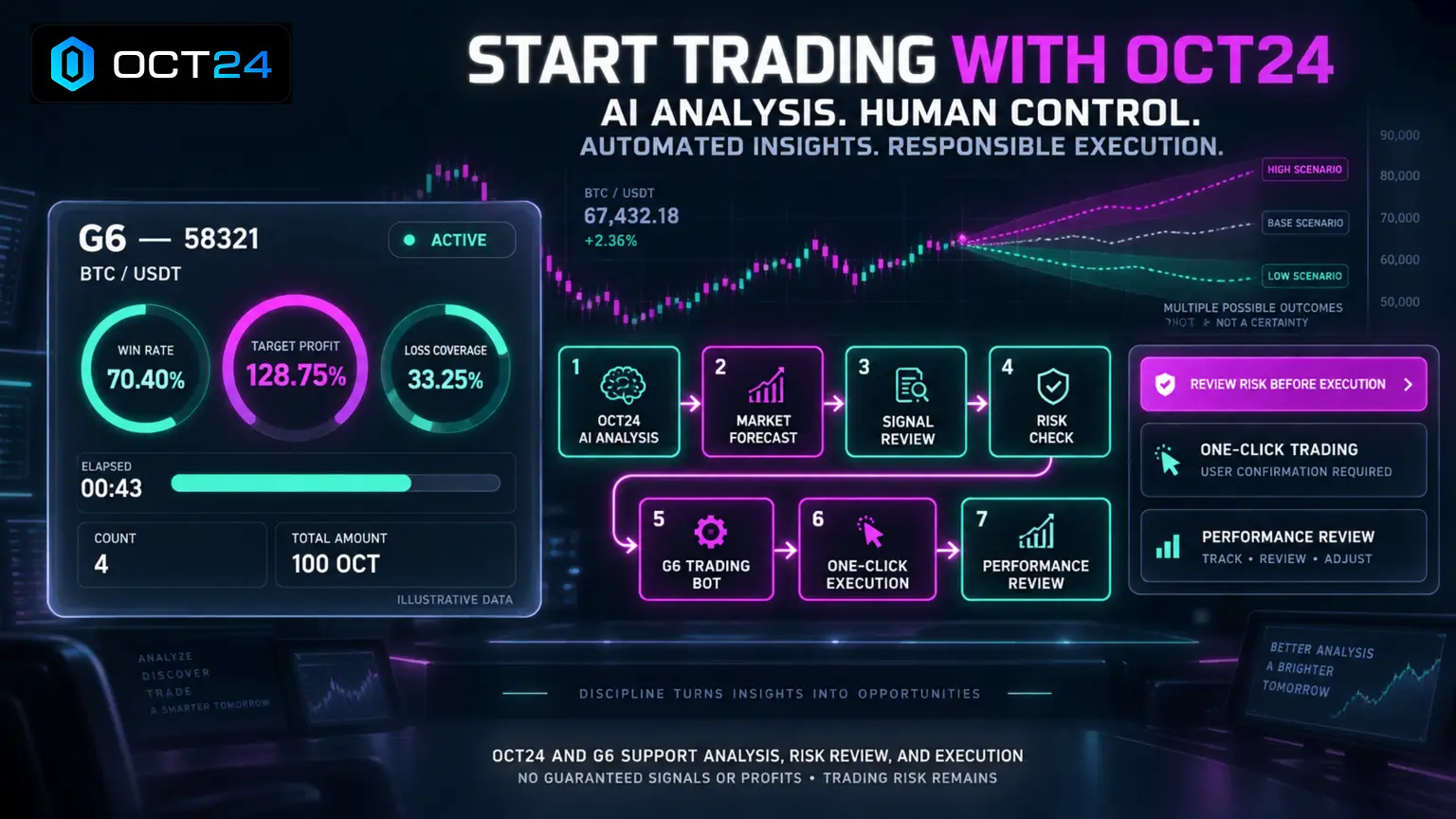
The G6 Trading Bot is relevant for traders who want to explore OCT24’s crypto-focused AI technology more directly. The important point is that the bot workflow should still be approached with review and risk awareness.
A trading bot can make the process more efficient, but it should not be treated as a guarantee. Traders may see take profits and stop losses over time. That is normal in real market conditions. The goal is to use a structured process, not to expect every signal to win.
OCT24 can support the workflow by scanning the crypto market, identifying possible opportunities, and presenting AI-supported trading signals. The trader still needs to decide whether the opportunity fits their account and risk comfort.
If you want to explore the platform, Start Trading with OCT24 is the clear signup path. Review each signal carefully, start with responsible exposure, and remember that no AI trading platform can remove market risk.
Final Thoughts
A strong crypto trading signal is not defined by one exciting number. It is defined by balance. Win rate, target profit, loss coverage, market context, position size, and trader discipline all matter.
OCT24 can make that review easier by scanning crypto market conditions and presenting AI-supported trading signals in a cleaner workflow. That can help beginners and professionals compare opportunities with less noise. Still, every signal needs responsible review.
OCT24 can support the analysis, but it does not guarantee profits or remove risk. When you are ready to explore AI-supported crypto trading opportunities, Start Trading with OCT24 and keep your risk settings, exposure, capital allocation, and execution decisions front and center.
FAQs
What makes a crypto trading signal strong?
A strong crypto trading signal has balanced support from win rate, target profit, loss coverage, market context, and risk fit. It should be clear enough for the trader to understand before activation.
Does a strong signal guarantee a winning trade?
No. A strong signal can still lose. It only means the trade idea has more supporting evidence than a weak or emotional setup. Crypto trading always involves risk.
Why is win rate important?
Win rate gives probability context. It helps traders understand how often similar setups have produced winning outcomes, but it should be reviewed with target profit and loss coverage.
Why does target profit matter?
Target profit helps traders understand the possible upside of the signal. It should be realistic for the current market and meaningful enough compared with risk.
What does loss coverage show?
Loss coverage gives downside context. It helps traders see how the signal accounts for unfavorable price movement, but it does not prevent losses or remove risk.
Can OCT24 find strong signals for beginners?
OCT24 can scan crypto market conditions and present AI-supported trading opportunities in a simpler format. Beginners still need to review each signal and manage risk responsibly.
Should traders activate every strong-looking signal?
No. A signal can look strong and still be unsuitable for a trader’s account, exposure, or risk comfort. Skipping a trade can be a smart decision.
How can I avoid chasing weak signals?
Use a repeatable review process. Check win rate, target profit, loss coverage, market context, position size, and your reason for clicking before activating any trade.
Is OCT24 only for crypto trading?
Yes. OCT24 content and platform positioning focus on crypto trading. Traders should use it for crypto-focused signal review and avoid assuming it supports other markets.