
How AI Identifies Trading Opportunities
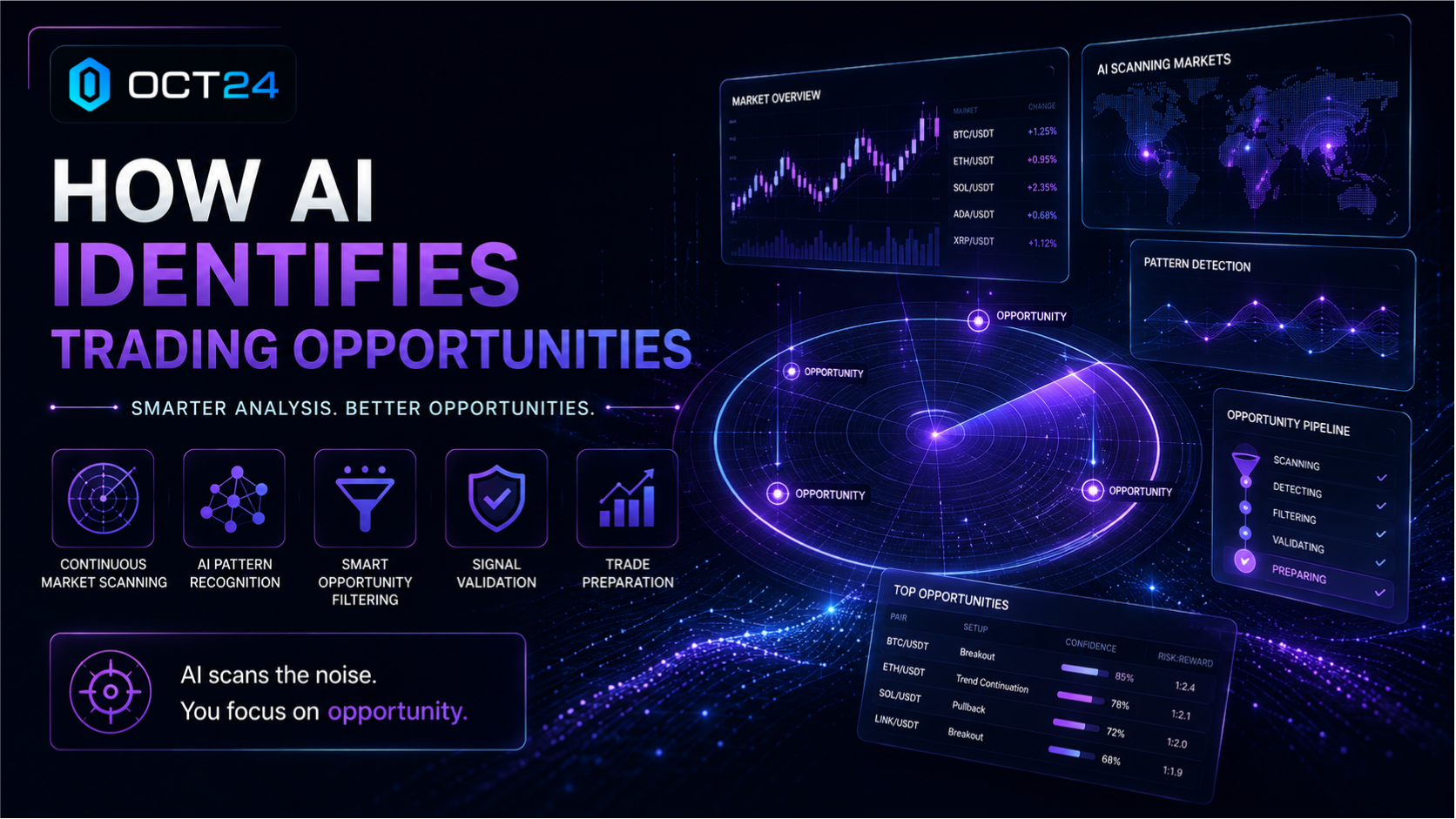
Understanding how AI identifies trading opportunities is essential for anyone exploring modern trading technology. Before a trade is ever placed, AI systems continuously analyze market data, identify meaningful patterns, and filter potential opportunities based on predefined criteria. Rather than relying on intuition or emotion, AI uses data-driven analysis to help traders focus on market conditions that may deserve closer attention.
Modern financial markets generate enormous amounts of information every second. Prices fluctuate continuously, trading volume changes rapidly, and market sentiment can shift within minutes. Reviewing all this information manually is difficult, especially for active traders following multiple cryptocurrencies or financial markets at once.
Think of AI as a highly efficient research assistant.
Imagine searching through thousands of pages to find a handful of useful insights. A person might need hours to complete the task, while an intelligent assistant can scan everything in minutes and present only the most relevant findings. AI performs a similar role in trading by continuously scanning markets, organizing information, and highlighting opportunities that match specific trading conditions.
It's important to remember that AI identifies potential opportunities—it does not predict the future with certainty. Markets remain unpredictable, and every trading decision still involves risk.
What Information Does AI Analyze?
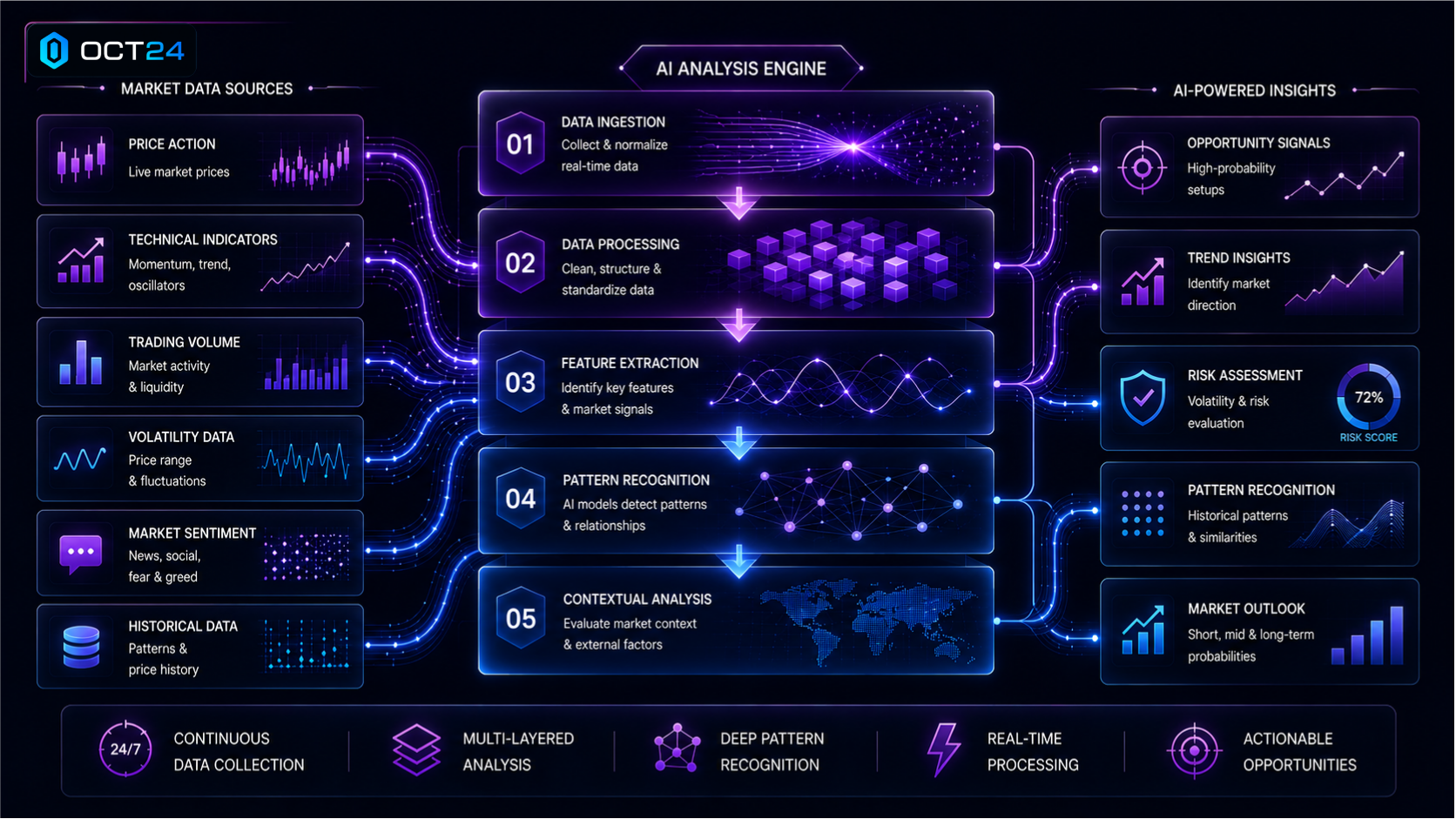
Before AI can identify a trading opportunity, it must first understand what is happening in the market.
Rather than focusing on a single chart or indicator, modern AI systems evaluate numerous data sources simultaneously. This broader perspective helps traders identify situations that might otherwise be overlooked.
Some of the most common types of information AI analyzes include:
- Price action
- Technical indicators
- Trading volume
- Market volatility
- Market sentiment
- Historical price behavior
Each data source contributes another piece of the overall market picture.
Price Action
Price action refers to how an asset's price moves over time.
AI continuously evaluates whether prices are trending upward, moving sideways, or declining. It also identifies sudden changes that could indicate increasing buying or selling pressure.
Instead of viewing only the current price, AI analyzes how prices behave over multiple timeframes to understand broader market conditions.
Technical Indicators
Technical indicators help traders interpret market momentum and trend strength.
Examples include:
- Moving averages
- Relative Strength Index (RSI)
- MACD
- Bollinger Bands
- Volume indicators
As explained in our guide to AI Trading, these indicators become more useful when evaluated together rather than individually.
Trading Volume
Volume measures how much of an asset is being traded.
Strong price movements supported by increasing volume often carry more significance than price movements occurring with very little trading activity.
AI continuously compares changes in volume alongside price action to better understand market participation.
Market Volatility
Volatility measures how quickly prices change.
Periods of high volatility may create more trading opportunities, but they also increase risk.
AI evaluates changing volatility levels to help determine whether market conditions align with predefined trading criteria.
Market Sentiment
News events, investor behavior, and social discussions can all influence market sentiment.
Some advanced AI trading platforms incorporate sentiment analysis alongside technical market data to provide a broader understanding of current market conditions.
Historical Data
Markets rarely behave exactly the same way twice.
However, historical market behavior often provides useful context for evaluating current conditions.
AI compares present market activity against thousands of previous situations to identify similarities that may warrant further attention.
As discussed in AI Trading Software, analyzing multiple data sources simultaneously is one of AI's greatest strengths.
Step 1 — Continuous Market Scanning
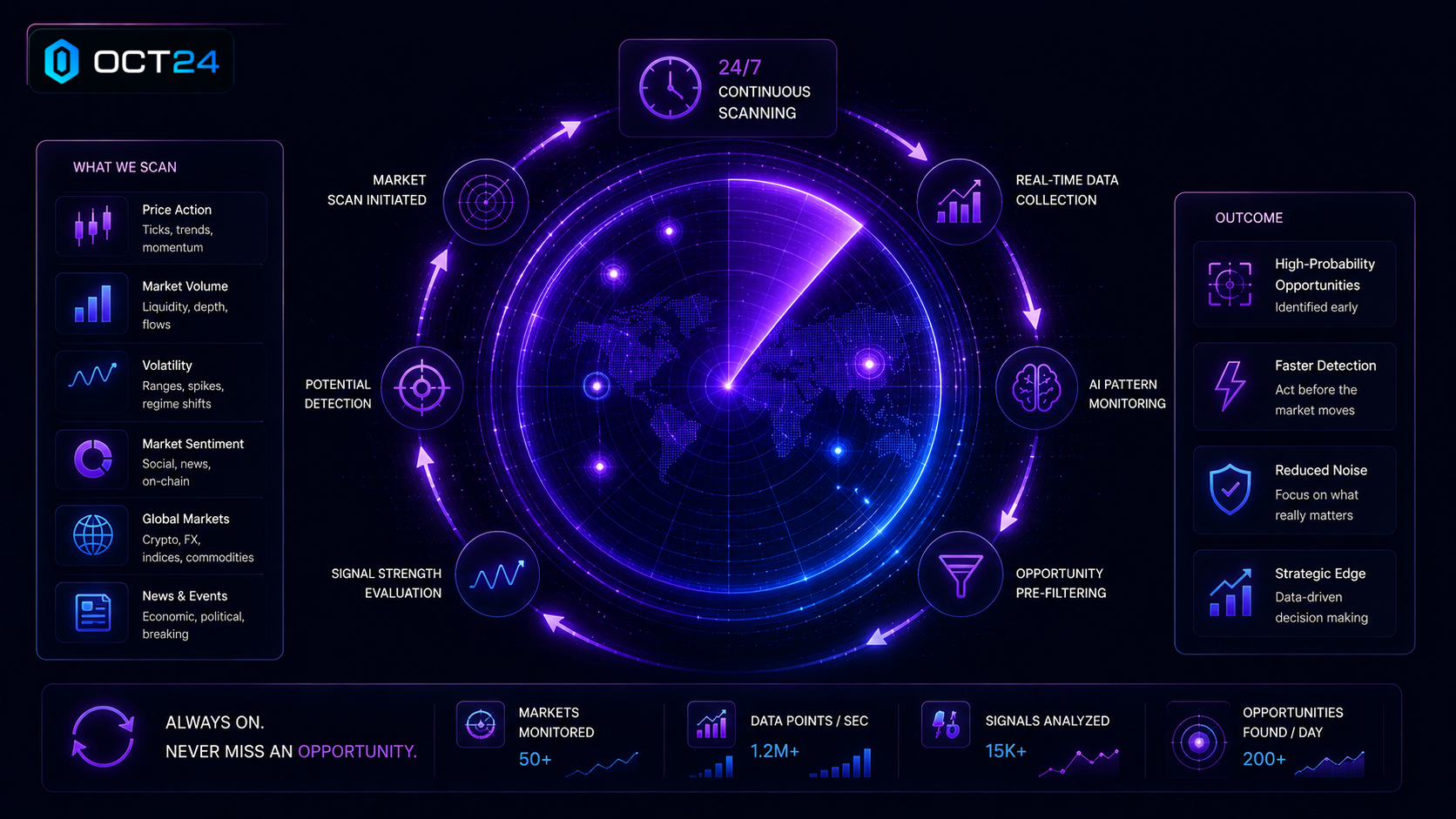
The first step in identifying trading opportunities is continuous market scanning.
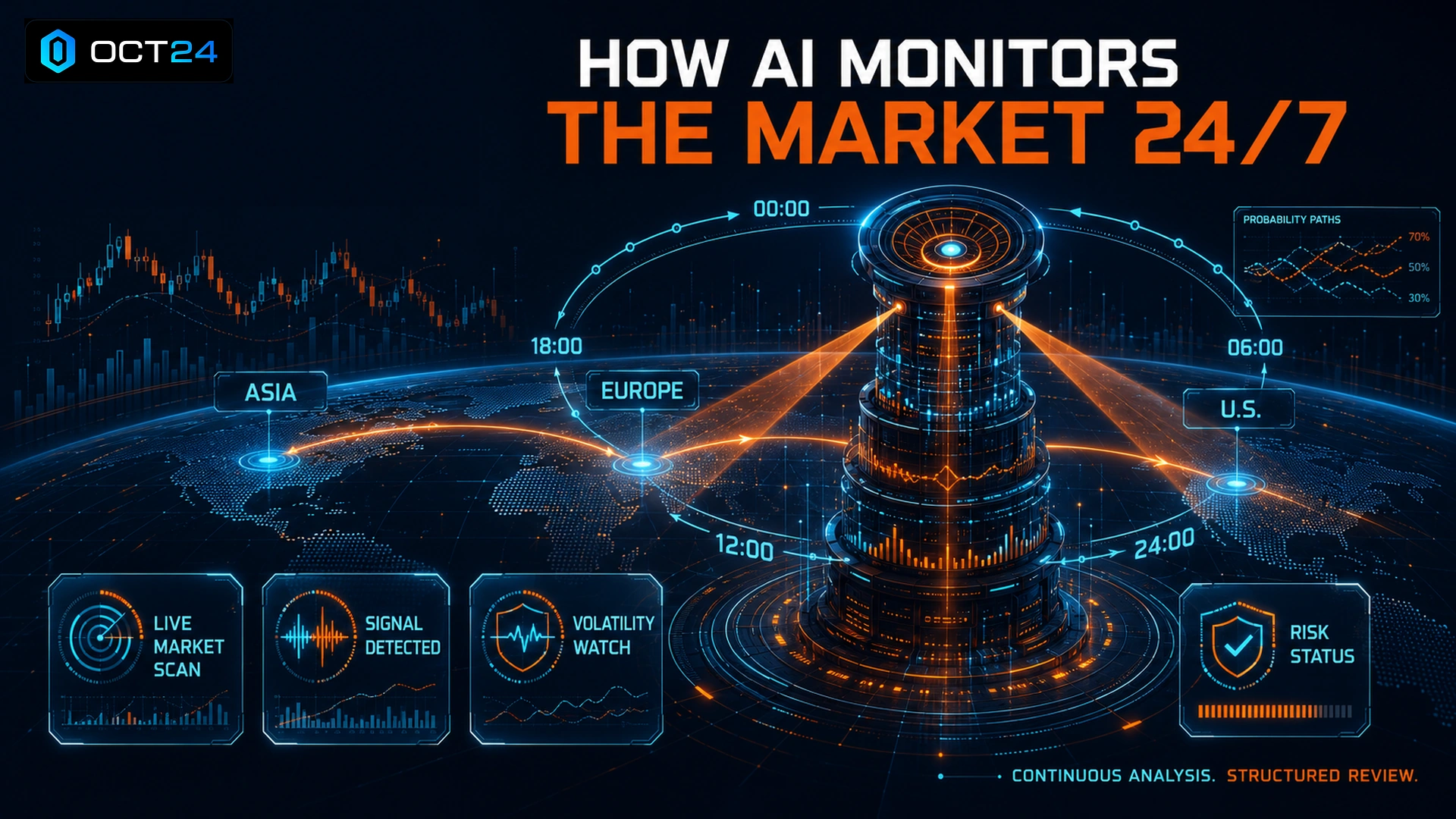
Unlike human traders, AI never needs to rest, sleep, or take breaks.
Instead, it continuously monitors markets throughout the day and night.
For cryptocurrency traders, this capability is especially valuable because digital asset markets operate 24 hours a day, seven days a week.
Rather than monitoring only one cryptocurrency, AI may simultaneously analyze dozens of markets while tracking:
- Live prices
- Trading volume
- Technical indicators
- Volatility
- Momentum
- Market structure
Multiple Markets
Many traders naturally focus on only a handful of assets.
AI, however, can evaluate Bitcoin, Ethereum, Solana, XRP, and numerous other cryptocurrencies simultaneously without becoming overwhelmed.
This wider market coverage increases the likelihood of identifying meaningful opportunities as they develop.
Multiple Timeframes
Successful market analysis often requires viewing more than one timeframe.
For example, a trader might examine:
- 5-minute charts
- 15-minute charts
- 1-hour charts
- 4-hour charts
- Daily charts
AI performs this analysis continuously, comparing trends across multiple timeframes much faster than most traders can manually.
Real-Time Updates
Markets change constantly.
As new information becomes available, AI immediately updates its analysis and reevaluates whether current market conditions continue to satisfy predefined trading criteria.
This continuous monitoring allows AI to respond far more quickly than someone manually reviewing charts throughout the day.
Many AI Trading Bots rely on this continuous market scanning as the foundation for identifying potential trading opportunities.
Step 2 — Pattern Recognition
Collecting market data is only the beginning.
The next step is identifying meaningful patterns within that information.
Pattern recognition is one of AI's most valuable capabilities because markets often display recurring behaviors before significant price movements occur.
Rather than searching randomly, AI evaluates whether current market conditions resemble historical situations that previously produced noteworthy outcomes.
Common examples include:
Support and Resistance
Support levels represent price areas where buying interest has historically increased.
Resistance levels represent areas where selling pressure has previously limited price advances.
AI continuously monitors whether prices are approaching, breaking, or rebounding from these important levels.
Chart Patterns
AI can identify familiar chart formations such as:
- Triangles
- Channels
- Double tops
- Double bottoms
- Flags
- Breakouts
Recognizing these formations helps traders understand changing market conditions more efficiently.
Trend Strength
Not every trend deserves attention.
AI evaluates whether a trend appears strong, weakening, or potentially reversing based on multiple technical measurements rather than relying on a single indicator.
Momentum
Momentum measures the speed of price movement.
Rapid changes in momentum often attract trader attention because they may signal increasing buying or selling pressure.
AI continuously compares momentum across different markets and timeframes.
Although AI excels at AI pattern recognition, identifying familiar market behavior never guarantees future price movements.
Markets remain influenced by economic events, investor psychology, regulation, and countless unpredictable factors.
This is why Algorithmic Trading systems typically combine multiple forms of analysis before considering a trading opportunity.
Step 3 — Opportunity Filtering
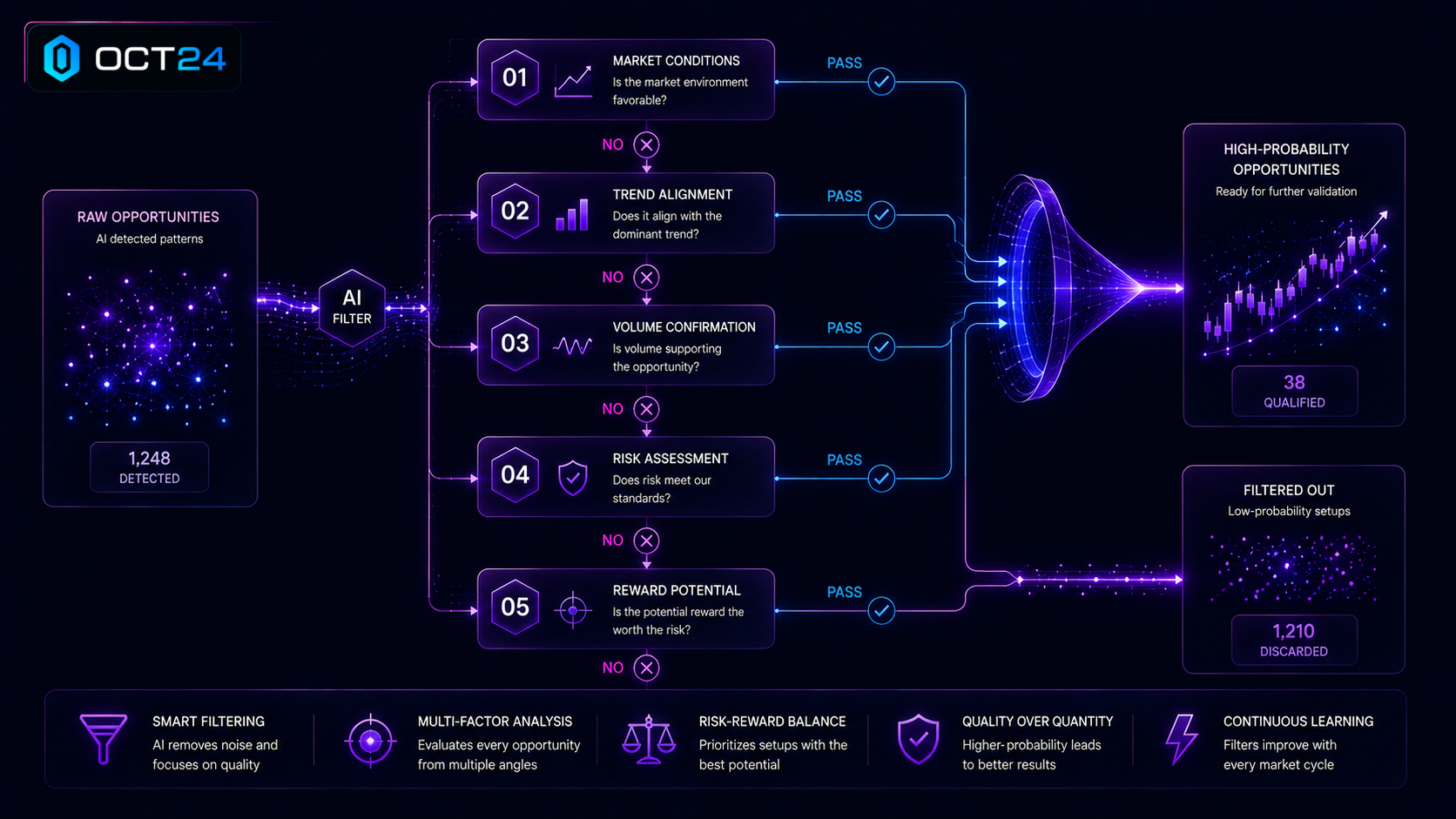
Once AI has identified numerous potential opportunities, the final step is filtering them.
Without filtering, traders would quickly become overwhelmed by an excessive number of signals.
Instead of presenting every possible setup, AI prioritizes opportunities that satisfy multiple predefined conditions.
Common filtering criteria include:
- Trend confirmation
- Indicator agreement
- Trading volume
- Market volatility
- Risk-to-reward potential
- Overall market conditions
Removing Weak Signals
Many market movements appear promising at first but fail to develop into meaningful opportunities.
AI eliminates many of these weaker signals before presenting opportunities to traders, reducing unnecessary distractions.
Ranking Opportunities
Not every opportunity carries the same level of confidence.
Some may satisfy only a few trading conditions, while others align with multiple indicators simultaneously.
Rather than treating every signal equally, AI ranks opportunities according to how closely they match predefined criteria.
Confidence Scoring
Some platforms also assign confidence scores based on the strength of supporting evidence.
These scores help traders prioritize which opportunities deserve closer review without suggesting that success is guaranteed.
Risk Evaluation
Before presenting a trading opportunity, AI may also evaluate whether market conditions satisfy basic risk requirements.
For example, opportunities with excessive volatility or unfavorable risk-to-reward characteristics may receive lower priority or be filtered out entirely.
As highlighted in our article on Benefits of AI Trading, AI is often most valuable when it reduces information overload, allowing traders to focus on fewer, higher-quality opportunities instead of reacting to every market movement.
Step 4 — Signal Validation
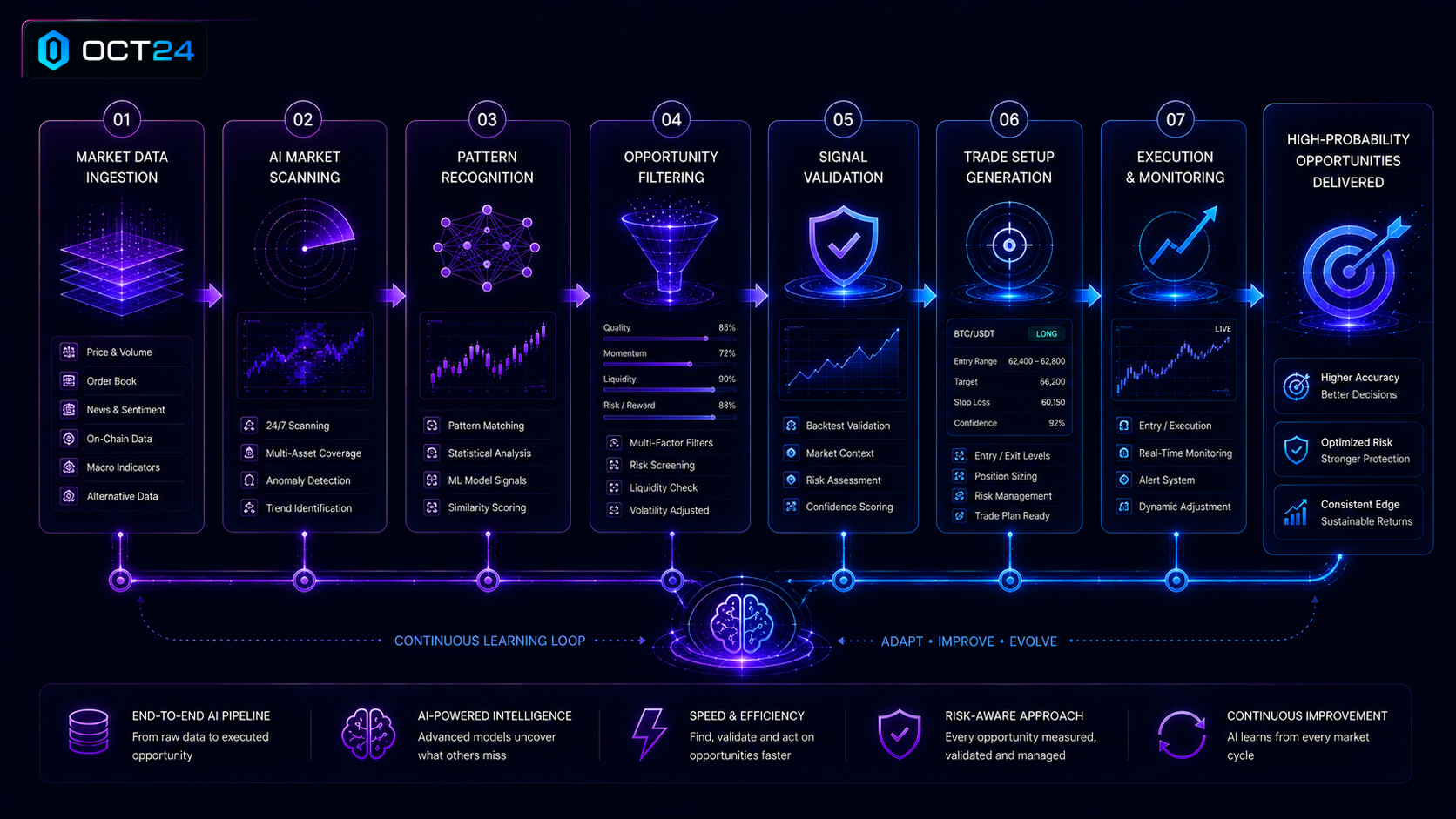
By this stage, AI has already scanned markets, recognized meaningful patterns, and filtered out weaker opportunities.
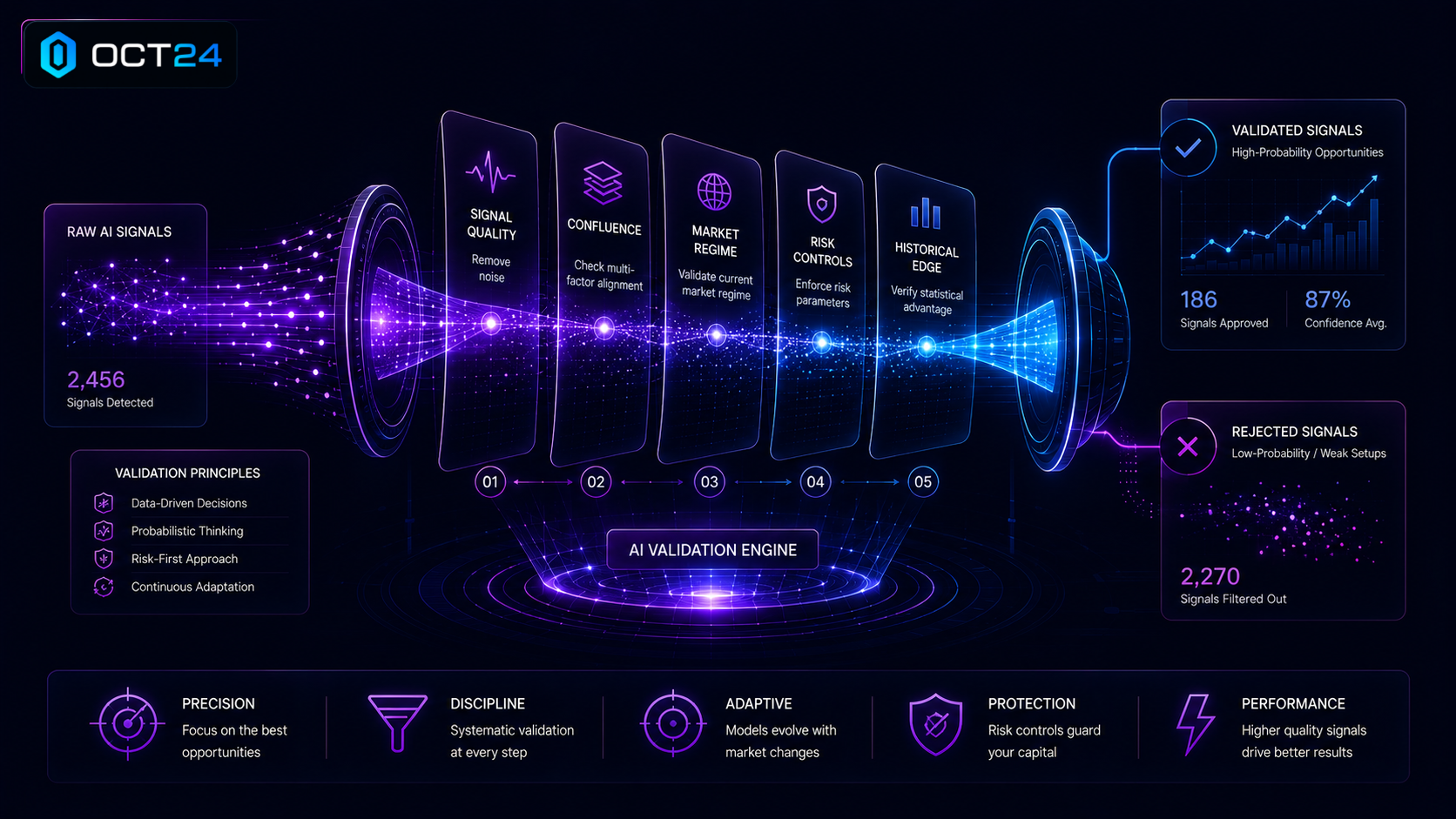
Before presenting a potential trade to the user, however, many AI trading platforms perform one more important step: signal validation.
Signal validation helps determine whether multiple pieces of evidence support the same trading opportunity. Rather than relying on a single indicator, AI looks for confirmation across several independent factors to improve the overall quality of potential trades.
Although multiple confirmations can increase confidence, they never guarantee a successful outcome. Financial markets remain unpredictable, and every trade still carries risk.
Multiple Confirmation Signals
Professional traders rarely make decisions based on a single chart indicator.
Instead, they look for several signals pointing in the same direction before considering a trade.
AI follows a similar principle by evaluating numerous data points simultaneously.
For example, a potential buying opportunity might require confirmation from:
- Trend direction
- Trading volume
- Momentum indicators
- Support or resistance levels
- Overall market conditions
When several independent signals align, the opportunity may be considered stronger than one based on a single indicator alone.
Trend Confirmation
One important validation step involves confirming the broader market trend.
Suppose a cryptocurrency experiences a short-term price increase.
Rather than assuming an upward trend has begun, AI examines larger timeframes to determine whether the broader market direction supports the move.
Trading opportunities that align with longer-term trends often receive greater confidence than those moving against the prevailing market direction.
Volume Confirmation
Trading volume provides valuable context for price movements.
For example, a breakout supported by increasing trading volume may indicate stronger market participation than one occurring on very low volume.
AI compares price action with volume to determine whether market activity supports the observed movement.
Risk-to-Reward Assessment
Not every technically valid opportunity offers an attractive level of risk.
Before presenting a trade, AI often estimates whether the potential reward justifies the amount of capital being placed at risk.
For example, if the potential downside is significantly larger than the expected upside, the opportunity may receive a lower ranking or be rejected altogether.
Confidence Scoring
Many AI trading platforms assign confidence scores to potential opportunities.
These scores summarize how closely current market conditions match predefined trading criteria.
Higher confidence scores do not predict success—they simply indicate that more supporting evidence has been identified.
Confidence scoring helps traders prioritize opportunities while remaining responsible for the final decision.
Step 5 — Trade Preparation
Once an opportunity has been validated, AI begins preparing the trade.
Preparation involves organizing the information traders need to evaluate a potential position before deciding whether to execute it.
Rather than automatically placing every trade, high-quality AI systems focus on presenting clear, structured recommendations.
Entry Levels
AI estimates price levels where market conditions may provide a suitable entry point.
These suggested entries are based on technical analysis, current market structure, and predefined trading logic.
Rather than chasing rapidly moving prices, traders can evaluate opportunities with clearly defined entry plans.
Stop-Loss Suggestions
Managing downside risk is an essential part of every trading strategy.
Many AI platforms suggest logical stop-loss levels based on recent support, resistance, volatility, or other market conditions.
These suggestions help traders define risk before entering a position rather than making emotional decisions after prices begin moving.
Profit Targets
AI may also identify reasonable profit objectives using historical market behavior, trend strength, or nearby resistance levels.
Having predefined exit targets encourages disciplined decision-making instead of relying entirely on emotions during live market conditions.
Position Sizing
Determining how much capital to allocate to each trade is just as important as deciding when to enter.
Tools such as Position Sizing Controls help traders maintain consistent risk exposure by sizing positions according to their individual risk tolerance and trading plan.
Risk Controls
Modern AI platforms often combine multiple safeguards before presenting a trade.
These may include:
- Volatility limits
- Maximum risk thresholds
- Risk-to-reward requirements
- Exposure limits
- Position size recommendations
Resources like Trading Bot Risk Management explain how these controls help support more disciplined trading without eliminating market risk.
Why Human Oversight Still Matters
Artificial intelligence is an incredibly powerful analytical tool, but it should never replace human judgment entirely.
Markets constantly evolve, and no AI system can anticipate every possible event.
Unexpected developments—including major economic announcements, geopolitical events, exchange outages, or regulatory decisions—can quickly change market conditions.
Changing Market Conditions
Financial markets rarely behave exactly as historical data suggests.
AI continuously adapts to changing information, but traders remain responsible for deciding whether current conditions still support a potential opportunity.
Unexpected News
Breaking news can dramatically alter market sentiment within minutes.
Although AI may rapidly incorporate new information into its analysis, experienced traders often consider additional context that extends beyond technical indicators alone.
Strategy Adjustments
Every trader has unique objectives and risk tolerance.
Some may prefer conservative opportunities, while others seek higher volatility.
Human oversight allows traders to adjust strategies as personal goals and market conditions evolve.
Trader Judgment
AI excels at processing data, but it cannot fully replace experience, intuition, or personal decision-making.
The strongest results often come from combining intelligent technology with thoughtful human judgment.
Developing analytical skills—such as learning How to Read Crypto Charts—helps traders better understand the opportunities AI identifies.
How OCT24 Identifies Trading Opportunities
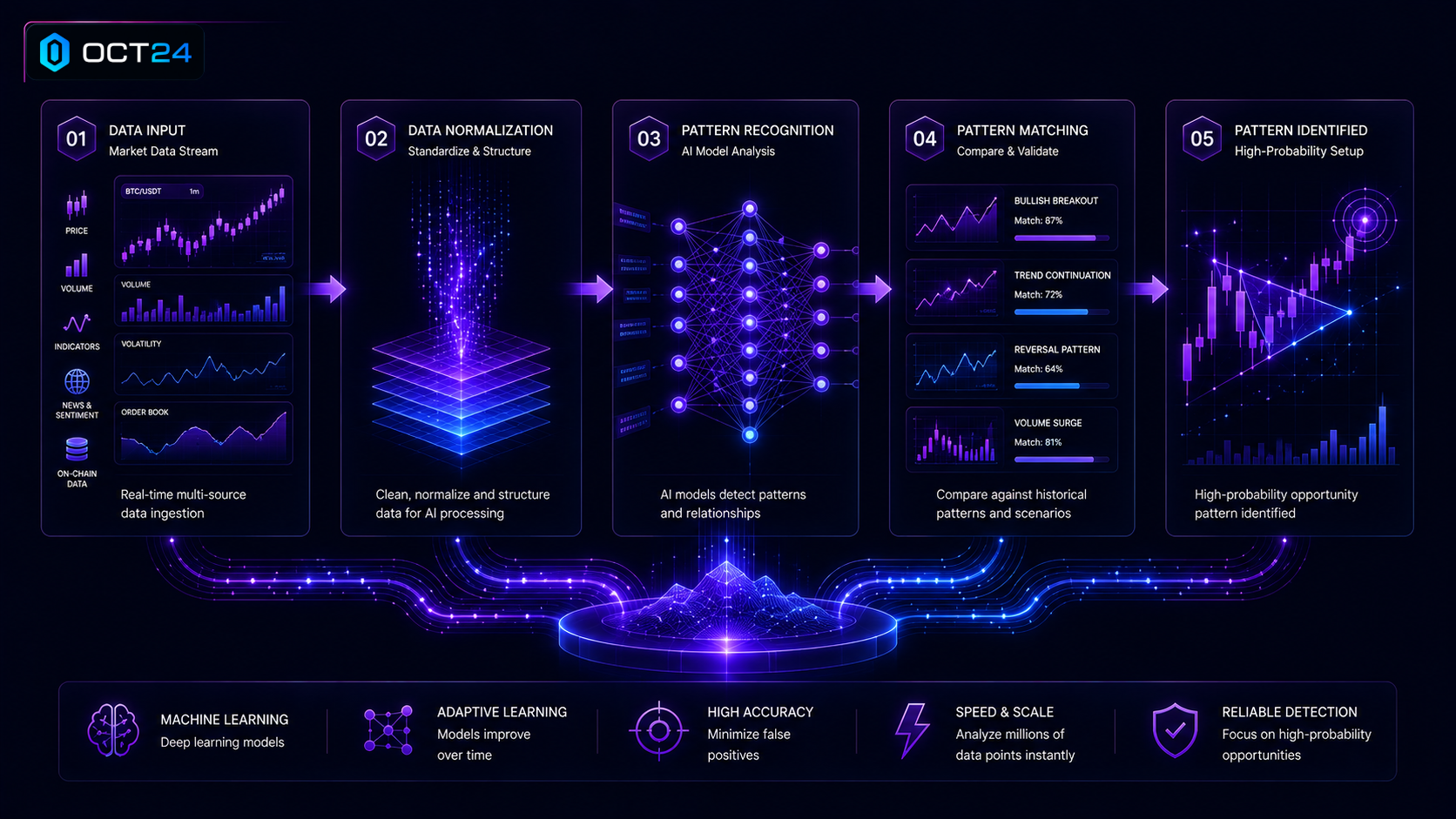
OCT24 combines artificial intelligence, technical analysis, and automated market monitoring to simplify the process of identifying potential trading opportunities.
At the center of the platform is the G6 Trading Bot.
The platform continuously:
- Monitors live cryptocurrency markets
- Performs AI-powered market analysis
- Detects technical patterns
- Applies algorithmic decision logic
- Evaluates potential risk
- Ranks opportunities based on predefined criteria
- Prepares structured trade ideas
- Supports one-click trade execution
Instead of requiring users to monitor charts throughout the day, analyze dozens of markets, build trading algorithms, or configure complex automation, OCT24 performs much of the analytical work automatically.
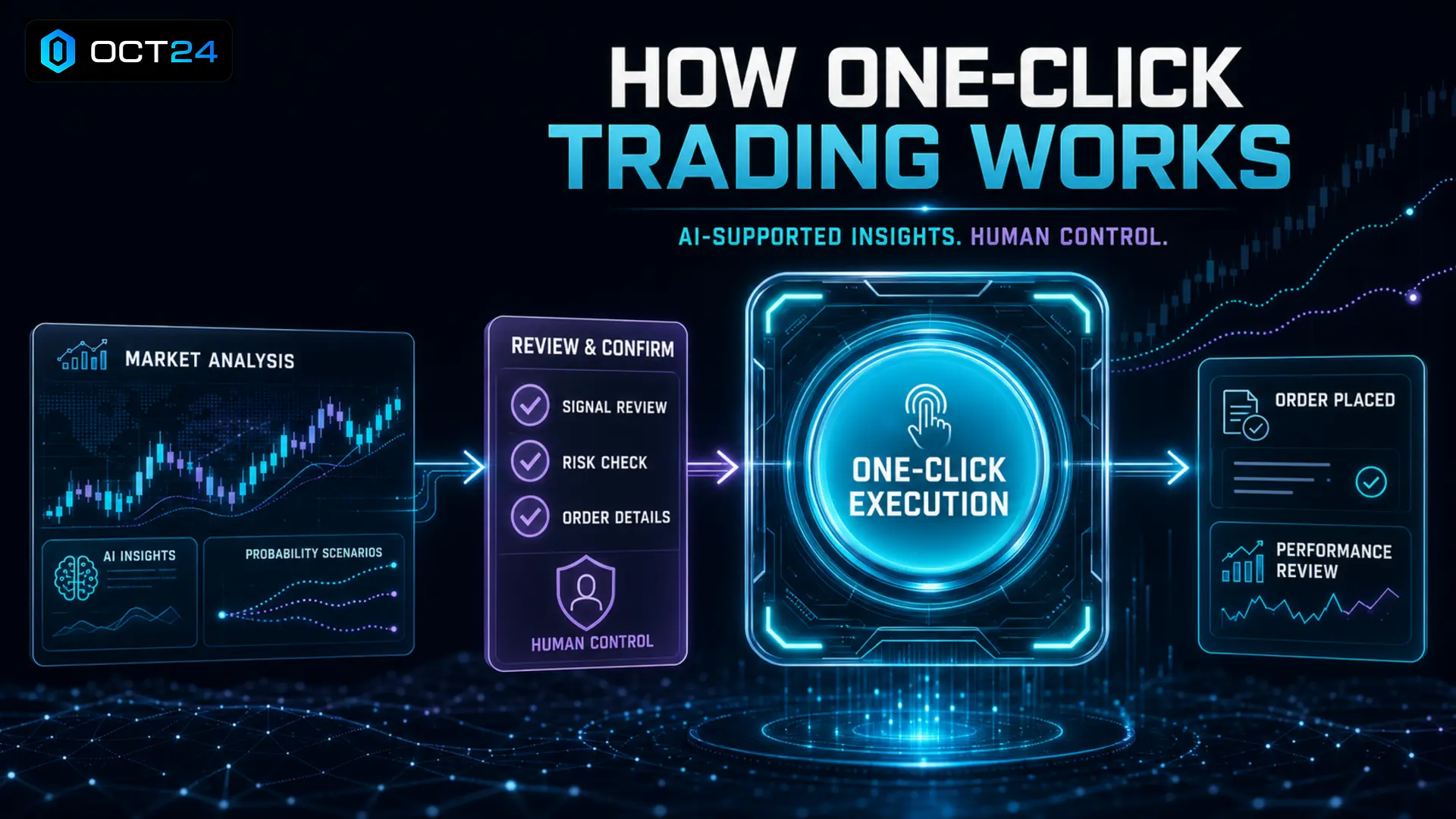
When market conditions satisfy predefined criteria, the platform presents reviewed trading opportunities through an intuitive interface. Users remain fully in control by reviewing each opportunity before deciding whether to execute the trade.
Additional features such as Portfolio Diversification Tools help traders manage exposure across multiple assets while maintaining a balanced approach to risk.
To learn more about the company's platform and mission, visit About OCT24.
Frequently Asked Questions
How does AI identify trading opportunities?
AI continuously scans market data, analyzes technical indicators, recognizes recurring patterns, validates multiple confirmation signals, and filters opportunities based on predefined trading criteria.
Does AI predict the market?
No. AI identifies probabilities based on available data and historical patterns, but it cannot predict future market movements with certainty.
What data does AI analyze?
AI commonly analyzes price action, trading volume, technical indicators, volatility, historical market behavior, and—in some cases—market sentiment.
Can AI detect chart patterns?
Yes. Many AI systems recognize chart formations such as triangles, channels, breakouts, and support and resistance levels much faster than manual analysis.
Does AI guarantee profitable trades?
No. AI improves analytical efficiency but cannot eliminate market uncertainty or guarantee profitable outcomes.
Why is human oversight important?
Human oversight allows traders to consider changing market conditions, unexpected news, personal risk tolerance, and broader market context before executing trades.
Can beginners use AI trading?
Yes. Many modern AI trading platforms simplify complex market analysis, making them accessible to traders with varying levels of experience while still encouraging informed decision-making.
How do I get started?
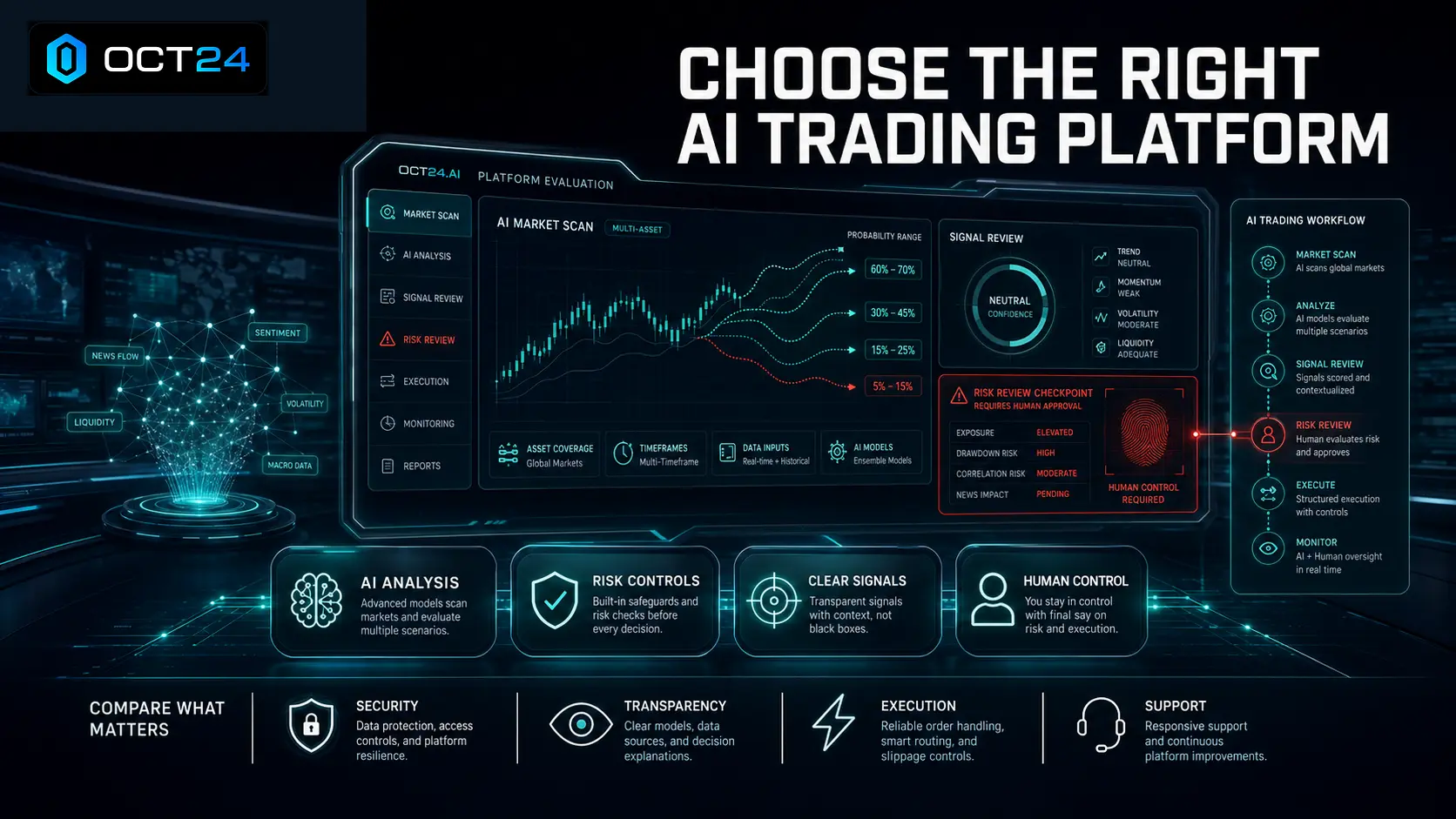
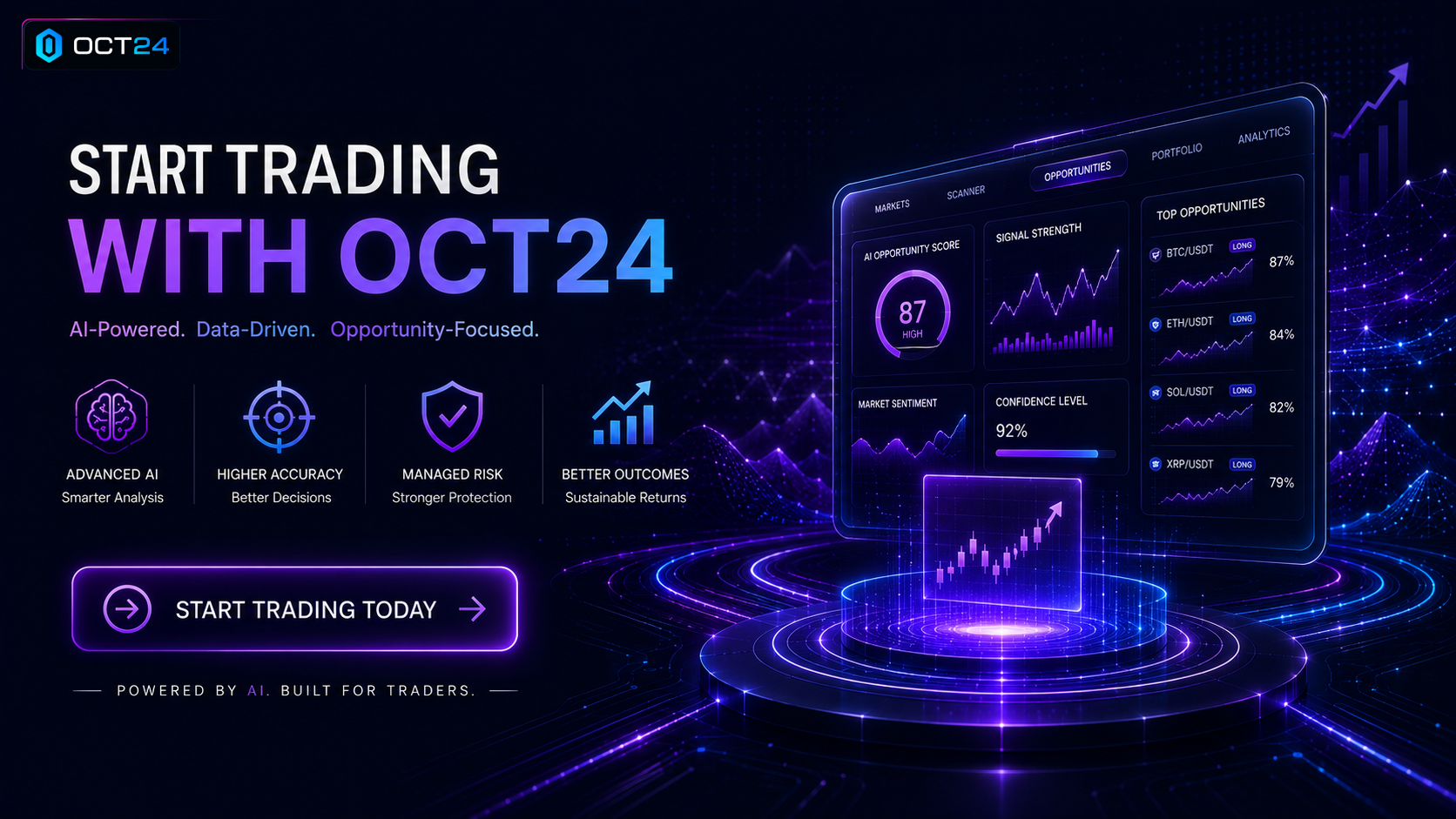
Begin by understanding how AI analyzes markets, developing sound risk management practices, and selecting a platform that provides transparent analysis while keeping you in control. When you're ready, you can Start Trading with OCT24.
Final Summary
Identifying a trading opportunity involves far more than spotting a single chart pattern.
Modern AI systems continuously scan markets, analyze multiple sources of information, recognize recurring patterns, filter weaker signals, validate opportunities using several confirmation factors, and prepare structured trade ideas for human review.
This process enables traders to evaluate higher-quality opportunities more efficiently while reducing much of the repetitive analysis involved in active trading.
However, AI remains a decision-support tool—not a substitute for sound judgment. Successful trading still depends on disciplined risk management, continuous learning, and thoughtful decision-making. When combined with human oversight, AI can help traders navigate increasingly complex markets with greater confidence and efficiency.