
Are Trading Bots Worth It?
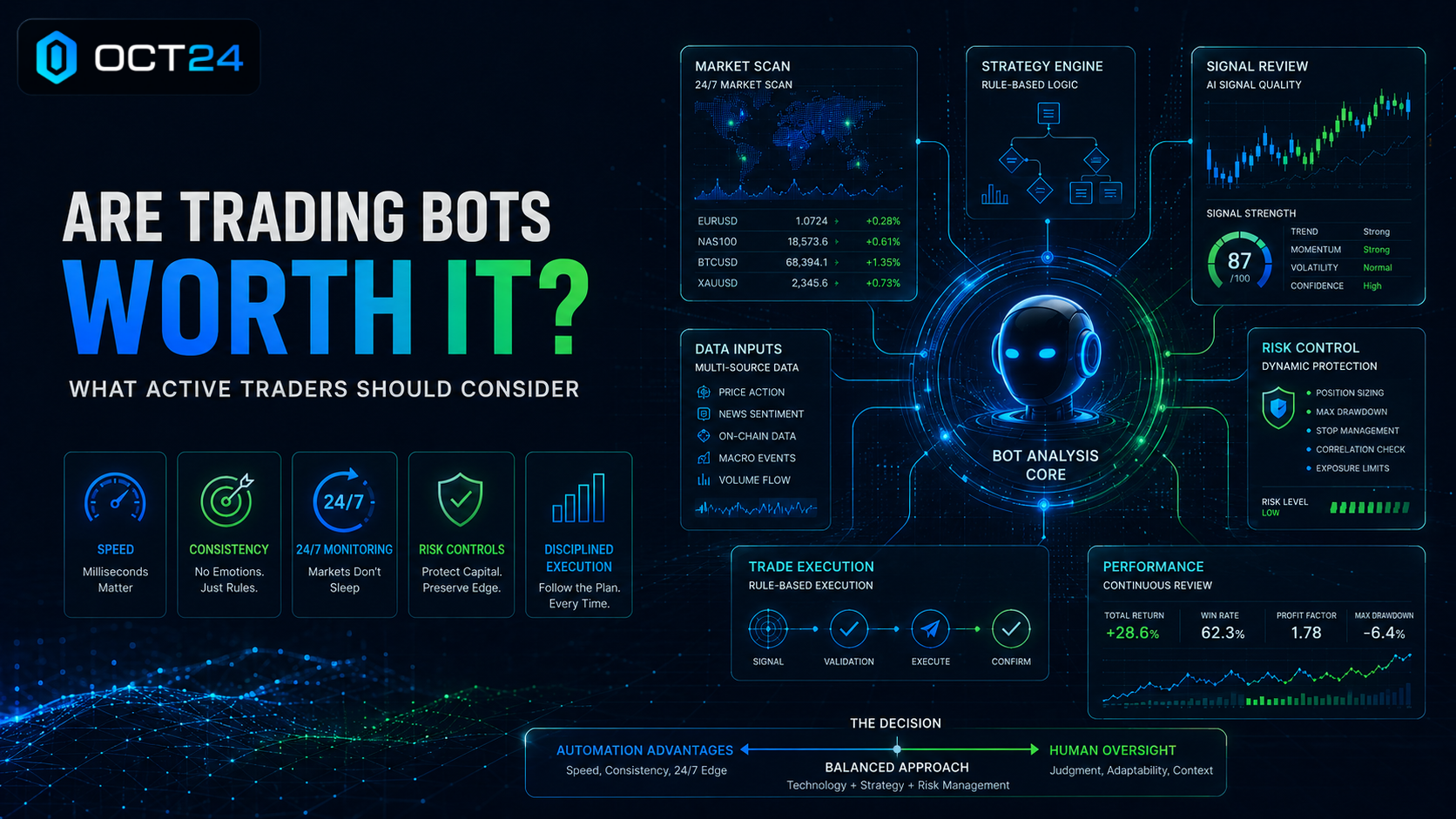
Trading Bots can be worth it when they help traders save time, follow a clear strategy, manage risk, and make more consistent decisions. But they are not magic profit machines. A trading bot can support analysis and execution, but it cannot remove market uncertainty, guarantee results, or replace responsible decision-making.
For beginner and intermediate traders, the better question is not simply, “Do trading bots make money?” A more useful question is, “Can a trading bot improve my trading process?”
That distinction matters. A trader who uses a bot without a plan may still overtrade, ignore risk, or react emotionally to losses. A trader who uses automation within a clear framework may benefit from faster analysis, more consistent execution, and better discipline.
Platforms like OCT24 are designed around this more practical view of automation. OCT24 uses AI to scan markets, analyze conditions, and surface potential opportunities.
This article explains what makes trading bots valuable, why traders use them, and how to think about their real benefits before deciding whether an AI trading bot fits your goals.
What Does It Mean for a Trading Bot to Be “Worth It”?
A trading bot is “worth it” if it improves the way you trade. That does not always mean it produces immediate profits. It may mean it helps you save time, reduce emotional decisions, follow rules more consistently, or identify opportunities faster than manual chart watching.
This is important because many traders judge bots too narrowly. They ask whether a bot can win every trade or produce guaranteed returns. That is the wrong standard.
No trading tool can guarantee profits. Markets move because of liquidity, volatility, news, sentiment, macroeconomic events, and trader behavior. Even strong strategies can experience losses.
A better way to evaluate trading bot value is to ask whether the bot improves the quality of your process.
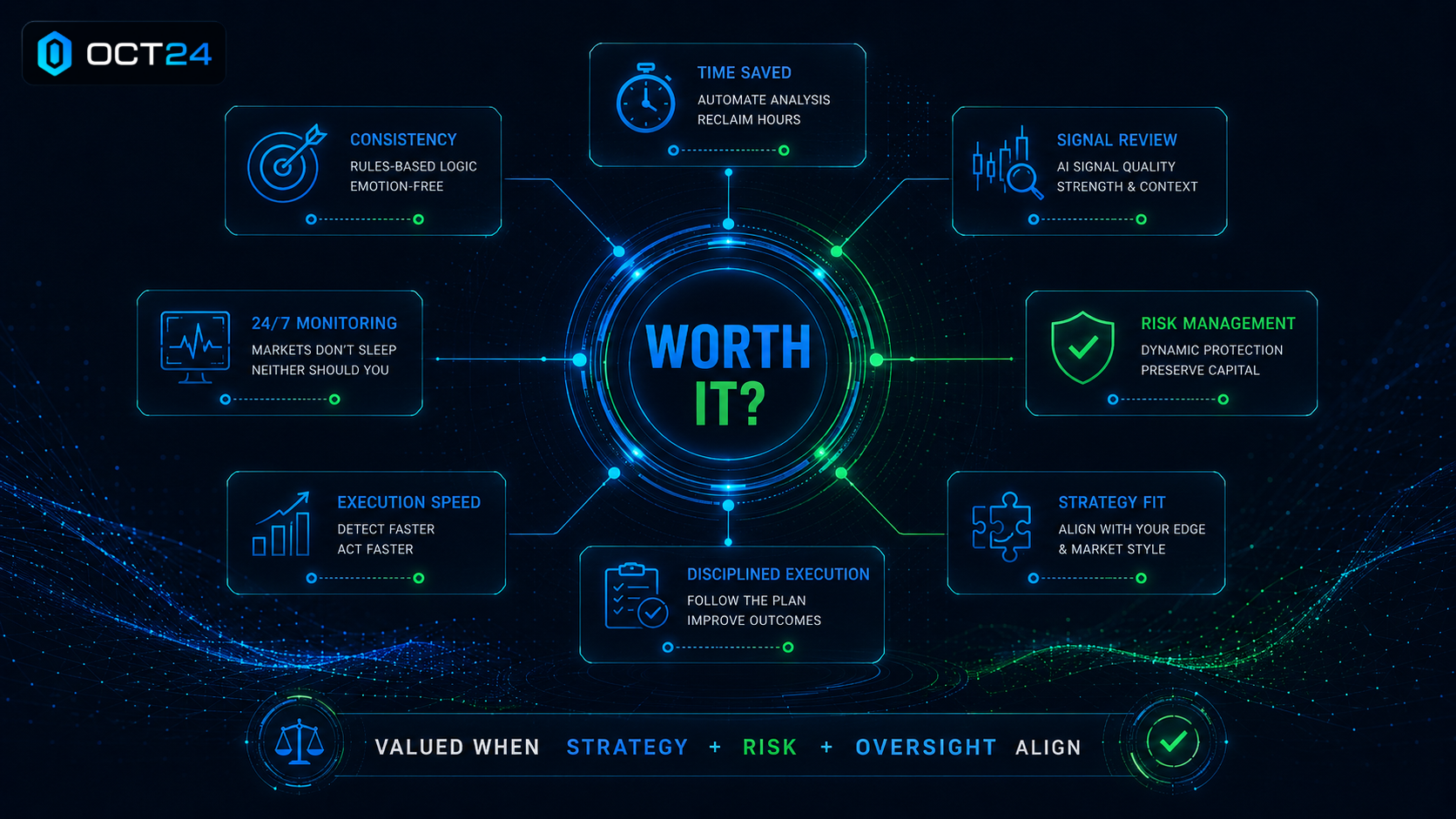
A trading bot may be worth it if it helps with:
- Saving time
- Reducing manual chart watching
- Following rules more consistently
- Reviewing signals faster
- Supporting risk management
- Avoiding emotional decisions
- Monitoring multiple assets
- Learning how structured trading works
- Executing a defined strategy more efficiently
For example, a trader who manually checks ten crypto charts every hour may miss signals, rush decisions, or become emotionally tired. A bot can help scan those markets continuously and flag setups that match predefined conditions. The trader still needs to review the setup, but the monitoring burden is reduced.
That is where AI Trading Software can be helpful. Good software should not simply push traders into more trades. It should help organize information, evaluate signals, and support a more disciplined workflow.
OCT24 performs much of the analysis by organizing market data, identifying signals, and presenting risk-aware trade opportunities.
“Worth It” Depends on Your Trading Goals
A trading bot may be useful for one trader and unnecessary for another.
If your goal is to actively monitor short-term crypto opportunities, automation may be valuable. Crypto markets operate 24/7, and it is difficult for one person to watch every chart, indicator, and price move manually.
If your goal is to learn slowly and place only occasional trades, a bot may still help with analysis, but full automation may not be necessary.
For active traders, Automated Trading can support speed and consistency. But automation only helps when the trader has a strategy, risk limits, and realistic expectations.
A bot should fit the trader’s plan. The trader should not build their entire plan around a bot they do not understand.
Why Traders Use Trading Bots
Traders use trading bots because markets move quickly, opportunities can appear at any time, and emotional decision-making can damage consistency. Bots can scan data, monitor assets, and follow rules faster than most traders can manually.
This does not mean bots are always better than humans. It means they can be useful for specific tasks.
A human trader may be better at interpreting context, understanding goals, and making judgment-based decisions. A bot may be better at monitoring repetitive conditions, processing large amounts of data, and executing predefined rules without hesitation.
That is why many traders use bots as part of a broader process rather than as a complete replacement for decision-making.
Markets Move Quickly
Active trading often depends on timing. A breakout, pullback, reversal, or volatility shift can happen quickly. If a trader is not watching the right chart at the right time, they may miss the setup.
This is especially true in crypto markets, where price action can change rapidly across multiple assets.
A bot can monitor conditions continuously. It can scan charts, indicators, and market data without getting tired or distracted. This can help traders identify opportunities faster.
OCT24 supports this type of AI-powered monitoring by helping traders review market activity in a more organized way. Instead of manually searching for every potential setup, traders can use AI-assisted tools to focus attention on opportunities that deserve closer review.
Crypto Markets Operate 24/7
Unlike traditional markets, crypto does not close at the end of the trading day. Bitcoin, Ethereum, and other digital assets can move overnight, on weekends, and during global market events.
This creates both opportunity and stress.
A trader cannot realistically monitor the market every hour of every day. Trying to do so can lead to fatigue, poor decisions, and emotional trading.
Crypto trading bots can help by watching markets continuously. They can alert traders to conditions that match a strategy or, depending on the setup, assist with execution.
However, 24/7 monitoring does not mean 24/7 trading. A bot may identify many potential signals, but a disciplined trader still needs rules for which setups are worth acting on.
Manual Monitoring Is Difficult
Manual chart watching takes time and attention. A trader may need to check price action, support and resistance, volume, indicators, volatility, and broader market conditions.
That is manageable for one or two assets. It becomes harder across many assets and timeframes.
A bot can reduce this workload by scanning multiple markets simultaneously. This is one of the practical Benefits of AI Trading: AI can process more information than a human trader can review manually in the same amount of time.
For example, if a trader is looking for momentum setups across several crypto pairs, a bot can help identify which pairs are showing stronger movement, rising volume, or improving technical conditions.
OCT24 does much of the scanning and analysis, so traders do not need to manually review every chart.

Emotions Can Interfere With Decisions
One of the biggest challenges in active trading is emotional control. Traders may hesitate after losses, chase entries because of fear of missing out, or increase position sizes after a few winning trades.
Bots do not experience fear, greed, excitement, or frustration. They follow rules.
That can be useful when the rules are well-designed. If a trader has a clear strategy, automation can help reduce impulsive behavior.
However, a bot cannot fix a poor strategy. If the trader gives the bot weak rules, excessive risk settings, or unclear instructions, the bot may simply execute bad decisions faster.
This is why Common AI Trading Mistakes to Avoid still matter when using bots. Automation can support discipline, but it does not create discipline on its own.
Bots Can Follow Rules Consistently
Consistency is one of the main reasons traders use automated trading bots. A bot can apply the same logic repeatedly without becoming impatient or distracted.
For example, a trader may define a strategy that requires:
- Price to be above a moving average
- Volume to be above average
- Momentum to be improving
- Risk-to-reward to meet a minimum threshold
- Position size to stay within a defined limit
A bot can help monitor these conditions consistently. It does not skip steps because it is bored. It does not enter early because it feels excited. It does not ignore the plan after a loss.
This is where Algorithmic Trading principles become useful. A rule-based system can bring more structure to trading decisions. But traders still need to understand what the rules are and whether they make sense in current market conditions.
Bots Can Help Identify Opportunities Faster
Trading bots can scan multiple markets and detect potential opportunities based on predefined criteria. This can include price movement, volume changes, technical indicators, volatility, and market structure.
This connects naturally to How AI Identifies Trading Opportunities. AI-powered systems can review technical and market data quickly, then surface setups that may deserve attention.
For example, a bot may identify that a crypto asset is approaching a breakout zone, volume is increasing, and momentum indicators are improving. That does not mean the trade is automatically worth taking, but it gives the trader a setup to evaluate.
OCT24 reduces the manual analysis burden by continuously scanning market conditions.
Key Benefits of Trading Bots
The main trading bot benefits are speed, consistency, 24/7 monitoring, reduced emotional decision-making, efficient data analysis, structured execution, risk control support, and time savings. These benefits can be valuable, but they still require oversight.
A trading bot is most useful when it supports a trader’s process. It is least useful when it encourages blind automation.
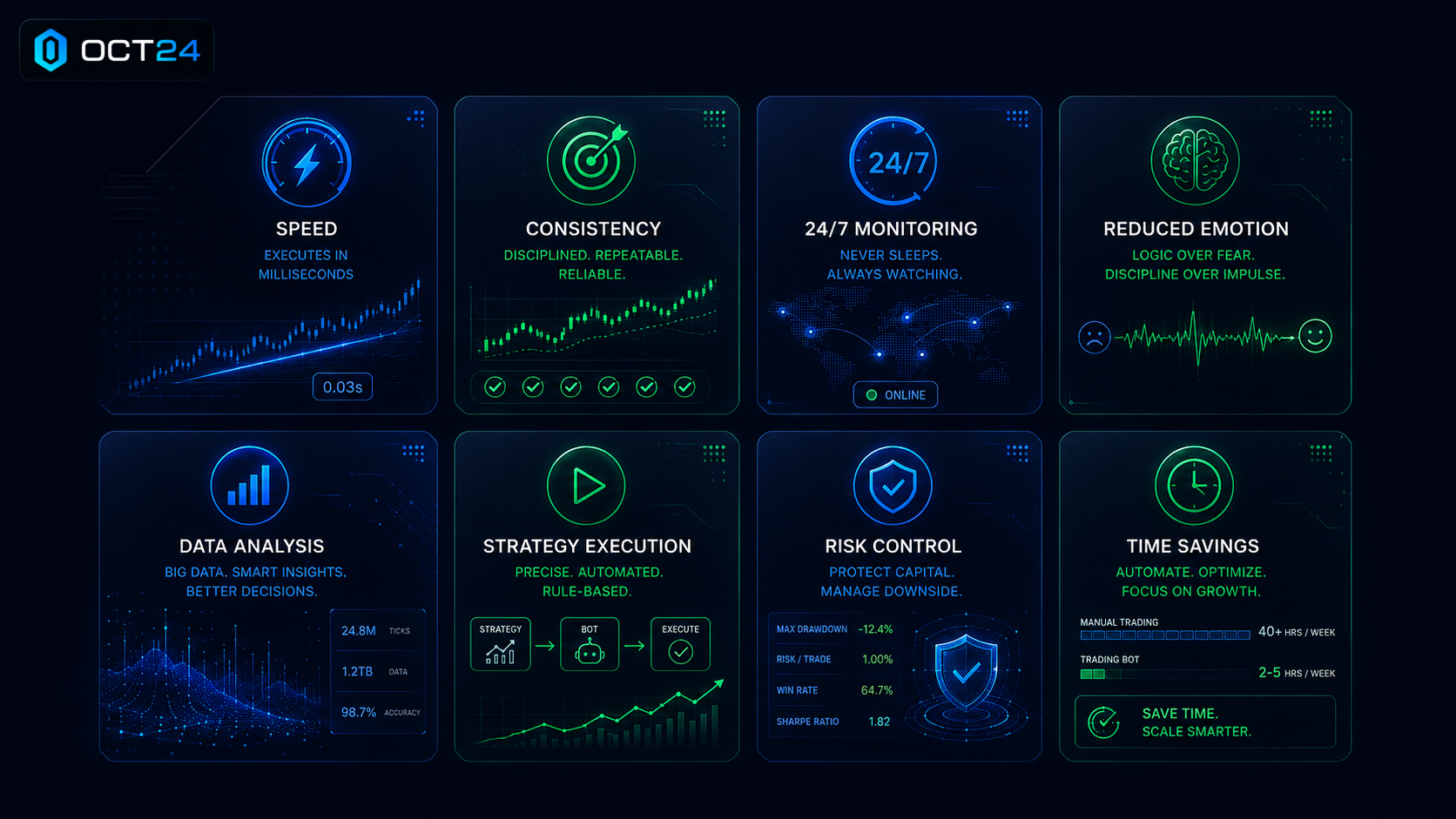
1. Speed
Speed is one of the clearest advantages of trading bots. Bots can process information, scan markets, and respond to predefined conditions faster than humans.
In active trading, speed can matter. A trader who waits too long may miss an entry, enter after the move has already happened, or react emotionally after price changes.
A bot can help by identifying signals quickly. For example, if price breaks above resistance while volume increases, a bot may detect that condition immediately.
However, faster does not always mean better. A fast bad decision is still a bad decision. Speed only becomes useful when it is connected to a clear strategy and risk plan.
OCT24’s AI-powered environment is designed to support faster analysis while still encouraging traders to review risk, signal quality, and strategy fit.
2. Consistency
Consistency is another major benefit. Human traders can be inconsistent because emotions, fatigue, and distractions affect decisions.
A bot applies the same rules the same way each time.
If your strategy requires confirmation before entering, the bot can help enforce that confirmation. If your plan limits trade frequency, the bot can support that rule. If your process requires risk checks, automation can help keep those checks visible.
This does not mean every result will be positive. It means the process may become more repeatable.
For beginner and intermediate traders, consistency can be more valuable than complexity. A simple strategy followed consistently is often more useful than a complicated system applied randomly.
3. 24/7 Market Monitoring
Crypto traders often value bots because the market never sleeps. Price can move while a trader is working, sleeping, traveling, or focusing on other responsibilities.
A bot can monitor conditions during those periods. It can track assets, watch technical levels, and identify potential setups.
This can be especially useful for traders who cannot sit in front of charts all day.
Still, 24/7 monitoring should not become 24/7 risk-taking. A trader should define when the bot should act, when it should only alert, and when no trade should be taken.
OCT24 helps traders approach automation with more structure by supporting workflows that combine monitoring, review, and risk awareness.
4. Reduced Emotional Trading
Trading bots can help reduce emotional decision-making because they follow predefined logic. They do not chase candles, panic after losses, or become overconfident after wins.
This can be helpful for traders who struggle with hesitation, FOMO, or impulsive entries.
For example, a trader may emotionally want to enter a trade after a sudden price spike. A bot can help enforce rules that require confirmation first, such as volume support, trend alignment, or a valid setup.
However, traders can still make emotional decisions when configuring the bot. They may increase risk after a winning streak or change settings after a loss. The bot may be emotionless, but the user is not.
That is why trading discipline still matters.
5. Efficient Data Analysis
Bots can analyze large amounts of data quickly. This may include price action, volume, volatility, indicators, support and resistance, and market trends.
This connects to How AI Uses Technical Analysis. AI can evaluate multiple technical factors at once, helping traders understand whether a setup has stronger or weaker confirmation.
For example, a bot may compare RSI, moving averages, MACD, volume, and price structure. Instead of making the trader manually check each condition, the bot can organize the data into a clearer view.
OCT24 analyzes price action, volume, volatility, indicators, and market structure to help identify potential setups.
6. Strategy Execution
A trading bot can help execute a strategy more consistently. This is useful when the trader already knows what rules they want to follow.
For example, a trader using AI Trading Strategies may define conditions for trend following, breakout trading, or momentum trading. A bot can help monitor those conditions and support execution when they appear.
The key is that the strategy comes first.
OCT24 can analyze and surface opportunities while the trader defines goals, risk limits, and execution preferences.
7. Risk Control Support
Trading bots can support risk control when they include settings for position size, stop-losses, exposure limits, and trade frequency.
This is where Trading Bot Risk Management becomes important. A bot should not only help identify entries. It should also help traders think about exits, risk per trade, drawdown limits, and account exposure.
For example, a bot may help prevent oversized positions by applying position sizing rules. It may also help avoid repeated entries after losses if trade frequency limits are in place.
OCT24’s risk-aware workflow supports this broader view. The value of automation is not just speed. It is the ability to combine analysis, execution, and risk controls into a more disciplined process.
8. Time Savings
One of the most practical benefits of trading bots is time savings.
Many traders do not have the time to monitor charts constantly. They may have jobs, businesses, families, or other responsibilities. A bot can help reduce the amount of manual work involved in scanning markets and reviewing conditions.
This does not mean trading becomes effortless. Traders still need to review performance, update strategy logic when necessary, and understand market risk.
But a good bot can make the process more manageable.
For example, instead of manually checking twenty charts, a trader may use OCT24 to surface relevant opportunities, review signal quality, and decide whether a setup fits their plan.
Practical Takeaway
Trading bots can be worth it when they improve the trading process. They can help with speed, consistency, monitoring, emotional discipline, data analysis, strategy execution, risk control, and time savings.
But trading bots are not worth it if they are used as shortcuts.
A bot should help traders become more structured, not more reckless. It should support decisions, not replace judgment. It should make risk easier to manage, not easier to ignore.
For traders using OCT24, the goal is to combine AI-powered automation with responsible trading habits. That means reviewing signals carefully, understanding risk, using tools like the G6 Trading Bot within a defined plan, and remembering that no automation removes the uncertainty of the market.
OCT24 handles much of the market analysis and signal discovery, while traders remain responsible for risk settings and responsible use.
The Main Risks of Trading Bots
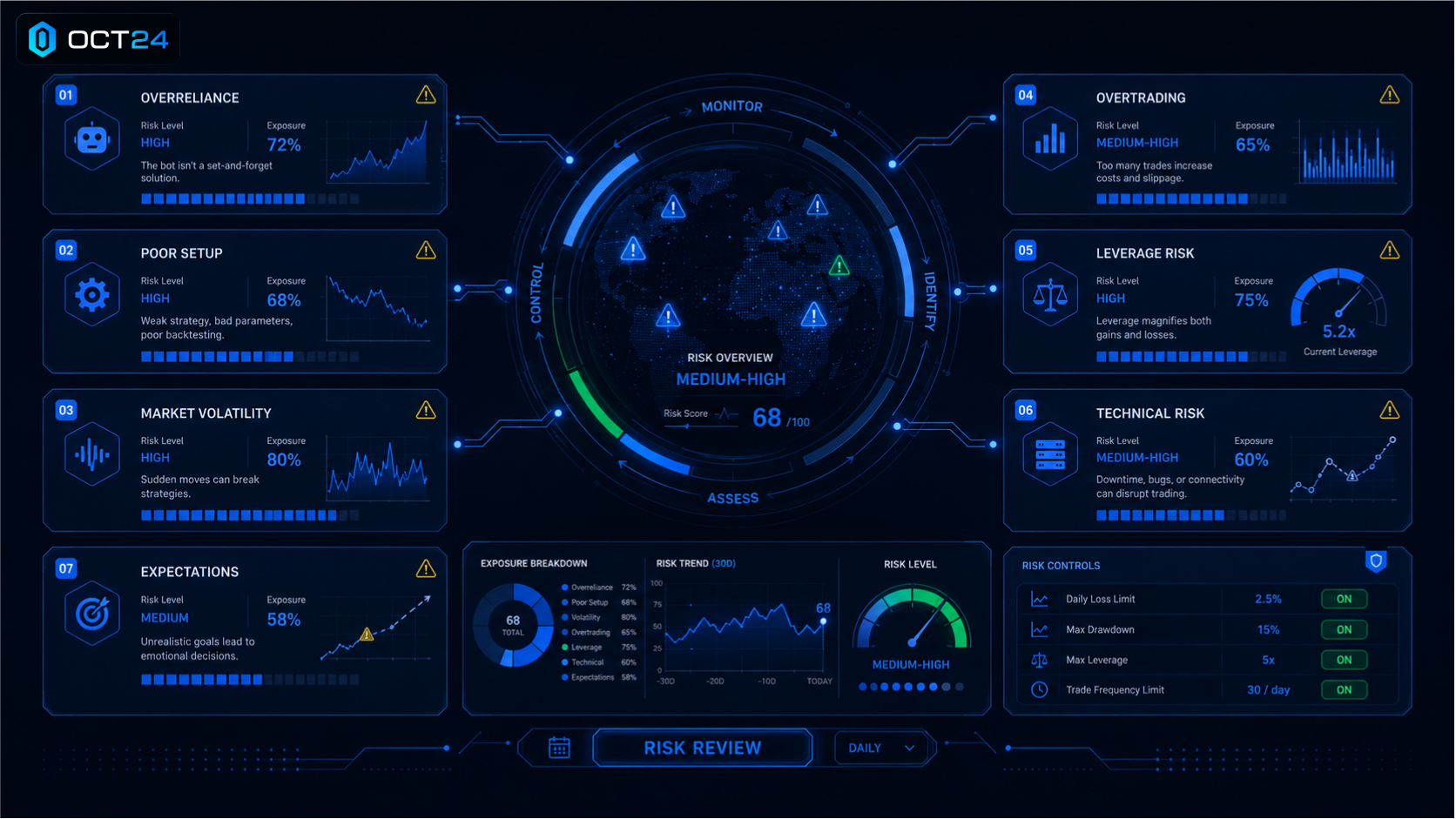
Trading bots can be useful, but they also carry risks. The biggest trading bot risks usually appear when traders treat automation as a shortcut instead of a tool that needs strategy, oversight, and risk management.
A bot can scan markets quickly, follow rules consistently, and support faster execution. But it cannot know a trader’s financial situation, emotional tolerance, or long-term goals. It also cannot remove uncertainty from the market.
This is why OCT24 encourages a structured approach to automation. AI-powered tools should support better decision-making, not replace judgment entirely.
Overreliance on Automation
One of the most common risks is relying too heavily on the bot. A trader may assume that because a system is automated, every signal must be reliable.
That is not how trading works.
Even advanced AI Trading Bots still operate in uncertain markets. They analyze data, identify patterns, and follow programmed logic, but they do not guarantee correct outcomes. A signal may look strong, then fail because of sudden volatility, weak liquidity, or unexpected news.
A responsible trader should still review market conditions, understand risk, and know when not to trade.
Poor Strategy Setup
A bot is only as useful as the strategy behind it. If the rules are unclear, too aggressive, or poorly matched to market conditions, the bot may produce weak results.
For example, a trader may use a momentum strategy during a sideways market. The bot may continue identifying signals, but those signals may fail because the environment does not support the strategy.
This is why AI Trading Strategies should come before automation. The trader needs to understand what the bot is trying to do, when it should act, and when it should stay out of the market.
Ignoring Risk Management
Risk management is one of the most important parts of using automated trading bots. A bot that enters trades without clear stop-loss rules, position sizing, leverage limits, or drawdown controls can create serious problems.
Automation can make trading faster. That also means mistakes can happen faster.
A poorly managed bot may open too many positions, increase exposure too quickly, or continue trading during unfavorable conditions. This is why Trading Bot Risk Management should be part of every bot evaluation.
Traders should define risk before the bot is active, not after losses occur.
Market Volatility
Market volatility can affect any trading system. A strategy that works in calm conditions may struggle when price moves sharply.
During volatile periods, spreads can widen, stop-losses can trigger quickly, and price can move through technical levels before reversing. A bot may act on signals that were valid seconds earlier but become weaker as conditions change.
This does not mean bots are useless during volatility. It means traders need rules for volatility. They may reduce position size, require stronger confirmation, or pause certain strategies during extreme conditions.
Technical Failures
Trading bots rely on technology. That means they can be affected by connection issues, exchange problems, software bugs, API delays, or incorrect settings.
Even if the strategy is strong, technical problems can still interfere with execution.
Traders should understand how their tools work, how orders are placed, and what controls exist if something goes wrong. A responsible AI trading software environment should make settings, controls, and performance review easy to understand.
Overtrading
Bots can make trading feel effortless. That can tempt beginners to run too many strategies, monitor too many assets, or take too many signals.
Overtrading can increase fees, create unnecessary risk, and make performance harder to evaluate.
This is one of the Common AI Trading Mistakes to Avoid. More activity does not always mean better trading. In many cases, the best bot setup is the one that filters opportunities carefully instead of chasing every possible move.
Using Too Much Leverage
Leverage can magnify gains, but it also magnifies losses. When combined with automation, excessive leverage can be especially risky.
A bot may identify a trade setup correctly, but if the position size is too large or leverage is too high, a small unfavorable move can cause major damage.
Trading bots do not make leverage safe. Traders still need clear rules for exposure, margin, and maximum acceptable loss.
Unrealistic Expectations
Many beginners approach bots with unrealistic expectations. They expect passive income, constant wins, or guaranteed performance.
That mindset is dangerous.
Trading bots can support speed, structure, consistency, and analysis. They cannot guarantee profits. They cannot make every trade successful. They cannot remove the need for education, risk management, and performance review.
The most useful way to think about trading bots is simple: they are tools for improving the trading process, not shortcuts around the process.
When Trading Bots May Be Worth It
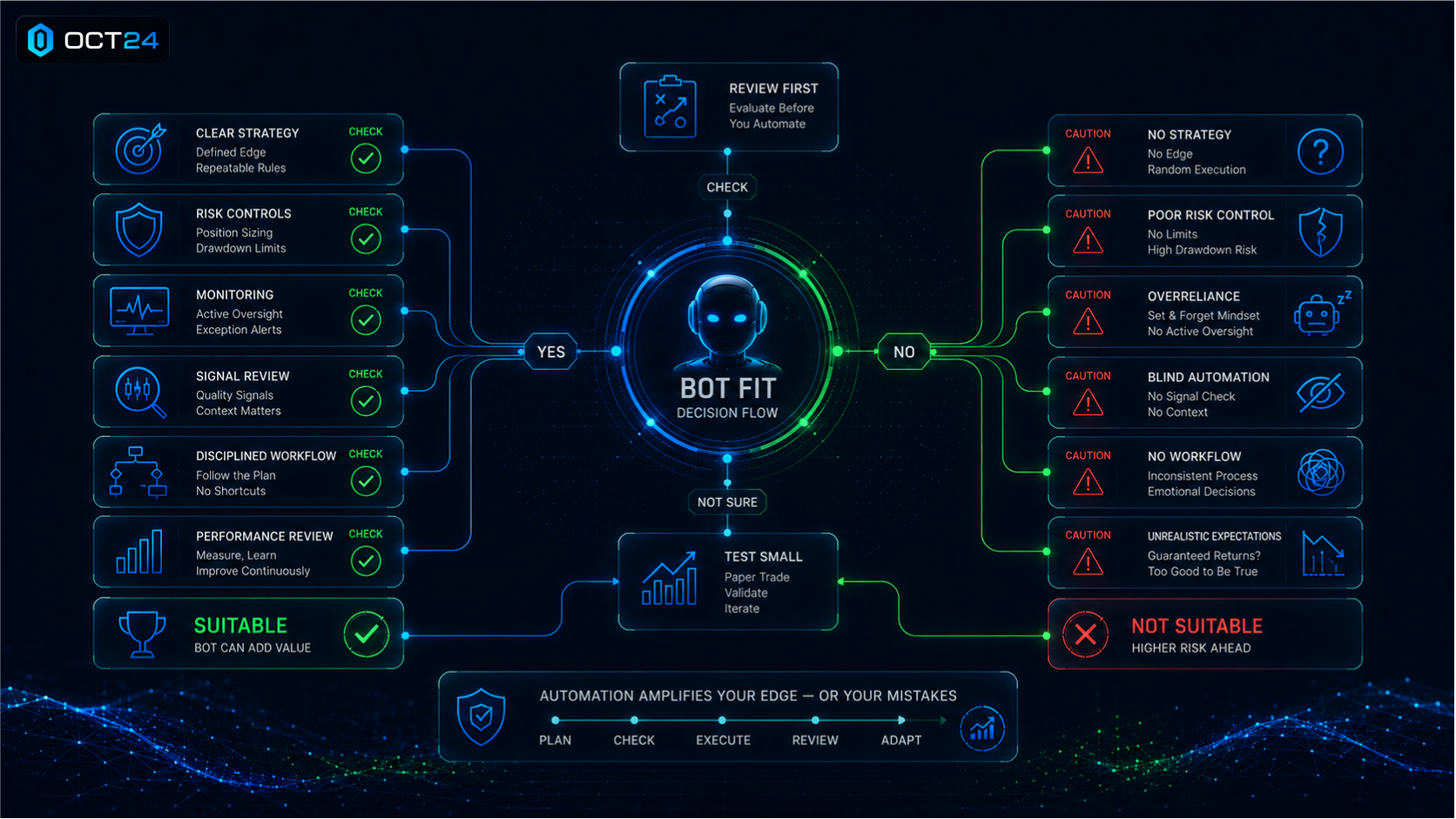
Trading bots may be worth it when they support a clear strategy, defined risk controls, consistent execution, and regular performance review. They are most valuable when they help a trader become more disciplined, not more impulsive.
A bot may make sense if the trader understands what role it plays.
The Trader Has a Clear Strategy
A bot works best when it is connected to a defined strategy. That strategy might focus on momentum, breakouts, trend following, or technical setups.
For example, a trader may want to trade short-term crypto momentum. Instead of manually checking many charts, the bot can scan for assets with rising volume, improving momentum, and strong price movement.
This connects to How AI Identifies Trading Opportunities. AI can help surface possible setups, but the trader still needs rules for confirming, rejecting, or managing those setups.
The Trader Understands the Bot’s Role
A trading bot should have a clear job.
Is it scanning markets? Generating alerts? Supporting execution? Managing risk rules? Helping review performance?
A bot becomes more useful when the trader knows what it is supposed to do. It becomes risky when the trader simply turns it on and hopes for results.
OCT24 helps traders approach automation more thoughtfully by combining AI insights, structured signal review, risk-aware workflows, and practical execution tools.
Risk Controls Are Defined
Trading bots may be worth it when risk controls are already in place.
These controls may include:
- Maximum risk per trade
- Stop-loss rules
- Position size limits
- Trade frequency limits
- Drawdown limits
- Asset exposure limits
- Leverage limits
Without these rules, a bot may create more risk than value.
The Trader Wants Help Monitoring Markets
Bots can be especially useful for traders who cannot monitor charts constantly. Crypto markets operate around the clock, and opportunities can appear outside normal working hours.
A bot can help scan conditions and reduce manual monitoring. This is one of the practical Benefits of AI Trading for busy or active traders.
But monitoring is not the same as blindly executing. The trader still needs to decide how much control the bot has and when human review is required.
The Trader Wants Faster Analysis
A bot can review price action, volume, indicators, volatility, and trend conditions faster than most traders can manually.
This can help traders focus on higher-quality opportunities instead of searching through dozens of charts.
For example, a trader who understands How AI Uses Technical Analysis may use a bot to scan for moving average alignment, RSI momentum, volume confirmation, and support or resistance levels. The bot helps organize the data, while the trader reviews whether the setup makes sense.
The Trader Reviews Performance Regularly
A bot is not something traders should set and forget.
Regular review matters. Traders should look at win rate, average gain, average loss, drawdowns, trade frequency, and whether the bot is following the intended strategy.
A bot may need adjustments if market conditions change. But those adjustments should be based on evidence, not emotion.
When Trading Bots May Not Be Worth It
Trading bots may not be worth it when a trader has no strategy, expects guaranteed profits, ignores risk, or uses automation without understanding how it works.
Sometimes the problem is not the bot itself. The problem is how it is used.
The Trader Expects Guaranteed Profits
No bot can guarantee profits. Any platform, system, or tool suggesting otherwise should be treated carefully.
Markets are uncertain. Losses are part of trading. Even a strong AI trading bot can experience losing periods.
If a trader expects a bot to win every trade, they may become frustrated, increase risk, or abandon the strategy too quickly.
The Trader Has No Strategy
A trading bot is not a strategy by itself. It is a tool that can help apply a strategy.
If a trader does not know what conditions they want to trade, how much risk they can tolerate, or when they should avoid the market, automation may make things worse.
The bot may generate activity, but that activity may not be meaningful.
The Trader Does Not Understand Risk
A trader who does not understand position sizing, drawdowns, stop-losses, or exposure should be careful with automation.
Bots can execute quickly. If risk settings are too aggressive, losses can build faster than expected.
This is why beginners should treat risk management as a core part of learning, not an advanced topic to worry about later.
The Trader Keeps Changing Settings Randomly
Some traders change bot settings after every win or loss. They increase risk after a profitable trade, reduce settings after a loss, or switch strategies constantly.
This makes it difficult to evaluate performance.
A bot should be reviewed systematically. Random changes can turn a structured tool into an emotional trading habit.
The Trader Ignores Market Conditions
A strategy that works in one market may struggle in another. Trend-following systems may perform differently in sideways markets. Breakout strategies may be weaker when volume is low. Momentum strategies may become riskier during extreme volatility.
A bot should be used with awareness of market conditions. AI vs Algorithmic Trading matters here because not all systems adapt the same way. Some bots follow fixed rules, while AI-assisted systems may help interpret changing conditions more dynamically.
The Trader Does Not Monitor Performance
Even automated systems need review.
If a trader never checks performance, they may miss warning signs. The bot could be overtrading, underperforming, taking poor-quality signals, or operating in unsuitable market conditions.
Responsible automation includes review, adjustment, and accountability.
How to Evaluate an AI Trading Bot
To evaluate whether an AI trading bot is worth using, look for transparency, clear risk controls, understandable strategy logic, ease of use, performance review tools, security controls, educational support, and realistic claims.
A bot should make trading more structured, not more confusing.
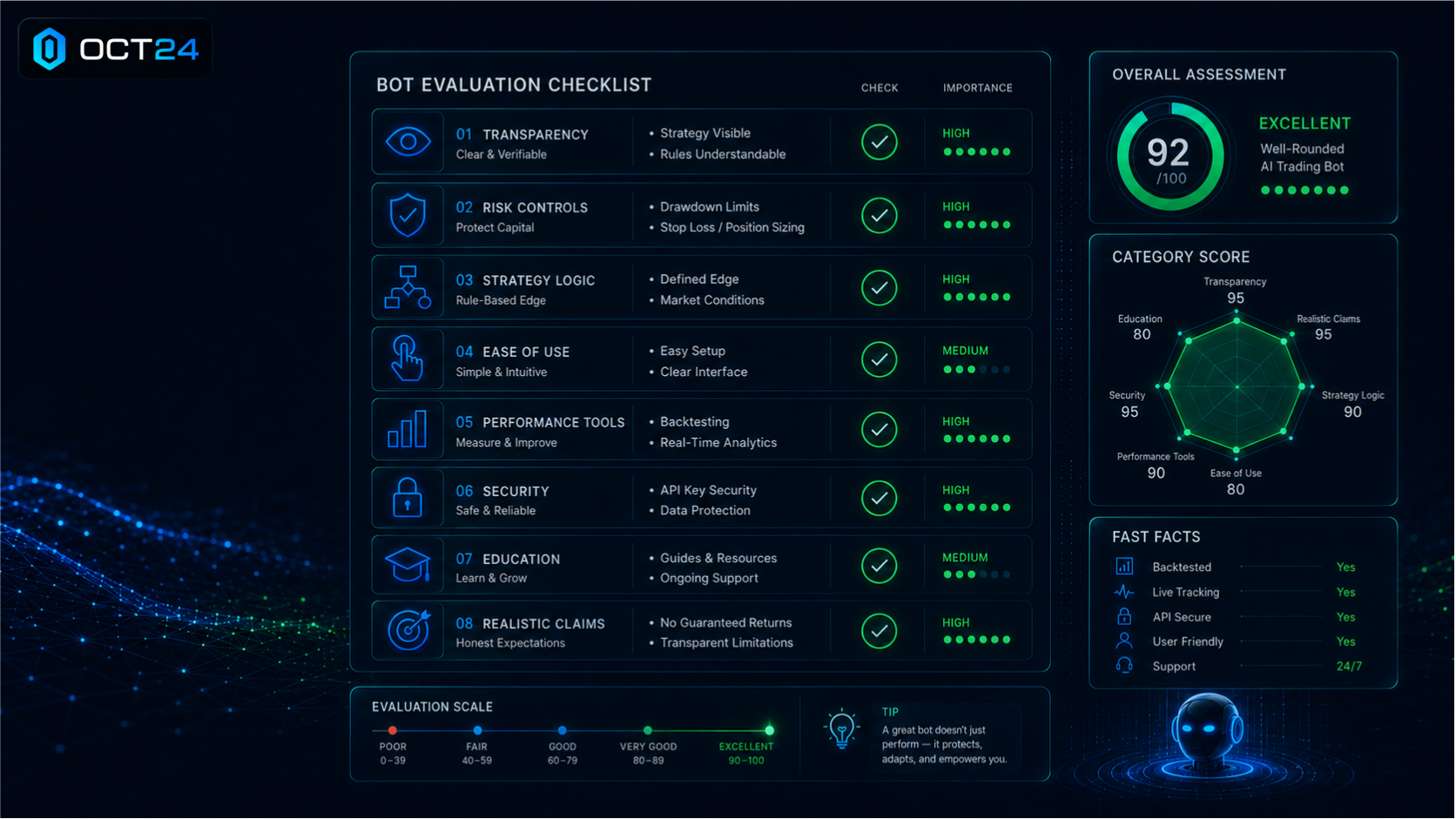
Use this practical checklist:
- Does the bot explain what it is designed to do?
- Are the strategy rules understandable?
- Can you control risk settings?
- Does it support stop-losses or position sizing?
- Can you review performance over time?
- Does it show signal quality or market context?
- Is the interface easy to use?
- Does it support the assets you want to trade?
- Are security and account controls clear?
- Does it avoid unrealistic profit claims?
- Does it provide educational support?
- Can you decide when to execute manually or with assistance?
OCT24 is built around the idea that AI-powered tools should support responsible trading workflows. Traders should be able to review signals, understand risk, and use automation without feeling forced into blind execution.
That is especially important for beginners. Good tools should help users learn how better decisions are made.
Practical Example: When a Trading Bot Helps
Imagine a trader follows a short-term momentum strategy. They are interested in several crypto pairs, but manual chart watching is taking too much time.
The trader wants to look for assets with rising volume, improving momentum, and price strength near a technical breakout level. Manually checking every chart would be slow and inconsistent.
A trading bot can help by scanning those conditions automatically.
First, the bot monitors multiple crypto pairs. It looks for technical setups that match the trader’s rules.
Second, the bot identifies a potential setup. A crypto asset is moving upward, volume is increasing, and momentum indicators show strength.
Third, the trader reviews the signal. They check whether the trade has a reasonable risk-to-reward profile, whether volatility is acceptable, and whether the setup fits the day’s plan.
Fourth, the trader reviews position size and stop-loss placement. They decide how much they are willing to risk before entering.
If the setup fits the plan, the trader may use one-click execution to enter more efficiently.
This is how a bot can help without replacing judgment. The bot scans and organizes the opportunity. The trader still reviews quality, risk, and strategy fit.
Using OCT24, a trader could apply this type of workflow with the G6 Trading Bot, which can perform the technical review, identify the opportunity, and present the trader with one-click execution. The result is not guaranteed profit. The value is a more organized process.
How OCT24 Helps Traders Use Trading Bots Responsibly
OCT24 helps traders use trading bots responsibly by combining AI-powered market scanning, structured signal review, automation tools, risk management features, and one-click execution within a more disciplined trading workflow.
OCT24 can help traders:
- Scan market conditions
- Identify potential trading opportunities
- Review AI trading signals
- Use automation more thoughtfully
- Support one-click trade execution
- Apply risk management tools
- Reduce emotional decision-making
- Review performance over time
The G6 Trading Bot is part of this broader OCT24 ecosystem. It is designed to monitor market conditions, identify potential setups, and support faster decision-making. However, traders should use it with a clear strategy, defined risk limits, and realistic expectations.
For readers who want to better understand the platform and its approach, the About OCT24 page can provide helpful context. Choosing a trading platform is not only about features; it is also about whether the platform supports disciplined and responsible trading behavior.
OCT24’s value is in helping traders combine AI, automation, and risk-aware decision-making. For traders who want speed without losing structure, that can make trading bots more practical.
Frequently Asked Questions
Are trading bots worth it for beginners?
Trading bots can be worth it for beginners if they are used as learning and support tools, not guaranteed-profit systems. Beginners should start with clear rules, small risk, and a strong focus on understanding how the bot works.
Do trading bots guarantee profits?
No. Trading bots do not guarantee profits. They can help with analysis, monitoring, and execution, but markets remain uncertain and every trade carries risk.
Are crypto trading bots risky?
Yes, crypto trading bots can be risky if they are used without strategy, risk controls, or performance review. Crypto markets are volatile, so traders should use bots carefully and avoid excessive leverage.
What makes an AI trading bot useful?
An AI trading bot is useful when it helps traders scan markets, identify potential setups, review signals, manage risk, and execute a defined strategy more consistently.
How much control should traders keep when using bots?
Traders should keep enough control to understand the strategy, risk settings, position sizing, and execution rules. Even when automation is used, traders remain responsible for the decisions they make.
Can trading bots help reduce emotional decisions?
Yes. Trading bots can help reduce emotional decisions by following predefined rules. However, traders can still make emotional choices when changing settings, increasing risk, or reacting to losses.
Do trading bots work during market volatility?
Trading bots can operate during market volatility, but volatile conditions may increase risk. Traders may need stricter filters, smaller position sizes, wider stop-loss logic, or rules that pause trading during extreme conditions.
How does OCT24 use trading bots?
OCT24 uses AI-powered tools and the G6 Trading Bot to help traders scan market conditions, review trading signals, support automation, apply risk management tools, and execute trades more efficiently.
What is the G6 Trading Bot?
The G6 Trading Bot is part of the OCT24 ecosystem. It is designed to support AI-assisted trading by monitoring market conditions, identifying potential opportunities, and helping traders use automation within a structured workflow.
Should traders use one-click execution?
One-click execution can be useful when a trader has already reviewed the setup, risk, and strategy fit. It should support faster action, not impulsive trading.
Final Summary
Trading bots can be worth it when they help traders save time, improve consistency, monitor markets, reduce emotional decisions, and execute a clear strategy more efficiently.
They are not worth it when traders expect guaranteed profits, ignore risk, use excessive leverage, or rely on automation without understanding the strategy.
The key is to treat trading bots as tools, not shortcuts.
A responsible trader uses automation to support better decisions. They still define the strategy, manage risk, review performance, and stay aware of market conditions.
OCT24 reduces manual analysis by using AI to scan markets, identify opportunities, and support more structured trading decisions.
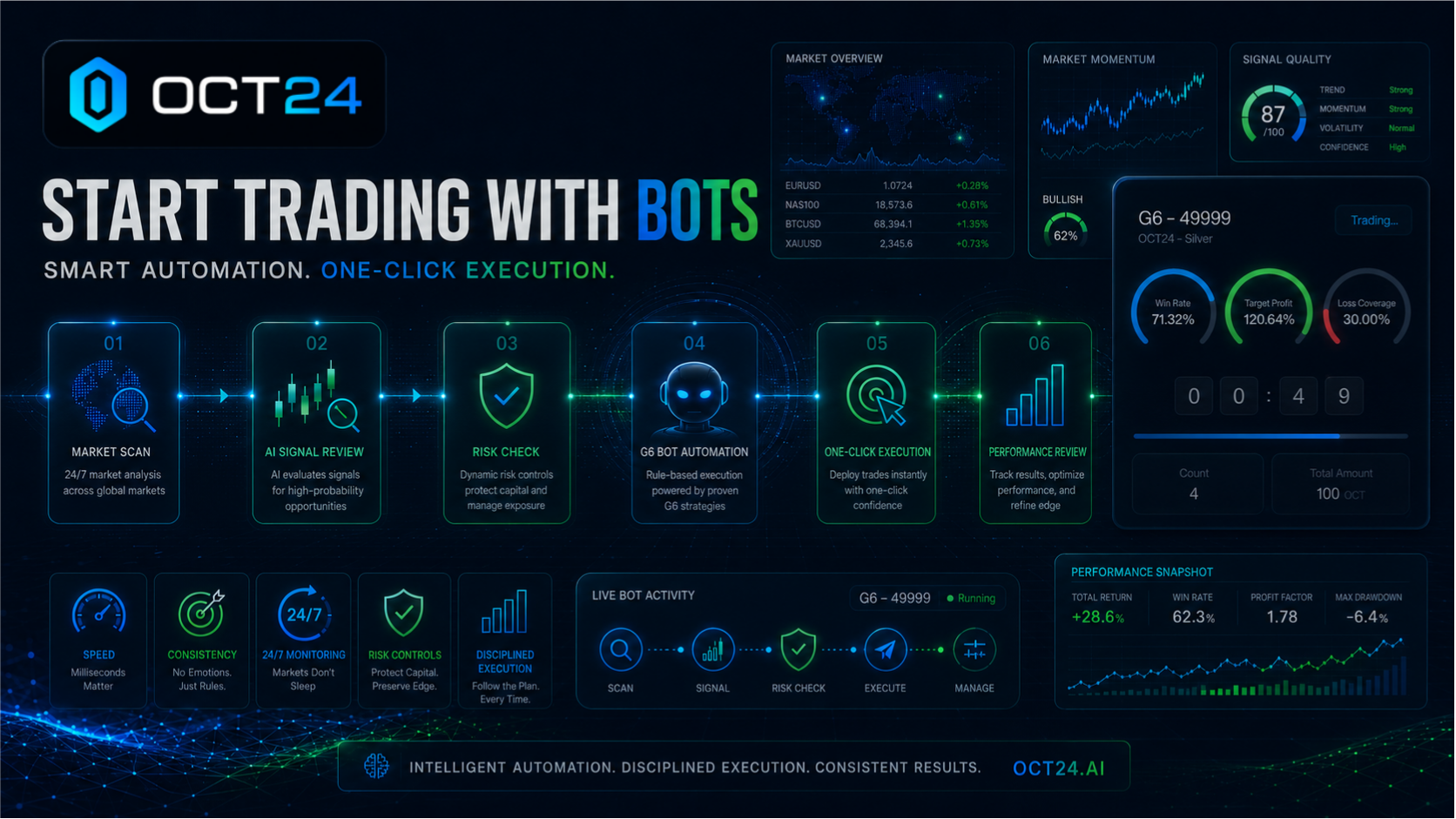
If you are ready to use automation with more structure and control, Start Trading with OCT24 and build a smarter approach to AI-assisted trading.