
Cryptocurrency Market Volatility: Why Crypto Prices Move So Fast in 2026
Cryptocurrency Market Volatility: The Complete 2026 Guide
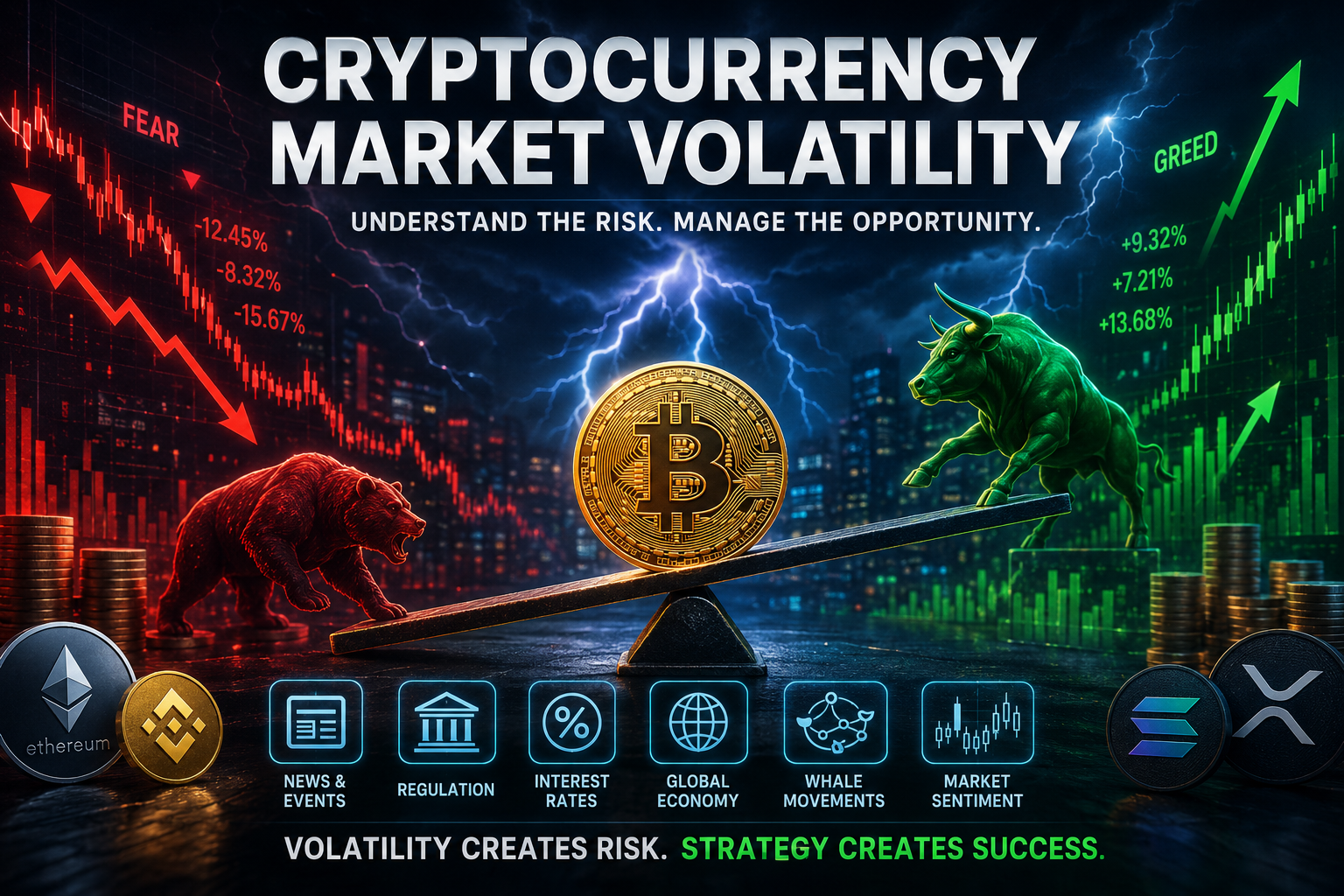
The cryptocurrency market is one of the most volatile financial markets in the world. Unlike traditional assets such as stocks, bonds, or commodities, cryptocurrencies can experience significant price movements within minutes.
For some traders, volatility creates opportunity.
For others, it creates risk.
Understanding cryptocurrency market volatility has become one of the most important skills for anyone involved in Bitcoin, Ethereum, altcoins, or AI-powered trading systems.
In this guide, we will explain what crypto volatility means, why it happens, what factors drive market movements in 2026, and how modern traders use technology and AI tools to navigate highly volatile conditions.
What Is Cryptocurrency Market Volatility?
Cryptocurrency market volatility refers to the speed and magnitude of price changes in digital assets.
A highly volatile market can experience:
- Large price increases within hours
- Sharp market crashes
- Unexpected trend reversals
- High trading volume spikes
- Rapid liquidation events
For example, Bitcoin can move several percentage points in a single day, while smaller altcoins may experience double-digit gains or losses within hours.
Volatility is not always negative.
In reality, volatility creates both risk and opportunity depending on how traders manage their positions.
Why Is The Crypto Market So Volatile?
Several unique characteristics make cryptocurrencies more volatile than traditional financial markets.
1. 24/7 Market Activity
Unlike stock markets, cryptocurrency markets never close.
Trading continues:
- 24 hours a day
- 7 days a week
- 365 days a year
This constant activity means news, regulations, macroeconomic events, or market sentiment can affect prices instantly.
Research continues to show that cryptocurrency markets react rapidly to public information and changing sentiment because of their nonstop trading environment.
2. Market Sentiment
Crypto prices are heavily influenced by investor sentiment.
Factors include:
- Social media trends
- Market news
- Fear and greed cycles
- Community narratives
- Influencer activity
Unlike traditional assets that often rely heavily on company earnings or economic reports, cryptocurrencies frequently experience large moves driven by expectations and sentiment.
3. Leverage Trading
Many cryptocurrency exchanges offer leveraged trading products.
Leverage allows traders to control larger positions using less capital.
While leverage can increase profits, it also increases risk.
When markets move aggressively, liquidations can trigger chain reactions that accelerate volatility.
Recent market events continue to demonstrate how leveraged positions contribute to large-scale liquidations during periods of uncertainty.
4. Regulatory News
Government decisions remain one of the largest volatility drivers.
Markets often react strongly to:
- ETF approvals
- New regulations
- Tax policies
- Exchange restrictions
- Compliance updates
Even rumors surrounding regulatory changes can create major price swings.
The Biggest Drivers of Crypto Volatility in 2026
The structure of cryptocurrency markets has changed significantly in recent years.
Several major forces now influence volatility.
Institutional ETF Flows
One of the largest developments in 2026 is the continued growth of institutional investment through Bitcoin ETFs.
Institutional participation has reshaped market liquidity and market structure. ETF inflows and outflows now influence short-term market movements across Bitcoin and many altcoins.
Many analysts believe ETF adoption has reduced some forms of extreme volatility while creating new institutional-driven price movements.
Bitcoin Halving Effects
The long-term impact of Bitcoin halving events continues to affect supply dynamics.
With fewer new Bitcoins entering circulation, large increases in demand can create stronger price reactions.
Many analysts consider post-halving supply pressure one of the major volatility factors affecting crypto markets in 2026.
Macroeconomic Conditions
Cryptocurrency markets have become increasingly connected to global financial markets.
Key factors include:
- Interest rates
- Inflation expectations
- Federal Reserve policy
- Global liquidity
- Geopolitical tensions
Recent market volatility has shown how crypto assets react to inflation concerns and geopolitical uncertainty.
Bitcoin Volatility vs Altcoin Volatility
Not all cryptocurrencies experience the same level of volatility.
Bitcoin
Bitcoin remains the largest cryptocurrency by market capitalization.
Although Bitcoin is still volatile, institutional adoption and ETF growth have helped reduce some of the extreme price swings seen in earlier market cycles.
Altcoins
Altcoins generally experience:
- Higher volatility
- Lower liquidity
- Faster market reactions
- Greater speculative activity
Because many altcoins have smaller market capitalizations, they are often more sensitive to sudden changes in investor sentiment.
How Traders Manage Cryptocurrency Volatility
Professional traders focus heavily on risk management.
Common methods include:
Position Sizing
Instead of risking large amounts on a single trade, traders adjust position sizes according to volatility levels.
Stop-Loss Strategies
Stop-loss orders help limit downside exposure during unexpected market moves.
Diversification
Many investors spread risk across multiple assets rather than concentrating their portfolio in a single cryptocurrency.
Volatility Monitoring
Advanced traders track:
- Trading volume
- Liquidity conditions
- Funding rates
- Open interest
- ETF flows
- Market sentiment
These indicators often provide early warnings about increasing volatility.
The Rise of AI Trading During Volatile Markets
Artificial intelligence is becoming increasingly important in cryptocurrency trading.
Modern AI systems can:
- Monitor markets continuously
- Analyze large amounts of data
- Detect changing volatility regimes
- Adjust risk exposure
- Automate execution strategies
Industry research suggests AI-assisted and automated systems now account for a significant portion of crypto trading activity because of their speed and consistency.
AI tools are increasingly used for:
- Volatility forecasting
- Position sizing
- Risk management
- Stop-loss automation
- Market monitoring
Research and industry reports show growing adoption of AI-based approaches for handling rapidly changing market conditions.
Common Mistakes During High Volatility
Many traders lose money during volatile periods because of emotional decision-making.
Common mistakes include:
FOMO Trading
Buying after a large price increase because of fear of missing out.
Overleveraging
Using excessive leverage that increases liquidation risk.
Revenge Trading
Attempting to recover losses immediately after a losing trade.
Ignoring Risk Management
Failing to use stop-losses or proper position sizing.
Following Market Hype
Making decisions based only on social media trends.
Will Crypto Become Less Volatile?
Many experts believe cryptocurrency volatility may gradually decline over time.
Reasons include:
- Growing institutional participation
- Deeper liquidity
- Larger market capitalization
- Better derivatives infrastructure
- Improved regulatory frameworks
Several analyses suggest Bitcoin's volatility profile is already becoming more similar to major technology assets compared to previous market cycles.
However, cryptocurrency remains a developing asset class, and significant price swings are likely to remain part of the market for the foreseeable future.
Frequently Asked Questions
Why is cryptocurrency more volatile than stocks?
Cryptocurrency markets operate 24/7, have lower overall liquidity than traditional markets, and are heavily influenced by sentiment, regulation, and macroeconomic events.
Is volatility good for traders?
Volatility creates opportunities for profit but also increases risk. Successful traders typically combine volatility analysis with strong risk management.
Which cryptocurrency is the least volatile?
Bitcoin is generally considered less volatile than most altcoins because of its larger market capitalization and increasing institutional adoption.
Can AI help reduce trading risk?
AI tools can assist with market monitoring, risk controls, position sizing, and volatility analysis, but they cannot eliminate trading risk entirely.
Will Bitcoin volatility decrease in the future?
Many analysts expect long-term volatility to gradually decline as institutional participation and market maturity continue to grow, although major price fluctuations are still expected.
Final Thoughts
Cryptocurrency market volatility is one of the defining characteristics of digital assets.
It creates both opportunity and risk.
As the market evolves in 2026, volatility is increasingly shaped by institutional ETF flows, global macroeconomic conditions, regulatory developments, AI-driven trading systems, and changing liquidity structures.
For traders and investors, understanding volatility is no longer optional.
Whether you trade manually or use AI-assisted tools, successful participation in cryptocurrency markets depends on risk management, education, discipline, and a clear understanding of how volatile digital assets behave.