
AI vs Algorithmic Trading: What's the Difference?
Understanding AI vs Algorithmic Trading is important because the two terms are often used interchangeably, even though they describe different approaches to market analysis and trade execution. Both rely on technology to improve trading efficiency, but they process information and make decisions in different ways. Knowing these differences can help traders choose the right tools for their goals and better understand how modern trading platforms operate.
A simple analogy is to compare them to navigation systems.
Imagine driving to a new destination. A traditional GPS follows a predefined route based on the directions it has been given. An intelligent navigation app, however, continuously analyzes live traffic, road closures, and travel times before recommending the most efficient route. Similarly, traditional algorithmic trading follows fixed rules, while AI enhances decision-making by continuously evaluating changing market conditions and ranking potential opportunities.
Neither approach is inherently better in every situation. Instead, they serve different purposes and often work together within modern trading platforms.
Why People Often Confuse the Two
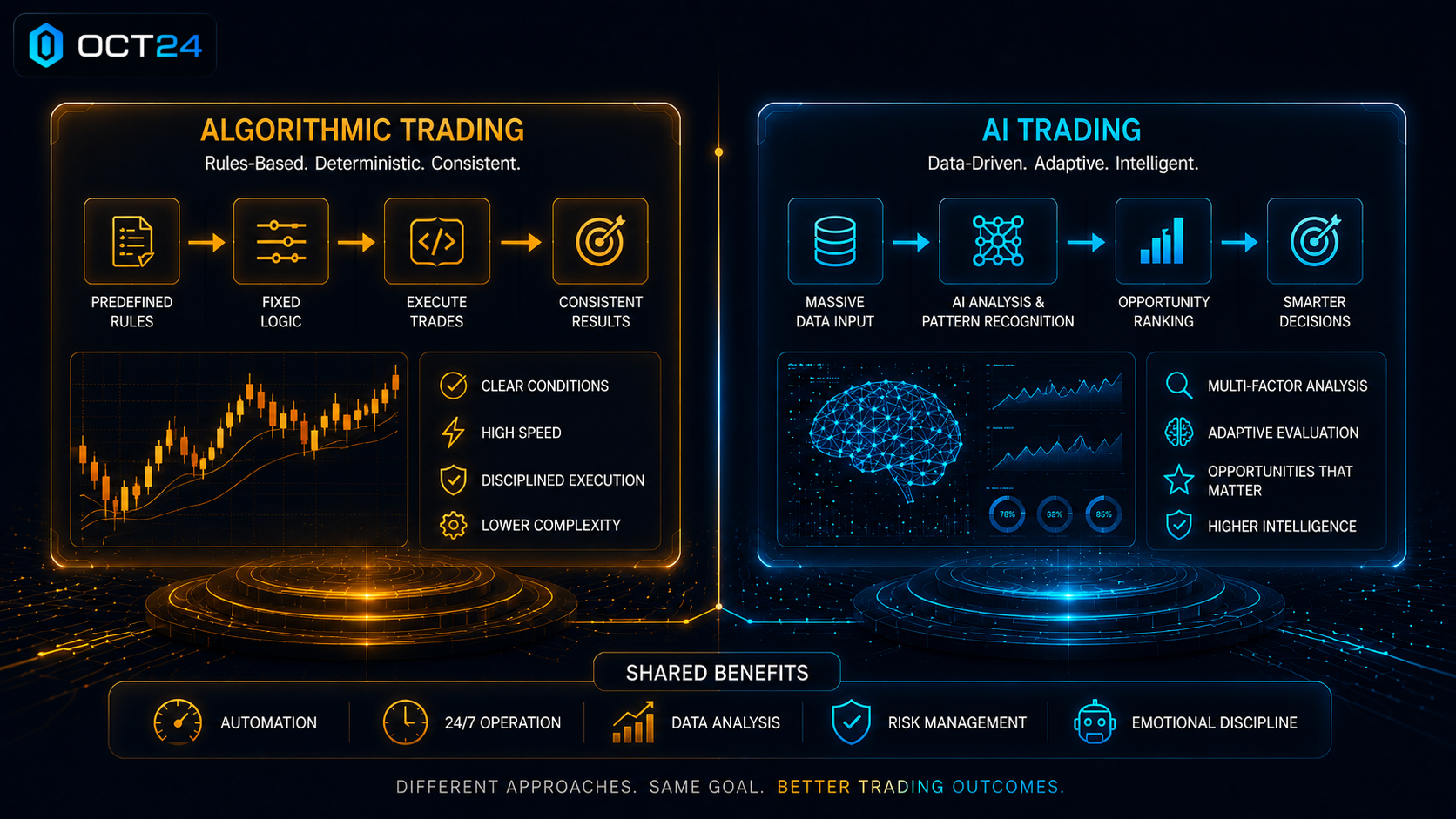
It is easy to understand why AI trading and algorithmic trading are frequently confused. Both use computers to analyze markets, automate repetitive tasks, and support faster decision-making than manual trading alone.
At first glance, they appear almost identical because both reduce the amount of manual work required from traders.
The similarities include:
- Using computers to process market data
- Automating parts of the trading process
- Following predefined objectives
- Improving speed and consistency
- Reducing repetitive manual analysis
These shared characteristics often lead people to assume they are the same technology.
The difference becomes clearer when you look at how each system reaches its conclusions.
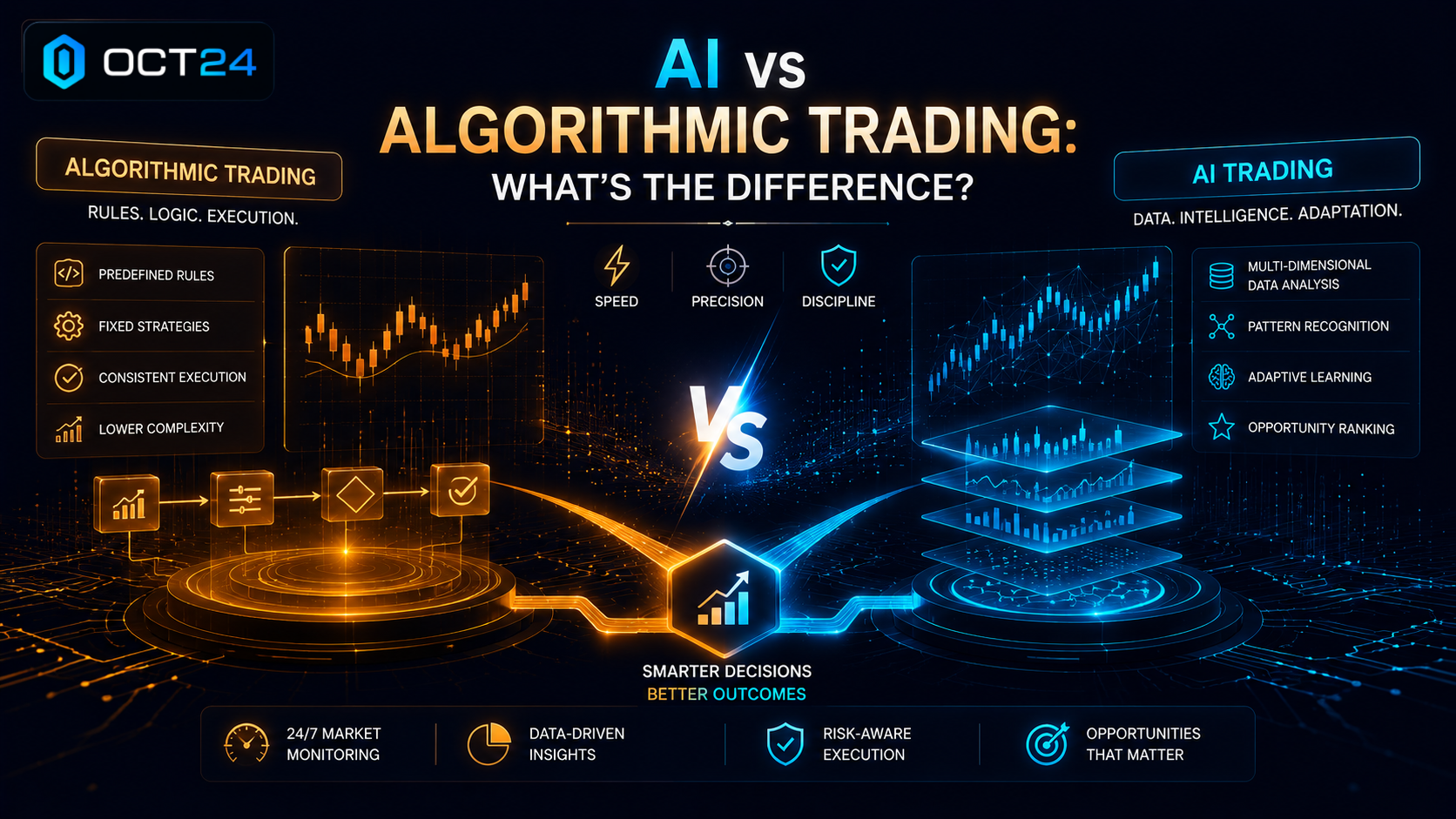
Traditional Algorithmic Trading follows explicit instructions created in advance. AI-enhanced systems still operate within predefined rules, but they evaluate far more information before identifying and prioritizing potential trading opportunities.
Similarly, Automated Trading simply refers to the use of software to automate certain trading tasks. Automation alone does not necessarily involve artificial intelligence or advanced market analysis.
How Traditional Algorithmic Trading Works
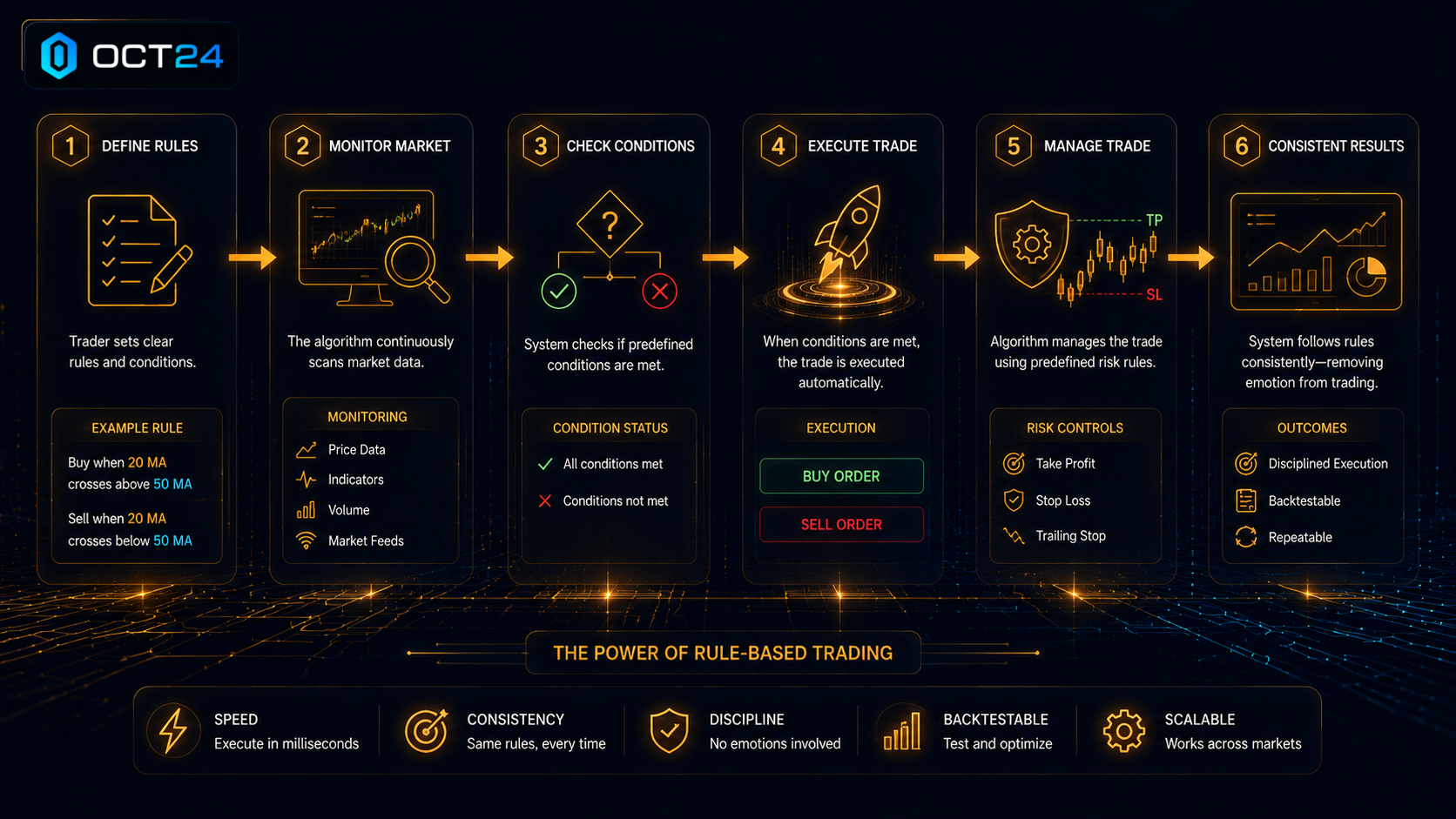
Traditional algorithmic trading is built around predefined rules.
Before the system begins operating, traders establish specific conditions that determine when trades should be entered or exited. Once these rules are in place, the software executes them consistently whenever the required conditions are met.
Unlike AI systems, traditional algorithms do not adapt their decision-making based on changing market behavior. Instead, they repeatedly apply the same logic until those rules are modified by the trader.
Common rule-based conditions include:
- Price crosses above a moving average
- RSI moves below a specified level
- Trading volume exceeds a defined threshold
- Price reaches a predetermined target
- Stop-loss conditions are triggered
For example, consider a simple moving average strategy.
A trader might instruct the system to buy Bitcoin whenever the 20-day moving average crosses above the 50-day moving average and sell when the opposite occurs.
The algorithm continuously checks for these exact conditions.
If the conditions occur, the trade executes.
If they do not occur, nothing happens.
This consistency is one of algorithmic trading's greatest strengths because every decision follows the same predefined process without emotional interference.
However, traditional algorithms evaluate only the rules they have been given. They do not compare dozens of additional market factors before acting.
Many AI Trading Bots incorporate algorithmic logic for execution while expanding the analytical process that occurs beforehand.
How AI Trading Works Differently
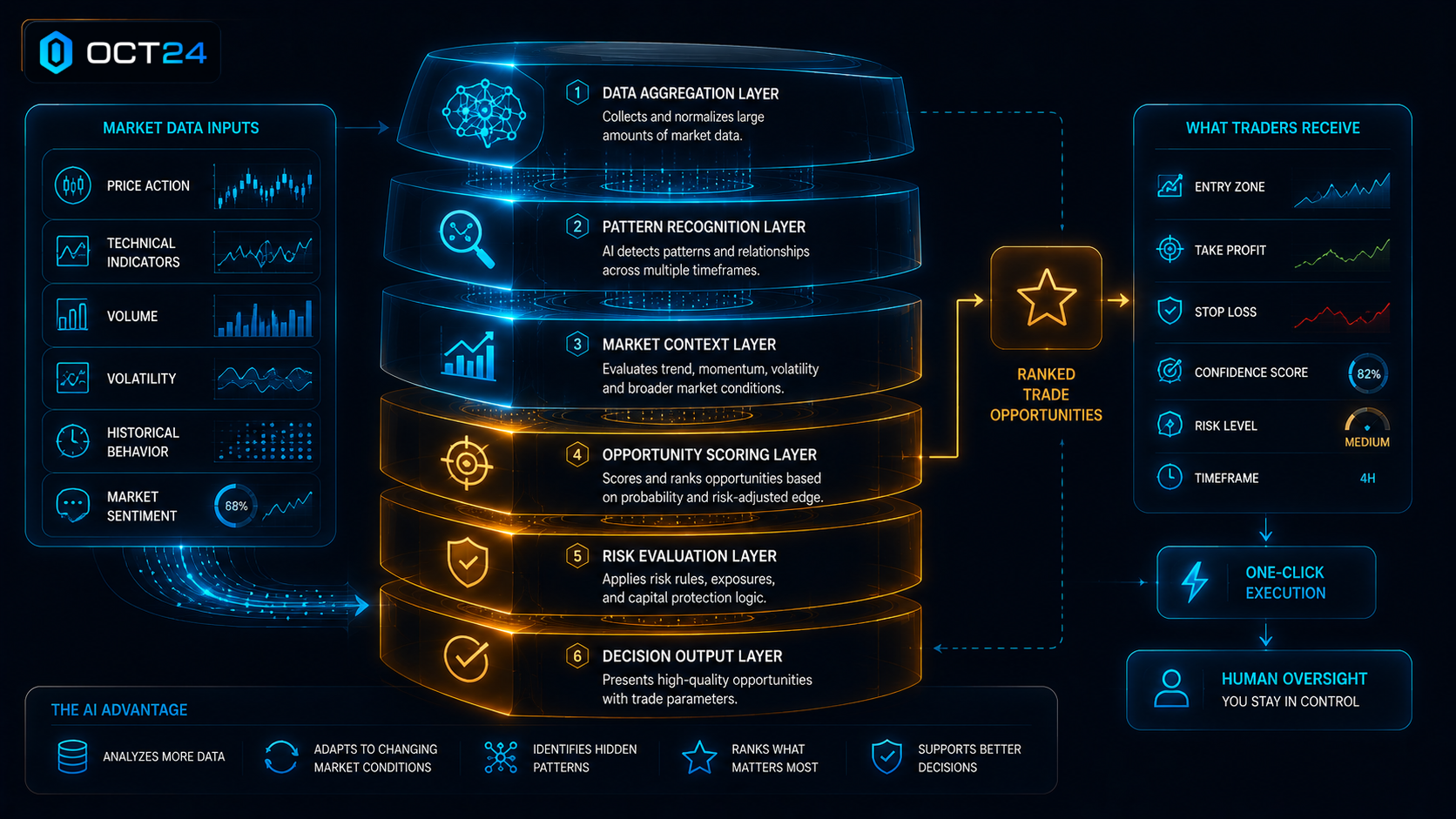
AI trading builds upon traditional automation by adding another layer of market analysis.
Rather than relying exclusively on fixed rules, AI continuously evaluates large amounts of market information before identifying opportunities that satisfy predefined trading objectives.
This allows AI to provide richer context while still operating within established risk management parameters.
Modern AI systems commonly analyze:
- Price action
- Technical indicators
- Trading volume
- Market volatility
- Historical price behavior
- Market sentiment
- Pattern recognition across multiple timeframes
Instead of asking a single question—such as whether one moving average crossed another—AI evaluates numerous factors simultaneously.
For example, rather than identifying only a moving average crossover, AI may also examine:
- Whether volume supports the move
- Whether momentum is increasing
- Whether broader market trends agree
- Whether current volatility remains acceptable
- Whether historical market behavior resembles similar situations
Only after considering this broader collection of information does the system rank potential opportunities.
This additional layer of AI market analysis helps traders focus on opportunities that satisfy multiple conditions instead of reacting to isolated indicators.
It is important to remember that AI does not "think" like a human trader.
Instead, AI operates within carefully designed system rules, evaluates far more information than traditional algorithms, and presents opportunities based on probabilities rather than certainty.
As discussed in AI Trading Software, AI supports better decision-making without removing the need for human oversight.
Likewise, our guide on How AI Identifies Trading Opportunities explains how continuous market scanning, pattern recognition, and opportunity filtering work together before any trade reaches the execution stage.
Key Differences at a Glance
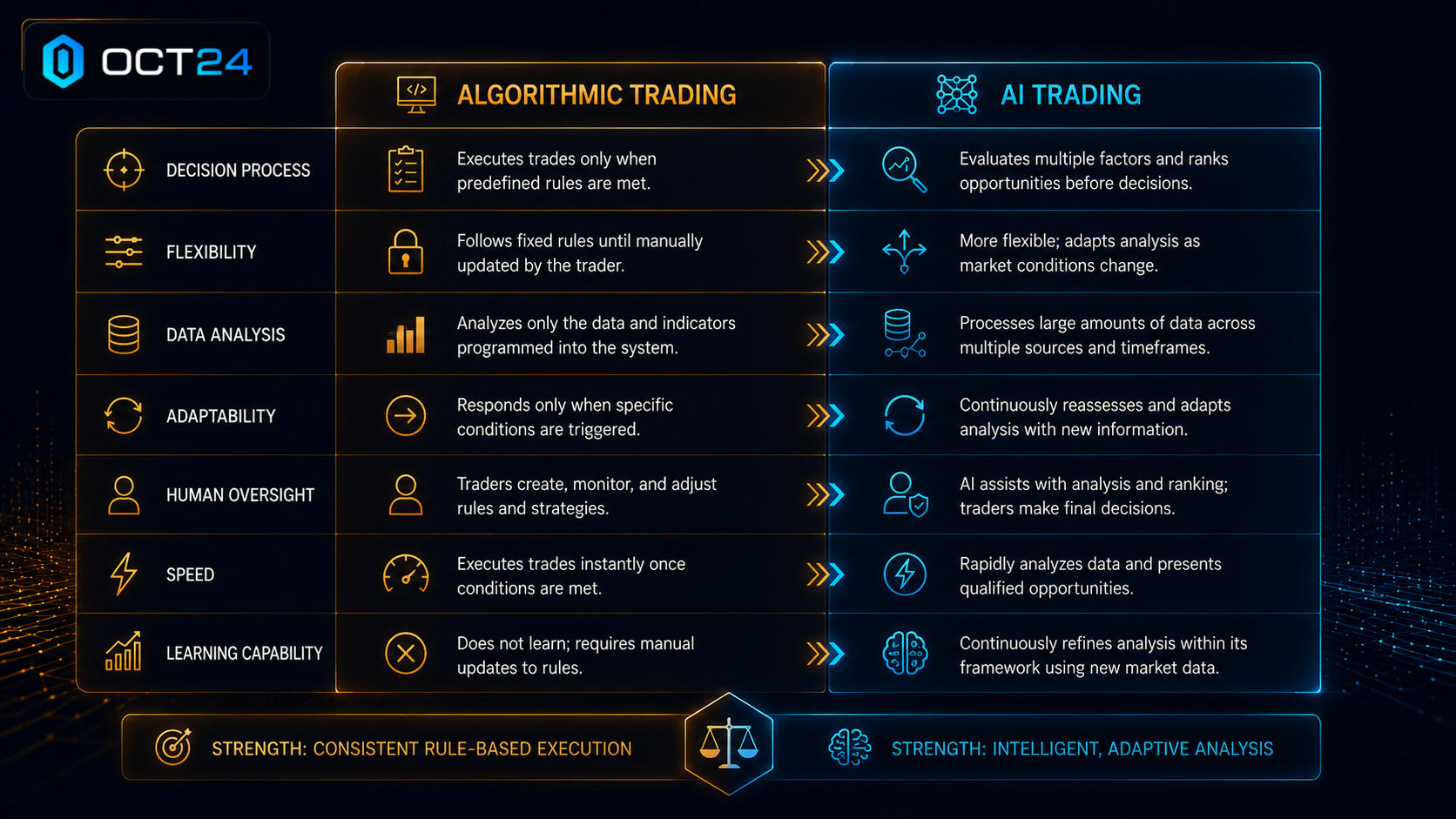
Although AI trading and algorithmic trading share many similarities, they differ in how they analyze markets and support trading decisions.
Decision Process
Traditional algorithmic trading executes trades only when predefined rules are met. AI trading, by contrast, evaluates multiple market factors simultaneously before identifying and ranking potential opportunities.
Flexibility
Algorithmic trading follows fixed instructions until a trader manually updates the strategy. AI trading is more flexible because it continuously evaluates changing market conditions within its predefined system design.
Data Analysis
Traditional algorithms typically analyze only the indicators and conditions they have been programmed to monitor. AI trading processes a much broader range of information, including price action, trading volume, technical indicators, volatility, historical market behavior, and other relevant market data.
Adaptability
Algorithmic trading responds only when specific programmed conditions are triggered. AI trading continually reassesses market conditions, allowing it to adapt its analysis as new information becomes available.
Human Oversight
Neither approach removes the need for human involvement. Algorithmic trading requires traders to create, monitor, and adjust trading rules, while AI trading assists with market analysis and opportunity identification but still relies on traders to review opportunities and make final trading decisions.
Speed
Both technologies operate much faster than manual trading. Algorithmic trading is designed to execute trades almost instantly once predefined conditions are satisfied, while AI rapidly analyzes large amounts of market information before presenting qualified opportunities.
Learning Capability
Traditional algorithmic trading does not change its behavior unless a trader modifies the underlying rules. AI trading continuously refines its market analysis within its designed framework by evaluating evolving market data and identifying patterns across changing market conditions.
Overall, traditional algorithmic trading excels at consistent rule-based execution, while AI trading enhances the decision-making process through broader market analysis and opportunity ranking. Rather than competing with one another, the two technologies are often combined to create more intelligent and efficient trading workflows.
When Algorithmic Trading May Be the Better Choice
Although AI has expanded the capabilities of modern trading platforms, traditional algorithmic trading remains highly effective in many situations. Its greatest strengths lie in consistency, speed, and the ability to execute clearly defined strategies without deviation.
Algorithmic trading works best when trading rules are straightforward and unlikely to change frequently. Once the rules have been established, the system applies them exactly as instructed every time the required conditions are met.
Clearly Defined Strategies
Some trading strategies are based on objective rules that rarely require interpretation.
Examples include:
- Moving average crossovers
- Breakout strategies
- Mean reversion strategies
- Arbitrage opportunities
- Scheduled rebalancing
In these cases, a rule-based algorithm can execute trades consistently without requiring additional market interpretation.
High-Frequency Execution
Markets can change within seconds.
Traditional algorithms excel at executing trades almost instantly once predefined conditions are satisfied. This rapid execution helps reduce delays that might occur during manual trading.
Consistency
One of the greatest advantages of algorithmic trading is its discipline.
Unlike human traders, algorithms never become distracted, impatient, or emotional. Every decision follows the same logical process regardless of previous wins or losses.
Stable Market Conditions
Rule-based systems often perform well in markets that behave consistently over time.
For example, a trend-following strategy may continue generating signals as long as market conditions remain relatively stable and the predefined rules continue to align with current price behavior.
When AI Trading May Offer Advantages
While algorithmic trading focuses on executing predefined instructions, AI trading adds another layer of intelligence by evaluating a broader range of market information before opportunities are presented.
This additional analysis can be particularly valuable when market conditions become more dynamic.
Changing Market Conditions
Financial markets rarely remain static.
Volatility, trading volume, and market sentiment can shift rapidly throughout the trading day.
AI continuously evaluates these changing conditions, allowing traders to view opportunities within a broader market context instead of relying on a single trigger.
Large Amounts of Data
Modern markets generate enormous quantities of information.
AI can simultaneously evaluate:
- Multiple cryptocurrencies
- Various timeframes
- Technical indicators
- Trading volume
- Volatility
- Historical market behavior
- Market sentiment
Processing this amount of information manually would be extremely time-consuming.
Pattern Recognition
AI excels at identifying relationships between multiple market variables.
Rather than reacting to one isolated indicator, AI evaluates how numerous signals interact before highlighting potential opportunities.
Opportunity Ranking
Not every trading setup deserves equal attention.
AI helps prioritize opportunities by comparing the strength of supporting evidence across numerous market conditions.
Instead of overwhelming traders with every possible signal, AI helps focus attention on opportunities that satisfy more comprehensive criteria.
Decision Support
One of the most important advantages of AI is that it supports better decision-making without replacing the trader.
As discussed in Benefits of AI Trading, AI improves analytical efficiency by reducing repetitive research while leaving the final trading decision in human hands.
Despite these advantages, AI does not eliminate market risk or guarantee successful outcomes.
Can AI and Algorithmic Trading Work Together?
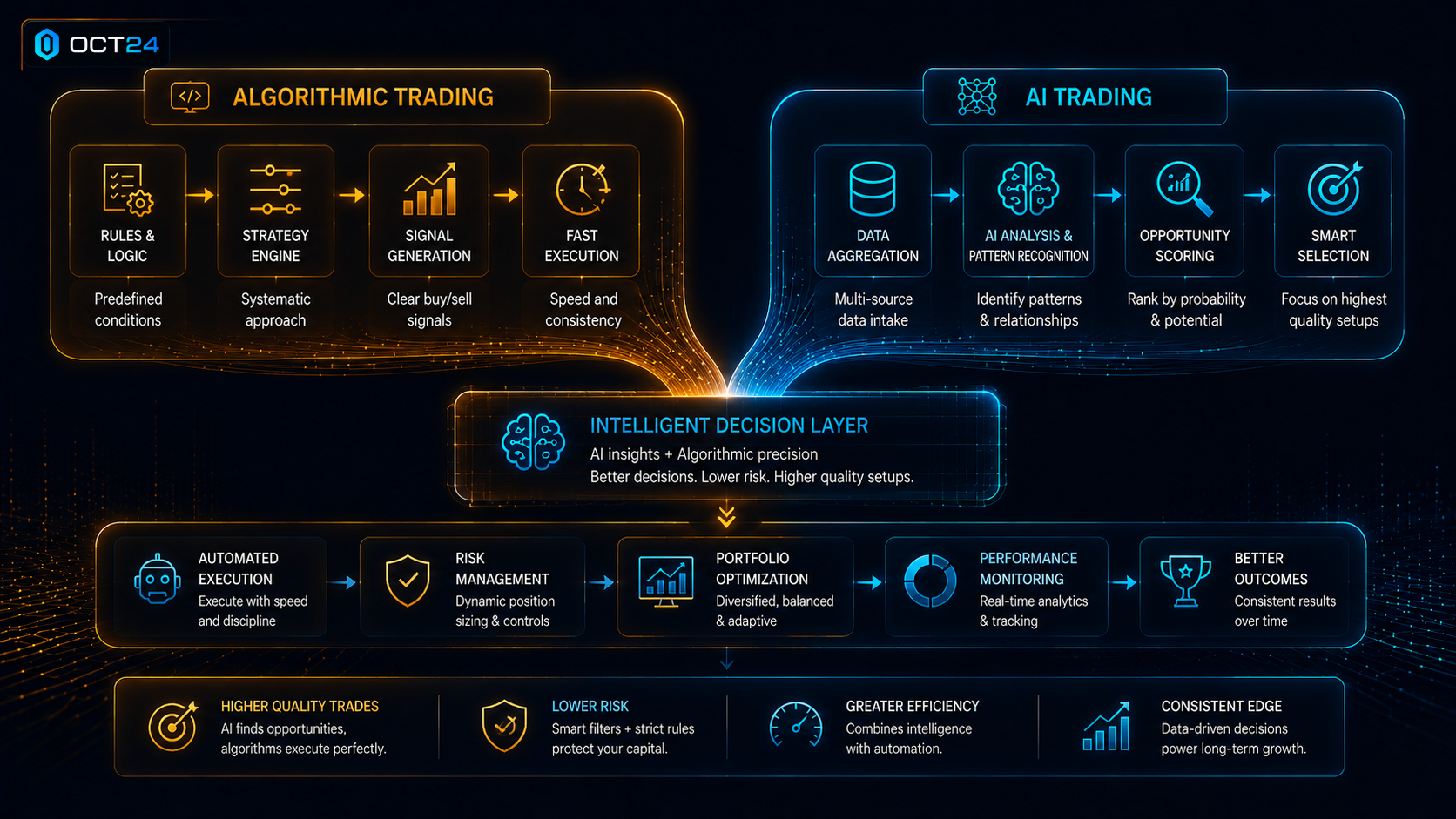
Many people assume AI trading and algorithmic trading compete with one another.
In reality, modern trading platforms often combine both approaches because they complement each other's strengths.
- A simplified workflow may look like this:
- AI continuously monitors multiple markets.
- AI analyzes market conditions and identifies potential opportunities.
- Algorithmic logic evaluates whether predefined trading rules are satisfied.
- Risk management rules assess acceptable exposure.
- The opportunity is presented to the trader for review.
In this approach, AI performs much of the analytical work while algorithmic logic provides consistency and structured execution.
Human oversight remains an essential part of the process.
Traders continue to determine whether opportunities align with their objectives, risk tolerance, and current market conditions.
Resources such as Trading Bot Risk Management, Position Sizing Controls, and Portfolio Diversification Tools further support disciplined decision-making by helping traders manage exposure before executing trades.
How OCT24 Combines AI and Algorithmic Trading
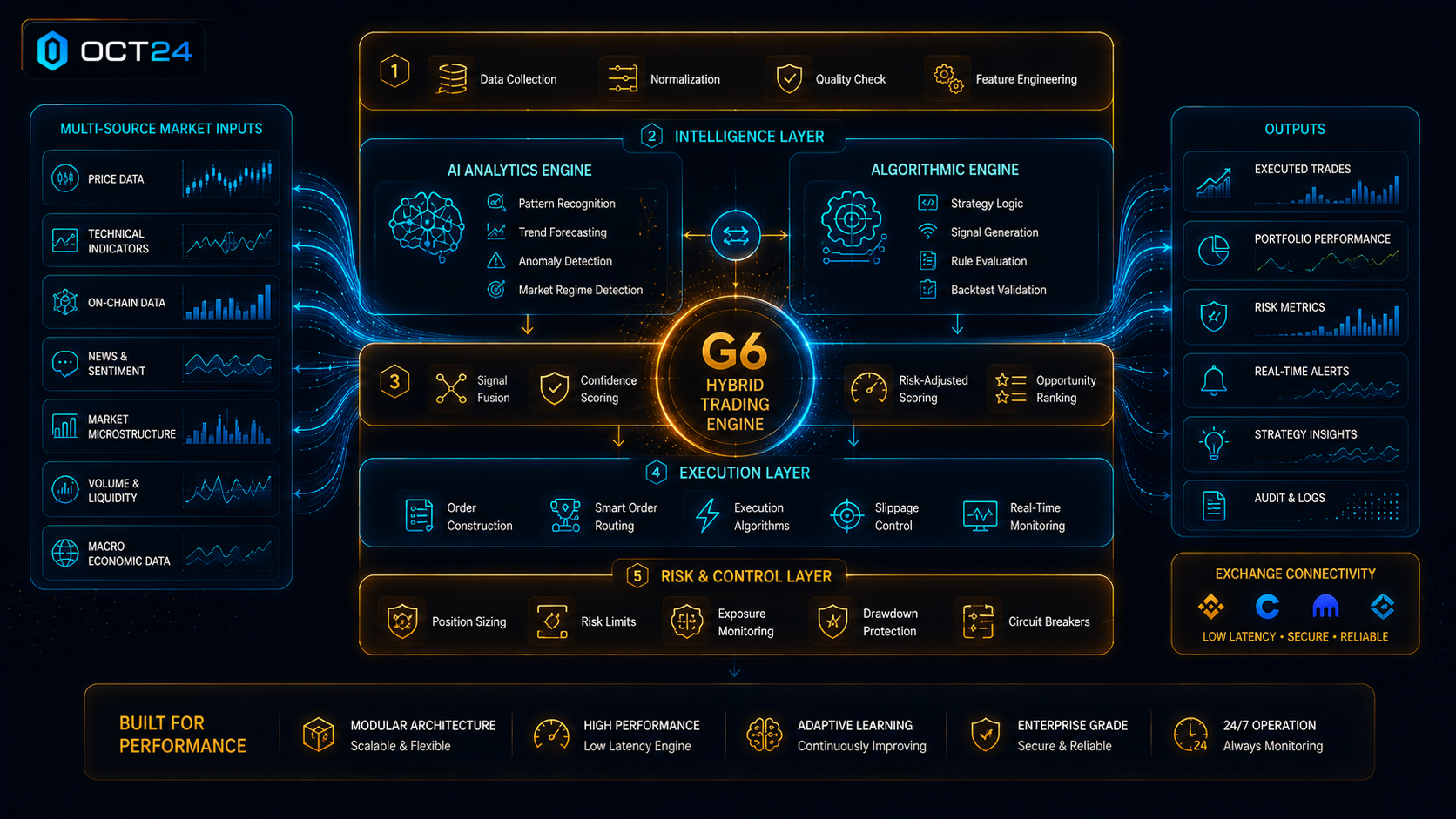
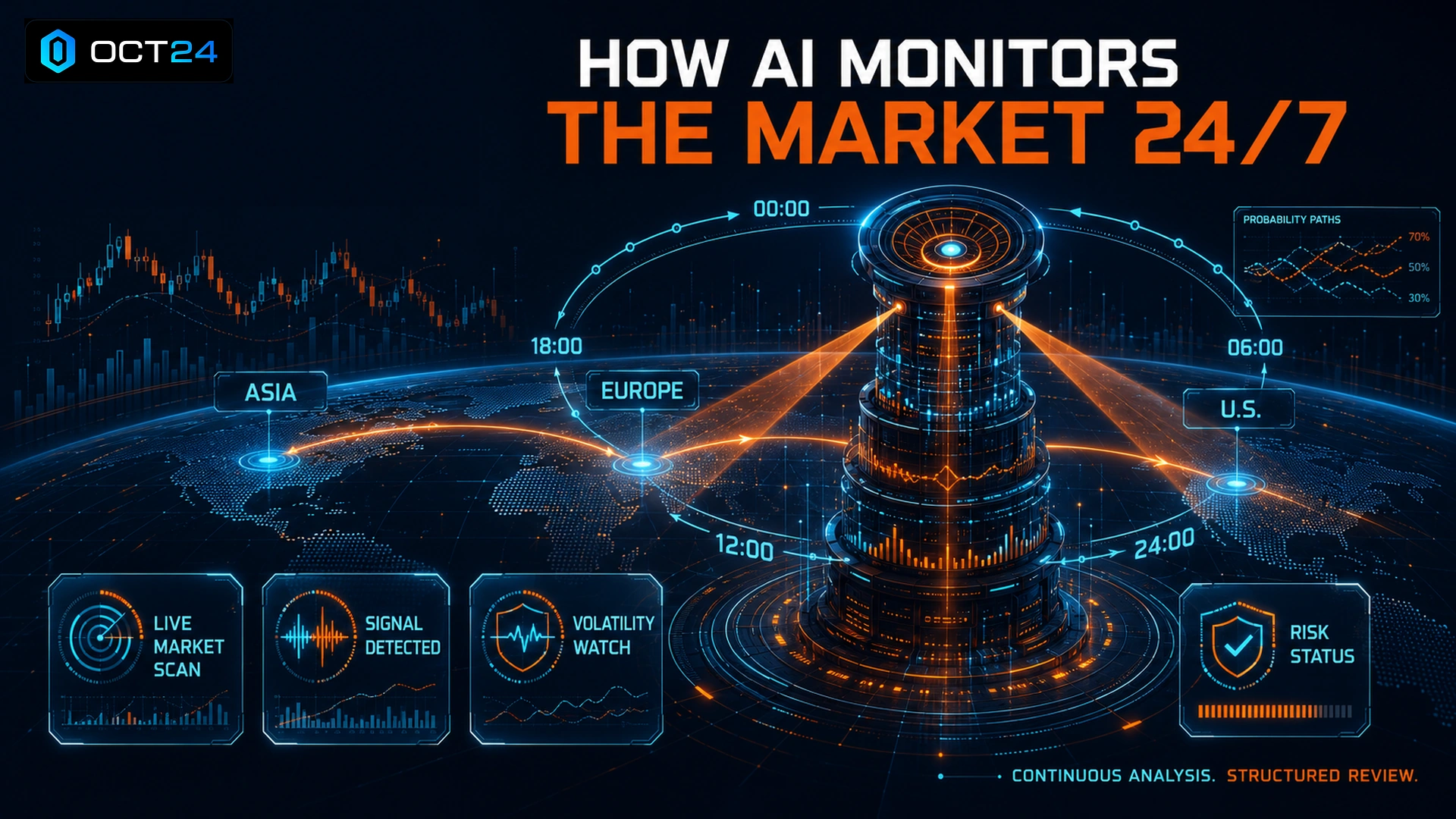
OCT24 integrates artificial intelligence with algorithmic decision logic to streamline the process of identifying and evaluating trading opportunities.
At the center of the platform is the G6 Trading Bot.
Rather than relying solely on fixed trading rules, the platform continuously:
- Monitors live cryptocurrency markets
- Performs AI-powered market analysis
- Detects technical patterns
- Applies algorithmic decision logic
- Evaluates potential risk
- Ranks trading opportunities
- Prepares structured trade setups
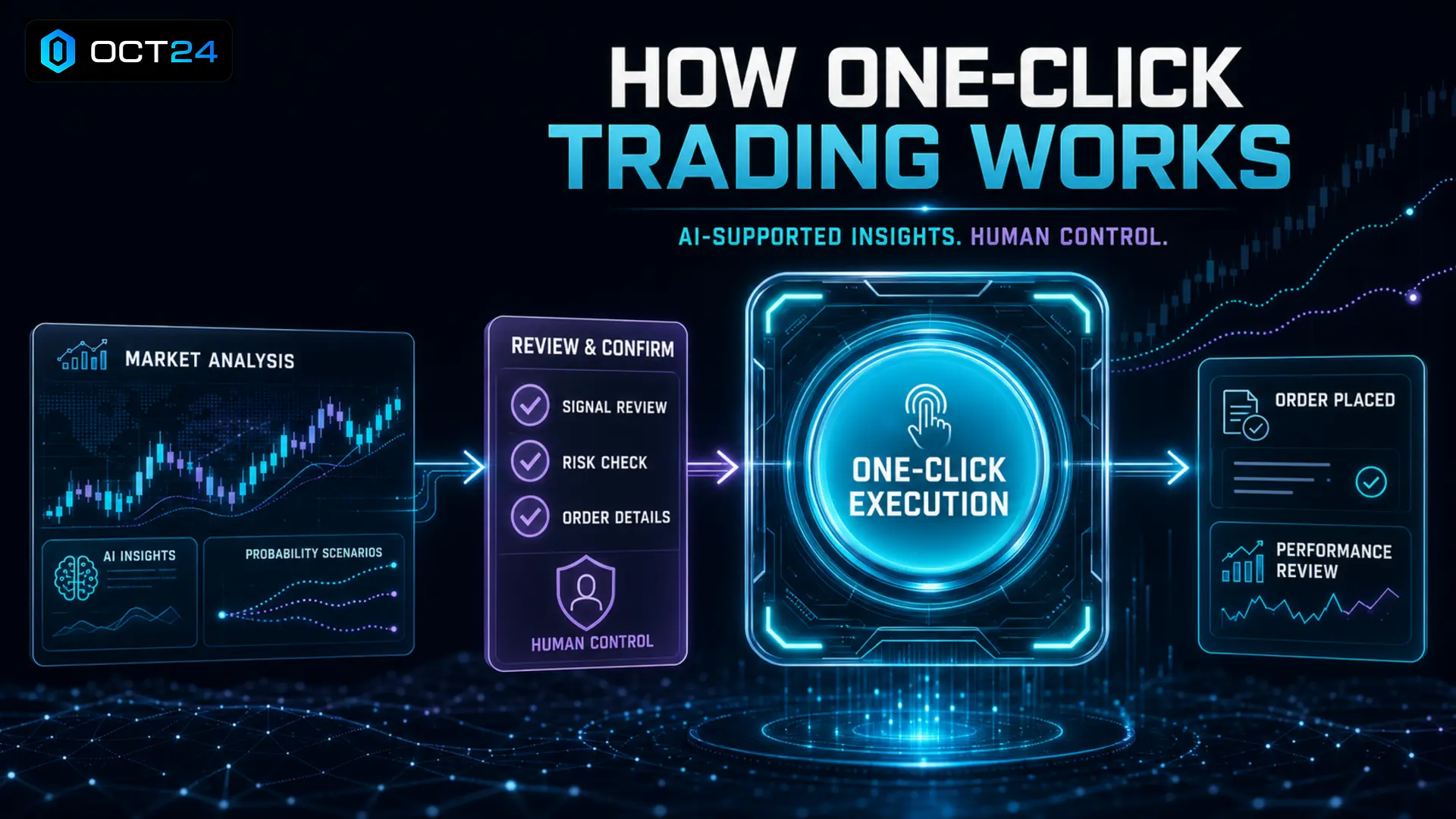
- Supports one-click trade execution
This approach allows traders to benefit from continuous market analysis without needing to:
- Monitor markets throughout the day
- Build trading algorithms
- Analyze dozens of charts simultaneously
- Configure complex automation systems
Instead, OCT24 continuously evaluates changing market conditions, prepares opportunities for review, and allows users to remain in control by deciding whether to execute each trade.
Developing chart-reading skills remains valuable alongside AI analysis. Learning How to Read Crypto Charts helps traders better understand why specific opportunities are identified.
You can also learn more about the company's platform and mission by visiting About OCT24.
Frequently Asked Questions
Is AI trading the same as algorithmic trading?
No. Algorithmic trading follows predefined rules, while AI trading analyzes broader market data to identify and rank potential opportunities before execution.
Which is better for beginners?
Both approaches can be useful. AI-assisted platforms often simplify market analysis, while traditional algorithms may be easier to understand when based on straightforward trading rules.
Can AI replace algorithmic trading?
Not entirely.
AI and algorithmic trading frequently work together. AI enhances market analysis, while algorithmic logic provides structured and consistent execution.
Do both use automation?
Yes.
Both technologies automate parts of the trading process, although AI generally performs more advanced market analysis before opportunities are presented.
Which analyzes more data?
AI typically analyzes significantly more market information than traditional algorithmic systems, including technical indicators, volatility, historical behavior, and multiple timeframes simultaneously.
Does AI guarantee better results?
No.
AI improves analytical efficiency but cannot predict future market movements or eliminate trading risk.
Can AI and algorithmic trading work together?
Yes.
Many modern trading platforms combine AI-powered analysis with algorithmic execution and predefined risk controls to improve overall trading efficiency.
How do I get started?
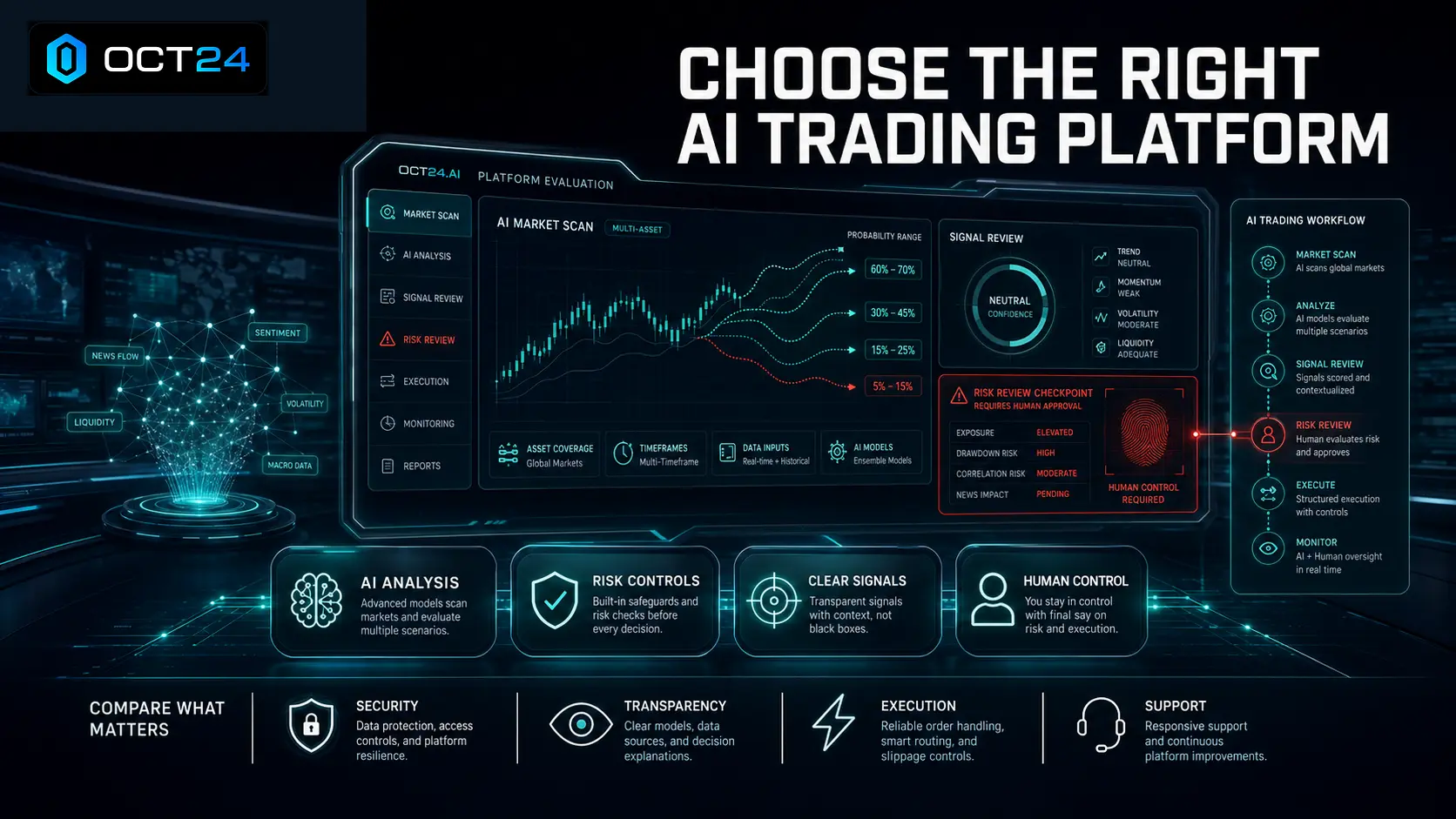
Begin by understanding how both technologies work, developing strong risk management habits, and selecting a platform that provides transparent analysis while keeping you in control of every trading decision. When you're ready, you can Start Trading with OCT24.
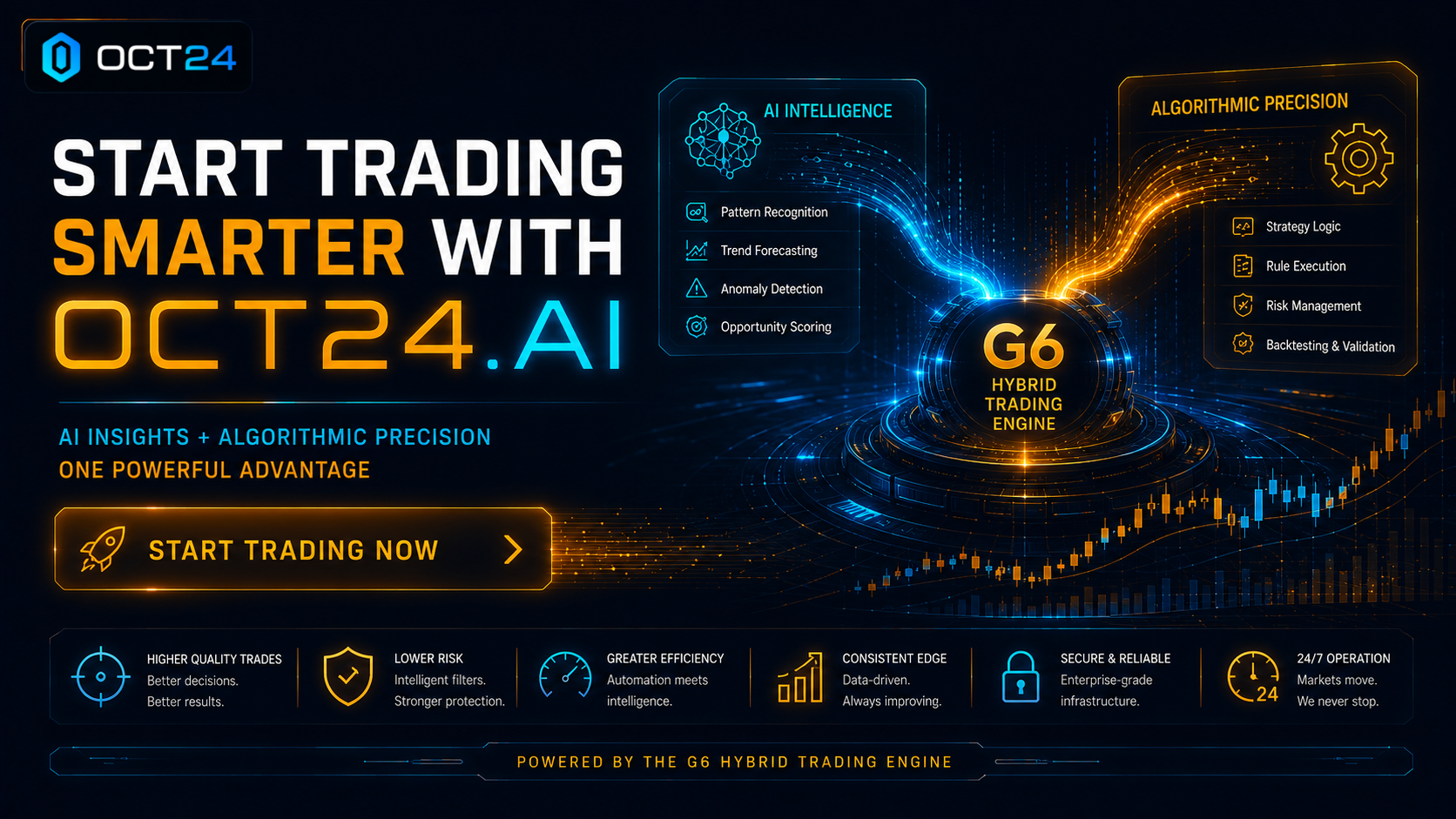
Final Summary
AI trading and traditional algorithmic trading share many similarities. Both use technology to automate aspects of trading, improve consistency, and reduce manual workload.
The key difference lies in how decisions are made. Traditional algorithmic trading executes predefined rules, while AI analyzes a broader range of market information, identifies patterns, evaluates changing conditions, and ranks potential opportunities before they reach the trader.
Neither approach is universally better. Algorithmic trading is well suited to clearly defined, repeatable strategies, while AI provides additional analytical insight when markets become more dynamic and information grows increasingly complex.
When combined, AI-powered market analysis and algorithmic decision logic create a more comprehensive trading workflow that can improve efficiency without removing the need for disciplined risk management, sound judgment, and continuous learning.